UK Legal Frameworks For Cease And Desist Letters
Letter Type | Relevant Legal Framework | Protected Interest | Key Limitation | Typical Sender Type |
|---|---|---|---|---|
United Kingdom-wide | ||||
Trade mark infringement | Trade Marks Act 1994 | Registered brand names, logos and signs | Unjustified threats rules can apply to careless infringement allegations. | Sole trader Company Charity or non-profit |
England and Wales, Scotland, Northern Ireland | ||||
Passing off | Common law tort of passing off | Business goodwill and reputation | Requires goodwill, misrepresentation and likely damage. | Sole trader Company Charity or non-profit |
United Kingdom-wide | ||||
Copyright infringement | Copyright, Designs and Patents Act 1988 | Original text, images, music, software and films | Exceptions such as fair dealing may defeat the complaint. | Individual Sole trader Company Charity or non-profit |
Design right infringement | Registered Designs Act 1949 and Copyright, Designs and Patents Act 1988 | Product appearance and design features | Unjustified threats rules may apply to registered designs. | Sole trader Company |
Patent infringement | Patents Act 1977 | Protected inventions and technical processes | Unjustified threats rules are a major drafting risk. | Individual Sole trader Company |
Cybersquatting or domain misuse | Passing off, trade mark law and Nominet DRS | Brand identity and online customer trust | Domain dispute procedures may be faster than court action. | Sole trader Company Charity or non-profit |
England and Wales, Scotland, Northern Ireland | ||||
Misuse of confidential information | Breach of confidence and contract law | Private business, personal or technical information | Information must have necessary quality of confidence. | Individual Sole trader Company Charity or non-profit Public body |
Non-disclosure agreement breach | Contract law and equitable confidentiality duties | Contractually protected confidential information | Overbroad NDAs may be unenforceable or restricted. | Company Charity or non-profit Public body |
United Kingdom-wide | ||||
Trade secret misuse | Trade Secrets Regulations 2018 | Commercially valuable secret know-how | Reasonable steps must be taken to keep information secret. | Sole trader Company |
England and Wales | ||||
Defamation | Defamation Act 2013 | Reputation against seriously harmful false statements | Claimant must show serious harm or likely serious harm. | Individual Sole trader Company Charity or non-profit |
Scotland | ||||
Defamation in Scotland | Defamation and Malicious Publication (Scotland) Act 2021 | Reputation against defamatory publications | Scottish statutory rules differ from England and Wales. | Individual Sole trader Company Charity or non-profit |
England and Wales, Northern Ireland | ||||
Malicious falsehood | Defamation Act 1952 and common law malicious falsehood | Economic interests harmed by false statements | Requires falsity, malice and special damage unless exceptions apply. | Individual Sole trader Company |
United Kingdom-wide | ||||
False online reviews | Defamation, malicious falsehood and consumer protection rules | Business reputation and customer trust | Honest opinion and truth may provide defences. | Sole trader Company Charity or non-profit |
England and Wales | ||||
Harassment | Protection from Harassment Act 1997 | Freedom from repeated oppressive conduct | Immediate danger should be reported to police. | Individual Company Charity or non-profit Public body |
Scotland | ||||
Harassment in Scotland | Protection from Harassment Act 1997 Part II | Protection from harassment and alarm | Scottish interdict procedure differs from injunctions. | Individual Company Charity or non-profit Public body |
England and Wales | ||||
Stalking | Protection from Harassment Act 1997 and Stalking Protection Act 2019 | Personal safety and freedom from stalking | Letters may escalate risk safety planning is essential. | Individual |
Domestic abuse unwanted contact | Domestic Abuse Act 2021 and protective injunctions | Safety from abusive or controlling contact | Court orders and police help may be safer than letters. | Individual |
England and Wales, Northern Ireland | ||||
Misuse of private information | Common law misuse of private information and Human Rights Act 1998 | Reasonable expectation of personal privacy | Public interest and free expression may outweigh privacy. | Individual |
United Kingdom-wide | ||||
Personal data misuse | UK GDPR and Data Protection Act 2018 | Lawful handling of personal data | Identify the controller and the specific data rights engaged. | Individual Sole trader Company Charity or non-profit Public body |
Data erasure demand | UK GDPR Article 17 | Deletion of personal data in qualifying cases | Erasure is not absolute and exemptions may apply. | Individual |
Unwanted direct marketing | PECR and UK GDPR | Control over marketing emails, texts and calls | Rules vary for individuals, corporate subscribers and soft opt-in. | Individual Sole trader Company Charity or non-profit |
Abusive online communications | Online Safety Act 2023 and communications offences | Protection from harmful online messages | Criminal threats or abuse should be reported promptly. | Individual Company Charity or non-profit Public body |
England and Wales, Scotland, Northern Ireland | ||||
Trespass to land | Common law trespass and property remedies | Exclusive possession and control of land | Occupiers, protesters and rights of way may raise separate issues. | Individual Sole trader Company Charity or non-profit Public body |
Private nuisance | Common law nuisance and statutory nuisance rules | Use and enjoyment of land | Statutory nuisance complaints may need local authority involvement. | Individual Sole trader Company Charity or non-profit Public body |
Boundary encroachment | Land law, trespass and title evidence | Land boundaries and physical property rights | Title plans rarely prove exact legal boundaries. | Individual Sole trader Company Charity or non-profit Public body |
Noise nuisance | Environmental Protection Act 1990 statutory nuisance | Quiet enjoyment and health at home | Councils investigate statutory nuisance and may serve abatement notices. | Individual Company Public body |
England and Wales | ||||
Anti-social behaviour | Anti-social Behaviour, Crime and Policing Act 2014 | Protection from nuisance, annoyance or disorder | Local authority, police or landlord powers may be more appropriate. | Individual Company Charity or non-profit Public body |
England and Wales, Scotland, Northern Ireland | ||||
Breach of contract | Contract law and agreed contractual terms | Performance of agreed obligations | A letter before claim may be needed before proceedings. | Individual Sole trader Company Charity or non-profit Public body |
Unpaid invoice or debt | Contract law and debt recovery procedure | Payment of money owed | Debt collection must avoid harassment and unfair pressure. | Individual Sole trader Company Charity or non-profit Public body |
United Kingdom-wide | ||||
Debt collector harassment | Consumer Credit Act 1974 and FCA CONC rules | Fair treatment during debt collection | Disputed debts should be challenged with evidence and complaints routes. | Individual Sole trader |
Misleading consumer practices | Consumer Protection from Unfair Trading Regulations 2008 | Protection from misleading or aggressive practices | Trading standards or regulators may need to enforce breaches. | Individual Company Public body |
Misleading advertising | CAP Code, BCAP Code and Business Protection from Misleading Marketing Regulations | Fair competition and accurate advertising | ASA complaints may be more suitable for advertising standards issues. | Individual Sole trader Company Charity or non-profit Public body |
Unlawful comparative advertising | Business Protection from Misleading Marketing Regulations 2008 | Fair comparison and brand reputation | Comparisons can be lawful if objective and not misleading. | Sole trader Company Charity or non-profit |
England and Wales, Scotland, Northern Ireland | ||||
Restrictive covenant breach | Employment contract law and restraint of trade doctrine | Legitimate business interests after employment ends | Covenants must be reasonable in scope, time and geography. | Sole trader Company Charity or non-profit Public body |
Employee or client solicitation | Contract law, fiduciary duties and restraint of trade | Workforce stability and customer relationships | General competition is lawful unless a valid restriction is breached. | Sole trader Company Charity or non-profit Public body |
Employee confidentiality breach | Employment contract law, confidence and trade secrets rules | Employer confidential information and trade secrets | Whistleblowing disclosures may be legally protected. | Sole trader Company Charity or non-profit Public body |
United Kingdom-wide | ||||
Whistleblowing retaliation | Employment Rights Act 1996 protected disclosures | Protection from detriment after protected disclosure | Letter should not compromise tribunal deadlines. | Individual |
England and Wales, Scotland | ||||
Discriminatory harassment | Equality Act 2010 | Protection from harassment linked to protected characteristics | Employment tribunal and discrimination claim time limits can be short. | Individual Company Charity or non-profit Public body |
Northern Ireland | ||||
Discriminatory harassment in Northern Ireland | Northern Ireland equality and anti-discrimination legislation | Protection from unlawful discriminatory conduct | Northern Ireland equality law is separate from the Equality Act 2010. | Individual Company Charity or non-profit Public body |
England and Wales | ||||
Landlord harassment or interference | Protection from Eviction Act 1977 and quiet enjoyment covenant | Tenant occupation without unlawful interference | Illegal eviction and harassment can be criminal matters. | Individual Company Charity or non-profit |
Scotland | ||||
Unlawful eviction in Scotland | Rent (Scotland) Act 1984 and housing legislation | Tenant protection from unlawful removal | Eviction normally requires a tribunal or court order. | Individual Company Charity or non-profit |
United Kingdom-wide | ||||
Marketplace counterfeit listings | Trade Marks Act 1994 and copyright law | Brand protection against counterfeit goods | Platform takedown procedures may require proof of rights. | Sole trader Company Charity or non-profit |
Unauthorised image use | Copyright law, data protection and privacy law | Photographs, likeness, privacy and personal data | UK law has no general standalone image right. | Individual Sole trader Company Charity or non-profit |
Software licence breach | Copyright, Designs and Patents Act 1988 and contract law | Software code and licence restrictions | Open-source licences may impose different compliance remedies. | Individual Sole trader Company Charity or non-profit |
Database right infringement | Copyright and Rights in Databases Regulations 1997 | Substantial investment in database contents | Protection differs from copyright in individual data items. | Sole trader Company Charity or non-profit Public body |
Moral rights infringement | Copyright, Designs and Patents Act 1988 moral rights | Attribution and objection to derogatory treatment | Some moral rights must be asserted and can be waived. | Individual |
Counterfeit goods | Trade Marks Act 1994 criminal and civil provisions | Brand integrity and consumer protection | Trading standards or police may be needed for criminal counterfeiting. | Sole trader Company Charity or non-profit Public body |
England and Wales, Scotland, Northern Ireland | ||||
Publisher libel complaint | Defamation law, public interest defence and press standards | Reputation affected by media publication | Pre-publication threats may engage freedom of expression concerns. | Individual Sole trader Company Charity or non-profit Public body |
England and Wales | ||||
Intimate image disclosure | Sexual Offences Act 2003 and Online Safety Act 2023 amendments | Sexual privacy and protection from image abuse | Threats or disclosure may require urgent police and platform action. | Individual |
Blackmail or extortion threats | Theft Act 1968 blackmail offence | Protection from unwarranted demands with menaces | Criminal threats should be reported rather than negotiated alone. | Individual Sole trader Company Charity or non-profit |
United Kingdom-wide | ||||
Impersonation or scam misuse | Fraud Act 2006 and passing off | Identity, brand and prevention of deception | Active fraud should be reported to Action Fraud or police. | Individual Sole trader Company Charity or non-profit Public body |
England and Wales | ||||
Charity name or logo misuse | Charities Act 2011, trade mark law and passing off | Charity identity, donations and public trust | Regulatory reporting may be needed for serious misuse. | Charity or non-profit |
United Kingdom-wide | ||||
Public body identity misuse | Trade mark law, Crown copyright and passing off | Official identity and public trust | Some public sector information is reusable under open licences. | Public body |
England and Wales | ||||
Protest obstruction or intimidation | Public Order Act 1986, tort law and injunction principles | Access, safety and freedom from intimidation | Peaceful protest rights under Articles 10 and 11 must be considered. | Individual Company Charity or non-profit Public body |
England and Wales, Scotland, Northern Ireland | ||||
Pollution or environmental nuisance | Environmental Protection Act 1990 and common law nuisance | Land, health and environmental quality | Regulators may need to handle pollution or permit breaches. | Individual Sole trader Company Charity or non-profit Public body |
England and Wales | ||||
Planning breach interference | Town and Country Planning Act 1990 enforcement powers | Lawful land use and amenity | Planning enforcement is mainly a local authority function. | Individual Company Charity or non-profit Public body |
United Kingdom-wide | ||||
Unauthorised disclosure of records | UK GDPR, Data Protection Act 2018 and confidence duties | Confidential personal records and data security | ICO complaints usually require first raising the issue with the organisation. | Individual |
England and Wales, Scotland, Northern Ireland, United Kingdom-wide | ||||
Tender information misuse | Procurement law, confidentiality and contract principles | Commercially sensitive bid information | Public procurement remedies have strict standstill and limitation periods. | Sole trader Company Charity or non-profit Public body |
United Kingdom-wide | ||||
Confusing business name | Companies Act 2006, passing off and trade mark law | Company identity and market distinctiveness | Companies House name rules do not replace trade mark rights. | Sole trader Company Charity or non-profit |
England and Wales, Scotland, Northern Ireland | ||||
Malicious complaints | Defamation, malicious falsehood and harassment law | Reputation and freedom from vexatious allegations | Genuine complaints and protected disclosures may be privileged or protected. | Individual Sole trader Company Charity or non-profit Public body |
United Kingdom-wide | ||||
Social media impersonation | Fraud Act 2006, passing off, trade mark and data protection law | Identity, brand and prevention of deception | Platform reporting and evidence preservation are often urgent. | Individual Sole trader Company Charity or non-profit Public body |
Website scraping | Database right, copyright, contract and data protection law | Website content, database investment and personal data | Publicly accessible data is not automatically free to reuse. | Sole trader Company Charity or non-profit Public body |
England and Wales, Scotland, Northern Ireland | ||||
Unauthorised works on land | Trespass, nuisance, easements and land law | Control over land and structures | Rights of access, easements or statutory powers may authorise entry. | Individual Sole trader Company Charity or non-profit Public body |
Unauthorised parking on private land | Trespass, contract law and private parking rules | Control of private parking spaces | Clamping on private land is generally restricted or unlawful. | Individual Sole trader Company Charity or non-profit Public body |
Lease covenant breach | Lease, tenancy and property law | Compliance with lease restrictions | Forfeiture, eviction and enforcement rules are highly procedural. | Individual Company Charity or non-profit Public body |
Settlement agreement breach | Contract law and settlement agreement terms | Finality of agreed dispute resolution | Confidentiality and non-derogatory clauses must be enforceable and lawful. | Individual Sole trader Company Charity or non-profit Public body |
What Laws Can A UK Cease And Desist Letter Rely On?
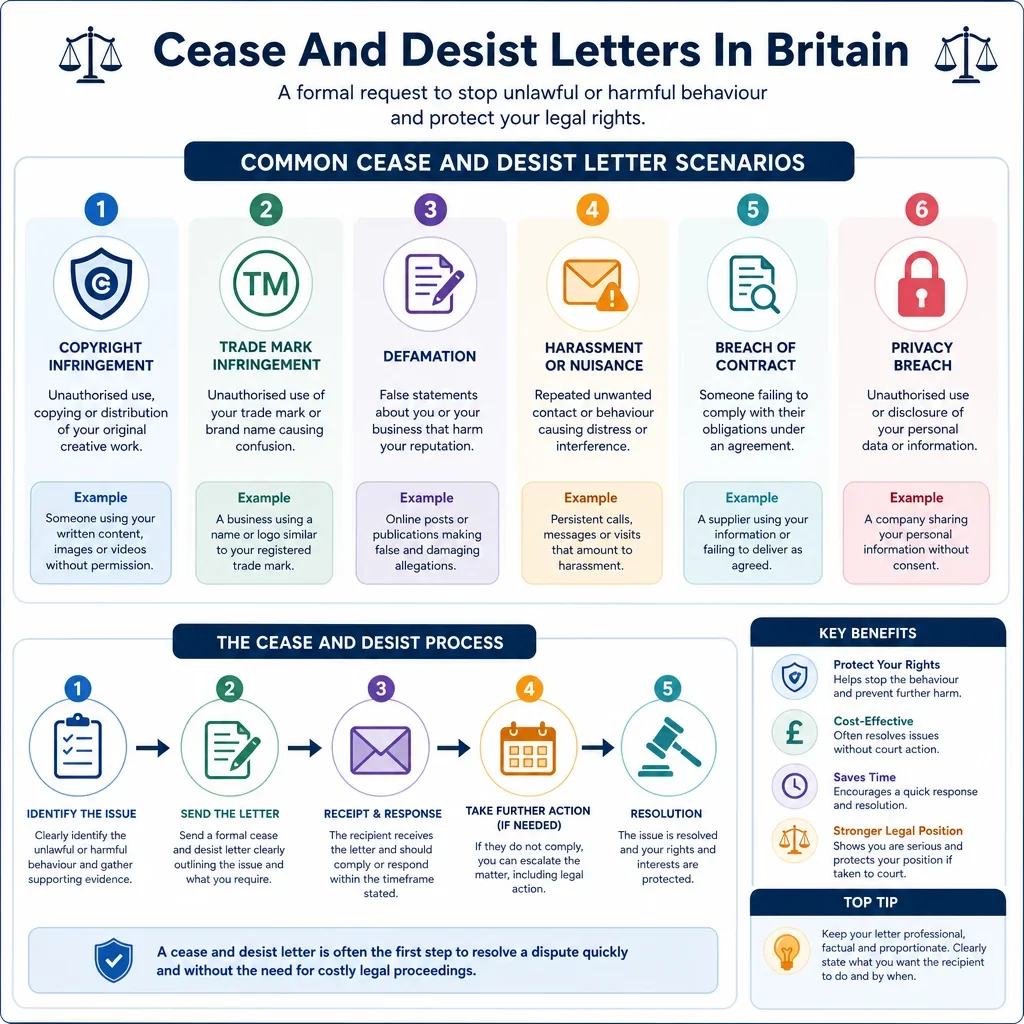
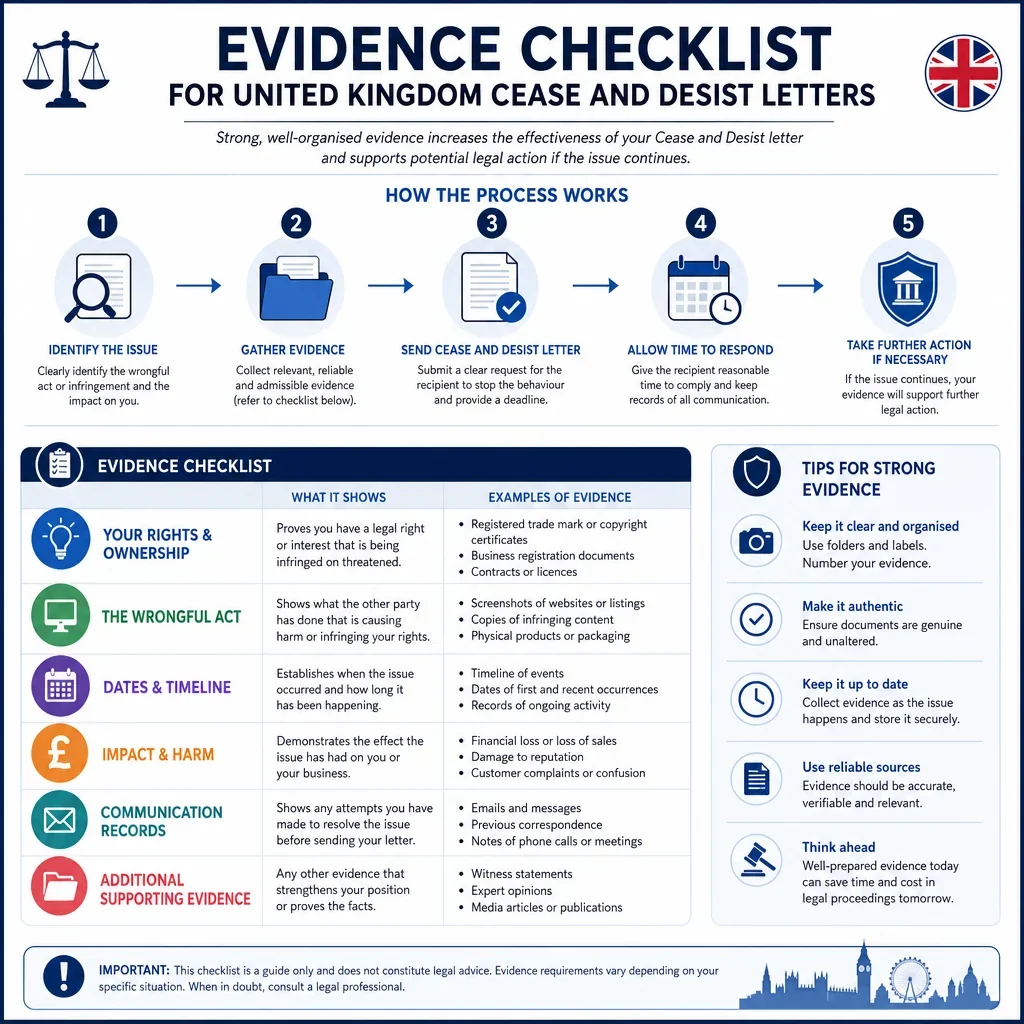
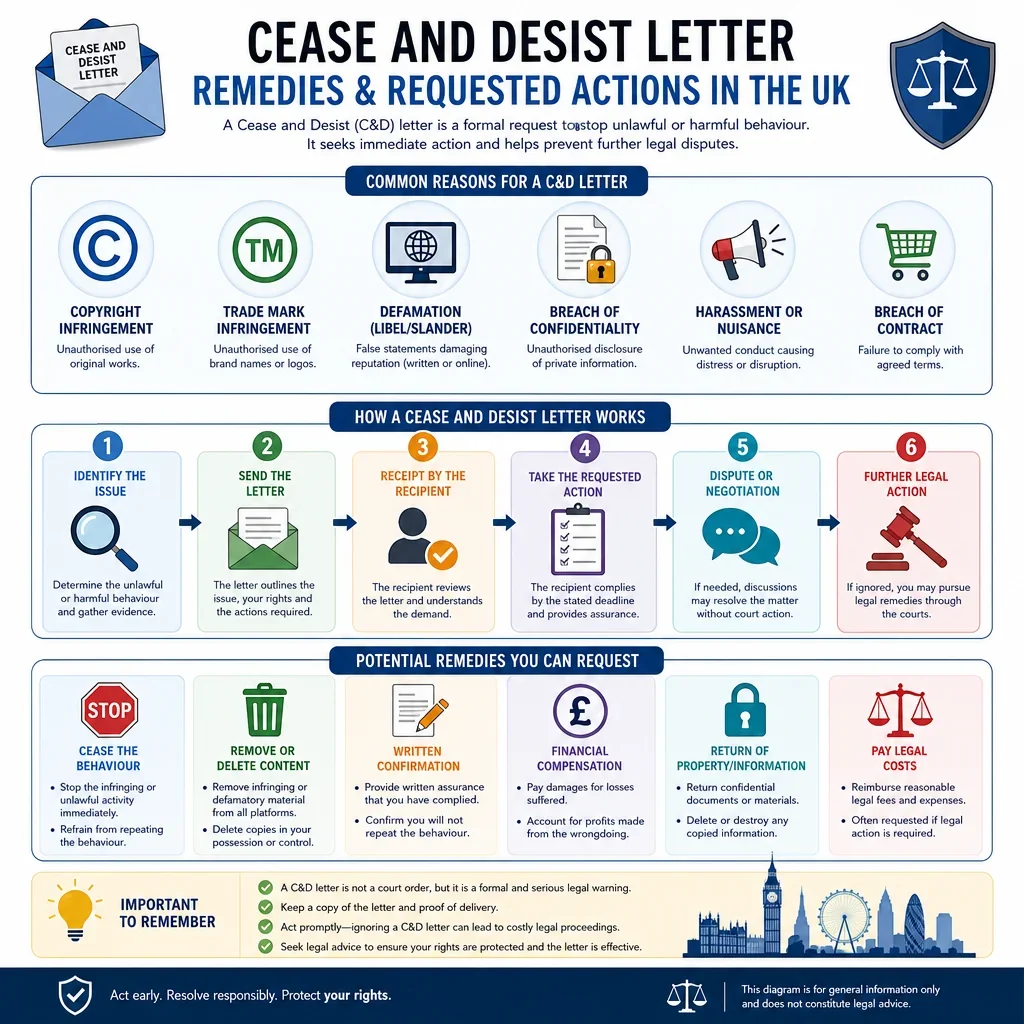
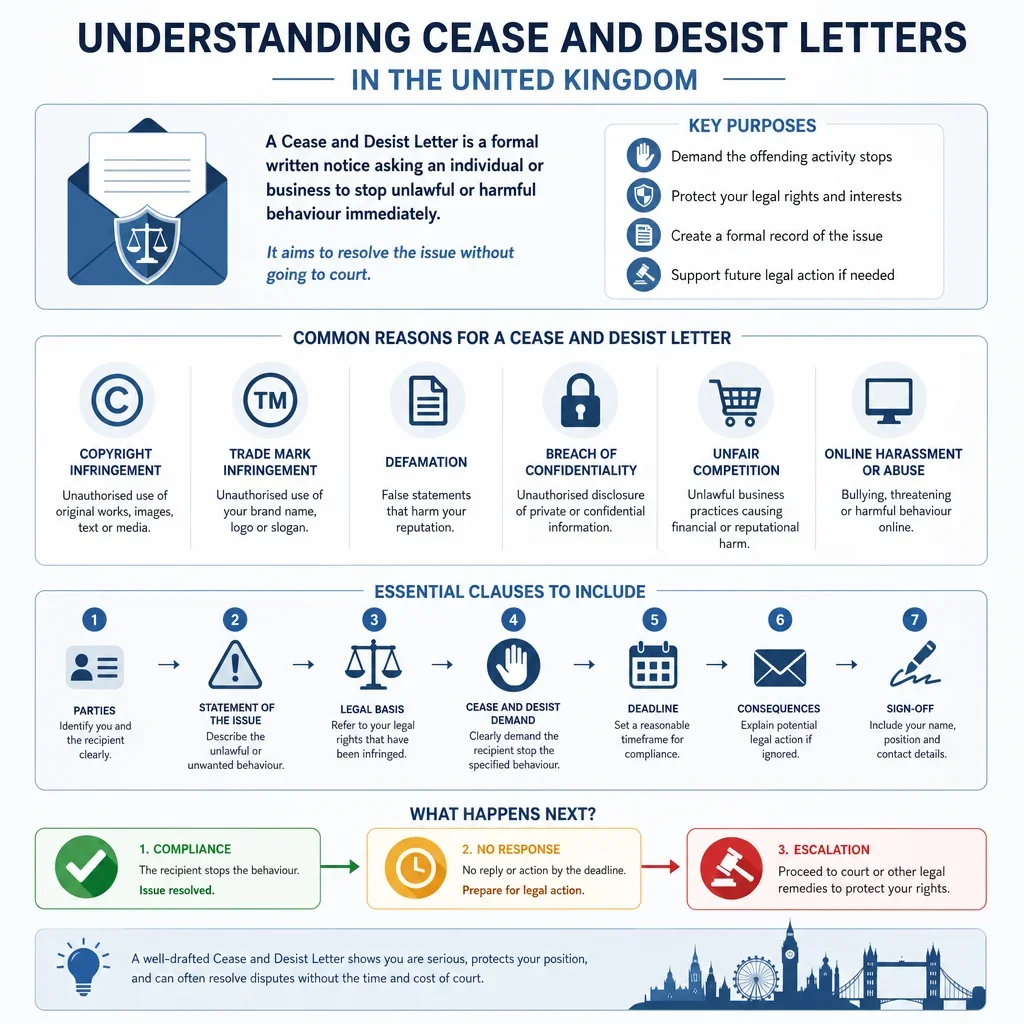
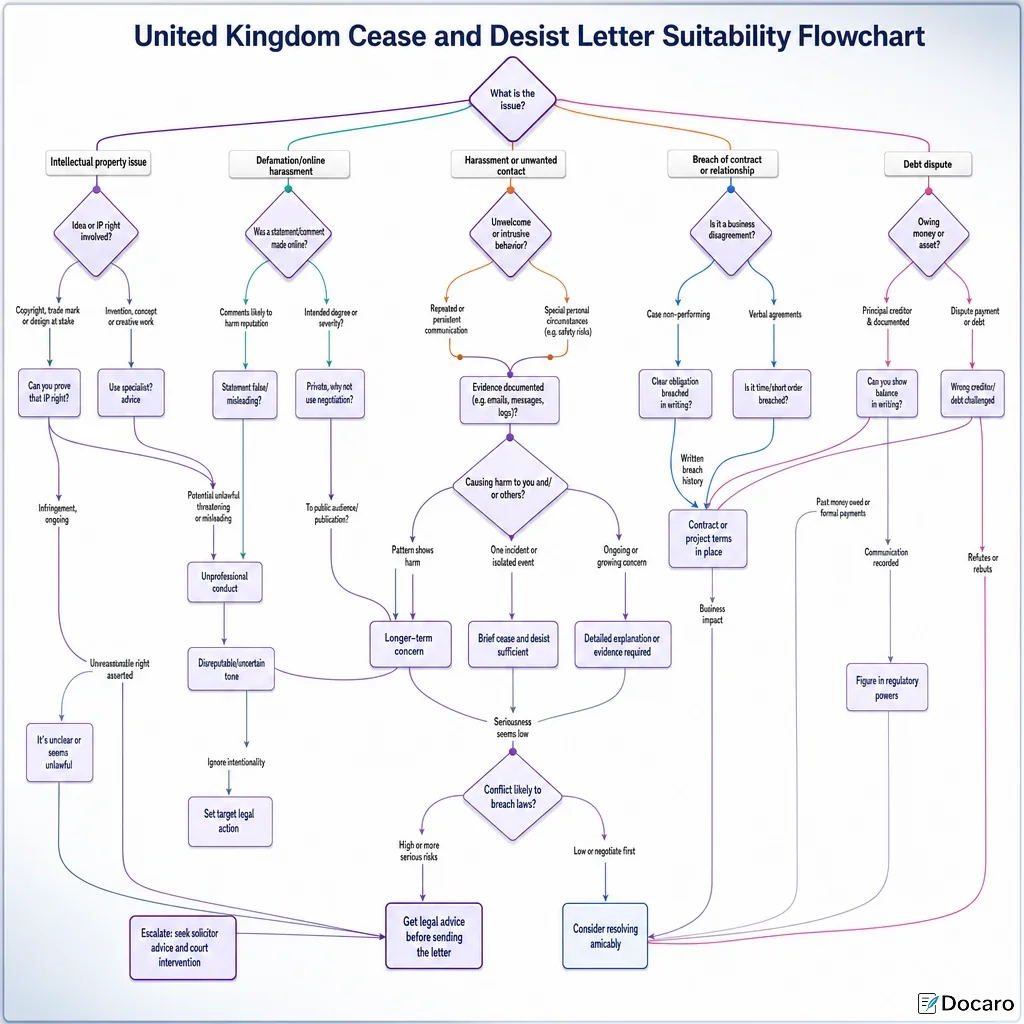
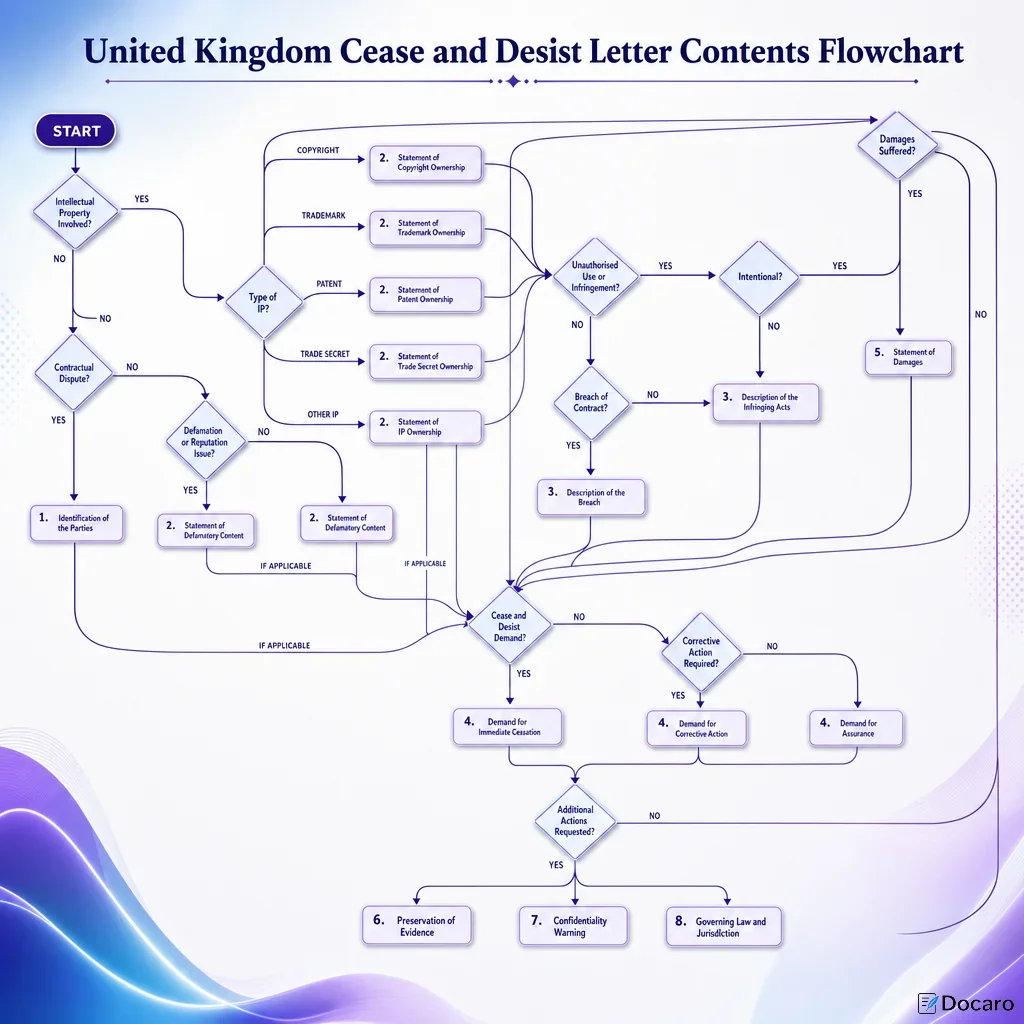
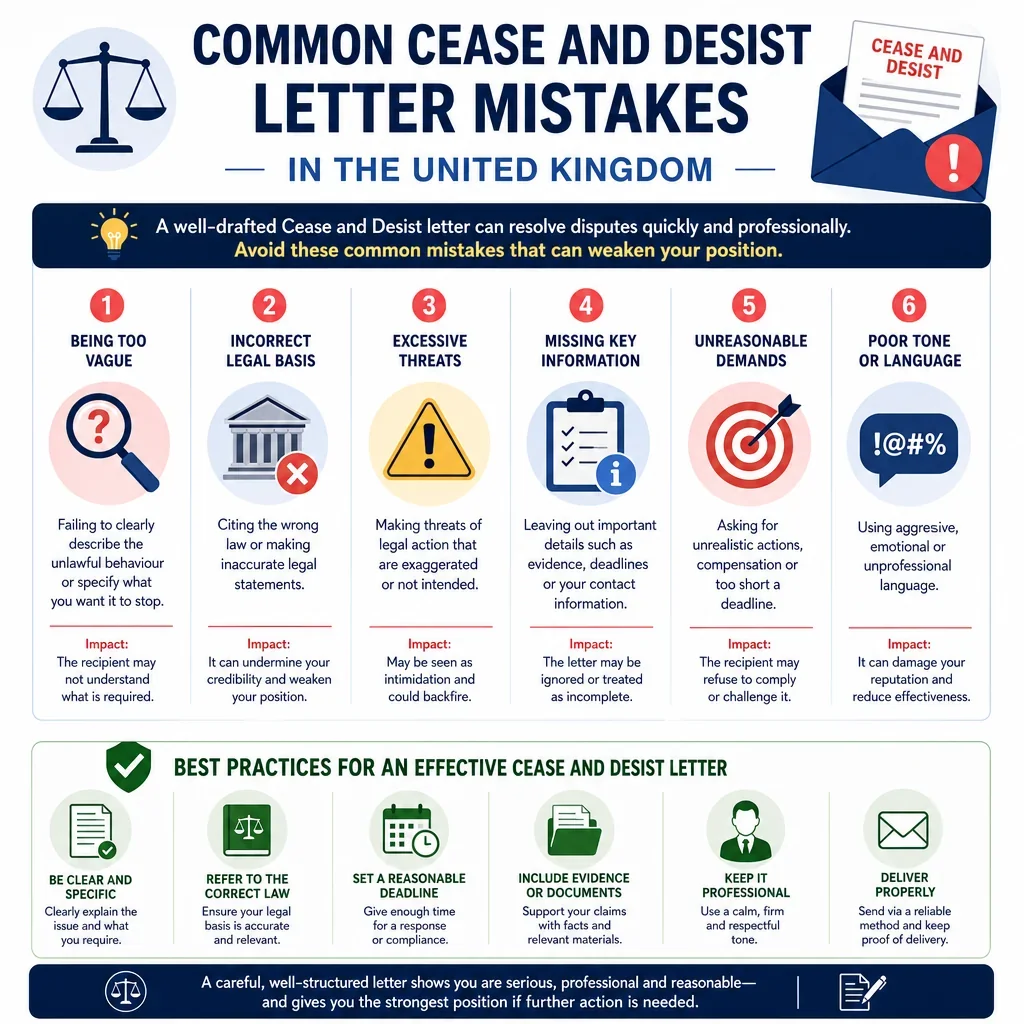
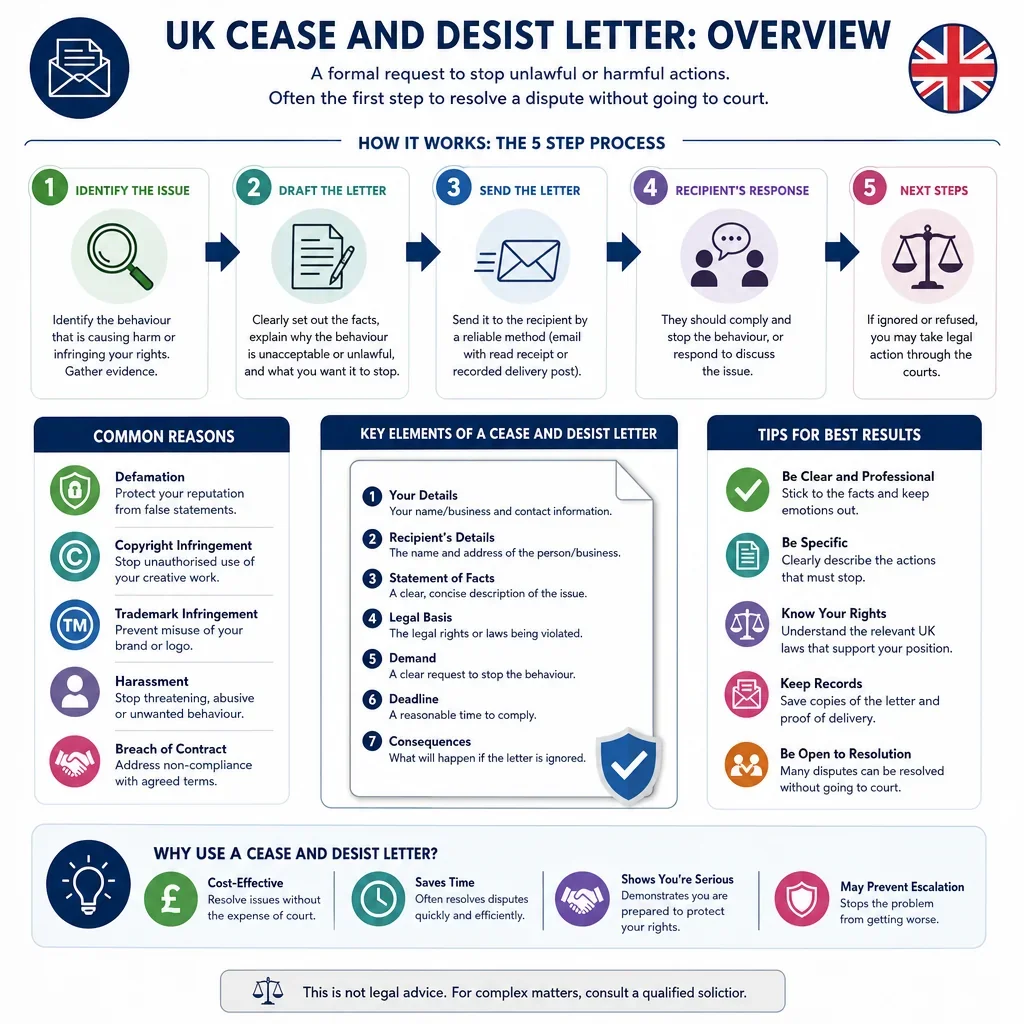
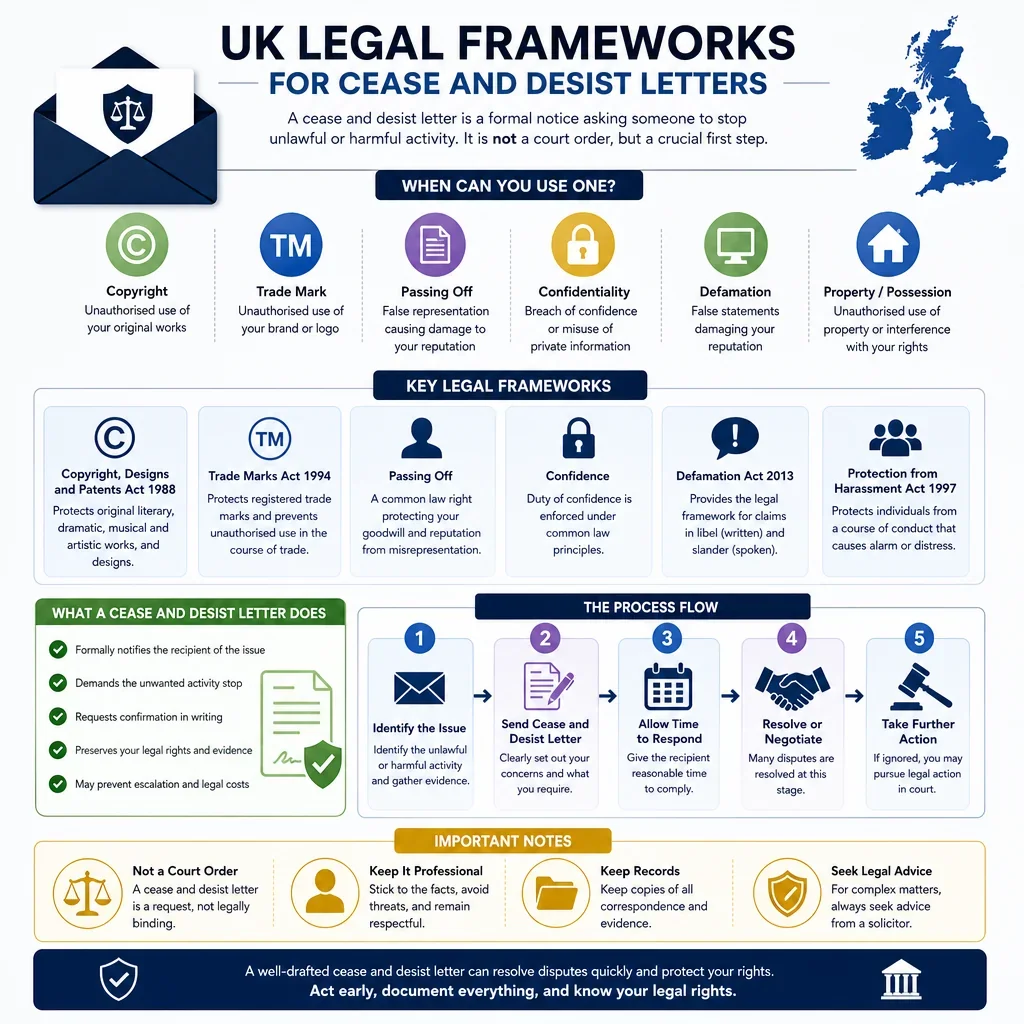
UK cease and desist letters are not limited to one area of law. The strongest letters usually identify a specific legal framework, such as trade mark law, copyright law, data protection law, harassment law, defamation law, passing off, nuisance, confidentiality, consumer protection, employment restrictions or property rights. The correct framework affects the wording of the demand, the evidence required and the remedies that may realistically be available.
When Should A Letter Be Treated With Particular Caution?
- Intellectual property threats: unjustified threats rules can apply to patents, trade marks and designs, so letters should usually focus on primary infringers and be carefully worded.
- Defamation: a letter should distinguish false statements of fact from opinion and consider the serious harm test under the Defamation Act 2013.
- Harassment and stalking: urgent safety concerns may require police reporting or protective orders rather than only a letter.
- Data protection: UK GDPR and Data Protection Act 2018 rights often require specific requests, time limits and identification of the controller or processor.
- Employment and non-compete disputes: restrictive covenants are enforceable only if reasonable and necessary to protect legitimate business interests.
Which UK Jurisdiction Matters Most?
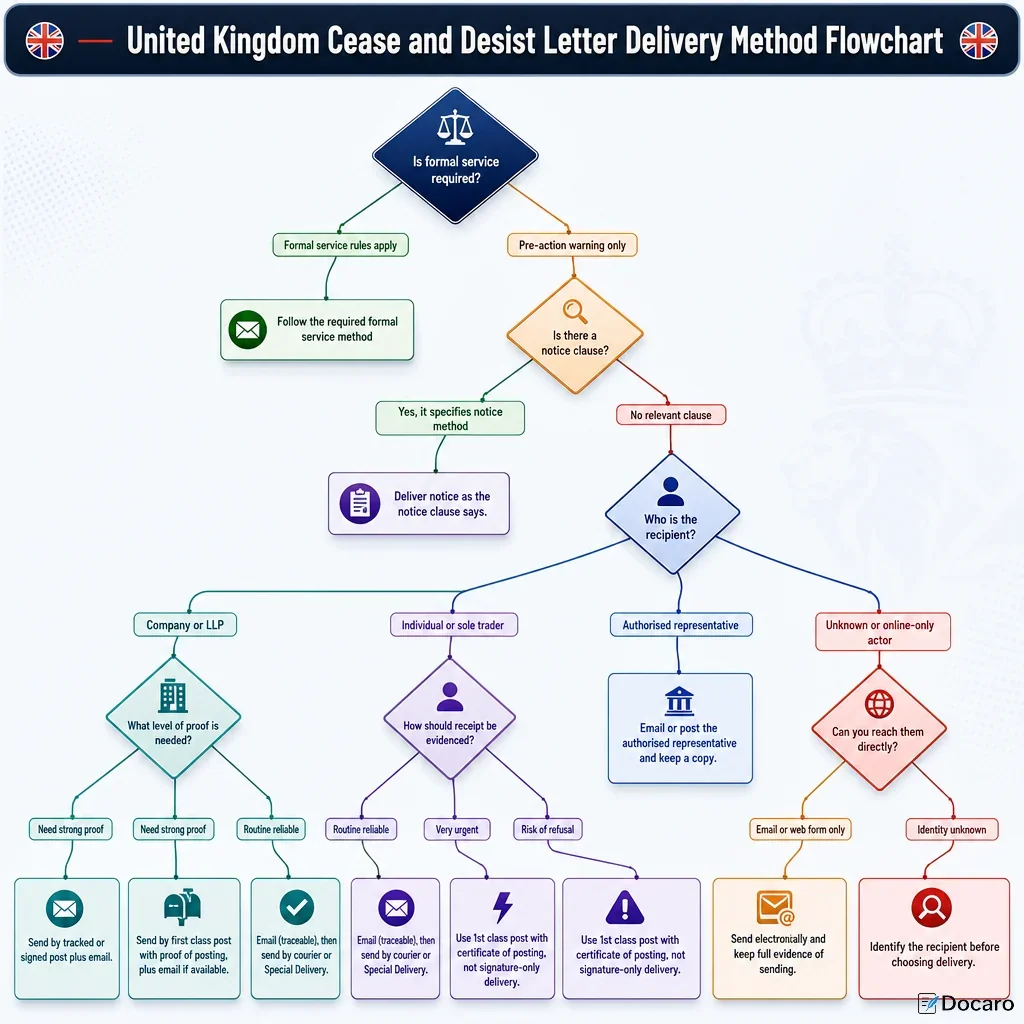
Some legal frameworks are United Kingdom-wide, including UK GDPR, copyright, trade marks and many consumer rules. Others differ between England and Wales, Scotland and Northern Ireland, especially property remedies, harassment procedure, defamation procedure and court terminology. A letter should match the jurisdiction where the conduct occurs, where the recipient is based, or where proceedings would most likely be issued.
Who Commonly Uses Cease And Desist Letters In The UK?
Individuals commonly use them for harassment, defamation, privacy, neighbour nuisance and debt contact disputes. Companies and sole traders frequently use them for intellectual property, passing off, confidential information, online reviews, employment restrictions and unfair competition. Charities and public bodies may use them where brand misuse, data misuse, trespass, protest activity or safeguarding-related communications create legal risk.
FAQs
You Might Also Be Interested In