AI Generated British Consultancy Agreements
PDF & Word - 2026 Updated
Docaro Pricing
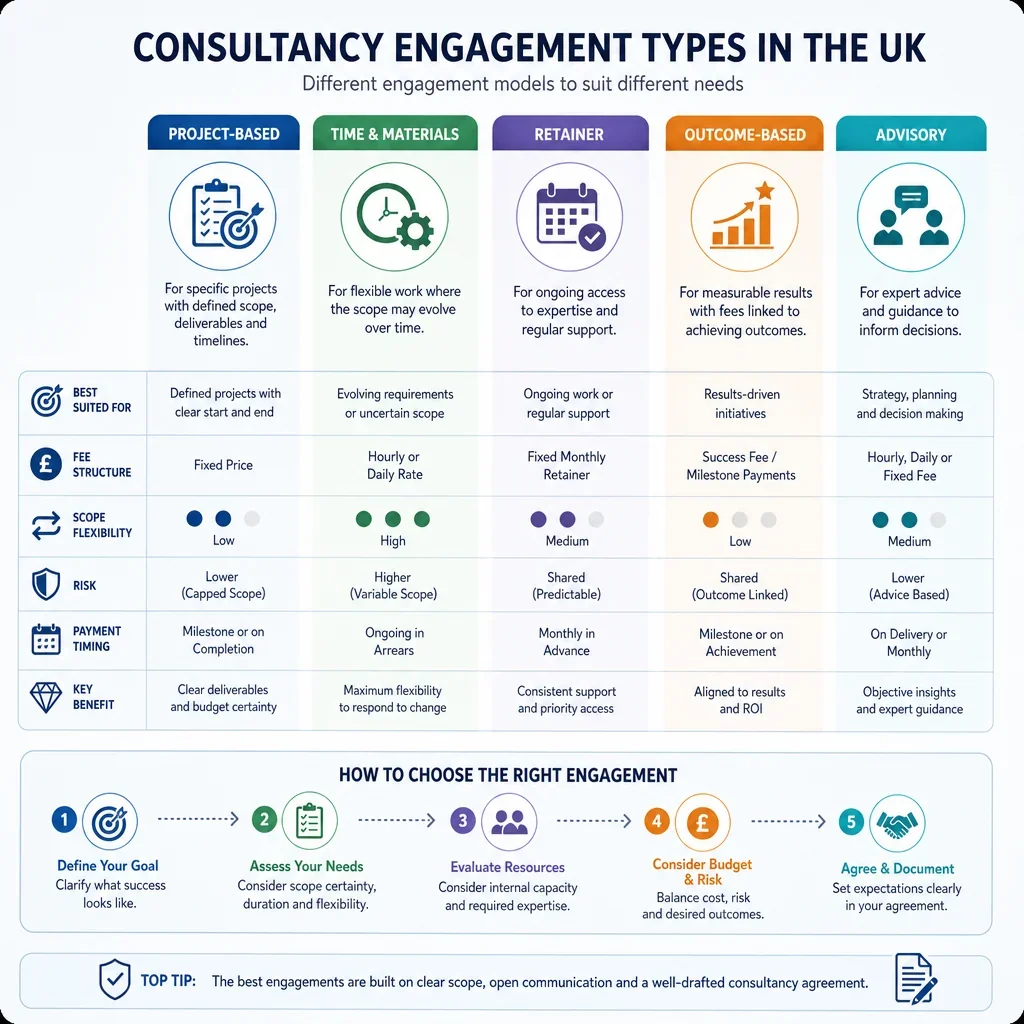
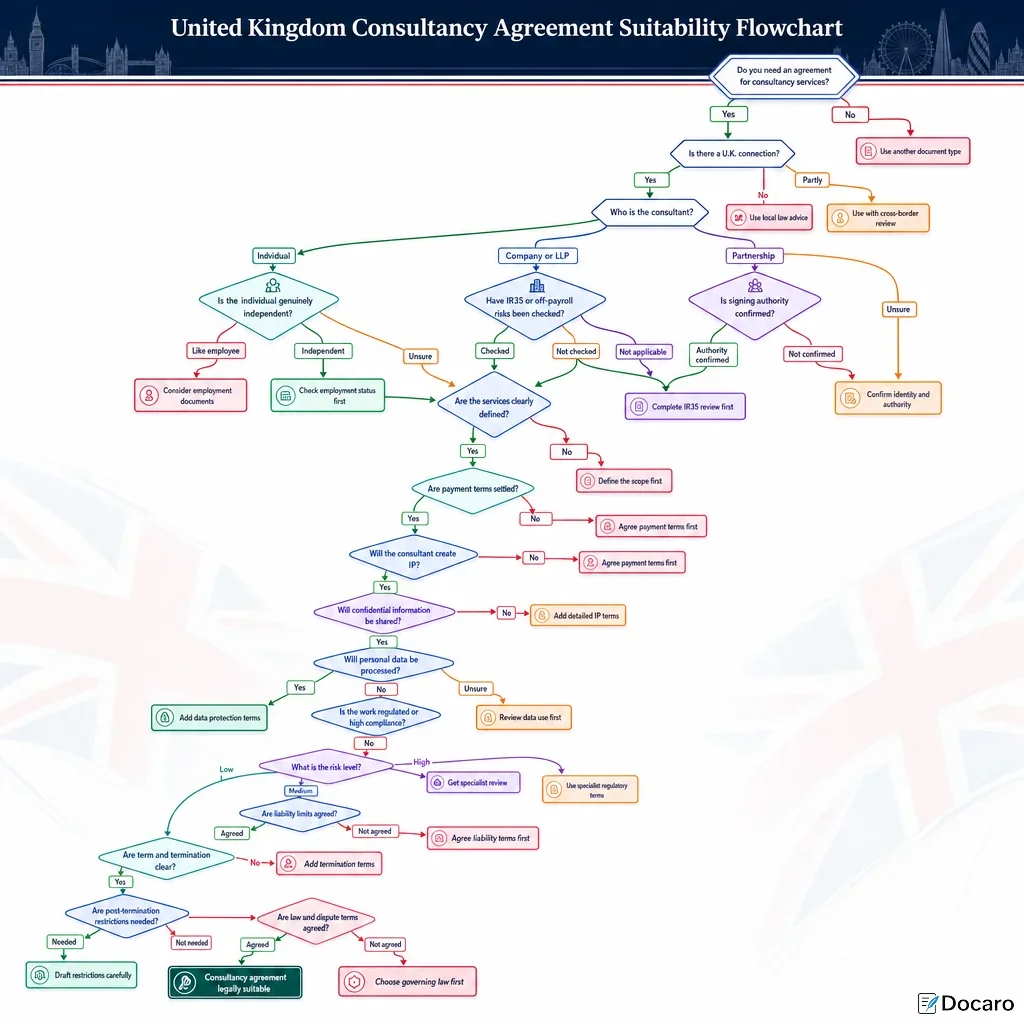
When do you need a Consultancy Agreement in the United Kingdom?
British Legal Rules for a Consultancy Agreement
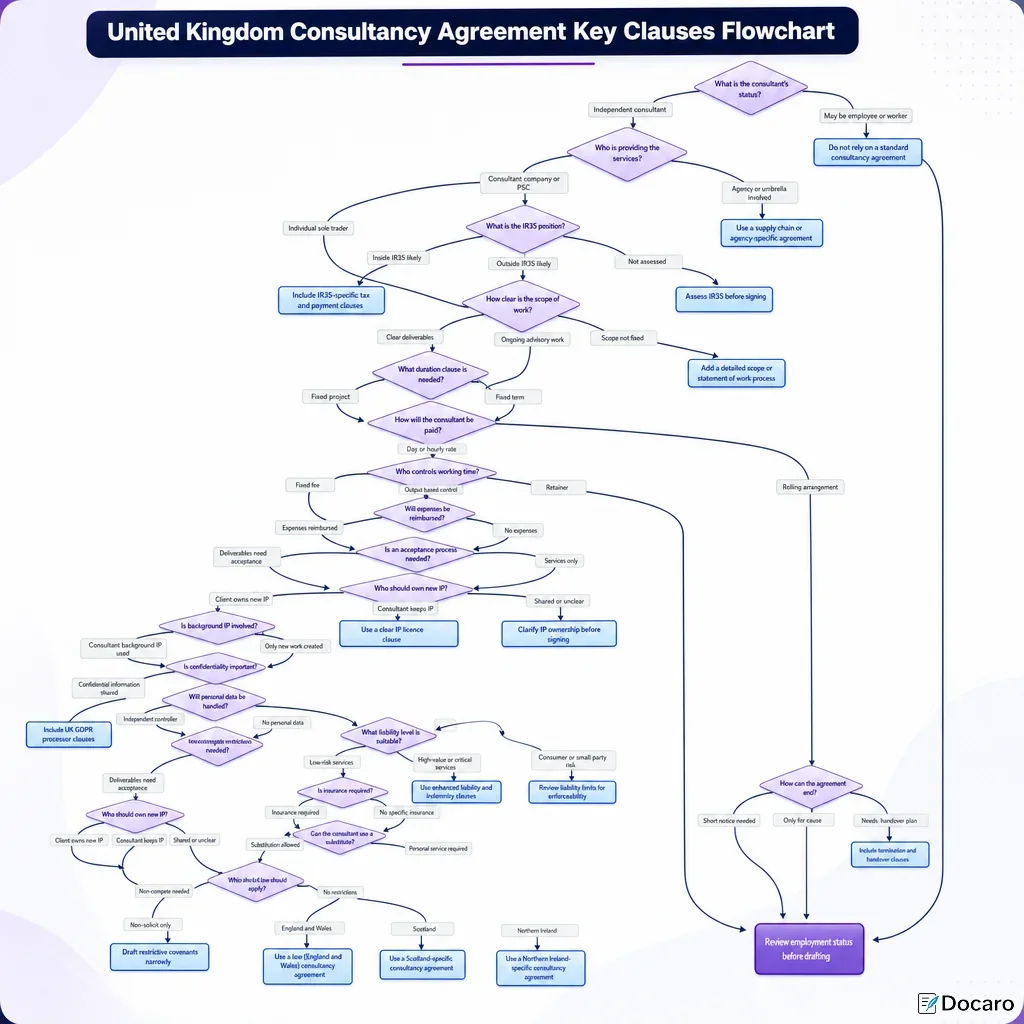
Using the wrong structure for a consultancy agreement can inadvertently create an employment relationship with unintended rights and obligations.
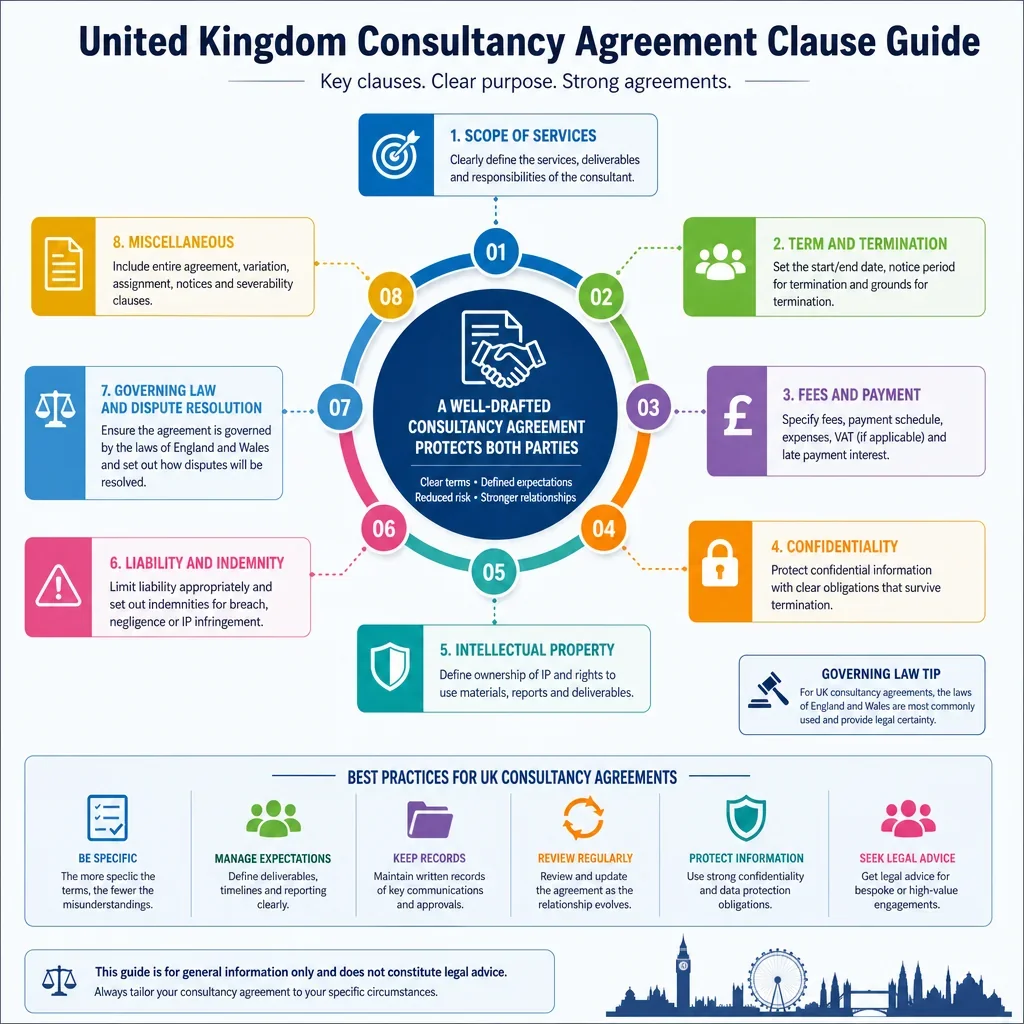
What a Proper Consultancy Agreement Should Include
- Parties InvolvedClearly identify the consultant and the client, including their full names, addresses, and contact details.
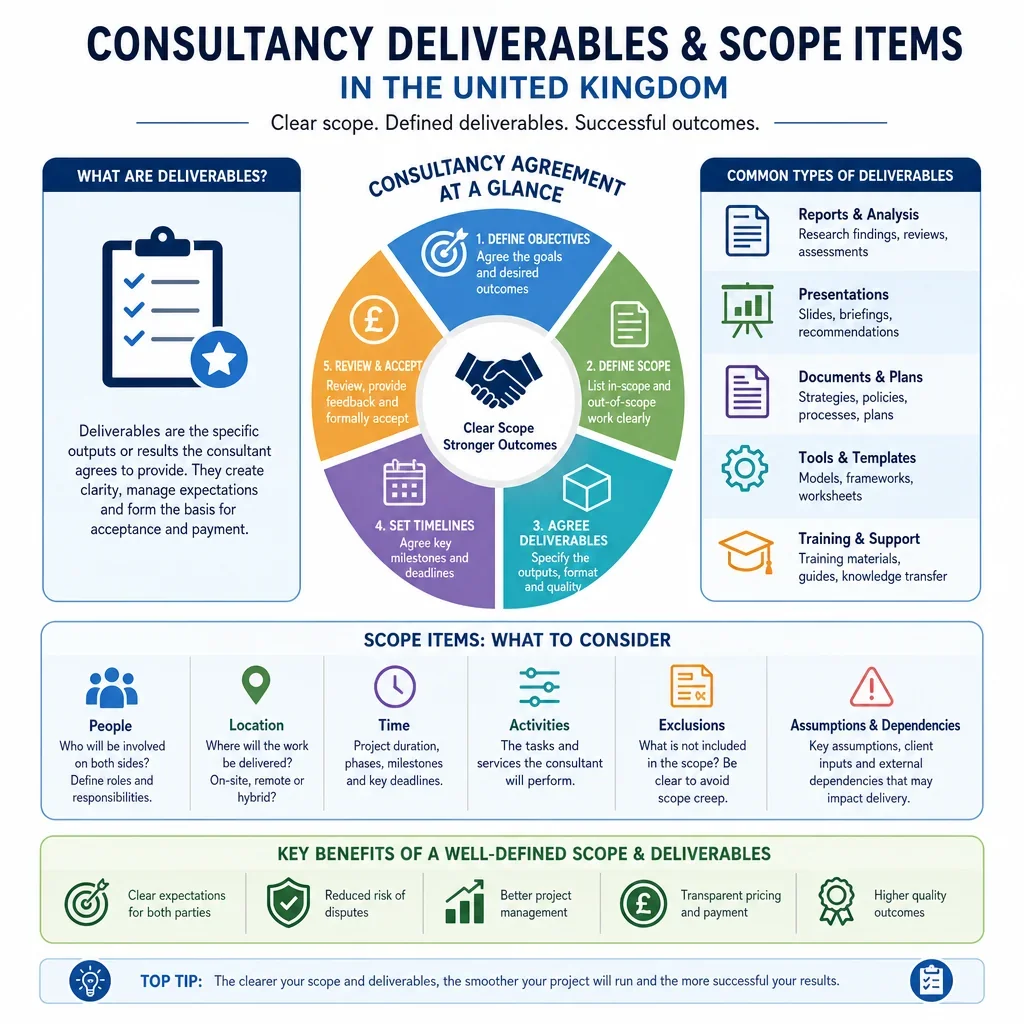
- Scope of WorkDescribe the specific services the consultant will provide and any tasks that are excluded.
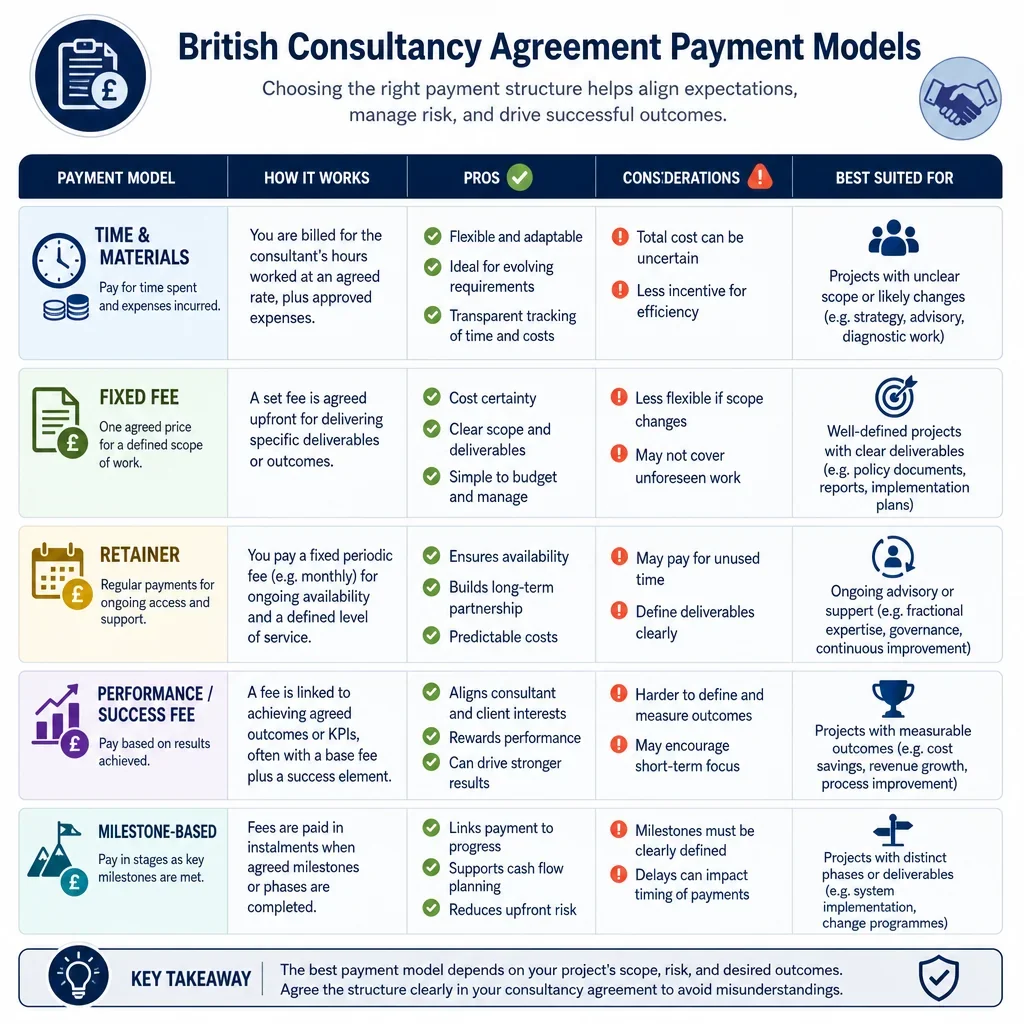
- Payment TermsOutline how much the consultant will be paid, when payments are due, and details on expenses or invoicing.
- Duration and End DateSpecify the start and end dates of the agreement, including how it can be extended or terminated early.
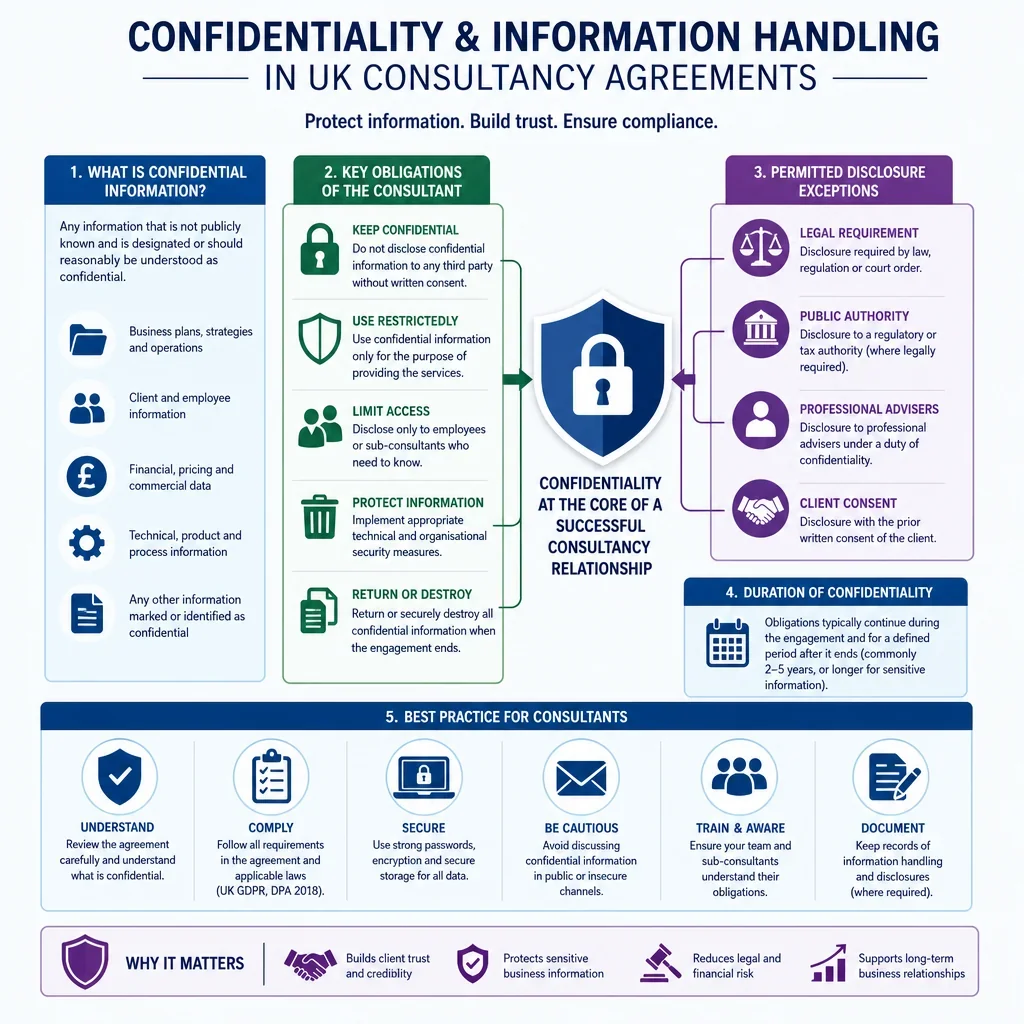
- Confidentiality RulesState that the consultant must keep the client's information private and not share it with others.
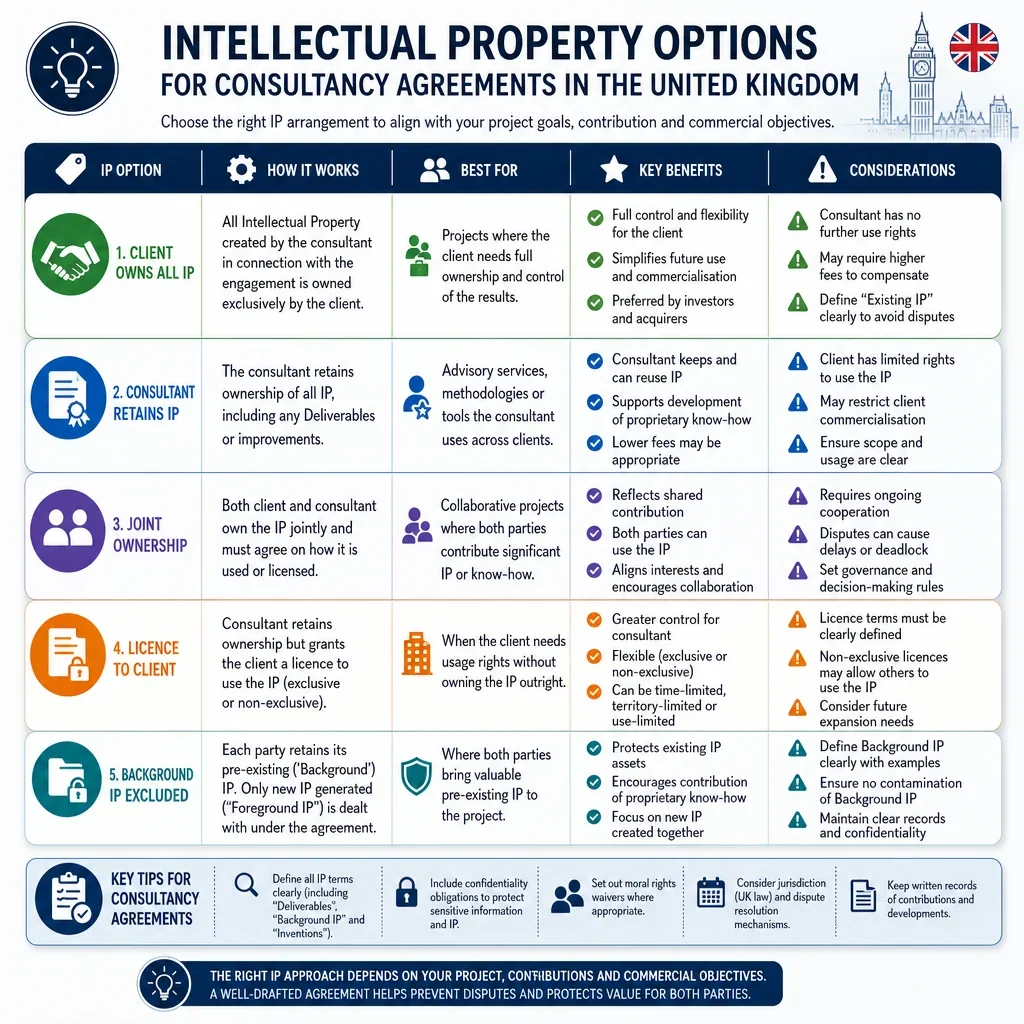
- Intellectual Property RightsClarify who owns any work or ideas created by the consultant during the project.
- Non-Compete LimitsLimit the consultant from working with competitors or starting similar work for a set time after the agreement ends.
- Liability and InsuranceDefine each party's responsibility for any mistakes or damages, and require proof of insurance if needed.
- Dispute ResolutionExplain how disagreements will be handled, such as through negotiation or legal processes in the UK.
- Governing LawConfirm that the agreement follows UK laws, specifically those of England and Wales if applicable.
Generate Your Document in 4 Easy Steps
Why Use Docaro?
 United Kingdom
Free Example Consultancy Agreement Template
Below is a free template example of a Consultancy Agreement for use in the United Kingdom generated by our AI model.
The clauses in your actual Consultancy Agreement will vary from this example as they will be entirely bespoke to your requirements as set out in the questionnaire you complete.
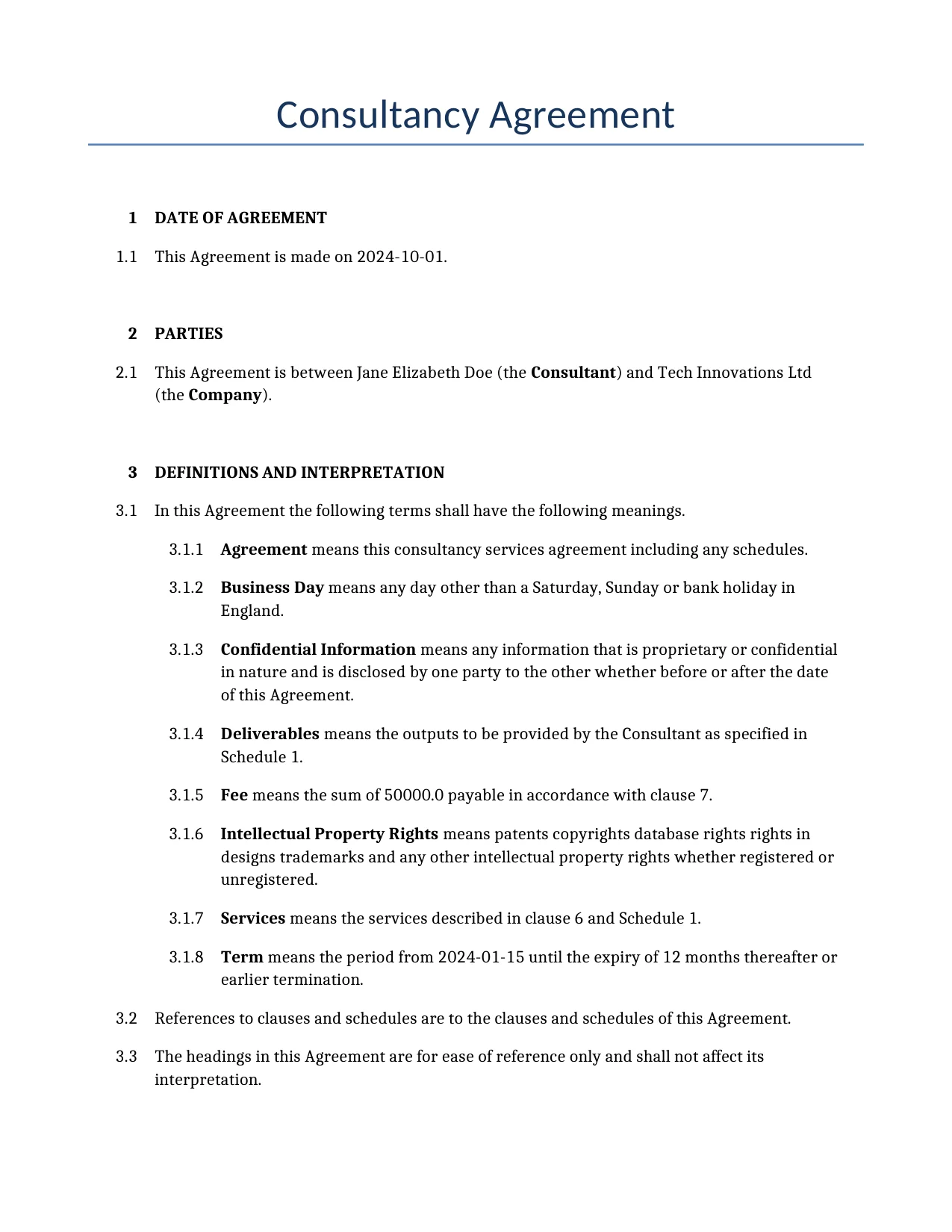
Consultancy Services Agreement
1DATE OF AGREEMENT
This Agreement is made on 2024-10-01.
2PARTIES
This Agreement is between Jane Elizabeth Doe (the Consultant) and Tech Innovations Ltd (the Company).
3DEFINITIONS AND INTERPRETATION
In this Agreement the following terms shall have the following meanings.
Agreement means this consultancy services agreement including any schedules.
Business Day means any day other than a Saturday, Sunday or bank holiday in England.
Confidential Information means any information that is proprietary or confidential in nature and is disclosed by one party to the other whether before or after the date of this Agreement.
Deliverables means the outputs to be provided by the Consultant as specified in Schedule 1.
Fee means the sum of 50000.0 payable in accordance with clause 7.
Intellectual Property Rights means patents copyrights database rights rights in designs trademarks and any other intellectual property rights whether registered or unregistered.
Services means the services described in clause 6 and Schedule 1.
Term means the period from 2024-01-15 until the expiry of 12 months thereafter or earlier termination.
References to clauses and schedules are to the clauses and schedules of this Agreement.
The headings in this Agreement are for ease of reference only and shall not affect its interpretation.
4STATUS OF THE CONSULTANT
The Consultant is an independent contractor and nothing in this Agreement shall create a partnership, joint venture, or contract of employment between the parties. The Consultant shall be responsible for all tax, National Insurance, and other statutory obligations arising from the provision of the Services, including compliance with IR35 rules if applicable. The Consultant shall indemnify the Company against any claims by HMRC or other authorities in respect of tax or National Insurance.
5APPOINTMENT
The Company appoints the Consultant to provide the Services on a fixed term basis commencing on 2024-01-15.
The Consultant shall provide the Services exclusively to the Company during the Term.
The Consultant shall provide the Services in a professional manner with due care and skill.
6SERVICES
The Consultant shall deliver expert financial consulting encompassing budgeting forecasting risk assessment and preparation of financial reports to support the Company's fiscal planning and compliance with UK regulations.
The Consultant shall provide the Services on a hybrid basis mixing remote and on-site work at locations approved by the Company.
The Consultant shall deliver the Deliverables listed in Schedule 1.
The Consultant shall submit monthly progress reports to the Company and a final report upon completion of the Services.
The Consultant shall submit invoices monthly detailing services provided hours worked and any applicable expenses via email to accounts@company.com.
The Consultant shall comply with all applicable health and safety laws and the Company's policies when working on-site.
7TERM
This Agreement shall commence on 2024-01-15 and shall continue for a fixed term of 12 months unless terminated earlier in accordance with clause 14.
8FEES AND PAYMENT
The Company shall pay the Consultant the Fee of 50000.0 which shall be exclusive of VAT.
The Fee shall be paid in three instalments comprising 30 percent upon signing 40 percent after completion of phase 1 and 30 percent upon project completion.
The Company shall pay each invoice within 30 days of receipt.
If the Company fails to pay any sum due the Company shall pay interest on the overdue amount at 4 percent above the base rate of the Bank of England from time to time and the Consultant may suspend provision of the Services until payment is made.
9EXPENSES
The Company shall reimburse the Consultant for reasonable expenses properly incurred in the provision of the Services.
The Consultant must obtain the Company's prior written approval for any expense exceeding 100.00.
Reimbursable expenses shall include travel costs including train tickets and mileage at 45p per mile accommodation and meals up to 50.00 per day.
The Consultant shall submit receipts for all expenses to the Company.
The Company shall reimburse approved expenses within 30 days of submission by bank transfer.
10CONFIDENTIALITY
Each party shall keep the other party's Confidential Information secret and shall not disclose it to any person except as permitted by this clause 10.
A party may disclose Confidential Information if required by law or regulatory authority provided that it gives the other party prompt written notice where lawful.
Upon termination of this Agreement the Consultant shall return or destroy all Confidential Information belonging to the Company and shall certify in writing that it has done so.
The obligations in this clause 10 shall survive termination of this Agreement for a period of 5 years.
11INTELLECTUAL PROPERTY RIGHTS
The Consultant grants the Company a non-exclusive licence to use the Consultant's pre-existing proprietary software framework which includes algorithms for data analysis for the purpose of receiving the Services.
The Consultant shall not modify or sublicense the pre-existing intellectual property without the Company's prior written consent.
All Intellectual Property Rights in any materials created by the Consultant in the course of providing the Services (the Deliverables) shall vest automatically in the Company upon creation subject to payment of the applicable portion of the Fee.
The Consultant shall at the Company's request and expense promptly execute all documents and do all acts as may be necessary to perfect the assignment of IPR in the Deliverables to the Company.
The Consultant waives all moral rights in the materials created under this Agreement.
The Consultant warrants that it owns or has the right to license the pre-existing intellectual property and that the Services and Deliverables will not infringe any third party Intellectual Property Rights.
12WARRANTIES AND REPRESENTATIONS
The Consultant warrants that it is an incorporated entity in good standing with full authority to enter into this Agreement.
The Consultant warrants that it has no conflicts of interest that could affect the provision of the Services.
The Consultant warrants that it is not subject to any tax or other liabilities that could result in a lien or claim over the Deliverables.
The Consultant warrants that it will comply with all applicable laws including the Bribery Act 2010 the Competition Act 1998 the Data Protection Act 2018 the Equality Act 2010 and all tax obligations including IR35 rules where applicable.
The Consultant warrants that it has not and will not engage in any form of bribery corruption or use of forced labour in connection with the Services.
The Consultant warrants that it complies with the requirements of the Unfair Contract Terms Act 1977 the Consumer Rights Act 2015 the Companies Act 2006 and the Employment Rights Act 1996 to the extent that they apply to this Agreement.
13LIABILITY AND INDEMNITY
Each party shall indemnify the other against all losses claims and expenses arising from any breach of its warranties under this Agreement or any infringement of third party Intellectual Property Rights by the Services or Deliverables.
The indemnity in clause 13.1 shall apply to data protection breaches and shall be mutual between the parties.
Subject to clause 13.5 the total liability of each party to the other under or in connection with this Agreement shall not exceed 50000.
Neither party shall be liable to the other for any indirect or consequential loss including loss of profit or goodwill.
Nothing in this Agreement limits or excludes liability for death or personal injury caused by negligence or for fraud or fraudulent misrepresentation.
14INSURANCE
The Consultant shall maintain professional indemnity insurance with a minimum cover of 5000000 GBP and public liability insurance for the duration of the Term and for 6 years thereafter.
The Consultant shall maintain the insurances from 2024-01-15.
The Consultant shall provide evidence of the insurance cover to the Company upon request.
15DATA PROTECTION
Each party shall comply with its obligations under the Data Protection Act 2018 and the UK GDPR. The Consultant shall only process personal data on behalf of the Company in accordance with the Company's documented instructions and shall implement appropriate technical and organisational measures to protect the personal data. The Consultant shall not transfer personal data outside the UK without the Company's prior written consent.
16TERMINATION
Either party may terminate this Agreement for convenience on 3 months' written notice.
Either party may terminate this Agreement immediately by written notice if the other party commits a material breach of this Agreement and fails to remedy it within 14 days of notice or if the other party suffers an insolvency event.
17CONSEQUENCES OF TERMINATION
Upon termination the Consultant shall return all property belonging to the Company including documents and equipment.
The Consultant shall return or destroy all Confidential Information as required by clause 10.3.
The Company shall pay the Consultant all accrued but unpaid Fees and Expenses up to the termination date calculated on a pro-rata basis.
The provisions of clauses 10 18 19 and 20 shall survive termination of this Agreement.
18NON-SOLICITATION
The Consultant shall not for a period of 12 months after termination directly or indirectly solicit any employee or customer of the Company.
19NON-COMPETE
The Consultant shall not during the Term or for 6 months after termination directly or indirectly provide services the same as or similar to the Services to any direct competitors of the Company in the financial consulting sector within the United Kingdom.
If the Company requires the Consultant to comply with the restriction in clause 19.1 for any period after termination it shall pay the Consultant a sum equivalent to the pro-rated Fee for that period.
If any restriction in this clause 19 is found to be unreasonable by a court it shall be enforceable to the maximum extent permitted by law.
20FORCE MAJEURE
Neither party shall be liable for any failure to perform its obligations under this Agreement if such failure is caused by a force majeure event including pandemics epidemics or natural disasters such as floods or earthquakes.
The affected party shall give written notice of the force majeure event by email or registered post within 5 days of its occurrence.
Both parties shall take reasonable steps to mitigate the effects of any force majeure event.
If the force majeure event continues for more than 30 days either party may terminate this Agreement by written notice.
The Consultant shall not be entitled to any payment for periods when the Services cannot be provided due to a force majeure event.
21NOTICES
Any notice under this Agreement shall be in writing and may be delivered by post email or hand delivery.
Notices to the Company shall be sent to John Smith at 123 Business Street London SW1A 1AA or by email to the designated Company address.
Notices to the Consultant shall be sent to Jane Doe at 456 Freelance Avenue Manchester M1 1AA or by email to the designated Consultant address.
Notices sent by post shall be deemed served 2 Business Days after posting.
22ANTI-BRIBERY AND CORRUPTION
The Consultant shall comply with all applicable anti-bribery and anti-corruption laws including the Bribery Act 2010. The Consultant shall not offer, promise, give, or accept any bribe or other improper payment in connection with this Agreement.
23ENTIRE AGREEMENT
This Agreement constitutes the entire agreement between the parties and supersedes all prior agreements understandings or arrangements whether oral or in writing.
24ASSIGNMENT AND SUBCONTRACTING
The Consultant shall not assign subcontract or transfer any of its rights or obligations under this Agreement without the prior written consent of the Company.
The Company may assign its rights and obligations under this Agreement to any affiliate or successor entity.
25SEVERANCE
If any provision of this Agreement is held to be invalid or unenforceable the remaining provisions shall remain in full force and effect.
26WAIVER
No failure or delay by either the Company or the Consultant in exercising any right under this Agreement shall constitute a waiver of that right.
27VARIATION
No variation of this Agreement shall be effective unless it is in writing and signed by both the Company and the Consultant.
28GOVERNING LAW
This Agreement and any dispute or claim arising out of or in connection with it shall be governed by and construed in accordance with English Law.
29JURISDICTION
The courts of England and Wales shall have exclusive jurisdiction over any dispute arising out of or in connection with this Agreement.
30THIRD PARTY RIGHTS
A person who is not a party to this Agreement shall have no rights under the Contracts (Rights of Third Parties) Act 1999 to enforce any term of this Agreement.
31COUNTERPARTS
This Agreement may be executed in any number of counterparts including by electronic signatures and exchanged by email each of which when executed shall constitute a single agreement.
32SCHEDULES
Schedule 1 forms part of this Agreement.
33SCHEDULE 1 SERVICES
The Consultant will provide expert financial consulting encompassing budgeting forecasting risk assessment and preparation of financial reports to support the Company's fiscal planning and compliance with UK regulations over a period of 12 months commencing on 2024-01-15 on a hybrid basis.
The Consultant shall be paid the Fee in three instalments in accordance with clause 8 and shall be reimbursed for reasonable expenses in accordance with clause 9.
All Intellectual Property Rights created pursuant to the Services shall be owned by the Company in accordance with clause 11.
34EXECUTION
Signed by Jane Elizabeth Doe (Consultant): ___________________________ Date: ________
Signed by a duly authorised representative of Tech Innovations Ltd: ___________________________ Date: ________
This example shows approximately 70% of a typical document and is provided for illustrative purposes only. The remaining content has been omitted.
Every document generated by Docaro is tailored to your specific circumstances, jurisdiction and the information you provide. The completed document includes all applicable clauses and provisions required for your situation.
To generate the full, personalised document, answer a short series of questions and your document will be created instantly.
Useful Resources When Considering a Consultancy Agreement in the United Kingdom
United Kingdom Reference Legislation
Consultancy Agreement FAQs
Document Generation FAQs
Related Articles