AI Generated British End-User Licence Agreement (EULA)
PDF & Word - 2026 Updated
Docaro Pricing
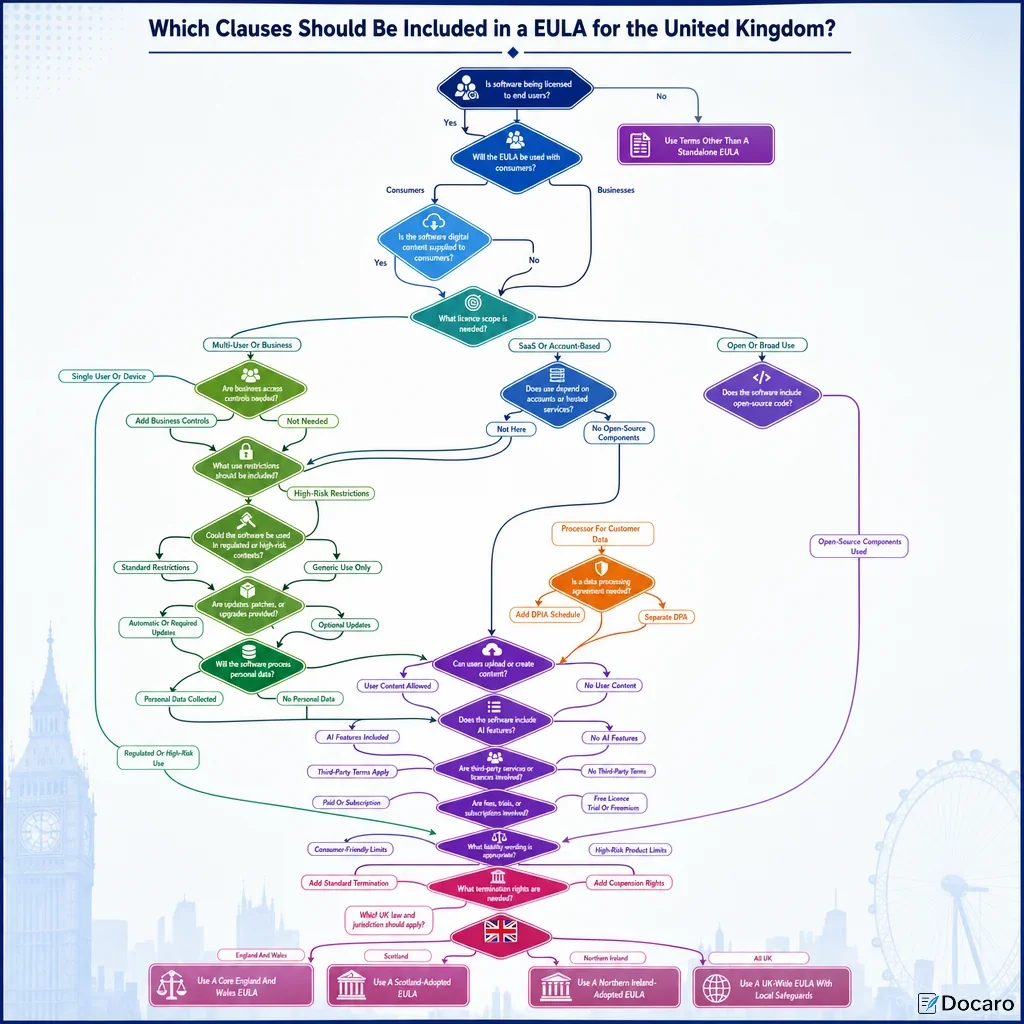
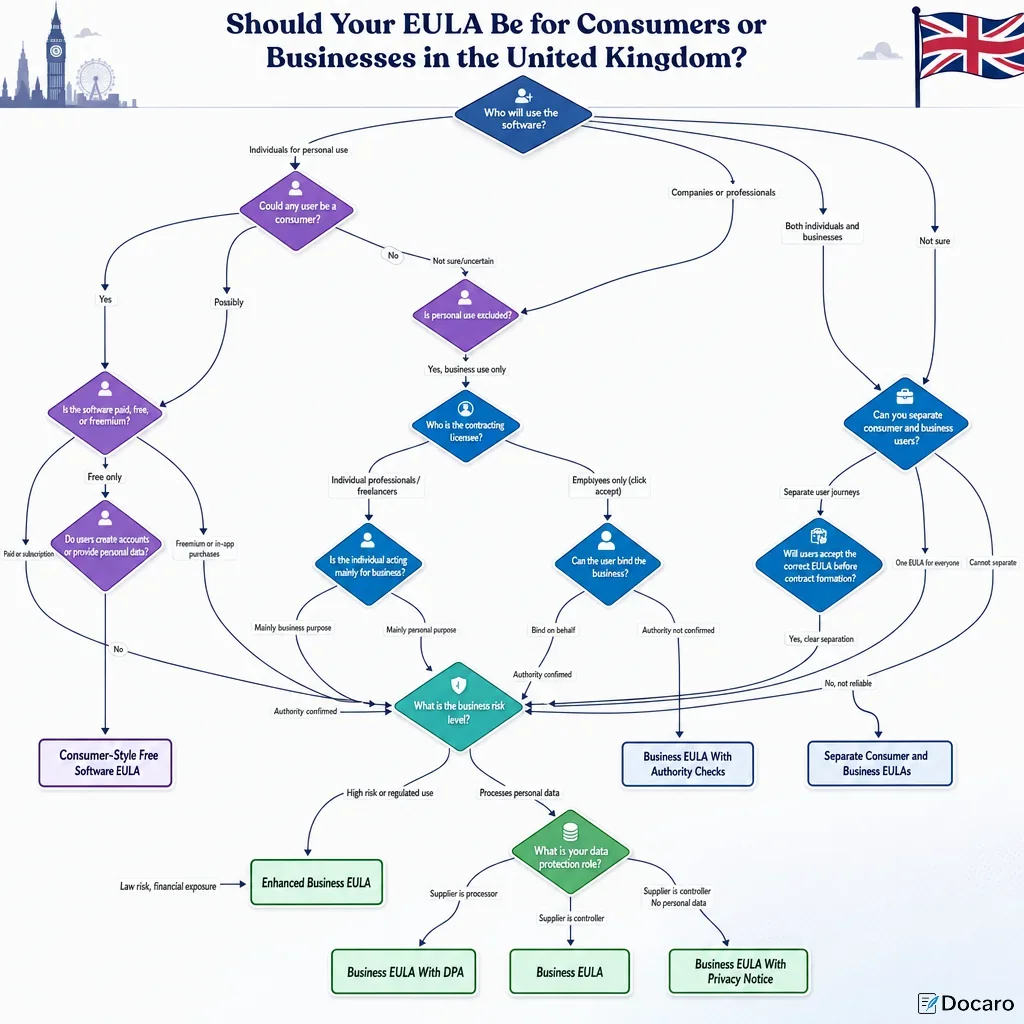
When do you need an End-User Licence Agreement (EULA) in the United Kingdom?
British Legal Rules for an End-User Licence Agreement (EULA)
Using the wrong structure for a EULA can fail to adequately protect intellectual property rights or expose you to unintended liabilities.
What a Proper End-User Licence Agreement (EULA) Should Include
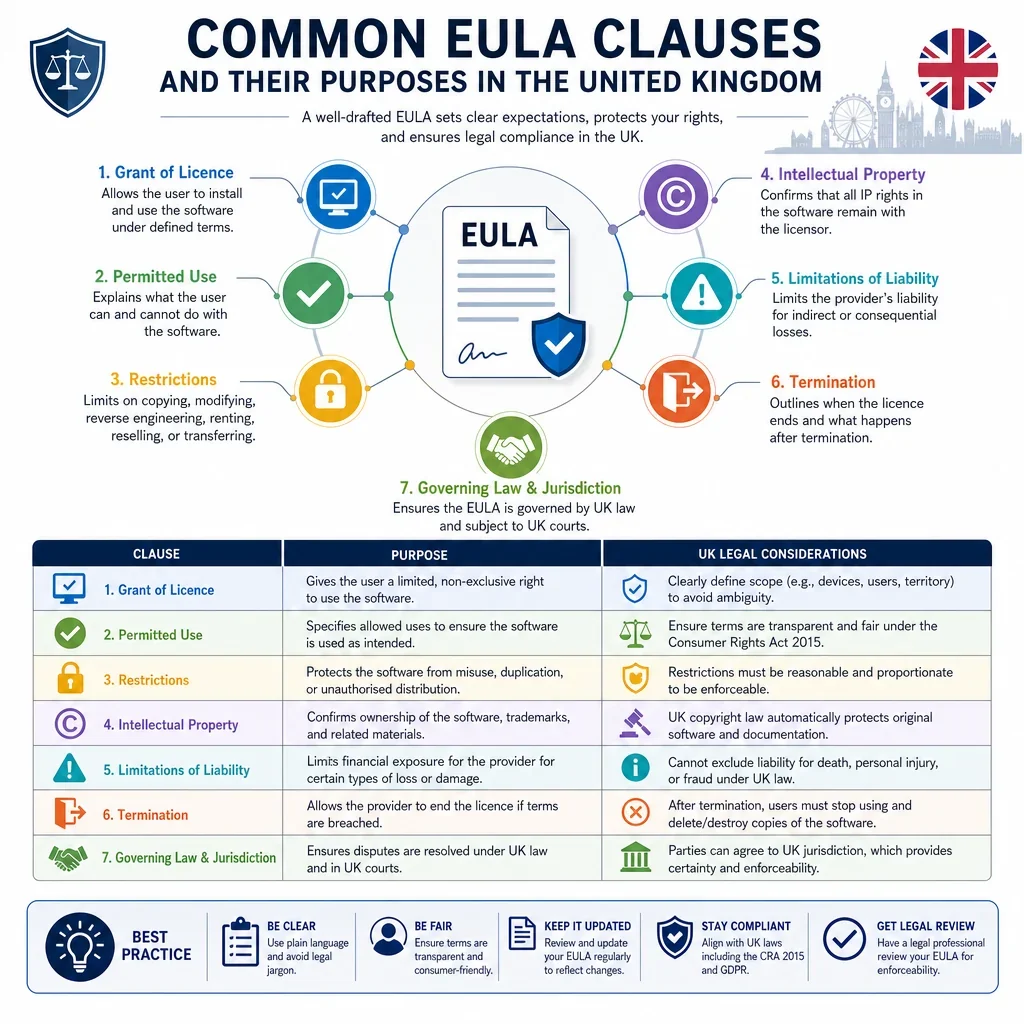
- Grant of LicenceThis section clearly states what rights the user gets to use the software, such as personal or commercial use, and any limits on the number of devices.
- Restrictions on UseIt outlines what the user cannot do, like copying the software, modifying it, or using it for illegal purposes.
- Payment TermsThis covers how much the user must pay, when payments are due, and what happens if payments are missed.
- Intellectual Property RightsIt confirms that the software is owned by the provider and the user only gets limited rights to use it.
- Warranties and DisclaimersThis explains any guarantees about the software's performance and limits the provider's responsibility for issues.
- Liability LimitationsIt sets boundaries on how much the provider can be held responsible for any problems caused by the software.
- Termination ConditionsThis details when and how the licence can end, such as for breaking the rules or not paying.
- Governing LawIt specifies that UK law applies to any disputes and where they would be handled.
Generate Your Document in 4 Easy Steps
Why Use Docaro?
 United Kingdom
Free Example End-User Licence Agreement (EULA) Template
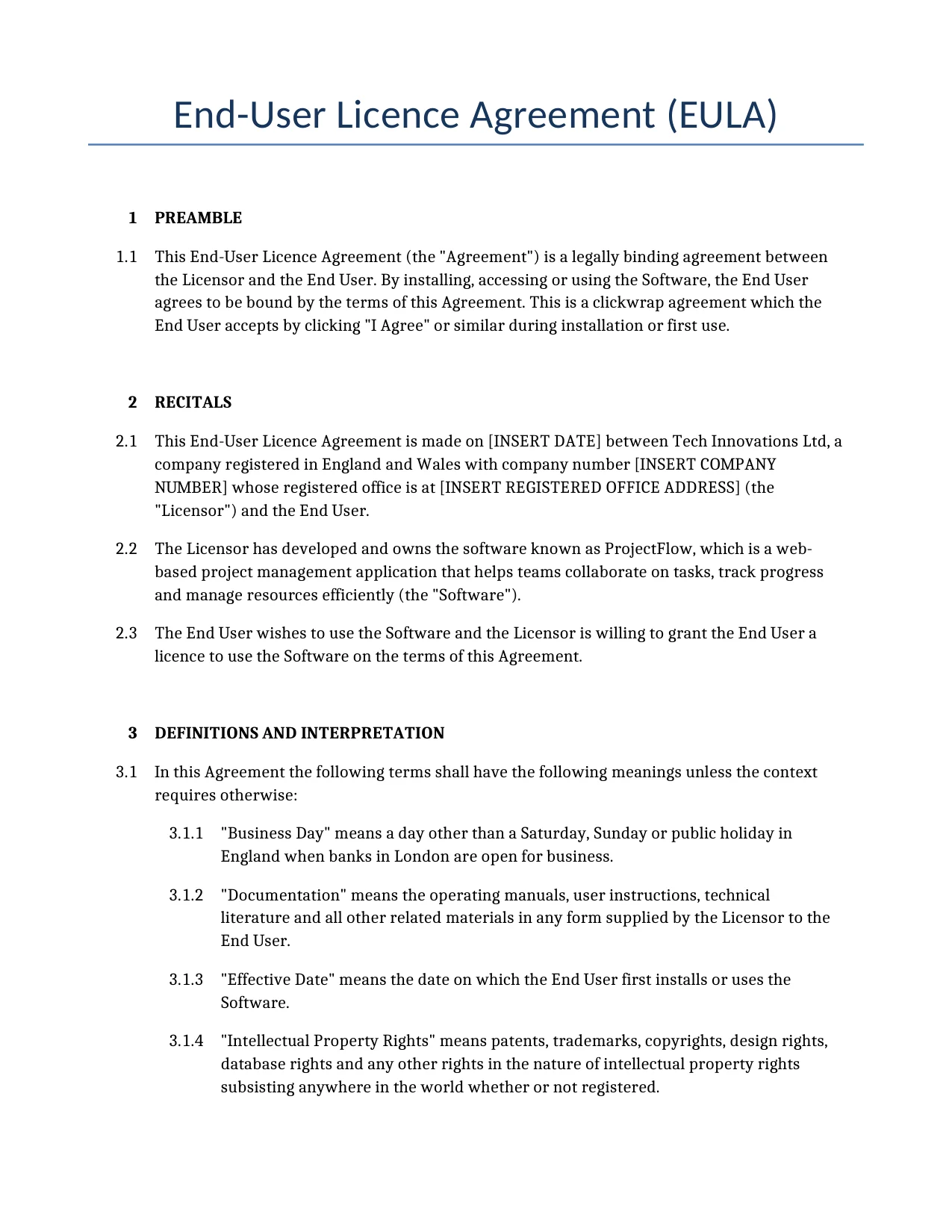
Below is a free template example of a End-User Licence Agreement (EULA) for use in the United Kingdom generated by our AI model.
The clauses in your actual End-User Licence Agreement (EULA) will vary from this example as they will be entirely bespoke to your requirements as set out in the questionnaire you complete.
End-User Licence Agreement
1PREAMBLE
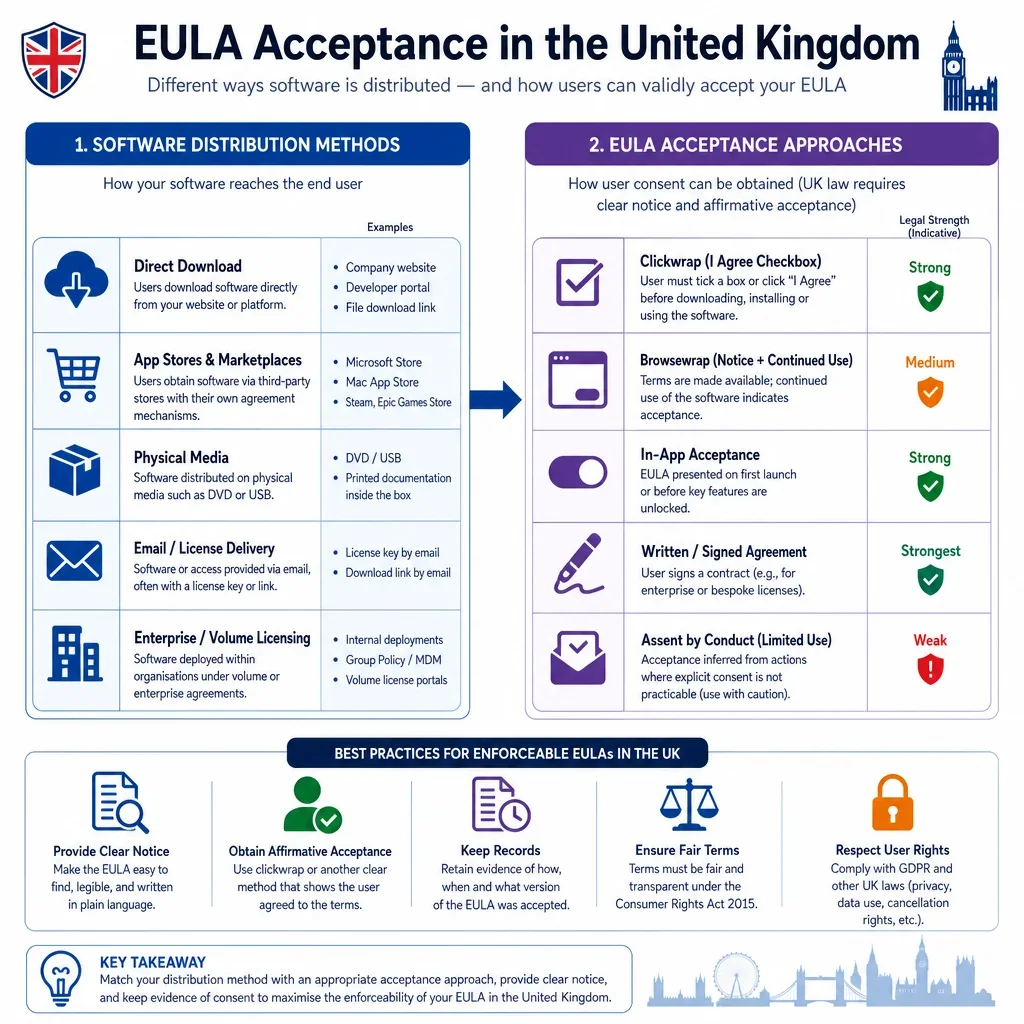
This End-User Licence Agreement (the "Agreement") is a legally binding agreement between the Licensor and the End User. By installing, accessing or using the Software, the End User agrees to be bound by the terms of this Agreement. This is a clickwrap agreement which the End User accepts by clicking "I Agree" or similar during installation or first use.
2RECITALS
This End-User Licence Agreement is made on [INSERT DATE] between Tech Innovations Ltd, a company registered in England and Wales with company number [INSERT COMPANY NUMBER] whose registered office is at [INSERT REGISTERED OFFICE ADDRESS] (the "Licensor") and the End User.
The Licensor has developed and owns the software known as ProjectFlow, which is a web-based project management application that helps teams collaborate on tasks, track progress and manage resources efficiently (the "Software").
The End User wishes to use the Software and the Licensor is willing to grant the End User a licence to use the Software on the terms of this Agreement.
3DEFINITIONS AND INTERPRETATION
In this Agreement the following terms shall have the following meanings unless the context requires otherwise:
"Business Day" means a day other than a Saturday, Sunday or public holiday in England when banks in London are open for business.
"Documentation" means the operating manuals, user instructions, technical literature and all other related materials in any form supplied by the Licensor to the End User.
"Effective Date" means the date on which the End User first installs or uses the Software.
"Intellectual Property Rights" means patents, trademarks, copyrights, design rights, database rights and any other rights in the nature of intellectual property rights subsisting anywhere in the world whether or not registered.
"Licensor" means Tech Innovations Ltd.
"Permitted Use" means the internal business use of the Software by the End User in accordance with the Documentation.
"Software" means the software known as ProjectFlow, which is a web-based project management application that helps teams collaborate on tasks, track progress and manage resources efficiently, together with any updates and new releases provided by the Licensor.
"VAT" means value added tax chargeable under the Value Added Tax Act 1994.
The headings in this Agreement do not affect its interpretation. References to clauses are to the clauses of this Agreement.
4GRANT OF LICENCE
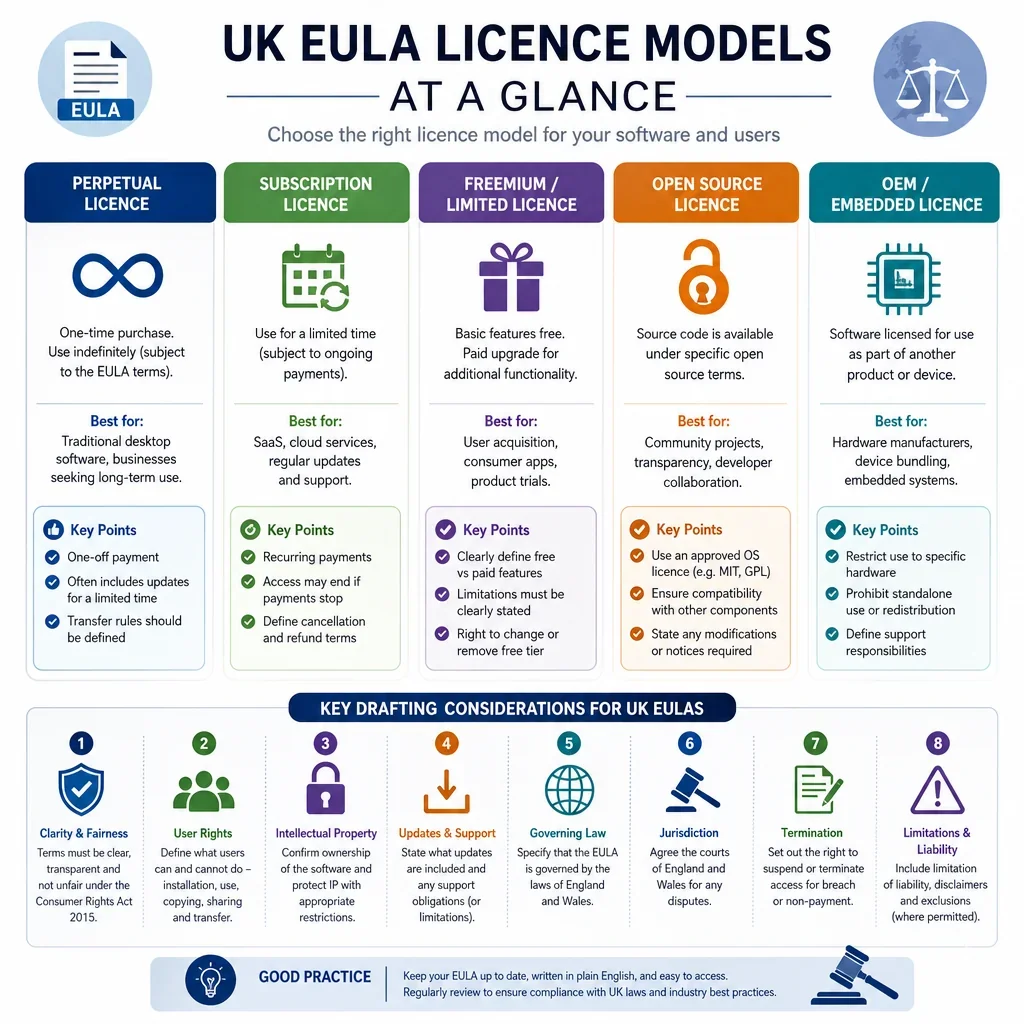
In consideration of the payment of the Licence Fee, the Licensor hereby grants to the End User a non-exclusive, non-transferable, perpetual licence to use the Software and the Documentation solely for the Permitted Use within the United Kingdom. This licence is for business use only and commences on the Effective Date.
The licence granted under clause 3.1 permits the End User to install and use the Software on the number of devices or in accordance with any concurrency or user limits notified by the Licensor from time to time. The Software is provided as a downloadable application or via a software-as-a-service model as specified in the Documentation.
The licence granted under clause 3.1 includes the right for the End User to receive updates, upgrades and new versions of the Software as and when they are made available by the Licensor during the term of this Agreement, subject to payment of any applicable maintenance fees.
This licence is granted under the Copyright, Designs and Patents Act 1988 and all other applicable laws. All rights not expressly granted to the End User are reserved to the Licensor.
5LICENCE RESTRICTIONS
The End User shall not, except as expressly permitted in this Agreement or to the extent permitted by law:
copy, modify, adapt or create derivative works of the Software or Documentation;
sublicence, rent, lease, lend, sell, distribute, commercially exploit or otherwise transfer the Software or Documentation to any third party;
reverse engineer, decompile, disassemble or otherwise attempt to derive the source code of the Software, except to the extent that such activities cannot be prohibited by law;
remove, obscure or alter any copyright, trademark or other proprietary notices contained in the Software or Documentation;
use the Software in any way that breaches any applicable laws or regulations or in any manner that exceeds any user, concurrency or other limits notified by the Licensor;
use the Software other than for the Permitted Use.
The restrictions in this clause 4 are without prejudice to the End User\’s statutory rights under the Copyright, Designs and Patents Act 1988 or any other applicable law that cannot be excluded by contract.
6PAYMENT TERMS
In consideration of the licence granted under this Agreement, the End User shall pay to the Licensor a one-time licence fee of \£500 (the "Licence Fee"). The one-time fee grants a perpetual licence in accordance with clause 3.1. Any optional annual renewal fee of \£100 relates solely to ongoing support and maintenance services under clause 23 and is not required to maintain the perpetual licence itself.
All fees stated under this Agreement are exclusive of VAT which shall be payable by the End User at the applicable rate.
The End User may make payment by bank transfer, credit card (Visa or Mastercard) or PayPal.
Payment shall be due within 30 days of the date of the Licensor\’s invoice.
If the End User fails to pay any sum due by the due date, the Licensor may charge interest on the overdue amount at the rate of 8\% per annum above the Bank of England base rate from time to time in accordance with the Late Payment of Commercial Debts (Interest) Act 1998. Such interest shall accrue on a daily basis from the due date until payment.
The Licensor may suspend the End User\’s access to the Software or Support and Maintenance until all overdue payments are made. The Licensor\’s refund policy is that the Licence Fee is non-refundable except as expressly provided in this Agreement or as required by law.
7INTELLECTUAL PROPERTY RIGHTS
The Licensor owns and retains all right, title and interest in and to the Software, the Documentation and all Intellectual Property Rights therein. The End User acquires no rights in the Software or Documentation except the limited licence granted under clause 3.
Any modifications or derivative works created by the End User (even if permitted under this Agreement) shall belong to and vest in the Licensor. The End User hereby assigns all such rights to the Licensor with full title guarantee.
The End User grants to the Licensor a perpetual, irrevocable, royalty-free, worldwide licence to use any feedback, suggestions or improvements provided by the End User in relation to the Software.
The End User shall promptly notify the Licensor in writing of any actual or suspected infringement of the Licensor\’s Intellectual Property Rights in the Software of which the End User becomes aware.
8CONFIDENTIALITY
"Confidential Information" means all information (whether in oral, written or electronic form) disclosed by one party (the "Disclosing Party") to the other party (the "Receiving Party") under or in connection with this Agreement that is marked as confidential or which would reasonably be considered confidential, including without limitation the Software, its source code, the terms of this Agreement, and any business, technical or commercial information.
The obligations in this clause 7 shall not apply to information which: (a) is or becomes publicly available through no fault of the Receiving Party; (b) was lawfully in the Receiving Party\’s possession before disclosure; (c) is lawfully disclosed to the Receiving Party by a third party without confidentiality obligations; or (d) is independently developed by the Receiving Party without reference to the Disclosing Party\’s Confidential Information.
The Receiving Party shall keep the Disclosing Party\’s Confidential Information confidential and shall not disclose it to any third party except to its employees, officers, advisers or contractors who need to know it for the purposes of this Agreement and who are bound by equivalent confidentiality obligations. The Receiving Party shall use the Confidential Information solely for the purpose of exercising its rights and performing its obligations under this Agreement.
The obligations of confidentiality shall survive termination or expiry of this Agreement for any reason and shall continue indefinitely.
This clause 7 is without prejudice to either party\’s rights and obligations under the Defamation Act 2013 or any other applicable law.
9WARRANTIES AND DISCLAIMERS
The Licensor warrants that: (a) it has the right to grant the licence set out in clause 3; (b) the Software will materially conform to the specifications set out in the Documentation for a period of 90 days from the Effective Date; and (c) to the best of its knowledge, the Software does not contain any viruses, malware or other harmful code at the time of delivery.
Except as expressly set out in this Agreement, all warranties, conditions and other terms implied by statute or common law are, to the fullest extent permitted by law, excluded from this Agreement. In particular, the Licensor does not warrant that the Software will be error-free or uninterrupted or that it will meet the End User\’s specific requirements.
If the End User is a consumer, nothing in this Agreement affects the End User\’s statutory rights under the Consumer Rights Act 2015. The Licensor\’s liability for breach of the warranties in clause 8.1 shall be limited to repair or replacement of the Software or, at the Licensor\’s option, refund of the Licence Fee.
10LIMITATION OF LIABILITY
Nothing in this Agreement limits or excludes the liability of either party for: (a) death or personal injury caused by its negligence; (b) fraud or fraudulent misrepresentation; or (c) any other liability which cannot be excluded or limited by law.
Subject to clause 9.1, the Licensor\’s total aggregate liability to the End User under or in connection with this Agreement (whether in contract, tort (including negligence), breach of statutory duty or otherwise) shall not exceed \£5,000. This cap is considered reasonable having regard to the nature of the Software and the Licence Fee paid.
Subject to clause 9.1, the Licensor shall not be liable to the End User for any: (a) loss of profits, sales, business or revenue; (b) loss of or damage to data or goodwill; (c) loss of anticipated savings; or (d) any indirect or consequential loss, in each case arising under or in connection with this Agreement.
The End User is advised to ensure it has appropriate insurance and data backup procedures in place. This clause 9 is subject to the Unfair Contract Terms Act 1977 and the Consumer Rights Act 2015 and shall be construed accordingly so as to be effective to the maximum extent permitted by law.
11INDEMNIFICATION
Each party (the "Indemnifier") shall indemnify the other party (the "Indemnified Party") against any losses, damages, costs (including reasonable legal fees) and expenses incurred by the Indemnified Party arising out of or in connection with any claim that the Indemnifier\’s use or provision (as applicable) of the Software infringes the Intellectual Property Rights of any third party.
The Indemnified Party shall give the Indemnifier prompt written notice of any claim subject to indemnification. The Indemnifier shall have sole control of the defence and settlement of the claim, provided that the Indemnified Party shall provide reasonable cooperation at the Indemnifier\’s expense. The Indemnified Party shall take reasonable steps to mitigate any losses.
This clause 10 shall not apply to the extent that a claim arises from the Indemnified Party\’s modification of the Software, use in breach of this Agreement or combination with non-Licensor products. This indemnity is subject to the liability limits in clause 9.
12TERMINATION
This Agreement shall commence on the Effective Date and continue in perpetuity unless terminated earlier in accordance with this clause 11.
Either party may terminate this Agreement immediately on written notice if the other party: (a) commits a material breach of any term of this Agreement and (if remediable) fails to remedy it within 30 days of being notified; or (b) becomes insolvent, enters administration, bankruptcy or any analogous proceedings.
The Licensor may terminate this Agreement on 30 days\’ written notice for convenience. The End User may terminate this Agreement on 30 days\’ written notice, but shall not be entitled to any refund of the Licence Fee except as provided in clause 12.4.
The annual renewal fee for Support and Maintenance (if elected) shall be subject to automatic renewal unless either party gives at least 30 days\’ written notice prior to the renewal date.
13CONSEQUENCES OF TERMINATION
Upon termination or expiry of this Agreement for any reason: (a) the licence granted under clause 3 shall immediately cease; (b) the End User shall immediately cease all use of the Software and Documentation; and (c) the End User shall, within 7 days, permanently delete or destroy all copies of the Software and Documentation in its possession or control and certify such deletion or destruction in writing to the Licensor.
Termination shall not affect any rights, remedies, obligations or liabilities of the parties that have accrued up to the date of termination.
The following clauses shall survive termination or expiry: clauses 6 (Intellectual Property Rights), 7 (Confidentiality), 9 (Limitation of Liability), 10 (Indemnification), 12 (Consequences of Termination), 13 (Data Protection and Privacy), 14 (Governing Law and Jurisdiction), 26 (Entire Agreement) and any other clause expressed to survive or which by its nature ought to survive.
On early termination by the End User under clause 11.3 or by the Licensor for convenience, the Licensor shall refund a pro-rata portion of any prepaid Support and Maintenance fees relating to the unexpired period. No refund of the Licence Fee shall be payable.
14DATA PROTECTION AND PRIVACY
Each party shall comply with its obligations under the UK General Data Protection Regulation (UK GDPR), the Data Protection Act 2018 and all other applicable data protection legislation.
The parties acknowledge that the Licensor acts as a processor of personal data on behalf of the End User where the End User uploads or inputs personal data into the Software. The Licensor shall process such personal data only on documented instructions from the End User and in accordance with this clause 13.
The Licensor shall implement appropriate technical and organisational measures to ensure a level of security appropriate to the risk, including (without limitation) measures to protect against accidental or unlawful destruction, loss, alteration, unauthorised disclosure of, or access to personal data.
The Licensor shall notify the End User without undue delay (and in any event within 48 hours) of any personal data breach. The Licensor shall assist the End User in ensuring compliance with obligations relating to data subject rights, data protection impact assessments and prior consultation.
The Licensor shall not transfer personal data outside the UK without the End User\’s prior written consent and appropriate safeguards (such as the UK International Data Transfer Agreement).
The End User consents to the Licensor\’s use of sub-processors provided that the Licensor enters into equivalent data processing agreements with them. This clause 13 shall survive termination of the Agreement.
15GOVERNING LAW, JURISDICTION AND DISPUTE RESOLUTION
This Agreement and any dispute or claim arising out of or in connection with it or its subject matter or formation (including non-contractual disputes or claims) shall be governed by and construed in accordance with the law of England and Wales.
Subject to clause 14.3, the parties irrevocably agree that the courts of England and Wales shall have non-exclusive jurisdiction to settle any dispute or claim arising out of or in connection with this Agreement.
The parties shall first attempt to resolve any dispute by negotiation in good faith. If the dispute is not resolved within 30 days, the parties shall refer it to mediation under the CEDR Model Mediation Procedure before commencing court proceedings. Nothing in this clause prevents either party from seeking interim injunctive relief.
16FORCE MAJEURE
Neither party shall be in breach of this Agreement nor liable for delay in performing, or failure to perform, any of its obligations under this Agreement if such delay or failure results from events, circumstances or causes beyond its reasonable control (a "Force Majeure Event").
A Force Majeure Event shall not include any event that could reasonably have been prevented, avoided or mitigated by the affected party (including by insurance) or any strike, lock-out or other labour dispute affecting only the affected party\’s employees or contractors.
The affected party shall promptly notify the other party in writing of the Force Majeure Event, its expected duration and its effect on its ability to perform its obligations. The affected party shall use all reasonable endeavours to mitigate the effect of the Force Majeure Event.
If the Force Majeure Event prevents the affected party from performing a material obligation for a continuous period of more than 30 days, the other party may terminate this Agreement on written notice.
17ASSIGNMENT AND SUB-LICENSING
The End User shall not assign, transfer, mortgage, charge, subcontract or otherwise dispose of any of its rights or obligations under this Agreement without the prior written consent of the Licensor.
The Licensor may assign, transfer or novate this Agreement to any affiliate or to any successor in title to the business to which this Agreement relates without the consent of the End User, provided that the assignee is solvent and can fulfil the Licensor\’s obligations.
Sub-licensing of the Software is prohibited except to the extent expressly permitted in the scope of the licence under clause 3 or otherwise agreed in writing by the Licensor.
18AUDIT RIGHTS
The Licensor (or its nominated auditor) may, on reasonable notice and during normal business hours, audit the End User\’s use of the Software to verify compliance with the terms of this Agreement. The End User shall provide reasonable cooperation and access to relevant records and systems.
If the audit reveals that the End User has underpaid fees or exceeded any licence limits, the End User shall promptly pay the Licensor the additional fees due (calculated at the Licensor\’s then current rates) plus interest. Material non-compliance may also constitute a material breach entitling the Licensor to terminate this Agreement under clause 11.2.
19SUPPORT AND MAINTENANCE
Subject to payment of the annual renewal fee, the Licensor shall provide technical support and maintenance services for the Software during the term of this Agreement. Support shall be provided via email or telephone during Business Hours (9am to 5pm UK time, Monday to Friday, excluding Bank Holidays).
The Licensor shall use reasonable endeavours to respond to support requests within 4 Business Hours for critical issues and 1 Business Day for non-critical issues. The Licensor shall provide updates and bug fixes as part of the maintenance services.
Support and maintenance services exclude issues arising from: (a) use of the Software not in accordance with the Documentation or this Agreement; (b) modification of the Software by anyone other than the Licensor; (c) failure of the End User\’s hardware, software or network; or (d) Force Majeure Events. Any additional support may be provided at the Licensor\’s then current rates.
The duration of support and maintenance is tied to payment of the applicable fees and may be subject to a separate support agreement.
20EXPORT CONTROLS
The End User shall comply with all applicable export control, sanctions and trade embargo laws and regulations of the United Kingdom, including those administered by the Export Control Joint Unit (ECJU), and any equivalent laws of other jurisdictions.
The End User shall not export, re-export, transfer or otherwise make available the Software to any person or entity in breach of such laws, including to any person or entity on any sanctions list or to or via Russia, Iran or any other territory subject to comprehensive sanctions without required licences.
The End User confirms that it is not a reseller or distributor and shall obtain all necessary export licences or authorisations for any export or transfer of the Software. The End User shall indemnify the Licensor against any losses, claims, damages, costs and expenses arising from the End User\’s breach of this clause 19.
21OPEN SOURCE SOFTWARE
The Software may contain or be provided with components subject to open source licences ("Open Source Components"). A list of such Open Source Components and their licences is available in the Documentation or a separate file accompanying the Software.
The End User shall comply with the terms of all applicable open source licences. To the extent that any open source licence conflicts with this Agreement, the open source licence shall prevail solely in respect of the relevant Open Source Component. No copyleft open source licence is used in a manner that would require the proprietary parts of the Software to be made available in source code form.
22ANTI-BRIBERY AND ANTI-CORRUPTION
Each party shall comply with all applicable anti-bribery and anti-corruption laws, including the Bribery Act 2010. Each party shall not, directly or indirectly, offer, promise, give, request, agree to receive or accept any bribe, facilitation payment or other improper advantage in connection with this Agreement.
Breach of this clause 21 shall be a material breach of this Agreement and shall entitle the non-breaching party to terminate this Agreement immediately on written notice.
23CONSUMER RIGHTS
This Agreement distinguishes between business users and consumers. Where the End User is a consumer (as defined in the Consumer Rights Act 2015), nothing in this Agreement excludes or restricts any statutory rights or remedies that cannot lawfully be excluded, including rights relating to the quality of digital content and services under the Consumer Rights Act 2015.
The Licensor does not seek to limit its liability in any way that would be unlawful under the Consumer Rights Act 2015 or the Consumer Protection Act 1987. If any provision is found to be unfair under the Consumer Rights Act 2015, it shall not apply to the consumer but shall not affect the remainder of this Agreement.
24UPDATES AND AMENDMENTS
The Licensor may update the Software from time to time. Material updates to this Agreement (other than updates to the Software itself) shall require the End User\’s explicit consent, which may be obtained via clickwrap acceptance. The Licensor shall provide at least 30 days\’ notice of any material change by email or in-Software notification.
If the End User does not accept a material update to this Agreement, the End User may terminate this Agreement under clause 11.3 and shall receive a pro-rata refund of any prepaid Support and Maintenance fees. Continued use of the Software after the notice period shall constitute acceptance of the updated terms. This clause is subject to the unfair terms provisions of the Consumer Rights Act 2015.
25SEVERABILITY
If any provision of this Agreement is held to be invalid, illegal or unenforceable, such provision shall be severed and the remaining provisions shall continue in full force and effect. The invalid provision shall be replaced with a valid provision that achieves, to the extent possible, the original commercial intention.
26WAIVER
A failure or delay by either party to enforce any right or remedy under this Agreement shall not constitute a waiver of that or any other right or remedy. No waiver shall be effective unless it is in writing and signed by the waiving party.
27NOTICES
Any notice under this Agreement shall be in writing and may be delivered by hand, post (recorded delivery), email or courier. Notices shall be deemed delivered: (a) if by hand or courier, at the time of delivery; (b) if by post, 2 Business Days after posting; and (c) if by email, at the time of sending provided no bounce-back is received.
Notices to the Licensor shall be sent to the address or email address specified in the Documentation or on the Licensor\’s website. Notices to the End User shall be sent to the address or email address provided by the End User during registration or as updated in accordance with this clause. Any change to a notice address must be notified in writing to the other party.
28THIRD PARTY RIGHTS
A person who is not a party to this Agreement shall have no rights to enforce any term of this Agreement under the Contracts (Rights of Third Parties) Act 1999.
29ENTIRE AGREEMENT
This Agreement constitutes the entire agreement between the parties and supersedes all prior agreements, understandings or arrangements (whether oral or in writing) relating to its subject matter. Each party acknowledges that it has not entered into this Agreement in reliance on any representation, warranty or undertaking not expressly set out in this Agreement.
30SIGNATURE
Signed for and on behalf of the Licensor: ___________________________ Name: Position: Date:
Signed for and on behalf of the End User: ___________________________ Name: Position: Date:
This example shows approximately 70% of a typical document and is provided for illustrative purposes only. The remaining content has been omitted.
Every document generated by Docaro is tailored to your specific circumstances, jurisdiction and the information you provide. The completed document includes all applicable clauses and provisions required for your situation.
To generate the full, personalised document, answer a short series of questions and your document will be created instantly.
Useful Resources When Considering a End-User Licence Agreement (EULA) in the United Kingdom
United Kingdom Reference Legislation
End-User Licence Agreement (EULA) FAQs
Document Generation FAQs
Related Articles