AI Generated British Intellectual Property Assignment Agreement
PDF & Word - 2026 Updated
Docaro Pricing
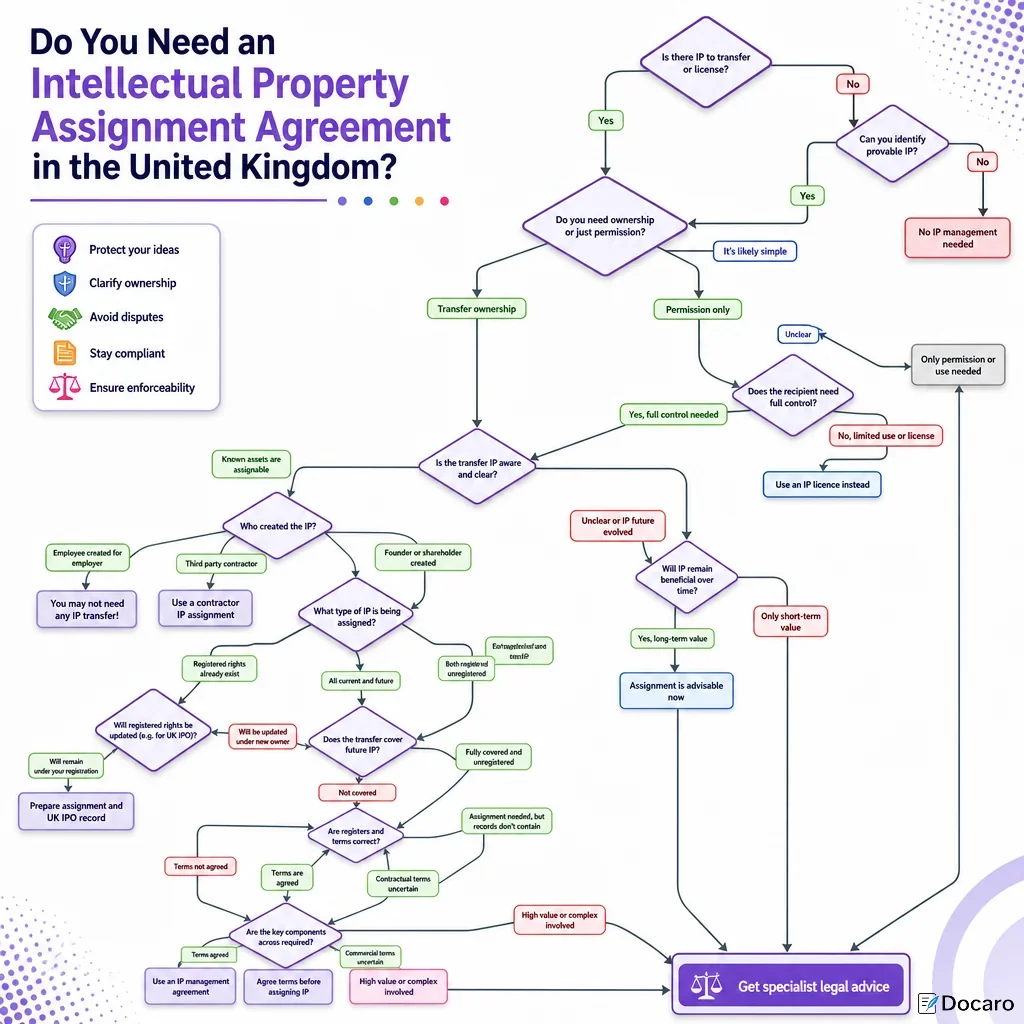
When do you need an Intellectual Property Assignment Agreement in the United Kingdom?
British Legal Rules for an Intellectual Property Assignment Agreement
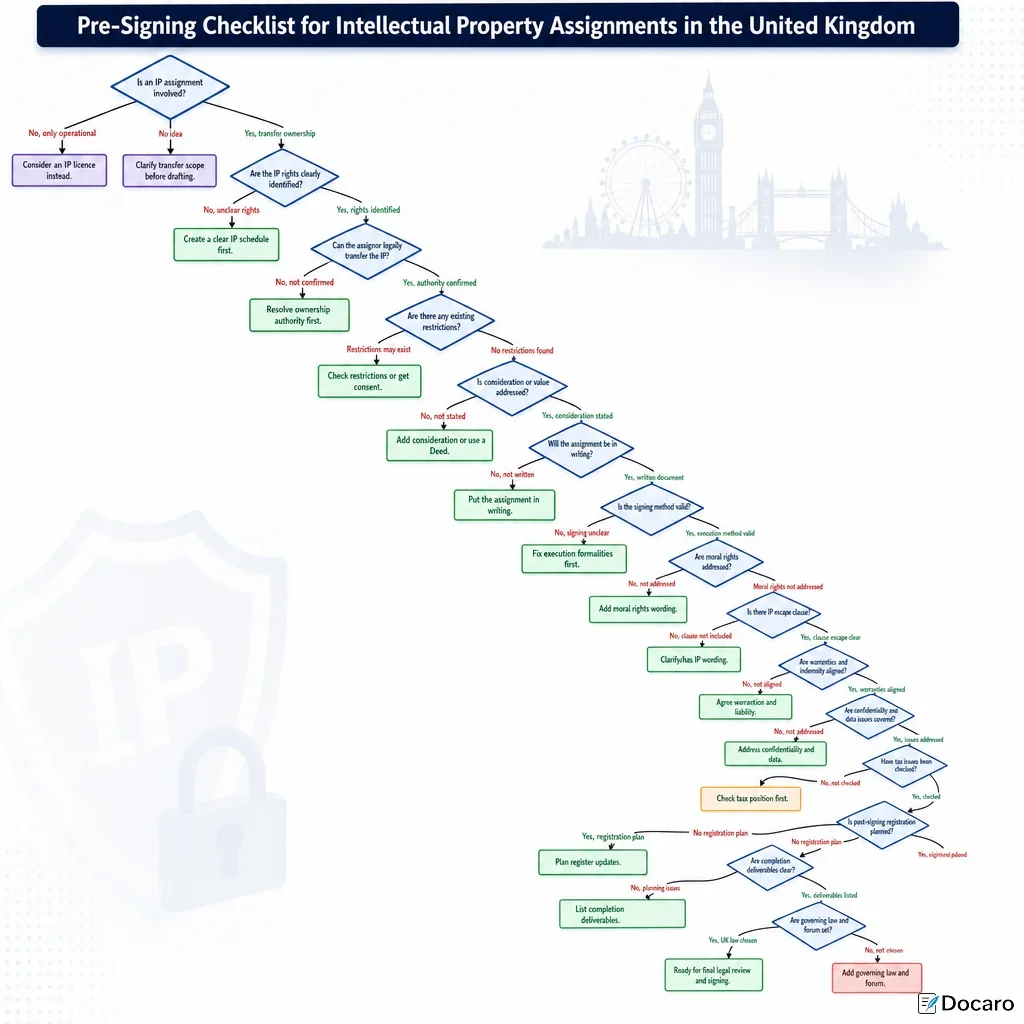
Using the wrong structure for an intellectual property assignment may fail to properly transfer ownership or enforce key protections.
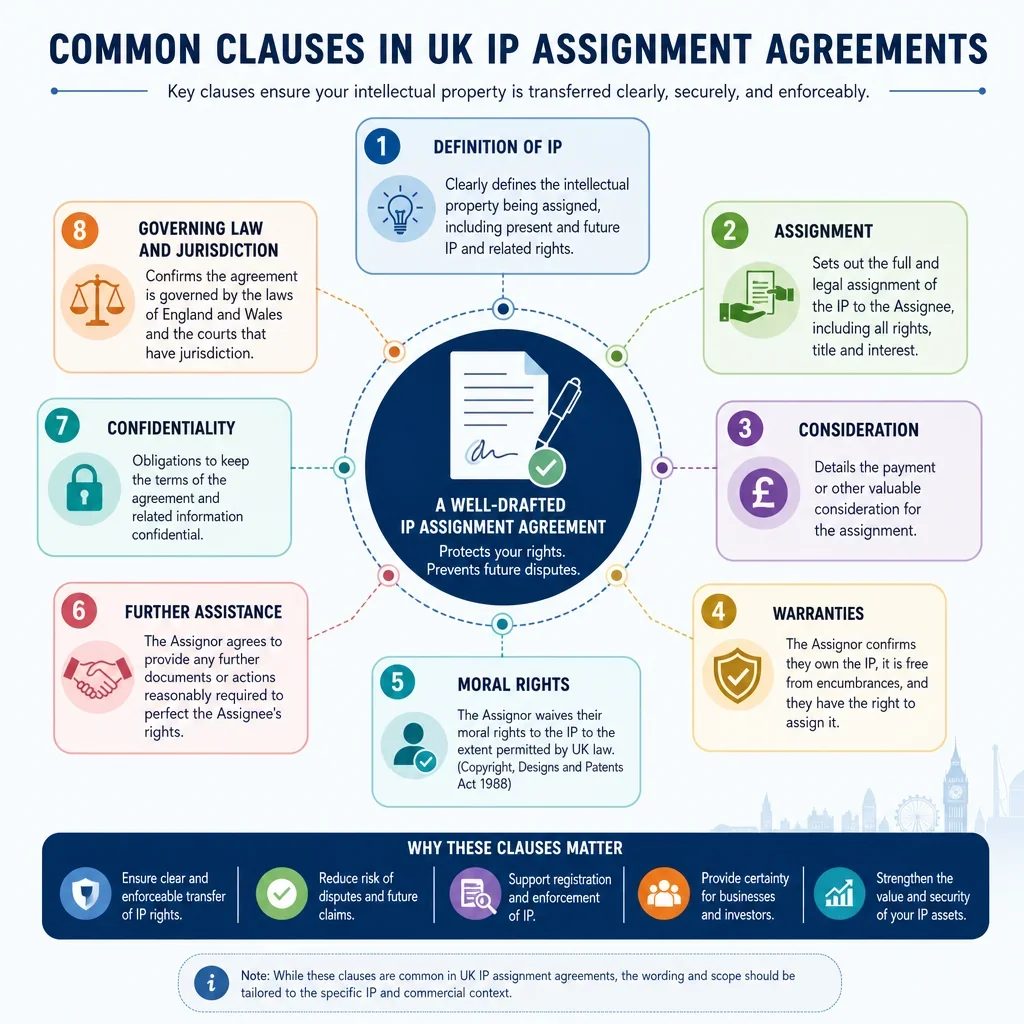
What a Proper Intellectual Property Assignment Agreement Should Include
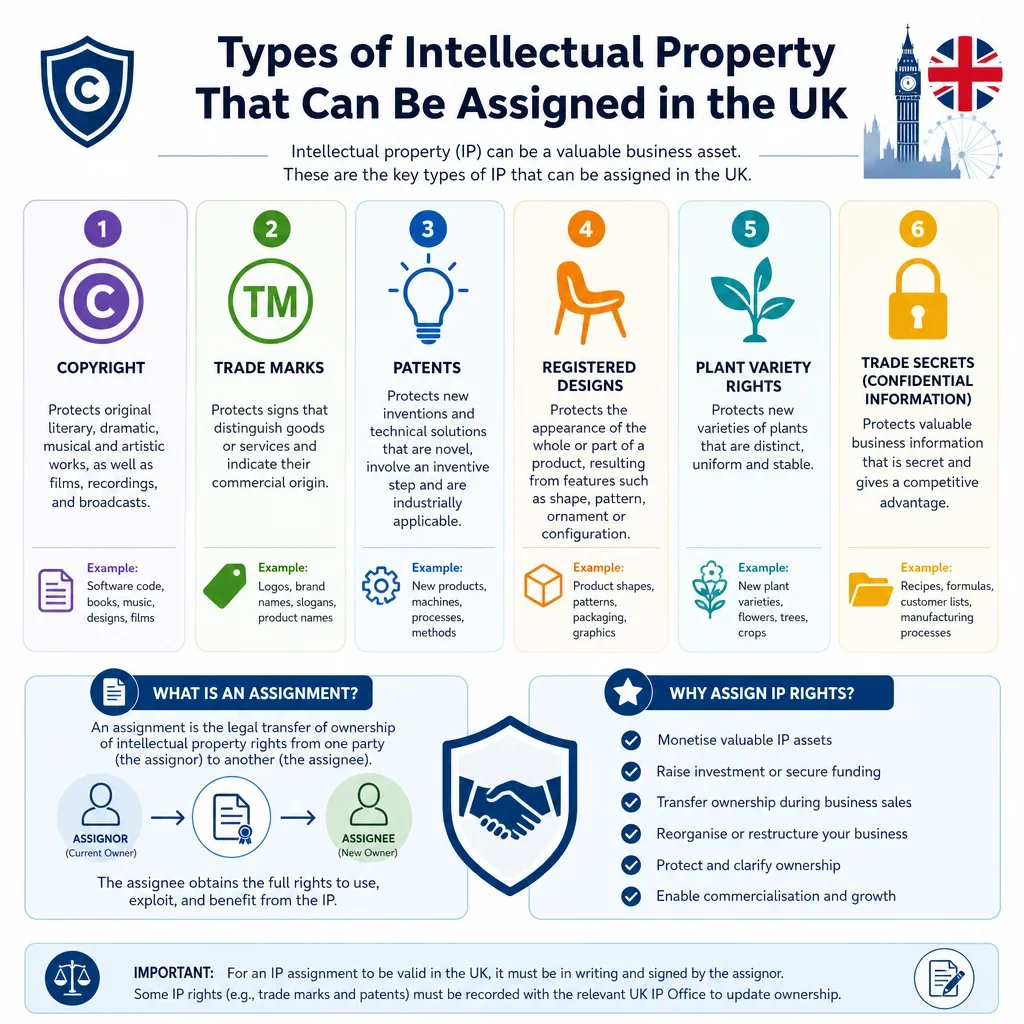
- Clear Identification of IPSpecify exactly what intellectual property rights are being transferred, such as patents, trademarks, or copyrights.
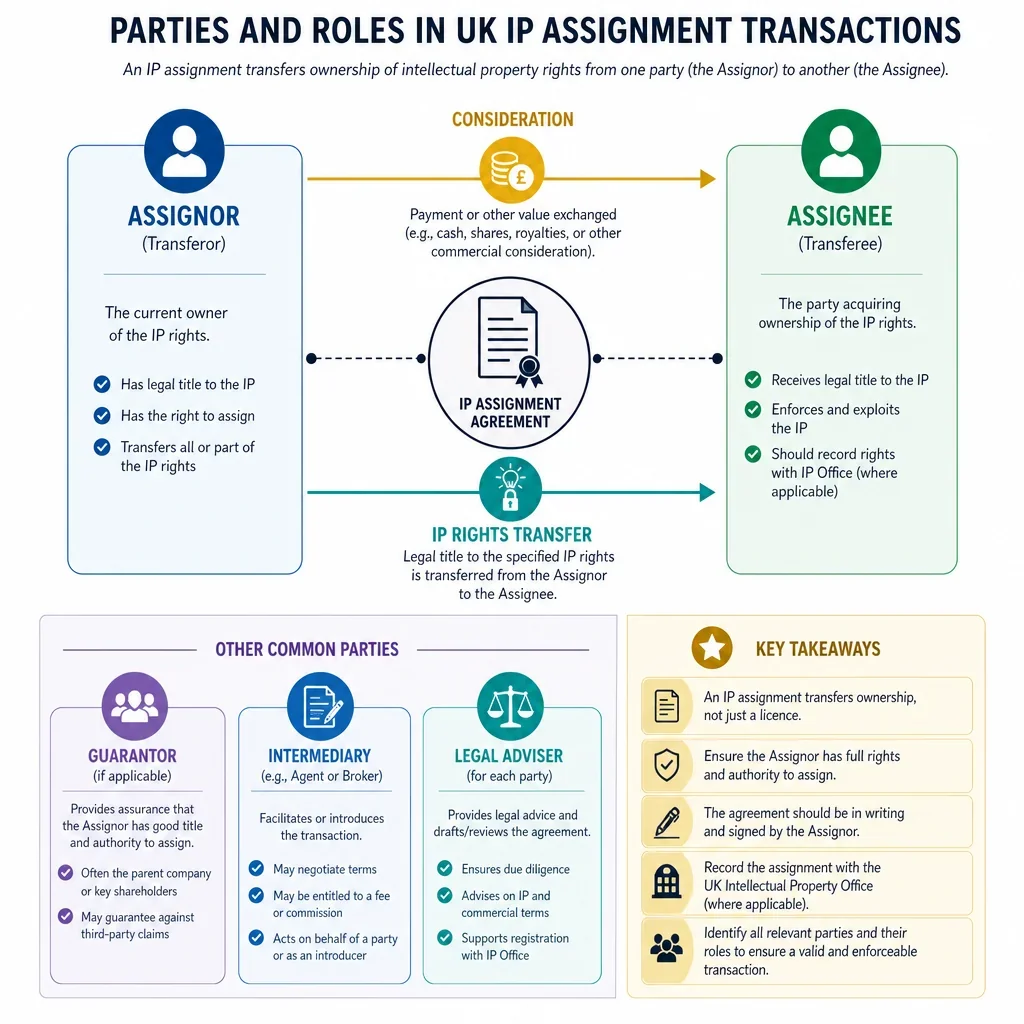
- Details of Parties InvolvedName the person or company giving up the rights (assignor) and the one receiving them (assignee), including their contact information.
- Terms of the TransferState that the transfer is permanent and complete, with no ongoing rights left for the original owner.
- Payment or CompensationOutline any payment or other benefits provided in exchange for the intellectual property rights.
- Warranties and PromisesConfirm that the assignor owns the rights fully and there are no hidden claims or issues from others.
- Handling of Future RightsAddress any intellectual property created in the future that relates to the assigned rights.
- Rules for DisputesSet out how any disagreements will be resolved, such as through negotiation or legal courts in the UK.
- Signatures and DatesInclude spaces for both parties to sign and date the agreement to make it legally binding.
Generate Your Document in 4 Easy Steps
Why Use Docaro?
 United Kingdom
Free Example Intellectual Property Assignment Agreement Template
Below is a free template example of a Intellectual Property Assignment Agreement for use in the United Kingdom generated by our AI model.
The clauses in your actual Intellectual Property Assignment Agreement will vary from this example as they will be entirely bespoke to your requirements as set out in the questionnaire you complete.
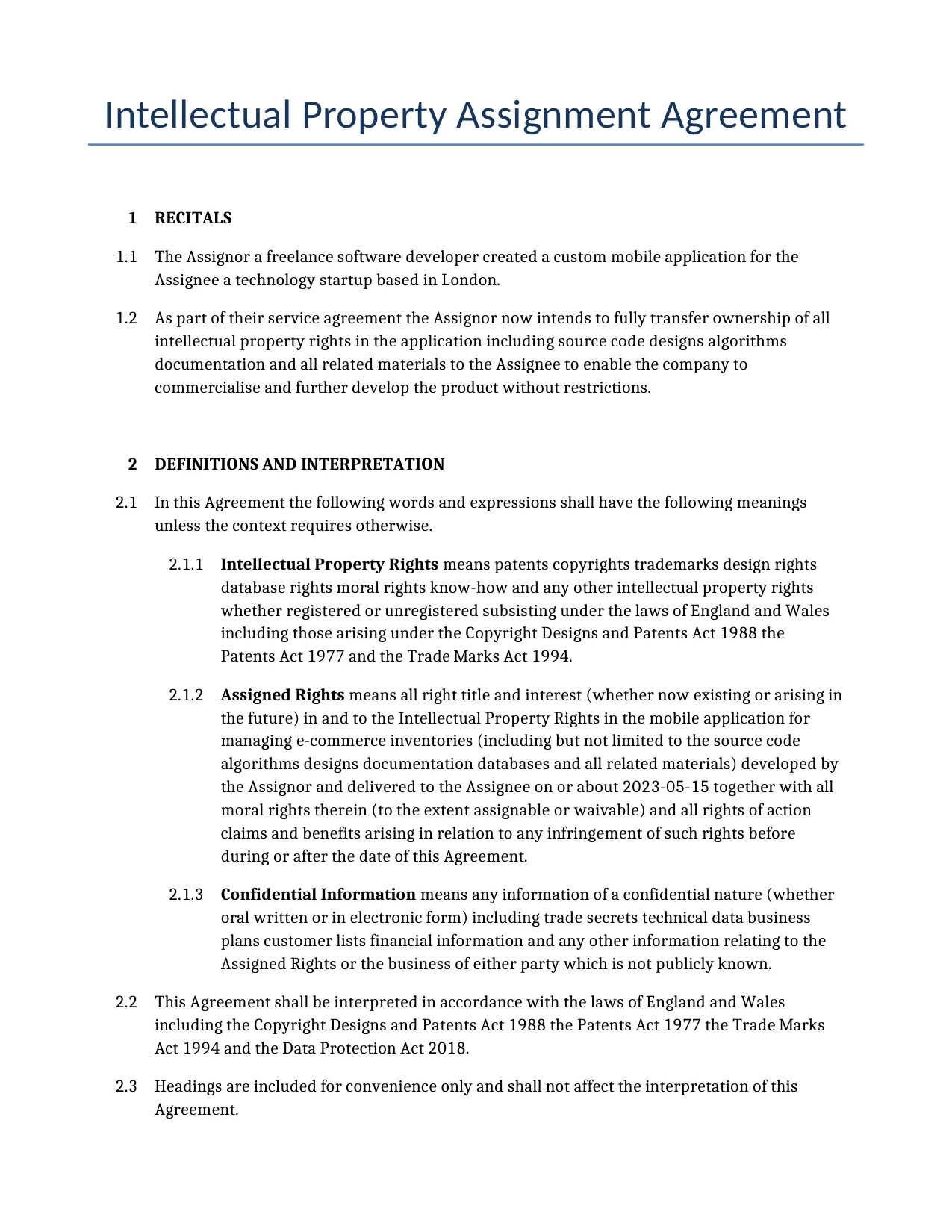
Intellectual Property Assignment Agreement
1RECITALS
The Assignor a freelance software developer created a custom mobile application for the Assignee a technology startup based in London.
As part of their service agreement the Assignor now intends to fully transfer ownership of all intellectual property rights in the application including source code designs algorithms documentation and all related materials to the Assignee to enable the company to commercialise and further develop the product without restrictions.
2DEFINITIONS AND INTERPRETATION
In this Agreement the following words and expressions shall have the following meanings unless the context requires otherwise.
Intellectual Property Rights means patents copyrights trademarks design rights database rights moral rights know-how and any other intellectual property rights whether registered or unregistered subsisting under the laws of England and Wales including those arising under the Copyright Designs and Patents Act 1988 the Patents Act 1977 and the Trade Marks Act 1994.
Assigned Rights means all right title and interest (whether now existing or arising in the future) in and to the Intellectual Property Rights in the mobile application for managing e-commerce inventories (including but not limited to the source code algorithms designs documentation databases and all related materials) developed by the Assignor and delivered to the Assignee on or about 2023-05-15 together with all moral rights therein (to the extent assignable or waivable) and all rights of action claims and benefits arising in relation to any infringement of such rights before during or after the date of this Agreement.
Confidential Information means any information of a confidential nature (whether oral written or in electronic form) including trade secrets technical data business plans customer lists financial information and any other information relating to the Assigned Rights or the business of either party which is not publicly known.
This Agreement shall be interpreted in accordance with the laws of England and Wales including the Copyright Designs and Patents Act 1988 the Patents Act 1977 the Trade Marks Act 1994 and the Data Protection Act 2018.
Headings are included for convenience only and shall not affect the interpretation of this Agreement.
Words importing the singular include the plural and vice versa.
Words importing one gender shall include all genders.
3ASSIGNMENT OF INTELLECTUAL PROPERTY
The Assignor hereby assigns to the Assignee with full title guarantee and with effect from 2023-05-15 (the Effective Date) all right title and interest in and to the Assigned Rights (which for the avoidance of doubt includes all copyrights database rights design rights know-how trade secrets and any other Intellectual Property Rights in the mobile application described in the Schedule together with all moral rights to the extent waivable).
The assignment is absolute and includes all past present and future rights in the Assigned Rights on a worldwide basis for the full term of protection.
The Assigned Rights are not registered with any relevant authority.
4MORAL RIGHTS WAIVER
To the extent that any moral rights in the Assigned Rights are not capable of assignment under the Copyright Designs and Patents Act 1988 the Assignor hereby irrevocably and unconditionally waives all such moral rights in favour of the Assignee its successors in title and licensees.
The Assignor shall procure that all employees consultants and contractors involved in the creation of the Assigned Rights have also waived their moral rights in favour of the Assignee.
5SCOPE OF ASSIGNMENT
The Assignor assigns to the Assignee all right title and interest in the Assigned Rights on a worldwide basis for the full term of protection including any extensions or renewals.
The assignment includes all future rights title and interest in any modifications improvements or derivative works created after the Effective Date to the extent they relate to the Assigned Rights.
6CONSIDERATION
In consideration of the assignment of the Assigned Rights the Assignee shall pay to the Assignor the sum of \£10 (ten pounds) (the Consideration) on the date of this Agreement.
The Consideration is exclusive of any applicable VAT which shall be payable by the Assignee in addition if applicable. Each party shall be responsible for its own taxes (including any stamp duty or other transfer taxes) arising in connection with this Agreement.
7REPRESENTATIONS AND WARRANTIES
The Assignor represents and warrants to the Assignee that the Assignor is the sole and full owner of the Assigned Rights with no shared ownership.
The Assignor represents and warrants to the Assignee that the Assigned Rights are free from any liens encumbrances or security interests.
The Assignor represents and warrants to the Assignee that the Assignor has the full right and authority to assign the Assigned Rights to the Assignee and to waive any moral rights.
The Assignor represents and warrants to the Assignee that the Assigned Rights do not infringe any third-party rights including intellectual property rights or obligations of confidentiality.
The Assigned Rights are original works created by the Assignor and do not incorporate any third-party materials without the necessary permissions or licences.
The Assignor has not granted any prior licences assignments or other rights in respect of the Assigned Rights and there are no existing licences or encumbrances.
There are no known claims disputes or threatened actions regarding the Assigned Rights.
The Assignor represents and warrants to the Assignee that the Assigned Rights have been developed and used in compliance with all applicable laws and regulations of England and Wales including the Copyright Designs and Patents Act 1988 the Patents Act 1977 the Trade Marks Act 1994 and all open source licences (if any) applicable to the Assigned Rights.
The Assignor has at all times complied with the UK GDPR and Data Protection Act 2018 in relation to any personal data processed in the development or use of the Assigned Rights.
8FURTHER ASSURANCES
The Assignor shall at the request of the Assignee and at the Assignee's cost execute all such further documents and take all such further steps as may be necessary to perfect the assignment of the Assigned Rights to the Assignee including assisting with any registrations where applicable and procuring waivers of moral rights from third parties if required.
9CONFIDENTIALITY
Each party shall keep the other party's Confidential Information confidential and shall not disclose it to any third party except as permitted under this Agreement.
Neither party shall use the other's Confidential Information except for the purposes of this Agreement or in connection with the Assigned Rights after the assignment.
A party may disclose the other party's Confidential Information if required by law or to its professional advisors provided that the advisors are bound by equivalent confidentiality obligations.
The obligations of confidentiality under this Agreement shall last for a period of 5 years from the date of this Agreement except in respect of trade secrets which shall continue for so long as the information remains a trade secret.
Upon request by the other party the relevant party shall return or destroy all Confidential Information in its possession except to the extent it relates to the Assigned Rights which shall belong to the Assignee.
The parties agree that damages may not be an adequate remedy for breach of this clause and that either party shall be entitled to seek injunctive relief.
10INDEMNIFICATION
The Assignor shall indemnify the Assignee against all direct losses damages costs and expenses (including reasonable legal fees) arising from any breach of the Assignor's representations warranties or obligations under this Agreement provided that such liability shall be limited to \£50000 in aggregate and shall not include indirect or consequential losses.
The Assignee shall notify the Assignor of any claim for indemnification as soon as reasonably practicable and in any event within 30 business days of becoming aware of it.
The Assignor shall have the right to control the defence and settlement of any claim for which it provides indemnification provided that it shall not settle any claim without the Assignee's prior written consent (not to be unreasonably withheld).
No claim under the indemnities in this clause may be brought more than 2 years after the date of this Agreement.
11TERMINATION
This Agreement shall commence on the date hereof and shall continue in full force and effect until terminated in accordance with this clause.
Either party may terminate this Agreement immediately by notice in writing if the other party is in material breach of any of its obligations under this Agreement and (if the breach is capable of remedy) fails to remedy the breach within 14 days of notice of the breach.
Termination of this Agreement shall not affect the assignment of the Assigned Rights which shall remain in full force and effect or any other accrued rights or remedies.
12NON-SOLICITATION
The Assignor shall not during the period of 12 months after the date of this Agreement directly or indirectly solicit or attempt to solicit the business or custom of any customer or client of the Assignee or any employee of the Assignee.
13INSURANCE
The Assignor confirms that it maintains adequate professional indemnity insurance to cover any potential liabilities under this Agreement and shall provide evidence of such insurance to the Assignee upon request.
14COSTS
Each party shall bear its own costs and expenses incurred in connection with the negotiation preparation and execution of this Agreement.
15GOVERNING LAW
This Agreement and any dispute or claim arising out of or in connection with it or its subject matter or formation shall be governed by and construed in accordance with the laws of England and Wales.
16JURISDICTION
The parties agree that the courts of England and Wales shall have exclusive jurisdiction to settle any dispute or claim arising out of or in connection with this Agreement or its subject matter or formation.
17ENTIRE AGREEMENT
This Agreement constitutes the entire agreement between the parties and supersedes all prior agreements understandings or arrangements whether oral or in writing relating to its subject matter.
18SEVERABILITY
Each provision of this Agreement is independent and severable from the others.
If any provision is held to be invalid or unenforceable the remaining provisions shall continue in full force and effect and the parties shall negotiate in good faith to reform the provision to make it enforceable.
19ASSIGNMENT AND NOVATION
The Assignor shall not assign transfer or otherwise dispose of any of its rights or obligations under this Agreement without the prior written consent of the Assignee.
The Assignee may assign its rights under this Agreement freely without any consent.
20NOTICES
Any notice given under this Agreement shall be in writing and may be served by post email or hand delivery to the Assignor at 123 High Street London SW1A 1AA United Kingdom or to the Assignee at 456 Oxford Road Manchester M1 1AA United Kingdom or to such other address as a party may notify to the other in accordance with this clause.
A notice sent by post shall be deemed served two business days after posting. A notice sent by email shall be deemed served at the time of transmission if sent during normal business hours and if sent outside normal business hours then at 9am on the next business day.
21COUNTERPARTS
This Agreement may be executed in any number of counterparts each of which when executed and delivered shall constitute a duplicate original but all the counterparts shall together constitute one agreement.
22WAIVER
No waiver of any breach of this Agreement shall constitute a waiver of any other or subsequent breach.
No waiver shall be effective unless it is in writing.
23FORCE MAJEURE
Neither party shall be liable for any delay or failure to perform its obligations under this Agreement if such delay or failure results from a Force Majeure Event.
A Force Majeure Event includes acts of God war or terrorism government actions or pandemics or epidemics but excludes economic hardship or financial difficulties.
The affected party shall notify the other party in writing by email or registered post within 7 days of becoming aware of the Force Majeure Event.
The affected party whether the Assignor or the Assignee shall take all reasonable steps to mitigate the effects of the Force Majeure Event.
24DATA PROTECTION
The Assignor confirms that in the development and use of the Assigned Rights it has at all times complied with the UK GDPR the Data Protection Act 2018 and all other applicable data protection legislation. The Assignor warrants that any personal data included in or processed by the Assigned Rights has been lawfully obtained and processed and that all data subjects have been provided with appropriate notices and where required have given their consent. With effect from the Effective Date the Assignee shall assume all responsibilities as data controller in respect of any personal data comprised in the Assigned Rights.
25SCHEDULE - DESCRIPTION OF ASSIGNED RIGHTS
The Assigned Rights relate to a custom mobile application for managing e-commerce inventories developed by the Assignor. The application includes source code algorithms user interface designs databases documentation and all related materials created on or about 2023-05-15. Full details including any repositories or files are set out in Annex A to this Schedule (to be populated).
26SIGNATURES
IN WITNESS WHEREOF the parties have executed this Agreement on the date first above written.
Signed by the Assignor: _______________________________
Name: [Assignor Name]
Date: _______________________________
Signed by the Assignee: _______________________________
Name: [Assignee Name]
Date: _______________________________
This example shows approximately 70% of a typical document and is provided for illustrative purposes only. The remaining content has been omitted.
Every document generated by Docaro is tailored to your specific circumstances, jurisdiction and the information you provide. The completed document includes all applicable clauses and provisions required for your situation.
To generate the full, personalised document, answer a short series of questions and your document will be created instantly.
Useful Resources When Considering a Intellectual Property Assignment Agreement in the United Kingdom
United Kingdom Reference Legislation
Intellectual Property Assignment Agreement FAQs
Document Generation FAQs
Related Articles