AI Generated British Commercial Lease Renewal Agreement
PDF & Word - 2026 Updated
Docaro Pricing
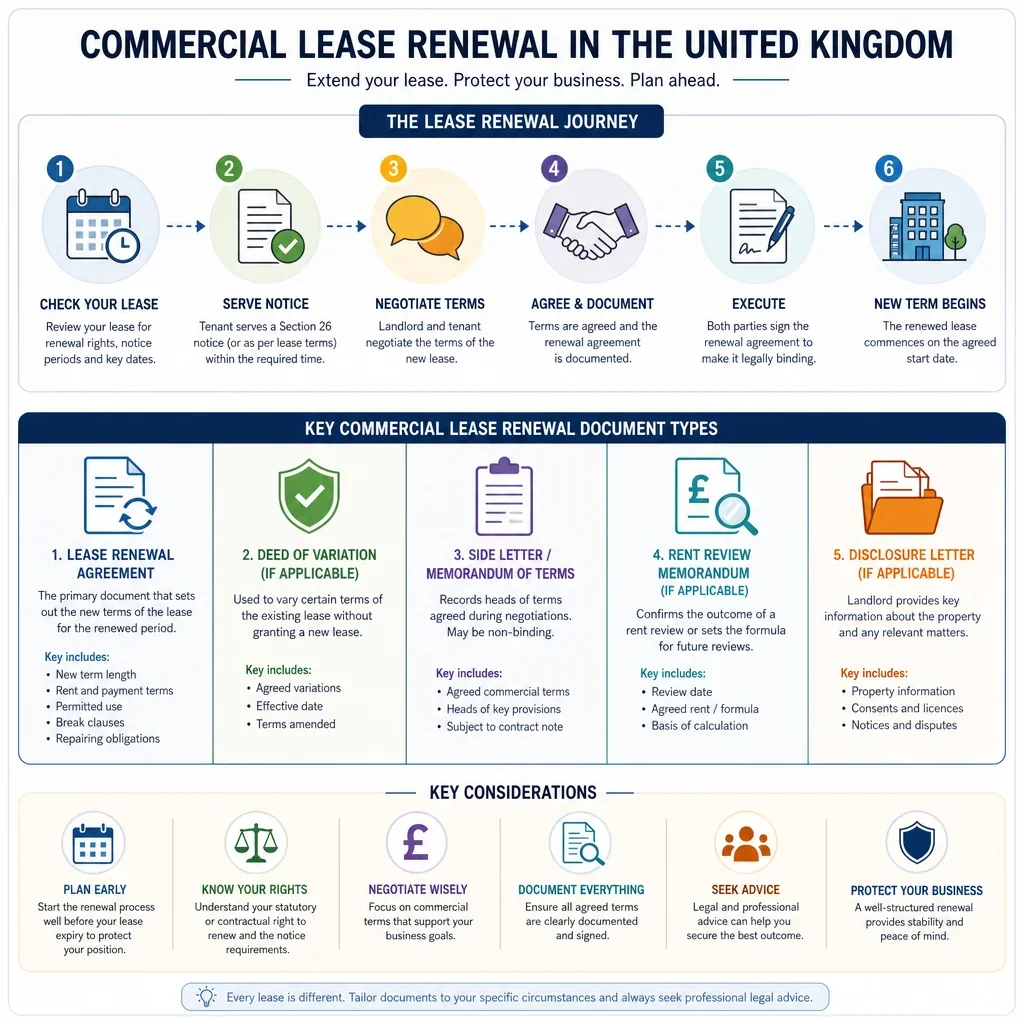
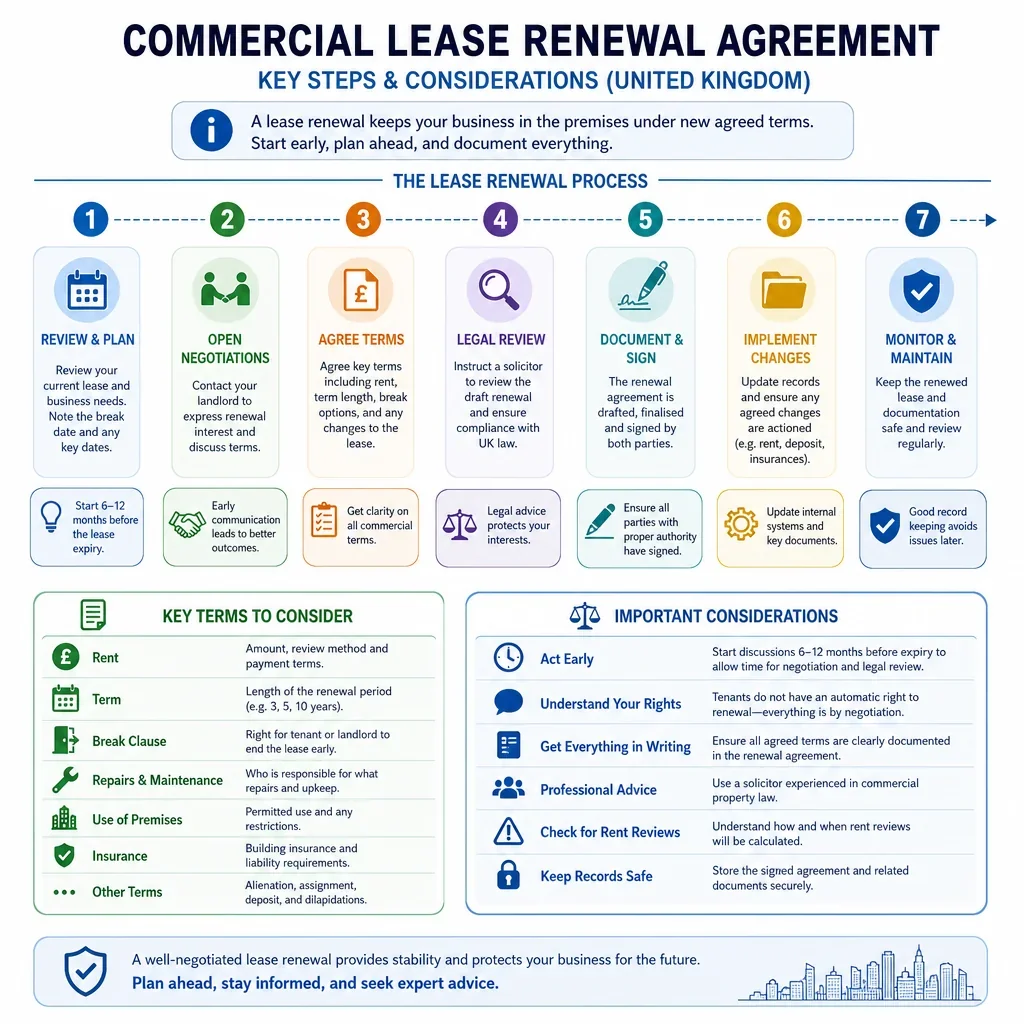
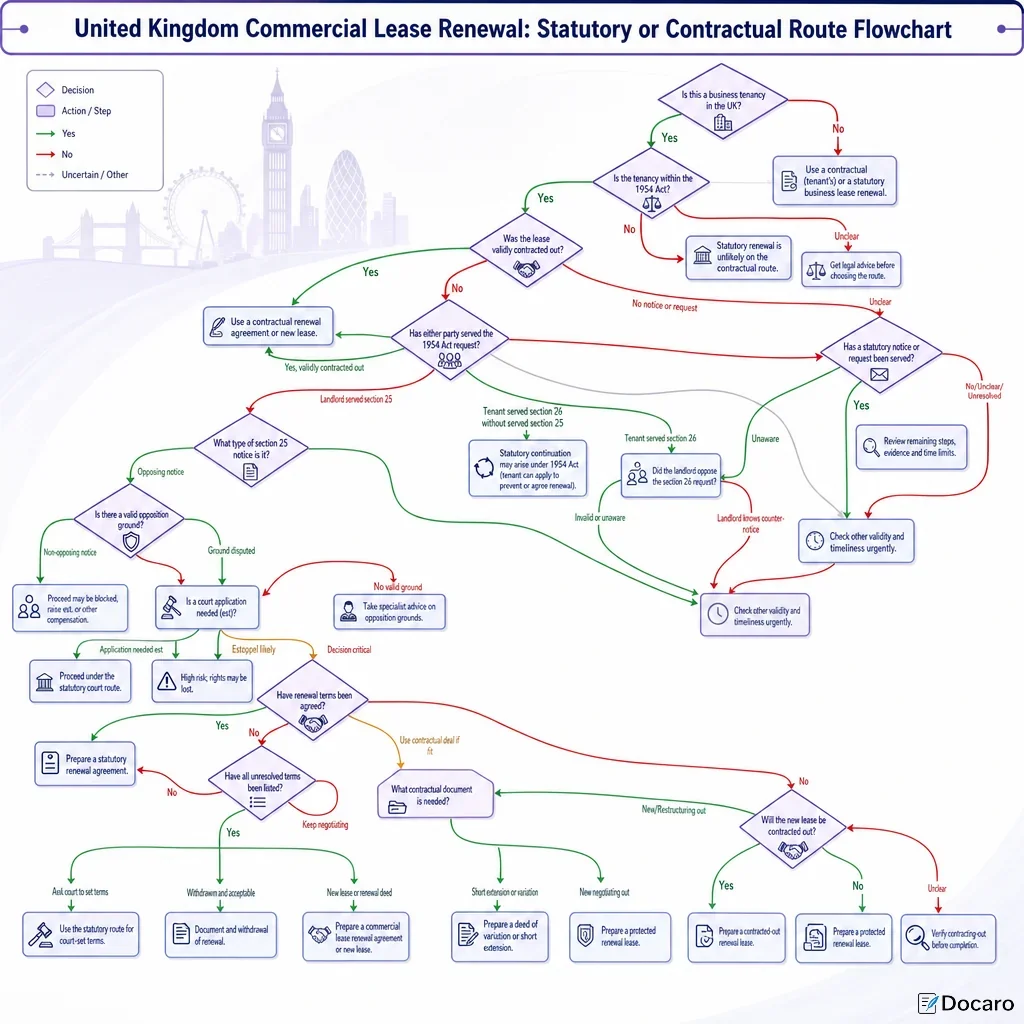
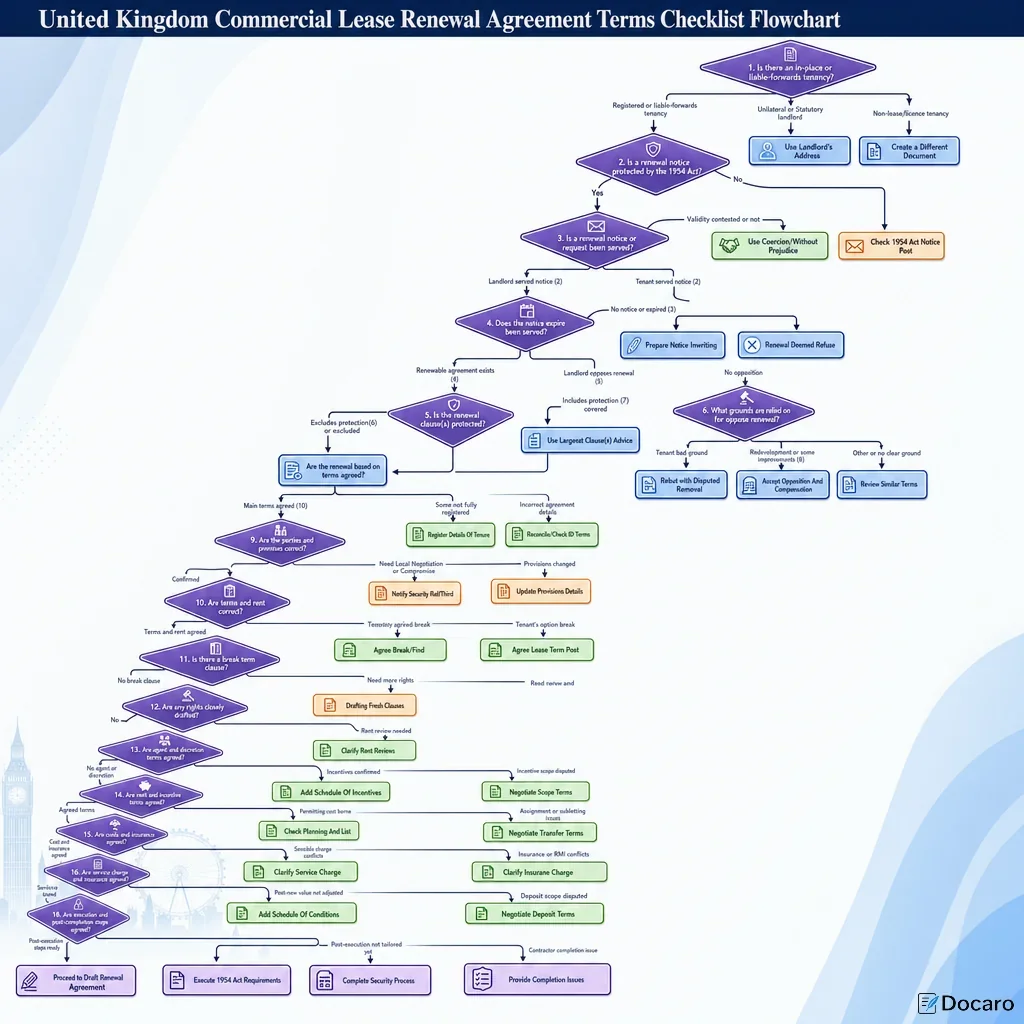
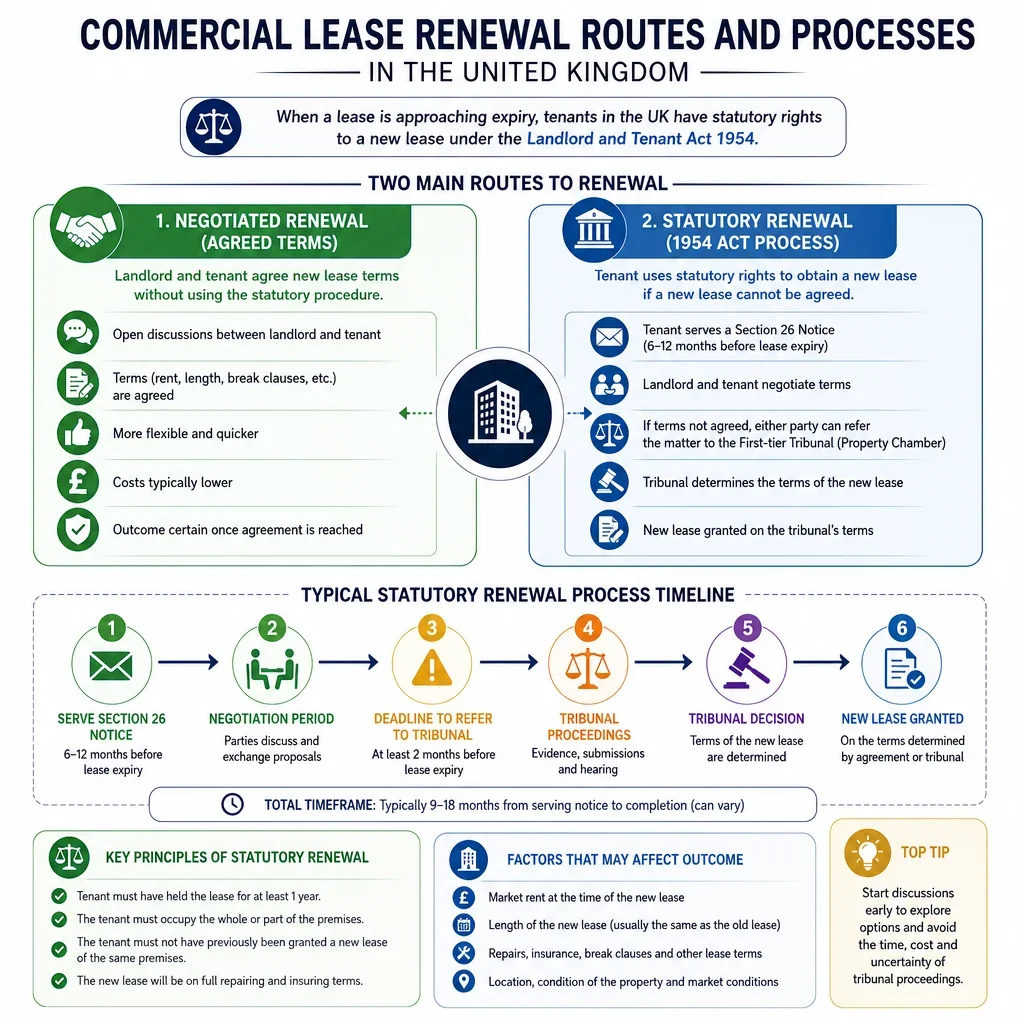
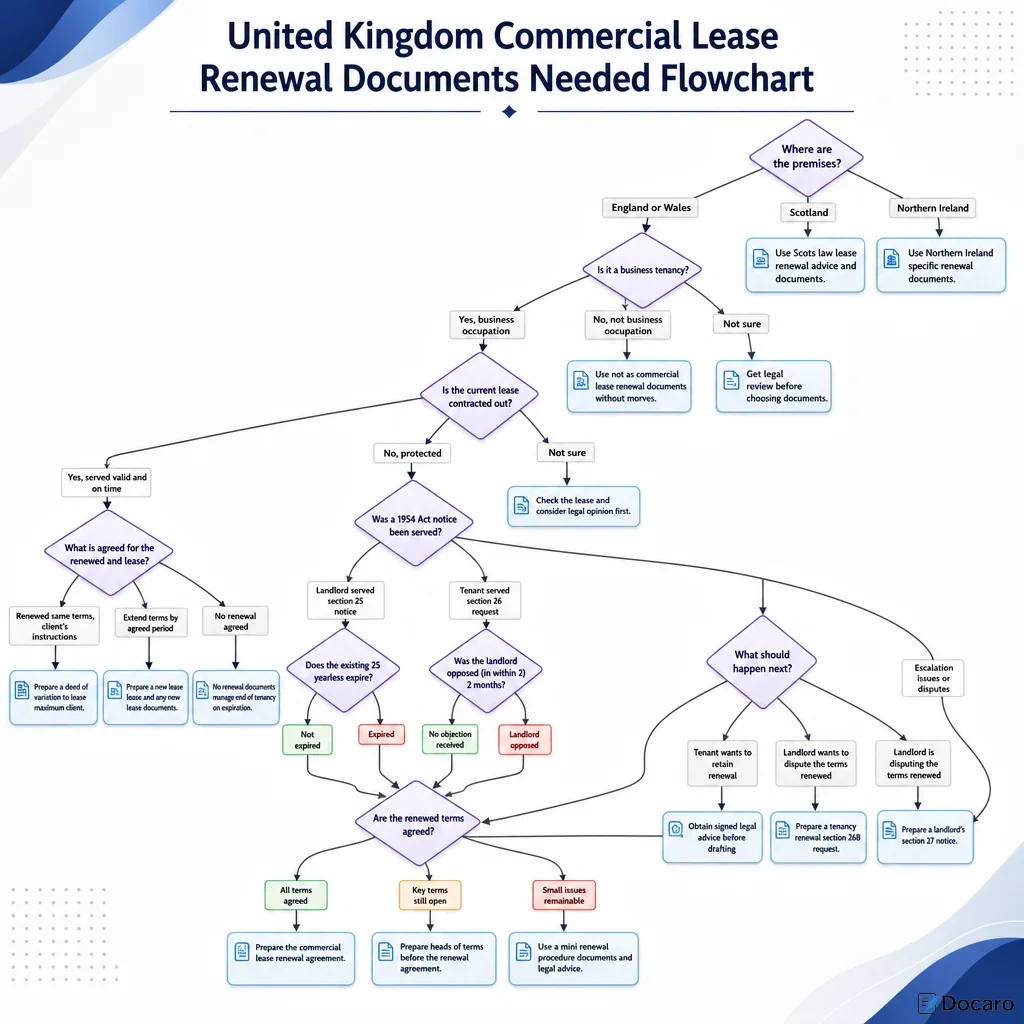
When do you need a Commercial Lease Renewal Agreement in the United Kingdom?
British Legal Rules for a Commercial Lease Renewal Agreement
Using the wrong structure for a commercial lease renewal can inadvertently create unintended renewal rights or obligations.
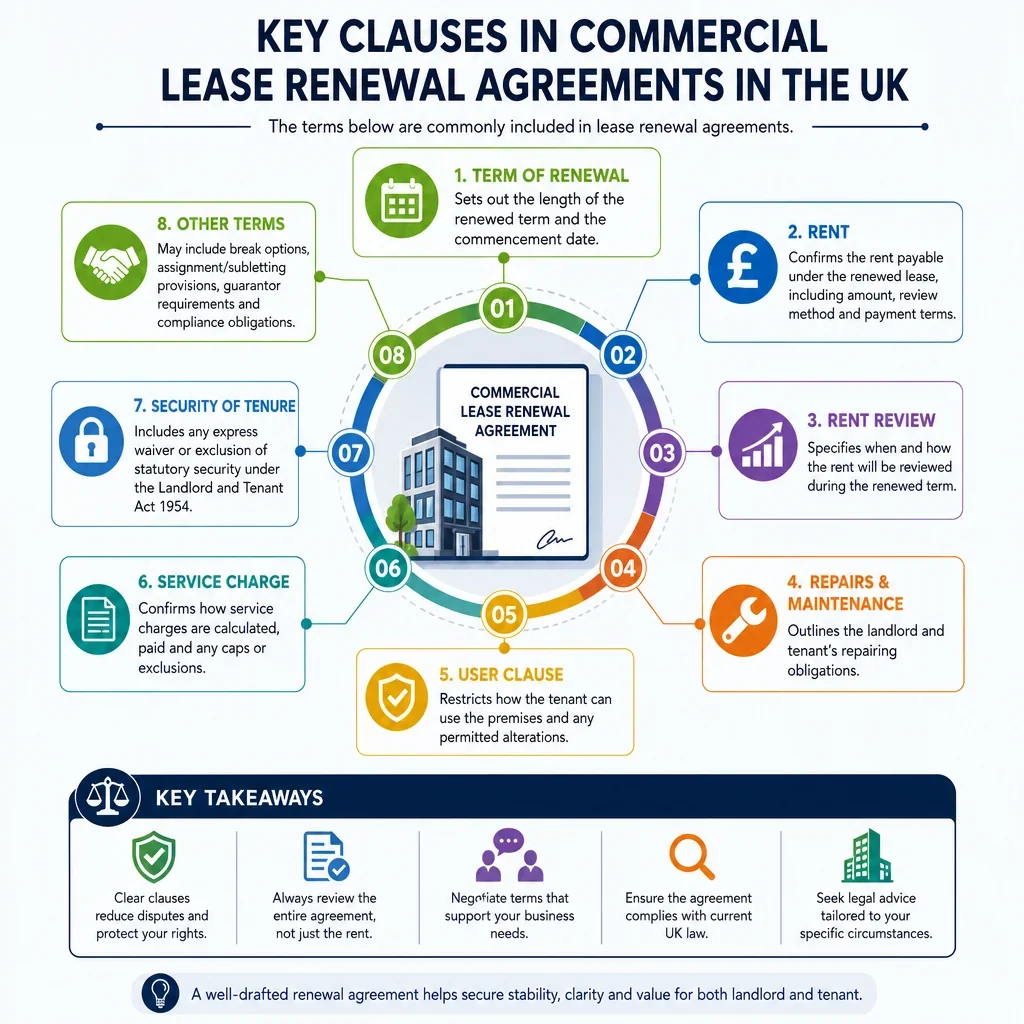
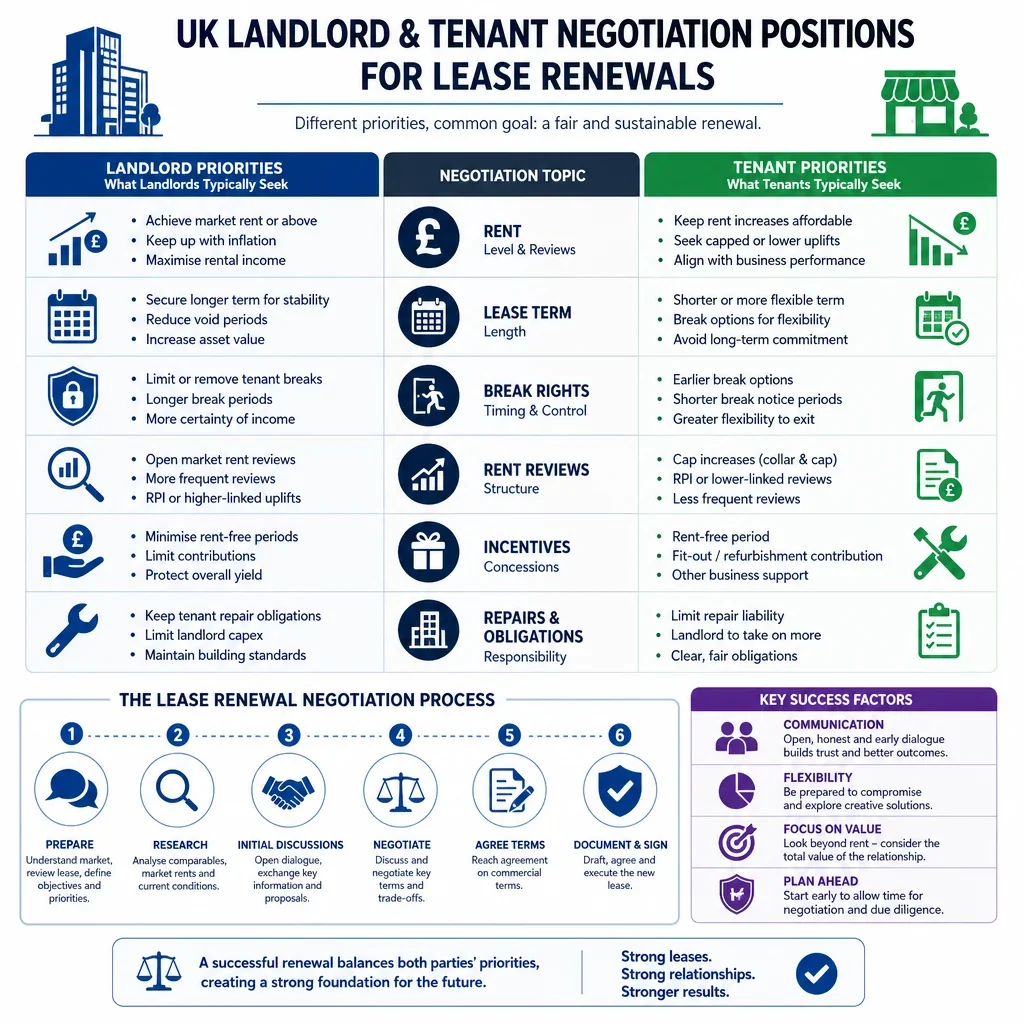
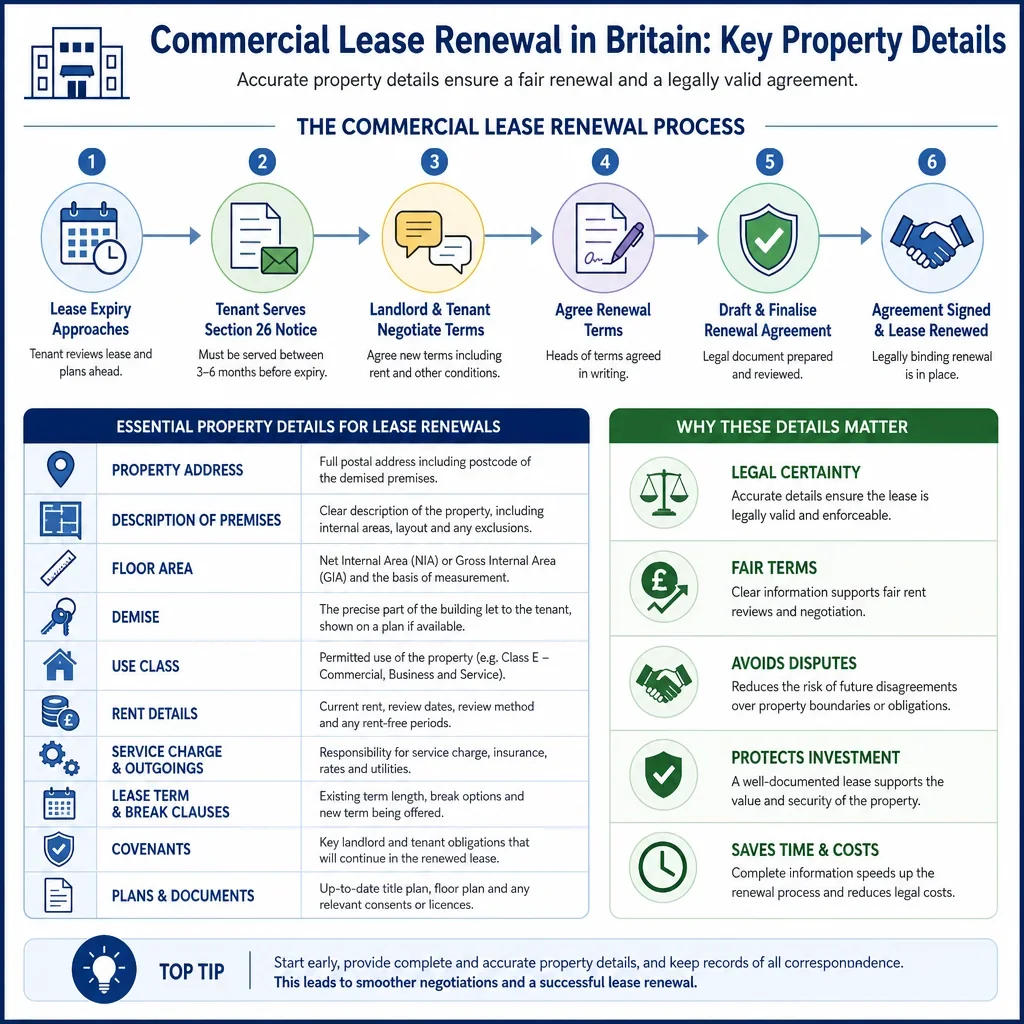
What a Proper Commercial Lease Renewal Agreement Should Include
- Renewal Term DetailsClearly state the length of the new lease period and the start date to set the renewal duration.
- Rent Amount and IncreasesSpecify the new rent price and any planned increases over time to outline financial obligations.
- Property Condition and RepairsDescribe the expected state of the property at renewal and who handles maintenance responsibilities.
- Service Charges and CostsDetail any additional fees for shared building services and how they will be shared or paid.
- Usage PermissionsConfirm what the property can be used for and any restrictions on business activities.
- Termination OptionsOutline conditions under which the lease can end early and required notice periods.
- Legal ComplianceEnsure the agreement follows UK laws, including health, safety, and environmental rules.
Generate Your Document in 4 Easy Steps
Why Use Docaro?
 United Kingdom
Free Example Commercial Lease Renewal Agreement Template
Below is a free template example of a Commercial Lease Renewal Agreement for use in the United Kingdom generated by our AI model.
The clauses in your actual Commercial Lease Renewal Agreement will vary from this example as they will be entirely bespoke to your requirements as set out in the questionnaire you complete.
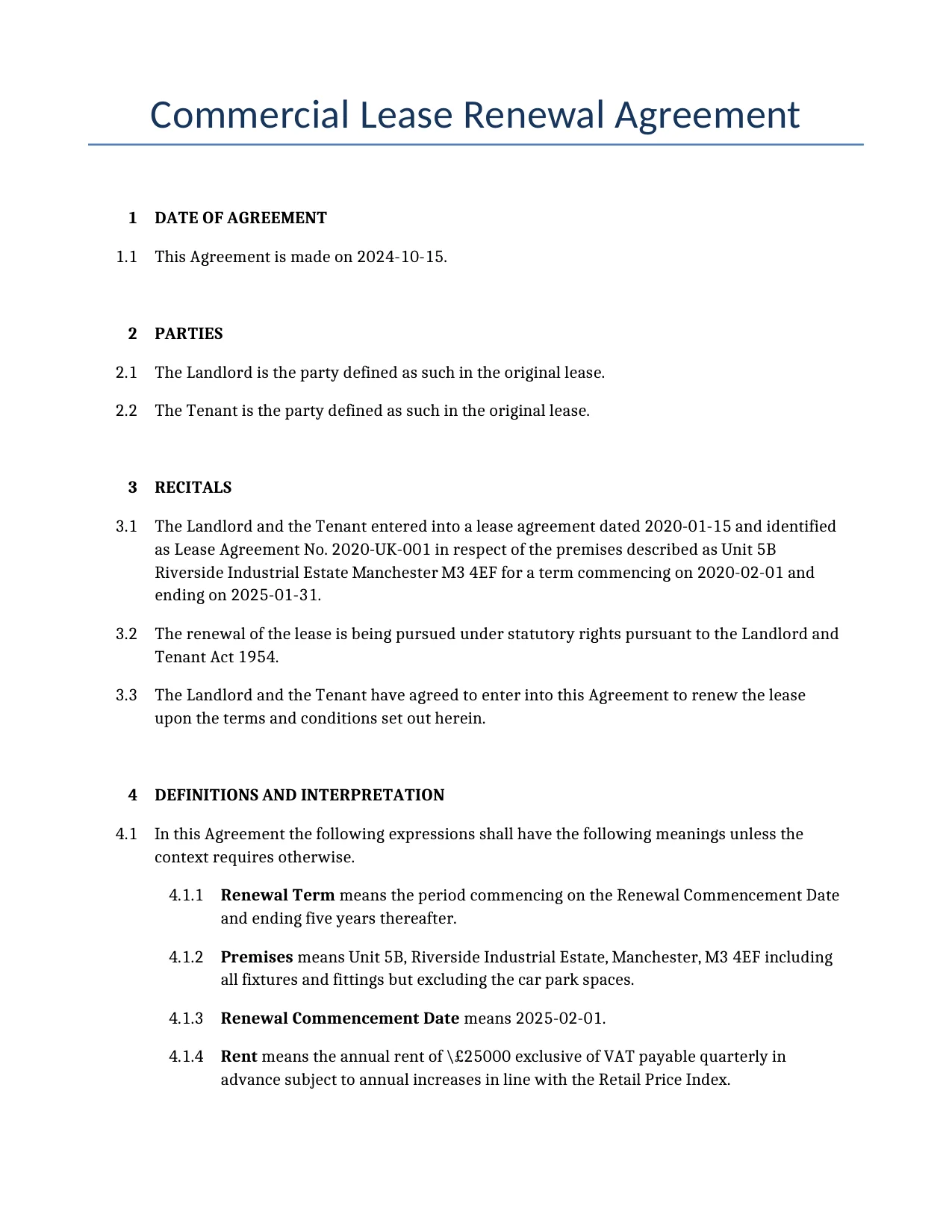
Commercial Lease Renewal Agreement
1DATE OF AGREEMENT
This Agreement is made on 2024-10-15.
2PARTIES
The Landlord is the party defined as such in the original lease.
The Tenant is the party defined as such in the original lease.
3RECITALS
The Landlord and the Tenant entered into a lease agreement dated 2020-01-15 and identified as Lease Agreement No. 2020-UK-001 in respect of the premises described as Unit 5B Riverside Industrial Estate Manchester M3 4EF for a term commencing on 2020-02-01 and ending on 2025-01-31.
The renewal of the lease is being pursued under statutory rights pursuant to the Landlord and Tenant Act 1954.
The Landlord and the Tenant have agreed to enter into this Agreement to renew the lease upon the terms and conditions set out herein.
4DEFINITIONS AND INTERPRETATION
In this Agreement the following expressions shall have the following meanings unless the context requires otherwise.
Renewal Term means the period commencing on the Renewal Commencement Date and ending five years thereafter.
Premises means Unit 5B, Riverside Industrial Estate, Manchester, M3 4EF including all fixtures and fittings but excluding the car park spaces.
Renewal Commencement Date means 2025-02-01.
Rent means the annual rent of \£25000 exclusive of VAT payable quarterly in advance subject to annual increases in line with the Retail Price Index.
Permitted Use means operating a retail coffee shop with ancillary storage.
1954 Act means the Landlord and Tenant Act 1954.
The headings in this Agreement are for reference only and shall not affect its interpretation.
Words importing the singular shall include the plural and vice versa.
Words importing any gender shall include all genders.
The renewed lease is inside the security of tenure provisions of the 1954 Act.
5RENEWAL OF LEASE TERM
The Landlord and the Tenant agree that the lease of the Premises shall be renewed for the term commencing on the Renewal Commencement Date and expiring five years thereafter.
The renewed lease shall incorporate all the terms of the original lease except as varied by this Agreement.
6RENEWAL RENT AND REVIEW
The initial annual rent payable under this Agreement shall be \£25000 exclusive of VAT.
The rent shall be reviewed on the fifth anniversary of the Renewal Commencement Date in accordance with the provisions of this clause.
The rent review shall be conducted on the basis of open market rent.
The rent review shall be upwards only and the rent shall not decrease as a result of any review.
The reviewed rent shall be the higher of the Rent payable immediately before the review and the open market rent.
The open market rent shall be the rent at which the Premises might reasonably be expected to be let in the open market at the review date on the assumptions that: (a) the Premises are available to let on the terms of this lease (other than the amount of rent); (b) the term is the residue of the term at the review date; (c) the Tenant has complied with all its covenants in this lease; and (d) there is no discount for a rent free period or other inducement.
Either party may serve notice on the other requiring the rent to be determined.
If the parties cannot agree the reviewed rent within three months of the review date either party may apply to the President of the Royal Institution of Chartered Surveyors for the appointment of an independent arbitrator.
The arbitrator shall act as an arbitrator in accordance with the Arbitration Act 1996.
The costs of the arbitrator shall be in the discretion of the arbitrator.
7TENANT COVENANTS
The Tenant covenants with the Landlord to pay the rent reserved by the lease on the due dates during the renewed term.
The Tenant covenants with the Landlord to pay all outgoings such as rates taxes and charges attributable to the Premises during the renewed term.
The Tenant covenants with the Landlord to maintain and repair the non-structural parts of the Premises in good condition during the renewed term.
The Tenant covenants with the Landlord to observe and perform all other terms of the lease during the renewed term.
The Tenant covenants with the Landlord not to assign sublet or part with possession of the Premises without the prior consent of the Landlord during the renewed term.
The Tenant covenants with the Landlord that the Premises shall be used only for operating a retail coffee shop with ancillary storage (Class E use under the Town and Country Planning (Use Classes) Order 1987 as amended) and not for any other purpose during the renewed term.
The Tenant covenants with the Landlord to carry out alterations to the Premises only with the prior consent of the Landlord during the renewed term.
The Tenant covenants with the Landlord to allow the Landlord access to the Premises for inspections and repairs during the renewed term.
The Tenant covenants with the Landlord not to cause nuisance or annoyance to the Landlord or neighbouring properties during the renewed term.
8LANDLORD COVENANTS
The Landlord covenants with the Tenant to provide quiet enjoyment of the Premises during the renewed term.
The Landlord covenants with the Tenant to be responsible for structural repairs to the Premises during the renewed term.
The Landlord covenants with the Tenant to comply with all statutory requirements and planning laws affecting the Premises during the renewed term.
9INSURANCE
The Landlord covenants to insure the building of which the Premises form part against the Insured Risks in an amount equal to the full reinstatement value in an insurance office of repute.
The Insured Risks are fire flood storm explosion aircraft and other risks normally insured against.
The Tenant shall pay to the Landlord on demand a fair and reasonable proportion of the insurance premiums.
The Tenant shall insure its own contents fixtures fittings stock and improvements and maintain public liability insurance with a limit of indemnity of not less than \£5,000,000.
The Tenant shall produce to the Landlord on demand evidence of the insurances it is required to maintain.
10SERVICE CHARGE
In addition to the Rent the Tenant shall pay by way of further rent a service charge being a fair and reasonable proportion of the costs incurred by the Landlord in providing the Services.
The Services include maintenance repair and decoration of the common parts of the building insurance premiums management costs and other reasonable expenditure.
The Landlord shall provide the Tenant with an annual budget and certified statement of the service charge costs within three months of the end of each service charge year.
The service charge shall be payable quarterly in advance based on the estimated expenditure with a balancing payment or credit at the end of the year.
11REPAIRS
The lease is a full repairing and insuring lease. The Tenant shall keep the non-structural parts of the Premises in good and substantial repair and condition.
The Landlord shall keep the structure and exterior of the building in good repair.
The Tenant shall carry out all repairs required under this clause at its own cost.
The Tenant shall permit the Landlord to enter the Premises on reasonable notice to inspect and carry out repairs.
12ALTERATIONS AND IMPROVEMENTS
The Tenant shall not carry out any alterations or improvements to the Premises without the prior written consent of the Landlord.
The Landlord's consent for alterations shall not be unreasonably withheld.
The Tenant shall reinstate the Premises to its original condition at the end of the lease term in respect of any alterations made.
The Tenant shall indemnify the Landlord against any claims arising from the Tenant's alterations.
13USE OF THE PROPERTY
The Tenant shall not use the Premises otherwise than for operating a retail coffee shop with ancillary storage (within Class E of the Town and Country Planning (Use Classes) Order 1987 as amended) and not for any other purpose.
The Tenant shall comply with all planning laws and shall not cause the Landlord to be in breach of any planning permissions.
The Tenant shall obtain all necessary consents for its use and any change of use.
14ASSIGNMENT AND SUBLETTING
The Tenant shall be permitted to sublet the whole or part of the Premises.
The lease shall be freely assignable with consent.
The Tenant shall obtain the Landlord's consent before assigning or subletting the lease.
The Landlord's consent for assignment or subletting shall not be unreasonably withheld.
The Tenant shall be permitted to sublet the entire premises or part only.
The Tenant shall not assign or sublet at an undervalue.
The outgoing Tenant shall enter into an Authorised Guarantee Agreement for the assignee in accordance with the Landlord and Tenant (Covenants) Act 1995.
15REGISTRATION OF THE LEASE
The existing title number for the property at the Land Registry is known to the parties.
The full postal address and description of the leased property for registration purposes is Unit 5B, Riverside Industrial Estate, Manchester, M3 4EF a ground floor retail unit with ancillary storage.
The term of the renewed lease is five years.
The Tenant shall register the renewed lease at the Land Registry in accordance with the Land Registration Act 2002 and the Land Registration Rules 2003.
16RIGHTS OF ACCESS
The Landlord shall have the right to access the Premises for the purpose of inspections.
The Landlord shall have the right to access the Premises for the purpose of carrying out repairs.
The Landlord shall have access for the purposes of inspections repairs and maintenance and emergency situations.
The Landlord shall provide a minimum of seven days' notice before accessing the Premises for non-emergency purposes.
The Landlord shall give seven days' notice before entering the Premises for any non-emergency works during the renewed term.
The Landlord shall have access rights for inspections or repairs with 48 hours notice during the renewed term.
17NOTICES
Notices to the Landlord shall be sent to 123 High Street London SW1A 1AA.
Notices to the Tenant shall be sent to 456 Oxford Road Manchester M1 1AA.
Notices sent by first-class post shall be deemed served on the next business day.
Notices may be served by first class post personal delivery or email.
Notices sent by post shall be deemed served two days after posting.
18DISPUTE RESOLUTION
Any dispute arising under this Agreement shall first be referred to mediation.
If mediation fails the dispute shall be referred to expert determination.
If expert determination does not resolve the dispute litigation in the courts shall be the fallback mechanism.
The Tenant shall provide 14 days' notice to the Landlord before initiating dispute resolution.
The Landlord shall have seven days to respond after receiving a dispute notice from the Tenant.
The costs of dispute resolution mechanisms shall be equally shared between the Landlord and the Tenant.
All dispute resolution proceedings shall be confidential.
19COMPLIANCE WITH LAWS
The Tenant shall comply with all applicable laws regulations and planning permissions during the renewal term.
The Tenant shall bear all costs associated with complying with new or amended laws during the renewal term.
The Tenant shall obtain and maintain all necessary planning permissions licences and consents required for their use of the Premises.
20FORCE MAJEURE
Neither the Landlord nor the Tenant shall be liable for failure to perform any obligation under this Agreement if such failure is caused by a force majeure event.
Force majeure events shall include acts of God war or terrorism and pandemics or epidemics.
Economic downturns or changes in market conditions shall be excluded from the definition of force majeure events.
The force majeure clause shall apply mutually to both the Landlord and the Tenant.
The affected party shall notify the other party within seven days of the occurrence of a force majeure event.
The affected party shall take reasonable steps to mitigate the effects of a force majeure event.
In the event of prolonged force majeure events the consequences shall include rent abatement and a termination right.
21CONFIDENTIALITY
The Landlord and the Tenant shall keep the terms of this Agreement confidential.
Disclosure of the agreement's terms shall be permitted to the Landlord's or Tenant's representatives such as employees advisors or agents.
Disclosure of the agreement's terms shall be permitted if required by law court order or regulatory authority.
The confidentiality obligations shall last for a fixed period of five years after the termination of this Agreement.
Disclosure of the agreement's terms shall be permitted to prospective purchasers of the Landlord's interest in the property.
The disclosing party shall give notice to the other party before making any permitted disclosure under legal requirements.
22ENTIRE AGREEMENT
This Agreement constitutes the entire understanding between the Landlord and the Tenant and supersedes all prior agreements understandings and representations whether oral or written.
There are no prior written agreements or understandings between the Landlord and the Tenant that are not superseded by this Agreement.
This Agreement does not exclude liability for any pre-contractual statements made fraudulently.
23SEVERANCE
If any provision of this Agreement is held to be invalid or unenforceable the remaining provisions shall continue in full force and effect.
The severance clause shall apply to the entire Agreement.
The severance clause shall be mutually applicable to both the Landlord and the Tenant.
24WAIVER
No waiver by the Landlord or the Tenant of any breach of any term of this Agreement shall constitute a waiver of any subsequent breach of that or any other term.
25GOVERNING LAW
This Agreement and any dispute or claim arising out of or in connection with it or its subject matter or formation shall be governed by and construed in accordance with the laws of England and Wales.
The laws of England and Wales shall exclusively govern this Agreement without reference to any other laws.
26JURISDICTION
The courts of England and Wales shall have exclusive jurisdiction over any disputes arising from this Agreement.
27COUNTERPARTS
This Agreement may be executed in any number of counterparts each of which when executed and delivered shall constitute a duplicate original but all the counterparts shall together constitute one agreement.
28LANDLORD AND TENANT ACT 1954
The renewed lease is contracted inside the security of tenure provisions of the Landlord and Tenant Act 1954. The parties confirm that a valid section 25 notice and section 26 request have been served and that the protections of sections 24 to 28 of the 1954 Act apply to this renewal.
29VAT
All sums payable under this Agreement are exclusive of VAT.
The Tenant must pay to the Landlord any VAT properly chargeable on any supplies made by the Landlord under or in connection with this lease where the Landlord has elected to charge VAT or is otherwise required to do so.
The Landlord has elected to waive exemption from VAT under Schedule 10 to the Value Added Tax Act 1994 in respect of the Premises.
30SCHEDULE OF CONDITION
The Premises are let on the basis of the schedule of condition annexed to this Agreement at Annex A and the Tenant shall deliver up the Premises in no worse condition than evidenced therein fair wear and tear excepted.
31ENERGY PERFORMANCE AND ENVIRONMENTAL MATTERS
The Tenant shall not carry out any works that would adversely affect the energy performance or the EPC rating of the Premises.
The Tenant shall cooperate with the Landlord in connection with any improvements the Landlord wishes to carry out to improve the energy performance of the Premises in accordance with the Energy Performance of Buildings (England and Wales) Regulations 2012 (as amended).
The Tenant shall comply with the Minimum Energy Efficiency Standards (MEES) and shall not do anything that would put the Landlord in breach of its obligations under the Energy Performance of Buildings Regulations.
The Tenant shall comply with the Control of Asbestos Regulations 2012 and any asbestos management plan for the Premises.
32GUARANTOR
No guarantor is required for this renewal.
33TERMINATION
The Tenant has the option to break this lease on the third anniversary of the Renewal Commencement Date by giving to the Landlord not less than six months' prior written notice.
The break option is conditional upon the Tenant having paid all rents and other sums due under this lease up to the break date having complied with all its covenants up to the break date and paying to the Landlord a break premium equal to three months' Rent on the break date.
Upon the break date this lease shall determine but without prejudice to any rights or remedies of either party in respect of any antecedent breach.
34EXECUTION
| LANDLORD | |
| Signature: | |
| Print Name: | |
| Date: |
Signed as a deed by the Landlord in the presence of:
_________________________ (signature)
Print name: _________________________
Date: _________________________
In the presence of: Witness signature: _________________________
Witness name: _________________________
Witness address: _________________________
| TENANT | |
| Signature: | |
| Print Name: | |
| Date: |
Signed as a deed by the Tenant in the presence of:
_________________________ (signature)
Print name: _________________________
Date: _________________________
In the presence of: Witness signature: _________________________
Witness name: _________________________
Witness address: _________________________
This example shows approximately 70% of a typical document and is provided for illustrative purposes only. The remaining content has been omitted.
Every document generated by Docaro is tailored to your specific circumstances, jurisdiction and the information you provide. The completed document includes all applicable clauses and provisions required for your situation.
To generate the full, personalised document, answer a short series of questions and your document will be created instantly.
Useful Resources When Considering a Commercial Lease Renewal Agreement in the United Kingdom
United Kingdom Reference Legislation
Commercial Lease Renewal Agreement FAQs
Document Generation FAQs
Related Articles