AI Generated British Prenuptial Agreement
PDF & Word - 2026 Updated
Docaro Pricing
When do you need a Prenuptial Agreement in the United Kingdom?
British Legal Rules for a Prenuptial Agreement
Using the wrong type of prenuptial agreement can render it unenforceable under UK law.
What a Proper Prenuptial Agreement Should Include
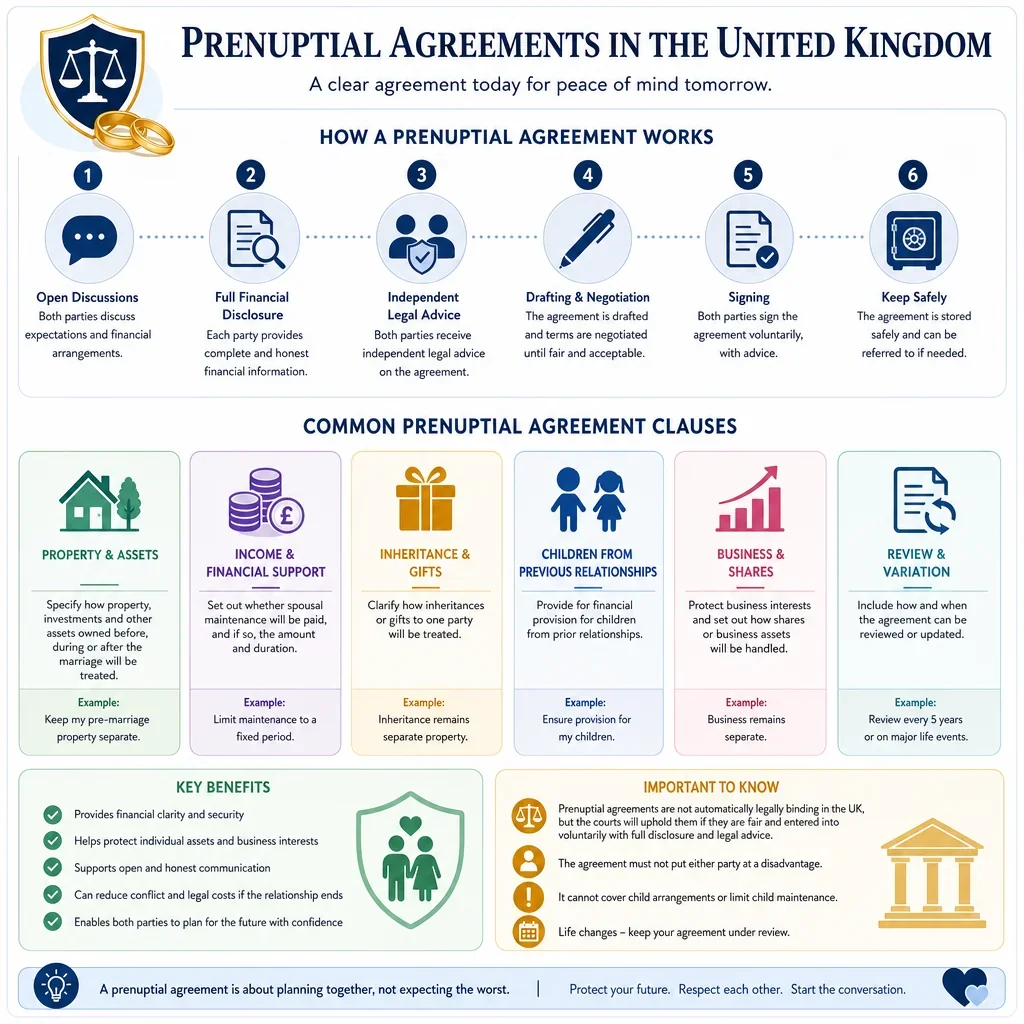
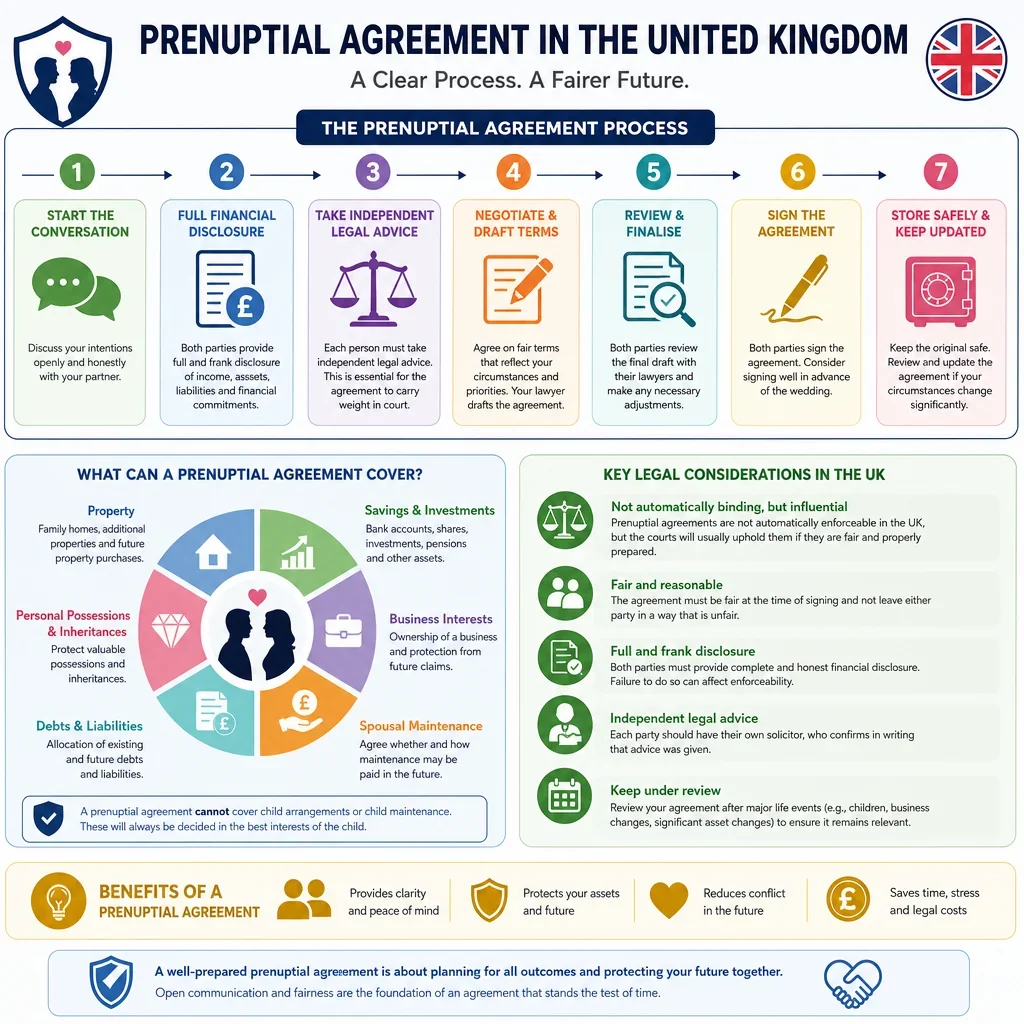
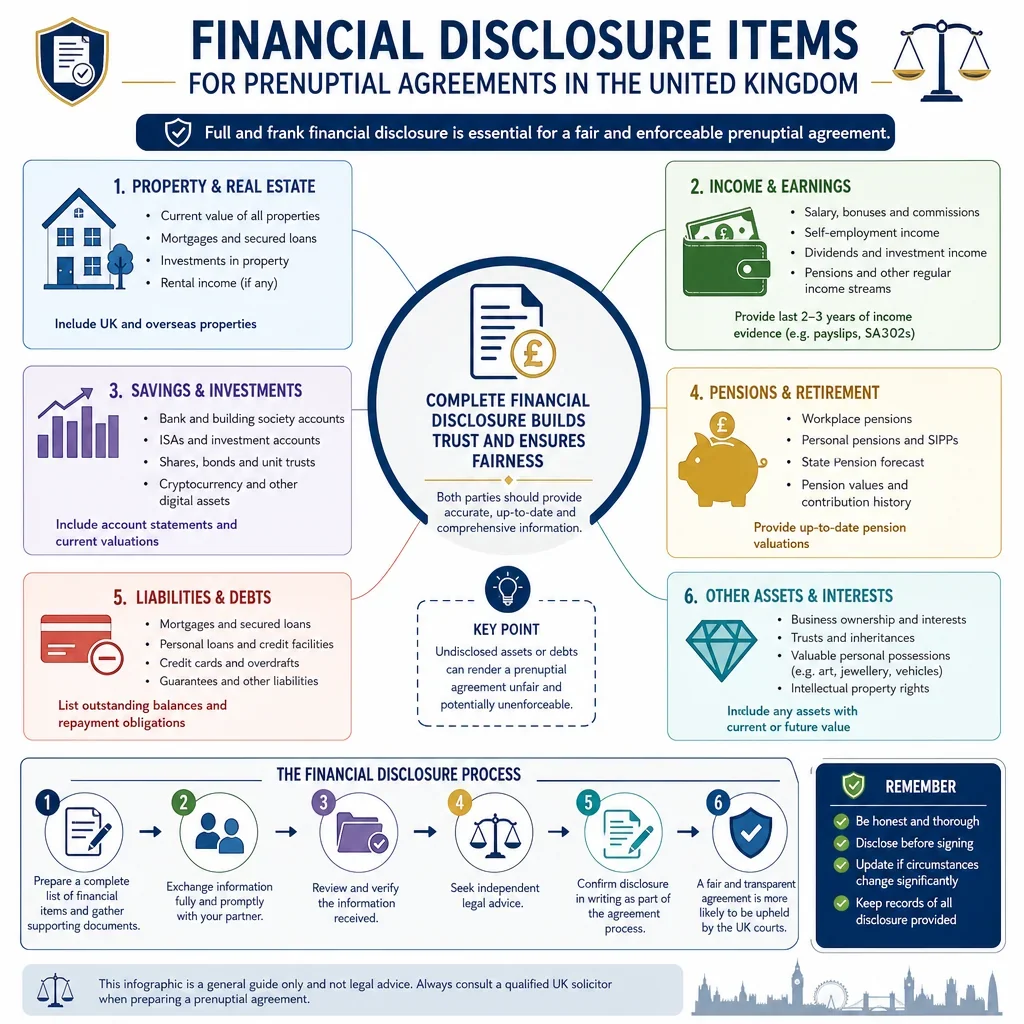
- Full Financial DisclosureBoth partners must openly share all details about their assets, debts, and income to ensure transparency and fairness.
- Identification of AssetsClearly list all separate and shared property, such as homes, savings, and investments, to distinguish what belongs to each person.
- Division of Assets on DivorceOutline how property and money will be split if the marriage ends, helping to avoid disputes later.
- Spousal MaintenanceSpecify any financial support one partner might provide to the other after separation, based on individual needs.
- Rights for ChildrenAddress arrangements for any children from the marriage, focusing on their welfare and support.
- Debts and LiabilitiesDetail how existing and future debts will be handled to protect each partner's financial interests.
- Independence ClauseState that the agreement allows each partner to manage their own career and finances without interference.
- Review and UpdatesInclude provisions to revisit and adjust the agreement if major life changes occur, like having children or career shifts.
Generate Your Document in 4 Easy Steps
Why Use Docaro?
 United Kingdom
Free Example Prenuptial Agreement Template
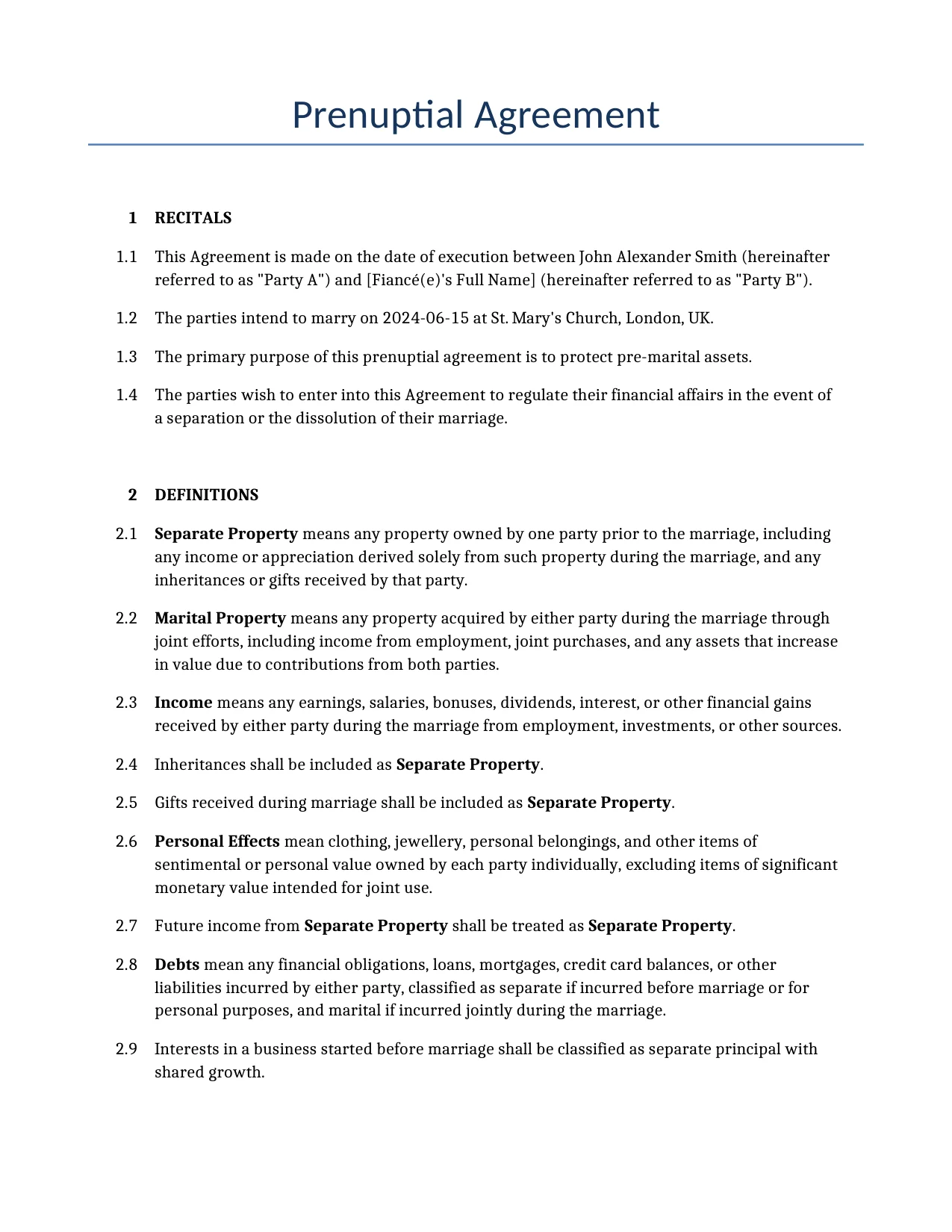
Below is a free template example of a Prenuptial Agreement for use in the United Kingdom generated by our AI model.
The clauses in your actual Prenuptial Agreement will vary from this example as they will be entirely bespoke to your requirements as set out in the questionnaire you complete.
Prenuptial Agreement
1RECITALS
This Agreement is made on the date of execution between John Alexander Smith (hereinafter referred to as "Party A") and [Fiancé(e)'s Full Name] (hereinafter referred to as "Party B").
The parties intend to marry on 2024-06-15 at St. Mary's Church, London, UK.
The primary purpose of this prenuptial agreement is to protect pre-marital assets.
The parties wish to enter into this Agreement to regulate their financial affairs in the event of a separation or the dissolution of their marriage.
2DEFINITIONS
Separate Property means any property owned by one party prior to the marriage, including any income or appreciation derived solely from such property during the marriage, and any inheritances or gifts received by that party.
Marital Property means any property acquired by either party during the marriage through joint efforts, including income from employment, joint purchases, and any assets that increase in value due to contributions from both parties.
Income means any earnings, salaries, bonuses, dividends, interest, or other financial gains received by either party during the marriage from employment, investments, or other sources.
Inheritances shall be included as Separate Property.
Gifts received during marriage shall be included as Separate Property.
Personal Effects mean clothing, jewellery, personal belongings, and other items of sentimental or personal value owned by each party individually, excluding items of significant monetary value intended for joint use.
Future income from Separate Property shall be treated as Separate Property.
Debts mean any financial obligations, loans, mortgages, credit card balances, or other liabilities incurred by either party, classified as separate if incurred before marriage or for personal purposes, and marital if incurred jointly during the marriage.
Interests in a business started before marriage shall be classified as separate principal with shared growth.
3DISCLOSURE OF ASSETS AND LIABILITIES
Party A, whose full legal name is John Alexander Smith and whose date of birth is 1985-03-15, confirms that his current annual income is 45000.00, that he is employed, and that his total monthly living expenses are 2500.50.
Party A confirms that he has existing debts or liabilities, that he owns real property, that he has bank or savings accounts, that he has other significant assets such as vehicles, jewellery, or art, and that he has no investment assets such as stocks, shares, or pensions, no pending legal claims or lawsuits that could affect his finances, and no guarantees or sureties for others' debts.
Each party has made full and frank disclosure of their assets, liabilities, income, and financial obligations to the other party prior to the execution of this Agreement.
Party B has similarly made full and frank disclosure of their assets, liabilities, income, and financial obligations to Party A prior to the execution of this Agreement.
4SEPARATE PROPERTY
Party A owns a two-bedroom flat located in London, UK, fully owned by him since purchase on 2015-03-15, with no mortgage outstanding, which shall remain his Separate Property.
Party A owns a portfolio of shares in UK-based companies including 500 shares in Barclays and 200 shares in BP, plus £10,000 in government bonds, acquired on 2018-07-22 and with a current value of 45000.50, which shall remain his Separate Property.
Any inheritance that Party A expects to receive shall be treated as his Separate Property.
Any property that either party intends to acquire using only their Separate Property funds during the marriage, where such funds derive from pre-marriage savings or inheritance proceeds, shall remain the Separate Property of the acquiring party.
Party B's Separate Property shall be treated in a corresponding manner to the provisions set out for Party A in this section.
5MARITAL PROPERTY
The parties include a specific definition of Marital Property as set out in section 2 of this Agreement.
Marital Property shall be treated upon separation or divorce by way of equal division.
The Marital Property rules shall become effective from 2024-01-01.
Future income earned during the marriage shall be treated as Marital Property.
6FINANCIAL ARRANGEMENTS DURING MARRIAGE
The parties shall arrange contributions to household expenses during the marriage by way of an equal split between both parties.
Each party shall contribute the monthly amount of 500.0 to household expenses.
The parties shall establish a joint bank account for shared expenses during the marriage.
The parties shall maintain separate personal bank accounts in addition to the joint account.
The parties shall have authority for major financial decisions during the marriage by way of joint decision by both parties.
The parties shall not share responsibility for debts incurred during the marriage.
7DEBTS AND LIABILITIES
Party A has pre-marital debts consisting of a student loan from the Student Loans Company amounting to approximately £15,000 taken out in 2015 for university tuition fees and a personal loan from Barclays Bank for £5,000 used for home improvements in 2018, with a total outstanding amount of 20000.5 originating on 2015-09-01.
Party A alone shall be responsible for repaying his pre-marital debts.
Marital Debts shall be handled in terms of repayment responsibility by way of equal split.
The parties shall include a clause protecting Separate Property from the other party's debts.
Outstanding debts shall be handled upon separation or divorce by being assigned to the incurring party.
Party B's pre-marital debts shall be treated in a corresponding manner to the provisions set out for Party A in this section.
8SPOUSAL MAINTENANCE AND SUPPORT
The parties include a clause waiving the right to spousal maintenance for both parties in accordance with the Matrimonial Causes Act 1973.
The type of spousal maintenance arrangement that the parties include is periodic payments.
The parties specify periodic spousal maintenance payments in the event that the waiver is not upheld by a court.
9CHILDREN AND CHILD SUPPORT
The parties do not currently have any children from a previous relationship.
The parties intend to have children together during the marriage.
The parties acknowledge that any arrangements for children, including custody, access, and child maintenance, shall be subject to the jurisdiction of the courts and the best interests of the child under applicable law including the Matrimonial Causes Act 1973, the Family Law (Scotland) Act 1985, the Matrimonial Property (Northern Ireland) Order 1978, and any amendments thereto.
10DIVISION OF PROPERTY ON SEPARATION OR DIVORCE
The parties specify a custom division of property on separation or divorce rather than solely applying standard UK matrimonial law principles.
All Marital Property acquired during the marriage shall be divided equally on separation or divorce.
Inheritances shall be treated in the division of property on separation or divorce as Separate Property.
The interest in any business shall not be included as Marital Property for division.
The division of property shall be in accordance with the Matrimonial Causes Act 1973, the Family Law (Scotland) Act 1985, the Matrimonial Property (Northern Ireland) Order 1978, the Marriage (Prenuptial Agreements) Law Reform, the Law Reform (Miscellaneous Provisions) (Scotland) Act 1980, and any amendments or successor legislation.
11INHERITANCE AND ESTATE PLANNING
Party A currently has a will in place.
The parties intend to make a new will after marriage with the primary intention of including the spouse as primary beneficiary.
The parties shall not enter into a mutual wills agreement whereby neither party can change their will after the other's death.
The parties shall not waive any rights to inherit from the spouse's estate under UK law and shall retain all inheritance rights.
The estimated total value of Party A's current estate, including all assets and liabilities, is 150000.00.
The parties do not have any existing trusts that affect their inheritance or estate planning.
This Agreement shall not affect any rights under the Inheritance (Provision for Family and Dependants) Act 1975 or equivalent legislation in Scotland or Northern Ireland.
12CONFIDENTIALITY
The parties shall include a confidentiality obligation in this Agreement.
Each party shall keep the terms of this Agreement confidential except for disclosures required by law, for enforcement purposes, or to professional advisors.
13GOVERNING LAW
This Agreement shall be governed by British law, specifically the laws of England and Wales.
The parties explicitly exclude the application of laws from other jurisdictions.
The governing law provisions shall become effective from 2024-10-15.
This Agreement is made in compliance with the Matrimonial Causes Act 1973, the Marriage (Prenuptial Agreements) Law Reform, the Family Law (Scotland) Act 1985, the Law Reform (Miscellaneous Provisions) (Scotland) Act 1980, and the Matrimonial Property (Northern Ireland) Order 1978.
14SEVERABILITY
The parties include a severability clause in this Agreement.
If any provision of this Agreement is found to be invalid or unenforceable, the remaining provisions shall continue in full force and effect under the standard severability principle.
15ENTIRE AGREEMENT
This Agreement represents the entire understanding between the parties, with no other promises or terms outside this document.
This Agreement supersedes any prior representations or warranties under the standard supersession principle.
Each party acknowledges that they have had the opportunity to review this Agreement with independent legal advice before agreeing that it constitutes the entire understanding.
16AMENDMENT AND WAIVER
All amendments to this Agreement shall be made in writing.
Both parties shall sign any amendments to this Agreement.
Waivers of provisions in this Agreement shall be handled by way of a written and signed waiver.
No waiver of a breach shall constitute a waiver of future breaches.
This Agreement shall become effective on 2024-10-01, which shall be the date from which amendments may first be made.
17INDEPENDENT LEGAL ADVICE
The full name of the solicitor who provided Party A with independent legal advice is Johnathan R. Smith of Smith & Associates Law Firm whose professional address is 123 Legal Street, London, EC1A 1BB, United Kingdom.
Party A received the independent legal advice on 2023-10-15.
Party A confirms that he has received independent legal advice from a qualified UK solicitor, specifically a Solicitor of England and Wales, regarding the implications of this Agreement.
Party B confirms that he or she has received independent legal advice from a qualified UK solicitor regarding the implications of this Agreement.
18VOLUNTARY AGREEMENT AND DURESS
Each party confirms that he or she is entering into this Agreement voluntarily.
Each party confirms that he or she is not entering into this Agreement under any form of duress.
Each party confirms that he or she is not entering into this Agreement under any undue influence.
Each party confirms that he or she is not entering into this Agreement under any coercion.
Each party confirms that he or she fully understands all the terms of this Agreement.
Each party has received independent legal advice regarding this Agreement.
There are no sources of potential pressure influencing the decision to sign this Agreement.
19DISPUTE RESOLUTION
The parties specify mediation as the preferred method for resolving disputes arising from this Agreement before resorting to court proceedings.
The parties include arbitration as a method for resolving disputes in this Agreement.
Disputes arising from this Agreement shall be resolved under English law.
The courts of England and Wales shall have exclusive jurisdiction over any disputes from this Agreement.
This Agreement shall become effective for dispute resolution purposes on 2024-10-15.
20TERMINATION OF AGREEMENT
The circumstances that shall trigger termination of this Agreement are mutual consent and death of either party.
The parties do not include any custom circumstances for termination beyond the standard events.
This Agreement shall become effective from 2024-10-01.
21EXECUTION IN COUNTERPARTS
This Agreement may be executed in multiple counterparts, each of which shall be deemed an original.
22NOTICES
Any notice required to be given under this Agreement shall be in writing and shall be sent by recorded delivery to the last known address of the other party or to such other address as may be notified in writing.
23VARIATION
No variation of this Agreement shall be effective unless it is in writing and signed by or on behalf of each of the parties.
24SCHEDULES OF ASSETS AND LIABILITIES
This Agreement shall include detailed schedules attached as Schedule 1 for Party A and Schedule 2 for Party B, listing all assets, liabilities, pensions, business interests, and values with full financial disclosure to ensure compliance with UK law and the requirements under the Matrimonial Causes Act 1973 for the agreement to be considered binding.
25PENSIONS
Each party shall retain their own pension rights and benefits accrued before and during the marriage as Separate Property, with no sharing or claims on the other party's pension, explicitly stating that this is intended to be fair and that both parties have received independent legal advice on the implications under the Matrimonial Causes Act 1973.
26BUSINESS INTERESTS
Any pre-marital business interests, including ownership stakes, shares, or intellectual property in businesses started before the marriage, shall remain the Separate Property of the owning party; any growth in value during the marriage attributable solely to passive appreciation or market forces shall also be Separate Property, while active contributions by the non-owning spouse may be considered for compensation from other marital assets to ensure fairness under the Matrimonial Causes Act 1973.
27TAX IMPLICATIONS
The parties acknowledge that this Agreement may have tax implications under UK tax law, including but not limited to capital gains tax, inheritance tax, and income tax; each party agrees to seek independent tax advice and confirms that the division of assets and waiver provisions are structured to minimize unfair tax burdens while complying with all applicable laws.
28DEATH VS DIVORCE PROVISIONS
This Agreement distinguishes between provisions on divorce or separation and on death: on divorce, the property division, spousal maintenance waivers, and other terms apply as specified; on death, the surviving party retains their Separate Property and rights under any will or intestacy rules, but this Agreement does not limit claims under the Inheritance (Provision for Family and Dependants) Act 1975 unless explicitly waived after independent legal advice confirming fairness.
29EXPLICIT WAIVER OF SPOUSAL SUPPORT
Both parties hereby explicitly waive any and all rights to spousal maintenance, periodical payments, lump sum orders, or property adjustment orders under sections 23, 24, and 25 of the Matrimonial Causes Act 1973, acknowledging that this waiver is intended to be binding, that full financial disclosure has been made, that independent legal advice has been received, and that the waiver will not cause undue hardship.
30EXPLICIT WAIVER OF INHERITANCE RIGHTS
Both parties hereby explicitly waive any rights to claim against the other's estate under the Inheritance (Provision for Family and Dependants) Act 1975 or equivalent legislation, confirming this waiver is made with full knowledge of the implications, after independent legal advice, and that it will not leave either party without reasonable financial provision.
31FAIRNESS AND COMPLIANCE STATEMENT
The parties affirm that this Agreement is fair and reasonable at the time of execution, that there has been full and frank financial disclosure including all assets, liabilities, pensions, and business interests via attached schedules, that both have received independent legal advice from qualified UK solicitors, and that they intend the Agreement to be upheld by courts under the principles established in cases such as Radmacher v Granatino, in compliance with the Matrimonial Causes Act 1973.
32SIGNATURES
SIGNED by Party A in the presence of the witness whose name and address appear below:
Signature of Party A: ___________________________ Date: _______________
Name of Witness: ___________________________
Signature of Witness: ___________________________
Address of Witness: ___________________________
SIGNED by Party B in the presence of the witness whose name and address appear below:
Signature of Party B: ___________________________ Date: _______________
Name of Witness: ___________________________
Signature of Witness: ___________________________
Address of Witness: ___________________________
This example shows approximately 70% of a typical document and is provided for illustrative purposes only. The remaining content has been omitted.
Every document generated by Docaro is tailored to your specific circumstances, jurisdiction and the information you provide. The completed document includes all applicable clauses and provisions required for your situation.
To generate the full, personalised document, answer a short series of questions and your document will be created instantly.
Useful Resources When Considering a Prenuptial Agreement in the United Kingdom
United Kingdom Reference Legislation
Prenuptial Agreement FAQs
Document Generation FAQs
Related Articles