AI Generated British Power of Attorney
PDF & Word - 2026 Updated
Docaro Pricing
When do you need a Power of Attorney in the United Kingdom?
British Legal Rules for a Power of Attorney
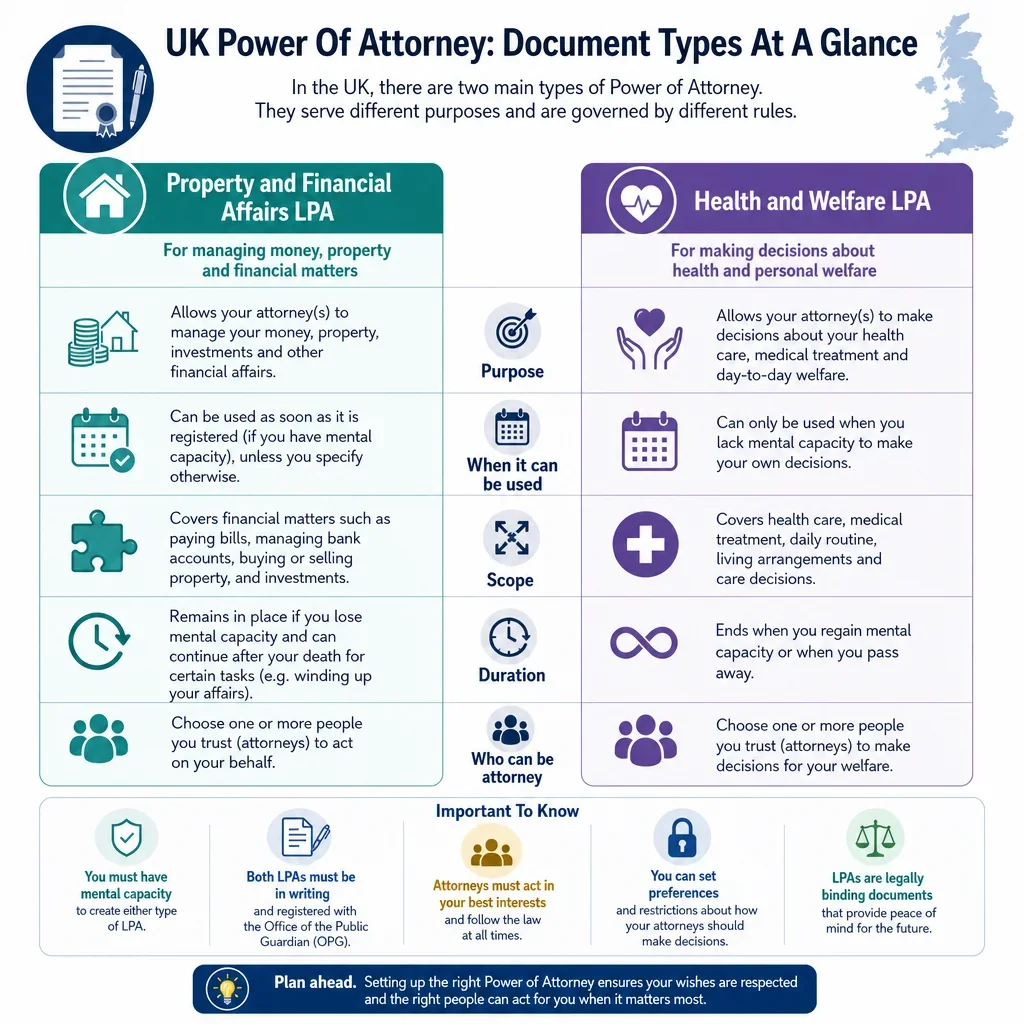
Using the wrong type of power of attorney can fail to grant the intended authority or lead to invalidity under UK law.
What a Proper Power of Attorney Should Include
- Your Full DetailsInclude your complete name, address, and date of birth to clearly identify you as the person granting the power.
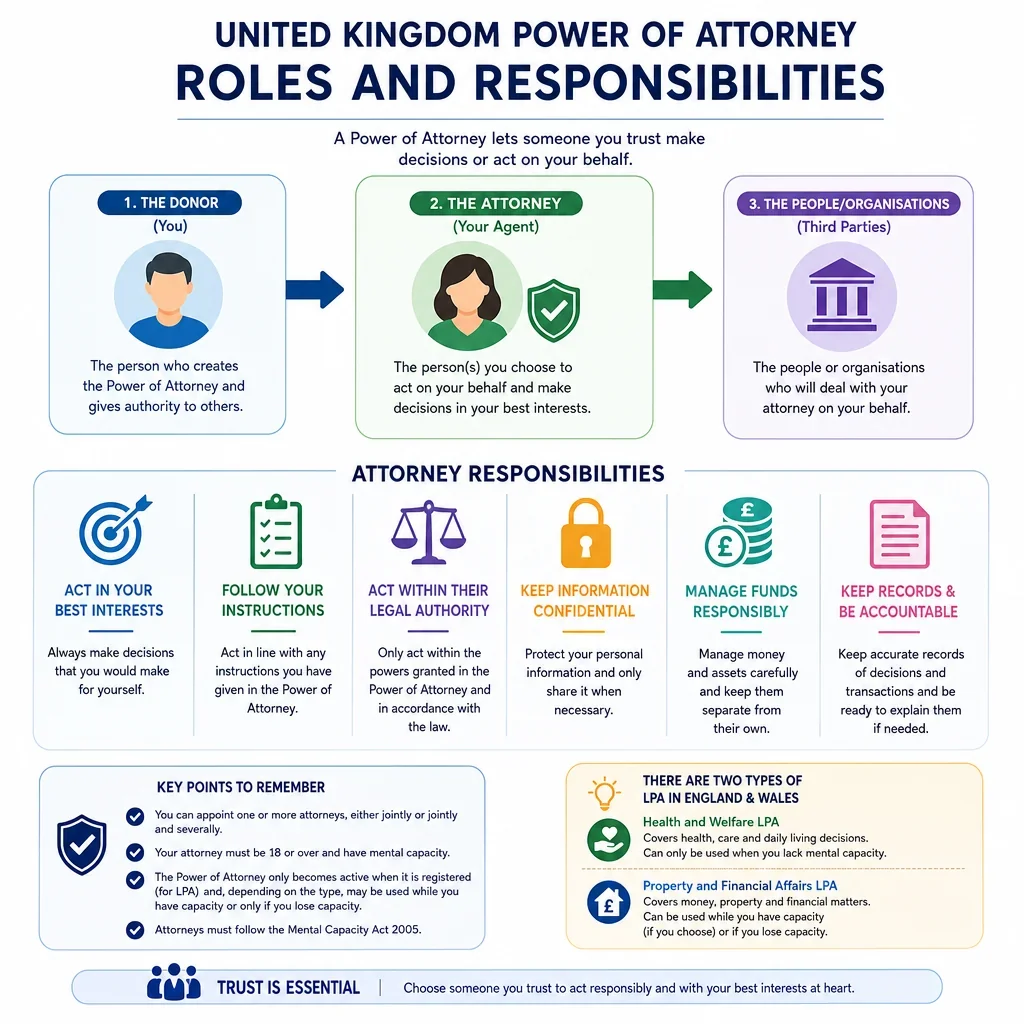
- The Attorney's DetailsList the full name and address of the trusted person or professional you are appointing to act on your behalf.
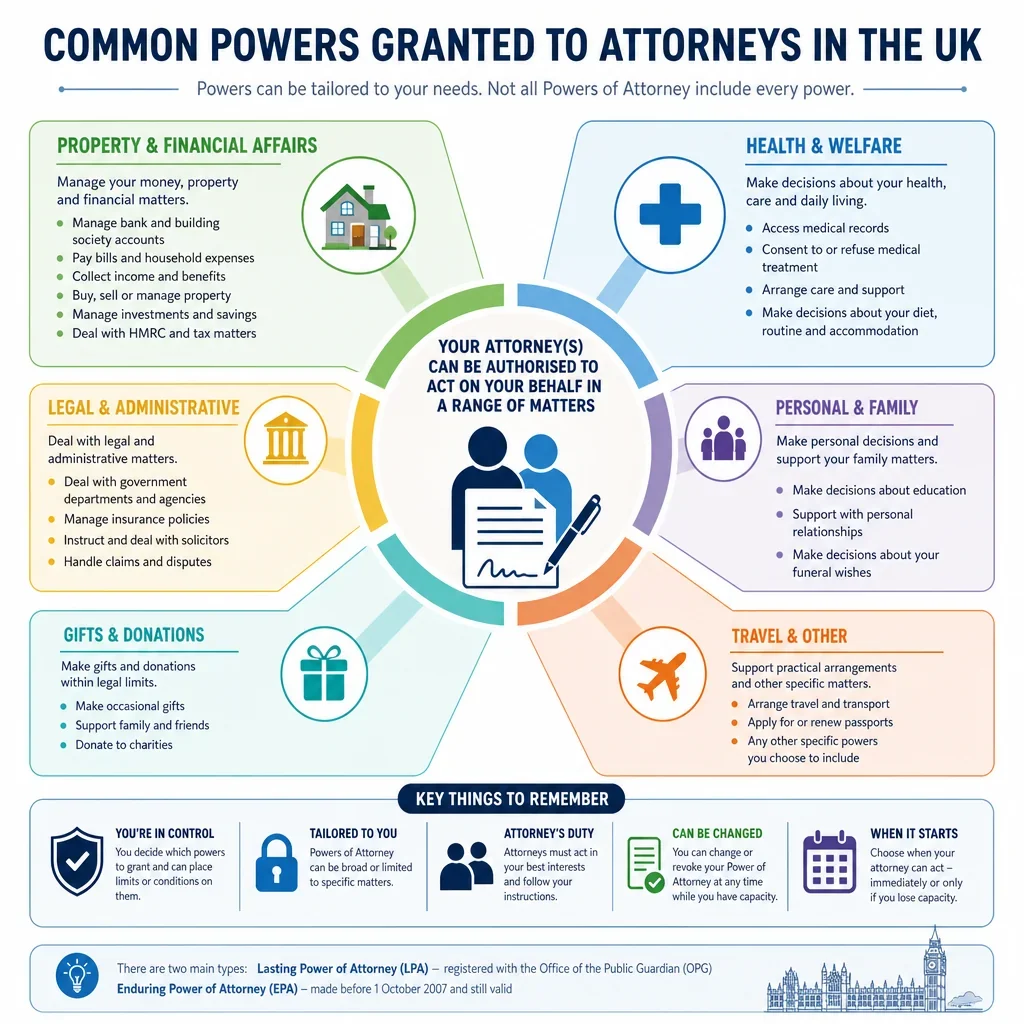
- Specific Powers GrantedClearly state what actions the attorney can take, such as handling finances, property, or health decisions.
- When the Power StartsSpecify if the power begins immediately or only when you lose mental capacity, to match your needs.
- Duration and EndingDefine how long the power lasts and under what conditions it can be revoked or ends, like your death.
- Your Signature and DateSign and date the document in the presence of a witness or as required by law to make it valid.
- Witness InformationInclude the witness's name, address, and signature to confirm the document's authenticity.
Generate Your Document in 4 Easy Steps
Why Use Docaro?
 United Kingdom
Free Example Power of Attorney Template
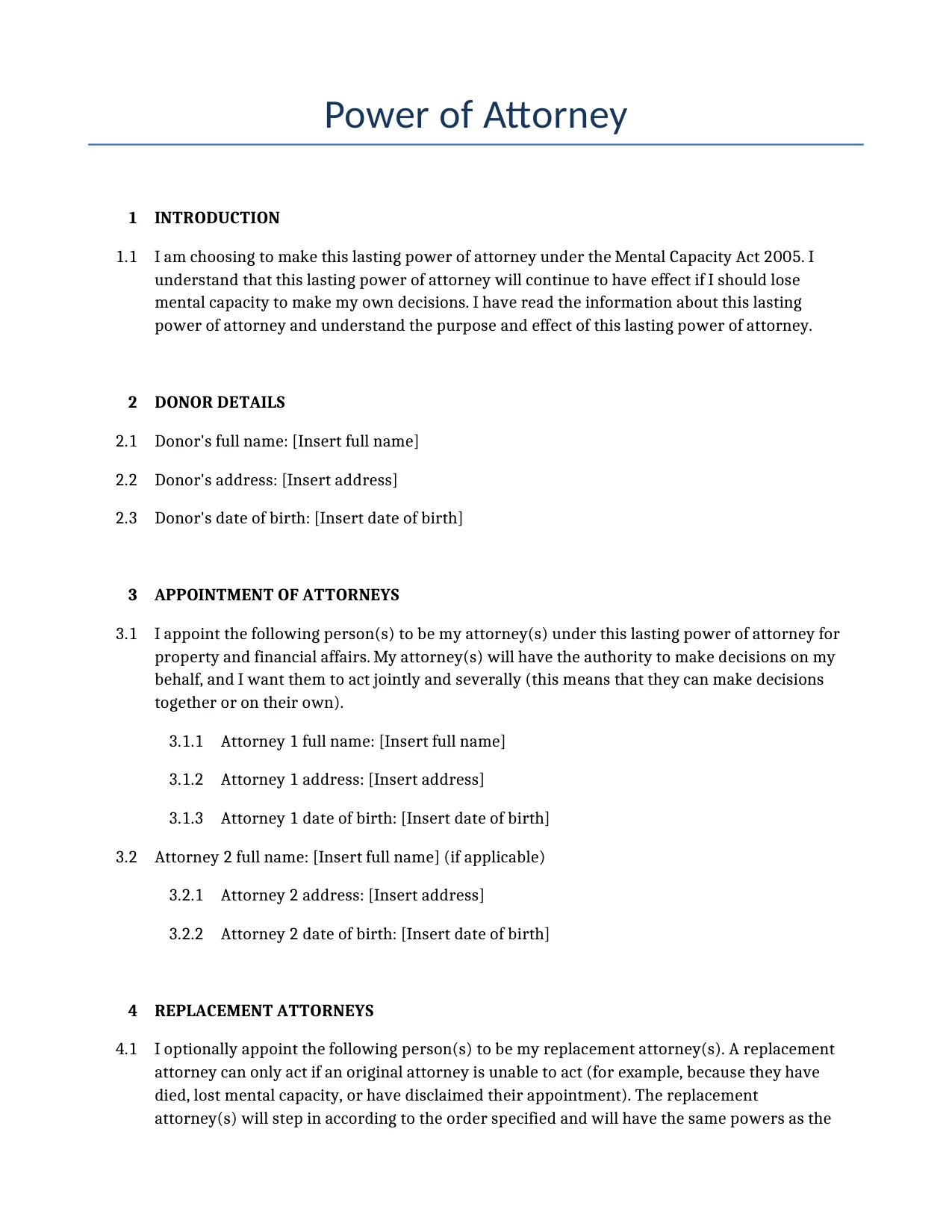
Below is a free template example of a Power of Attorney for use in the United Kingdom generated by our AI model.
The clauses in your actual Power of Attorney will vary from this example as they will be entirely bespoke to your requirements as set out in the questionnaire you complete.
Lasting Power of Attorney for Property and Financial Affairs
1INTRODUCTION
I am choosing to make this lasting power of attorney under the Mental Capacity Act 2005. I understand that this lasting power of attorney will continue to have effect if I should lose mental capacity to make my own decisions. I have read the information about this lasting power of attorney and understand the purpose and effect of this lasting power of attorney.
2DONOR DETAILS
Donor's full name: [Insert full name]
Donor's address: [Insert address]
Donor's date of birth: [Insert date of birth]
3APPOINTMENT OF ATTORNEYS
I appoint the following person(s) to be my attorney(s) under this lasting power of attorney for property and financial affairs. My attorney(s) will have the authority to make decisions on my behalf, and I want them to act jointly and severally (this means that they can make decisions together or on their own).
Attorney 1 full name: [Insert full name]
Attorney 1 address: [Insert address]
Attorney 1 date of birth: [Insert date of birth]
Attorney 2 full name: [Insert full name] (if applicable)
Attorney 2 address: [Insert address]
Attorney 2 date of birth: [Insert date of birth]
4REPLACEMENT ATTORNEYS
I optionally appoint the following person(s) to be my replacement attorney(s). A replacement attorney can only act if an original attorney is unable to act (for example, because they have died, lost mental capacity, or have disclaimed their appointment). The replacement attorney(s) will step in according to the order specified and will have the same powers as the original attorney(s).
Replacement Attorney 1 full name: [Insert full name] (optional)
Replacement Attorney 1 address: [Insert address]
Replacement Attorney 1 date of birth: [Insert date of birth]
5POWERS GRANTED
My attorneys can make decisions about my property and financial affairs. This includes managing my bank accounts, paying bills, handling investments, managing property (including selling it if necessary), and dealing with my business interests. These powers are subject to the restrictions and guidance set out in this LPA.
My attorneys must follow any instructions I have given in the 'Preferences and Instructions' section. They must act in my best interests at all times.
My attorneys can only make gifts on my behalf in limited circumstances: to people related to or connected with me on customary occasions (such as birthdays or weddings) up to a value that is reasonable having regard to my estate, or to any charity to whom I have made or might be expected to make gifts. They cannot make large gifts without Court of Protection approval.
This LPA only relates to property and financial affairs. A separate Health and Welfare LPA requires a different form (LPA2) and cannot be combined with this document.
This lasting power of attorney will only be used once it has been registered with the Office of the Public Guardian.
6PREFERENCES AND INSTRUCTIONS
Preferences (non-binding guidance for my attorneys): [Insert any preferences, for example: I would like my attorneys to consult with me as much as possible and to prioritise investments that align with ethical considerations.]
Instructions (binding): [Insert any binding instructions, for example: My attorneys must not sell my family home without first consulting my children and obtaining their agreement unless it is necessary to pay for my care.]
7NAMED PERSONS
I want the following people to be notified when an application is made to register this lasting power of attorney. They can object to the registration if they have concerns. (You can name up to 4 or 5 people.)
Named Person 1 full name: [Insert full name] Address: [Insert address] Relationship: [Insert relationship]
Named Person 2 full name: [Insert full name] Address: [Insert address] Relationship: [Insert relationship] (if applicable)
8CERTIFICATE PROVIDER
I have chosen one independent certificate provider who is not a family member of mine, not an attorney or replacement attorney, and who has known me personally for at least 2 years or is a professional person such as a solicitor, doctor (provided they meet independence rules), or similar. The certificate provider must be independent and not Mr. Johnathan Reeves if he is a family friend.
Certificate provider full name: [Insert full name]
Certificate provider address: [Insert address]
Certificate provider's statement: I certify that: 1. I am not a member of the donor's family, nor an attorney or replacement attorney, nor a partner, employee or business associate of any attorney or replacement attorney. 2. I have discussed with the donor the purpose and effect of this lasting power of attorney. I am satisfied that the donor understands it, that the donor is not acting under undue pressure or fraud, and that there is nothing to stop this LPA from being registered. I have also considered whether the donor has capacity to make this LPA.
Signed by certificate provider: _______________________________ Date: _______________
9ATTORNEY'S STATEMENT
Each attorney must agree to the following: I have read the prescribed information and understand my duties under the Mental Capacity Act 2005, in particular: to act in the donor's best interests, to have regard to the guiding principles of the Act, to act only within the scope of the authority given by the donor, and not to act if I know that the LPA has been revoked or is otherwise invalid. I agree to act as an attorney according to the terms of this lasting power of attorney.
Attorney 1 signature accepting appointment: _______________________________ Date: _______________
Attorney 2 signature accepting appointment: _______________________________ Date: _______________ (if applicable)
10DONOR'S CONFIRMATION
I have read this lasting power of attorney and understand its purpose and effect. I confirm that I am making this LPA voluntarily and that I have the capacity to do so.
Donor signature: _______________________________ Date: _______________
11EXECUTION AND WITNESSING
The donor must sign this document in the presence of a witness. The witness must be an independent person over 18 who is not an attorney, replacement attorney, or the certificate provider.
Witness statement: I witnessed the donor sign this lasting power of attorney. The donor appeared to understand what they were signing.
Witness signature: _______________________________ Date: _______________
Witness full name: [Insert name] Address: [Insert address]
12REGISTRATION
This lasting power of attorney cannot be used until it has been registered with the Office of the Public Guardian (OPG). To register, an application must be made to the OPG using the appropriate form. Contact the Office of the Public Guardian at: PO Box 16185, Birmingham, B2 2WH. Telephone: 0300 456 0300.
13GOVERNING LAW
This Lasting Power of Attorney is governed by the laws of England and Wales.
14SIGNATURES
All signatures and dates must be completed as per the sections above. The donor must sign before the attorneys.
This example shows approximately 70% of a typical document and is provided for illustrative purposes only. The remaining content has been omitted.
Every document generated by Docaro is tailored to your specific circumstances, jurisdiction and the information you provide. The completed document includes all applicable clauses and provisions required for your situation.
To generate the full, personalised document, answer a short series of questions and your document will be created instantly.
Useful Resources When Considering a Power of Attorney in the United Kingdom
United Kingdom Reference Legislation
Power of Attorney FAQs
Document Generation FAQs
Related Articles