AI Generated Zero-hours contract for use in the United Kingdom
PDF & Word - 2026 Updated
Docaro Pricing
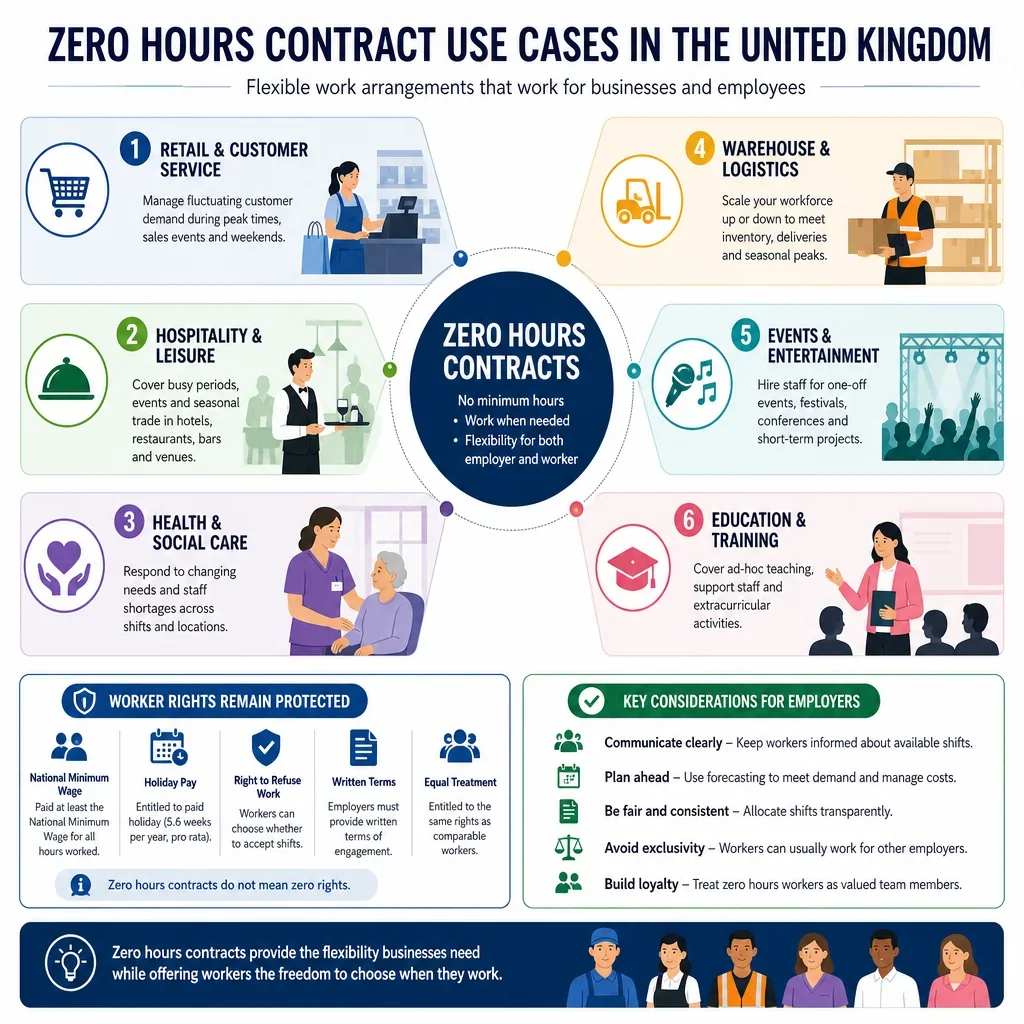
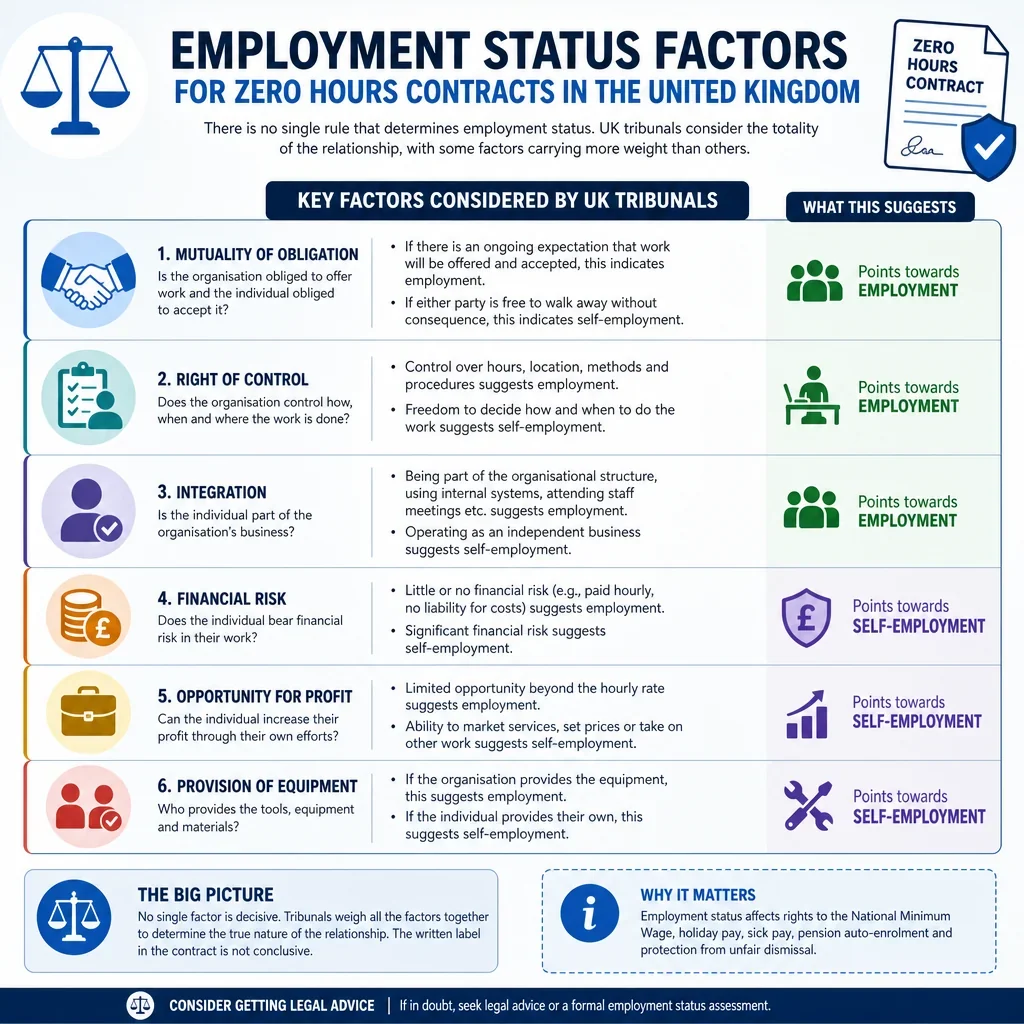
When do you need a Zero-hours contract in the United Kingdom?
British Legal Rules for a Zero-Hours Contract
Using the wrong type of agreement for zero hours work can inadvertently create obligations for guaranteed minimum hours or employment status.
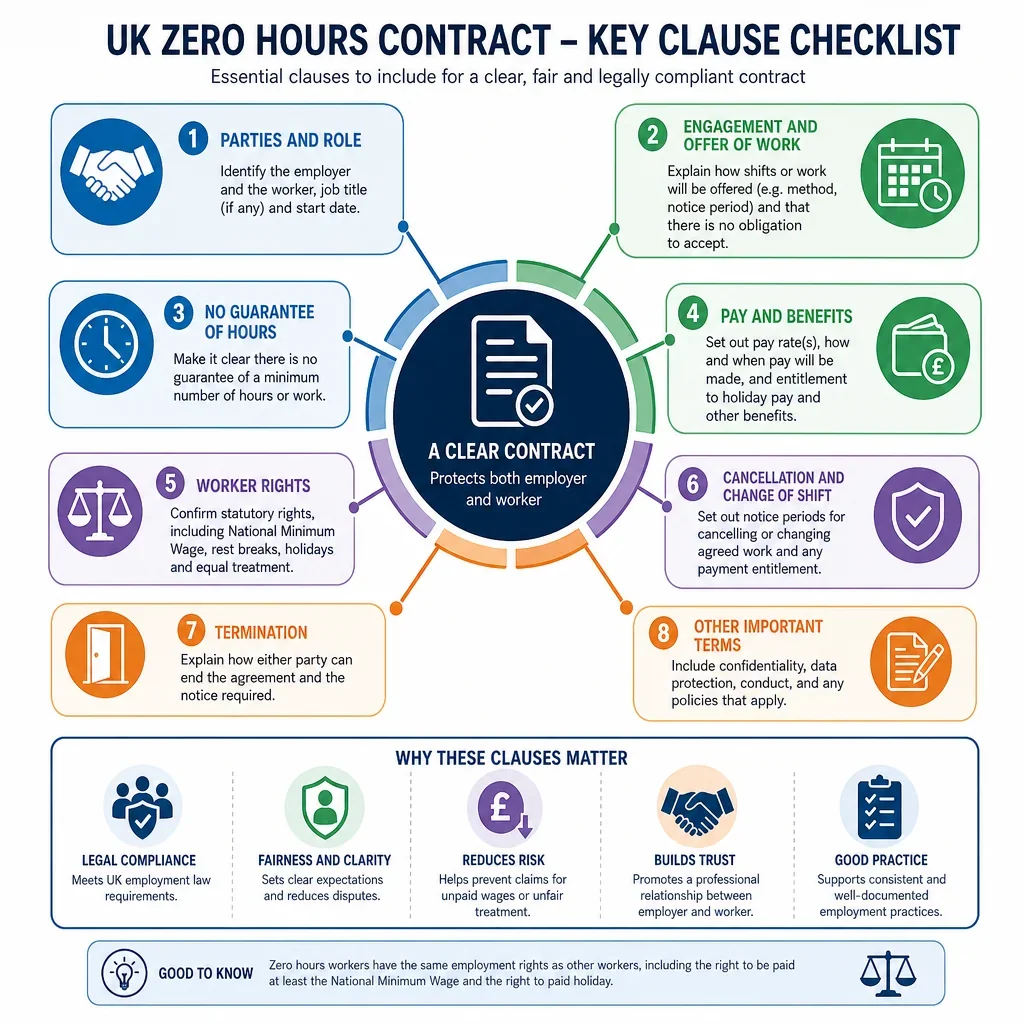
What a Proper Zero-Hours Contract Should Include
- Parties InvolvedClearly state the names and addresses of the employer and the worker entering into the agreement.
- Job DescriptionDescribe the worker's role, duties, and any specific responsibilities they will have.
- Hours and AvailabilityExplain that no fixed hours are guaranteed and outline how shifts will be offered and accepted.
- Pay DetailsSpecify the hourly rate, payment frequency, and how pay will be calculated for worked hours.
- Holiday and Sick PayDetail the worker's entitlement to paid holiday and sick leave based on hours worked.
- Notice PeriodsSet out how much notice is required to end the arrangement from either side.
- Rights and ObligationsCover key rules like keeping information confidential and following workplace policies.
Generate Your Document in 4 Easy Steps
Why Use Docaro?
 United Kingdom
Free Example Zero-hours contract Template
Below is a free template example of a Zero-hours contract for use in the United Kingdom generated by our AI model.
The clauses in your actual Zero-hours contract will vary from this example as they will be entirely bespoke to your requirements as set out in the questionnaire you complete.
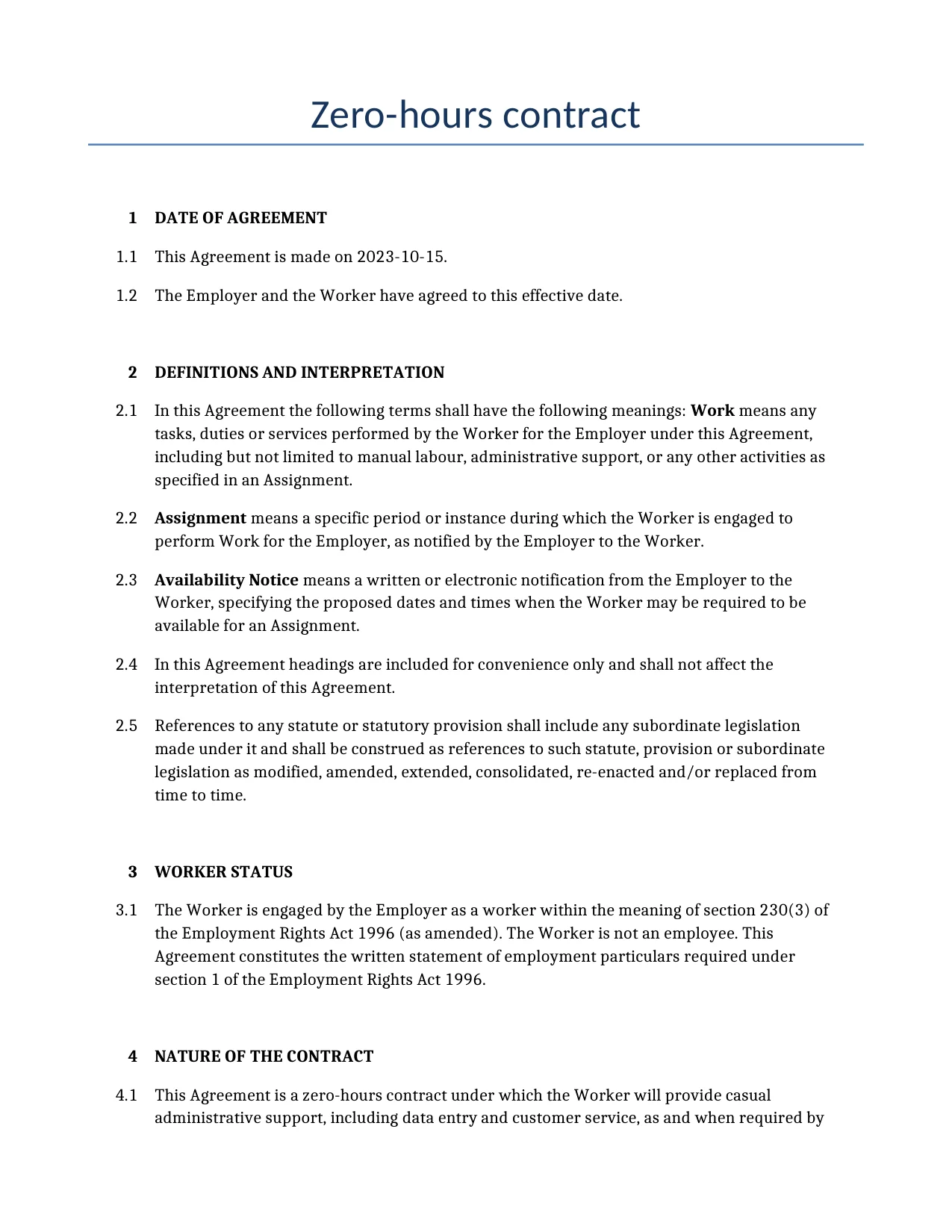
Zero-Hours Contract
1DATE OF AGREEMENT
This Agreement is made on 2023-10-15.
The Employer and the Worker have agreed to this effective date.
2DEFINITIONS AND INTERPRETATION
In this Agreement the following terms shall have the following meanings: Work means any tasks, duties or services performed by the Worker for the Employer under this Agreement, including but not limited to manual labour, administrative support, or any other activities as specified in an Assignment.
Assignment means a specific period or instance during which the Worker is engaged to perform Work for the Employer, as notified by the Employer to the Worker.
Availability Notice means a written or electronic notification from the Employer to the Worker, specifying the proposed dates and times when the Worker may be required to be available for an Assignment.
In this Agreement headings are included for convenience only and shall not affect the interpretation of this Agreement.
References to any statute or statutory provision shall include any subordinate legislation made under it and shall be construed as references to such statute, provision or subordinate legislation as modified, amended, extended, consolidated, re-enacted and/or replaced from time to time.
3WORKER STATUS
The Worker is engaged by the Employer as a worker within the meaning of section 230(3) of the Employment Rights Act 1996 (as amended). The Worker is not an employee. This Agreement constitutes the written statement of employment particulars required under section 1 of the Employment Rights Act 1996.
4NATURE OF THE CONTRACT
This Agreement is a zero-hours contract under which the Worker will provide casual administrative support, including data entry and customer service, as and when required by the Employer. There is no mutuality of obligation between the parties. The Employer is under no obligation to offer work to the Worker, and the Worker is under no obligation to accept any work offered. For the avoidance of doubt, the Worker will not suffer any detriment if they choose to refuse any offer of work.
5HOURS OF WORK
There are no guaranteed minimum hours of work under this Agreement. Work will be offered on an as-needed basis.
The Employer shall notify the Worker of available work by email or text message. Each notification shall include the date and time of the shift, expected duration, location, and any specific tasks or requirements. The Employer shall provide the Worker with at least 48 hours' notice of any Assignment. The Worker shall respond to any offer of work within 24 hours of receipt. If the Worker does not respond within this timeframe the offer shall be deemed declined.
6ANTI-EXCLUSIVITY
The Worker is free to work for other employers or engage in self-employment at any time and the Employer shall not impose any exclusivity restrictions or prevent the Worker from doing so. The Worker will not suffer any detriment for working elsewhere.
7PAY AND PAYMENT TERMS
The Worker shall be paid at an hourly rate of £12.50 (or the prevailing National Living Wage/National Minimum Wage rate applicable to the Worker’s age, whichever is higher). This rate is gross and statutory deductions (including income tax and National Insurance contributions) shall be made. The Employer shall comply with all obligations under the National Minimum Wage Act 1998. Payslips will be provided in accordance with section 8 of the Employment Rights Act 1996.
The Worker’s pay shall be calculated for hours worked by standard hourly multiplication. Overtime, unsocial hours, or other premiums (if any) shall be paid at the rates notified at the time of the Assignment offer.
Payment to the Worker shall be made monthly by bank transfer.
8HOLIDAY ENTITLEMENT AND PAY
The Worker is entitled to paid annual leave in accordance with the Working Time Regulations 1998 (as amended). For workers with irregular hours, holiday entitlement accrues at the rate of 5.6 weeks (or 12.07% of hours worked in the relevant pay period) per holiday year, calculated in line with the Employment Rights (Amendment, Revocation and Transitional Provision) Regulations 2023 using a 52-week reference period (or the number of weeks actually worked if fewer).
Holiday pay will be calculated at the Worker’s average hourly rate over the 52-week reference period in accordance with the law. The Worker must give at least 7 days’ notice of a request to take holiday. The Employer will respond to any holiday request within 7 days.
The Worker may carry over up to 4 weeks of untaken holiday into the next leave year only in circumstances permitted by law (such as where prevented from taking holiday due to sickness). The holiday year runs from 1 January to 31 December. Any untaken holiday (subject to carry-over rules) will be paid in lieu on termination.
9SICK PAY AND ABSENCE
The Worker may be entitled to Statutory Sick Pay (SSP) if they meet the eligibility criteria under the Social Security Contributions and Benefits Act 1992. SSP is payable for up to 28 weeks after a waiting period of 3 qualifying days. The Worker must notify the Employer of sickness absence by phone call or email by 9:00 AM on the first day of absence (or as soon as reasonably practicable). Self-certification is acceptable for absences of 7 days or less; a fit note is required for longer absences. Failure to follow the notification procedure may result in disciplinary action.
10PENSION
If the Worker meets the eligibility criteria under the Pensions Act 2008 (earnings above the qualifying earnings threshold and aged between 22 and State Pension age), the Employer will automatically enrol the Worker into a qualifying workplace pension scheme (currently NEST). The current qualifying earnings thresholds and minimum contribution rates will be applied in accordance with legislation (Employer minimum 3% of qualifying earnings; Worker minimum 5% if contributing). The Worker has the right to opt out of the scheme at any time after enrolment and will receive further information about their pension rights.
11HEALTH AND SAFETY
The Employer has conducted a risk assessment for the work environment.
The Employer shall provide the Worker with induction training on workplace hazards and emergency evacuation procedures.
The Employer shall supply personal protective equipment to the Worker at no cost.
The Worker must wear appropriate personal protective equipment at all times, follow all posted safety signs, and report any hazards or unsafe conditions to the supervisor immediately.
The Worker shall report any health and safety incidents immediately to the Employer.
The Employer assures a safe working environment for the Worker.
12CONFIDENTIALITY AND INTELLECTUAL PROPERTY
The Worker shall keep confidential any business information of the Employer during the engagement. Standard exceptions to the confidentiality obligations shall apply, such as information already in the public domain or required to be disclosed by law. The Worker’s confidentiality obligations shall continue for 12 months after the engagement ends. The Worker shall return or destroy all confidential materials upon termination of the engagement.
Any intellectual property created by the Worker in the course of performing Work for the Employer shall belong to and vest in the Employer.
13DATA PROTECTION
The Employer (ABC Services Ltd) is the data controller for the Worker’s personal data and will process it in accordance with the UK GDPR and Data Protection Act 2018. Types of personal data collected include basic contact information, financial data, performance and shift records. Data will be processed for administering this contract, payroll, compliance with legal obligations, and legitimate interests. Lawful bases include contractual necessity (Art 6(1)(b)), legal obligation, and legitimate interests. Data will not be transferred outside the UK. Appropriate technical and organisational measures (including encryption, access controls, training and audits) are in place. Data will be retained for no longer than 6 years after the end of the engagement. Automated decision-making is not used.
The Worker has the following data subject rights under the UK GDPR: access, rectification, erasure, restriction, portability, and objection. To exercise these rights or for any queries, contact dataprotection@abcservice.com. The Worker has the right to complain to the Information Commissioner’s Office.
14EQUAL OPPORTUNITIES AND FAMILY-RELATED RIGHTS
The Employer commits to an equal opportunities policy and shall not discriminate on the grounds of age, disability, gender reassignment, marriage and civil partnership, pregnancy and maternity, race, religion or belief, sex or sexual orientation in accordance with the Equality Act 2010. The Employer commits to non-discrimination in offering work opportunities and workplace conduct.
The Worker is entitled to the following family-related rights in accordance with applicable legislation: maternity, paternity, adoption, shared parental leave, parental leave, and time off for dependants. Further details are available from the Employer or at www.gov.uk.
15GRIEVANCE AND DISCIPLINARY PROCEDURE
Any grievance should be raised with the Worker’s line manager in the first instance. The Employer’s disciplinary and grievance procedures are available on request and will be followed where appropriate. These do not form part of the contract.
16LIABILITY FOR EQUIPMENT OR EXPENSES
The Worker is responsible for any equipment or tools provided by the Employer and must return them in good condition upon termination. The Employer will reimburse reasonable expenses incurred in the course of work if agreed in advance and supported by receipts.
17TERMINATION
Either party may terminate this Agreement by giving the other not less than the statutory minimum notice under section 86 of the Employment Rights Act 1996 (or such longer period as may be agreed). The Employer may terminate immediately without notice in cases of gross misconduct. Post-termination restrictions are limited to the confidentiality provisions set out above, which are reasonable in duration and scope.
18VARIATION
No variation of this Agreement shall be effective unless it is in writing and signed by both parties. The Employer cannot impose variations unilaterally. At least 14 days’ written notice shall be given for any proposed variation.
19ENTIRE AGREEMENT
This Agreement constitutes the entire agreement between the parties and supersedes any prior understandings between the Employer and the Worker.
This Agreement is governed by the law of England and Wales.
The Worker acknowledges that the contract is entered into without reliance on any representations outside the written terms.
20GOVERNING LAW AND JURISDICTION
This Agreement shall be governed by and construed in accordance with the laws of England and Wales.
The parties submit to the exclusive jurisdiction of the courts of England and Wales.
21SEVERABILITY
If any provision of this Agreement is held to be invalid or unenforceable the remaining provisions shall continue in full force and effect.
22NOTICES
Notices to the Employer shall be sent to 123 Business Street, London, EC1A 1BB, United Kingdom. Notices to the Worker shall be sent to the address or email provided by the Worker. Notices under this Agreement may be served by post, email or hand delivery. Notices sent by post shall be deemed delivered 2 business days after posting. Notices sent by email shall be deemed delivered at the time of sending.
23COMPLIANCE WITH LEGISLATION
This Agreement is compliant with the Employment Rights Act 1996 (as amended), the Working Time Regulations 1998 (as amended), the National Minimum Wage Act 1998, the Equality Act 2010, the Pensions Act 2008, the UK GDPR and Data Protection Act 2018, and the Employment Rights (Amendment, Revocation and Transitional Provision) Regulations 2023. This Agreement does not contain any prohibited exclusivity terms.
24SIGNATURES
Signed by the Employer: _______________________________ Date: _______________
Signed by the Worker: _______________________________ Date: _______________
This example shows approximately 70% of a typical document and is provided for illustrative purposes only. The remaining content has been omitted.
Every document generated by Docaro is tailored to your specific circumstances, jurisdiction and the information you provide. The completed document includes all applicable clauses and provisions required for your situation.
To generate the full, personalised document, answer a short series of questions and your document will be created instantly.
Useful Resources When Considering a Zero-hours contract in the United Kingdom
United Kingdom Reference Legislation
Zero-hours contract FAQs
Document Generation FAQs
Related Articles