AI Generated Quality Assurance Manual for use in the United Kingdom
PDF & Word - 2026 Updated
Docaro Pricing
When do you need a Quality Assurance Manual in the United Kingdom?
British Legal Rules for a Quality Assurance Manual
Using an inappropriate structure for a quality assurance manual may fail to comply with UK regulatory standards for corporate documentation.
What a Proper Quality Assurance Manual Should Include
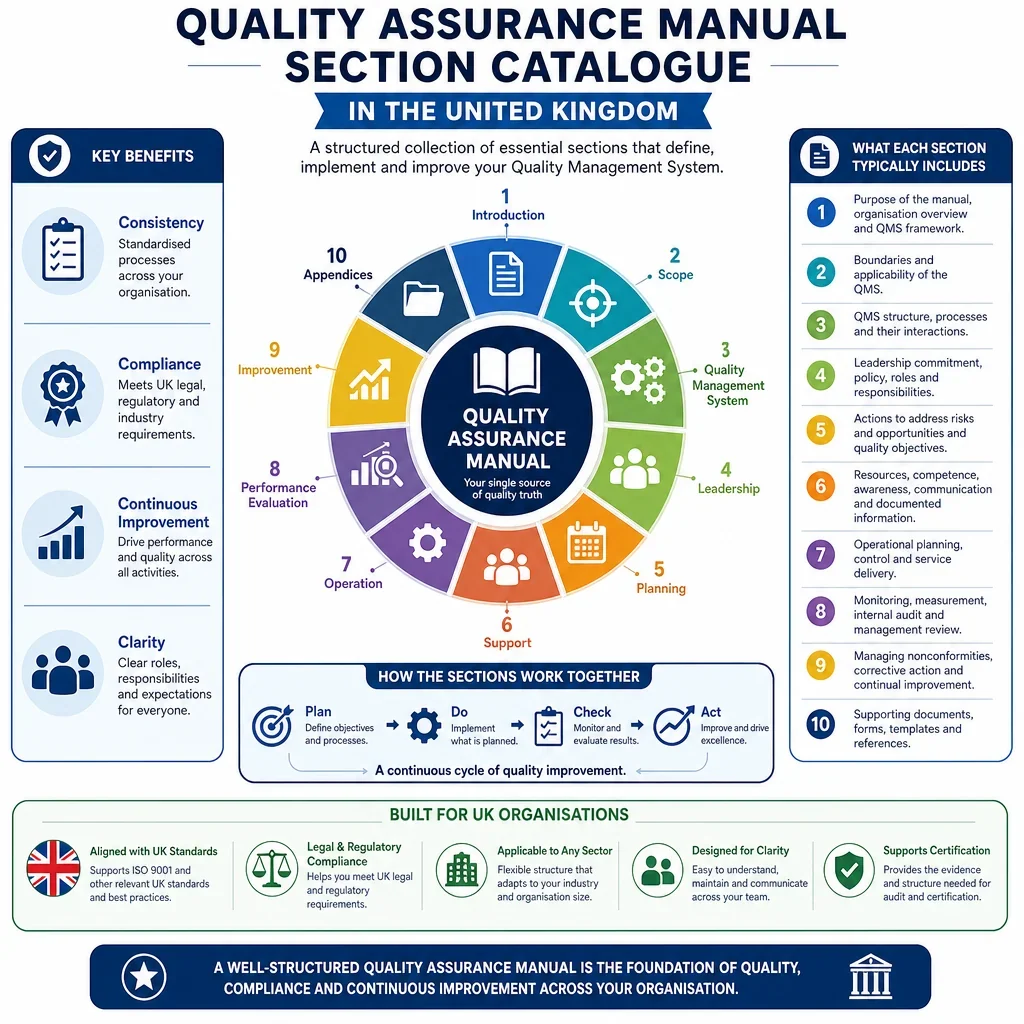
- Quality PolicyA clear statement from top management outlining the organization's commitment to quality and continuous improvement.
- Organizational StructureA description of roles, responsibilities, and reporting lines to ensure everyone understands their part in maintaining quality.
- Quality ObjectivesSpecific, measurable goals that align with the quality policy to guide the organization's efforts.
- Document Control ProceduresSteps to manage the creation, review, approval, and distribution of all quality-related documents.
- Resource ManagementDetails on providing adequate staff training, equipment, and facilities to support quality standards.
- Process ControlsGuidelines for planning, operating, and monitoring key processes to meet quality requirements.
- Inspection and TestingMethods for checking products or services at various stages to ensure they meet set standards.
- Non-Conformity HandlingProcedures for identifying issues, correcting them, and preventing them from happening again.
- Internal AuditsA schedule and approach for regular self-checks to verify the quality system is working effectively.
- Management ReviewRegular meetings where leaders assess the quality system's performance and plan improvements.
- Continuous ImprovementStrategies to regularly enhance processes and outcomes based on feedback and audits.
Generate Your Document in 4 Easy Steps
Why Use Docaro?
 United Kingdom
Free Example Quality Assurance Manual Template
Below is a free template example of a Quality Assurance Manual for use in the United Kingdom generated by our AI model.
The clauses in your actual Quality Assurance Manual will vary from this example as they will be entirely bespoke to your requirements as set out in the questionnaire you complete.
Quality Assurance Manual for XYZ Corporation
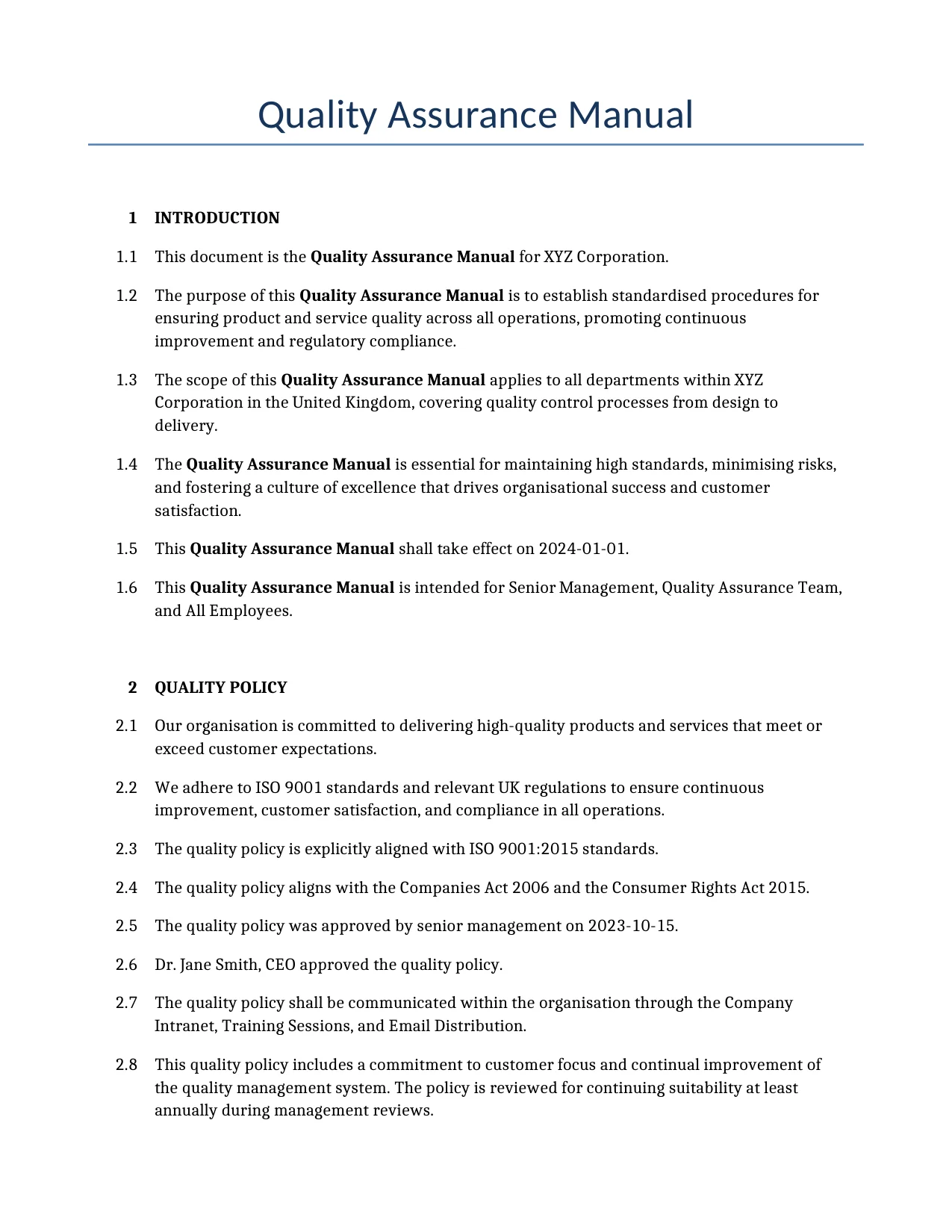
1INTRODUCTION
This document is the Quality Assurance Manual for XYZ Corporation.
The purpose of this Quality Assurance Manual is to establish standardised procedures for ensuring product and service quality across all operations, promoting continuous improvement and regulatory compliance.
The scope of this Quality Assurance Manual applies to all departments within XYZ Corporation in the United Kingdom, covering quality control processes from design to delivery.
The Quality Assurance Manual is essential for maintaining high standards, minimising risks, and fostering a culture of excellence that drives organisational success and customer satisfaction.
This Quality Assurance Manual shall take effect on 2024-01-01.
This Quality Assurance Manual is intended for Senior Management, Quality Assurance Team, and All Employees.
2QUALITY POLICY
Our organisation is committed to delivering high-quality products and services that meet or exceed customer expectations.
We adhere to ISO 9001 standards and relevant UK regulations to ensure continuous improvement, customer satisfaction, and compliance in all operations.
The quality policy is explicitly aligned with ISO 9001:2015 standards.
The quality policy aligns with the Companies Act 2006 and the Consumer Rights Act 2015.
The quality policy was approved by senior management on 2023-10-15.
Dr. Jane Smith, CEO approved the quality policy.
The quality policy shall be communicated within the organisation through the Company Intranet, Training Sessions, and Email Distribution.
This quality policy includes a commitment to customer focus and continual improvement of the quality management system. The policy is reviewed for continuing suitability at least annually during management reviews.
3QUALITY MANAGEMENT SYSTEM OVERVIEW
The scope of our Quality Management System encompasses the design, development, manufacturing, and delivery of electronic components for the automotive industry in the United Kingdom, ensuring compliance with ISO 9001:2015 standards while excluding non-applicable clauses related to post-delivery activities.
Exclusions from the ISO 9001:2015 requirements in our Quality Management System are applicable.
The interested parties relevant to our Quality Management System are Customers, Suppliers, Regulatory Bodies, and Employees.
Internal issues affecting our organisation's context for the Quality Management System include our organisational structure with 150 employees across departments, resource availability such as skilled workforce and technology infrastructure, and internal culture emphasising continuous improvement and employee training programmes.
External issues influencing our organisation's context for the Quality Management System encompass market competition in the UK automotive sector, evolving regulatory requirements from bodies like the UK Accreditation Service, economic factors such as supply chain disruptions, and technological advancements in manufacturing processes.
The core processes that are part of our Quality Management System structure are Leadership and Commitment, Planning and Risk Management, Support and Resources, and Operation and Control.
Our Quality Management System is structured around the Plan-Do-Check-Act (PDCA) cycle, incorporating key components such as documented procedures for quality policy and objectives, risk-based thinking for process planning, internal audit mechanisms, and management review processes to ensure ongoing conformance to ISO 9001:2015.
XYZ Corporation intends to pursue formal certification of its Quality Management System to ISO 9001:2015.
4ORGANIZATIONAL STRUCTURE AND RESPONSIBILITIES
Dr. Emily Carter is the Quality Manager responsible for UK operations.
The Quality Manager oversees the development and implementation of quality assurance policies, conducts regular audits to ensure compliance with UK regulations such as ISO 9001 and BSI standards, manages the QA team, and reports on quality metrics to senior leadership.
The Quality Manager also handles risk assessments, training programmes for staff, and continuous improvement initiatives.
The Quality Manager reports directly to the Director of Operations.
The Quality Manager holds qualifications including ISO 9001 Certification, Lead Auditor Qualification, and a Degree in Quality Management that are relevant to quality assurance in the United Kingdom.
There are 8 personnel in the Quality Assurance team for UK operations.
There is a dedicated Compliance Officer role for quality assurance in UK operations.
The planned start date for implementing this organisational structure in UK operations is 2024-01-15.
The frequency of quality assurance reporting to senior management in UK operations is Quarterly.
5QUALITY OBJECTIVES AND PLANNING
The specific quality objectives that support the policy include achieving 95 percent customer satisfaction, reducing defect rates to under 1 percent, and ensuring 100 percent compliance with ISO 9001 standards.
The quality objectives are designed to enhance operational efficiency, improve product reliability, and foster continuous improvement across all departments, directly supporting our commitment to excellence in service delivery.
The quality objectives shall be measurable through specific metrics.
The target percentage achievement for the quality objectives is 95 percent.
The first review date for the quality objectives shall be 2024-06-30.
The quality objectives are aligned with the organisation's overall business goals.
The planning processes for achieving the quality objectives involve cross-functional team workshops, risk assessments, resource allocation, and the development of action plans with clear timelines and responsibilities to ensure objectives are met.
The planning processes shall be updated Quarterly.
The planning processes for quality objectives shall start on 2024-01-01.
6RISK MANAGEMENT
Risk assessments shall be included in the quality planning processes.
The procedure the company uses for identifying risks to quality is that the company conducts regular team meetings and uses hazard checklists to identify potential risks to quality, followed by documentation in the central risk register.
The company conducts annual risk assessments for quality management.
The frequency at which the company performs quality risk assessments is Quarterly.
The methodology the company uses for assessing quality risks is a matrix-based approach, evaluating risks based on likelihood and impact scores to prioritise mitigation efforts.
The primary strategies the company employs to mitigate identified quality risks are Training Programmes, Process Redesign, and Third Party Audits.
The company has currently identified and documented 12 risks.
John Smith, Quality Assurance Manager is the designated person responsible for overseeing risk management procedures.
The risk management procedure explicitly references compliance with UK health and safety laws.
In accordance with ISO 9001:2015 clause 6.1, the company also identifies opportunities that can enhance customer satisfaction, achieve improved performance, and prevent undesired effects. Opportunities are identified during risk assessments, management reviews, and operational planning using tools such as SWOT analysis and stakeholder feedback. Actions to address risks and opportunities are integrated into the QMS processes, assigned to responsible owners with timelines, and evaluated for effectiveness through subsequent monitoring, audits, and management reviews. Records of these actions and their outcomes are maintained as documented information.
7RESOURCE MANAGEMENT
There are 15 full-time employees currently allocated to quality assurance activities.
The key roles allocated within the organisation for quality assurance purposes are Quality Manager, Compliance Officer, and Auditor.
The annual budget allocated for training quality assurance personnel is 25000.50 GBP.
Dedicated facilities or infrastructure are specifically allocated for quality assurance activities.
The infrastructural resources allocated for quality assurance include a dedicated quality assurance lab equipped with testing benches, specialised software tools like Minitab for statistical analysis, and a network of quality management systems including ISO-compliant databases.
The environmental resources or controls implemented for quality assurance processes are Temperature Control Systems, Humidity Regulation, and Waste Management Protocols.
The annual budget allocated for maintaining environmental resources in quality assurance is 15000.00 GBP.
8TRAINING AND COMPETENCE
The organisation provides comprehensive training programmes to staff involved in quality assurance, including introductory courses on ISO 9001 standards, advanced modules on auditing techniques, and specialised workshops on risk management and continuous improvement processes.
The company's training policy for staff ensures that all staff receive ongoing development aligned with organisational goals.
The training policy mandates initial induction training for new hires, annual refresher courses, and personalised development plans based on performance reviews, with a focus on compliance with UK health and safety regulations.
A formal training programme is in place for the staff.
The methods for delivering training to the staff include In-person workshops, Online courses, and On-the-job mentoring.
40 hours of training shall be allocated per staff member annually.
The methods the company uses for assessing staff competence are a combination of practical evaluations, such as simulated quality audits, written knowledge tests, peer reviews, and supervisor observations, ensuring alignment with ISO standards and UK regulatory requirements.
Regular competence assessments shall be conducted for all staff.
Competence assessments shall be conducted Annually.
The awareness initiatives the company implements for staff include monthly newsletters on quality assurance updates, annual awareness days focusing on regulatory changes in the UK, and interactive sessions on ethical practices and environmental responsibilities to foster a culture of continuous improvement.
150 staff members were trained last year.
9COMMUNICATION
The processes for internal communication related to quality matters within the organisation are facilitated through regular updates via the company's intranet and scheduled team briefings.
All departments are notified of quality incidents within 24 hours, and feedback is encouraged through anonymous channels to ensure continuous improvement.
The processes for external communication related to quality matters, such as with suppliers or customers, involve timely notifications to suppliers about quality requirements and to customers regarding any product issues.
This external communication is managed through dedicated portals and formal correspondence, ensuring compliance with UK regulations and maintaining transparency.
The methods used for internal communication on quality matters are Email Notifications, Intranet Portal, and Team Meetings.
The methods used for external communication on quality matters are Customer Portals, Phone Calls, and Supplier Meetings.
Internal quality reports for communication shall be generated 12 times per year.
A formal escalation procedure shall be included in the communication processes for quality issues.
10DOCUMENTED INFORMATION
Documented information required by the quality management system and ISO 9001:2015 is controlled to ensure it is available and suitable for use, where and when it is needed, and adequately protected from loss of confidentiality, improper use, or loss of integrity. This applies to both internal and external origins.
Documented information is identified by title, date, author, version number, and applicable classification. It is described with clear purpose, scope, and references where necessary. Formats include both electronic (e.g., PDF, Word) and hard copy as appropriate for the activity.
The procedure for creating quality documents and records is that quality documents and records are created using standardised templates in Microsoft Word. The process begins with drafting by the relevant department, followed by review for completeness and accuracy before finalisation.
A formal approval workflow shall be implemented for quality documents. The Quality Manager shall be designated as the approval authority for quality documents. The criteria used for approving quality documents are that approval is granted only if the document complies with ISO 9001 standards, is free of errors, and has been reviewed by at least two stakeholders for relevance and clarity.
Documented information is reviewed and updated as necessary through a formal change control process, with changes identified (e.g., revision history) and re-approved prior to distribution.
Electronic distribution of quality documents shall be enabled. The methods used for distributing quality documents and records are Email Notifications and Document Management System. Access is controlled on a role-based basis to ensure only authorised personnel can retrieve and use the information.
Documented information is stored in a secure, encrypted cloud-based system accessible only to authorised personnel, with regular backups performed weekly to prevent data loss. Suitable controls for preservation include protection against unauthorised access, environmental degradation for hard copies, and regular integrity checks.
3 previous versions of each quality document shall be retained. Retention periods are defined based on regulatory requirements (e.g., Companies Act 2006, Data Protection Act 2018), customer contracts, and organisational needs. Disposition of obsolete documented information is via secure deletion or shredding to prevent unintended use.
Role-based access control shall be implemented for quality documents. The method used for disposing of obsolete quality records is Secure Shredding.
11OPERATIONAL PLANNING AND CONTROL
The process the company uses for planning operations to ensure quality requirements are met is that the company follows a structured operational planning process that begins with defining quality objectives based on ISO 9001 standards.
The company conducts initial assessments of resources and capabilities, followed by detailed scheduling of production activities.
Quality checkpoints are integrated at each stage, including material sourcing, process execution, and final output verification to ensure all requirements are met.
Formal risk assessment procedures shall be included in the operational planning guidelines.
The quality control methods implemented during operations are Statistical Process Control and Inspection and Testing.
Operational plans shall be reviewed 4 times per year.
The last update for these operational guidelines was on 2023-10-15.
Documentation of all operational changes shall be required.
The percentage quality target set for operations is 98.5 percent.
The procedure the company follows for handling operational non-conformances is that when a non-conformance is identified during operations, it is immediately reported to the quality manager.
The item or process is quarantined, root cause analysis is performed using tools like the 5 Whys method, corrective actions are implemented, and the incident is documented in the non-conformance register.
Follow-up audits ensure the issue is resolved and preventive measures are applied to avoid recurrence.
12PRODUCT AND SERVICE REQUIREMENTS
The processes the company uses to determine customer requirements for products and services are that the company determines customer requirements through a structured process that includes initial client consultations to gather preliminary needs, followed by detailed surveys to capture specific preferences and expectations for products and services.
The processes the company uses to review regulatory requirements applicable to products and services in the UK market are that the company conducts quarterly reviews of regulatory requirements by assigning a compliance team to monitor updates from key UK bodies, analyse their impact on products and services, and integrate necessary changes into operational protocols.
The date of the company's last review of regulatory requirements was 2023-09-15.
The methods the company uses to determine customer requirements are Surveys and Questionnaires, Direct Consultations, and Market Research Analysis.
The regulatory sources the company monitors for UK market requirements are Health and Safety Executive Guidelines, UK Government Legislation Updates, and British Standards Institution Documents.
The company reviews customer requirements 4 times per year.
13DESIGN AND DEVELOPMENT
Formal procedures are in place for design and development activities.
The stages included in the planning of design and development activities are Initial Concept, Resource Allocation, Timeline Setting, and Risk Assessment.
The types of inputs used in the design and development process include customer requirements, regulatory standards applicable in the UK, technical specifications, and feedback from previous projects to ensure comprehensive planning.
Documented outputs shall be maintained for all design and development activities.
The types of reviews incorporated into the design and development process are Preliminary Design Review, Critical Design Review, and Peer Review.
Verification shall be performed to ensure design outputs meet input requirements.
Validation shall be conducted to ensure the design meets user needs and intended use.
The roles involved in overseeing design and development controls are Design Manager, Quality Assurance Officer, and Project Engineer.
The procedure for controlling changes in design and development is that changes are controlled through a formal process involving impact assessment, approval by the Design Manager, documentation updates, and re-verification to comply with UK quality standards.
14CONTROL OF EXTERNALLY PROVIDED PROCESSES, PRODUCTS, AND SERVICES
In accordance with ISO 9001:2015 clause 8.4, the organisation ensures that externally provided processes, products, and services conform to requirements. This includes controls applied to external providers and verification activities.
Processes that impact quality standards are currently outsourced. The types of processes the company outsources that require quality control are Manufacturing and Logistics and Distribution.
The criteria the company uses for selection, evaluation, monitoring, and re-evaluation of external providers are that suppliers are evaluated based on quality certifications such as ISO 9001, track record of on-time delivery, cost competitiveness, and technical capability assessments. Evaluation includes initial audits, review of references, and sample testing. Re-evaluation occurs annually or upon significant changes, with performance monitored via key metrics.
A formal approval process for new suppliers is in place. There are currently 12 external suppliers approved for quality-critical processes. The metrics the company uses to evaluate supplier performance are On-time Delivery Rate, Defect Rate, and Compliance Audit Scores. Regular audits of external suppliers shall be conducted.
Types of control applied to externally provided processes, products, and services include verification of purchased products upon receipt, on-site audits at supplier premises, review of certificates of conformity, and ongoing performance monitoring. Verification activities include inspection, testing, and review of documentation prior to acceptance.
The procedures the company follows for corrective actions with underperforming suppliers are that a corrective action request form is initiated, root cause analysis is conducted using tools like 5 Whys, agreed improvements are implemented, and progress is monitored through quarterly reviews. Persistent issues may lead to supplier probation or termination. Supplier contracts include specific quality assurance clauses.
There are 8 active contracts with external providers for controlled processes. The company manages risks associated with outsourced processes by conducting annual risk assessments using a Failure Mode and Effects Analysis framework, diversifying suppliers to avoid single points of failure, and including risk mitigation clauses in contracts such as backup supply options. Contingency plans are in place for key external suppliers.
15PRODUCTION AND SERVICE PROVISION
The procedures for controlled production involve a step-by-step process starting with raw material inspection, followed by automated assembly lines monitored by quality checkpoints, and ending with final testing to ensure compliance with ISO 9001 standards.
All steps are documented in real-time using the ERP system to maintain control and prevent deviations.
The procedures for controlled service delivery include initial client consultation to define requirements, scheduled on-site or remote delivery with progress tracking via a customer portal, and post-delivery review to confirm satisfaction and address any issues, ensuring all services meet contractual obligations and regulatory requirements in the United Kingdom.
Procedures for the identification of production outputs and services are implemented in the operations.
A traceability system is maintained for tracking production and service provision from initiation to delivery.
The methods used for traceability tracking in the production and service processes are Serial Numbering, Digital Logging, and Documented Records.
Traceability records shall be retained for a minimum of 7 years from the date of delivery, in compliance with UK data protection regulations and industry standards, to allow for audits and potential recalls.
Internal audits of the traceability systems shall be conducted every 6 months.
The procedures include requirements for traceability when using external providers in production or service delivery.
See Appendix A for the Non-Conformance Report template, referenced in procedures for handling nonconforming outputs during production.
16RELEASE OF PRODUCTS AND SERVICES
The specific criteria established for approving the release of products and services to customers are that all products must pass functional testing with zero critical defects, meet customer specifications, and receive sign-off from the quality control team.
Services must be verified against service level agreements and undergo a final user acceptance test.
A final quality inspection shall be required before releasing products and services to customers.
The Quality Manager shall authorise the final release of products and services to customers.
The step-by-step process for approving and releasing products and services to customers is as follows: complete production or service delivery, conduct internal quality checks, perform final quality inspection, obtain approval from the Quality Manager, generate release documentation, and notify customers and initiate delivery or deployment.
The effective date for this release of products and services policy is 2024-01-01.
Products and services that do not meet the release criteria shall be handled by Quarantine and Rework or Escalation to Senior Review.
The documentation required for each release of products and services to customers is a release certificate signed by the Quality Manager, inspection report with test results, compliance checklist against criteria, and customer notification letter.
17CONTROL OF NONCONFORMING OUTPUTS
Nonconforming outputs are defined as products or services that do not meet the specified requirements, standards, or customer expectations as defined in the quality management system.
A detailed procedure for identifying nonconforming outputs shall be included.
The methods the staff shall use for identifying nonconforming outputs are Visual Inspection, Automated Testing, and Customer Feedback Integration.
The protocol for segregating identified nonconforming outputs is that upon identification, nonconforming outputs must be immediately tagged with a red 'Nonconforming' label and moved to a designated quarantine area separate from conforming products to prevent unintended use or delivery.
The disposition options for nonconforming outputs include Rework or Repair, Scrap or Destruction, and Return to Supplier.
The Quality Manager or their designated deputy is responsible for authorising the disposition of all nonconforming outputs.
Mandatory record retention shall be enabled for all nonconforming outputs. See Appendix A for the Non-Conformance Report and Corrective Action Request templates.
18PERFORMANCE EVALUATION
The frequency of monitoring activities for the Quality Management System performance is that monitoring activities will be conducted monthly to ensure ongoing Quality Management System performance tracking.
Scheduled internal audits shall be included as part of the monitoring in the Performance Evaluation section.
The key performance indicators to be measured for Quality Management System evaluation are Customer Satisfaction Score, Non-Conformance Rate, and On-Time Delivery Percentage.
The methods for analysing Quality Management System data are that data will be analysed using statistical tools such as trend analysis and root cause analysis to identify improvement opportunities.
Formal Quality Management System performance evaluations shall be conducted Quarterly.
Top management reviews shall be included in the Quality Management System performance evaluation process.
Detailed procedures for conducting customer satisfaction monitoring in accordance with ISO 9001:2015 clause 9.1.2 include collection of feedback via post-delivery surveys, Net Promoter Score tracking, direct customer interviews, and analysis of complaints data. Feedback is collected quarterly, analysed using trend analysis to identify patterns, and used to drive improvement actions such as process changes or training, with results reviewed in management reviews. Records of customer satisfaction data and actions are maintained as documented information. See Appendix A for sample templates related to performance evaluation.
19MONITORING AND MEASUREMENT
Formal methods for monitoring customer satisfaction shall be implemented.
The methods for monitoring customer satisfaction are Surveys and Questionnaires and Net Promoter Score Tracking.
Customer satisfaction monitoring activities shall be conducted Quarterly.
Methods for monitoring process performance shall be established.
The key performance indicators for monitoring process performance are Cycle Time and On-Time Delivery Rate.
The start date for the initial review of process performance monitoring is 2024-01-01.
Methods for monitoring product conformity shall be implemented.
The methods for monitoring product conformity are Inspection and Testing and Calibration of Equipment.
20INTERNAL AUDIT
The internal audit policy ensures that audits are planned, conducted, and reported in compliance with ISO 9001 standards, focusing on continual improvement and risk-based auditing practices.
A fixed frequency shall be established for conducting internal audits.
The internal audits shall cover Quality Management System Processes and Risk and Opportunity Management.
The specific objectives set for the internal audits are to verify compliance with ISO 9001 requirements, identify non-conformities, and recommend actions for process improvements.
3 internal auditors shall be designated for conducting the audits.
The option to use external auditors for internal audits shall be incorporated when internal resources are insufficient.
The internal audit reports shall be distributed to Senior Management, Quality Manager, and Department Heads.
The procedure for handling corrective actions following internal audits is that corrective actions will involve root cause analysis, implementation of fixes within 30 days, and verification through follow-up audits.
An audit programme is established that considers the importance of the processes, changes affecting the organisation, and results of previous audits. Audits shall be conducted by objective and impartial auditors. Results of the audits are reported to relevant management.
See Appendix A for the Internal Audit Checklist template.
21MANAGEMENT REVIEW
The last management review of the Quality Management System was conducted by top management on 2023-06-15.
The management reviews shall occur at intervals of annually.
The management review process shall include a review of the performance and effectiveness of the Quality Management System, such as key performance indicators.
Customer feedback and complaints shall be incorporated into the management review process by being compiled quarterly from the CRM system and presented as a dedicated agenda item during the management review, including trends, resolution rates, and action plans.
The results of internal audits shall be included in the management review agenda.
The next planned management review of the Quality Management System shall be on 2024-06-15.
The management review shall evaluate the need for changes to resources, such as personnel or equipment, and shall always include this evaluation.
The management review process shall explicitly focus on opportunities for improving the effectiveness of the Quality Management System.
The procedure for documenting the outputs and minutes of the management review meetings is that minutes will be documented using a standardised template, including attendees, agenda items discussed, decisions made, and assigned actions.
They will be circulated to all participants within 5 business days and archived in the company's document management system for compliance records.
Management reviews shall consider the following inputs as required by ISO 9001:2015 clause 9.3.2: status of actions from previous management reviews; changes in external and internal issues relevant to the QMS; customer satisfaction and feedback from relevant interested parties; the extent to which quality objectives have been met; process performance and conformity of products and services; nonconformities and corrective actions; monitoring and measurement results; audit results; performance of external providers; adequacy of resources; effectiveness of actions taken to address risks and opportunities. Management reviews shall produce the following outputs: decisions and actions relating to opportunities for improvement; any need for changes to the QMS; resource needs. See Appendix A for the Management Review Minutes template.
22NONCONFORMITY AND CORRECTIVE ACTION
Nonconformity is defined as the non-fulfilment of a specified requirement in the quality management system, product, or service.
Immediate notification of nonconformities to the quality manager shall be required.
The methods for reporting nonconformities are Electronic Form and Email Report.
The preferred method for conducting root cause analysis is a structured approach using the 5 Whys technique to systematically identify the underlying causes of nonconformities.
The Quality Manager shall authorise the implementation of corrective actions.
A review of the effectiveness of implemented corrective actions shall be mandated.
The procedure for handling nonconforming products or services is that nonconforming products shall be quarantined immediately, tagged for identification, and evaluated by the quality team for disposition, which may include rework, repair, or scrapping.
The tools for root cause analysis include the 5 Whys Technique and Fishbone Diagram. See Appendix A for the Corrective Action Request and Risk Assessment Form templates.
23CONTINUAL IMPROVEMENT
The specific objectives for the continual improvement of the Quality Management System are to achieve a 20 percent reduction in non-conformities within the next year, enhance process efficiency by streamlining workflows, and increase employee training completion rates to 95 percent to support overall Quality Management System maturity.
A regular schedule for internal audits shall be established as part of the continual improvement processes.
Internal audits to support continual improvement shall be conducted Quarterly.
The process senior management will use for reviewing the Quality Management System to drive continual improvement is that senior management will conduct formal reviews quarterly, analysing audit results, key performance indicator performance, and feedback from stakeholders to identify trends and implement necessary adjustments to the Quality Management System.
A formal procedure for handling corrective actions arising from Quality Management System audits and reviews shall be implemented.
The key performance indicators to be tracked for measuring Quality Management System continual improvement are Customer Satisfaction Score, Non-Conformity Rate, and Process Efficiency Metric.
The mechanisms the organisation intends to use for gathering feedback to inform Quality Management System improvements are annual employee surveys, customer feedback forms after service interactions, and suggestion boxes in the workplace, with all inputs reviewed monthly during team meetings to drive Quality Management System enhancements.
24REGULATORY COMPLIANCE
Dr. Elena Ramirez is appointed as the Data Protection Officer to handle General Data Protection Regulation compliance.
The email address of the appointed Data Protection Officer is elena.ramirez@company.co.uk.
The company has obtained General Data Protection Regulation compliance certification.
The last date the company conducted a General Data Protection Regulation compliance review was 2023-06-15.
The products or categories the company needs to apply UKCA marking to are Machinery and Electrical Equipment.
The company has completed UKCA marking conformity assessments for applicable products.
Johnathan Hale, Compliance Manager is the responsible person for UKCA marking compliance.
The environmental laws the company needs to comply with in the United Kingdom are Waste Management and Producer Responsibility.
The last date the company conducted an environmental compliance audit was 2023-09-20.
The company's estimated annual carbon emissions are 1250 tonnes.
An Environmental Management System compliant with ISO 14001 shall be implemented.
The organisation ensures compliance with the UK Product Safety and Metrology Regulations 2011 (as amended), the Health and Safety at Work etc. Act 1974, and sector-specific regulations relevant to electronic components for the automotive industry such as IATF 16949 supplementary requirements where applicable. Responsibilities for compliance lie with the Compliance Manager and Quality Manager, who oversee monitoring processes including regular audits, regulatory horizon scanning via subscriptions to updates from the Health and Safety Executive, Department for Business and Trade, and BSI. Records of compliance, including audit reports, training records, and incident logs, are maintained as documented information for a minimum of 7 years or as required by law. Non-compliance is addressed through the nonconformity and corrective action process.
25EMERGENCY PREPAREDNESS AND RESPONSE
The organisation establishes, implements, and maintains processes to identify potential emergency situations that could impact product quality, customer safety, or the environment, particularly relevant to automotive component manufacturing in the UK. These include fire, power failure, supply chain disruptions, chemical spills, equipment malfunction, and natural disasters.
Emergency preparedness plans are developed, including response procedures, assigned responsibilities, communication protocols, and coordination with external services such as emergency responders. Plans are tested through drills at least annually, reviewed after any incident or test, and improved based on lessons learned. Records of tests, reviews, and actions are maintained as documented information. Integration with the QMS ensures that emergency responses do not compromise product conformity, with post-event reviews feeding into management reviews and risk management processes. Compliance with relevant UK laws such as the Health and Safety at Work etc. Act 1974 and the Control of Major Accident Hazards Regulations is ensured.
26HANDLING OF CUSTOMER PROPERTY
In accordance with ISO 9001:2015 clause 8.5.3, procedures are established for the identification, verification, protection, and safeguarding of customer property while it is under the organisation's control or being used by the organisation. Customer property includes materials, components, tooling, intellectual property, and data provided by the customer.
Upon receipt, customer property is identified, inspected for damage or discrepancies, and verified against delivery documentation. It is protected from damage, contamination, or deterioration through appropriate storage, handling, and maintenance procedures. Access is controlled, and traceability is maintained where required. In the event of loss, damage, or unsuitability for use, the customer is notified immediately, with details recorded in the non-conformance register. Corrective actions are taken as appropriate, and records of all activities are maintained as documented information.
27APPENDICES AND REFERENCES
A list of appendices shall be included in the Appendices and References section.
A glossary shall be included in the Appendices and References section.
A list of templates shall be included in the Appendices and References section.
The types of appendices referenced in the list are Process Flowcharts and Checklists.
The types of templates included in the list are Quality Control Template and Risk Assessment Template.
The date of the last update for the appendices and references is 2023-10-15.
Appendix A: Sample Forms and Templates. This appendix includes the following sample forms and templates for key processes: Non-Conformance Report, Corrective Action Request, Management Review Minutes, Internal Audit Checklist, and Risk Assessment Form. These are referenced throughout the relevant sections of this manual (e.g., sections on Risk Management, Internal Audit, Management Review, Nonconformity and Corrective Action, Production and Service Provision, and Performance Evaluation). Templates are provided in standardised formats and shall be used to ensure consistency and compliance with ISO 9001:2015 and UK regulations including the Companies Act 2006, Consumer Rights Act 2015, and Data Protection Act 2018.
28REVISION HISTORY
The initial version number assigned to the Quality Assurance Manual is 1.0.
The initial approval date for the Quality Assurance Manual is 2023-10-15.
Dr. Jane Smith is named as the initial approver of the Quality Assurance Manual.
Tracking of future revisions shall be enabled in the Revision History section.
29GOVERNING LAW
This Quality Assurance Manual and all matters arising from or in connection with it shall be governed by and construed in accordance with the laws of the United Kingdom.
The parties agree that the courts of the United Kingdom shall have exclusive jurisdiction to settle any dispute or claim that arises out of or in connection with this Quality Assurance Manual or its subject matter or formation.
30SIGNATURES
This Quality Assurance Manual is approved and accepted by the undersigned parties as of the effective date stated in Section 1.
Signed for and on behalf of XYZ Corporation by Dr. Jane Smith, CEO: _______________________________ Date: _______________
Signed for and on behalf of the Quality Assurance Team by Dr. Emily Carter, Quality Manager: _______________________________ Date: _______________
This example shows approximately 70% of a typical document and is provided for illustrative purposes only. The remaining content has been omitted.
Every document generated by Docaro is tailored to your specific circumstances, jurisdiction and the information you provide. The completed document includes all applicable clauses and provisions required for your situation.
To generate the full, personalised document, answer a short series of questions and your document will be created instantly.
Useful Resources When Considering a Quality Assurance Manual in the United Kingdom
United Kingdom Reference Legislation
Quality Assurance Manual FAQs
Document Generation FAQs
Related Articles