AI Generated British Copyright Licence Agreement
PDF & Word - 2026 Updated
Docaro Pricing
When do you need a Copyright Licence Agreement in the United Kingdom?
British Legal Rules for a Copyright Licence Agreement
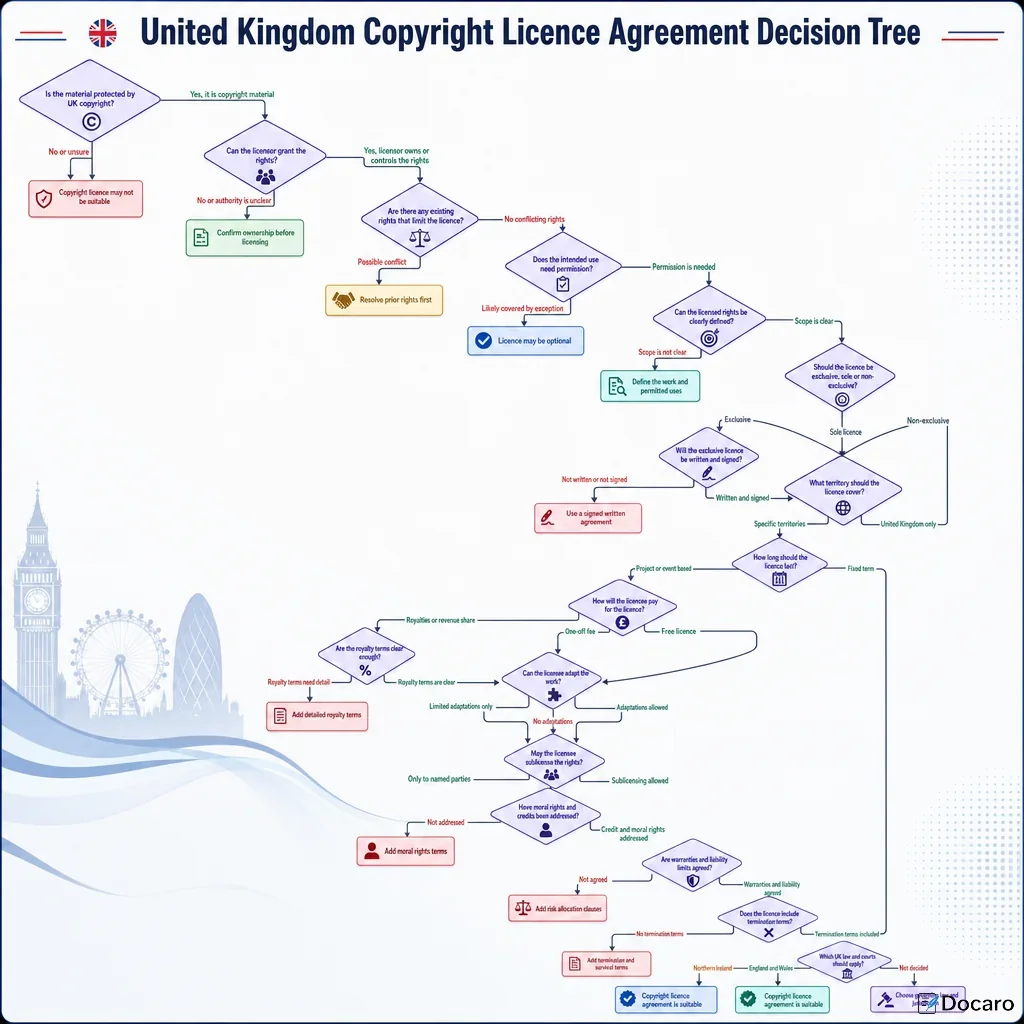
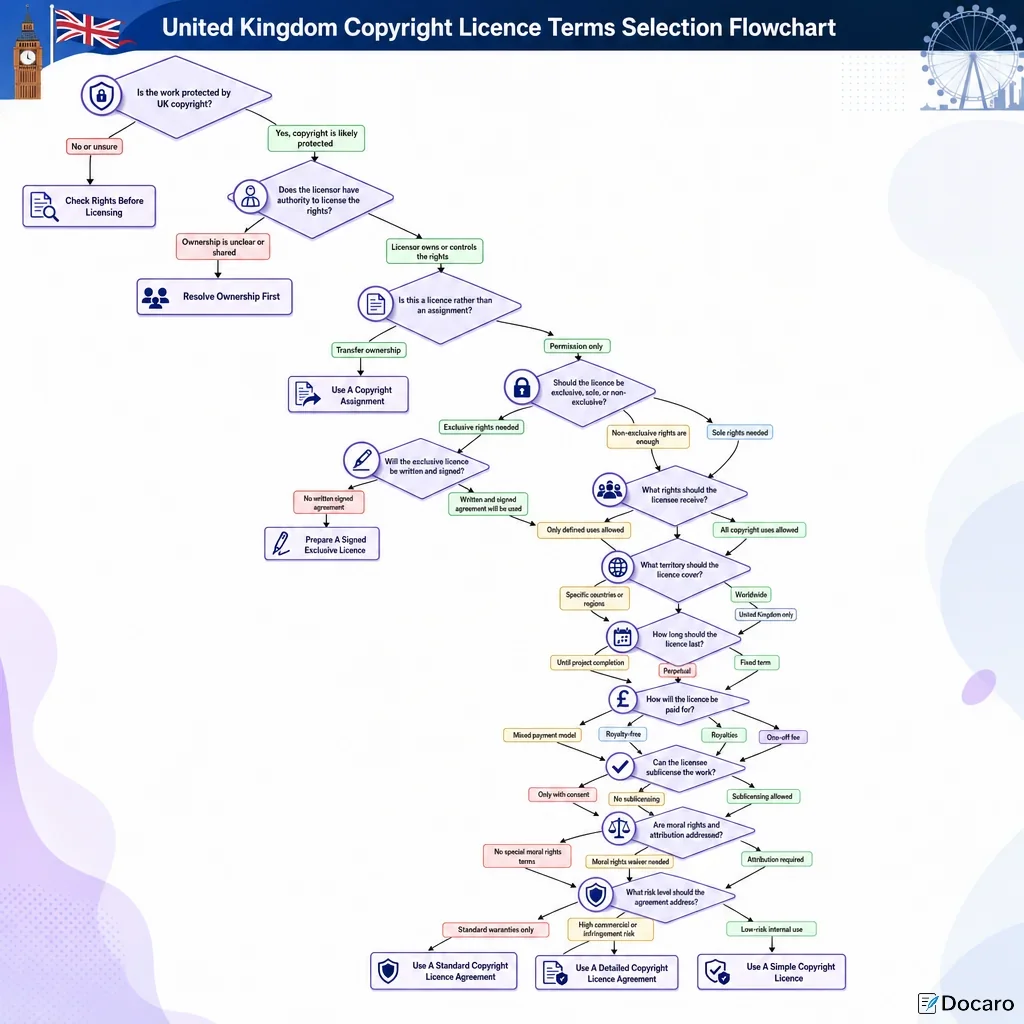
Using the wrong type of copyright license agreement can inadvertently grant or limit rights beyond what was intended, potentially leading to disputes or invalidation.
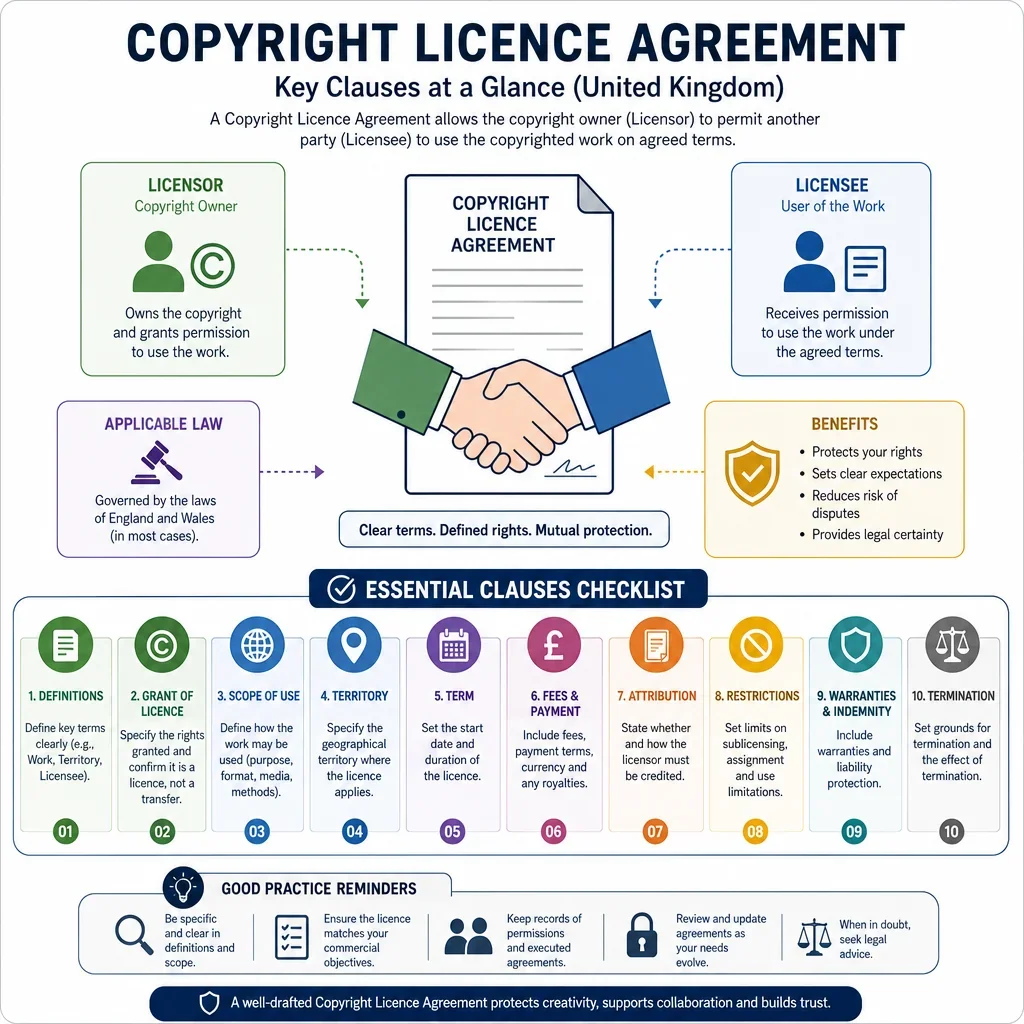
What a Proper Copyright Licence Agreement Should Include
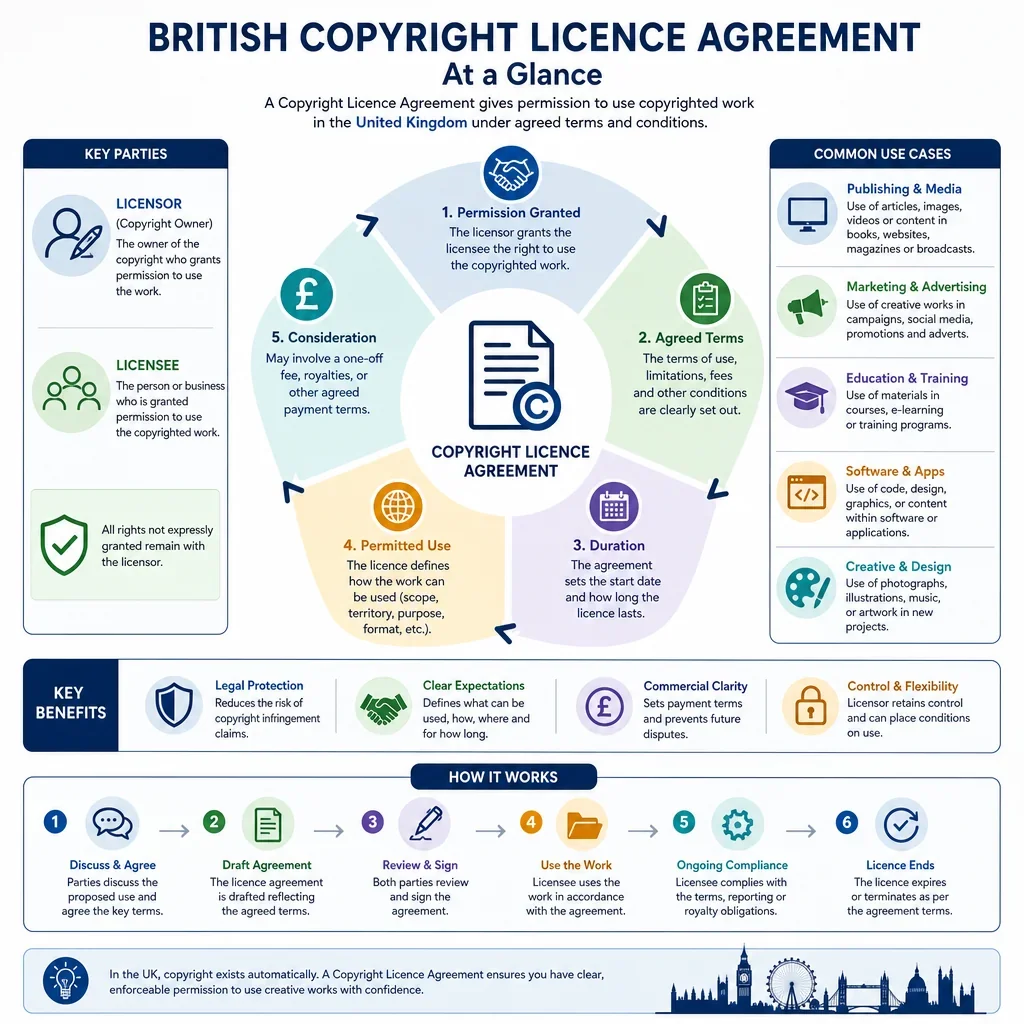
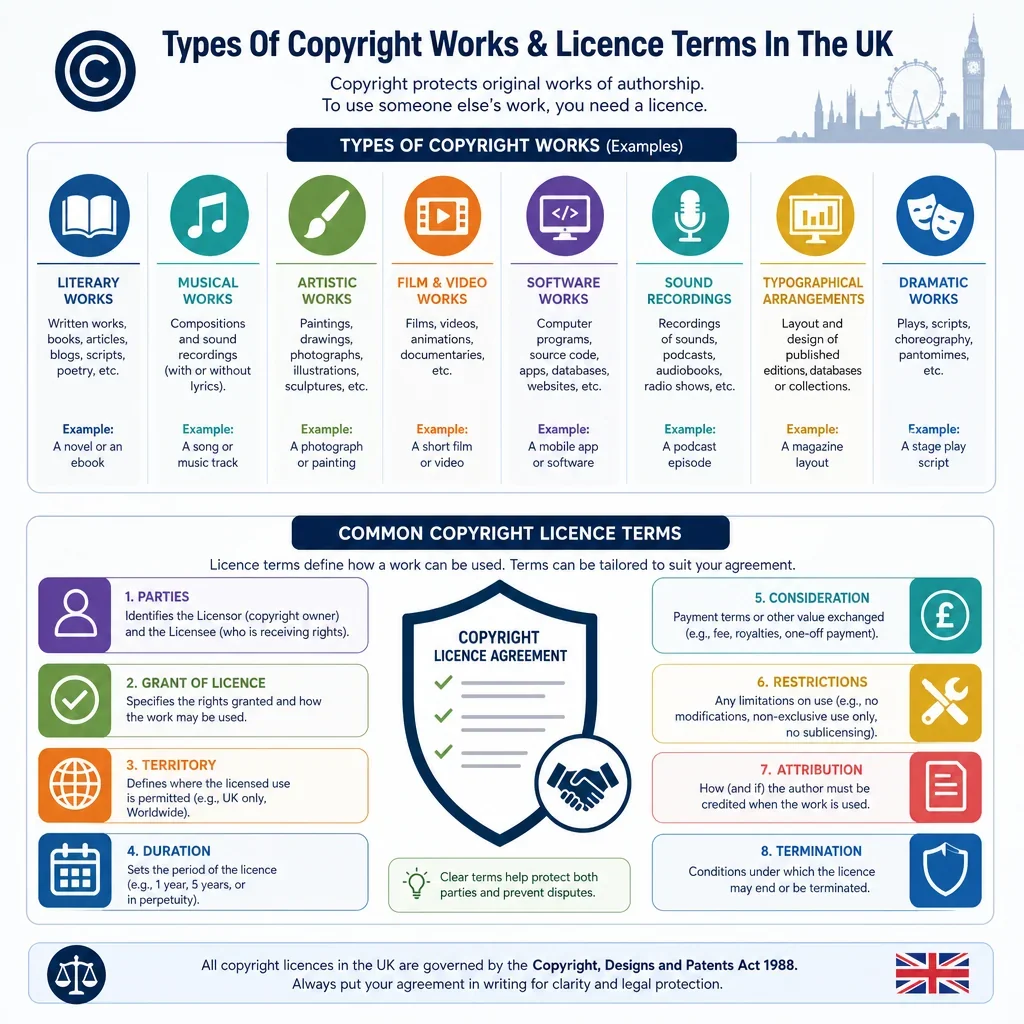
- Parties InvolvedClearly identify the owner of the copyright and the person or company receiving the licence to use it.
- Description of the WorkSpecify exactly what copyrighted material is being licensed, such as a book, software, or artwork.
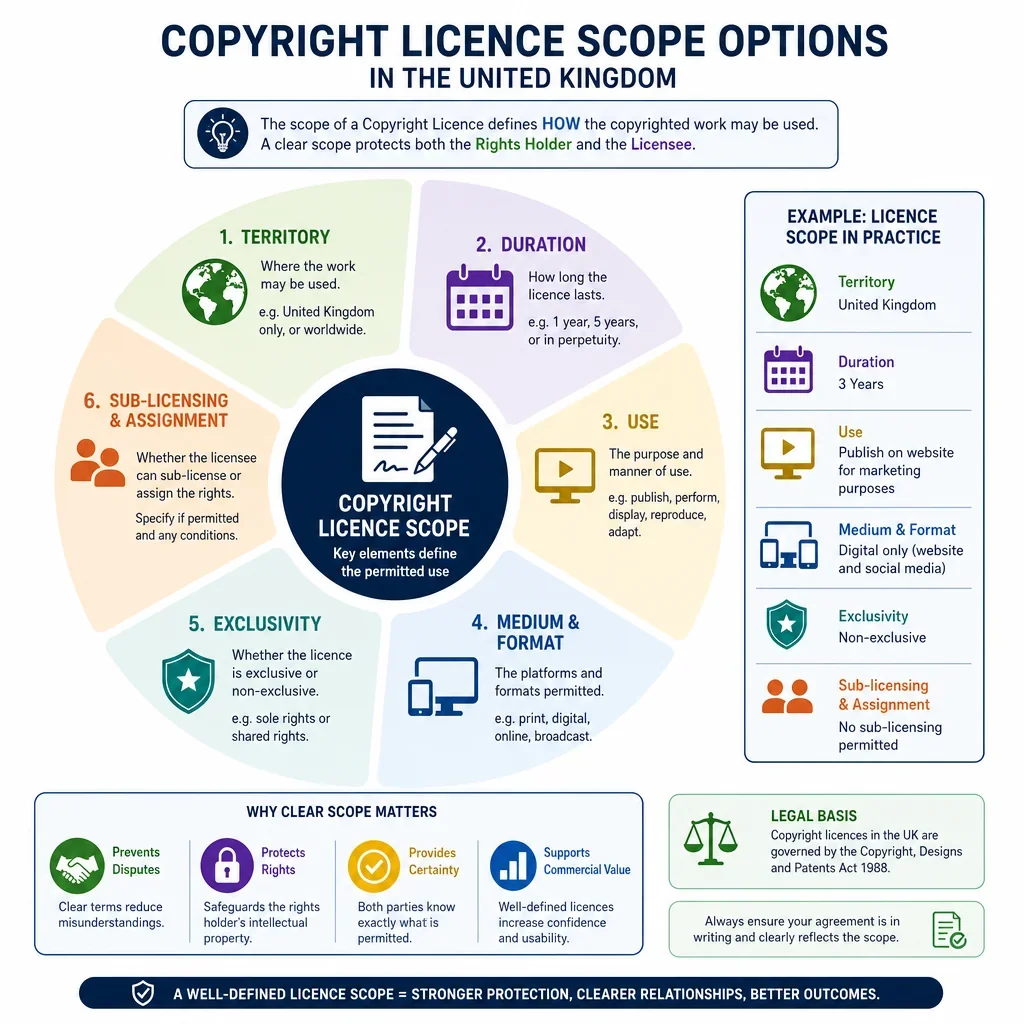
- Type of LicenceState whether the licence is exclusive (only the licensee can use it) or non-exclusive (others can too).
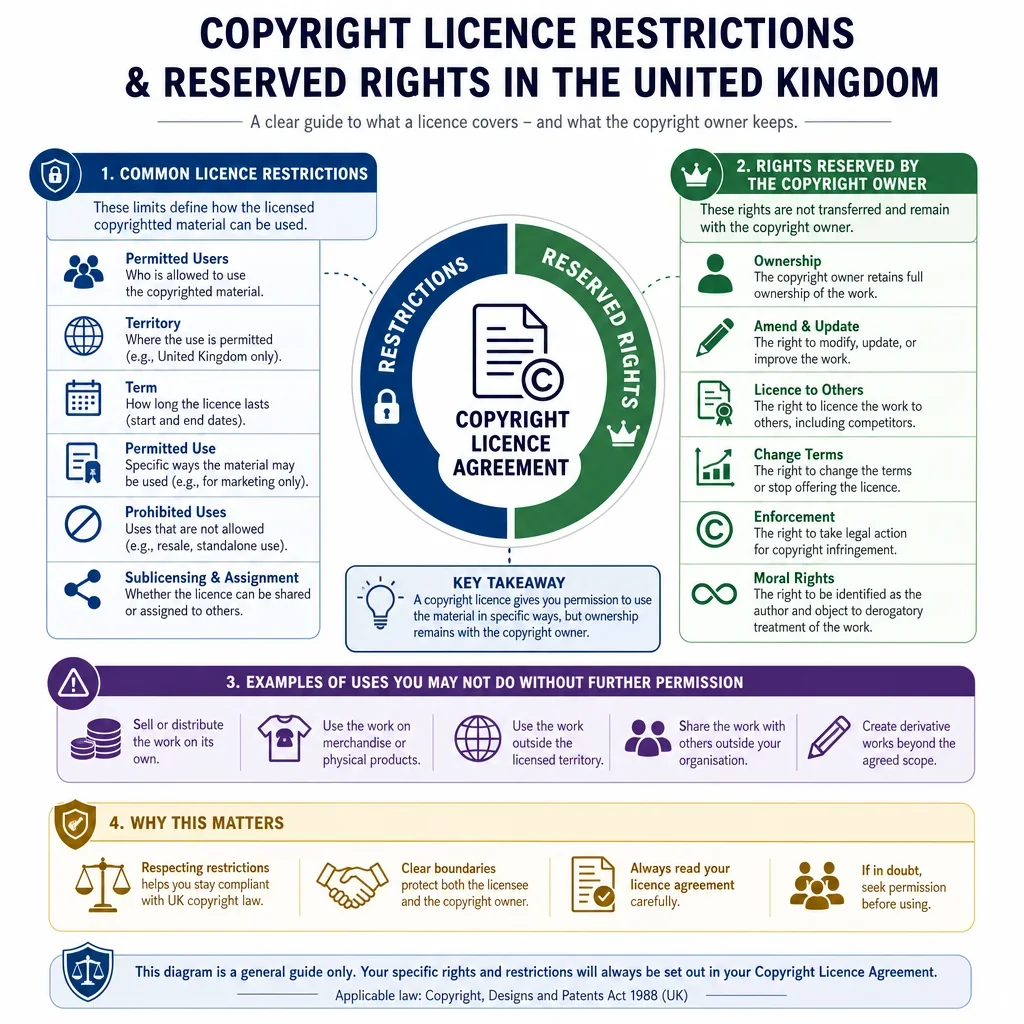
- Scope of UseDefine how the work can be used, including any limits on time, place, or purpose.
- DurationSet out how long the licence lasts, whether it's for a fixed period or indefinite.
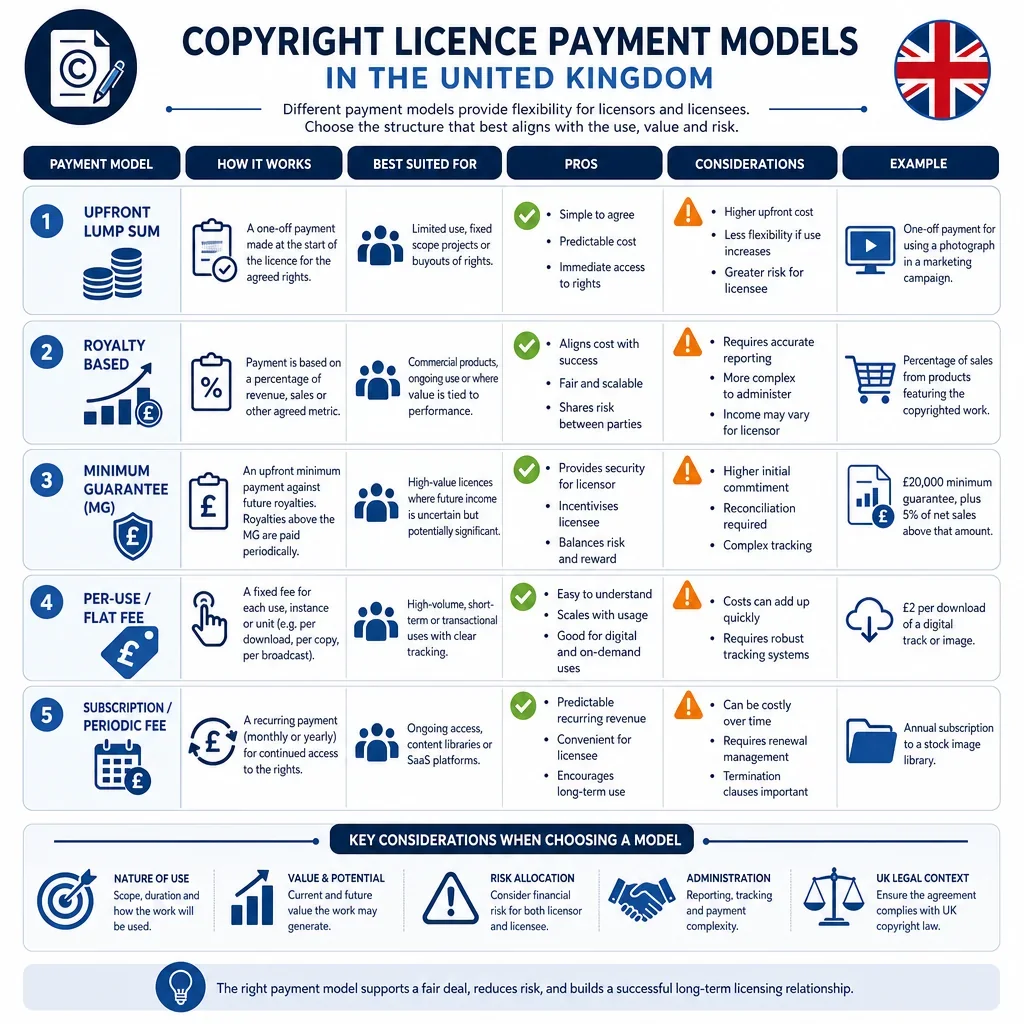
- Payment TermsOutline any fees or royalties to be paid, including when and how payments are made.
- Rights and ObligationsDetail what each party must do or avoid, like not modifying the work without permission.
- Termination RulesExplain the conditions under which the agreement can end, such as breach of terms.
- Dispute ResolutionDescribe how disagreements will be handled, often through negotiation or courts in the UK.
- Governing LawSpecify that UK law applies to the agreement to ensure it aligns with local rules.
Generate Your Document in 4 Easy Steps
Why Use Docaro?
 United Kingdom
Free Example Copyright Licence Agreement Template
Below is a free template example of a Copyright Licence Agreement for use in the United Kingdom generated by our AI model.
The clauses in your actual Copyright Licence Agreement will vary from this example as they will be entirely bespoke to your requirements as set out in the questionnaire you complete.
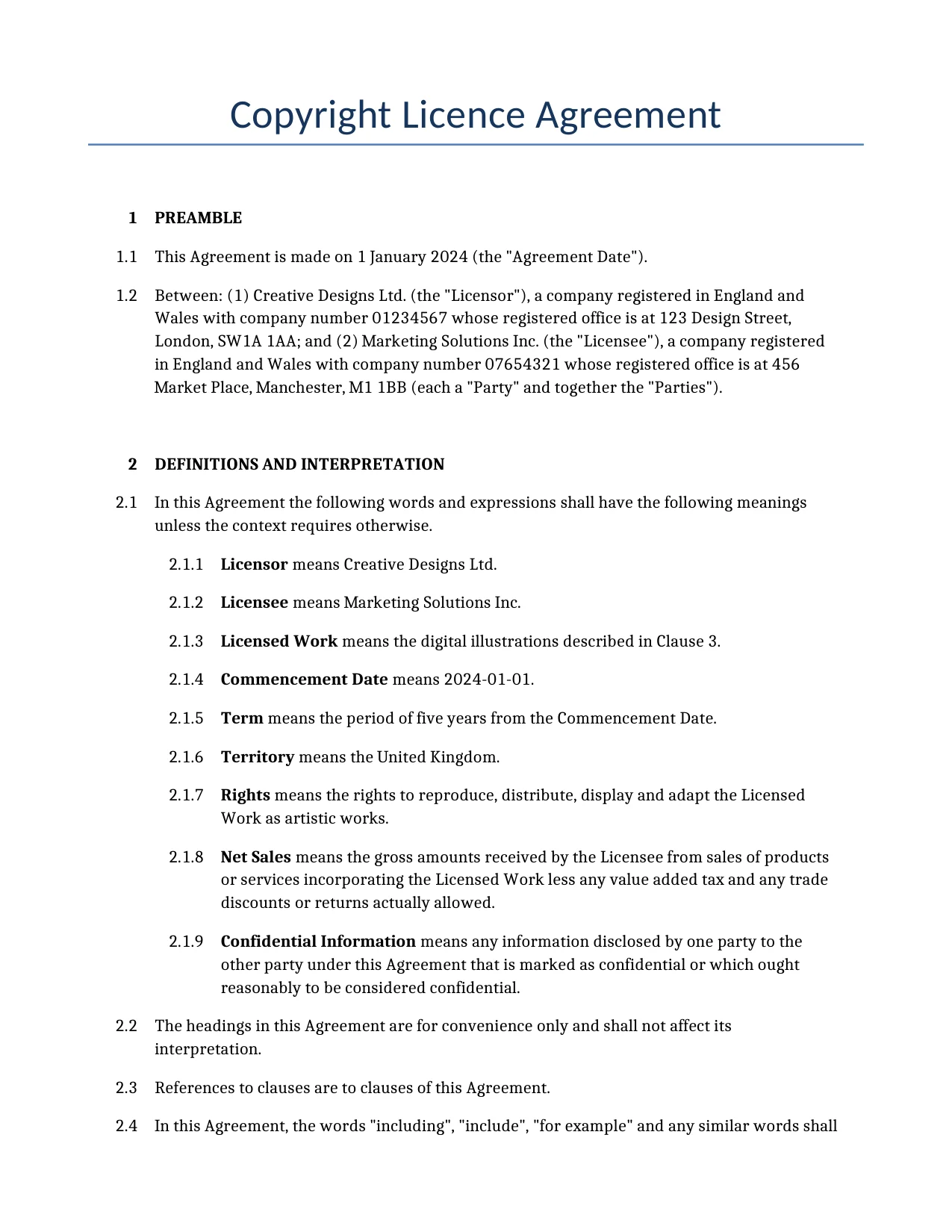
Copyright Licence Agreement for Digital Illustrations
1PREAMBLE
This Agreement is made on 1 January 2024 (the "Agreement Date").
Between: (1) Creative Designs Ltd. (the "Licensor"), a company registered in England and Wales with company number 01234567 whose registered office is at 123 Design Street, London, SW1A 1AA; and (2) Marketing Solutions Inc. (the "Licensee"), a company registered in England and Wales with company number 07654321 whose registered office is at 456 Market Place, Manchester, M1 1BB (each a "Party" and together the "Parties").
2DEFINITIONS AND INTERPRETATION
In this Agreement the following words and expressions shall have the following meanings unless the context requires otherwise.
Licensor means Creative Designs Ltd.
Licensee means Marketing Solutions Inc.
Licensed Work means the digital illustrations described in Clause 3.
Commencement Date means 2024-01-01.
Term means the period of five years from the Commencement Date.
Territory means the United Kingdom.
Rights means the rights to reproduce, distribute, display and adapt the Licensed Work as artistic works.
Net Sales means the gross amounts received by the Licensee from sales of products or services incorporating the Licensed Work less any value added tax and any trade discounts or returns actually allowed.
Confidential Information means any information disclosed by one party to the other party under this Agreement that is marked as confidential or which ought reasonably to be considered confidential.
The headings in this Agreement are for convenience only and shall not affect its interpretation.
References to clauses are to clauses of this Agreement.
In this Agreement, the words "including", "include", "for example" and any similar words shall be construed without limitation; references to any gender include all genders; references to a person include an individual, company, corporation, partnership or unincorporated association; and references to any statute or statutory provision include that statute or provision as amended, modified, consolidated, re-enacted or replaced from time to time.
This Agreement shall be interpreted in accordance with the laws of England and Wales.
3GRANT OF LICENCE
The Licensor grants to the Licensee an exclusive licence to exercise the Rights in the Licensed Work within the Territory for the Term.
The licence granted under Clause 2.1 shall commence on the Commencement Date.
The author, Dr. Emily Carter, waives all moral rights in the Licensed Work (within the meaning of sections 77 to 84 of the Copyright, Designs and Patents Act 1988) in favour of the Licensee and its licensees. The Licensee shall not be obliged to assert the moral rights of the author in any reproductions of the Licensed Work.
This Agreement does not grant the Licensee any right to renew the licence upon expiry of the Term.
4OWNERSHIP AND RESERVATION OF RIGHTS
The Licensor is the sole and exclusive owner of all copyright and other intellectual property rights in the Licensed Work.
All rights in the Licensed Work not expressly granted to the Licensee under this Agreement are reserved to the Licensor.
The Licensee shall promptly notify the Licensor in writing of any actual or suspected infringement of the Licensed Work that comes to its attention.
The Licensor shall have the right (but not the obligation) to bring proceedings in respect of any infringement of the Licensed Work at its own cost.
5LICENSED WORK
The Licensed Work consists of a set of 25 original digital illustrations titled 'Illustrations for Modern Web Development' in high-resolution digital format (PNG and SVG files) depicting various programming concepts, frameworks, website layouts, and visual metaphors for use in marketing materials and user interfaces.
The Licensed Work comprises artistic works created on 2023-05-15 by Dr. Emily Carter.
The Licensed Work has been published in digital format only.
The Licensed Work is supplied in digital format.
The Licensed Work does not include any third-party copyrighted content.
6ROYALTIES AND PAYMENTS
The Licensee shall pay to the Licensor a royalty of 8% of Net Sales received by the Licensee from the sale or licensing of products or services incorporating the Licensed Work.
The Licensee shall make all royalty payments quarterly in arrears.
Royalty calculations shall commence on 2024-01-01 and shall cease on 2028-12-31 unless this Agreement is renewed.
Each royalty payment shall be made on the 15th day of the month following the end of each quarter.
Interest shall accrue on any late royalty payments at the rate of 4 percent per annum above the base rate of the Bank of England from time to time.
All payments shall be made by bank transfer to the designated account of the Licensor.
The Licensee shall provide detailed royalty statements with each payment showing the calculation of Net Sales and royalties due.
All payments under this Agreement shall be made exclusively in British Pounds.
The Licensor (or its duly appointed representatives) shall have the right, upon giving not less than 14 days' written notice, to inspect and audit the Licensee's books, records and accounts relating to the sale of products or services incorporating the Licensed Work during normal business hours. Such audit shall be at the Licensor's expense unless it reveals an underpayment of 5% or more, in which case the Licensee shall reimburse the Licensor for the audit costs.
Any underpayment identified during an audit shall be paid by the Licensee within 30 days of notification together with interest calculated in accordance with Clause 4.4.
7WARRANTIES AND REPRESENTATIONS
Each Party warrants to the other that it has full power and authority to enter into this Agreement and to perform its obligations hereunder.
The Licensor warrants that it is the sole and exclusive owner of all rights in the Licensed Work and has full power to grant the licence set out in this Agreement.
The Licensor warrants that the Licensed Work is original, has been created by Dr. Emily Carter, and has not been copied from any third-party sources.
The Licensor warrants that the Licensed Work does not infringe any third-party intellectual property rights including copyright, trademarks or moral rights and that no third-party permissions or consents are required for the grant of the licence hereunder.
The Licensor warrants that there are no existing licences, mortgages, charges or other encumbrances on the Licensed Work and that it is not aware of any potential or actual infringements related to the Licensed Work.
The Licensor warrants that the Licensed Work is free from defects, viruses, malware or any other harmful code and has been scanned with up-to-date antivirus software prior to delivery.
All warranties implied by law are excluded to the fullest extent permitted by law except as expressly set out in this Agreement.
8INDEMNITIES
The Licensor shall indemnify the Licensee against all claims of direct copyright infringement, indirect infringement through use or moral rights violations arising from the Licensed Work.
The Licensee shall indemnify the Licensor against all claims arising from the Licensee's use of the Licensed Work beyond the scope of the licence granted or in breach of this Agreement.
The indemnities in this Clause 6 shall cover legal fees, court costs, damages awarded and any settlements approved by the indemnifying party.
The party seeking indemnity shall give the indemnifying party notice of any claim within 30 days of becoming aware of it.
The indemnifying party shall have the right to control the defence of any claims.
The indemnified party shall have approval rights over any settlement of indemnity claims.
9CONFIDENTIALITY
Each party shall keep the Confidential Information of the other party secret and shall not disclose it to any third party without the prior written consent of the other party.
Upon termination of this Agreement each party shall return or destroy all Confidential Information of the other party.
The obligations of confidentiality shall continue for a period of five years after termination or expiry of this Agreement.
10DATA PROTECTION
Each Party shall comply with all applicable requirements of the UK General Data Protection Regulation (UK GDPR), the Data Protection Act 2018 and any other applicable data protection legislation.
If either Party processes personal data on behalf of the other Party in connection with this Agreement, it shall do so only on documented instructions from the other Party and shall implement appropriate technical and organisational measures to protect such personal data.
Each Party shall notify the other Party without undue delay if it becomes aware of any personal data breach relating to the performance of this Agreement.
The obligations under this Clause 8 shall survive termination or expiry of this Agreement.
11TERMINATION
This Agreement shall continue for the Term unless terminated earlier in accordance with this Clause 9.
Either Party may terminate this Agreement immediately by written notice if the other Party commits a material breach of any term of this Agreement and (if such breach is remediable) fails to remedy that breach within 30 days of being notified in writing to do so.
The Licensor may terminate this Agreement immediately by written notice if the Licensee fails to pay any royalties or other sums due under this Agreement within 14 days of the due date.
Either Party may terminate this Agreement immediately by written notice if the other Party ceases to trade, becomes insolvent, enters into administration, receivership or liquidation or threatens to do any of these things.
This Agreement shall not automatically renew upon expiry of the Term.
12CONSEQUENCES OF TERMINATION
Upon termination or expiry of this Agreement the Licensee shall immediately cease all use of the Licensed Work, destroy or return (at the Licensor's option) all copies in its possession or control and pay any outstanding royalties within 30 days.
The Licensee shall provide a written certification signed by a director confirming compliance with its post-termination obligations within 14 days of termination or expiry.
The clauses relating to confidentiality, data protection, indemnities, payment obligations, consequences of termination, limitation of liability and governing law shall survive termination or expiry of this Agreement.
Termination or expiry of this Agreement shall not affect any rights, remedies, obligations or liabilities of the Parties that have accrued up to the date of termination or expiry.
13LIMITATION OF LIABILITY
Subject to Clause 11.3, neither Party shall be liable to the other whether in contract, tort (including negligence), breach of statutory duty or otherwise for any indirect or consequential loss or damage, loss of profit, loss of goodwill, loss of business opportunity or loss of anticipated savings arising under or in connection with this Agreement.
Subject to Clause 11.3, each Party's total aggregate liability to the other under or in connection with this Agreement (including in respect of any indemnities) shall not exceed £50,000.
Nothing in this Agreement shall limit or exclude the liability of either Party for death or personal injury resulting from its negligence, for fraud or fraudulent misrepresentation, for breach of any indemnity, for infringement of the other Party's intellectual property rights or for any other liability which cannot be excluded or limited by law.
14GOVERNING LAW
This Agreement and any dispute or claim arising out of or in connection with it or its subject matter or formation (including non-contractual disputes or claims) shall be governed by and construed in accordance with the laws of England and Wales.
15JURISDICTION
The courts of England and Wales shall have exclusive jurisdiction over any dispute arising out of or in connection with this Agreement.
16ENTIRE AGREEMENT
This Agreement constitutes the entire agreement between the parties and supersedes all previous agreements, understandings or arrangements between them relating to the subject matter hereof.
Any future amendments to this Agreement must be in writing and signed by both the Licensor and the Licensee.
17ASSIGNMENT AND SUB-LICENSING
The Licensor may assign its rights under this Agreement with the prior written consent of the Licensee (such consent not to be unreasonably withheld or delayed).
The Licensee may not assign its rights under this Agreement without the prior written consent of the Licensor.
The Licensee may grant sub-licences under the Rights granted in this Agreement provided that the Licensee obtains the prior written consent of the Licensor and any sub-licensee agrees in writing to be bound by equivalent obligations to those of the Licensee under this Agreement.
The Licensee shall remain liable to the Licensor for the acts and omissions of any sub-licensees.
18NOTICES
Any notice given under this Agreement shall be in writing and may be delivered by post or email.
Notices sent by post shall be deemed received 2 business days after posting. Notices sent by email shall be deemed received at the time of transmission if sent during normal business hours, or on the next business day if sent outside normal business hours.
All notices shall be given in English.
19FORCE MAJEURE
Neither party shall be liable for any delay or failure to perform its obligations under this Agreement if such delay or failure results from events beyond its reasonable control including acts of God, pandemics or epidemics or government actions.
The party affected by a force majeure event shall give written notice to the other party within 7 days of the event occurring.
Both parties shall use reasonable efforts to mitigate the effects of any force majeure event.
Either party may terminate this Agreement if a force majeure event continues for more than 60 days.
20WAIVER
No failure or delay by the Licensor or the Licensee in exercising any right or remedy under this Agreement shall constitute a waiver of that right or remedy.
21COUNTERPARTS
This Agreement may be executed in any number of counterparts each of which when executed and delivered shall constitute a duplicate original but all of which together shall constitute one agreement.
Transmission of an executed counterpart of this Agreement by email or other electronic means shall take effect as delivery of an executed original counterpart of this Agreement.
22SIGNATURES
Signed for and on behalf of the Licensor: _______________________________ Name: Position: Date:
Signed for and on behalf of the Licensee: _______________________________ Name: Position: Date:
This example shows approximately 70% of a typical document and is provided for illustrative purposes only. The remaining content has been omitted.
Every document generated by Docaro is tailored to your specific circumstances, jurisdiction and the information you provide. The completed document includes all applicable clauses and provisions required for your situation.
To generate the full, personalised document, answer a short series of questions and your document will be created instantly.
Useful Resources When Considering a Copyright Licence Agreement in the United Kingdom
United Kingdom Reference Legislation
Copyright Licence Agreement FAQs
Document Generation FAQs
Related Articles