AI Generated British Declaration of Trust
PDF & Word - 2026 Updated
Docaro Pricing
When do you need a Declaration of Trust in the United Kingdom?
British Legal Rules for a Declaration of Trust
Using the wrong type of trust structure can result in unintended tax liabilities or invalid distribution of assets.
What a Proper Declaration of Trust Should Include
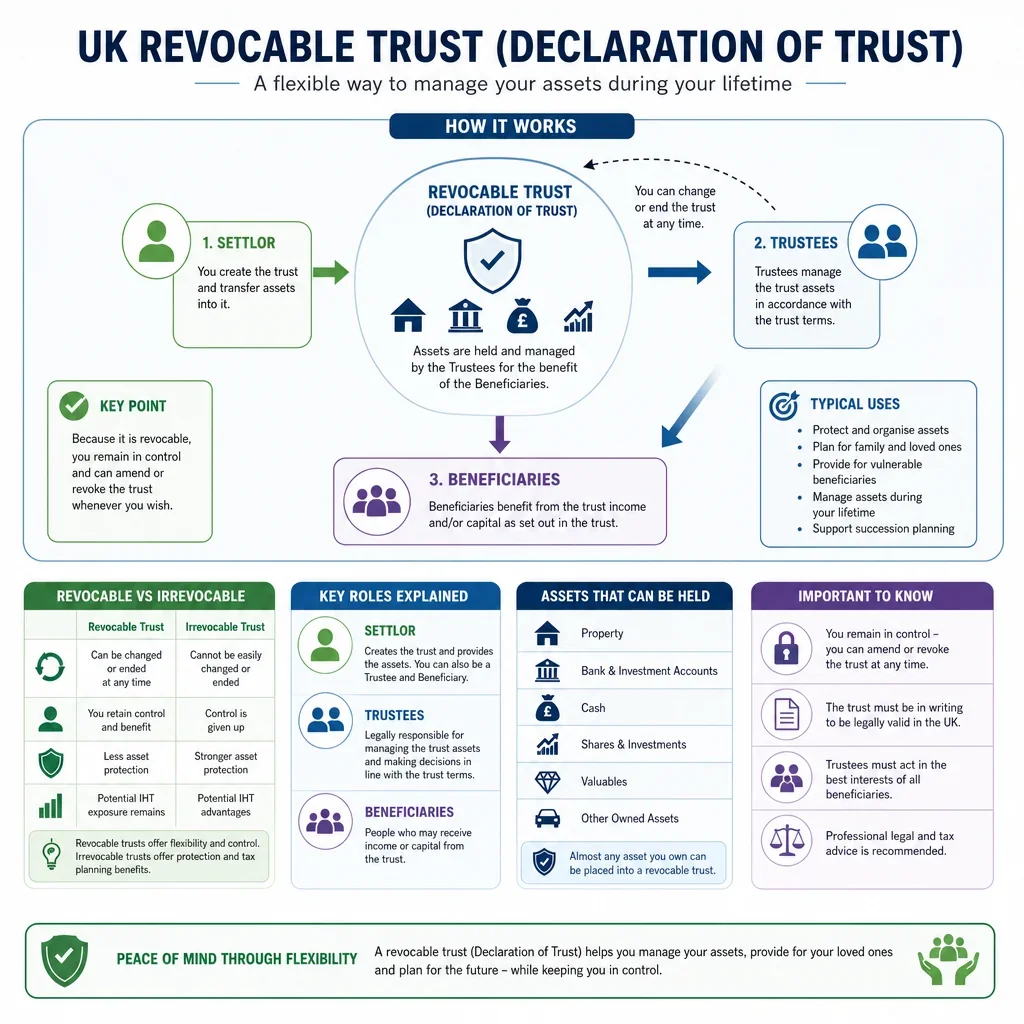
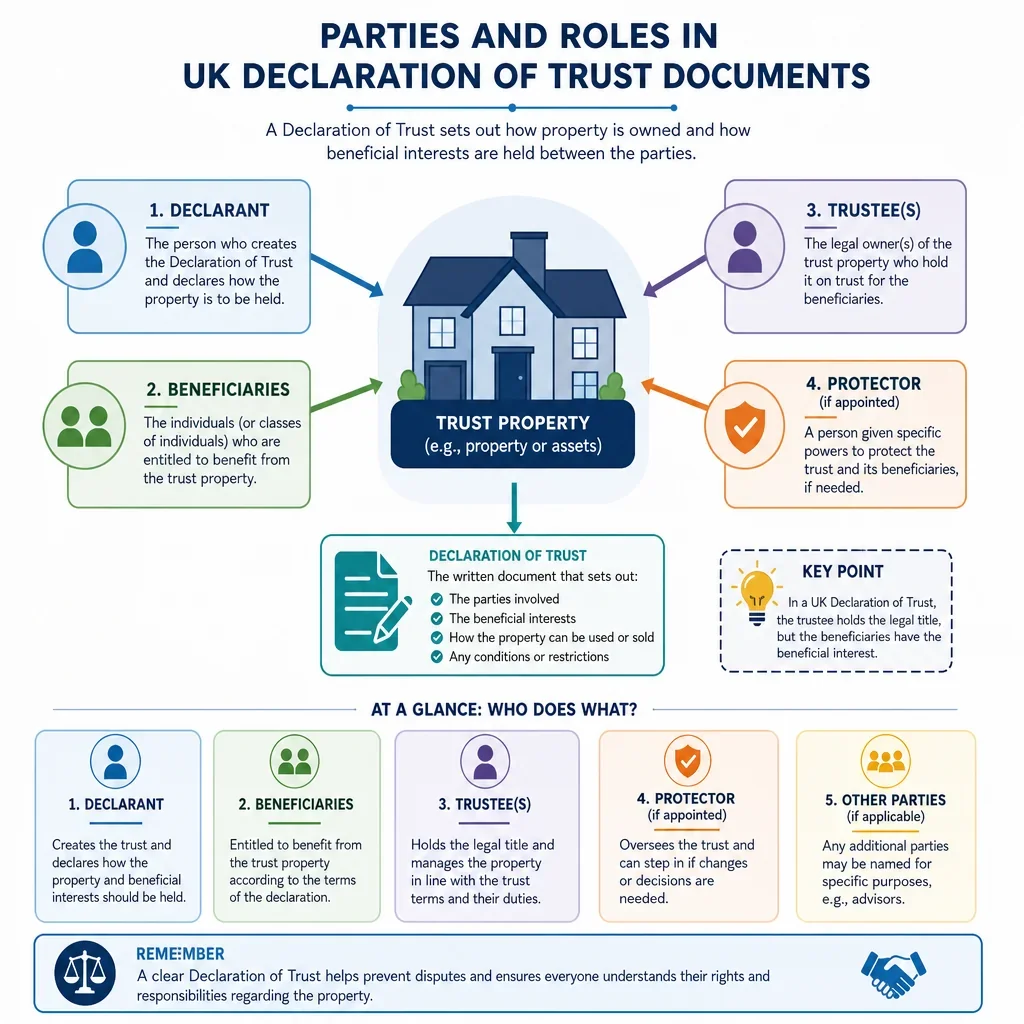
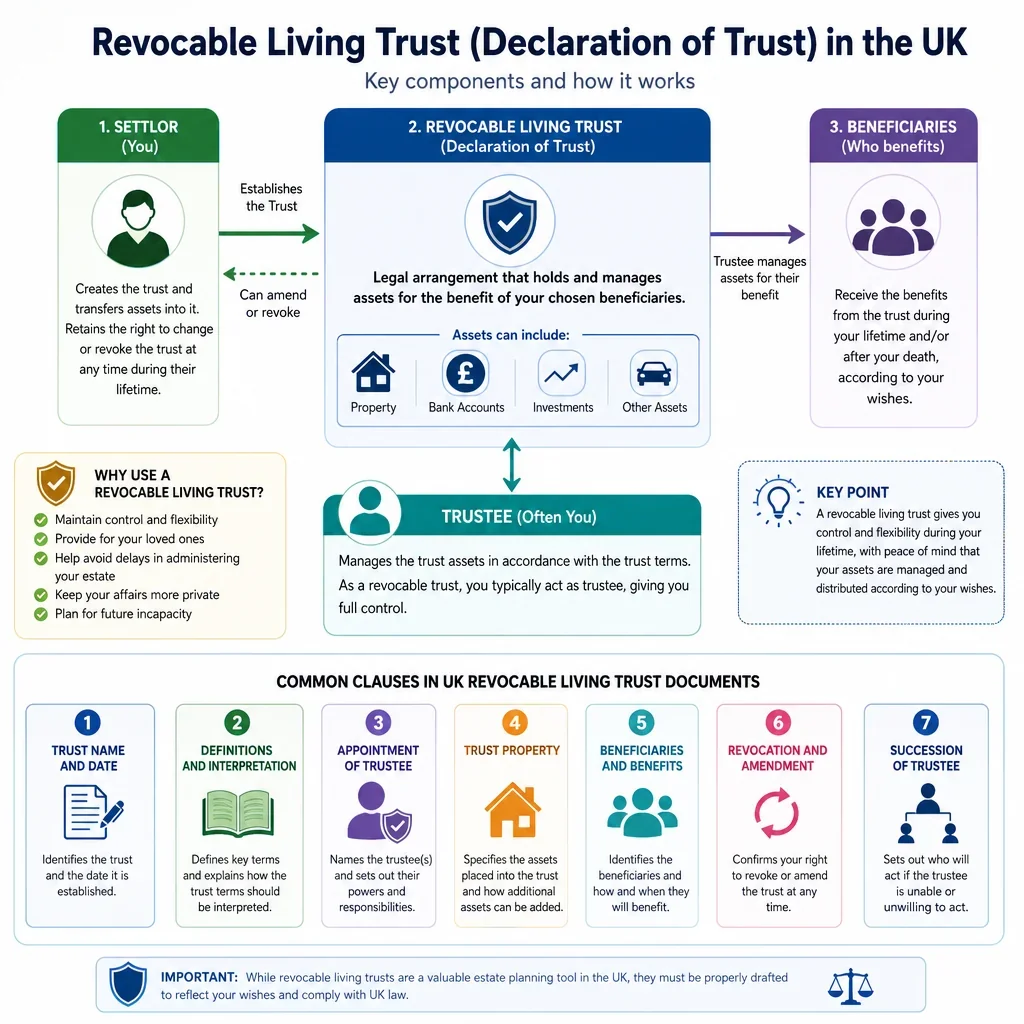
- Names of the PartiesClearly identify the settlor who creates the trust, the trustees who manage it, and any beneficiaries who receive benefits.
- Trust Property DescriptionList the specific assets or property being placed into the trust, such as money, real estate, or investments.
- Trust PurposeState the main goal of the trust, like protecting assets for family or planning for inheritance.
- Trustee Powers and DutiesOutline what the trustees can do, such as investing assets or distributing funds, and their responsibilities to act in the beneficiaries' best interests.
- Beneficiary RightsDescribe how and when beneficiaries can access or benefit from the trust property.
- Duration and EndingSpecify how long the trust will last and the conditions under which it can be terminated or revoked.
- Governing LawIndicate that English law applies to the trust to ensure it is legally valid in the UK.
Generate Your Document in 4 Easy Steps
Why Use Docaro?
 United Kingdom
Free Example Declaration of Trust Template
Below is a free template example of a Declaration of Trust for use in the United Kingdom generated by our AI model.
The clauses in your actual Declaration of Trust will vary from this example as they will be entirely bespoke to your requirements as set out in the questionnaire you complete.
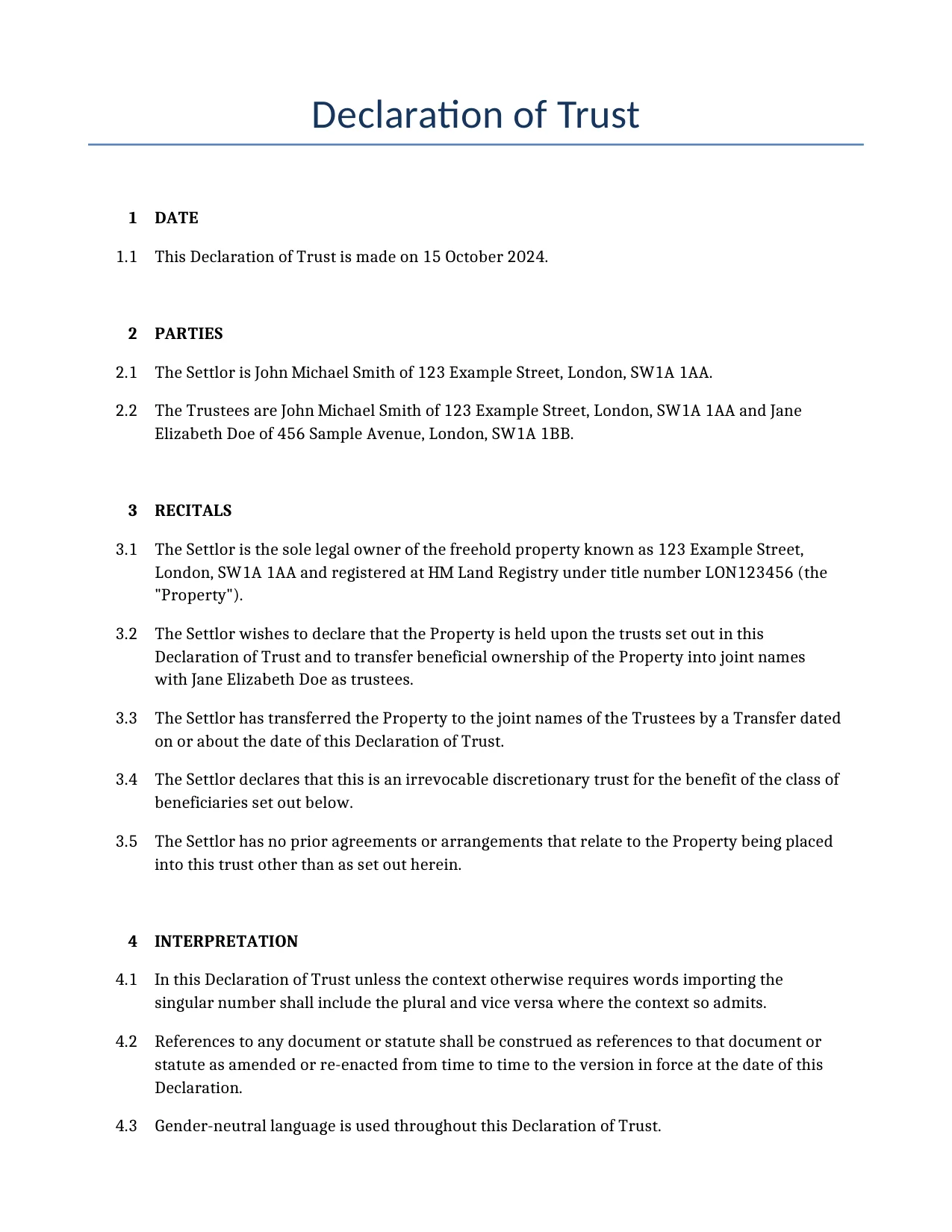
Declaration of Trust for Joint Ownership of Property at 123 Example Street, London
1DATE
This Declaration of Trust is made on 15 October 2024.
2PARTIES
The Settlor is John Michael Smith of 123 Example Street, London, SW1A 1AA.
The Trustees are John Michael Smith of 123 Example Street, London, SW1A 1AA and Jane Elizabeth Doe of 456 Sample Avenue, London, SW1A 1BB.
3RECITALS
The Settlor is the sole legal owner of the freehold property known as 123 Example Street, London, SW1A 1AA and registered at HM Land Registry under title number LON123456 (the "Property").
The Settlor wishes to declare that the Property is held upon the trusts set out in this Declaration of Trust and to transfer beneficial ownership of the Property into joint names with Jane Elizabeth Doe as trustees.
The Settlor has transferred the Property to the joint names of the Trustees by a Transfer dated on or about the date of this Declaration of Trust.
The Settlor declares that this is an irrevocable discretionary trust for the benefit of the class of beneficiaries set out below.
The Settlor has no prior agreements or arrangements that relate to the Property being placed into this trust other than as set out herein.
4INTERPRETATION
In this Declaration of Trust unless the context otherwise requires words importing the singular number shall include the plural and vice versa where the context so admits.
References to any document or statute shall be construed as references to that document or statute as amended or re-enacted from time to time to the version in force at the date of this Declaration.
Gender-neutral language is used throughout this Declaration of Trust.
The headings in this Declaration of Trust are for convenience only and shall not affect its interpretation.
"Trust Property" means the Property together with all money, investments and other assets from time to time representing the same or added to the trust and all income arising therefrom.
"Beneficiaries" means the discretionary beneficiaries as defined in clause 7.
5DECLARATION OF TRUST
The Settlor hereby declares that with effect from the date of this Declaration of Trust the Settlor and Jane Elizabeth Doe hold the Trust Property upon the trusts declared in this Declaration of Trust.
This declaration is irrevocable.
6TRUST PROPERTY
The Trust Property is the freehold property known as 123 Example Street, London, SW1A 1AA registered at HM Land Registry under title number LON123456 together with all buildings and fixtures thereon.
The estimated current market value of the Trust Property is £450,000.
The Trust Property is subject to an existing mortgage in favour of ABC Bank plc for approximately £150,000.
7BENEFICIARIES
The Beneficiaries shall be such of the children and remoter issue of the Settlor as shall be living from time to time and any spouse or civil partner of the Settlor.
The trust is a discretionary trust and no Beneficiary shall have any fixed interest in the capital or income of the Trust Property until the Trustees in their absolute discretion determine otherwise.
The primary objects of the trust are the Settlor's children (including any adopted or step-children) and their issue.
8TRUSTEES
The power of appointing new or additional trustees shall be exercisable by the Settlor during his lifetime and thereafter by the surviving or continuing trustees.
There shall be a minimum number of two Trustees and a maximum number of four Trustees at any time.
The Trustees shall make all decisions by unanimous agreement unless otherwise provided by law.
A Trustee who is also a Beneficiary may exercise all powers and discretions notwithstanding any personal interest.
9DISTRIBUTIONS TO BENEFICIARIES
The Trustees shall have absolute discretion as to the timing, amount and recipient of any distributions of income or capital to any of the Beneficiaries.
The Trustees shall have the power to accumulate income for the benefit of the Beneficiaries for a period of up to 125 years from the date of this Declaration of Trust.
No distribution of capital shall be made during the Settlor's lifetime without the Settlor's written consent.
The trust shall continue until the expiry of the perpetuity period of 125 years from the date of this Declaration of Trust at which time the capital and income shall be held for such of the Beneficiaries as the Trustees shall determine or in default for the Settlor's children in equal shares.
The Trustees may make such provisions for the maintenance, education, advancement or benefit of any Beneficiary (including minors) as they think fit.
10POWERS OF TRUSTEES
The Trustees shall have all the powers of an absolute owner in relation to the Trust Property in addition to the powers conferred by the Trustee Act 1925 and the Trustee Act 2000 (as amended).
The Trustees shall have the power to acquire, hold, insure, repair, improve, sell, mortgage or lease the Trust Property or any part of it.
The Trustees shall have the power to invest the Trust Property in any manner as if they were absolutely entitled to it.
The Trustees shall have the power to borrow money and to charge the Trust Property as security for any borrowing.
The Trustees shall have the power to delegate their powers and discretions in accordance with the Trustee Act 2000.
The Trustees shall have the power to appropriate assets in satisfaction of any share or interest.
The Trustees may carry on any business with the Trust Property only with the consent of all adult Beneficiaries.
11INVESTMENT AND TAX RESPONSIBILITIES
The Trustees shall be responsible for the payment of all taxes, including but not limited to income tax, capital gains tax and inheritance tax, arising in respect of the Trust Property or the trust generally.
The Trustees shall have wide powers of investment as set out in the Trustee Act 2000 and may invest in land, shares, securities or any other asset as they see fit without restriction to authorised investments.
The Settlor confirms that this trust is intended to be a relevant property trust for inheritance tax purposes under the Inheritance Tax Act 1984 and that appropriate entries will be made on any relevant inheritance tax returns.
12CONFLICTS OF INTEREST
A Trustee may exercise any power or discretion notwithstanding that such Trustee has a conflict of interest or may benefit personally provided that such Trustee acts in good faith.
No Trustee shall be liable for any loss to the trust arising from any conflict of interest where full disclosure has been made to the other Trustees.
13APPOINTMENT AND RETIREMENT OF TRUSTEES
The power of appointing new or additional trustees is vested in the Settlor during his lifetime and thereafter in the surviving trustees.
A trustee may retire by giving written notice to the other trustees provided that there remain at least two trustees thereafter or a trust corporation.
A trustee shall cease to be a trustee automatically upon death, mental incapacity or bankruptcy.
The minimum number of trustees shall be two at all times unless a trust corporation is appointed.
14INDEMNITY OF TRUSTEES
The Trustees shall be entitled to be indemnified out of the Trust Property against all liabilities and expenses properly incurred by them in the execution of the trusts and powers of this Declaration of Trust provided that such indemnity shall not extend to liabilities arising from their own fraud, wilful misconduct or gross negligence.
15TRUSTEE REMUNERATION
Any professional trustee shall be entitled to charge and be paid reasonable remuneration for services as trustee in accordance with the Trustee Act 2000. Any non-professional trustee shall be entitled to reimbursement of reasonable out-of-pocket expenses only unless otherwise agreed in writing.
16VARIATION
The trusts declared in this Declaration of Trust may be varied at any time with the written consent of the Settlor (during his lifetime) and all adult Beneficiaries who would be entitled to the capital if the trust were to terminate immediately.
17EXCLUSION OF DEFAULT PROVISIONS
The statutory default rules under the Trustee Act 1925, Trustee Act 2000, Wills Act 1837, Inheritance Tax Act 1984, Administration of Estates Act 1925 and Law of Property Act 1925 are excluded or modified to the extent specified in this Declaration of Trust.
18GOVERNING LAW
This Declaration of Trust shall be governed exclusively by the laws of England and Wales.
The laws of England and Wales shall govern the interpretation of this Declaration of Trust.
The courts of England and Wales shall have exclusive jurisdiction for any disputes arising under this Declaration of Trust.
19SEVERABILITY
If any provision of this Declaration of Trust is held to be invalid or unenforceable then such provision shall be severed and the remaining provisions shall continue in full force and effect.
20ENTIRE AGREEMENT
This Declaration of Trust constitutes the entire agreement between the parties and supersedes all prior agreements understandings or arrangements whether oral or in writing.
21NOTICES
Any notice required to be given under this Declaration of Trust shall be in writing and shall be delivered personally or sent by prepaid first class post to the address of the relevant party as set out in this Declaration of Trust or such other address as may be notified from time to time.
22BOILERPLATE PROVISIONS
This Declaration of Trust is executed as a deed and is delivered on the date stated at the beginning of this Declaration of Trust.
23EXECUTION
This Declaration of Trust may be executed in any number of counterparts each of which when executed and delivered shall constitute a duplicate original but all the counterparts together shall constitute one and the same instrument.
This Declaration of Trust may be executed by electronic signature which shall be deemed to be an original signature.
24SIGNATURES
Signed as a deed by John Michael Smith in the presence of a witness: ___________________________ (Signature of Settlor/Trustee).
Witness Name: ___________________________ Address: ___________________________ Occupation: ___________________________ Signature: ___________________________ Date: ___________________________
Signed as a deed by Jane Elizabeth Doe in the presence of a witness: ___________________________ (Signature of Trustee).
Witness Name: ___________________________ Address: ___________________________ Occupation: ___________________________ Signature: ___________________________ Date: ___________________________
This example shows approximately 70% of a typical document and is provided for illustrative purposes only. The remaining content has been omitted.
Every document generated by Docaro is tailored to your specific circumstances, jurisdiction and the information you provide. The completed document includes all applicable clauses and provisions required for your situation.
To generate the full, personalised document, answer a short series of questions and your document will be created instantly.
Useful Resources When Considering a Declaration of Trust in the United Kingdom
United Kingdom Reference Legislation
Declaration of Trust FAQs
Document Generation FAQs
Related Articles