AI Generated British Contract of Employment
PDF & Word - 2026 Updated
Docaro Pricing
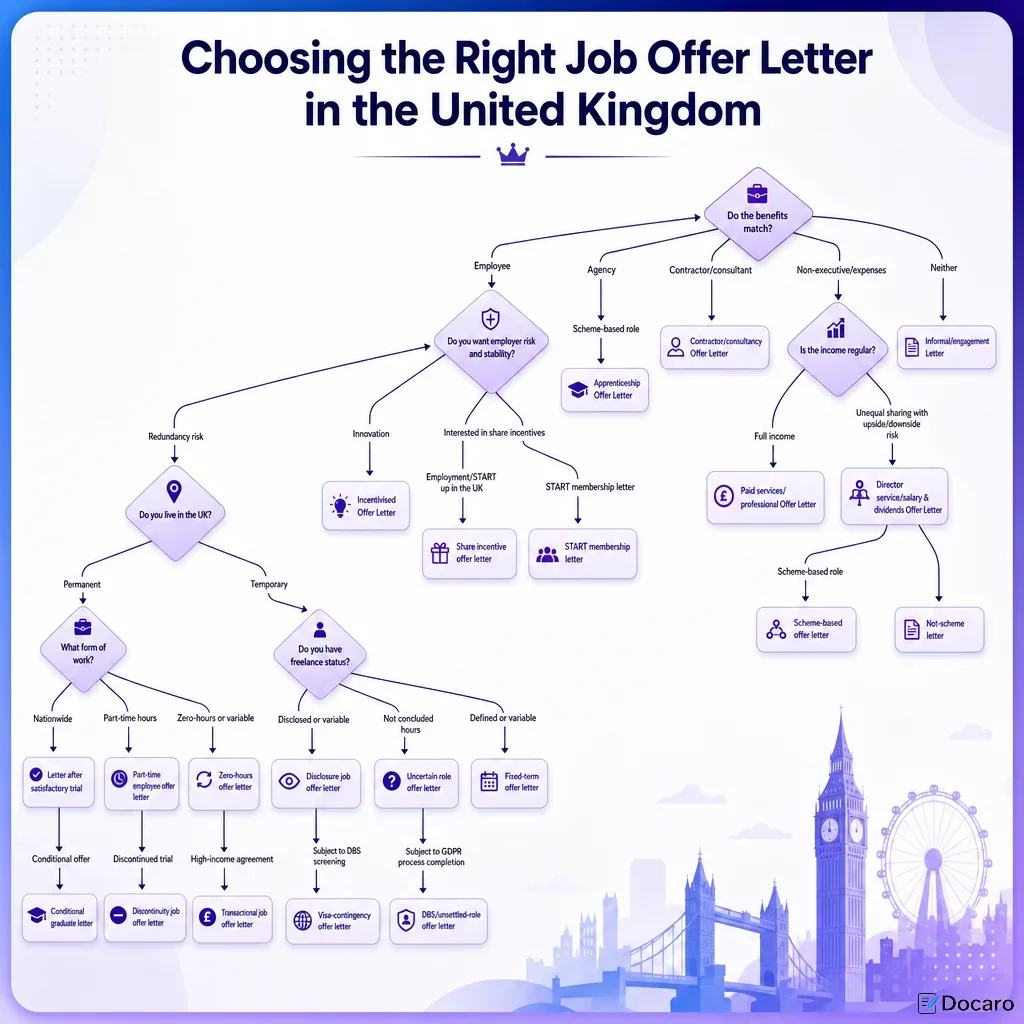
When do you need an Offer Letter in the United Kingdom?
British Legal Rules for an Offer Letter
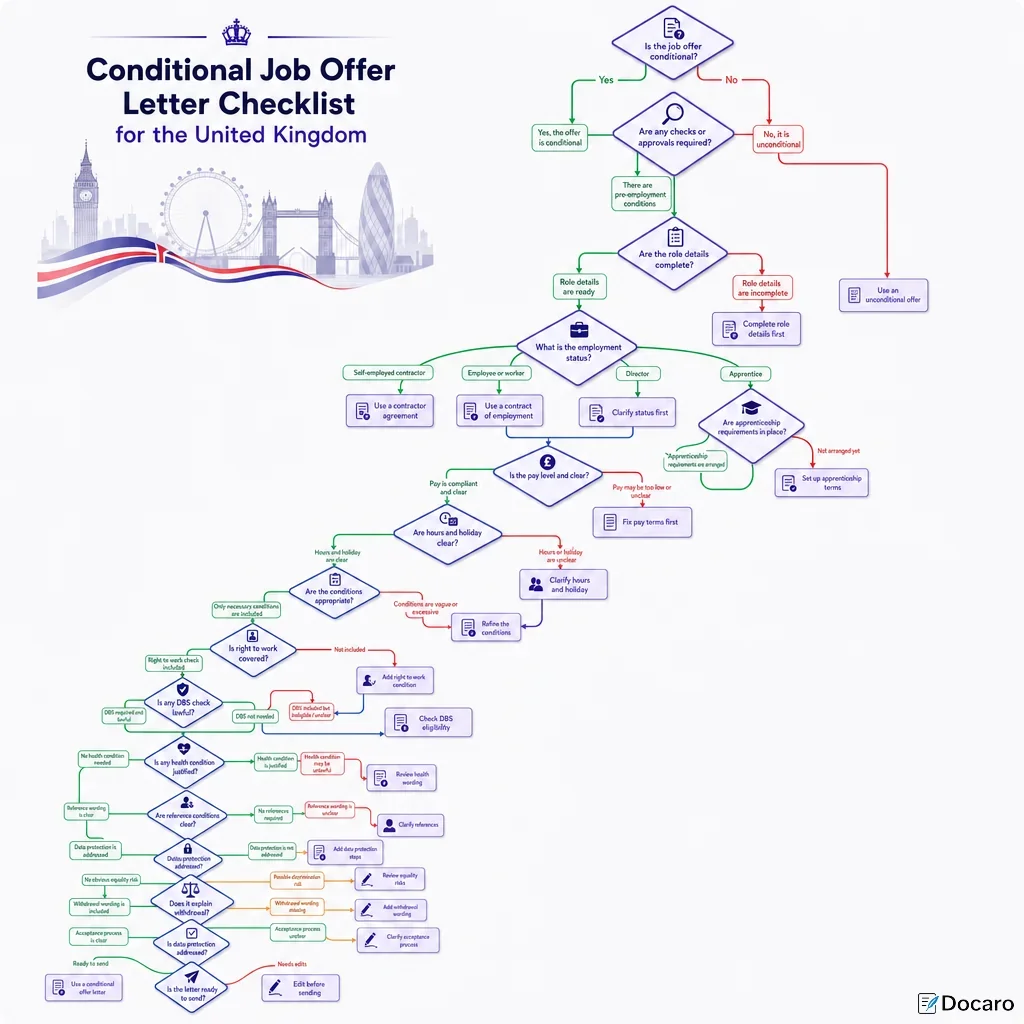
Using the wrong structure for a job offer letter can inadvertently create a binding employment contract with unintended terms.
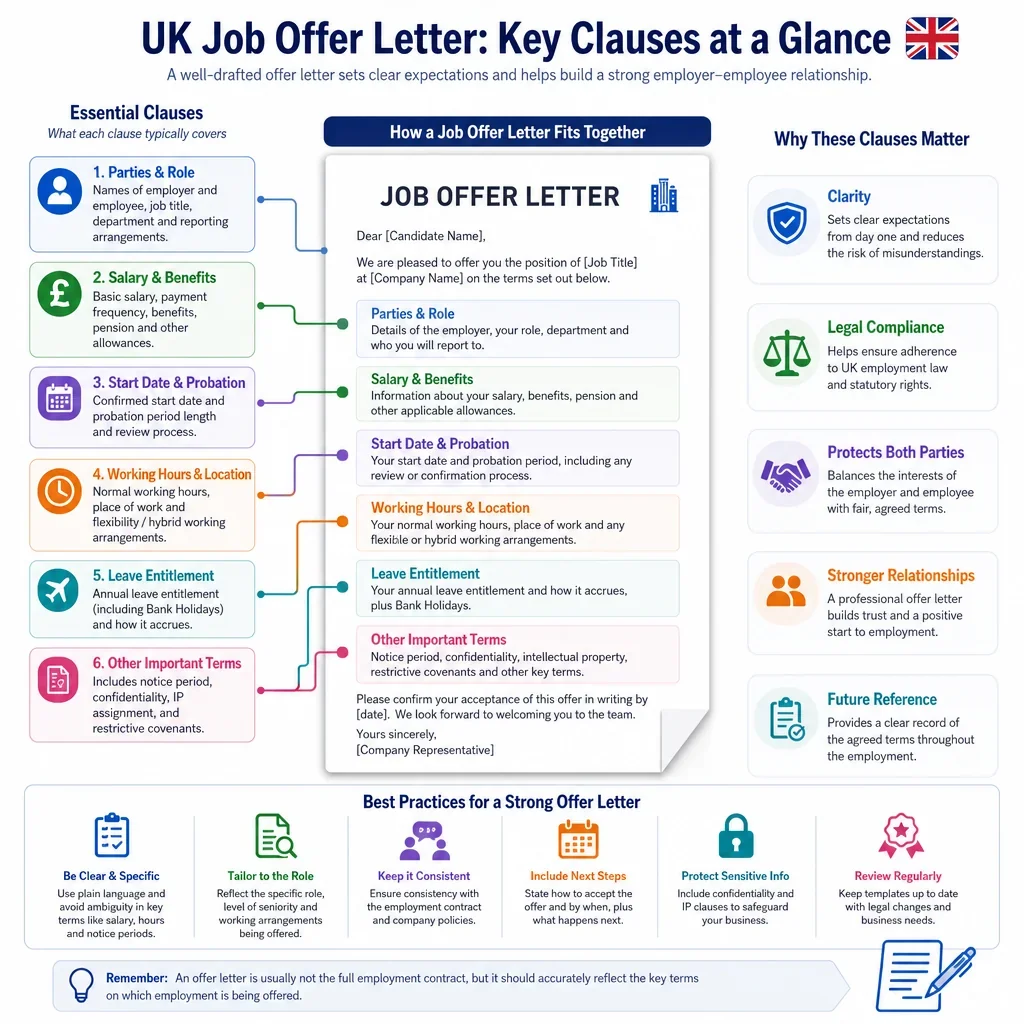
What a Proper Offer Letter Should Include
- Job Title and DutiesClearly state the position offered and a brief description of the main responsibilities.
- Start Date and LocationSpecify the expected start date and the primary work location.
- Salary and Payment DetailsOutline the annual or hourly pay rate and how often it will be paid.
- Working HoursDescribe the standard hours per week and any flexibility involved.
- Holiday EntitlementDetail the number of paid holiday days available each year.
- Benefits and PerksList any additional benefits like pension contributions or health insurance.
- Probation PeriodMention if there's an initial trial period and its length.
- Notice PeriodIndicate how much notice is required to end the employment from both sides.
- Acceptance InstructionsExplain how and by when the candidate must accept the offer.
Generate Your Document in 4 Easy Steps
Why Use Docaro?
 United Kingdom
Free Example Offer Letter Template
Below is a free template example of a Offer Letter for use in the United Kingdom generated by our AI model.
The clauses in your actual Offer Letter will vary from this example as they will be entirely bespoke to your requirements as set out in the questionnaire you complete.
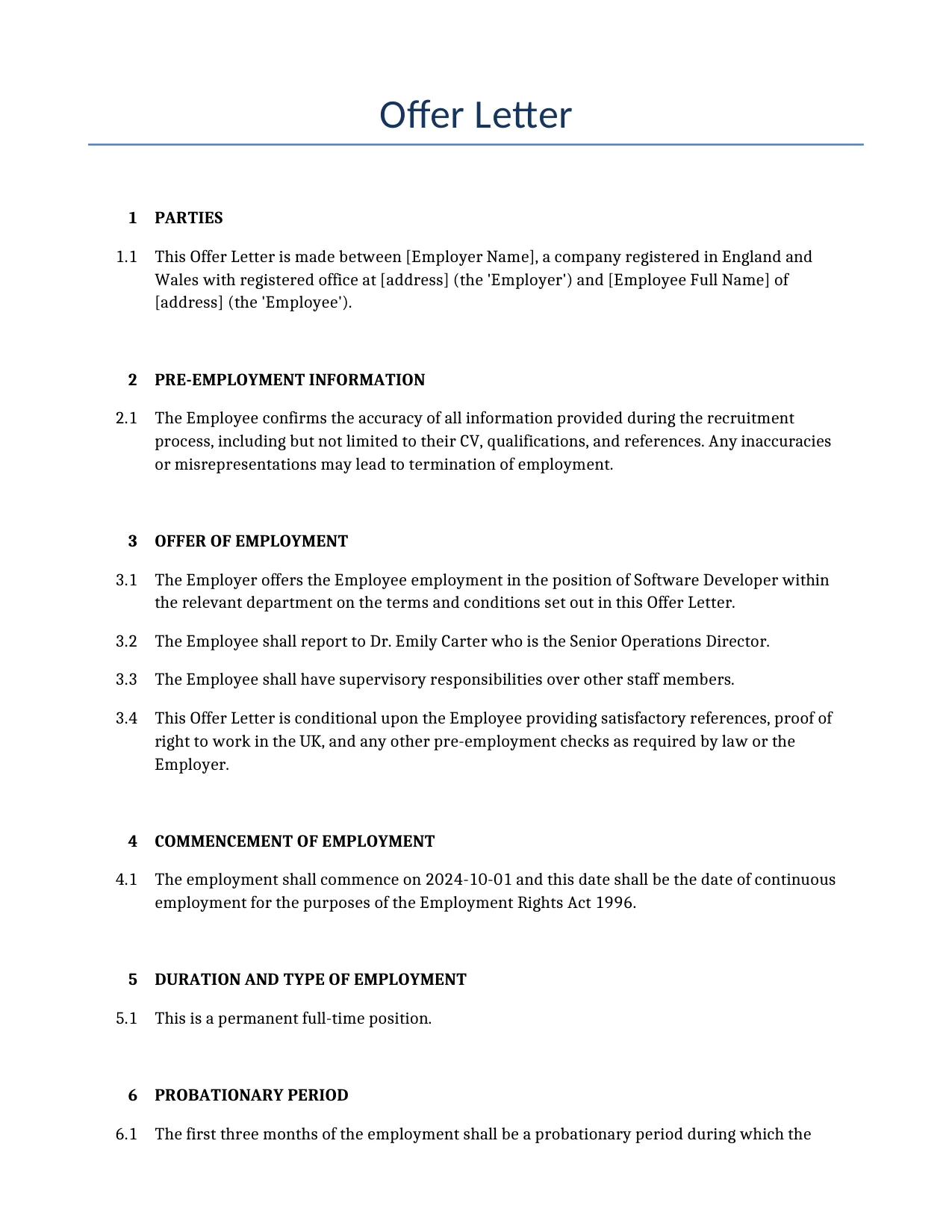
Offer Letter
1PARTIES
This Offer Letter is made between [Employer Name], a company registered in England and Wales with registered office at [address] (the 'Employer') and [Employee Full Name] of [address] (the 'Employee').
2PRE-EMPLOYMENT INFORMATION
The Employee confirms the accuracy of all information provided during the recruitment process, including but not limited to their CV, qualifications, and references. Any inaccuracies or misrepresentations may lead to termination of employment.
3OFFER OF EMPLOYMENT
The Employer offers the Employee employment in the position of Software Developer within the relevant department on the terms and conditions set out in this Offer Letter.
The Employee shall report to Dr. Emily Carter who is the Senior Operations Director.
The Employee shall have supervisory responsibilities over other staff members.
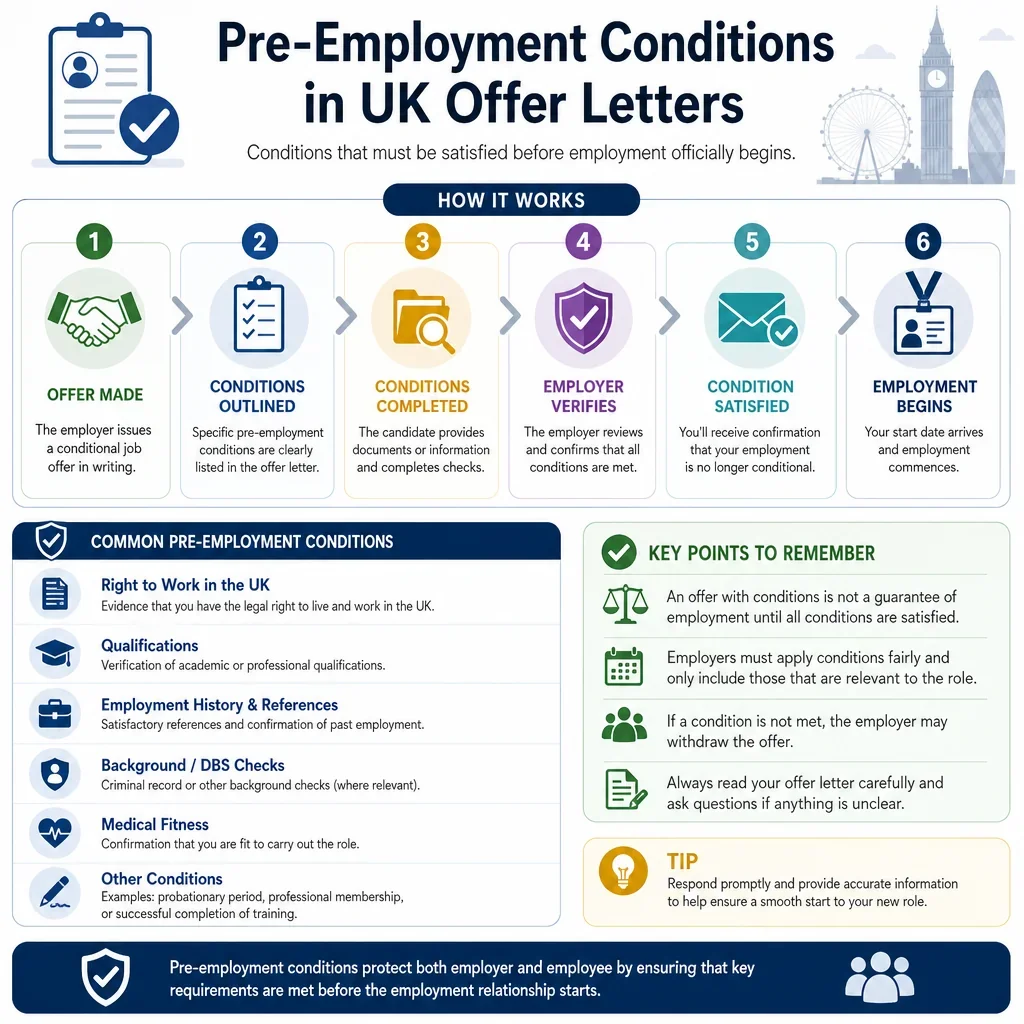
This Offer Letter is conditional upon the Employee providing satisfactory references, proof of right to work in the UK, and any other pre-employment checks as required by law or the Employer.
4COMMENCEMENT OF EMPLOYMENT
The employment shall commence on 2024-10-01 and this date shall be the date of continuous employment for the purposes of the Employment Rights Act 1996.
5DURATION AND TYPE OF EMPLOYMENT
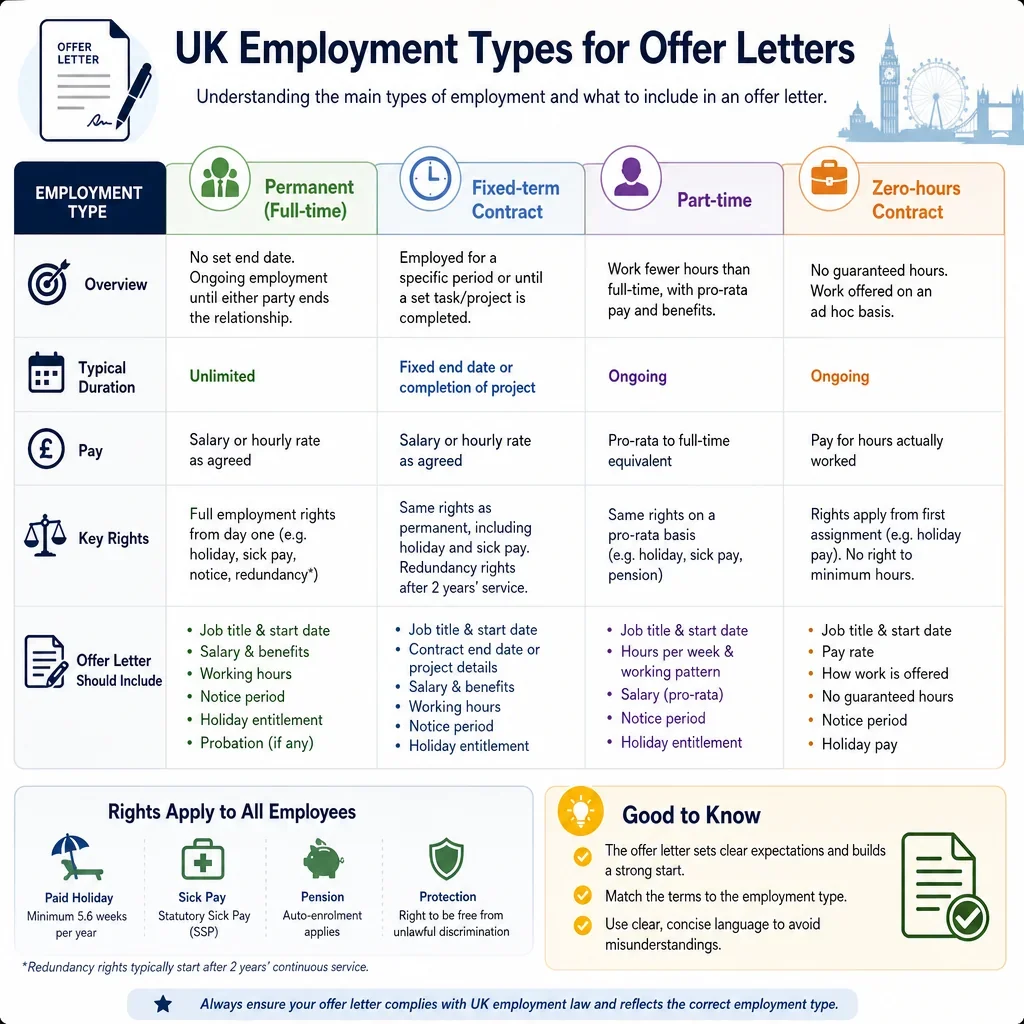
This is a permanent full-time position.
6PROBATIONARY PERIOD
The first three months of the employment shall be a probationary period during which the Employee's performance shall be assessed.
The Employee must demonstrate satisfactory performance in all assigned duties complete any required training modules and adhere to company policies without any disciplinary issues in order to successfully complete the probationary period.
During the probationary period either party may terminate the employment by giving to the other one week's notice in writing.
7PLACE OF WORK AND MOBILITY
The Employee's primary place of work is as set out in the Working Hours and Location section. The Employee may be required to work at any other location as reasonably required by the Employer, including overseas if necessary, subject to any applicable immigration requirements.
8DUTIES OF THE EMPLOYEE
The Employee shall develop and maintain web applications collaborate with team members on code reviews and ensure software meets quality standards.
The Employee shall perform such other duties as may be reasonably assigned by the Employer from time to time.
9SALARY AND COMPENSATION
The Employer shall pay the Employee an annual salary of 45000 which shall be paid monthly in arrears.
The Employee shall be eligible for a performance bonus in accordance with the Employer's bonus scheme as amended from time to time.
The Employee shall be eligible for such other incentives as the Employer may determine from time to time.
The salary shall be reviewed annually in accordance with the Employer's policy. Any increase is at the Employer's absolute discretion and there is no obligation to award an increase even if performance is satisfactory.
10BENEFITS
The Employee shall be entitled to participate in the Employer's private health insurance scheme in accordance with the rules of that scheme as amended from time to time.
The Employer shall make contributions to a pension scheme for the Employee in accordance with the rules of that scheme and applicable legislation including the Pensions Act 2008.
The Employee shall be entitled to 28 days paid holiday in each calendar year in addition to public holidays.
The holiday year runs from 1 January to 31 December in each year.
The Employee is responsible for any tax or National Insurance contributions arising on benefits provided, where applicable. Details of all benefits are subject to the rules of the relevant schemes which may be amended by the Employer at any time.
11WORKING HOURS AND LOCATION
The Employee shall work 40 hours per week as standard on a full-time basis.
The standard daily working hours shall be from 9:00 AM to 5:00 PM Monday to Friday.
The place of work shall be hybrid and the Employee may work remotely in accordance with the Employer's remote working policy as amended from time to time.
The Employee may be required to work overtime beyond standard hours when reasonably requested by the Employer and shall be compensated in accordance with the Working Time Regulations 1998.
The Employee agrees to opt out of the 48-hour average weekly working limit under the Working Time Regulations 1998. This opt-out may be revoked by the Employee giving the Employer three months' notice in writing.
12SICKNESS AND ABSENCE
The Employee is entitled to statutory sick pay in accordance with applicable legislation.
The Employee must notify the Employer of any absence due to sickness as soon as possible.
For absences of more than 7 days, the Employee must provide medical evidence such as a fit note from a doctor.
The Employer may require the Employee to attend an occupational health assessment at the Employer's expense.
13FAMILY FRIENDLY RIGHTS
The Employee is entitled to maternity, paternity, adoption, shared parental leave, and other statutory family-friendly rights in accordance with applicable legislation. For further details, please refer to the Employer's policy.
14NOTICE PERIOD
After successful completion of the probationary period the Employee shall give the Employer three months' notice in writing to terminate the employment. The Employee's notice period remains contractual.
After successful completion of the probationary period the Employer shall give the Employee the statutory minimum notice under the Employment Rights Act 1996 (or contractual notice if longer) in writing to terminate the employment. During the initial period of employment (first two years) the statutory minimum is one week per completed year of service.
15GARDEN LEAVE AND PAYMENT IN LIEU OF NOTICE
The Employer may at its discretion place the Employee on garden leave during any notice period.
The Employer may at its discretion make a payment in lieu of notice instead of requiring the Employee to work the notice period.
16SUMMARY DISMISSAL
The Employer may terminate the employment without notice or payment in lieu of notice in the event of gross misconduct or any other fundamental breach of contract by the Employee.
17CONFIDENTIALITY
The Employee shall not during the term of the employment or at any time thereafter disclose to any person or use for any purpose other than the business of the Employer any Confidential Information where Confidential Information means any information that is not publicly known and relates to the business or affairs of the Employer.
The obligations in clause 16.1 shall not apply to information that is already in the public domain through no fault of the Employee or that is required to be disclosed by law.
18RESTRICTIVE COVENANTS
The Employee shall not for a period of six months after the termination of the employment directly or indirectly compete with the Employer within the United Kingdom in any business that is similar to or competitive with the business of the Employer.
The Employee shall not for a period of twelve months after the termination of the employment directly or indirectly solicit or attempt to solicit any client customer employee or supplier of the Employer.
The Employee shall not at any time after the termination of the employment use or disclose any Confidential Information belonging to the Employer.
The Employee agrees that the restrictions contained in this clause are reasonable and necessary for the protection of the Employer's legitimate business interests. If any restriction is found to be unenforceable, it shall be deemed amended to the minimum extent necessary to make it enforceable.
19GRIEVANCE AND DISCIPLINARY PROCEDURES
The Employer's grievance and disciplinary procedures are available on request or via the staff handbook and do not form part of the contract. The Employee has the right to be accompanied at disciplinary or grievance meetings.
20INTELLECTUAL PROPERTY
The Employee shall promptly disclose to the Employer all inventions conceived or made during the employment.
All inventions copyrights designs trade secrets and confidential information created developed or conceived by the Employee during the course of employment or using company resources shall belong to and be the property of the Employer.
The Employee shall assign all rights in such intellectual property to the Employer and shall execute all documents and do all acts necessary to give effect to such assignment.
The Employee shall disclose to the Employer any pre-existing intellectual property that may be relevant to the employment.
The Employee waives all moral rights in the intellectual property created during the employment to the fullest extent permitted by law.
21DATA PROTECTION
The Employer shall process the Employee's personal data in accordance with the Data Protection Act 2018 and the UK General Data Protection Regulation.
The Employee consents to the processing of personal data as necessary for the performance of the employment contract and for the purposes set out in the Employer's privacy notice.
22COMPLIANCE WITH LEGISLATION
The Employer shall comply with the requirements of the Equality Act 2010 in all aspects of the employment.
The Employee's working hours shall comply with the Working Time Regulations 1998 and the Employee shall be paid at least the National Minimum Wage in accordance with the National Minimum Wage Act 1998.
23ENTIRE AGREEMENT
This Offer Letter constitutes the entire agreement between the parties and supersedes all previous agreements understandings and arrangements between them whether in writing or oral.
24VARIATION
No variation of this Offer Letter shall be effective unless it is in writing and signed by both the Employer and the Employee.
25SEVERABILITY
If any provision of this Offer Letter is held to be invalid or unenforceable then such provision shall be severed from this Offer Letter and the remaining provisions shall continue in full force and effect.
26NOTICES
Any notice required to be given under this Offer Letter shall be in writing and shall be sent by email to the address specified in this Offer Letter or such other address as the relevant party may notify to the other.
27GOVERNING LAW
This Offer Letter and any dispute or claim arising out of or in connection with it or its subject matter or formation shall be governed by and construed in accordance with the laws of England and Wales.
The parties agree to submit to the exclusive jurisdiction of the courts of England and Wales.
28COLLECTIVE AGREEMENTS
There are no collective agreements that directly affect the terms and conditions of your employment.
29STAFF HANDBOOK AND POLICIES
The Employee is required to comply with all policies and procedures set out in the Employer's staff handbook or otherwise notified to the Employee. These do not form part of the Employee's contract of employment and may be amended by the Employer at any time.
30ACCEPTANCE OF OFFER
This offer shall remain valid until 2024-12-31.
The Employee may accept this offer by providing written acceptance by email.
Please email your signed acceptance to contracts@company.co.uk confirming your agreement to all terms outlined in this offer letter.
If the Employee attempts to accept this offer after the specified deadline the offer shall automatically lapse.
By accepting this offer, the Employee confirms that they have had a reasonable opportunity to seek independent legal advice before accepting the offer.
31SIGNATURE
Signed for and on behalf of the Employer: _______________________________ Date: _______________
Signed by the Employee: _______________________________ Date: _______________
This example shows approximately 70% of a typical document and is provided for illustrative purposes only. The remaining content has been omitted.
Every document generated by Docaro is tailored to your specific circumstances, jurisdiction and the information you provide. The completed document includes all applicable clauses and provisions required for your situation.
To generate the full, personalised document, answer a short series of questions and your document will be created instantly.
Useful Resources When Considering a Offer Letter in the United Kingdom
United Kingdom Reference Legislation
Offer Letter FAQs
Document Generation FAQs
Related Articles