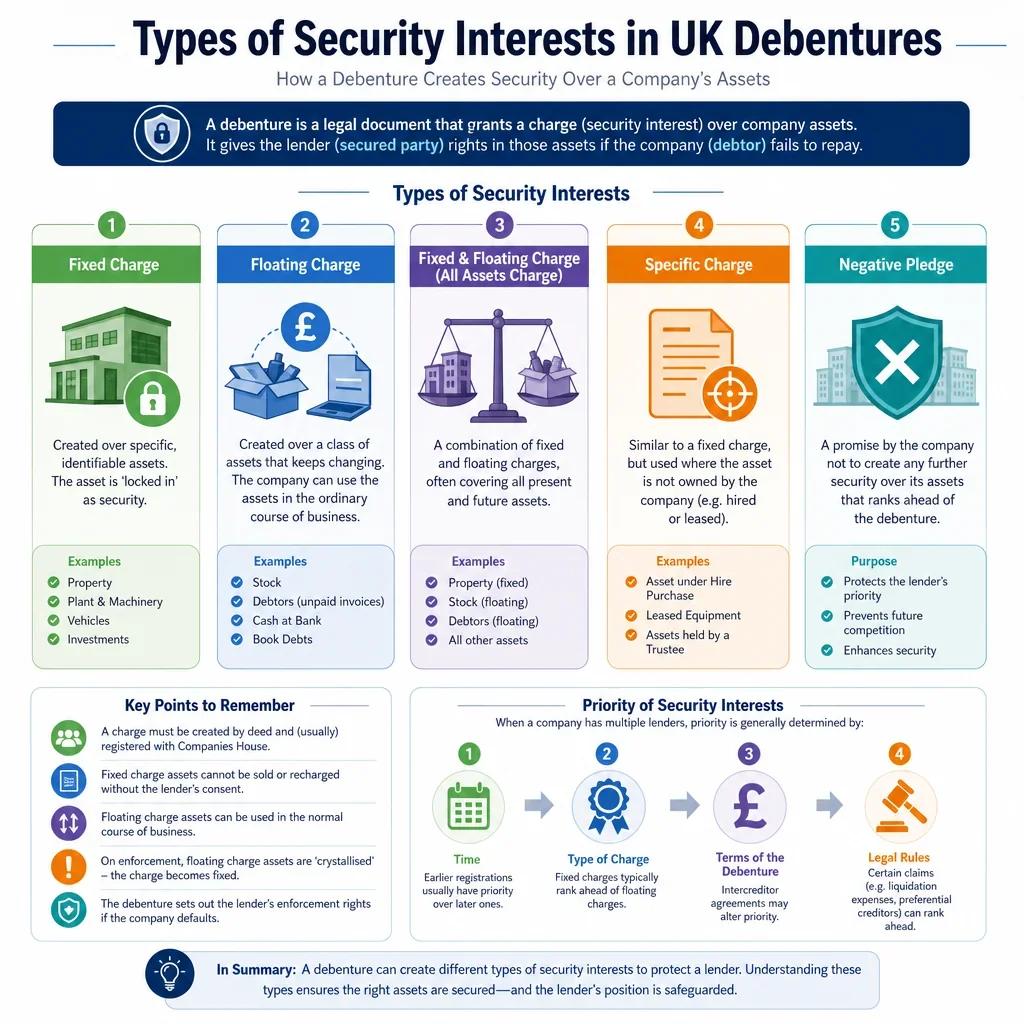
AI Generated British Debenture
PDF & Word - 2026 Updated
Docaro Pricing
When do you need a Debenture in the United Kingdom?
British Legal Rules for a Debenture
Using the wrong type of security agreement can fail to adequately protect the secured party's interests or comply with UK financial regulations.
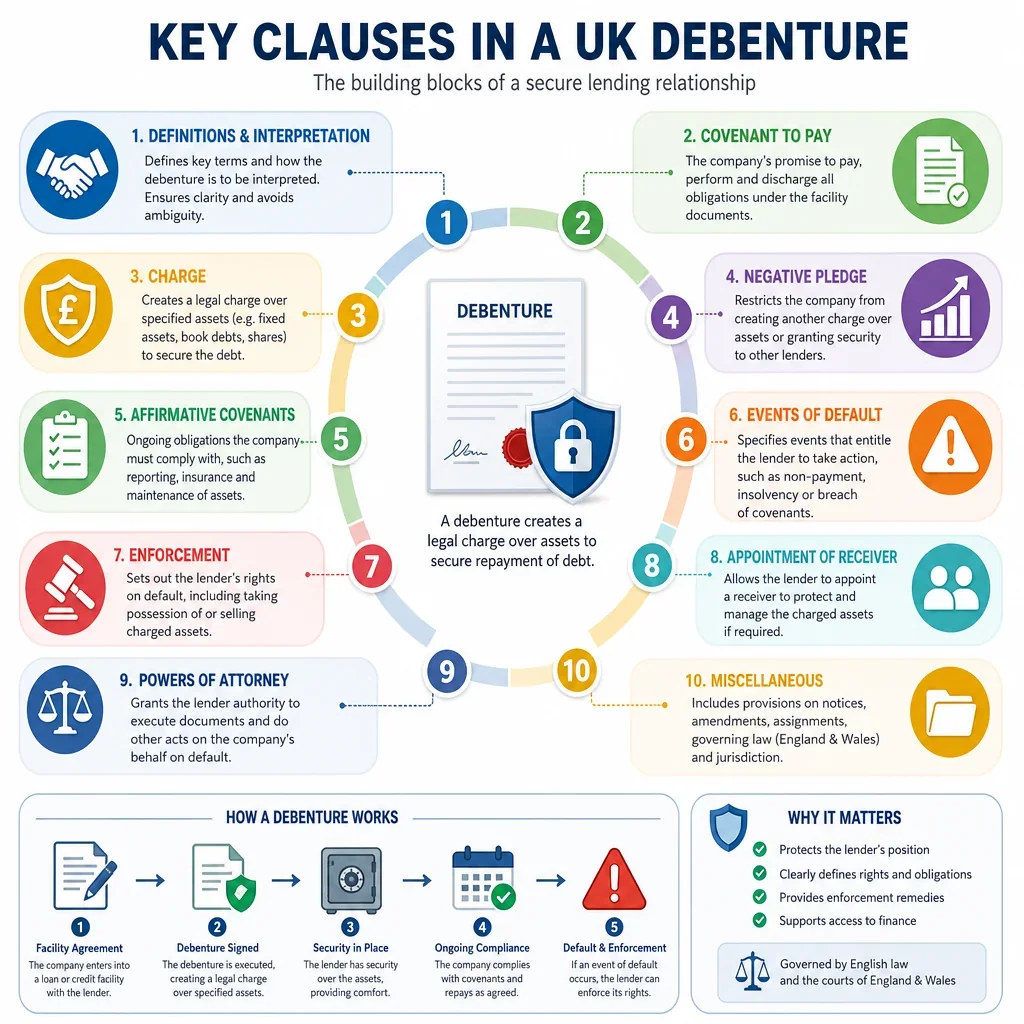
What a Proper Debenture Should Include
- Parties InvolvedClearly identify the lender and the borrower to establish who is entering the agreement.
- Loan AmountSpecify the exact amount of money being lent and any interest rates or repayment terms.
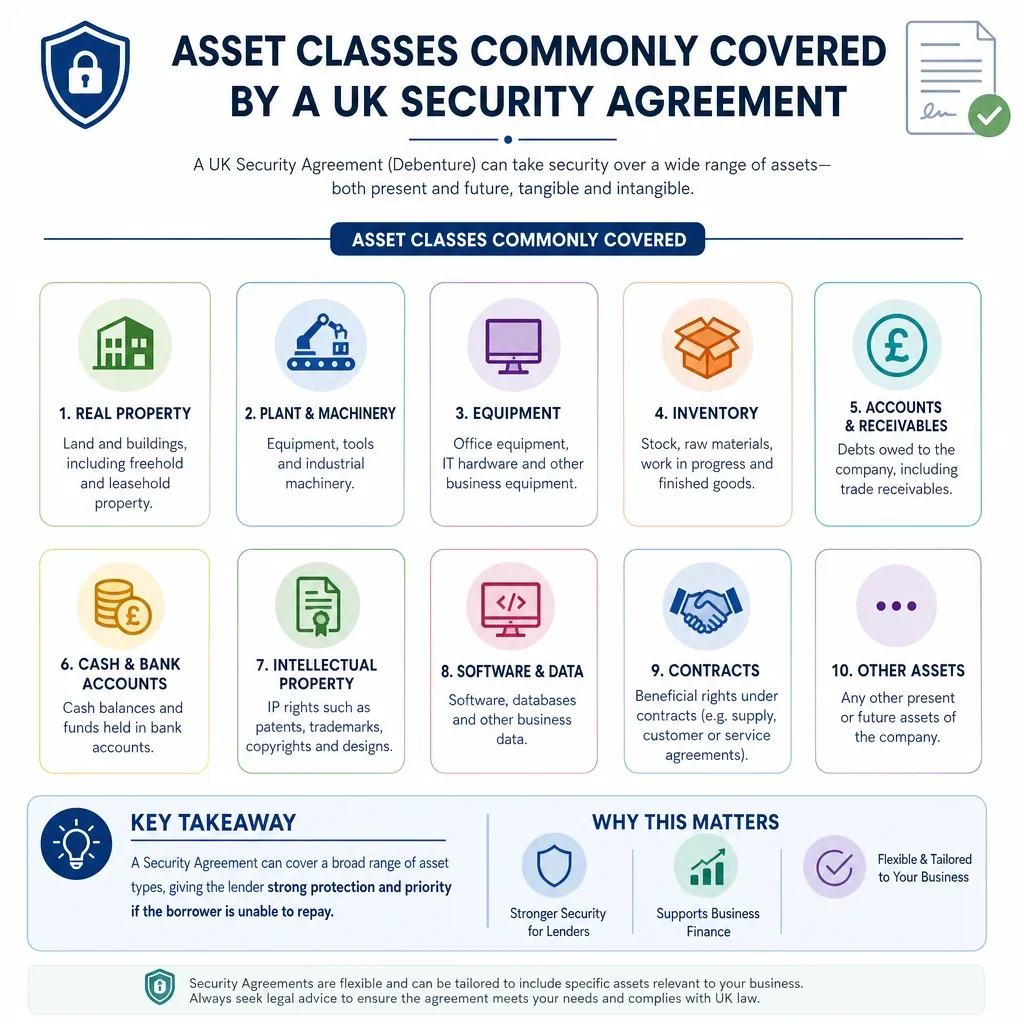
- Assets as SecurityList the specific assets or property that the borrower pledges as collateral for the loan.
- Borrower's PromisesOutline the borrower's commitments, such as maintaining the assets and using loan funds appropriately.
- Events Triggering ActionDefine situations like missed payments that allow the lender to take control of the secured assets.
- Lender's RightsDetail what the lender can do if the borrower defaults, including selling the assets to recover the debt.
- Governing RulesState that the agreement follows UK laws and specify which courts handle any disputes.
Generate Your Document in 4 Easy Steps
Why Use Docaro?
 United Kingdom
Free Example Debenture Template
Below is a free template example of a Debenture for use in the United Kingdom generated by our AI model.
The clauses in your actual Debenture will vary from this example as they will be entirely bespoke to your requirements as set out in the questionnaire you complete.
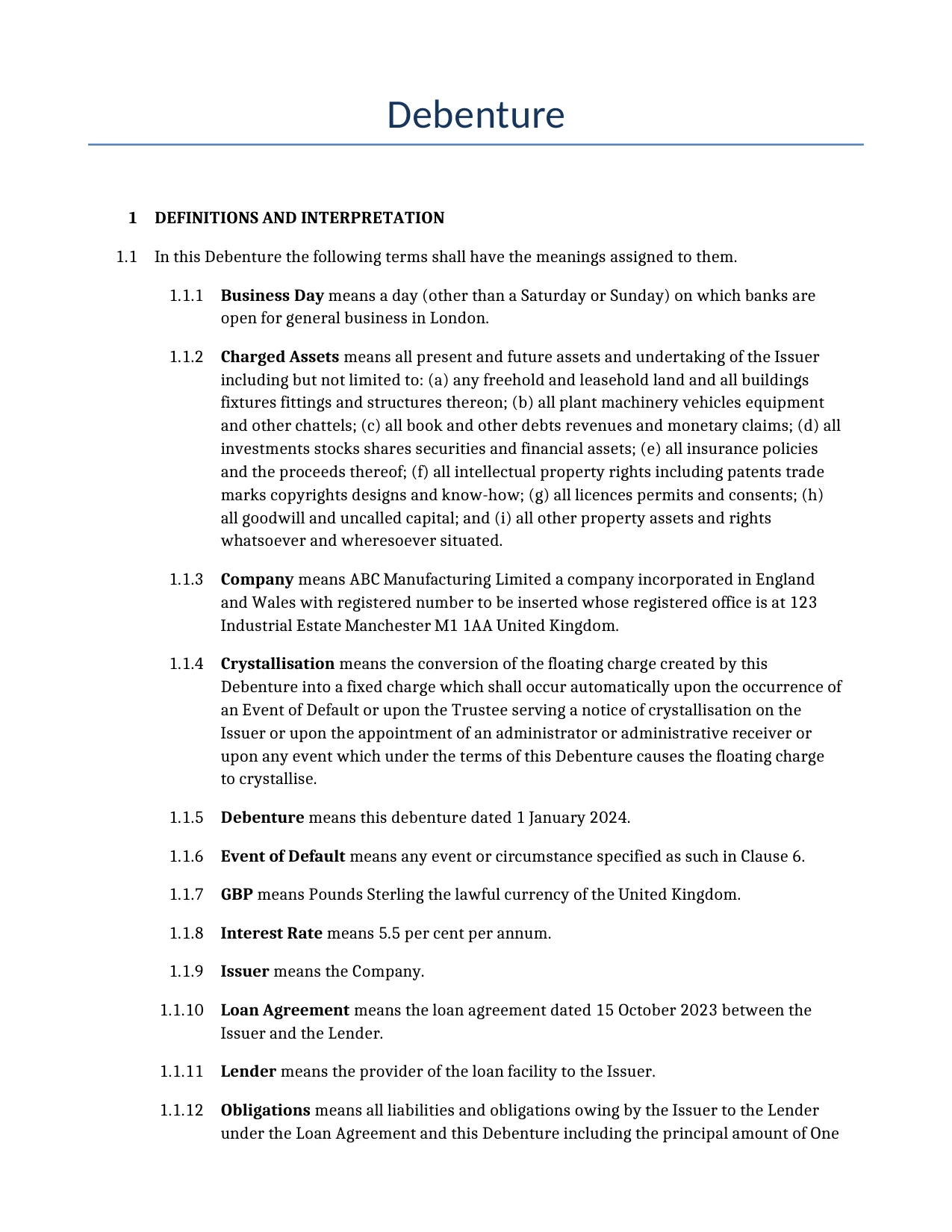
Debenture
1DEFINITIONS AND INTERPRETATION
In this Debenture the following terms shall have the meanings assigned to them.
Business Day means a day (other than a Saturday or Sunday) on which banks are open for general business in London.
Charged Assets means all present and future assets and undertaking of the Issuer including but not limited to: (a) any freehold and leasehold land and all buildings fixtures fittings and structures thereon; (b) all plant machinery vehicles equipment and other chattels; (c) all book and other debts revenues and monetary claims; (d) all investments stocks shares securities and financial assets; (e) all insurance policies and the proceeds thereof; (f) all intellectual property rights including patents trade marks copyrights designs and know-how; (g) all licences permits and consents; (h) all goodwill and uncalled capital; and (i) all other property assets and rights whatsoever and wheresoever situated.
Company means ABC Manufacturing Limited a company incorporated in England and Wales with registered number to be inserted whose registered office is at 123 Industrial Estate Manchester M1 1AA United Kingdom.
Crystallisation means the conversion of the floating charge created by this Debenture into a fixed charge which shall occur automatically upon the occurrence of an Event of Default or upon the Trustee serving a notice of crystallisation on the Issuer or upon the appointment of an administrator or administrative receiver or upon any event which under the terms of this Debenture causes the floating charge to crystallise.
Debenture means this debenture dated 1 January 2024.
Event of Default means any event or circumstance specified as such in Clause 6.
GBP means Pounds Sterling the lawful currency of the United Kingdom.
Interest Rate means 5.5 per cent per annum.
Issuer means the Company.
Loan Agreement means the loan agreement dated 15 October 2023 between the Issuer and the Lender.
Lender means the provider of the loan facility to the Issuer.
Obligations means all liabilities and obligations owing by the Issuer to the Lender under the Loan Agreement and this Debenture including the principal amount of One Hundred Thousand Pounds (GBP 100,000) together with interest at the Interest Rate and all other sums due.
Principal Amount means the maximum principal amount secured by this Debenture which is GBP 150,000.
Receiver means any receiver or receiver and manager appointed by the Trustee under this Debenture.
Secured Liabilities means all present and future obligations and liabilities of the Issuer to the Lender and the Trustee under this Debenture and the Loan Agreement.
Security means the fixed and floating charges created by this Debenture.
Trustee means ABC Trust Corporation Limited a trust corporation incorporated in England and Wales whose registered office is at 123 High Street London EC1A 1BB United Kingdom.
The headings in this Debenture shall not be used for the purposes of its interpretation.
References to any schedule to this Debenture shall be deemed to be included in the interpretation of the main body of this Debenture.
This Debenture shall be construed using gender-neutral language throughout.
Unless the context requires otherwise words in the singular shall include the plural and vice versa.
Any reference to a statute or statutory provision includes any subordinate legislation made under it and any reference to a statute or statutory provision includes that statute or provision as from time to time modified or re-enacted.
2RECITALS
The Lender has agreed to provide a loan facility to the Issuer to finance the Issuer's expansion into new markets in accordance with the Loan Agreement.
The Issuer requires additional funding for operational growth and to cover working capital needs.
This Debenture is created by the Issuer in favour of the Trustee as trustee for the Lender to provide security for the Secured Liabilities.
The Issuer has obtained all necessary regulatory approvals for the execution of this Debenture.
This Debenture creates a fixed and floating charge over the assets of the Issuer.
3GRANT OF SECURITY
In consideration of the Lender agreeing to make available the loan facility to the Issuer under the Loan Agreement the Issuer with full title guarantee hereby charges to the Trustee as trustee for the Lender by way of first fixed charge all the Charged Assets.
The grant of security under this Debenture shall take effect on 1 January 2024.
The security interests created by this Debenture shall commence on 1 January 2024.
The Issuer shall perfect the security interests by registration of this Debenture at Companies House and by giving notice to relevant debtors.
The Issuer shall file the particulars of this Debenture at Companies House within the timeframe required by the Companies Act 2006 to perfect the security.
The Issuer shall at its own cost promptly execute and deliver to the Trustee such further assurances and documents (including but not limited to deeds of accession assignments notices of assignment and other instruments) as the Trustee may reasonably require for the purpose of perfecting or protecting the Security or for the purpose of exercising the Trustee's rights under this Debenture. The Issuer shall register this Debenture at Companies House within 21 days of its execution as required by section 859A of the Companies Act 2006. In the event that any of the Charged Assets comprise real property the Issuer shall promptly register the Security at the Land Registry and shall provide the Trustee with certified copies of all registration applications and evidence of registration upon request.
4THE SECURITY
The Issuer grants a fixed charge over its real property and intellectual property to the Trustee.
The Issuer grants a floating charge over the remaining assets of the Issuer including its stock cash and general undertakings.
The Security created by this Debenture shall extend to all existing and future assets of the Issuer of the same type as the Charged Assets.
The Security created by this Debenture is given as security for the due and punctual payment and discharge of the Secured Liabilities.
This Debenture is a fixed and floating charge debenture for the purposes of the Law of Property Act 1925 the Bills of Sale Act 1878 the Sale of Goods Act 1979 the Companies Act 2006 and the Financial Collateral Arrangements (No. 2) Regulations 2003.
The Issuer shall not create or permit to subsist any mortgage charge lien or other encumbrance ranking in priority to or pari passu with this Debenture over all or any part of the Charged Assets without the prior written consent of the Trustee.
5COVENANTS
The Issuer covenants with the Trustee that it shall maintain its business in the manner currently conducted.
The Issuer covenants with the Trustee that it shall comply with all applicable laws and regulations.
The Issuer covenants with the Trustee that it shall at all times maintain a minimum net worth of 500000.00 GBP.
The Issuer covenants with the Trustee that it shall not permit its debt to equity ratio to exceed 2.5.
The Issuer covenants with the Trustee that it shall at all times maintain an interest coverage ratio of at least 3 times.
The Issuer covenants with the Trustee that it shall not dispose of any substantial assets without the prior written consent of the Trustee.
The Issuer covenants with the Trustee that it shall not incur any additional indebtedness without the prior written consent of the Trustee.
The Issuer covenants with the Trustee that it shall provide quarterly financial reports to the Trustee.
The Issuer covenants with the Trustee that it shall not pay any dividends without the prior written consent of the Trustee.
The Issuer covenants with the Trustee that it shall at all times keep the Charged Assets insured with an insurance office or underwriter approved by the Trustee against all risks which a prudent person carrying on the same business would insure for the full replacement value thereof with the interest of the Trustee noted on the policy and shall on request produce to the Trustee the policy or policies of insurance and evidence of payment of the latest premium due thereon.
The Issuer shall not without the prior written consent of the Trustee create or permit to subsist any mortgage charge lien pledge or other security interest or encumbrance over all or any part of the Charged Assets.
The Issuer shall not without the prior written consent of the Trustee sell transfer lease or otherwise dispose of all or any part of the Charged Assets (other than in the ordinary course of trading in respect of assets subject to the floating charge).
6EVENTS OF DEFAULT
It shall be an Event of Default if the Issuer fails to pay any part of the principal amount when due.
It shall be an Event of Default if the Issuer fails to pay any interest when due.
It shall be an Event of Default if the Issuer commits any breach of any covenant contained in this Debenture.
It shall be an Event of Default if the Issuer becomes insolvent or enters into any bankruptcy or analogous proceedings.
It shall be an Event of Default if there occurs any material adverse change in the financial condition of the Issuer which in the opinion of the Trustee may affect the ability of the Issuer to perform its obligations under this Debenture.
It shall be an Event of Default if any event of default occurs under the Loan Agreement (cross-default).
It shall be an Event of Default if any representation or warranty made or given by the Issuer under this Debenture or the Loan Agreement proves to have been incorrect or misleading in any material respect when made or given.
It shall be an Event of Default if the Issuer ceases or threatens to cease to carry on all or a material part of its business.
For any non-monetary default which is capable of remedy the Issuer shall be given a period of 14 days from the date of written notice from the Trustee to remedy such default before it constitutes an Event of Default.
7ENFORCEMENT
Upon the occurrence of an Event of Default the outstanding principal and interest shall automatically become immediately due and payable.
The Trustee shall not enforce the Security until it has provided written notice to the Issuer of the occurrence of an Event of Default.
Upon the occurrence of an Event of Default and after the giving of notice the Trustee shall have the right to appoint a Receiver over the Charged Assets and to sell the Charged Assets.
The powers of enforcement conferred by this Debenture shall be in addition to and without prejudice to any other powers conferred by the Law of Property Act 1925 or otherwise by law.
8POWER OF ATTORNEY
The Issuer hereby irrevocably appoints the Trustee and each of its delegates and substitutes as its attorney with full power in its name or otherwise and on its behalf and as its act and deed to execute and deliver all such deeds agreements instruments notices and other documents and to do all such acts and things as the Trustee may in its absolute discretion consider necessary or desirable for the purpose of perfecting protecting or enforcing the Security created by this Debenture or for exercising any of the rights powers and remedies of the Trustee under this Debenture or by law. This power of attorney is given by way of security and is irrevocable and is coupled with an interest.
9THE TRUSTEE
The Issuer hereby appoints the Trustee to act as trustee for the Lender under this Debenture with effect from 1 January 2024.
The Trustee is a trust corporation for the purposes of this Debenture.
The Trustee shall have the power to enforce the Security to call meetings of the holders of the debentures and to appoint Receivers.
The Trustee may retire from its appointment under this Debenture upon giving not less than 30 days' written notice to the Issuer and the Lender.
Upon the retirement of the Trustee a new trustee shall be appointed in accordance with the provisions of the Trustee Act 1925.
10APPLICATION OF MONEYS
All moneys received by the Trustee or any Receiver pursuant to this Debenture shall be applied in the following order of priority.
First in payment of all costs charges and expenses incurred by the Trustee or any Receiver in connection with the enforcement of this Debenture.
Secondly in or towards payment of the Secured Liabilities including all interest accrued thereon.
Thirdly in payment of the surplus if any to the Issuer.
If the moneys available for distribution are insufficient to pay in full any amount falling within a particular class of liability such amount shall be paid pro rata among the obligations of the same priority.
Interest shall continue to accrue on the Obligations after the occurrence of an Event of Default at the standard default rate provided for in the Loan Agreement.
11RELEASE OF SECURITY
Upon full satisfaction of all the Secured Liabilities the Security created by this Debenture shall be automatically released.
The Trustee shall upon full satisfaction of the Secured Liabilities provide written notice to the Issuer confirming the release of the Security.
The release of the Security shall be effected by a deed of release executed by the Trustee.
12INDEMNITIES
The Issuer shall indemnify the Trustee against all liabilities incurred by the Trustee in its role as trustee under this Debenture.
The Issuer shall indemnify the Trustee against all losses incurred by the Trustee in performing its duties under this Debenture.
The indemnities shall cover all tax liabilities and legal costs incurred by the Trustee.
The indemnities shall take effect from 1 January 2024.
The indemnities shall survive the termination or repayment of this Debenture.
Any claim under the indemnities shall be made by written notice given within 30 days of the relevant liability arising.
13EXPENSES AND STAMP DUTY
The Company shall pay all costs charges and expenses incurred by the Security Trustee in connection with the preparation negotiation and execution of this Debenture.
The Company shall pay all costs charges and expenses incurred by the Security Trustee in connection with the enforcement of this Debenture.
The stamp duty payable in connection with this Debenture is estimated at 500.00 and shall be paid by the Company.
The Company shall indemnify the Security Trustee against any liability for stamp duty arising in connection with this Debenture.
14NOTICES
Any notice under this Debenture shall be given by personal delivery post or email.
A notice sent by post shall be deemed to be received 2 days after posting.
Notices to the Company shall be sent to 123 Business Street London EC1A 1BB United Kingdom.
Notices to the Security Trustee shall be sent to 456 Trust Avenue Manchester M1 1AA United Kingdom.
Business days for the purposes of this Clause 14 shall exclude Saturdays Sundays and bank holidays.
All notices under this Debenture shall be given in the English language only.
15GOVERNING LAW
This Debenture and any non-contractual obligations arising out of or in connection with it shall be governed by the laws of England and Wales.
The grant of security under this Debenture shall be governed by the laws of England and Wales.
This Debenture is governed by English law.
The miscellaneous provisions of this Debenture shall be governed by the laws of England and Wales.
16JURISDICTION
The courts of England and Wales shall have exclusive jurisdiction to settle any dispute arising out of or in connection with this Debenture.
The Issuer irrevocably submits to the exclusive jurisdiction of the English courts.
The Issuer consents to service of any legal proceedings related to this Debenture being made by prepaid post to its registered address.
17MISCELLANEOUS PROVISIONS
If any provision of this Debenture is held to be invalid or unenforceable the validity and enforceability of the remaining provisions shall not be affected.
No waiver by the Trustee of any breach of this Debenture shall be considered as a waiver of any subsequent breach of the same or any other provision.
No amendment to this Debenture shall be effective unless it is in writing and signed by or on behalf of each party.
A person who is not a party to this Debenture shall have no rights under the Contracts (Rights of Third Parties) Act 1999 to enforce any term of this Debenture.
This Debenture constitutes the entire agreement between the parties relating to the subject matter hereof.
This Debenture is executed as a deed and delivered on the date first above written.
The Trustee may at any time without notice to the Issuer set off any liability owed by the Trustee to the Issuer against any Secured Liabilities owed by the Issuer to the Trustee or the Lender.
If any provision of this Debenture is held to be invalid illegal or unenforceable the validity legality or enforceability of the remaining provisions shall not in any way be affected or impaired.
This Debenture is drawn up in the English language which language shall be the governing language.
This Debenture may be executed in any number of counterparts each of which when executed and delivered shall constitute a duplicate original but all of which together shall constitute one and the same instrument.
18SCHEDULE 1 - FORM OF DEBENTURE STOCK CERTIFICATE
Certificate Number DSC001.
This is to certify that Johnathan Robert Smith is the registered holder of debenture stock of ABC Manufacturing Limited in the principal amount of 50000.00.
The debenture stock is issued on 15 October 2023 and carries interest at the rate of 5.5 per cent per annum payable semi-annually.
This debenture stock certificate is governed by the laws of England and Wales.
19SCHEDULE 2 - CONDITIONS OF THE DEBENTURES
The principal amount of the debentures is GBP 500,000.
The annual interest rate for the debentures is 5.5 per cent.
Interest shall be paid to the debenture holders semi-annually.
Interest on the debentures shall start accruing from 1 January 2024.
The maturity date for the debentures is 1 January 2029 at which date the principal shall be repaid by bullet repayment.
The Company shall have the option to redeem the debentures early.
The following events shall constitute a default under these conditions namely non-payment of interest or principal breach of covenants and insolvency or bankruptcy.
20SCHEDULE 3 - PARTICULARS OF CHARGED ASSETS
The Charged Assets include real property plant and machinery and intellectual property.
The charged assets include the freehold property located at 123 High Street London comprising a commercial office building with an area of 500 square meters all plant and machinery used in the company's manufacturing operations including two CNC machines three assembly line robots and associated tools valued at approximately 150000 and intellectual property rights specifically UK trademark number 456789 for the brand TechSolutions and patent number GB0123456 for the proprietary widget design.
There are no existing charges liens or encumbrances on these assets.
The real property is located in London United Kingdom the plant and machinery are situated at the company's factory in Manchester United Kingdom and the intellectual property is registered with the UK Intellectual Property Office.
A fixed charge shall apply to these assets.
The charge shall extend to future-acquired assets of the same type.
21EXECUTION
This Debenture is executed and delivered as a deed.
Executed and delivered as a deed by ABC Manufacturing Limited acting by two directors or a director and the company secretary in accordance with section 44 of the Companies Act 2006.
Director Signature ___________________________ Name ___________________________ Date ___________________________
Director/Secretary Signature ___________________________ Name ___________________________ Date ___________________________
Executed and delivered as a deed by ABC Trust Corporation Limited acting by two directors or a director and the company secretary in accordance with section 44 of the Companies Act 2006.
Director Signature ___________________________ Name ___________________________ Date ___________________________
Director/Secretary Signature ___________________________ Name ___________________________ Date ___________________________
This example shows approximately 70% of a typical document and is provided for illustrative purposes only. The remaining content has been omitted.
Every document generated by Docaro is tailored to your specific circumstances, jurisdiction and the information you provide. The completed document includes all applicable clauses and provisions required for your situation.
To generate the full, personalised document, answer a short series of questions and your document will be created instantly.
Useful Resources When Considering a Debenture in the United Kingdom
United Kingdom Reference Legislation
Debenture FAQs
Document Generation FAQs
Related Articles