AI Generated British Flexible Working Arrangement Agreement
PDF & Word - 2026 Updated
Docaro Pricing
When do you need a Teleworking Agreement in the United Kingdom?
British Legal Rules for a Teleworking Agreement
Using the wrong structure for a remote work agreement may fail to comply with UK employment laws and expose the employer to unintended liabilities.
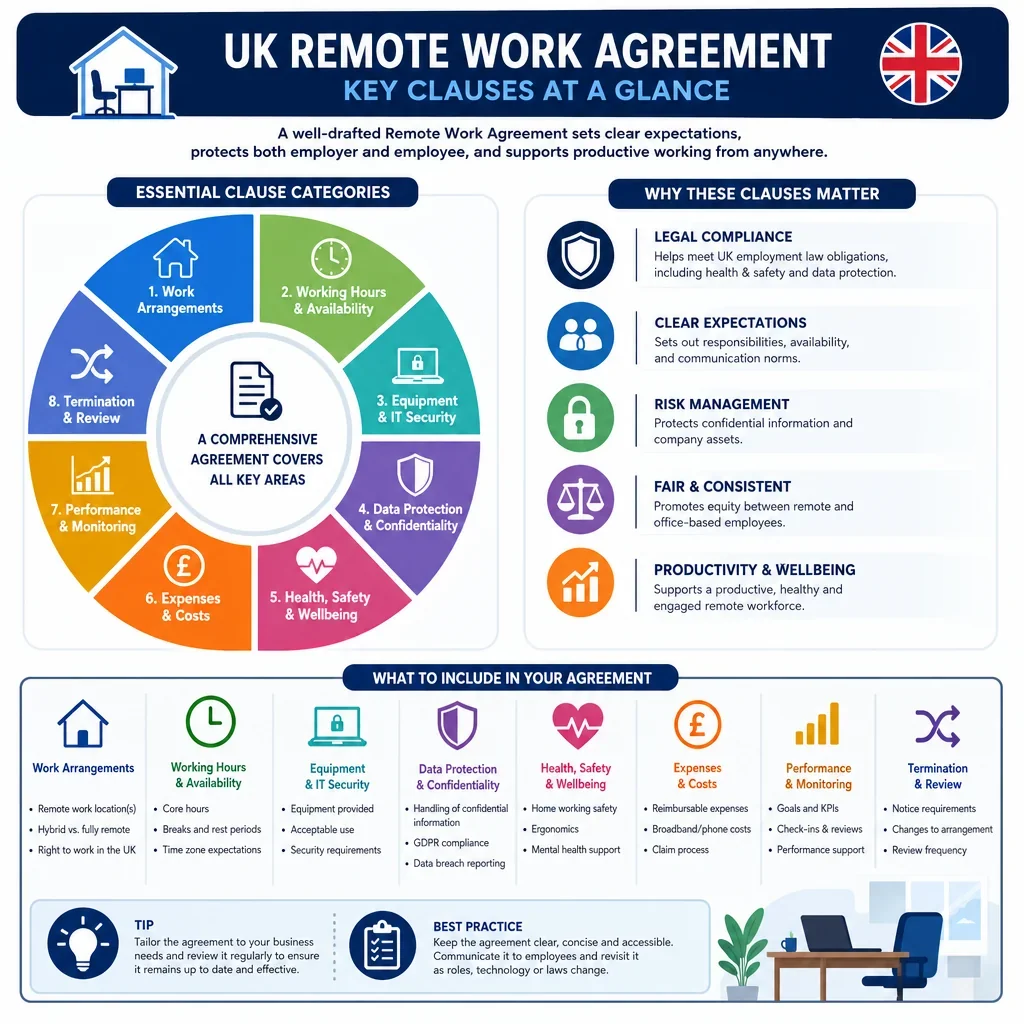
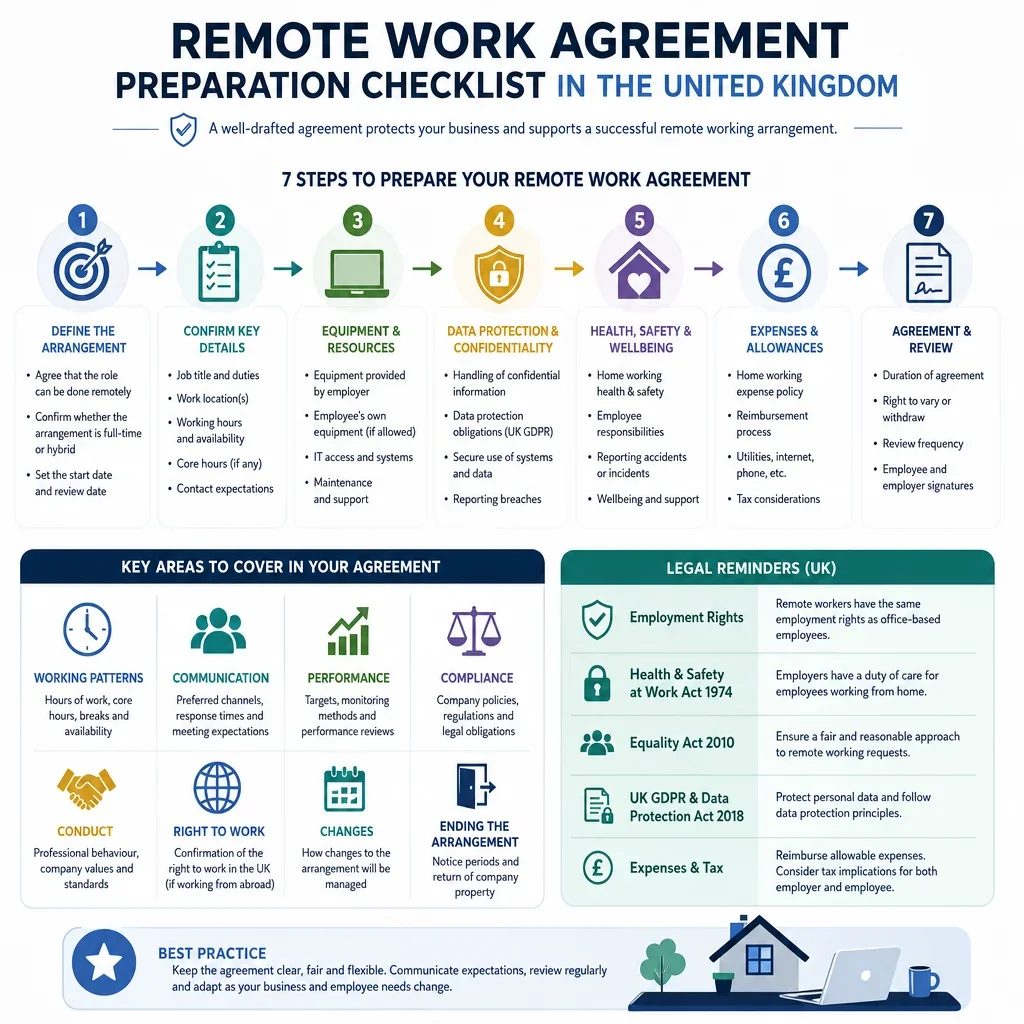
What a Proper Teleworking Agreement Should Include
- Work Location and SetupSpecifies the employee's approved home or remote workspace and any requirements for a safe, suitable environment.
- Working Hours and AvailabilityOutlines expected daily hours, breaks, and how the employee should be available for communication during work time.
- Equipment and ExpensesDetails what tools or devices the employer provides and how costs like internet or utilities will be reimbursed.
- Health and SafetyRequires the employee to maintain a safe remote workspace and report any hazards, in line with UK regulations.
- Data Protection and ConfidentialitySets rules for securely handling company information and protecting personal data from home.
- Communication and MeetingsDescribes how often and through what methods the employee must check in with the team or attend virtual meetings.
- Performance and MonitoringExplains how work progress will be tracked and reviewed without invading privacy.
- Leave and AbsencesCovers how to request holidays, sick days, or other time off while working remotely.
- Termination and NoticeStates the process for ending the remote arrangement or employment, including required notice periods.
Generate Your Document in 4 Easy Steps
Why Use Docaro?
 United Kingdom
Free Example Teleworking Agreement Template
Below is a free template example of a Teleworking Agreement for use in the United Kingdom generated by our AI model.
The clauses in your actual Teleworking Agreement will vary from this example as they will be entirely bespoke to your requirements as set out in the questionnaire you complete.
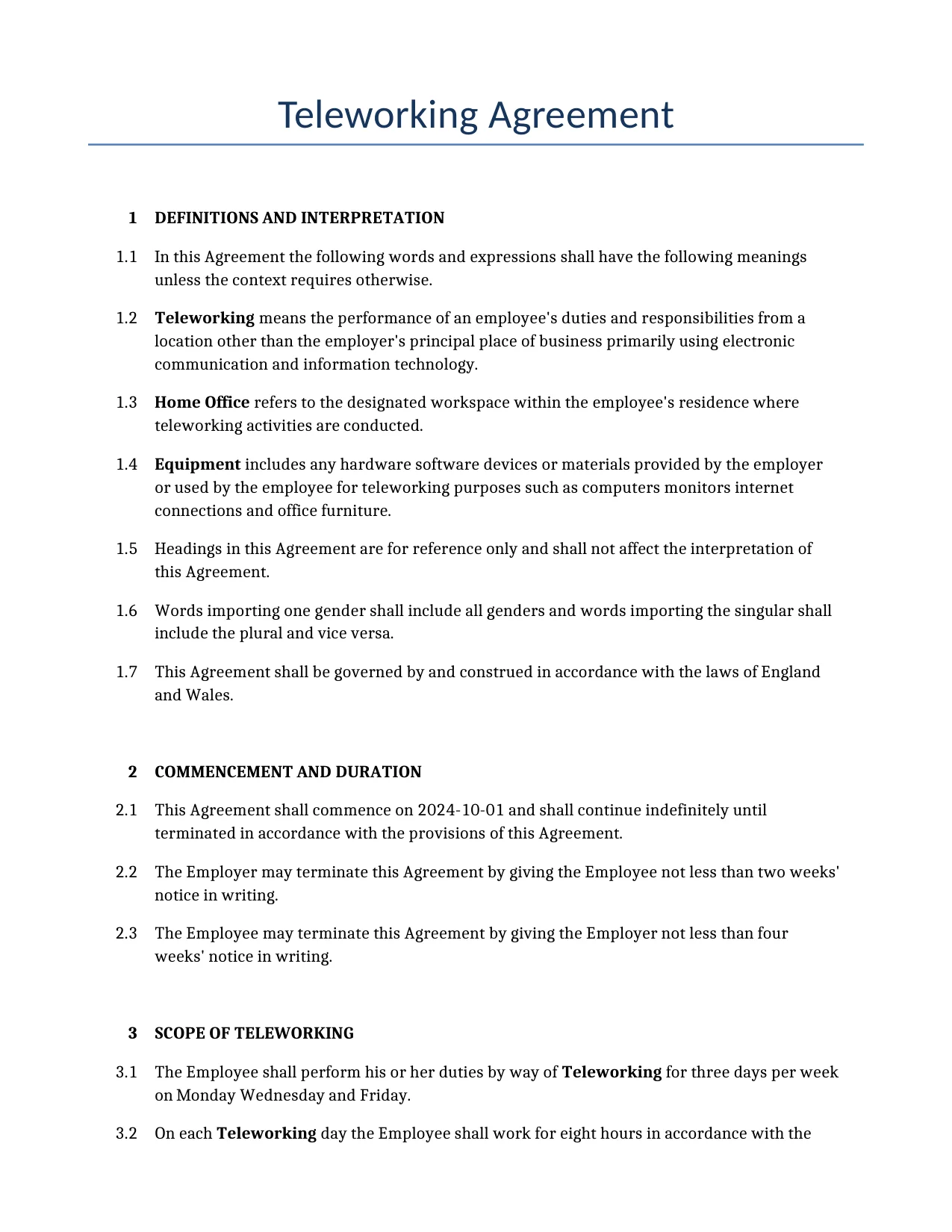
Teleworking Agreement
1DEFINITIONS AND INTERPRETATION
In this Agreement the following words and expressions shall have the following meanings unless the context requires otherwise.
Teleworking means the performance of an employee's duties and responsibilities from a location other than the employer's principal place of business primarily using electronic communication and information technology.
Home Office refers to the designated workspace within the employee's residence where teleworking activities are conducted.
Equipment includes any hardware software devices or materials provided by the employer or used by the employee for teleworking purposes such as computers monitors internet connections and office furniture.
Headings in this Agreement are for reference only and shall not affect the interpretation of this Agreement.
Words importing one gender shall include all genders and words importing the singular shall include the plural and vice versa.
This Agreement shall be governed by and construed in accordance with the laws of England and Wales.
2COMMENCEMENT AND DURATION
This Agreement shall commence on 2024-10-01 and shall continue indefinitely until terminated in accordance with the provisions of this Agreement.
The Employer may terminate this Agreement by giving the Employee not less than two weeks' notice in writing.
The Employee may terminate this Agreement by giving the Employer not less than four weeks' notice in writing.
3SCOPE OF TELEWORKING
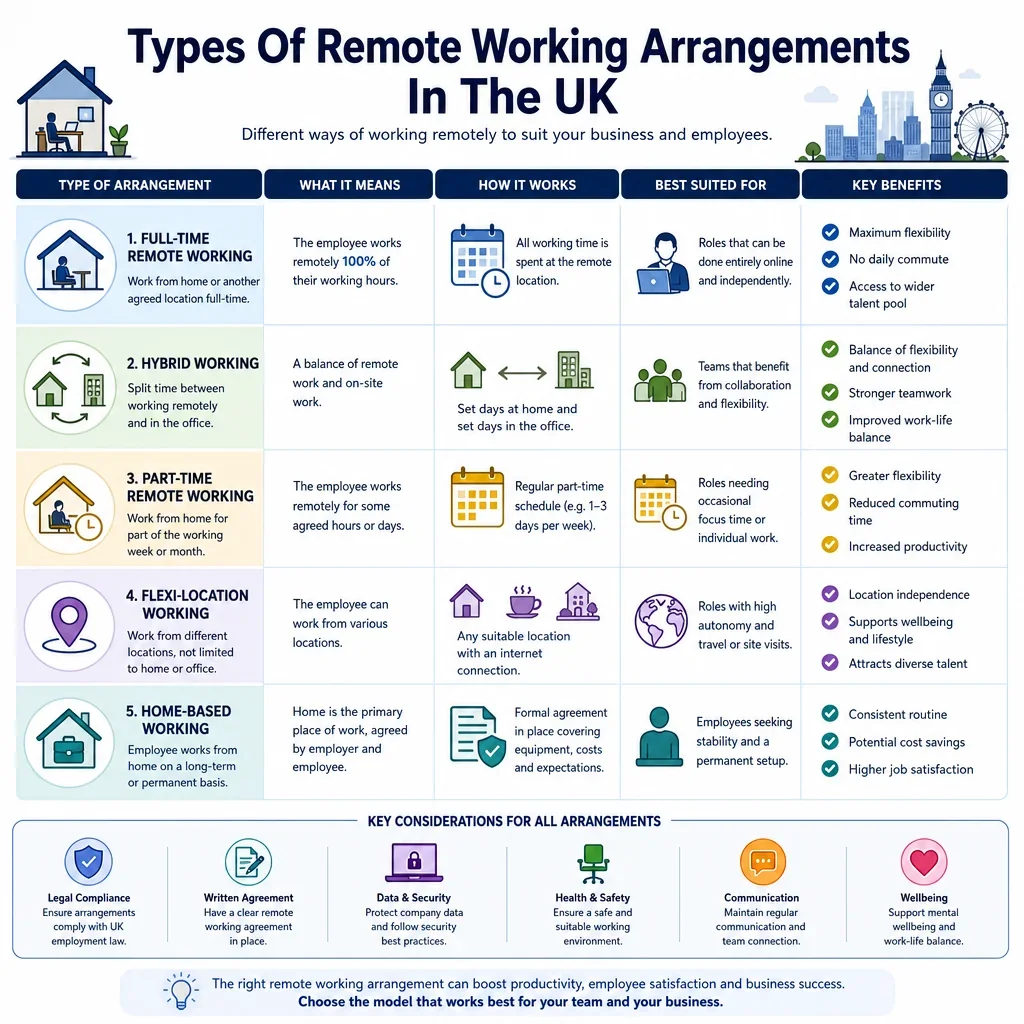
The Employee shall perform his or her duties by way of Teleworking for three days per week on Monday Wednesday and Friday.
On each Teleworking day the Employee shall work for eight hours in accordance with the Working Time Regulations 1998.
The Employee shall only conduct Teleworking from within the United Kingdom and shall maintain a dedicated Home Office at all times.
The Employee shall not engage in any secondary employment while performing Teleworking and shall use only Equipment provided by the Employer.
This Teleworking arrangement shall commence on 2024-10-01.
4WORKPLACE AND EQUIPMENT
The designated Home Office is located at 123 Oak Street London SW1A 1AA United Kingdom and consists of a dedicated spare room on the ground floor equipped with a desk natural lighting from a large window and separate from main living areas for privacy.
The Employer shall provide all necessary Equipment including ergonomic equipment such as an adjustable chair or desk to the Employee for the purposes of Teleworking.
The Employer shall provide office supplies such as stationery or printing facilities to the Employee.
The Employer shall reimburse the Employee for any Equipment or furniture that the Employee provides himself or herself for Teleworking purposes in accordance with HMRC rules.
5HEALTH AND SAFETY
The Employer shall conduct a suitable and sufficient risk assessment of the Employee's home workspace (or review the Employee's self-assessment) in accordance with the Health and Safety at Work etc. Act 1974 and the Management of Health and Safety at Work Regulations 1999. This includes identifying hazards providing guidance on ergonomic setups and ensuring display screen equipment (DSE) assessments are completed.
The Employee has conducted a self-risk assessment of the Home Office and shall maintain a safe working environment at all times in accordance with the Health and Safety at Work etc. Act 1974. The Employee shall allow the Employer reasonable access for inspections if needed upon reasonable notice.
The Employee's home insurance policy is provided by ABC Insurance Company policy number 123456789 valid from 1 January 2024 to 31 December 2024 and includes coverage for contents up to \£50000 with an extension for business use at home covering Equipment up to \£5000.
The Employee's home insurance policy explicitly covers Teleworking and business Equipment used in the Home Office.
The Employee shall report any health and safety incidents occurring in the Home Office to the Employer immediately. The Employer shall investigate and where applicable report under RIDDOR.
6DATA PROTECTION AND CONFIDENTIALITY
The Employee shall handle confidential information including client personal data such as names addresses and financial details proprietary company strategies and business plans employee HR records and sensitive project documents related to ongoing developments while Teleworking in compliance with the Data Protection Act 2018 and UK GDPR.
The Employee acknowledges that he or she is bound by the Employer's existing confidentiality obligations when handling information at the Home Office.
The Employee shall implement secure passwords and multi-factor authentication encrypted storage and transmission firewall and antivirus software and regular software updates at the Home Office to protect company data.
The Employee has completed or agrees to complete GDPR compliance training provided by the Employer in accordance with the Data Protection Act 2018.
The Employee shall use company data at the Home Office solely for performing assigned tasks such as analyzing client reports during business hours preparing presentations and communicating with team members via secure channels and shall not use it for personal purposes or share it outside of work requirements.
In the event of a data breach or confidentiality incident the Employee shall provide immediate verbal notification followed by a written report to the Employer.
The Employee agrees to adhere to the GDPR principle of data minimization by only accessing necessary company data at the Home Office.
The Employer will ensure all monitoring of the Employee's work (such as through software or video calls) complies with UK GDPR is proportionate transparent and that the Employee has been provided with a privacy notice detailing the monitoring.
7COMMUNICATION AND AVAILABILITY
The Employee shall use email instant messaging and video conferencing for all work-related interactions while Teleworking.
The Employee shall engage in daily check-ins via instant messaging and weekly updates via email.
The Employee shall respond to work-related communications within two hours during Teleworking hours.
The Employee shall remain available during core hours of 10am to 4pm Monday to Friday.
The Employee shall not handle non-urgent communications outside of core hours.
The Employee must notify his or her manager via email or instant messaging at least 24 hours in advance or as soon as possible in emergencies stating the reason and expected duration of any unavailability during core hours.
8RIGHT TO DISCONNECT
The Employee has the right to disconnect outside of agreed working hours without repercussions in line with UK best practices and the Working Time Regulations 1998.
The Employer will not expect responses to communications outside core hours except in genuine emergencies.
Both parties will respect work-life balance and the Employee's right to disconnect.
9EXPENSES AND REIMBURSEMENT
The Employer shall reimburse the Employee for allowable expenses such as a flat-rate home office allowance using HMRC rates or actual costs for utilities and broadband with supporting evidence. All reimbursements will comply with HMRC rules to avoid tax implications and will be paid via payroll without deduction of tax/NI where qualifying.
The Employer shall provide all Teleworking Equipment such as computers or monitors to the Employee.
The Employer shall reimburse the Employee for travel costs related to Teleworking such as occasional office visits.
The Employee shall submit expense claims via email to the HR department with receipts attached including a detailed description of the expense within 30 days after incurring the expense.
Reimbursement of the Employee's Teleworking expenses shall commence on 2024-10-01.
10PERFORMANCE AND MONITORING
The Employee must maintain the same level of productivity as in the office completing all assigned tasks by the deadlines set responding to communications within two hours during working hours and achieving at least 95 percent accuracy in deliverables.
The Employer shall monitor the Employee's work output while Teleworking using regular video calls project management software tracking and performance reviews in compliance with data protection laws.
The Employee shall submit regular reports on his or her work output while Teleworking.
11MENTAL HEALTH AND WELLBEING
The Employer is committed to supporting the Employee's mental health and wellbeing providing access to resources such as an Employee Assistance Programme (EAP). The Employer encourages regular breaks in line with the Working Time Regulations 1998.
The Employee shall report any concerns about isolation or stress related to teleworking to the Employer who will address them appropriately without detriment to the Employee.
12LEAVE AND ABSENCE
The Employee shall be entitled to 28 days of annual leave which shall be calculated on a pro rata basis if the Employee works less than full-time hours under this Teleworking arrangement in line with the Working Time Regulations 1998.
The Employee shall request approval for annual leave by email to his or her manager and shall provide a minimum of 14 days' notice.
The Employee shall not carry over unused annual leave to the next year except as permitted by law.
The Employee may self-certify for the first seven days of sick leave without a medical note.
The Employee must notify his or her manager by phone or email before 9:00 AM on the first day of absence providing the expected duration if known.
Prolonged absences may require the Employee to return to the office temporarily.
13TRAINING AND SUPPORT
The Employer shall provide training on Teleworking practices to the Employee consisting of a comprehensive online training module covering secure remote access data protection best practices ergonomic Home Office setup and effective communication tools for Teleworking.
The Employee shall complete the Teleworking training by 2024-10-31.
The Employer shall provide IT support to the Employee by way of a dedicated helpdesk and remote access support available by email at it-support@company.co.uk or by phone at 020 1234 5678 between 9am and 5pm GMT Monday to Friday.
The Employer shall provide ongoing assistance to the Employee beyond initial training and IT support.
14INSURANCE AND LIABILITY
The Employer maintains employer's liability insurance which covers the Employee while teleworking in accordance with legal requirements. The Employer is not liable for any loss or damage to the Employee's personal property unless caused by the Employer's negligence.
The Employee has existing home contents insurance that covers Teleworking Equipment and includes public liability coverage for Teleworking activities. The Employee is responsible for ensuring adequate personal insurance.
The Employee shall report any accidents occurring during Teleworking at home by email to the HR Department immediately for investigation under health and safety rules.
The Employee is responsible for ensuring that the Home Office is safe for any visitors during Teleworking hours and has in place safety measures consisting of a dedicated room with ergonomic chair non-slip flooring fire extinguisher nearby and secure cable management to prevent tripping hazards.
15TERMINATION AND RETURN TO OFFICE
This Agreement may be terminated by either party in accordance with the notice periods set out in clause 2 of this Agreement.
The Employer may terminate this Agreement in the event of business reorganization performance issues or return to office policy.
The Employee may voluntarily end this Agreement for personal circumstances or health reasons.
Upon termination of the teleworking agreement the Employee has the right to request a return to office-based work or discuss alternative flexible arrangements under the Flexible Working Regulations 2018 and the Employer will consider such requests reasonably.
Upon termination of this Agreement the Employee must contact the IT department to schedule a pickup or return the Equipment to the office reception within seven days after notice.
The Employee will attend an induction session on the first day back in the office and follow a phased return schedule over the first two weeks when transitioning back to full office work.
If the Employee fails to return Equipment on time the Employee shall pay to the Employer a sum equal to the replacement value of any unreturned Equipment.
16RIGHT TO REQUEST FLEXIBLE WORKING
The Employee has the statutory right to request flexible working under the Flexible Working Regulations 2018. The Employer will consider any such requests in a reasonable manner in accordance with the Employment Rights Act 1996.
17EQUALITY AND INCLUSION
The teleworking arrangement will not disadvantage the Employee in terms of career progression training opportunities or performance evaluations compared to office-based staff in compliance with the Equality Act 2010.
The Employer is committed to monitoring for any indirect discrimination and will provide equal access to promotion and development opportunities.
18INTELLECTUAL PROPERTY
Any work created by the Employee during teleworking remains the property of the Employer. The Employee hereby assigns all intellectual property rights in such work to the Employer in line with UK copyright and IP laws including the Copyright Designs and Patents Act 1988.
19DISPUTE RESOLUTION
Any dispute arising out of or in connection with this Agreement shall in the first instance be referred to the Employer's internal grievance procedure.
Mediation shall be a mandatory step before any legal proceedings are commenced.
If the dispute is not resolved by mediation it shall be referred to the Employment Tribunal.
The Employer shall respond to any grievance raised under this Agreement within 14 days.
These dispute resolution procedures shall take effect on 2024-10-01.
All dispute resolution processes shall be conducted in confidence and the parties shall not disclose any details to third parties except as required by law.
20GOVERNING LAW AND JURISDICTION
This Agreement and any dispute or claim arising out of or in connection with it or its subject matter or formation shall be governed by and construed in accordance with the laws of England and Wales.
The parties agree that the courts of England and Wales shall have exclusive jurisdiction to settle any dispute or claim that arises out of or in connection with this Agreement or its subject matter or formation.
21VARIATION
Any changes to this Agreement must be mutually agreed in writing. Significant changes to terms and conditions shall follow proper consultation processes under UK employment law including the Employment Rights Act 1996.
22ENTIRE AGREEMENT AND AMENDMENTS
This Agreement constitutes the entire agreement between the parties and supersedes and extinguishes all previous agreements promises assurances warranties representations and understandings between them whether written or oral relating to its subject matter.
No amendment to this Agreement shall be effective unless it is in writing and signed by an authorised representative of the Employer and by the Employee.
23SEVERABILITY
If any provision of this Agreement is held to be invalid or unenforceable by any judicial or other competent authority all other provisions of this Agreement will remain in full force and effect and shall not in any way be affected or impaired.
24NOTICES
Any notice required to be given under this Agreement shall be in writing and shall be delivered by first class post email or hand delivery.
Notices to the Employer shall be sent to ABC Company Ltd 123 Business Street London EC1A 1BB United Kingdom.
Notices to the Employee shall be sent to John Doe 456 Residential Avenue Manchester M1 1AA United Kingdom.
Any notice sent by first class post shall be deemed to have been received two business days after the date of posting.
25SIGNATURES
This Agreement is executed as a deed and delivered on the date at the beginning of this Agreement.
Signed by the Employer: _______________________________ Date: _______________
Signed by the Employee: _______________________________ Date: _______________
This example shows approximately 70% of a typical document and is provided for illustrative purposes only. The remaining content has been omitted.
Every document generated by Docaro is tailored to your specific circumstances, jurisdiction and the information you provide. The completed document includes all applicable clauses and provisions required for your situation.
To generate the full, personalised document, answer a short series of questions and your document will be created instantly.
Useful Resources When Considering a Teleworking Agreement in the United Kingdom
United Kingdom Reference Legislation
Teleworking Agreement FAQs
Document Generation FAQs
Related Articles