AI Generated British Partnership Agreement
PDF & Word - 2026 Updated
Docaro Pricing
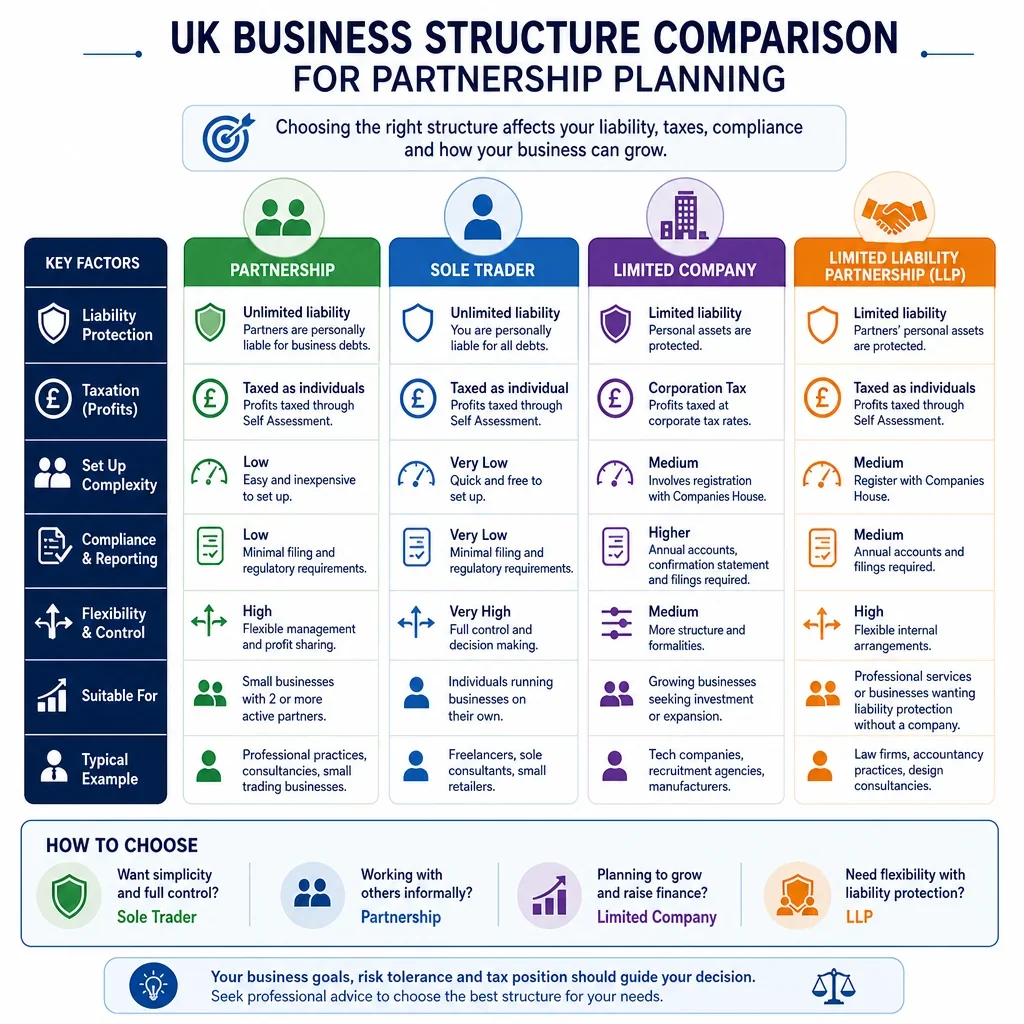
When do you need a Partnership Agreement in the United Kingdom?
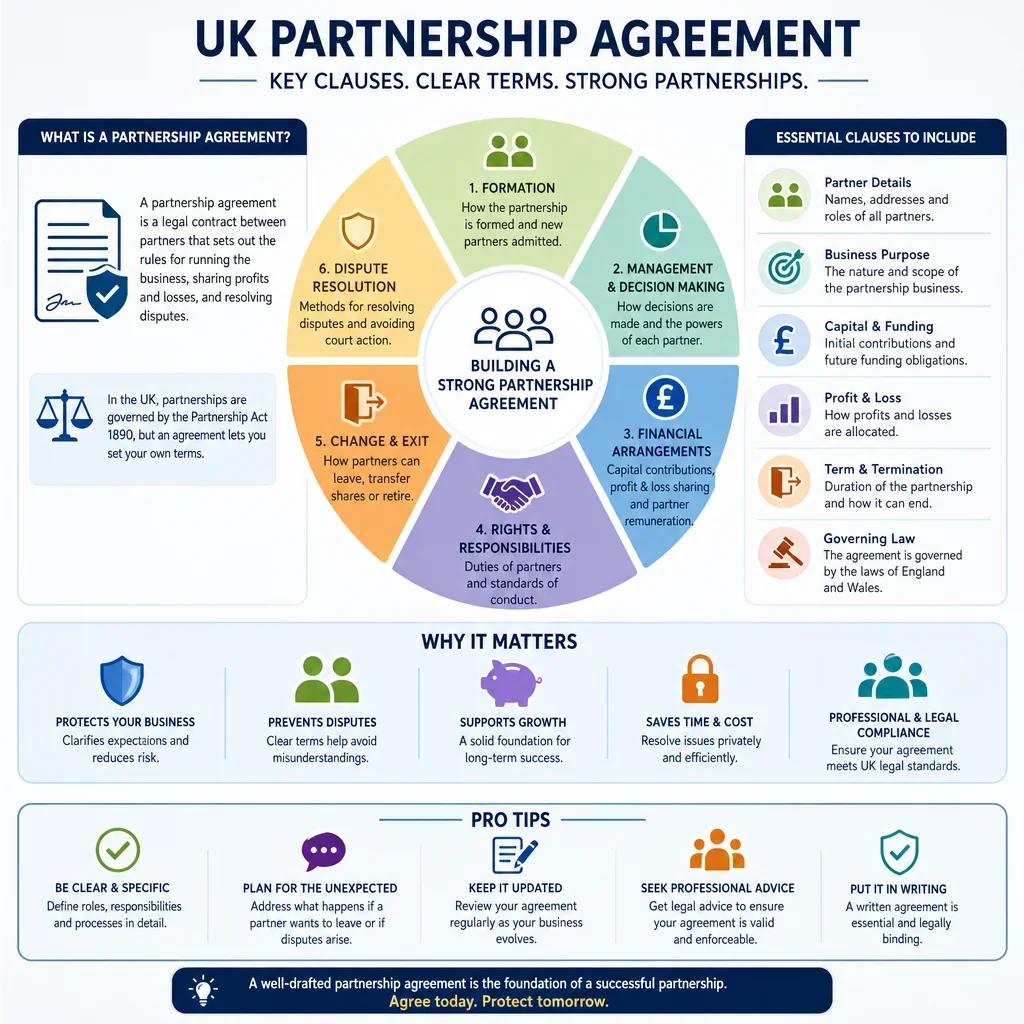
British Legal Rules for a Partnership Agreement
Selecting the incorrect partnership structure can expose partners to unintended personal liability or tax implications.
What a Proper Partnership Agreement Should Include
- Names and Details of PartnersList the full names, addresses, and contact information of all partners entering the agreement.
- Business Purpose and NameDescribe the main goals of the partnership and the official name of the business.
- Capital ContributionsSpecify how much money, property, or effort each partner will contribute to start and run the business.
- Profit and Loss SharingOutline how profits will be divided and losses will be covered among the partners.
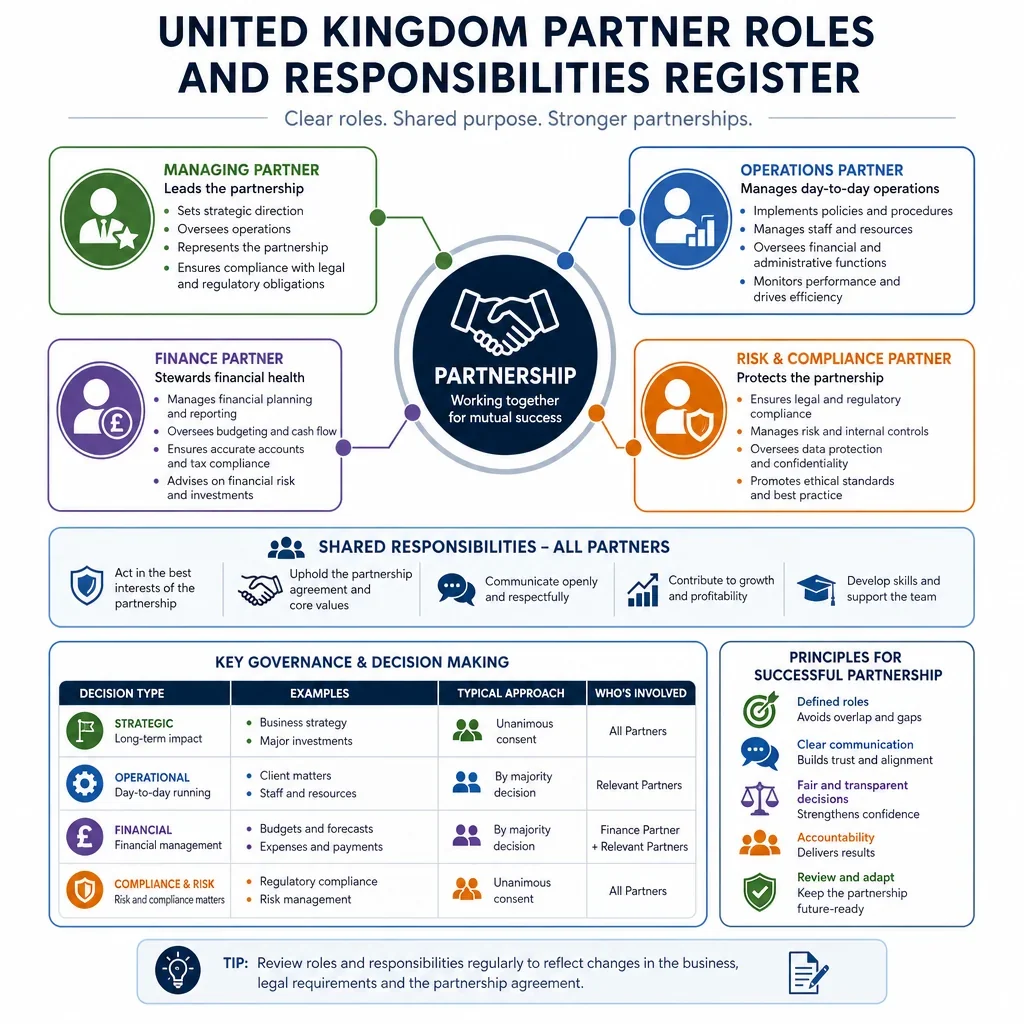
- Management and Decision-MakingDefine who makes day-to-day decisions and how major choices, like big investments, will be agreed upon.
- Duties and ResponsibilitiesSet out the specific roles and tasks each partner will handle in the business.
- Salary and DrawingsExplain if partners will receive a salary or how they can take money from the business for personal use.
- Books and AccountsDetail how financial records will be kept, reviewed, and shared among partners.
- Adding or Removing PartnersDescribe the process for bringing in new partners or handling a partner's exit from the business.
- Dissolution of the PartnershipSpecify what happens if the partnership ends, including how assets and debts will be divided.
Generate Your Document in 4 Easy Steps
Why Use Docaro?
 United Kingdom
Free Example Partnership Agreement Template
Below is a free template example of a Partnership Agreement for use in the United Kingdom generated by our AI model.
The clauses in your actual Partnership Agreement will vary from this example as they will be entirely bespoke to your requirements as set out in the questionnaire you complete.
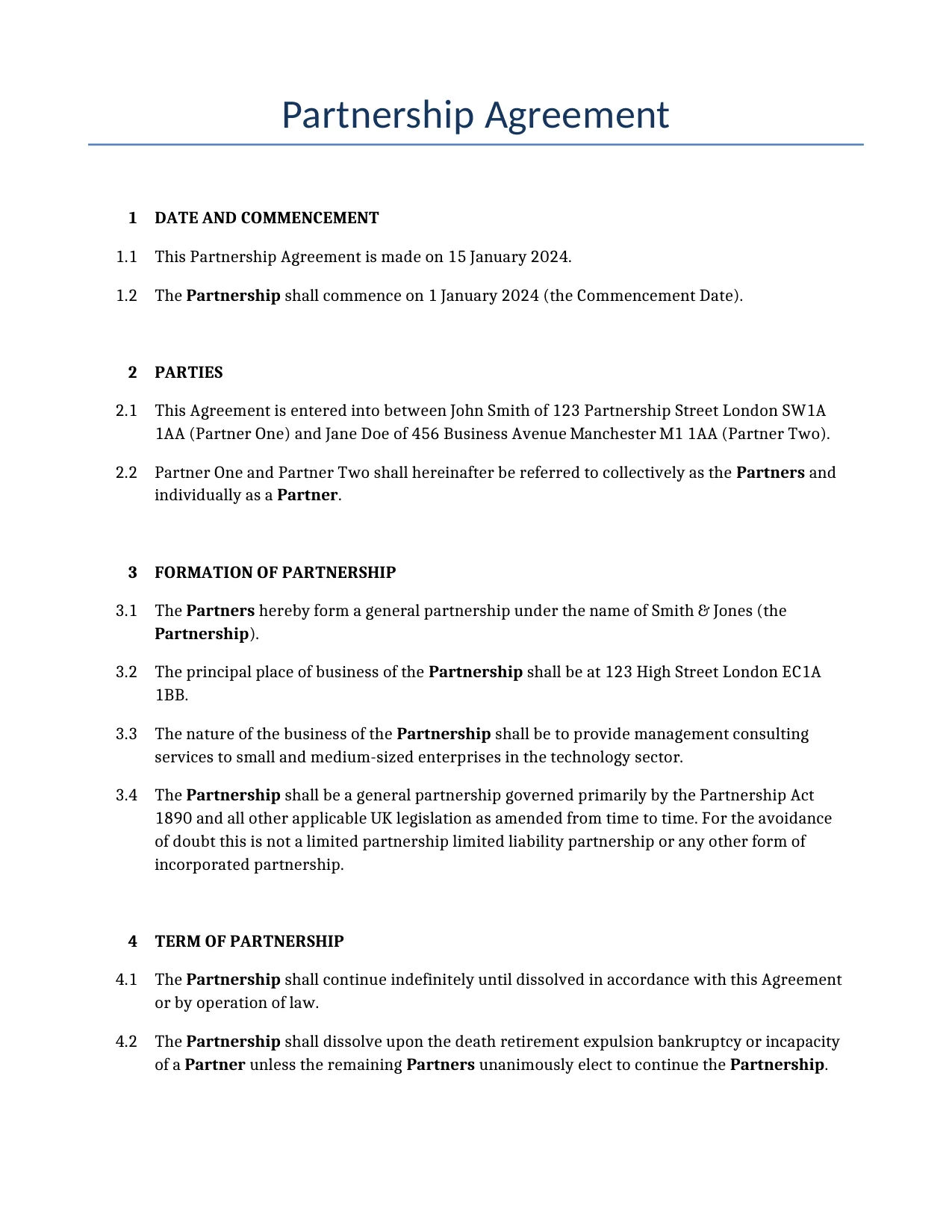
Partnership Agreement
1DATE AND COMMENCEMENT
This Partnership Agreement is made on 15 January 2024.
The Partnership shall commence on 1 January 2024 (the Commencement Date).
2PARTIES
This Agreement is entered into between John Smith of 123 Partnership Street London SW1A 1AA (Partner One) and Jane Doe of 456 Business Avenue Manchester M1 1AA (Partner Two).
Partner One and Partner Two shall hereinafter be referred to collectively as the Partners and individually as a Partner.
3FORMATION OF PARTNERSHIP
The Partners hereby form a general partnership under the name of Smith & Jones (the Partnership).
The principal place of business of the Partnership shall be at 123 High Street London EC1A 1BB.
The nature of the business of the Partnership shall be to provide management consulting services to small and medium-sized enterprises in the technology sector.
The Partnership shall be a general partnership governed primarily by the Partnership Act 1890 and all other applicable UK legislation as amended from time to time. For the avoidance of doubt this is not a limited partnership limited liability partnership or any other form of incorporated partnership.
4TERM OF PARTNERSHIP
The Partnership shall continue indefinitely until dissolved in accordance with this Agreement or by operation of law.
The Partnership shall dissolve upon the death retirement expulsion bankruptcy or incapacity of a Partner unless the remaining Partners unanimously elect to continue the Partnership.
5CAPITAL CONTRIBUTIONS
Partner One shall contribute fifty thousand pounds in cash to the Partnership bank account on or before the Commencement Date.
Partner Two shall contribute office equipment and furniture valued at twenty thousand pounds to the Partnership on or before 20 January 2024.
The Partners shall make such further capital contributions as may be agreed unanimously from time to time in writing.
Each Partner shall maintain a capital account which shall be credited with the amount of such Partner's capital contribution and adjusted in accordance with this Agreement.
6PROFITS LOSSES AND DISTRIBUTIONS
The profits of the Partnership shall be allocated equally between the Partners.
The losses of the Partnership shall be allocated in the same manner as profits.
Distributions of profits shall be made to the Partners on a quarterly basis.
The Partners may retain such funds as are reasonably required for the business needs of the Partnership before making distributions.
These provisions shall take effect from the Commencement Date.
7MANAGEMENT AND CONTROL
All decisions relating to the Partnership shall be made by unanimous agreement of the Partners.
Each Partner shall have equal voting rights irrespective of capital contributions.
A quorum for any meeting of the Partners shall be two Partners.
A Partner may vote by proxy if unable to attend a meeting provided that the proxy is appointed in writing and the appointment is delivered to the other Partners not less than twenty four hours before the meeting.
Day to day business decisions shall be made by a managing partner appointed by unanimous agreement of the Partners.
The following decisions shall require the unanimous approval of all Partners: admitting new partners borrowing money or incurring debt and selling Partnership assets.
Not less than seven days notice shall be given for any meeting of the Partners.
8PARTNER AUTHORITY AND BINDING THE PARTNERSHIP
No Partner shall bind the Partnership beyond the ordinary course of business without the unanimous prior written consent of the other Partners. This is subject to sections 5 to 9 of the Partnership Act 1890.
Prohibited acts requiring unanimous consent include but are not limited to: (a) borrowing or lending money on behalf of the Partnership; (b) giving guarantees or indemnities; (c) acquiring or disposing of assets valued over £5,000; (d) entering into contracts outside the ordinary course of the Partnership's business; and (e) admitting new partners or changing the nature of the business.
Any Partner who purports to bind the Partnership in breach of this clause shall indemnify the Partnership and the other Partners against all resulting losses liabilities and expenses.
9DUTIES AND RESPONSIBILITIES
Each Partner owes fiduciary duties of good faith loyalty and care to the Partnership and to the other Partners in accordance with the Partnership Act 1890.
In addition to the fiduciary duties each Partner shall perform the following duties: attend twelve partnership meetings per year participate in quarterly performance reviews and ensure the preparation of annual accounts.
Decisions on Partnership matters shall be made by unanimous vote among the Partners.
Each Partner shall maintain the confidentiality of all Partnership information in accordance with clause 21.
During the term of the Partnership no Partner shall engage in any competing business activity without the prior written consent of the other Partners.
10BOOKS AND RECORDS
The accounting reference date for the Partnership shall be 31 December.
The Partnership shall prepare its financial statements in accordance with UK GAAP using the accrual basis of accounting.
The books and records of the Partnership shall be maintained at the principal place of business in London.
The Partnership shall retain its financial books and records for seven years.
Each Partner shall have full access to the books and records of the Partnership at all reasonable times.
11BANK ACCOUNTS
The Partnership shall open and maintain a current account with Barclays Bank at 123 High Street London EC1A 1BB.
Online banking shall be enabled for the Partnership account.
All Partners shall be authorised signatories for the Partnership bank account.
All transactions on the Partnership bank account shall require dual signatures from two Partners.
The bank shall provide monthly statements for the account.
12SALARIES AND DRAWINGS
Each Partner shall receive a fixed salary which shall be paid monthly in accordance with the amounts agreed unanimously by the Partners from time to time.
The Partners may make drawings against anticipated profits subject to the retention of sufficient funds for the reasonable working capital needs of the Partnership.
No Partner shall be permitted to make drawings against such Partner's capital account without the prior unanimous written consent of the other Partners.
13ADMISSION OF NEW PARTNERS
No new partner shall be admitted to the Partnership without the unanimous consent of all existing Partners.
Any new partner shall make a capital contribution in an amount agreed by the existing Partners prior to admission.
Not less than thirty days notice shall be given to the existing Partners of any proposal to admit a new partner.
14WITHDRAWAL OR RETIREMENT
Any Partner may withdraw or retire from the Partnership by giving not less than three months notice in writing to the other Partners.
Notice of withdrawal or retirement shall be delivered by registered post or email to the Partnership's registered office and shall be in writing.
All Partners are eligible to withdraw or retire in accordance with this clause.
No consent from the remaining Partners shall be required for a Partner to withdraw or retire.
Upon withdrawal or retirement the outgoing Partner's share shall be valued using the formula set out in clause 17 and paid in instalments over six months. The outgoing Partner shall not use the Partnership name or goodwill after exit.
15EXPULSION OF PARTNERS
A Partner may be expelled from the Partnership for gross misconduct material breach of this Agreement or bankruptcy by unanimous vote of the other Partners.
The Partner proposed for expulsion shall be given not less than thirty days notice of the meeting at which the expulsion is to be considered and the right to make representations.
Upon expulsion the expelled Partner's interest shall be bought out by the remaining Partners at a value determined by an independent valuer appointed by the remaining Partners using the valuation method in clause 17. Payment shall be made in equal monthly instalments over twelve months with no entitlement to goodwill unless otherwise agreed.
The compulsory retirement age for Partners shall be 70 unless unanimously agreed otherwise.
16DEATH INCAPACITY OR BANKRUPTCY
In the event of the death incapacity or bankruptcy of a Partner the Partnership shall continue with the remaining Partners unless they unanimously agree to dissolve it.
Incapacity means a Partner is unable to manage their affairs due to mental or physical illness as certified by a qualified medical professional for a period exceeding six months.
The surviving or remaining Partners shall have sixty days from the date of the event to elect to purchase the affected Partner's share at the valuation determined in accordance with clause 17. Payment shall be made by instalments over a period not exceeding twenty four months. Goodwill shall be included in the valuation only if the remaining Partners so agree.
17DISSOLUTION AND WINDING UP
Upon dissolution the Partnership assets shall be valued by an independent valuer agreed by the Partners or appointed by the President of the Institute of Chartered Accountants in England and Wales if no agreement is reached. The valuation shall include goodwill if the Partners so decide.
Upon any event that would otherwise trigger dissolution the remaining Partners may elect by unanimous agreement to continue the Partnership.
Upon dissolution a manager for winding up the Partnership affairs shall be appointed by majority vote of the Partners.
In winding up the affairs of the Partnership all creditors shall be paid in full before any distributions are made to the Partners.
The remaining assets shall be distributed among the Partners in accordance with their capital accounts and profit sharing ratios after settling all liabilities.
A final account shall be prepared and signed by all Partners upon completion of the winding up. The outgoing Partner or their estate shall not use the Partnership name thereafter.
18TRANSFER OF PARTNERSHIP INTEREST
No Partner shall transfer any part of such Partner's interest in the Partnership without the prior unanimous written consent of the other Partners except for transfers to an existing Partner or to an immediate family member with approval.
Where a Partner proposes to transfer an interest to a third party the other Partners shall have a right of first refusal to purchase such interest on the same terms.
19INTELLECTUAL PROPERTY OWNERSHIP
All intellectual property rights created or developed by any Partner in the course of the Partnership business shall vest in and belong exclusively to the Partnership.
Each Partner assigns to the Partnership all right title and interest in any pre-existing intellectual property used in the Partnership business and listed in Schedule 2. Each Partner warrants that such assignment does not infringe any third party rights and shall indemnify the Partnership against any breach of this warranty.
The Partners shall execute all documents and do all acts reasonably required to perfect the Partnership's ownership of such intellectual property.
20TAX AND ACCOUNTING COMPLIANCE
The Partnership shall register with HMRC as a partnership and comply with all tax filing requirements including submission of the Partnership Tax Return (Form 1) under self-assessment within the statutory deadlines.
Each Partner shall be responsible for their own personal tax obligations including self-assessment tax returns on their share of Partnership profits losses and any salaries or drawings. Salaries and drawings shall be treated as drawings on account of profits for tax purposes and shall not be deductible expenses of the Partnership.
Each Partner shall be responsible for their own Class 2 and Class 4 National Insurance contributions as self-employed individuals.
If the Partnership turnover exceeds the VAT registration threshold the Partnership shall register for VAT and comply with all VAT accounting and filing obligations.
The Partners shall appoint a qualified accountant or tax advisor to prepare accounts tax returns and advise on compliance. The costs shall be borne by the Partnership.
21CONFIDENTIALITY
Each Partner shall keep confidential all information relating to the Partnership and shall not disclose it to any third party without the prior written consent of the other Partners.
The obligations of confidentiality shall survive termination of the Partnership without limit in time except for information that enters the public domain otherwise than by breach.
In the event of a breach of confidentiality the Partners shall be entitled to seek injunctions damages and indemnification.
Upon leaving the Partnership a departing Partner shall return or destroy all confidential information in their possession.
22NON-COMPETE AND NON-SOLICITATION
During the term of the Partnership and for six months after ceasing to be a Partner no Partner shall directly or indirectly engage in any competing business within a 20 mile radius of the Partnership's principal place of business or solicit any clients of the Partnership with whom they had material dealings in the twelve months prior to departure provided that this restriction is limited to the provision of management consulting services to small and medium-sized enterprises in the technology sector.
During the term of the Partnership and for six months after ceasing to be a Partner no Partner shall solicit any key employees or suppliers of the Partnership.
The restrictions in this clause are considered reasonable for the protection of the Partnership's legitimate interests and shall apply both during the active period of the Partnership and after termination. If any restriction is found unenforceable it shall be deemed amended to the minimum extent necessary to make it enforceable.
23INDEMNIFICATION
Each Partner shall indemnify the other Partners against all liabilities arising from such Partner's own negligence or wilful misconduct breach of Partnership duties or fraudulent acts.
The indemnification provisions shall be mutual and shall cover liabilities to third parties arising from Partnership activities.
A Partner seeking indemnification shall notify the other Partners of any potential claim within thirty days of becoming aware of it.
Indemnity payments shall be made by way of reimbursement after settlement of the relevant claim.
24INSURANCE
The Partnership shall obtain and maintain public liability insurance professional indemnity insurance and employers liability insurance.
The selection of insurance providers shall be made by unanimous decision of the Partners.
The Partnership shall obtain the required insurance coverage by the Commencement Date.
The insurance coverage shall be reviewed and updated annually.
In the event of failure to maintain the required insurance the defaulting Partner or Partners shall indemnify the Partnership and the other Partners and shall be subject to a financial penalty determined by unanimous agreement.
25DATA PROTECTION AND COMPLIANCE
The Partnership and each Partner shall comply with all applicable laws including the UK GDPR the Data Protection Act 2018 the Bribery Act 2010 anti-money laundering regulations the Equality Act 2010 and all other relevant legislation.
The Partners shall ensure appropriate technical and organisational measures are in place to protect personal data and shall notify each other promptly of any data breach. Each Partner shall be responsible for any fines or liabilities arising from their breach of these obligations.
The Partnership shall maintain records of processing activities and appoint a data protection officer where required by law.
26DISPUTE RESOLUTION
Any dispute arising out of or in connection with this Agreement shall first be referred to negotiation between the Partners acting in good faith.
If the dispute is not resolved by negotiation within thirty days it shall be referred to mediation in accordance with the LCIA Mediation Rules.
If the dispute is not resolved by mediation within a further thirty days it shall be referred to and finally resolved by arbitration under the LCIA Rules seated in London by a single arbitrator.
If arbitration is unavailable or not pursued the dispute shall be subject to the exclusive jurisdiction of the courts of England and Wales.
27GOVERNING LAW
This Agreement and any dispute or claim arising out of or in connection with it or its subject matter or formation (including non-contractual disputes or claims) shall be governed by and construed in accordance with the law of England and Wales.
This Agreement is executed as a deed for the purposes of extending any applicable limitation periods under English law.
The courts of England and Wales shall have exclusive jurisdiction over any dispute arising from this Agreement.
28SEVERABILITY
If any provision of this Agreement is held to be invalid or unenforceable the validity of the remaining provisions shall not be affected.
29ENTIRE AGREEMENT
This Agreement constitutes the entire understanding between the Partners and supersedes all prior agreements understandings or arrangements whether oral or in writing.
30AMENDMENTS
No amendment to this Agreement shall be effective unless it is in writing and signed by all the Partners.
Amendments shall require the unanimous consent of all Partners.
Not less than fourteen days notice shall be given of any proposal to amend this Agreement.
31NOTICES
Any notice required to be given under this Agreement shall be in writing and shall be delivered by hand registered post or email to the addresses set out below.
Notices to Partner One shall be sent to 123 Partnership Street London SW1A 1AA.
Notices to Partner Two shall be sent to 456 Business Avenue Manchester M1 1AA.
Notices sent by post shall be deemed delivered two days after posting.
Notices delivered after 17:00 hours on any day shall be deemed received on the next business day.
32FORCE MAJEURE
Neither Partner shall be liable for any failure to perform its obligations under this Agreement if such failure is caused by a force majeure event including natural disasters acts of war or terrorism or pandemics or epidemics.
The affected Partner shall notify the other Partners of the force majeure event within seven days of its occurrence.
The affected Partner shall use reasonable efforts to mitigate the effects of the force majeure event.
If the force majeure event continues for more than ninety days the Partners may agree to terminate this Agreement.
33WAIVER
No waiver by any Partner of any breach of this Agreement shall constitute a waiver of any subsequent breach.
Any waiver of rights under this Agreement must be in writing and signed by the waiving Partner.
Waivers of significant rights shall require the unanimous consent of all Partners.
34ASSIGNMENT
No Partner shall assign any rights under this Agreement without the prior written consent of the other Partners.
No Partner shall delegate any obligations under this Agreement without the prior written consent of the other Partners.
Any permitted assignment or delegation shall require written notice to all Partners.
35NO PARTNERSHIP WITH THIRD PARTIES
Nothing in this Agreement shall create any partnership or joint venture with any third party nor authorise any Partner to enter into any commitment on behalf of any such third party.
36VARIATION
No variation of this Agreement shall be effective unless it is in writing and signed by or on behalf of each of the Partners.
37COSTS
Each Partner shall bear their own legal and other costs incurred in connection with the preparation and execution of this Agreement.
38COUNTERPARTS AND ELECTRONIC SIGNATURES
This Agreement may be executed in any number of counterparts each of which when executed and delivered shall constitute a duplicate original but all the counterparts shall together constitute one agreement.
This Agreement may be executed by electronic signature (including by DocuSign or similar platform) and such electronic signature shall be valid and binding to the same extent as a manual signature under the laws of England and Wales including the Electronic Communications Act 2000.
39HEADINGS
Headings in this Agreement are for ease of reference only and shall not affect the interpretation or construction of this Agreement.
40DEFINITIONS AND INTERPRETATION
In this Agreement the following terms shall have the meanings set out below: Partnership means Smith & Jones; Partners means John Smith and Jane Doe; Partnership Property means all property assets and rights of the Partnership; Profits means the profits of the Partnership determined in accordance with UK GAAP before appropriation; Capital Account means the account maintained for each Partner recording their capital contributions drawings and share of profits and losses; Business Day means a day other than a Saturday Sunday or public holiday in England when banks in London are open for business; Commencement Date means 1 January 2024.
References to clauses are to clauses of this Agreement. Words importing the singular include the plural and vice versa. References to any legislation include any modification or re-enactment thereof.
41SCHEDULES
The contributions of the Partners are set out in Schedule 1 to this Agreement which forms part of and is incorporated into this Agreement.
The intellectual property of the Partnership is listed in Schedule 2 to this Agreement which forms part of and is incorporated into this Agreement.
Schedule 3 contains the initial business plan of the Partnership. The schedules shall take effect from the Commencement Date and may be amended only by unanimous written consent of the Partners.
42EXECUTION
Signed and delivered as a deed by the Partners on the date first above written.
Partner One: _______________________________ Date: _______________
Partner Two: _______________________________ Date: _______________
This example shows approximately 70% of a typical document and is provided for illustrative purposes only. The remaining content has been omitted.
Every document generated by Docaro is tailored to your specific circumstances, jurisdiction and the information you provide. The completed document includes all applicable clauses and provisions required for your situation.
To generate the full, personalised document, answer a short series of questions and your document will be created instantly.
Useful Resources When Considering a Partnership Agreement in the United Kingdom
United Kingdom Reference Legislation
Partnership Agreement FAQs
Document Generation FAQs
Related Articles