AI Generated Party Wall Agreement for use in the United Kingdom
PDF & Word - 2026 Updated
Docaro Pricing
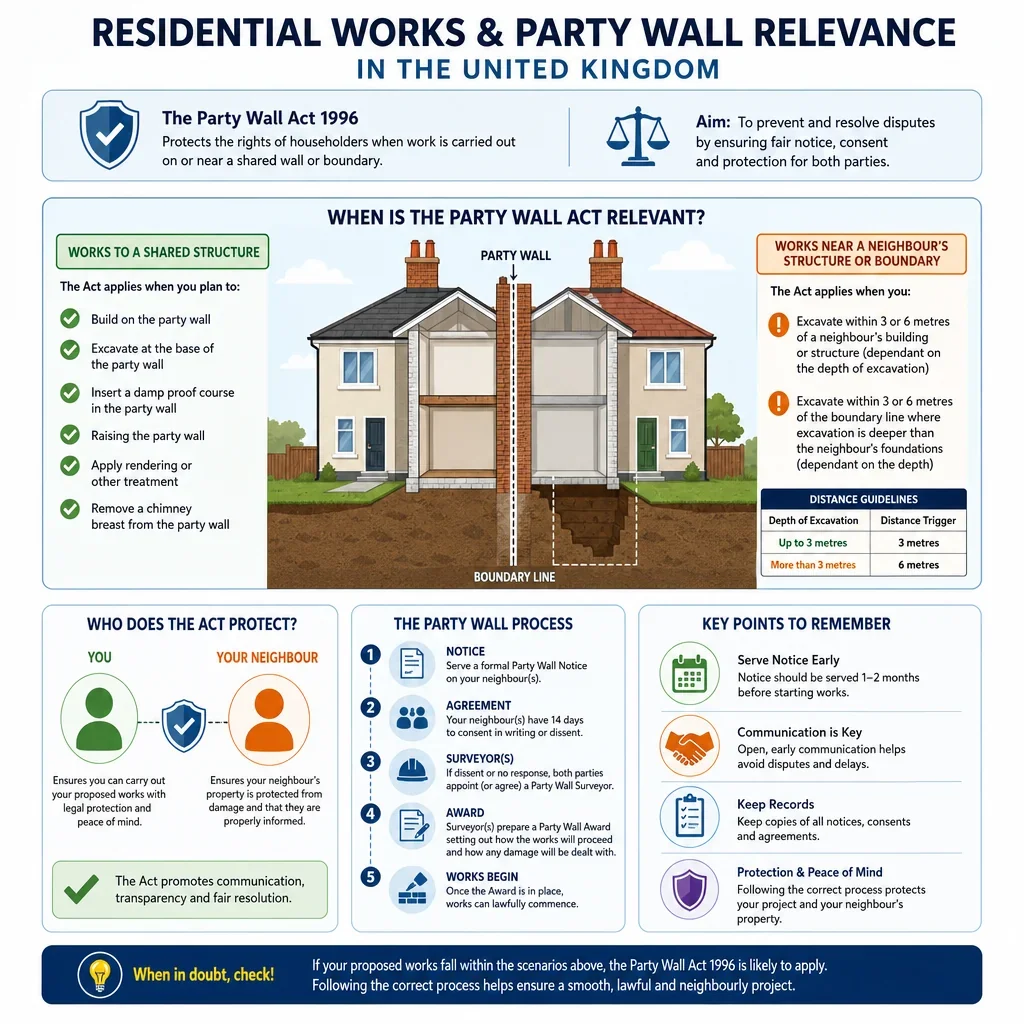
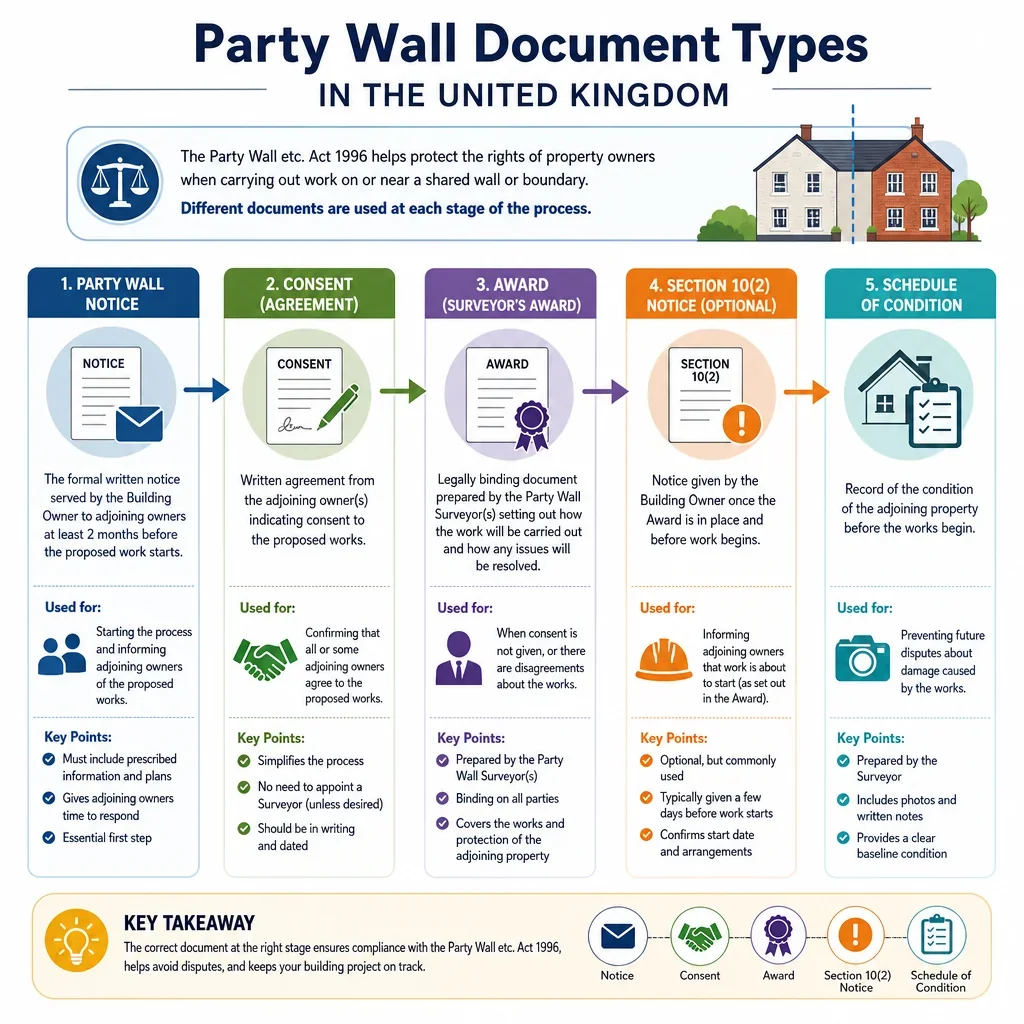
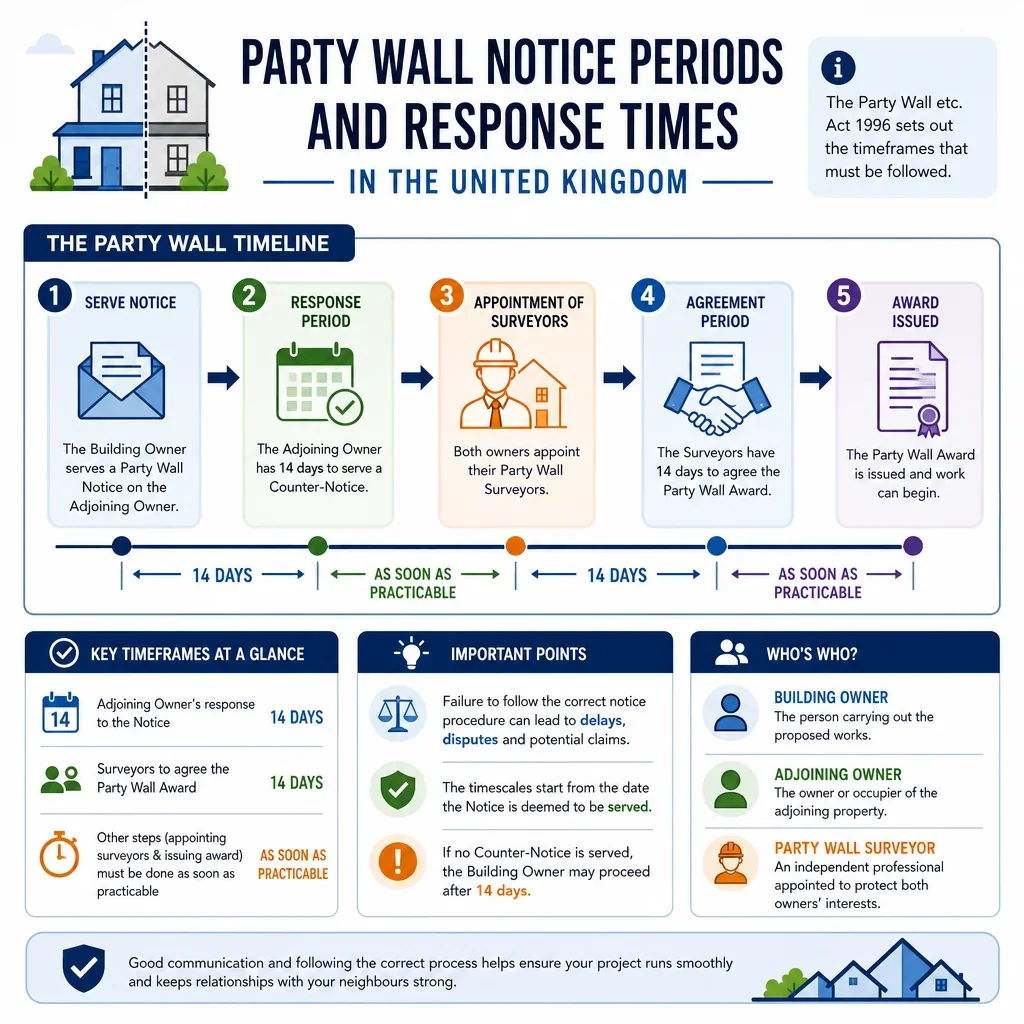
When do you need a Party Wall Agreement in the United Kingdom?
British Legal Rules for a Party Wall Agreement
Using the incorrect structure for a party wall agreement may fail to comply with the Party Wall etc. Act 1996, potentially leading to disputes or legal invalidity.
What a Proper Party Wall Agreement Should Include
- Details of the Properties and OwnersClearly identify the involved properties, their addresses, and the full names and contact details of all property owners.
- Description of the Planned WorkOutline the specific construction or alteration work that will affect the shared party wall, including its location and scope.
- Access Rights for the WorkSpecify permissions for accessing the neighboring property to carry out the necessary work safely and efficiently.
- Timeline for the ProjectProvide a realistic schedule for starting and completing the work to minimize disruption to neighbors.
- Responsibilities for CostsDetail who will pay for the work, any potential damages, and related expenses like surveys or repairs.
- Protection of the Party WallDescribe measures to safeguard the shared wall from damage during and after the construction.
- Handling Disputes and AgreementsInclude steps for resolving any disagreements and confirm that all parties agree to the terms.
- Signatures and DatesRequire signatures from all involved parties along with the date to make the agreement legally binding.
Generate Your Document in 4 Easy Steps
Why Use Docaro?
 United Kingdom
Free Example Party Wall Agreement Template
Below is a free template example of a Party Wall Agreement for use in the United Kingdom generated by our AI model.
The clauses in your actual Party Wall Agreement will vary from this example as they will be entirely bespoke to your requirements as set out in the questionnaire you complete.
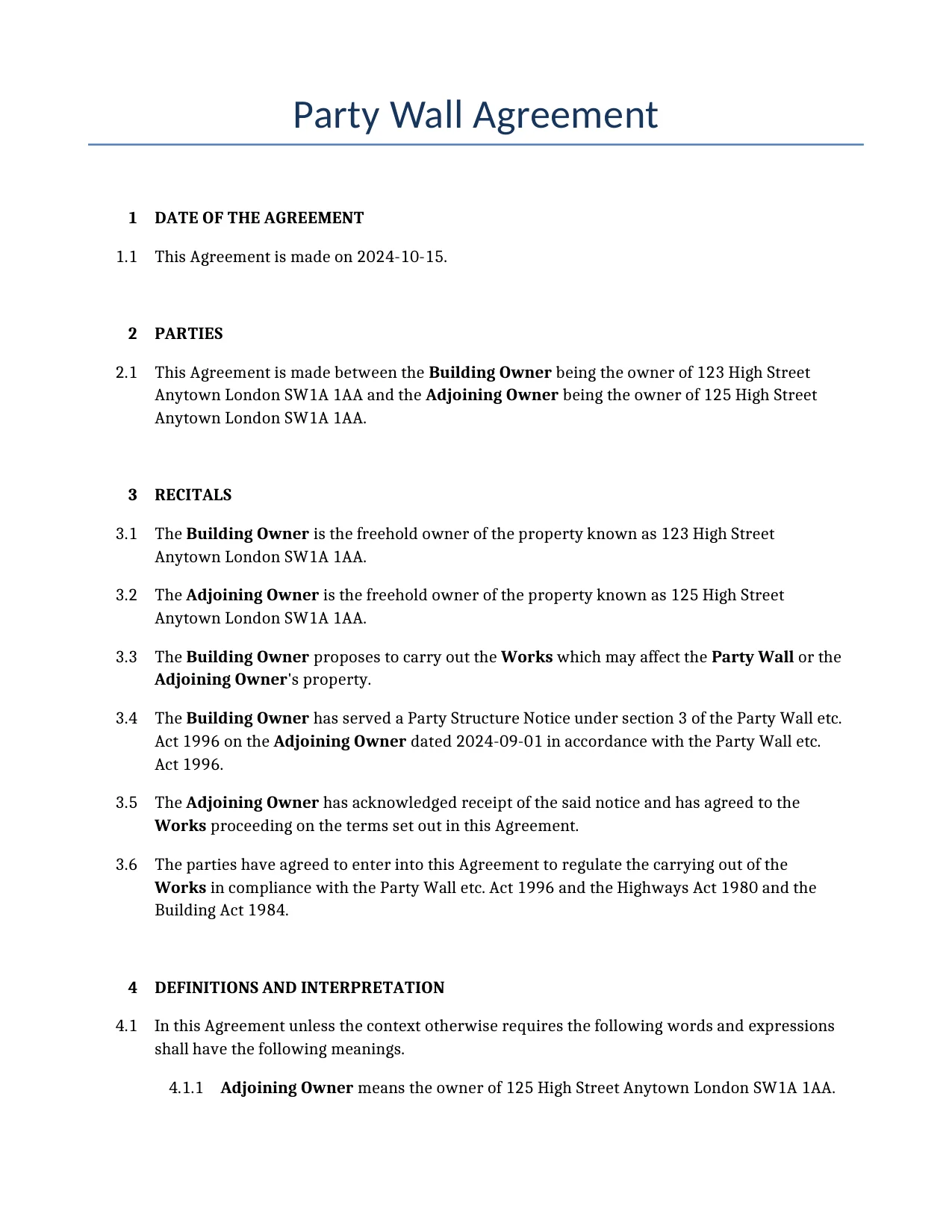
Party Wall Agreement
1DATE OF THE AGREEMENT
This Agreement is made on 2024-10-15.
2PARTIES
This Agreement is made between the Building Owner being the owner of 123 High Street Anytown London SW1A 1AA and the Adjoining Owner being the owner of 125 High Street Anytown London SW1A 1AA.
3RECITALS
The Building Owner is the freehold owner of the property known as 123 High Street Anytown London SW1A 1AA.
The Adjoining Owner is the freehold owner of the property known as 125 High Street Anytown London SW1A 1AA.
The Building Owner proposes to carry out the Works which may affect the Party Wall or the Adjoining Owner's property.
The Building Owner has served a Party Structure Notice under section 3 of the Party Wall etc. Act 1996 on the Adjoining Owner dated 2024-09-01 in accordance with the Party Wall etc. Act 1996.
The Adjoining Owner has acknowledged receipt of the said notice and has agreed to the Works proceeding on the terms set out in this Agreement.
The parties have agreed to enter into this Agreement to regulate the carrying out of the Works in compliance with the Party Wall etc. Act 1996 and the Highways Act 1980 and the Building Act 1984.
4DEFINITIONS AND INTERPRETATION
In this Agreement unless the context otherwise requires the following words and expressions shall have the following meanings.
Adjoining Owner means the owner of 125 High Street Anytown London SW1A 1AA.
Building Owner means the owner of 123 High Street Anytown London SW1A 1AA.
Party Wall means the shared brick wall between the properties at 123 High Street and 125 High Street which runs along the boundary line for approximately 10 meters is 2.5 meters high and is load-bearing supporting the roofs of both buildings.
Works means the construction of a single-storey extension to the rear of the Building Owner's property including excavation for foundations to a depth of 1.5 metres and includes cutting into the Party Wall to insert a steel lintel to support a new internal doorway and minor excavation to the rear for drainage works within 3 meters of the wall.
Notices means any notice required to be served under this Agreement or the Party Wall etc. Act 1996.
the Act means the Party Wall etc. Act 1996.
Surveyor means a person appointed under section 10 of the Act to act on behalf of a party or as an agreed surveyor.
Third Surveyor means a person appointed under section 10(1)(b) or 10(6) of the Act to determine disputes between the appointed surveyors.
Making Good means the repair or reinstatement of any damage caused by the Works to the reasonable satisfaction of the Adjoining Owner or as determined by the Surveyor(s).
Compensation means any sum payable to the Adjoining Owner for loss or damage arising from the Works as provided under the Act.
Headings in this Agreement are for convenience only and do not affect its interpretation.
Words importing the singular include the plural and vice versa and words importing the masculine include the feminine and neuter.
References to any statute include any modification or re-enactment of that statute.
5DESCRIPTION OF THE WORKS
The Building Owner shall carry out the Works in accordance with the plans drawings specifications and method statements attached to this Agreement as Schedule 1 and prepared by ABC Architects dated 15th May 2024 which shall include details of the extension the lintel installation and excavation depths.
The Works shall involve cutting into the Party Wall to create an opening approximately 1 meter wide for a new doorway and the installation of a 150mm x 75mm steel lintel secured with wall ties together with the construction of a single-storey rear extension including excavation for foundations to a depth of 1.5 metres and minor excavation to the rear for drainage works within 3 meters of the wall.
Protective scaffolding shall be erected on both sides of the Party Wall during the Works to prevent damage.
The Building Owner shall commence the Works on or after 2024-11-01 and shall use hand-held tools for cutting into the brickwork employing a diamond-tipped saw for precise cuts and shall implement dust suppression measures including water misting.
All debris shall be removed daily and the Works shall comply fully with the Party Wall etc. Act 1996 the Highways Act 1980 and the Building Act 1984.
6NOTICES SERVED
The Building Owner served a Party Structure Notice under section 3 of the Party Wall etc. Act 1996 on the Adjoining Owner on 2024-09-01 by delivering it in person and by recorded post. The notice described the Works as the construction of a single-storey rear extension including excavation for foundations to a depth of 1.5 metres cutting into the Party Wall to insert a steel lintel to support a new internal doorway and minor excavation to the rear for drainage works within 3 meters of the wall.
The Adjoining Owner has confirmed receipt of the notice and has acknowledged the description of the works.
The Adjoining Owner agrees to the described protections set out in this Agreement.
7AGREEMENT TO WORKS
The Adjoining Owner consents to the Building Owner proceeding with the Works under the terms and conditions of this Agreement.
The Building Owner shall give the Adjoining Owner prior written notice of the commencement of the Works.
The Adjoining Owner shall have the right to appoint a surveyor to monitor the Works and the Building Owner shall permit such access as is reasonably required for that purpose.
The Building Owner shall pay compensation to the Adjoining Owner for any damage caused by the Works as provided in clause 13 of this Agreement.
8RIGHTS AND OBLIGATIONS OF THE BUILDING OWNER
The Building Owner shall perform the Works in full compliance with the Party Wall etc. Act 1996 the Highways Act 1980 and the Building Act 1984.
The Building Owner shall ensure that the Works are carried out in a proper and workmanlike manner using good quality materials.
The Building Owner shall indemnify the Adjoining Owner against any claims losses or liabilities arising from the Works except to the extent caused by the negligence of the Adjoining Owner.
9ACCESS TO PREMISES
The Building Owner shall require temporary access to the Adjoining Owner's property for the erection of scaffolding and for excavation works in the boundary area.
The Adjoining Owner grants the Building Owner and its contractors reasonable access to the Adjoining Land for Scaffolding and the Boundary Area for Excavation for the purpose of carrying out the Works.
Such access shall be permitted on Monday to Friday and Saturday between the hours of 8:00 AM and 6:00 PM for a period not exceeding 4 weeks.
The Building Owner shall give the Adjoining Owner not less than 14 days' prior written notice before exercising any right of access under this clause.
Access rights shall commence on or after 2024-11-15.
The Building Owner shall cause as little inconvenience as reasonably practicable to the Adjoining Owner when exercising rights of access and shall make good any damage caused to the Adjoining Owner's property by such access.
A detailed condition survey of the Adjoining Owner's property (including photographs and written records) shall be carried out and attached as Schedule 2 prior to commencement of the Works. A further survey shall be carried out upon completion of the Works to record any damage.
10PROTECTION OF PROPERTY
The Building Owner shall install protective barriers around the shared boundary and shall conduct regular inspections to ensure that no damage occurs to the Adjoining Owner's property during the Works.
The Building Owner shall install temporary protection measures including scaffolding and sheeting along the shared boundary and shall use vibration monitoring equipment during the Works. The Building Owner shall also take all reasonable steps to protect the Adjoining Owner's property from damage including underpinning where necessary if excavations are likely to affect the stability of the Party Wall or Adjoining Owner's property.
The Building Owner shall follow safety protocols including site fencing and barriers structural monitoring.
Any damage to the Adjoining Owner's property shall be recorded promptly and the Building Owner shall notify the Adjoining Owner or their surveyor immediately.
The Adjoining Owner's property which requires protection is a two-story Victorian terraced house with a shared brick Party Wall including a rear extension and garden area adjacent to the construction site.
11INSURANCE
The Building Owner shall at its own cost maintain public liability insurance with a minimum cover of \£10,000,000 in respect of any one claim in respect of the Works and shall provide evidence of such insurance to the Adjoining Owner or their surveyor prior to commencement of the Works.
The Building Owner shall indemnify the Adjoining Owner against all claims losses damages costs and expenses arising out of or in connection with the Works except to the extent caused by the negligence of the Adjoining Owner.
12SURVEYORS AND DISPUTE RESOLUTION
Each party may appoint their own Surveyor if they wish. The Building Owner appoints John Smith of 123 High Street London SW1A 1AA telephone +44 20 1234 5678 and email john.smith@surveyors.co.uk as its surveyor.
If the Adjoining Owner appoints a surveyor the two appointed surveyors shall appoint a Third Surveyor to determine any matters in dispute between them.
The parties have agreed to appoint Emily Johnson of 456 Oxford Road Manchester M1 1BB telephone +44 161 9876 5432 and email emily.johnson@thirdsurveyor.uk as the Third Surveyor in the event that the appointed surveyors cannot agree on the identity of the Third Surveyor or if one is not appointed the Third Surveyor shall be appointed in accordance with section 10 of the Act.
The surveyors shall be formally appointed on or before commencement of the Works.
Any dispute arising under this Agreement or the Party Wall etc. Act 1996 shall be referred to the appointed surveyors and if they cannot agree to the Third Surveyor for determination in accordance with the full dispute resolution procedure under section 10 of the Party Wall etc. Act 1996.
This Agreement may be annexed to a formal Party Wall Award made pursuant to the Act.
13SECURITY FOR EXPENSES
Prior to commencement of the Works the Building Owner shall provide security for expenses to the Adjoining Owner in the form of a deposit of \£10,000 or a bond in like amount (or such other sum as may be agreed or determined by the surveyors) to cover any potential damage compensation or costs for which the Building Owner may be liable under the Act. Such security shall be held by the Adjoining Owner's solicitor as stakeholder and released or applied as agreed or determined under the Act upon completion of the Works and making good of any damage.
The Building Owner shall compensate the Adjoining Owner for any inconvenience or damage caused by the Works as determined by the surveyors or by agreement between the parties.
14MAKING GOOD AND REINSTATEMENT
The Building Owner shall be solely responsible for making good any damage caused to the Adjoining Owner's property by the Works in accordance with the detailed condition survey attached as Schedule 2.
The Building Owner shall reinstate the Adjoining Owner's property to its original condition after completion of the Works to the reasonable satisfaction of the Adjoining Owner or as determined by the surveyors.
Any damage caused by the Works shall be assessed by reference to the pre-works condition survey in Schedule 2 and recorded in a post-works survey. An independent surveyor may be appointed by agreement between the parties or by the Third Surveyor if required.
Upon completion of making good and reinstatement the Building Owner shall notify the Adjoining Owner in writing and the parties shall carry out a joint inspection of the works.
Any dispute regarding making good or reinstatement shall be resolved in accordance with the dispute resolution provisions under section 10 of the Party Wall etc. Act 1996.
15TERMINATION AND SUSPENSION
If the Works are suspended or terminated for any reason (other than completion) the Building Owner shall give the Adjoining Owner not less than 7 days' written notice. The Building Owner shall forthwith make good the site and the Adjoining Owner's property to the condition recorded in the pre-works condition survey in Schedule 2 and remove all debris and equipment at its own cost.
In the event of termination the security for expenses (if provided) shall be released or applied as agreed or determined under the dispute resolution procedure.
Suspension or termination shall not affect the parties' rights and obligations under this Agreement or the Act in respect of any damage caused or costs incurred prior to such suspension or termination.
16WITHDRAWAL OF NOTICES
A notice served under the Party Wall etc. Act 1996 may be withdrawn by mutual consent or before the Works commence.
The party withdrawing a notice must provide written notice of withdrawal to the other party within 14 days of the initial notice served by recorded delivery or in person and must include a statement of reasons.
Withdrawal of a notice shall cause the notice period to restart and the withdrawing party shall reimburse the other party for any reasonable costs incurred prior to withdrawal.
17SEVERABILITY
If any provision of this Agreement is held to be invalid or unenforceable the remainder of this Agreement shall continue in full force and effect.
18GOVERNING LAW
This Agreement and any dispute or claim arising out of or in connection with it shall be governed by and construed in accordance with the law of England and Wales.
The parties agree that the courts of England and Wales shall have exclusive jurisdiction to settle any dispute or claim arising out of or in connection with this Agreement.
19ENTIRE AGREEMENT
This Agreement constitutes the entire agreement between the parties and supersedes any prior understandings or agreements relating to the Party Wall.
The parties confirm that there are no prior understandings or agreements regarding the Party Wall that have not been incorporated into this document.
Any future modifications to this Agreement must be made in writing and signed by both parties.
20NOTICES
Any notice required to be served under this Agreement shall be in writing and may be served by post to the address of the relevant party set out in clause 2 or such other address as that party may notify to the other from time to time.
Notices sent by post shall be deemed served on the second working day after posting.
Notices hand delivered shall be deemed served on the day of delivery.
Working days for the purposes of this clause means Monday to Friday excluding bank holidays.
21SCHEDULES AND ATTACHMENTS
The following documents are attached to and form part of this Agreement.
Schedule 1: Detailed plans drawings specifications method statements for the Works including exact scope of the extension lintel installation and excavation depths.
Schedule 2: Detailed Condition Survey of the Adjoining Owner's property (pre-works) including photographs written records and description of the two-story Victorian terraced house shared brick Party Wall rear extension and garden area.
22EXECUTION
This Agreement is executed as a deed and may be executed in counterparts each of which when executed and delivered shall constitute an original but all of which together shall constitute one and the same instrument.
23SIGNATURES
Signed as a deed by the Building Owner in the presence of a witness.
Signature of Building Owner: _______________________________ Date: _______________
Name of Witness: _______________________________
Signature of Witness: _______________________________
Address of Witness: _______________________________
Signed as a deed by the Adjoining Owner in the presence of a witness.
Signature of Adjoining Owner: _______________________________ Date: _______________
Name of Witness: _______________________________
Signature of Witness: _______________________________
Address of Witness: _______________________________
This example shows approximately 70% of a typical document and is provided for illustrative purposes only. The remaining content has been omitted.
Every document generated by Docaro is tailored to your specific circumstances, jurisdiction and the information you provide. The completed document includes all applicable clauses and provisions required for your situation.
To generate the full, personalised document, answer a short series of questions and your document will be created instantly.
Useful Resources When Considering a Party Wall Agreement in the United Kingdom
United Kingdom Reference Legislation
Party Wall Agreement FAQs
Document Generation FAQs
Related Articles