AI Generated British Commercial Tenancy Agreement
PDF & Word - 2026 Updated
Docaro Pricing
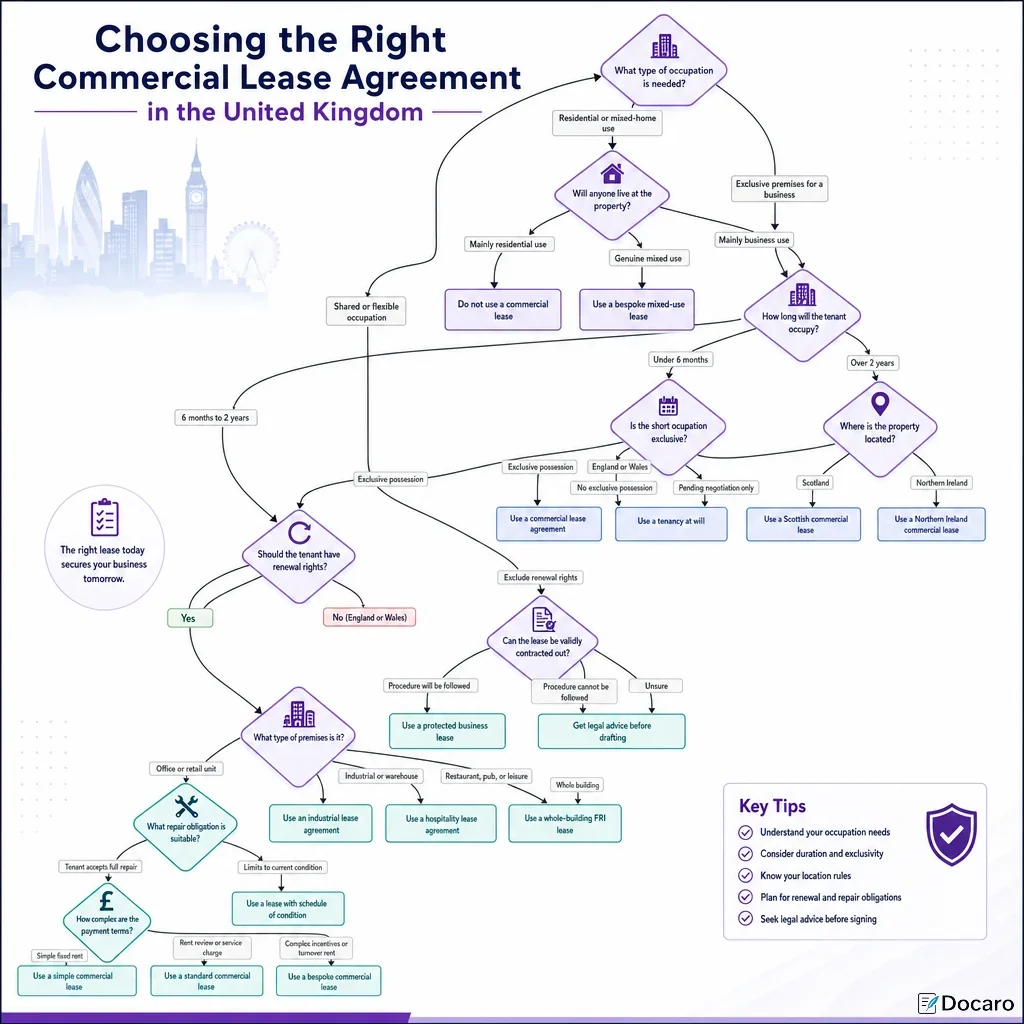
When do you need a Commercial Lease Agreement in the United Kingdom?
British Legal Rules for a Commercial Lease Agreement
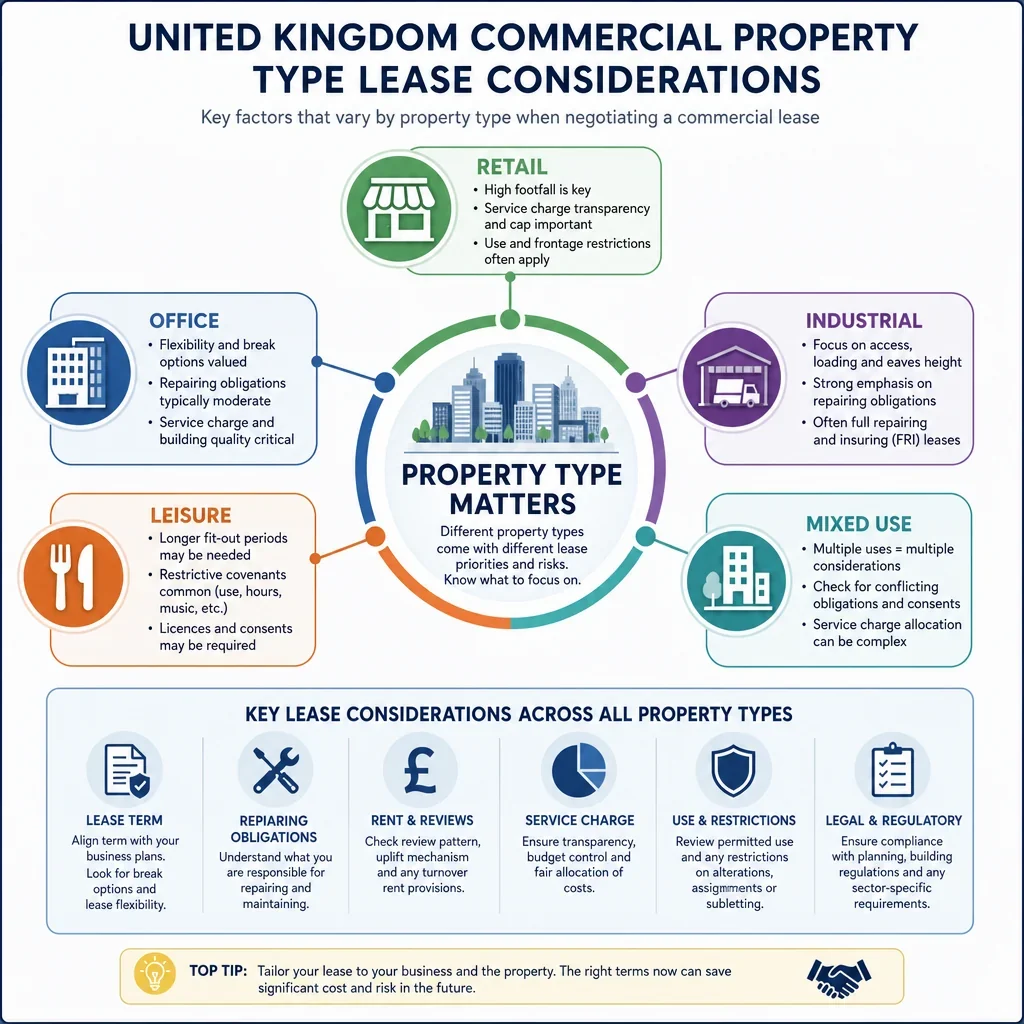
Selecting the incorrect structure for a commercial lease, such as using a residential template, may result in unenforceable terms or unintended liabilities.
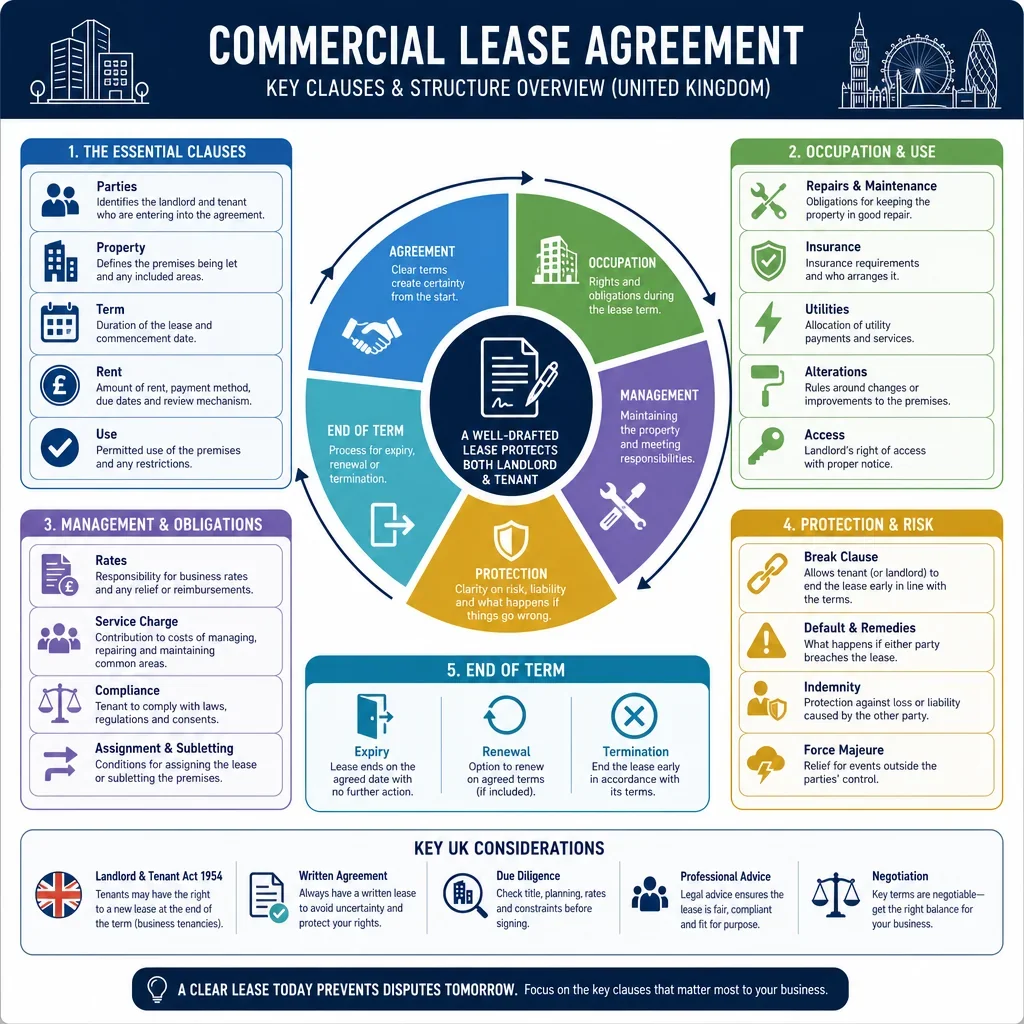
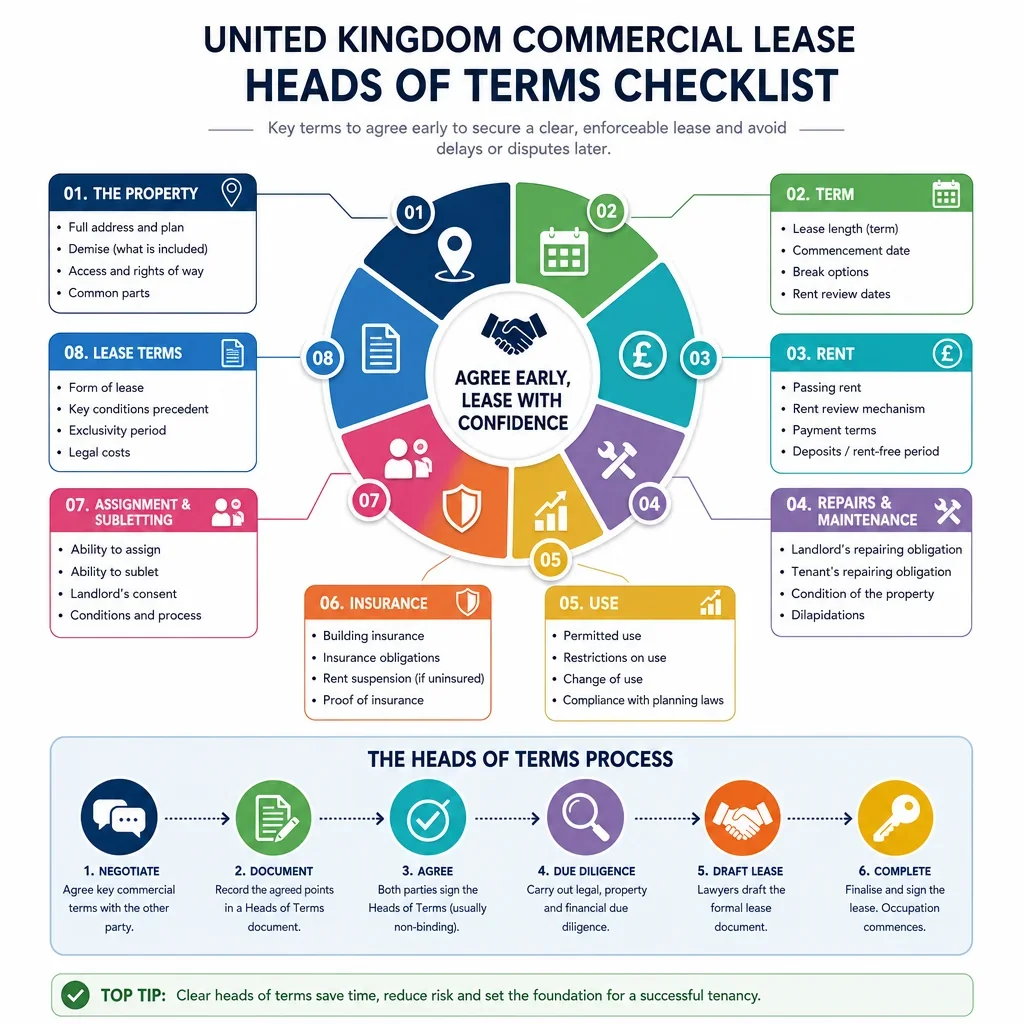
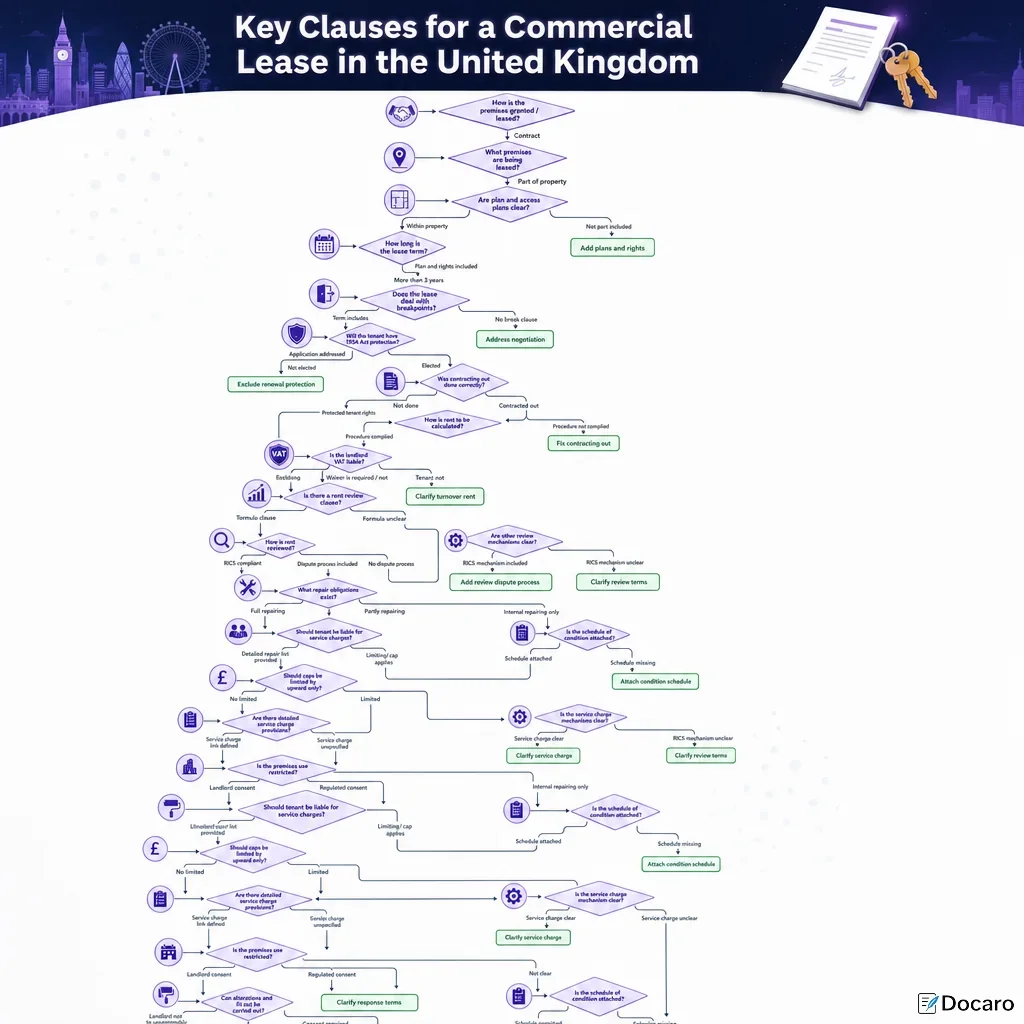
What a Proper Commercial Lease Agreement Should Include
- Parties InvolvedClearly identifies the landlord and tenant, including their full names and addresses.
- Property DescriptionProvides a detailed description of the leased property, including its location and boundaries.
- Lease TermSpecifies the start and end dates of the lease, along with any options for renewal.
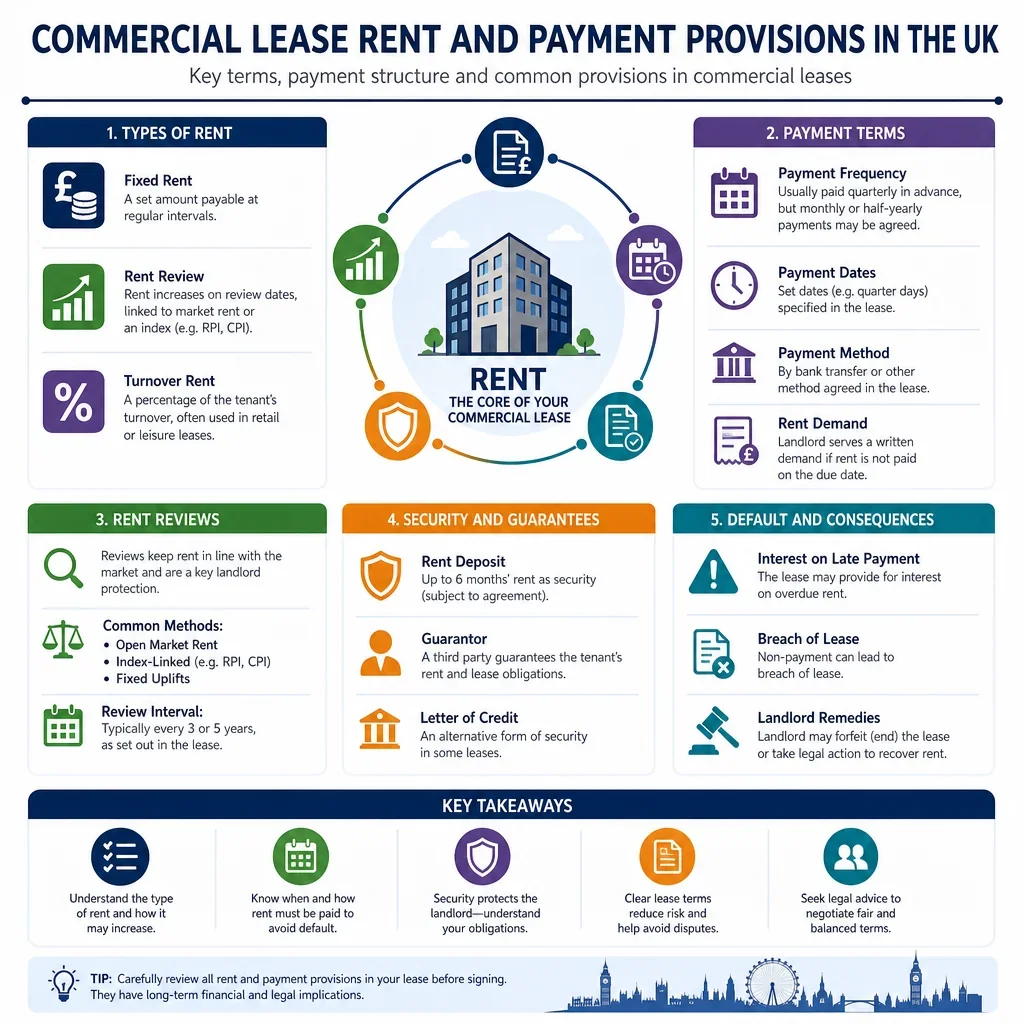
- Rent DetailsOutlines the rent amount, payment schedule, and any increases over time.
- Deposit RequirementsDetails the security deposit amount, how it is held, and conditions for its return.
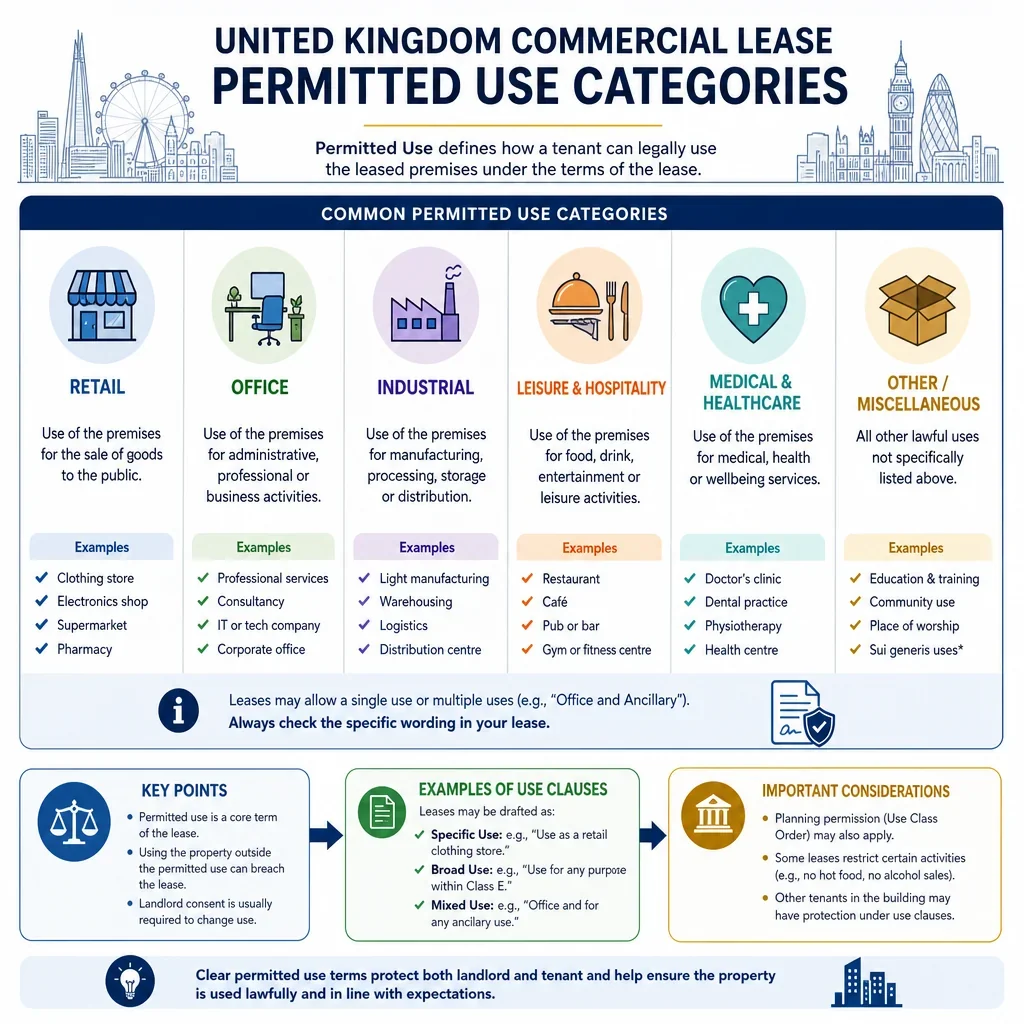
- Use of PropertyDescribes the permitted business activities and any restrictions on usage.
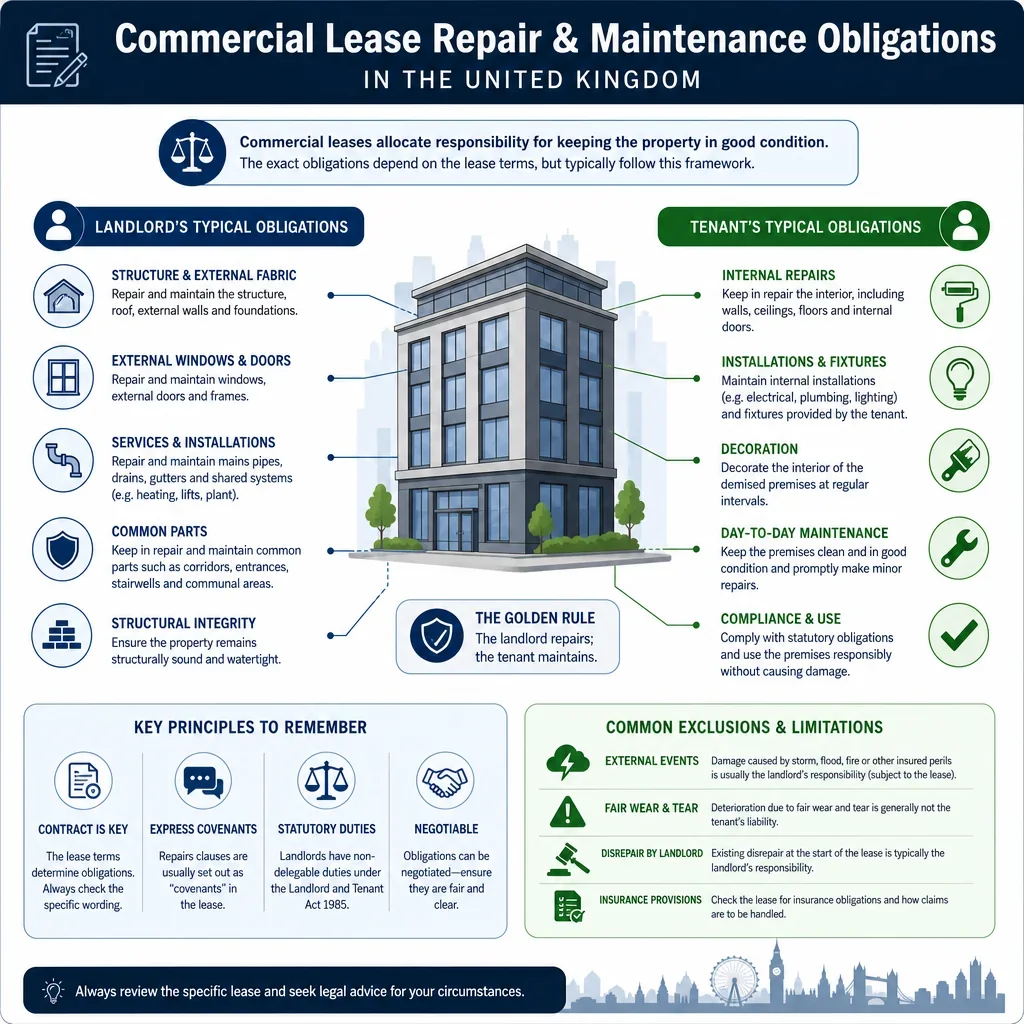
- Maintenance DutiesAssigns responsibilities for repairs and upkeep between landlord and tenant.
- Insurance ObligationsSpecifies who must insure the property and what coverage is required.
- Termination RulesExplains how the lease can end early and notice periods required.
- Dispute ResolutionOutlines steps for handling disagreements, such as mediation or court processes.
Generate Your Document in 4 Easy Steps
Why Use Docaro?
 United Kingdom
Free Example Commercial Lease Agreement Template
Below is a free template example of a Commercial Lease Agreement for use in the United Kingdom generated by our AI model.
The clauses in your actual Commercial Lease Agreement will vary from this example as they will be entirely bespoke to your requirements as set out in the questionnaire you complete.
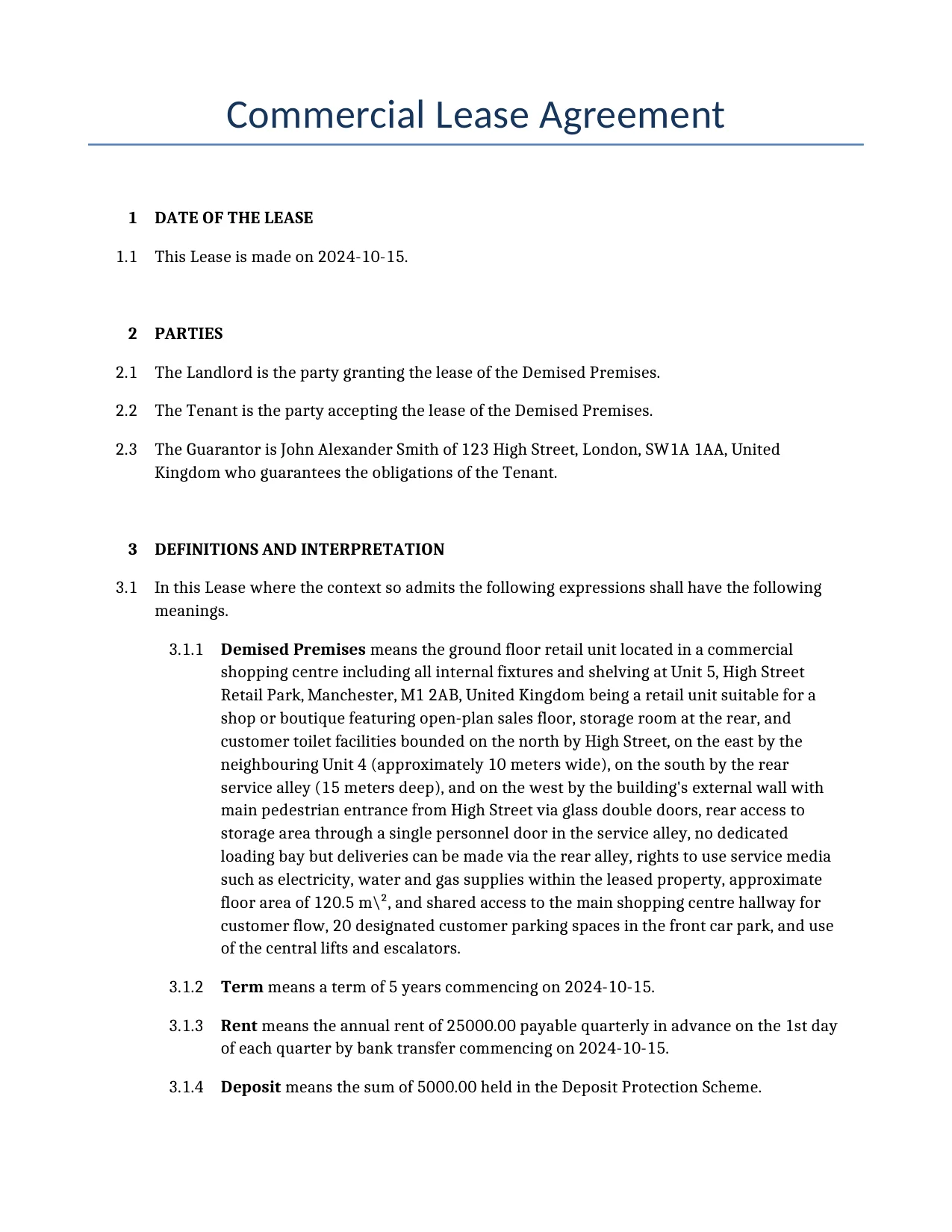
Commercial Lease Agreement
1DATE OF THE LEASE
This Lease is made on 2024-10-15.
2PARTIES
The Landlord is the party granting the lease of the Demised Premises.
The Tenant is the party accepting the lease of the Demised Premises.
The Guarantor is John Alexander Smith of 123 High Street, London, SW1A 1AA, United Kingdom who guarantees the obligations of the Tenant.
3DEFINITIONS AND INTERPRETATION
In this Lease where the context so admits the following expressions shall have the following meanings.
Demised Premises means the ground floor retail unit located in a commercial shopping centre including all internal fixtures and shelving at Unit 5, High Street Retail Park, Manchester, M1 2AB, United Kingdom being a retail unit suitable for a shop or boutique featuring open-plan sales floor, storage room at the rear, and customer toilet facilities bounded on the north by High Street, on the east by the neighbouring Unit 4 (approximately 10 meters wide), on the south by the rear service alley (15 meters deep), and on the west by the building's external wall with main pedestrian entrance from High Street via glass double doors, rear access to storage area through a single personnel door in the service alley, no dedicated loading bay but deliveries can be made via the rear alley, rights to use service media such as electricity, water and gas supplies within the leased property, approximate floor area of 120.5 m\², and shared access to the main shopping centre hallway for customer flow, 20 designated customer parking spaces in the front car park, and use of the central lifts and escalators.
Term means a term of 5 years commencing on 2024-10-15.
Rent means the annual rent of 25000.00 payable quarterly in advance on the 1st day of each quarter by bank transfer commencing on 2024-10-15.
Deposit means the sum of 5000.00 held in the Deposit Protection Scheme.
Service Charge means the proportionate share of the costs of Building Insurance, Repairs and Maintenance, Cleaning and Waste Management payable quarterly.
Headings in this Lease are ignored.
This Lease is gender neutral.
The singular includes the plural and vice versa.
References to persons include their successors.
4DEMISED PREMISES
The Landlord demises to the Tenant the Demised Premises together with the rights specified in Schedule 1.
The Tenant shall have access to the common areas of the building as described.
5TERM
The Landlord lets the Demised Premises to the Tenant for the Term.
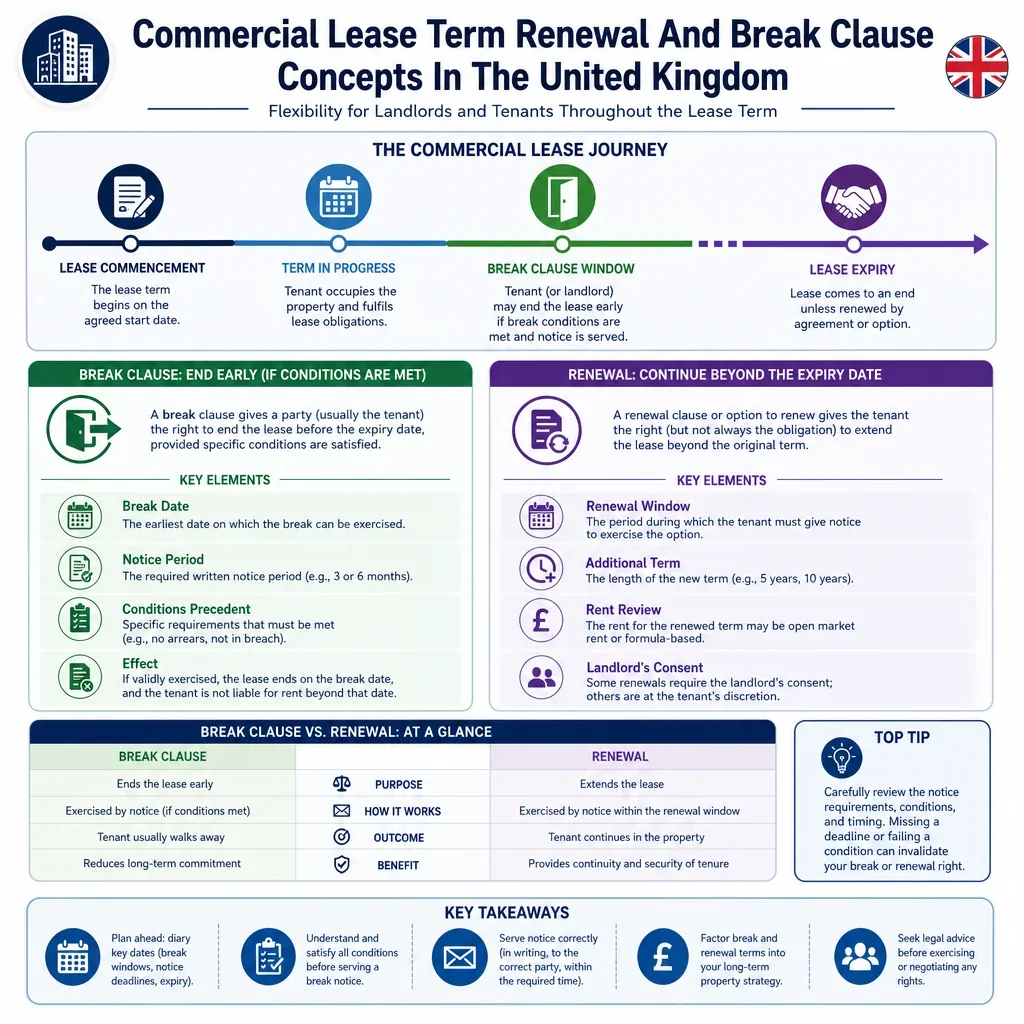
The Tenant has an option to renew the lease at the end of the initial Term.
6RENT AND OTHER PAYMENTS
The Tenant shall pay the Rent quarterly in advance on the 1st day of each quarter by bank transfer commencing on 2024-10-15.
The Rent shall be subject to a rent review mechanism.
The Tenant shall pay all other sums due under this Lease on the dates specified.
7DEPOSIT
The Tenant shall pay the Deposit to the Landlord on the date of this Lease.
The Deposit shall be held in the Deposit Protection Scheme.
The Landlord may withhold part or all of the Deposit in the event of unpaid rent or service charges, damage beyond fair wear and tear, or breach of lease covenants.
Subject to any deductions the Deposit shall be returned to the Tenant within 14 days of the end of the Term or earlier termination provided that the Tenant has complied with all its obligations under this Lease.
8SERVICE CHARGE
The Tenant shall pay the Service Charge quarterly in advance.
The Tenant's service charge contribution shall be strictly proportional to the leased area.
The Service Charge shall include the costs of building insurance, repairs and maintenance, cleaning and waste management.
The service charge year ends on 31 December.
The Tenant shall have the right to audit the service charge accounts.
Interest shall be charged on late service charge payments.
9INSURANCE
The Landlord shall insure the Demised Premises for the estimated reinstatement value of \£500,000 against fire and perils, subsidence, and public liability.
The Tenant shall contribute to the Landlord's insurance premiums as part of the service charge.
The Tenant shall insure its contents and stock and for business interruption from 2024-10-15.
The Tenant shall be liable for any damage caused by its negligence or breach.
10REPAIRS AND MAINTENANCE
The Demised Premises are let in fully fitted and ready for immediate occupation condition.
The Tenant shall maintain the Demised Premises in tenantable repair.
The Landlord shall be responsible for all structural repairs to the Demised Premises.
The Tenant shall be responsible for maintaining services and utilities within the Demised Premises.
Maintenance and repairs of the common areas shall be shared via the service charge.
The Tenant shall notify the Landlord in writing via email or registered post within 48 hours of discovering any repair issue providing details and photos where possible.
The Tenant must obtain the Landlord's prior written approval for any alterations that may affect repairs.
The Tenant must give the Landlord 7 days' notice for non-emergency repairs.
The Landlord insures the structure and the Tenant insures the contents in relation to repairs and maintenance.
11ALTERATIONS AND IMPROVEMENTS
The Tenant shall not make internal non-structural alterations, structural alterations, or alterations affecting external appearance without the Landlord's prior written consent which shall not be unreasonably withheld.
The Tenant shall obtain all necessary planning permissions and approvals for any alterations.
The Tenant shall reinstate all alterations unless otherwise agreed and alterations affecting external appearance at the end of the Term at its own cost.
12USE OF THE PREMISES
The Tenant shall use the Demised Premises for the permitted use of retail sale of clothing and accessories and operating a coffee shop serving hot and cold beverages and light snacks.
The Tenant shall comply with all restrictions on trade.
The proposed use complies with current planning permissions for the Demised Premises.
The local planning authority is the Manchester City Council and necessary permissions for retail use have been obtained.
The Tenant shall obtain and maintain a Food Business Licence.
The Tenant must comply with all planning and licensing requirements throughout the Term.
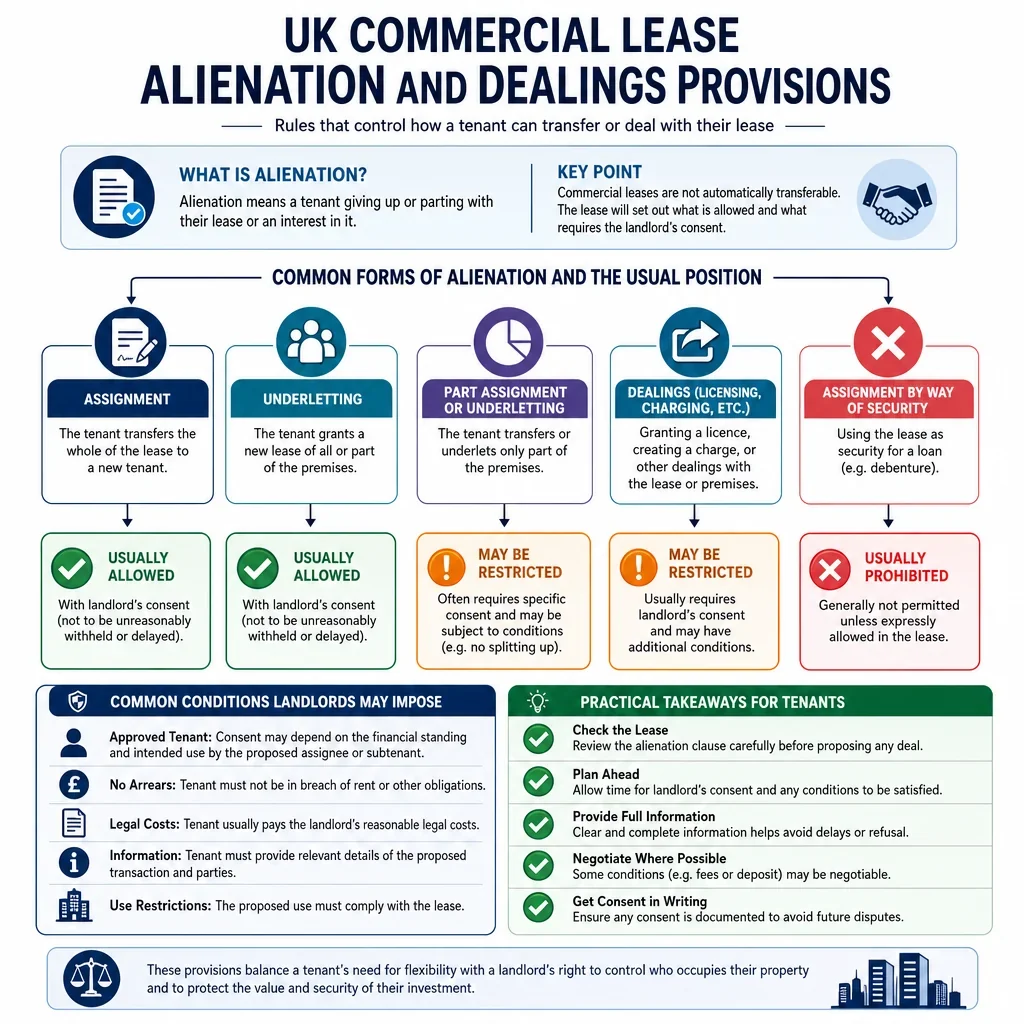
13ASSIGNMENT, UNDERLETTING AND SUBLETTING
The Tenant may assign the Lease or underlet the Demised Premises with the prior written consent of the Landlord such consent not to be unreasonably withheld or delayed.
The Tenant shall not sublet the entire Demised Premises.
The Tenant shall give the Landlord 14 days' notice before seeking consent for assignment or underletting.
The assignor Tenant shall enter into an Authorised Guarantee Agreement upon assignment.
14REGISTRATION OF THE LEASE
The Landlord shall register the Lease at the Land Registry by 2024-12-31.
The Landlord shall provide the necessary documentation for lease registration.
15OUTGOINGS AND UTILITIES
The Tenant shall be responsible for paying the non-domestic rates for the Demised Premises.
The Landlord shall be responsible for paying any council tax applicable to the Demised Premises.
The Tenant shall pay for electricity, gas, water and sewerage from 2024-10-15.
The Tenant shall contribute to the Landlord's insurance premiums for the Demised Premises.
The Tenant shall pay a service charge for maintenance and outgoings of the Demised Premises.
16COMPLIANCE WITH LAWS AND REGULATIONS
The Tenant shall comply with all applicable laws and regulations including health and safety laws and environmental regulations such as waste management and pollution control.
The Tenant shall obtain and comply with all necessary planning permissions for its proposed use of the Demised Premises.
The Tenant shall provide full indemnity to the Landlord for breaches of laws and regulations.
17ACCESS FOR LANDLORD
The Landlord shall have the right to access the Demised Premises for inspections annually upon 7 days' notice during business hours only.
The Landlord shall have the right to access the Demised Premises for repairs upon 7 days' notice during business hours only.
The Landlord shall have the right to access the Demised Premises for other purposes such as emergencies or showing to prospective tenants without notice in emergencies and upon 7 days' notice otherwise during business hours only or outside business hours with additional notice.
18EVENTS OF DEFAULT
It shall be an event of default if the Tenant fails to pay rent or other sums due.
It shall be an event of default if the Tenant fails to comply with repair and maintenance obligations.
It shall be an event of default if the Tenant fails to maintain required insurance cover.
It shall be an event of default if the Tenant misuses the Demised Premises such as unauthorised use or alterations.
It shall be an event of default if the Tenant becomes insolvent or bankrupt.
19REMEDIES
The Landlord shall give the Tenant 14 days' notice of a default before exercising remedies.
For non-payment of rent the Landlord shall have the right to distrain and charge interest on arrears.
The Landlord may forfeit the Lease upon the Tenant's default for non-payment of rent or breach of other covenants.
The Landlord shall have the right of re-entry upon the Tenant's default without court proceedings.
The Landlord may claim damages from the Tenant for any default calculated on the basis of actual losses and the Tenant shall indemnify the Landlord for losses arising from the Tenant's default.
The Landlord may recover legal and other costs incurred in enforcing remedies against the Tenant.
20DETERMINATION OF THE TERM
This Lease may be determined early by break option or surrender.
The Tenant shall have a break option to terminate this Lease early.
21YIELD UP AND REINSTATEMENT
At the end of the Term on 2029-10-14 the Tenant shall yield up the Demised Premises in broom-clean condition free from all debris with all systems in good working order subject to fair wear and tear.
The Tenant shall reinstate any alterations made to the Demised Premises at the end of the Term.
The Tenant shall give two months' notice before commencing any reinstatement works and obtain the Landlord's prior written approval before removing any alterations.
The Tenant shall bear the costs of yield up and reinstatement works.
22NOTICES
Notices to the Landlord shall be sent to 123 High Street, London, SW1A 1AA.
Notices to the Tenant shall be sent to 456 Oxford Road, Manchester, M1 1AA.
Notices may be served by personal delivery, post or email.
Notices sent by registered post or recorded delivery shall be deemed served 2 business days after posting.
23DISPUTE RESOLUTION
The parties shall attempt mediation as a required step before other dispute resolution methods.
Expert determination shall be used for specific types of disputes such as valuation disagreements.
The courts of England and Wales shall have exclusive jurisdiction for any court proceedings.
24GUARANTEE
The Guarantor guarantees to the Landlord the due performance by the Tenant of all payment obligations including rent, service charges, and any damages to the property during the Term from 2024-10-15.
25VAT
The Rent and other payments under this Lease shall be exclusive of VAT.
The Landlord is currently VAT registered.
The Tenant shall have full VAT recovery rights.
The Landlord shall provide VAT-compliant invoices for all VAT-charged payments.
26COSTS
Each party shall pay their own legal costs associated with this Lease.
Other costs associated with this Lease such as stamp duty or survey fees shall be split between the Landlord and the Tenant.
VAT shall be payable on top of the allocated costs.
Payment of allocated costs shall be due on the date of completion of this Lease.
27SEVERABILITY
If any provision of this Lease is held to be invalid or unenforceable the remaining provisions shall continue in full force and effect.
28WAIVER
No failure by the Landlord to enforce any rights under this Lease constitutes a waiver of those rights.
No failure by the Tenant to enforce any rights under this Lease constitutes a waiver of those rights.
Any waiver of rights under this Lease must be in writing and signed by the waiving party.
Notices related to waivers shall be delivered in writing or by email.
29ENTIRE AGREEMENT
This Lease constitutes the entire agreement between the parties and excludes liability for any prior representations or statements made before signing this Lease.
This Lease is governed by the laws of England and Wales.
If any part of this Lease is invalid the rest remains enforceable.
30GOVERNING LAW AND JURISDICTION
This Lease shall be governed by British law.
The parties submit to the exclusive jurisdiction of the courts of England and Wales.
31COUNTERPARTS
This Lease may be executed in any number of counterparts each of which when executed and delivered shall constitute a duplicate original but all counterparts shall together constitute one agreement.
Electronic signatures may be used for executing this Lease.
32SCHEDULES
The Landlord grants easements to the Tenant as set out in Schedule 1.
The property includes modern office space with air conditioning, high-speed internet access, and secure parking for 10 vehicles with a floor area of 500 m\².
33EXECUTION
| LANDLORD | |
| Signature: | |
| Print Name: | |
| Date: |
| TENANT | |
| Signature: | |
| Print Name: | |
| Date: |
| GUARANTOR | |
| Signature: | |
| Print Name: | |
| Date: |
This example shows approximately 70% of a typical document and is provided for illustrative purposes only. The remaining content has been omitted.
Every document generated by Docaro is tailored to your specific circumstances, jurisdiction and the information you provide. The completed document includes all applicable clauses and provisions required for your situation.
To generate the full, personalised document, answer a short series of questions and your document will be created instantly.
Useful Resources When Considering a Commercial Lease Agreement in the United Kingdom
United Kingdom Reference Legislation
Commercial Lease Agreement FAQs
Document Generation FAQs
Related Articles