AI Generated Code of Conduct and Ethics for use in the United Kingdom
PDF & Word - 2026 Updated
Docaro Pricing
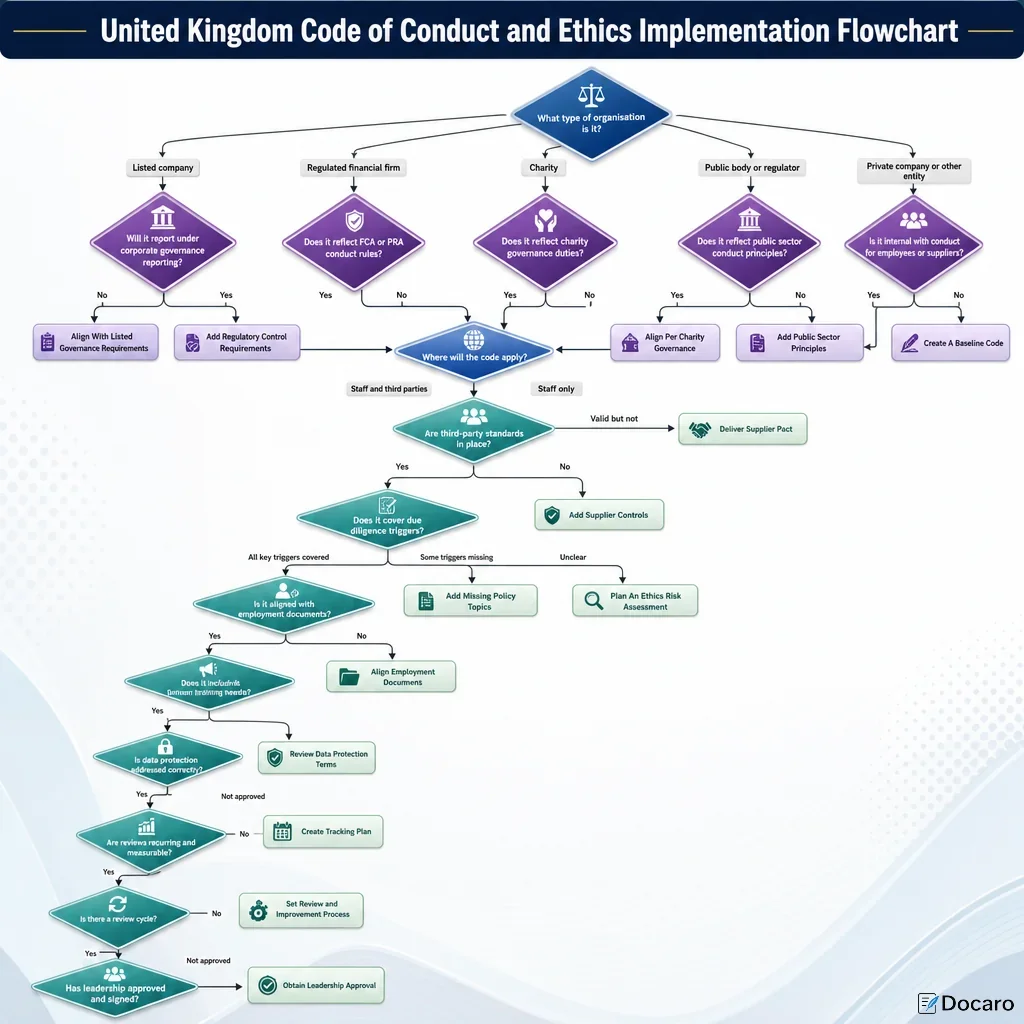
When do you need a Code of Conduct and Ethics in the United Kingdom?
British Legal Rules for a Code of Conduct and Ethics
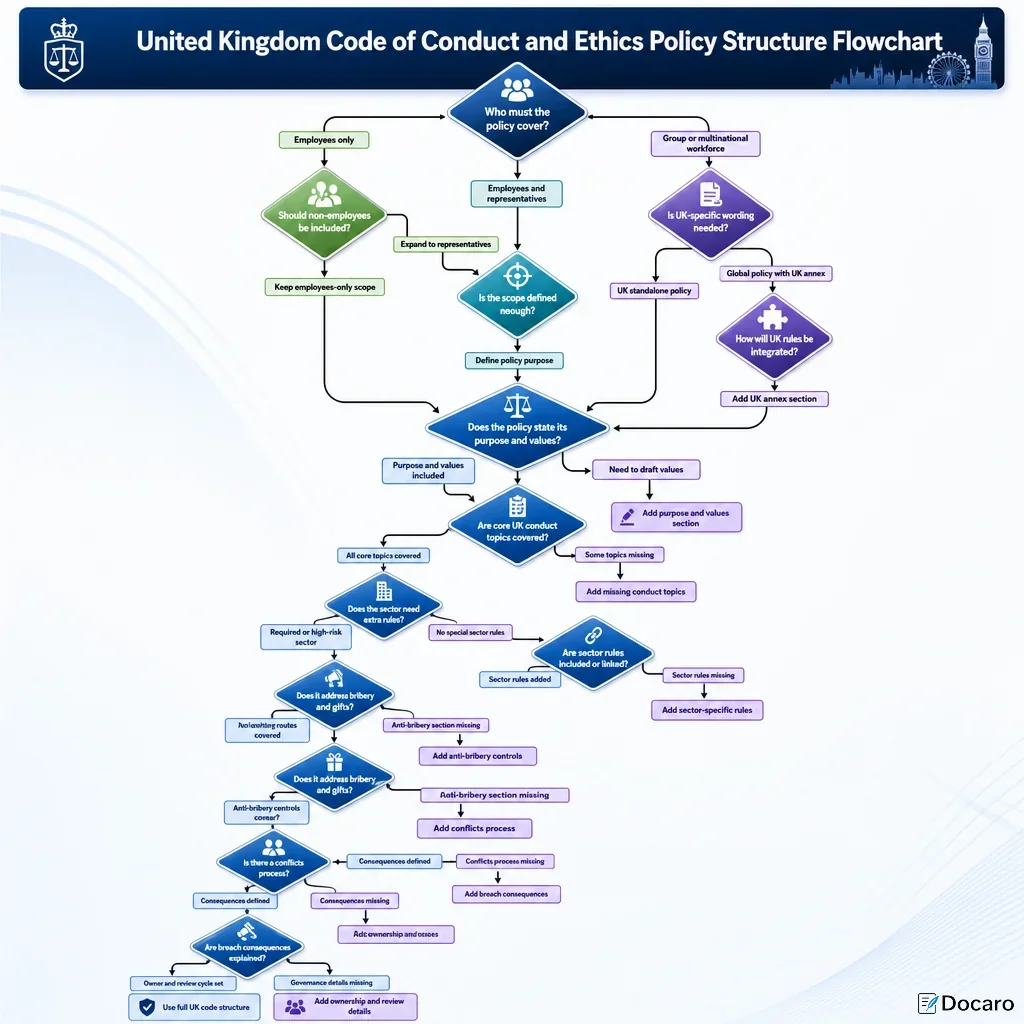
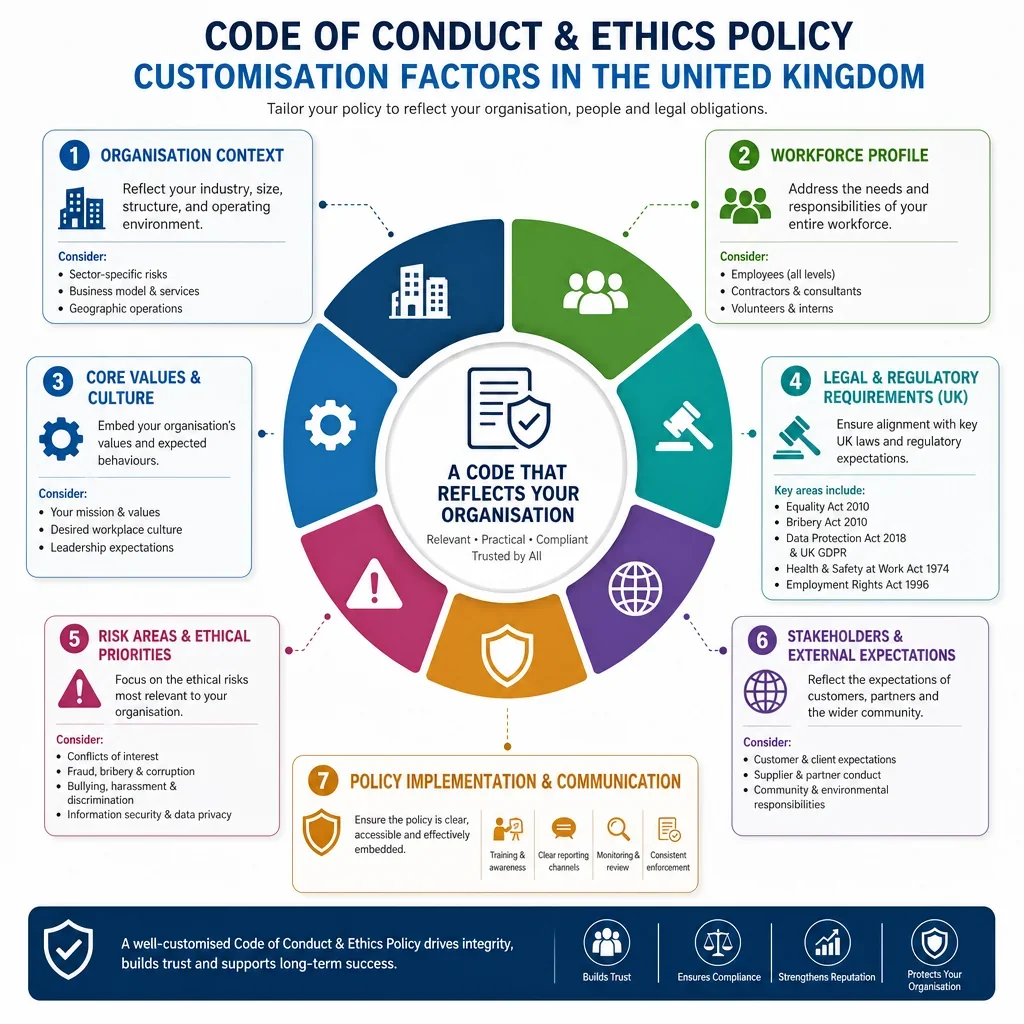
Using an inappropriate structure for a code of conduct and ethics policy may fail to adequately address specific legal obligations under UK employment or corporate governance laws.
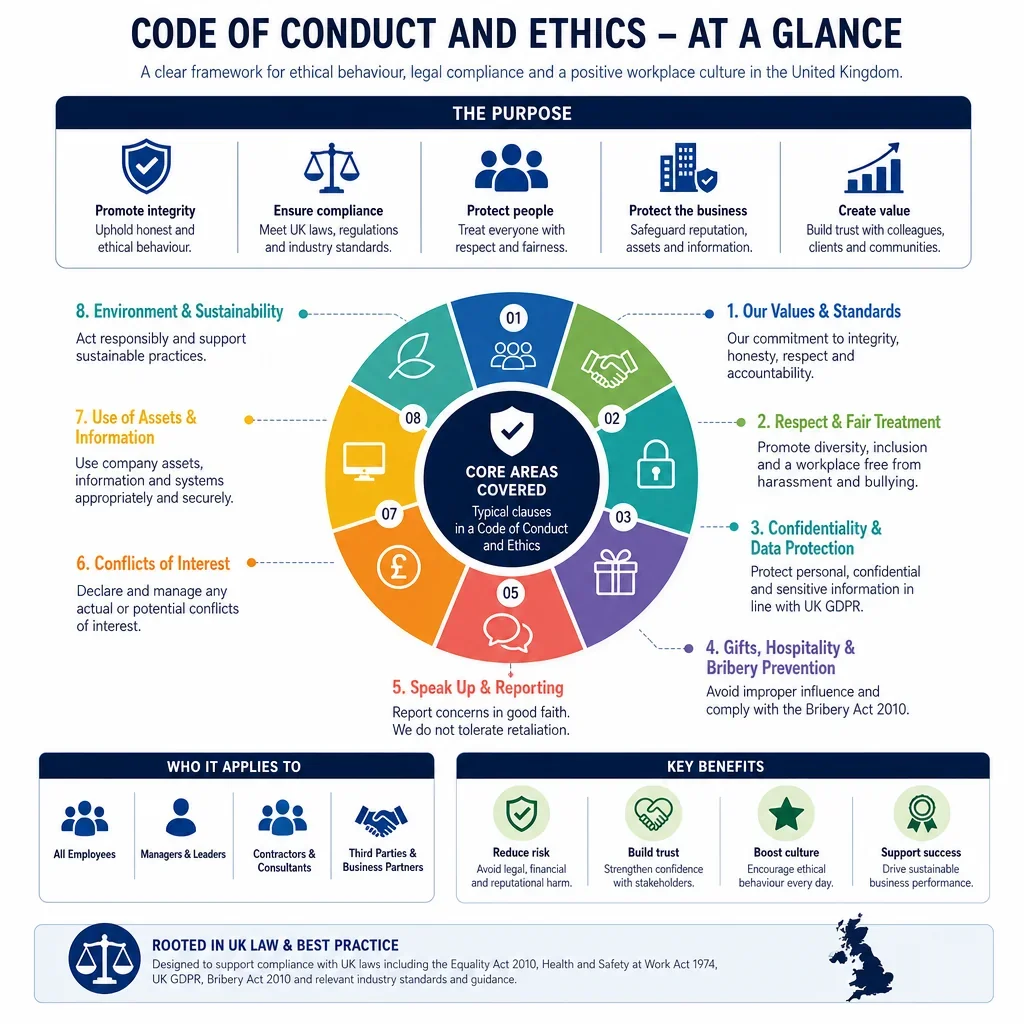
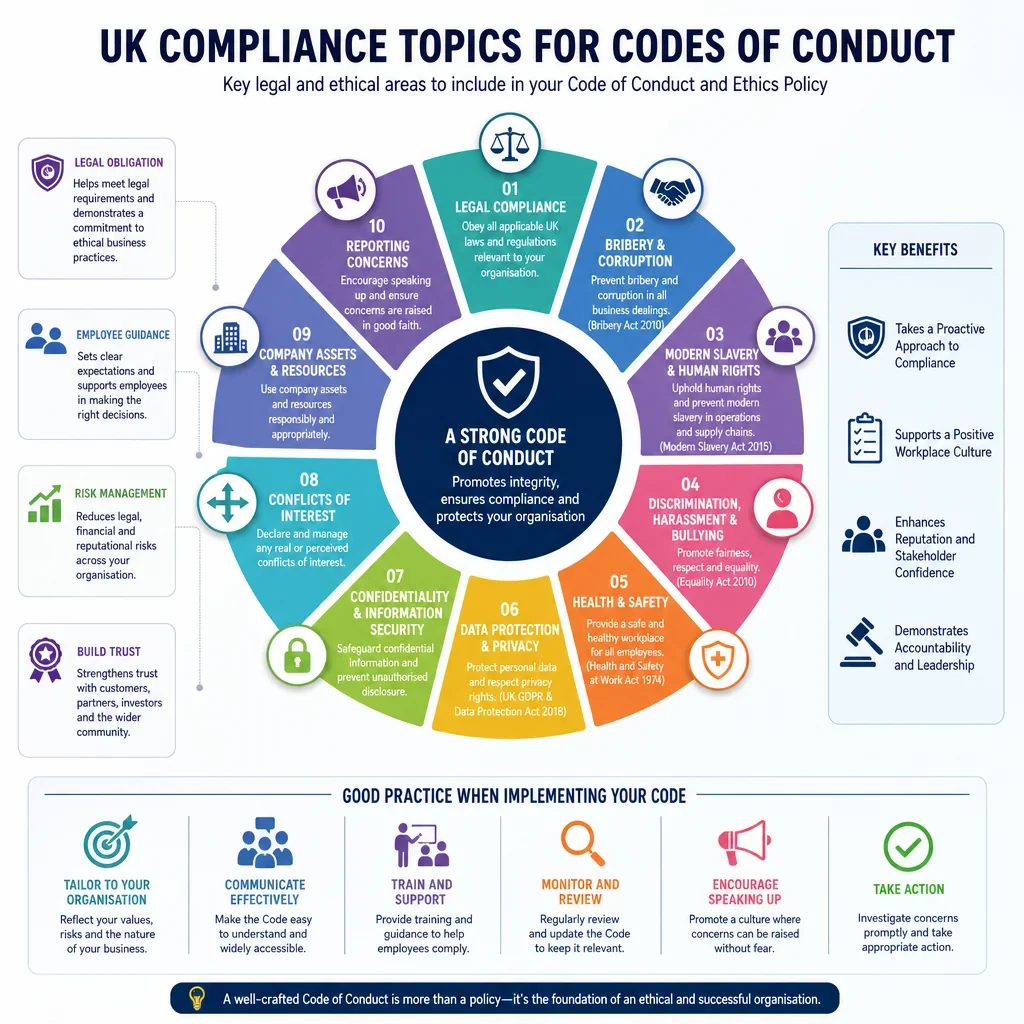
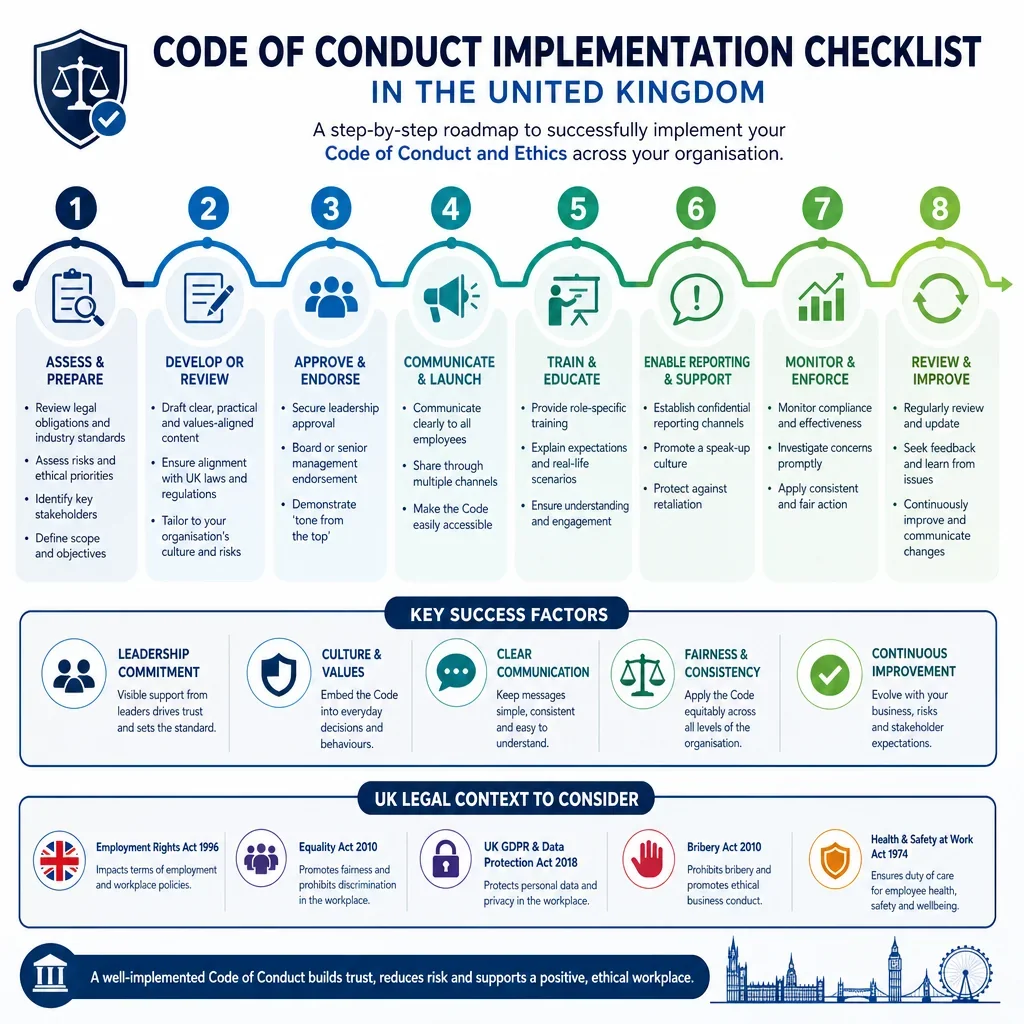
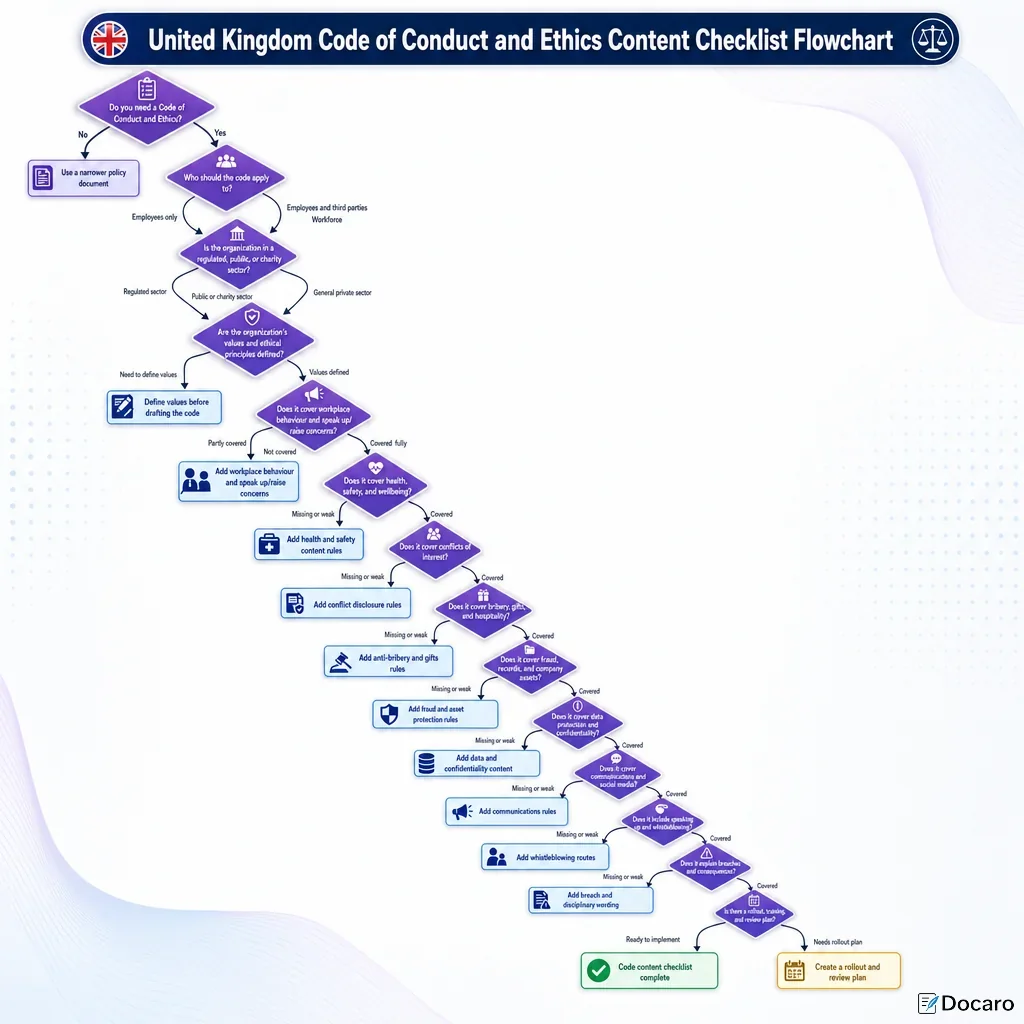
What a Proper Code of Conduct and Ethics Should Include
- Honesty and IntegrityEmployees must act truthfully and fairly in all business dealings to build trust.
- Compliance with LawsEveryone should follow UK laws and regulations in daily work activities.
- Respect for OthersTreat colleagues, customers, and partners with dignity and without discrimination.
- ConfidentialityProtect sensitive company information and respect privacy at all times.
- Avoiding Conflicts of InterestDisclose any personal interests that could influence business decisions.
- Responsible Use of ResourcesUse company assets and resources wisely and only for legitimate purposes.
- Health and SafetyPrioritise a safe working environment for everyone involved.
- Environmental ResponsibilitySupport sustainable practices to minimise harm to the environment.
- Reporting WrongdoingEncourage speaking up about unethical behaviour without fear of reprisal.
- Fair CompetitionCompete honestly and avoid unfair practices in the marketplace.
Generate Your Document in 4 Easy Steps
Why Use Docaro?
 United Kingdom
Free Example Code of Conduct and Ethics Template
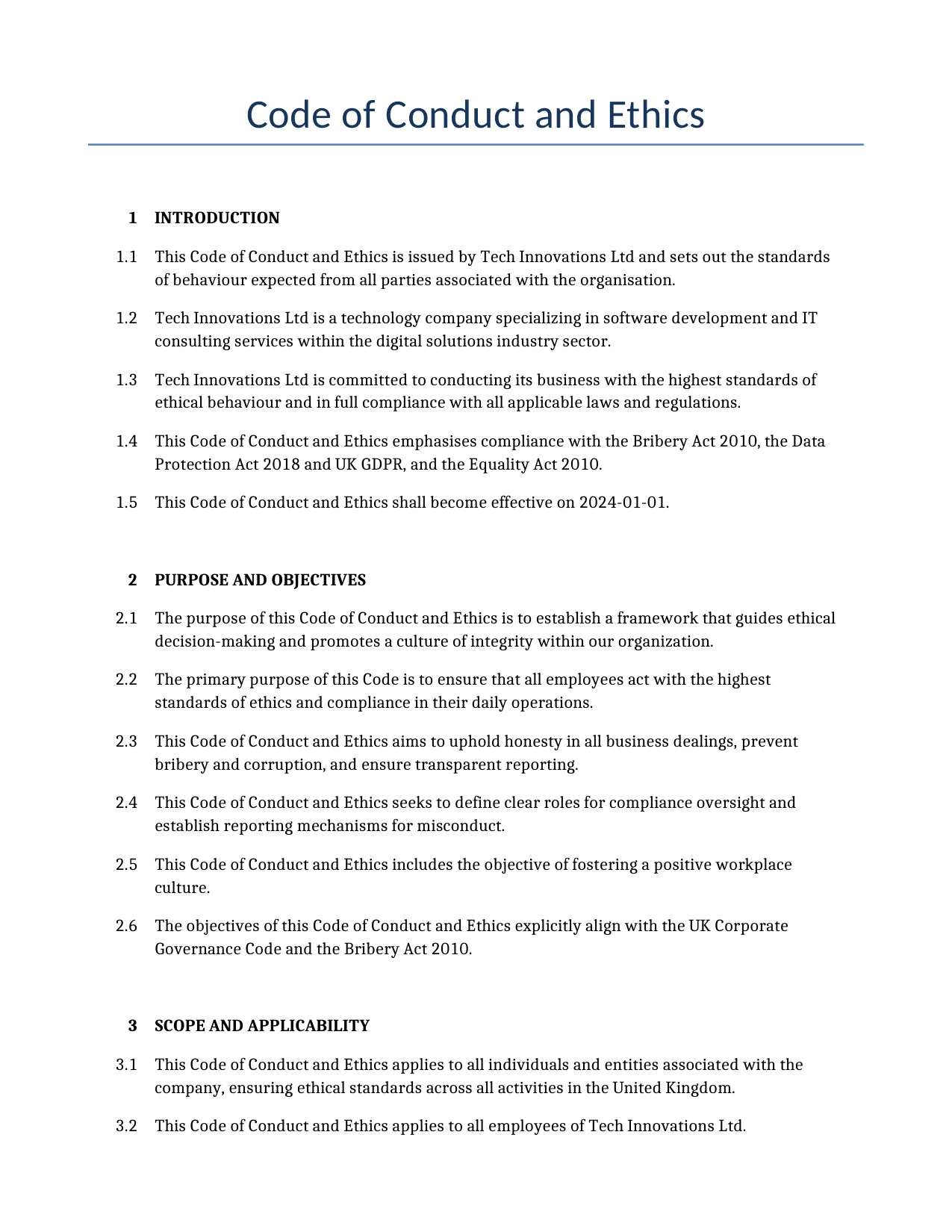
Below is a free template example of a Code of Conduct and Ethics for use in the United Kingdom generated by our AI model.
The clauses in your actual Code of Conduct and Ethics will vary from this example as they will be entirely bespoke to your requirements as set out in the questionnaire you complete.
Code of Conduct and Ethics
1INTRODUCTION
This Code of Conduct and Ethics is issued by Tech Innovations Ltd and sets out the standards of behaviour expected from all parties associated with the organisation.
Tech Innovations Ltd is a technology company specializing in software development and IT consulting services within the digital solutions industry sector.
Tech Innovations Ltd is committed to conducting its business with the highest standards of ethical behaviour and in full compliance with all applicable laws and regulations.
This Code of Conduct and Ethics emphasises compliance with the Bribery Act 2010, the Data Protection Act 2018 and UK GDPR, and the Equality Act 2010.
This Code of Conduct and Ethics shall become effective on 2024-01-01.
2PURPOSE AND OBJECTIVES
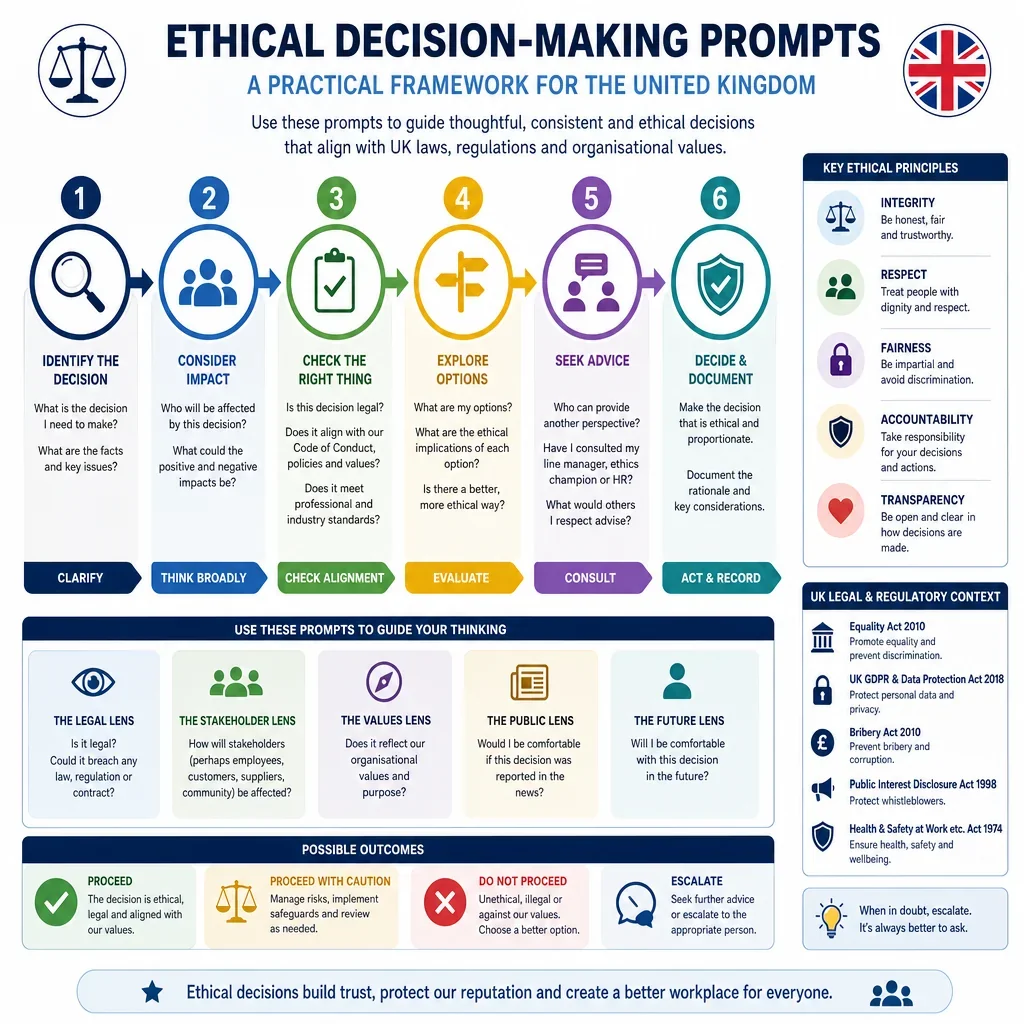
The purpose of this Code of Conduct and Ethics is to establish a framework that guides ethical decision-making and promotes a culture of integrity within our organization.
The primary purpose of this Code is to ensure that all employees act with the highest standards of ethics and compliance in their daily operations.
This Code of Conduct and Ethics aims to uphold honesty in all business dealings, prevent bribery and corruption, and ensure transparent reporting.
This Code of Conduct and Ethics seeks to define clear roles for compliance oversight and establish reporting mechanisms for misconduct.
This Code of Conduct and Ethics includes the objective of fostering a positive workplace culture.
The objectives of this Code of Conduct and Ethics explicitly align with the UK Corporate Governance Code and the Bribery Act 2010.
3SCOPE AND APPLICABILITY
This Code of Conduct and Ethics applies to all individuals and entities associated with the company, ensuring ethical standards across all activities in the United Kingdom.
This Code of Conduct and Ethics applies to all employees of Tech Innovations Ltd.
This Code of Conduct and Ethics applies to all directors of Tech Innovations Ltd.
This Code of Conduct and Ethics applies to all contractors of Tech Innovations Ltd.
This Code of Conduct and Ethics applies to third parties such as suppliers and partners of Tech Innovations Ltd.
The geographical scope of this Code of Conduct and Ethics is limited to the United Kingdom.
This Code of Conduct and Ethics applies to all core business operations including sales, marketing, human resources, finance, and customer service activities conducted within the UK.
This Code of Conduct and Ethics explicitly includes all subsidiaries of Tech Innovations Ltd operating in the United Kingdom.
This Code of Conduct and Ethics shall be reviewed and updated annually.
4CORE VALUES AND PRINCIPLES
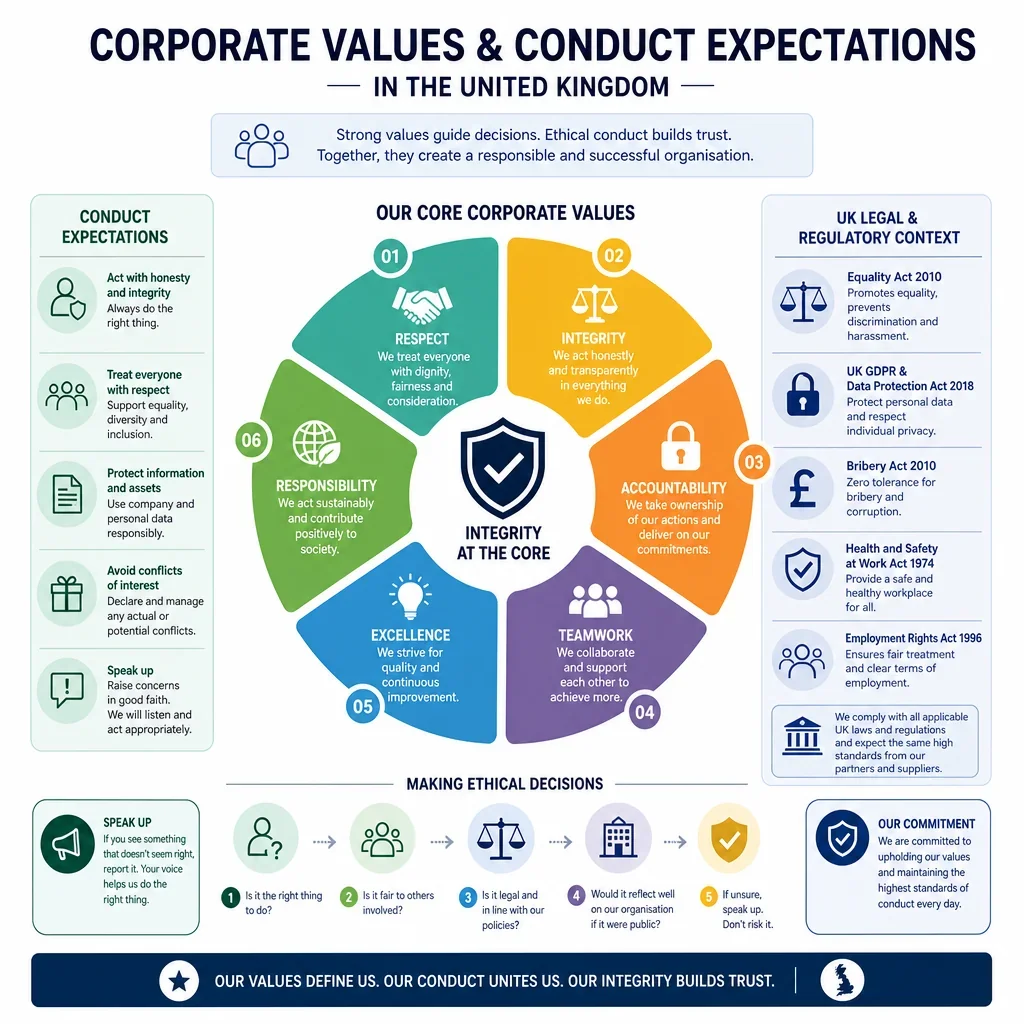
Integrity means acting with honesty, accountability, and moral principles in all business dealings, ensuring that our actions align with our commitments and ethical standards.
Respect is a core value of Tech Innovations Ltd and shall guide all interactions within the organisation.
Fairness will be applied by ensuring equal opportunities for all employees, impartial decision-making in promotions and resource allocation, and non-discriminatory practices in all interactions.
Transparency is a core principle of Tech Innovations Ltd and shall be maintained in all business activities.
These core values and principles serve as the foundation for every decision, policy, and interaction within the organization, guiding our employees to uphold the highest standards of ethical conduct in all activities.
5COMPLIANCE WITH LAWS AND REGULATIONS
Tech Innovations Ltd and its employees shall comply with all applicable laws and regulations, including but not limited to the Companies Act 2006, Bribery Act 2010, UK GDPR and Data Protection Act 2018, Equality Act 2010, Health and Safety at Work etc. Act 1974, Modern Slavery Act 2015, and any other relevant legislation. This includes maintaining adequate procedures to prevent bribery as outlined in the Ministry of Justice guidance on the Bribery Act 2010.
All employees of Tech Innovations Ltd shall undertake mandatory training on the Equality Act 2010, including provisions for reasonable adjustments for disabled persons.
The Chief Compliance Officer is designated as the primary compliance officer responsible for overseeing adherence to laws and regulations, with board-level oversight as per the UK Corporate Governance Code.
Tech Innovations Ltd shall implement an anonymous hotline, an online reporting portal, and direct reporting to the compliance officer as mechanisms for employees to report potential violations of laws and regulations. Reports will be handled in accordance with the Public Interest Disclosure Act 1998 (PIDA).
Tech Innovations Ltd shall mandate regular compliance training sessions for employees on UK laws and regulations, including anti-money laundering measures where relevant to business activities.
The company shall conduct annual risk assessments for compliance risks, including those related to bribery, data protection, equality, health and safety, and modern slavery, with results reported to the board.
6CONFLICTS OF INTEREST
Tech Innovations Ltd includes a specific policy requiring employees to annually review their personal and professional relationships for any potential conflicts of interest.
Annual conflict of interest disclosures shall be mandatory for all employees of Tech Innovations Ltd.
Directors, senior management, and all employees of Tech Innovations Ltd shall be required to make conflict disclosures.
Employees must submit a written disclosure form to the Compliance Officer within 7 days of identifying a potential conflict, including details of the conflict and any relevant relationships.
Tech Innovations Ltd shall manage identified conflicts through recusal from decisions, third party review, and ongoing monitoring.
7ANTI-BRIBERY AND CORRUPTION
Tech Innovations Ltd explicitly prohibits all forms of bribery by the company, its employees, and agents, in accordance with the Bribery Act 2010.
Tech Innovations Ltd explicitly prohibits all forms of corruption, including embezzlement and abuse of position.
The company shall implement and maintain adequate procedures designed to prevent bribery, as per the six principles in the Ministry of Justice guidance on the Bribery Act 2010: proportionate procedures, top level commitment, risk assessment, due diligence, communication (including training), and monitoring and review.
Gifts and hospitality may be offered or accepted only if they are reasonable, proportionate, transparent, and do not influence or appear to influence decisions. The company maintains a gifts and hospitality register for all items over \£50 in value, which must be approved in advance by a senior manager where appropriate.
Facilitation payments are prohibited in all circumstances, as they constitute bribery under the Bribery Act 2010.
The company shall conduct due diligence on all third parties, including agents, suppliers, and partners, proportionate to the assessed risk, including checks on beneficial ownership, reputation, and any red flags for bribery.
Third-party contracts shall include anti-bribery clauses requiring compliance with this Code and the Bribery Act 2010, with rights to audit and terminate for breach.
Political donations by the company are prohibited. Any personal political activities by employees must not use company resources or imply company endorsement and must be disclosed where they could create a conflict of interest.
Tech Innovations Ltd shall require annual anti-bribery training for all employees, with additional targeted training for those in high-risk roles such as sales, procurement, and those dealing with public officials.
Employees can report suspected bribery confidentially via our dedicated whistleblower hotline or by emailing the compliance team at compliance@company.co.uk. All reports will be investigated promptly without retaliation, in line with PIDA.
8CONFIDENTIALITY AND DATA PROTECTION
Tech Innovations Ltd shall be bound by a general obligation to maintain the confidentiality of sensitive information, in accordance with contractual obligations, common law, and statutory duties.
Tech Innovations Ltd shall appoint a Data Protection Officer to oversee compliance with the UK GDPR and Data Protection Act 2018.
Tech Innovations Ltd engages in the collection of personal data from individuals, the storage and maintenance of personal data records, and the disclosure of personal data to third parties, ensuring all processing is lawful, fair, transparent, and limited to necessary purposes.
Tech Innovations Ltd shall notify personal data breaches to the Information Commissioner's Office without undue delay and, where feasible, not later than 72 hours after becoming aware of the breach, where the breach is likely to result in a risk to the rights and freedoms of individuals. Affected data subjects shall be notified where the breach is likely to result in a high risk to them.
Personal data will be retained only for as long as necessary to fulfil the purposes for which it was collected, in accordance with legal requirements, and securely deleted or anonymised thereafter. The company maintains a data retention policy detailing specific periods.
Tech Innovations Ltd shall require mandatory training for employees on confidentiality and data protection, including data subject rights such as access, rectification, erasure, restriction, portability, and objection.
Tech Innovations Ltd shall permit disclosures of confidential information only when required by law or regulatory authority, with consent of the data subject, or to professional advisors under confidentiality agreements.
International transfers of personal data outside the UK shall only occur where appropriate safeguards are in place, such as the UK International Data Transfer Agreement, standard contractual clauses, or binding corporate rules, or where an adequacy decision applies. Tech Innovations Ltd maintains a record of such transfers.
Data subjects have the right to complain to the Information Commissioner's Office if they consider that the processing of their personal data infringes the UK GDPR or Data Protection Act 2018.
9FAIR COMPETITION AND ANTITRUST
Tech Innovations Ltd does not engage in any discussions with competitors regarding pricing strategies.
Tech Innovations Ltd does not allocate markets, customers, or territories with competitors.
Tech Innovations Ltd does not participate in bid rigging or collude on tenders with competitors.
Tech Innovations Ltd primarily operates in the technology and software industry and the retail and distribution industry, both of which may be subject to competition scrutiny.
Tech Innovations Ltd provides regular training on competition law to employees.
Employees can report suspected anti-competitive activities confidentially through an anonymous hotline or directly to the compliance officer via email or an internal portal, ensuring prompt investigation and protection from retaliation.
Tech Innovations Ltd does not hold a dominant position in any UK market that could raise abuse concerns.
10WORKPLACE HEALTH AND SAFETY
Tech Innovations Ltd is committed to ensuring the health, safety, and welfare of all employees, contractors, and visitors as far as is reasonably practicable, in accordance with the Health and Safety at Work etc. Act 1974, the Management of Health and Safety at Work Regulations 1999, and other applicable regulations. A formal written health and safety policy is maintained separately and referenced herein.
The Health and Safety Officer and senior management are designated with specific roles responsible for health and safety, including reporting to the board on health and safety matters as required by the UK Corporate Governance Code where applicable.
Tech Innovations Ltd commits to conducting suitable and sufficient risk assessments for all activities, reviewed at least annually or upon significant change, with appropriate control measures implemented.
Employees of Tech Innovations Ltd shall receive appropriate health and safety training at induction and regularly thereafter, including at least annually for higher-risk roles.
Tech Innovations Ltd shall maintain a mandatory procedure for reporting health and safety incidents, near misses, and concerns promptly, with investigation and corrective action as appropriate.
Suitable personal protective equipment shall be provided free of charge where risks cannot be otherwise controlled, following appropriate risk assessment. Training on its use and maintenance shall be provided.
Tech Innovations Ltd includes protections for employees who report health and safety concerns without fear of retaliation, in line with the Public Interest Disclosure Act 1998.
11ENVIRONMENTAL RESPONSIBILITY
Tech Innovations Ltd commits to sustainable practices in all its operations, minimising environmental impact in compliance with the Environment Act 2021 and all other applicable environmental laws and regulations.
Tech Innovations Ltd shall conduct regular environmental impact assessments and risk evaluations for its operations, proportionate to activities and risks identified.
Tech Innovations Ltd shall set and review appropriate science-based targets for reducing carbon emissions and other environmental impacts, aligned where feasible with relevant initiatives such as the Science Based Targets initiative, recognising that net zero by 2050 is an aspirational long-term goal dependent on technological and economic feasibility.
Tech Innovations Ltd shall conduct environmental audits at appropriate intervals based on risk and regulatory requirements.
Tech Innovations Ltd shall take steps to reduce single-use plastics and other unnecessary waste across its operations where reasonably practicable.
Tech Innovations Ltd shall report on environmental, social, and governance matters in accordance with applicable legal and regulatory requirements, taking into account relevant frameworks such as the Task Force on Climate-related Financial Disclosures (TCFD) and Global Reporting Initiative (GRI) standards where appropriate.
Tech Innovations Ltd shall assess and monitor suppliers for environmental compliance as part of its supply chain due diligence processes.
12DIVERSITY, EQUALITY, AND INCLUSION
All employees of Tech Innovations Ltd shall complete mandatory diversity, equality, and inclusion training at induction and regularly thereafter, in line with the Equality Act 2010 and associated codes of practice.
Tech Innovations Ltd shall establish a confidential reporting mechanism for harassment, discrimination, and victimisation incidents, with prompt investigation and remedial action.
Tech Innovations Ltd prohibits discrimination, harassment, and victimisation based on the protected characteristics under the Equality Act 2010: age, disability, gender reassignment, marriage and civil partnership, pregnancy and maternity, race, religion or belief, sex, and sexual orientation. This includes a duty to make reasonable adjustments for disabled persons where required.
Tech Innovations Ltd shall implement a zero-tolerance policy for harassment, including immediate disciplinary action up to and including dismissal where appropriate.
The company shall promote equality of opportunity and inclusion, including through equality impact assessments where appropriate, in line with the Equality Act 2010 and best practice guidance from the Equality and Human Rights Commission.
13HUMAN RIGHTS
Tech Innovations Ltd includes a dedicated human rights policy within this Code of Conduct and Ethics, committing to respect human rights in all operations and relationships.
Tech Innovations Ltd commits to publishing an annual Modern Slavery Statement as required by the Modern Slavery Act 2015, approved by the board and published on the company website, detailing steps taken to ensure slavery and human trafficking are not taking place in its business or supply chains.
The annual due date for publishing the Modern Slavery Statement shall be within 6 months of the financial year end, or as otherwise required by law.
Tech Innovations Ltd shall align with the United Nations Guiding Principles on Business and Human Rights, the Universal Declaration of Human Rights, and the International Labour Organization Conventions as international human rights frameworks.
Tech Innovations Ltd shall conduct regular due diligence on suppliers and the supply chain to ensure respect for human rights, including risk assessments for modern slavery, forced labour, and human trafficking, with appropriate mitigation measures and contractual safeguards.
Tech Innovations Ltd shall provide human rights training to employees annually, with additional training for those in high-risk roles or supply chain management.
Tech Innovations Ltd includes protections for whistleblowers reporting human rights violations within this Code of Conduct and Ethics, in accordance with the Public Interest Disclosure Act 1998.
Tech Innovations Ltd shall conduct a formal human rights risk assessment at least every 2 years, or more frequently where risks are identified, covering own operations and supply chains. Key performance indicators shall include the number of due diligence assessments completed, supplier audit outcomes, and reported incidents addressed.
The company shall maintain transparency in its supply chains, mapping high-risk areas and taking effective steps to prevent modern slavery, including remediation where issues are identified.
14FINANCIAL INTEGRITY AND REPORTING
This Code of Conduct and Ethics requires accurate and timely financial reporting by Tech Innovations Ltd and its employees, in compliance with the Companies Act 2006 and applicable accounting standards.
This Code of Conduct and Ethics incorporates a policy that prohibits the improper use of company assets, including personal use or unauthorized transactions.
This Code of Conduct and Ethics explicitly requires compliance with Financial Conduct Authority regulations regarding financial reporting and integrity where applicable.
Internal financial audits shall be conducted on an annual basis as outlined in this Code of Conduct and Ethics, with external audits where required by law.
Training on financial integrity and reporting shall be mandated for the finance department, senior management, and all employees as appropriate to their roles.
15USE OF COMPANY ASSETS AND RESOURCES
Company assets, including equipment, vehicles, and facilities, must be used solely for legitimate business purposes.
Employees are responsible for maintaining and safeguarding these assets to prevent damage, loss, or unauthorized use.
All personal use of company assets is prohibited except where expressly authorised by policy (for example, limited incidental personal use of IT systems where it does not interfere with business or breach this Code).
All employees must protect confidential information, including trade secrets and proprietary data.
Disclosure of intellectual property to third parties is strictly prohibited without prior written approval from management.
Employees should report any suspected breaches immediately.
All employees shall be required to sign confidentiality agreements regarding intellectual property.
Access control for IT resources shall include password protection, multi factor authentication, and role based access.
Unauthorized access to systems, downloading or distributing pirated software, accessing inappropriate websites, and using company IT for personal commercial activities are strictly prohibited on company IT resources.
Misuse of assets shall be reported through an online portal.
Misuse of company assets shall result in disciplinary action up to and including dismissal.
16OUTSIDE ACTIVITIES AND EMPLOYMENT
Employees are permitted to engage in secondary employment outside the organization provided it does not create a conflict of interest, impair performance, or breach this Code.
Employees must obtain prior approval for holding directorships in external companies where these could give rise to a conflict with the interests of Tech Innovations Ltd.
Employees are authorized to undertake external engagements such as consulting or advisory roles only with prior approval and where no conflict arises.
All outside activities and employment shall require prior written approval from the supervisor or designated manager.
Employees must disclose the nature of the activity, the time commitment involved, the external organization, and any potential financial benefits regarding their outside activities.
A mandatory conflict of interest check shall be required for all external engagements.
The next policy review of this section shall occur on 2025-12-31.
Employees should report changes in their outside activities via email to the HR department within 14 days of the change occurring.
17WHISTLEBLOWING AND REPORTING CONCERNS
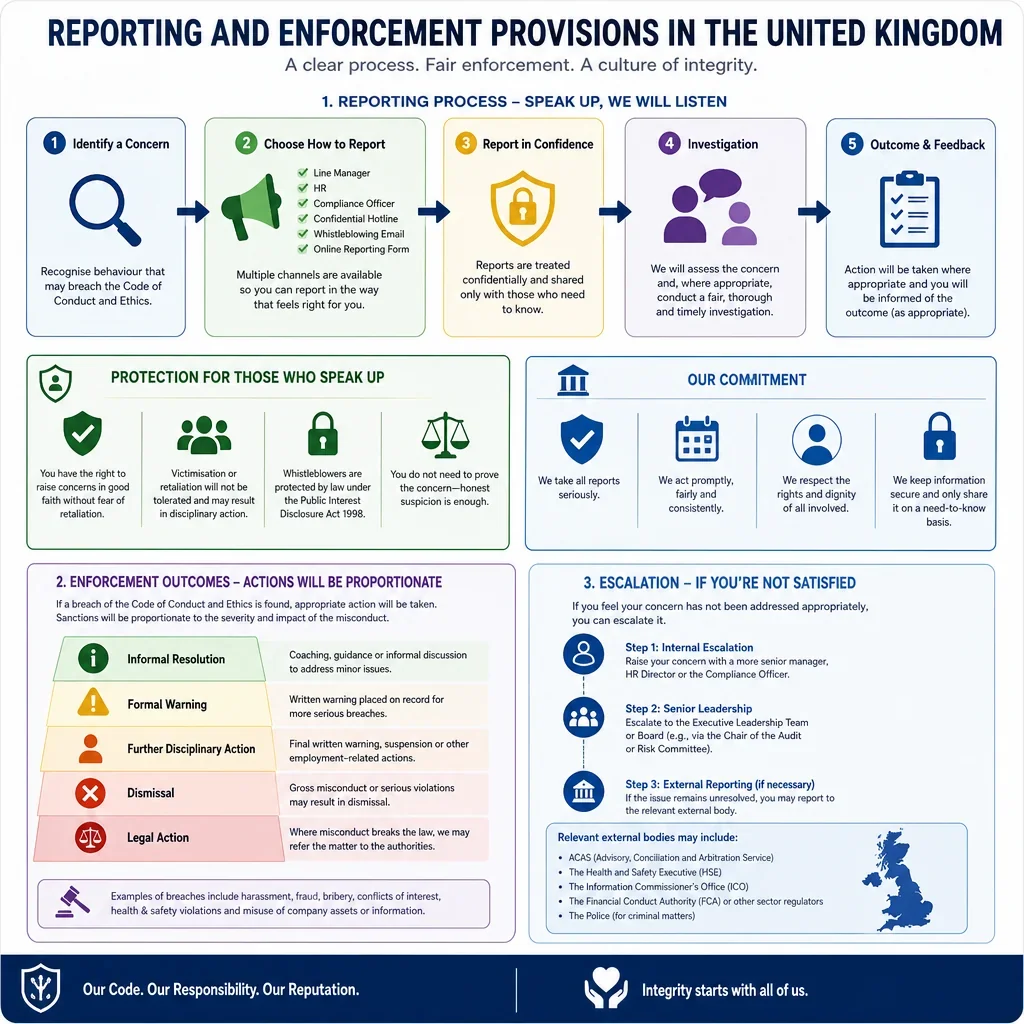
This Code of Conduct and Ethics includes a detailed step-by-step guide on how employees can report concerns, including initial contact, documentation requirements, and follow-up processes to ensure confidentiality and timely investigation as the whistleblowing reporting procedures. Protected disclosures under the Public Interest Disclosure Act 1998 (PIDA) are encouraged and protected, covering disclosures of criminal offences, failures to comply with legal obligations, miscarriages of justice, dangers to health and safety or the environment, and deliberate concealment of any of these.
Confidential and, where requested, anonymous reporting options shall be enabled for whistleblowers under the procedures, with no detriment for making a protected disclosure.
Employees shall use an internal hotline, email to the compliance officer, or an online reporting portal as designated channels for reporting concerns. External disclosures to prescribed persons or in the public interest may be protected under PIDA where internal channels are not appropriate.
This Code of Conduct and Ethics explicitly includes a non-retaliation policy to protect reporters from any detriment, victimisation, or detriment, with breaches leading to disciplinary action. This aligns with protections under the Public Interest Disclosure Act 1998 and the Employment Rights Act 1996.
Criminal activity, health and safety violations, breach of legal obligations, and other specified matters shall be qualifying disclosures for whistleblower protection under PIDA.
Tech Innovations Ltd shall require mandatory training for employees on whistleblowing procedures, including rights and protections under PIDA.
This Code of Conduct and Ethics includes provisions for protecting whistleblowers who report potential breaches of the Code of Conduct and Ethics, with independent investigation where appropriate.
18INVESTIGATIONS AND DISCIPLINARY ACTIONS
The HR Director or a designated senior manager authorised by the board shall be authorised to initiate an investigation into a potential breach of this Code of Conduct and Ethics.
An investigation committee for breaches of this Code of Conduct and Ethics shall include an HR representative, legal counsel, and senior management.
Investigations should be completed within 30 working days from initiation, unless exceptional circumstances require an extension approved by senior management.
Employees under investigation for breaches of this Code of Conduct and Ethics shall be allowed to be accompanied by a representative during interviews, in accordance with the Acas code of practice on disciplinary and grievance procedures.
Potential outcomes for breaches of this Code of Conduct and Ethics shall include a verbal warning, a written warning, a performance improvement plan, demotion, or dismissal, applied fairly and consistently.
A formal appeal process shall be included for disciplinary decisions related to breaches of this Code of Conduct and Ethics, in line with Acas guidance and employment law best practices.
All records must be securely stored in a confidential HR database for a minimum of 6 years, in compliance with UK data protection laws, and access limited to authorised personnel only as the policy for keeping records of investigations and disciplinary actions under this Code of Conduct and Ethics.
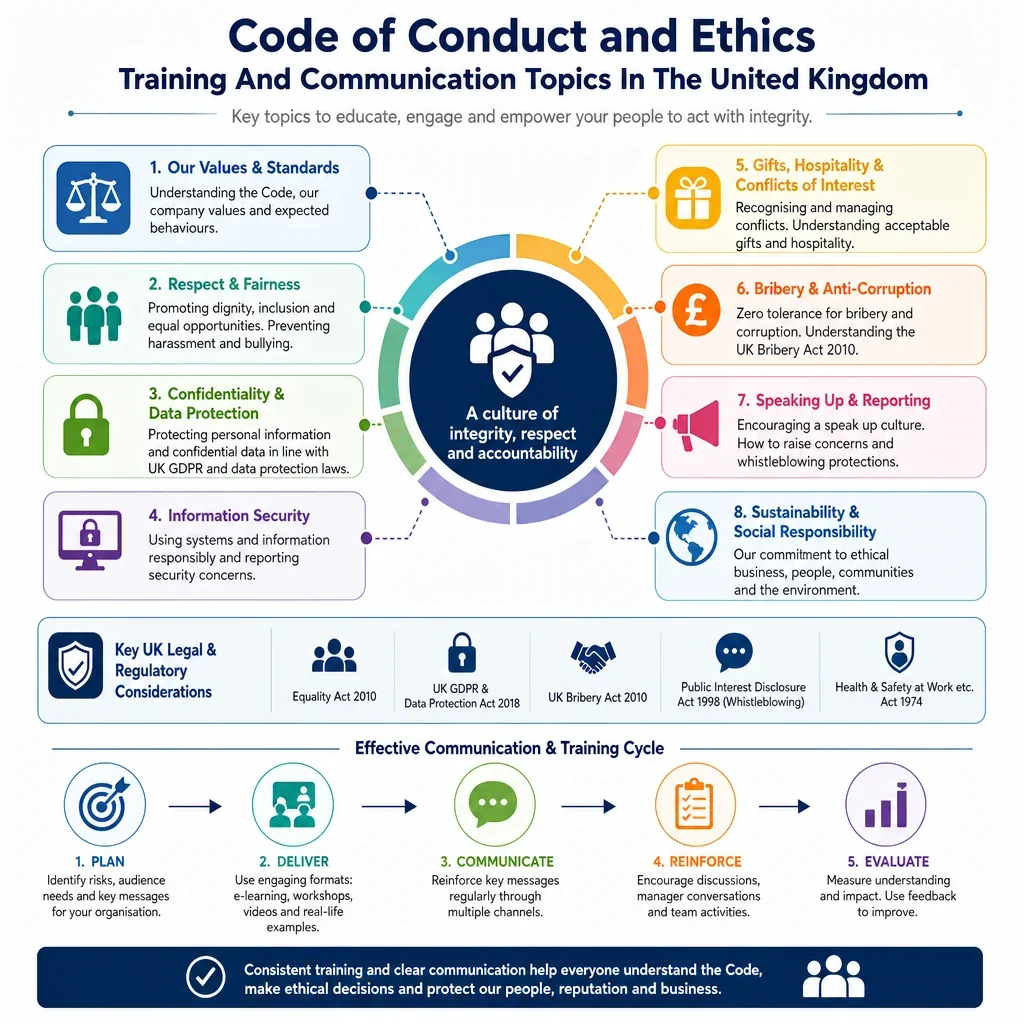
19TRAINING AND AWARENESS
Ethics training shall be mandatory for all personnel.
Compliance training shall be mandatory for all personnel.
The mandatory training programs shall occur annually for all employees and shall be mandatory upon hiring for new personnel.
The mandatory ethics and compliance training shall target all employees, senior management, and high-risk roles.
The delivery method for the mandatory training shall be a combination of online modules for accessibility and in-person workshops for senior management.
Each mandatory training session shall last 4 hours.
Assessments shall be included to measure the effectiveness of the mandatory training programs.
Key topics to be covered in the mandatory ethics and compliance training include understanding ethical decision-making, UK regulatory compliance requirements, anti-bribery and corruption policies, data protection under GDPR, and reporting mechanisms for ethical concerns.
Failure to complete the mandatory training shall result in a written warning and retraining.
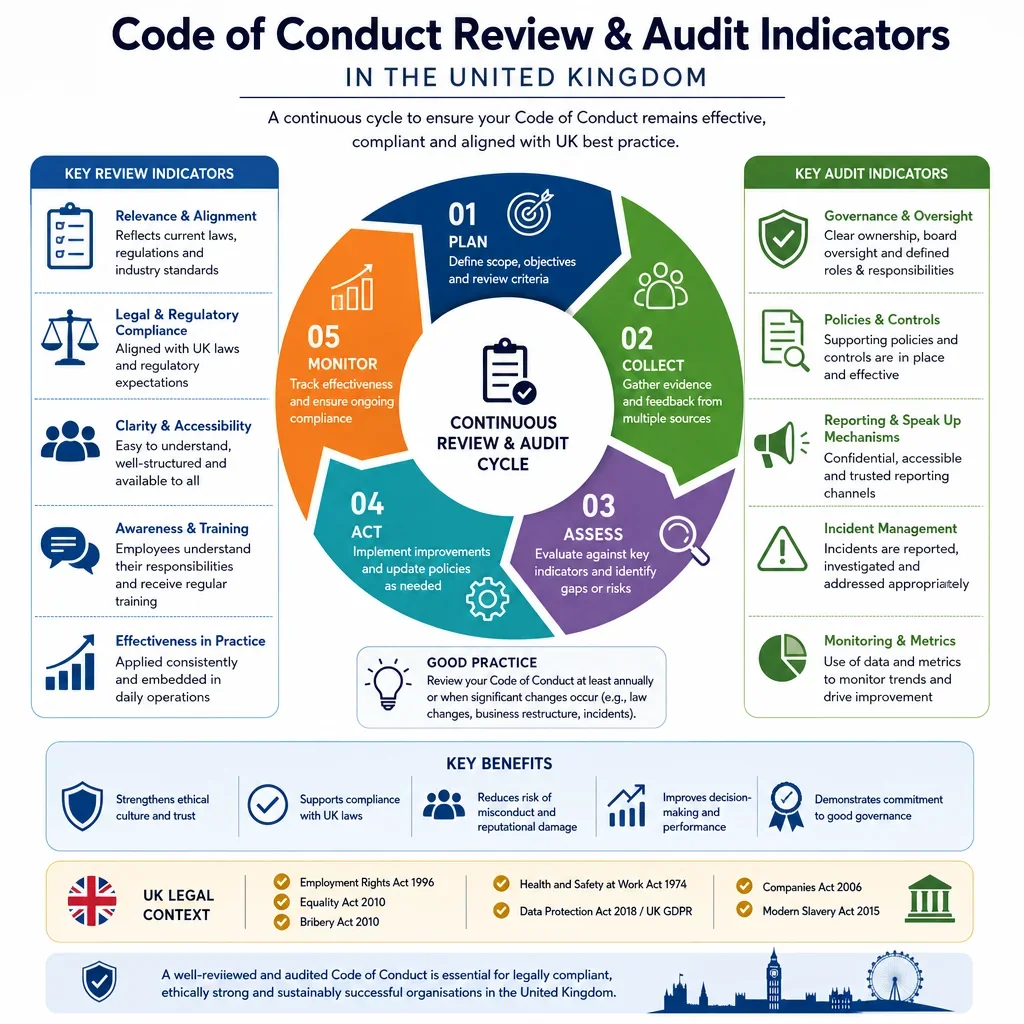
20MONITORING AND REVIEW
The Compliance and Ethics Department is designated as responsible for monitoring compliance with this Code of Conduct and Ethics.
The monitoring officer shall use regular audits, employee reporting mechanisms, and performance reviews as methods for ensuring compliance with this Code of Conduct and Ethics.
This Code of Conduct and Ethics shall be reviewed every 12 months for updates and effectiveness.
The next review of this Code of Conduct and Ethics shall occur on 2025-01-01.
Significant legal changes, compliance incidents, and stakeholder feedback shall serve as triggers for additional reviews of this Code of Conduct and Ethics beyond the regular schedule.
Updates to this Code of Conduct and Ethics will be drafted by the Compliance and Ethics Department, reviewed by senior management and legal counsel, approved by the Board of Directors, and then communicated to all employees via email and updated on the company intranet.
21IMPLEMENTATION AND RESPONSIBILITIES
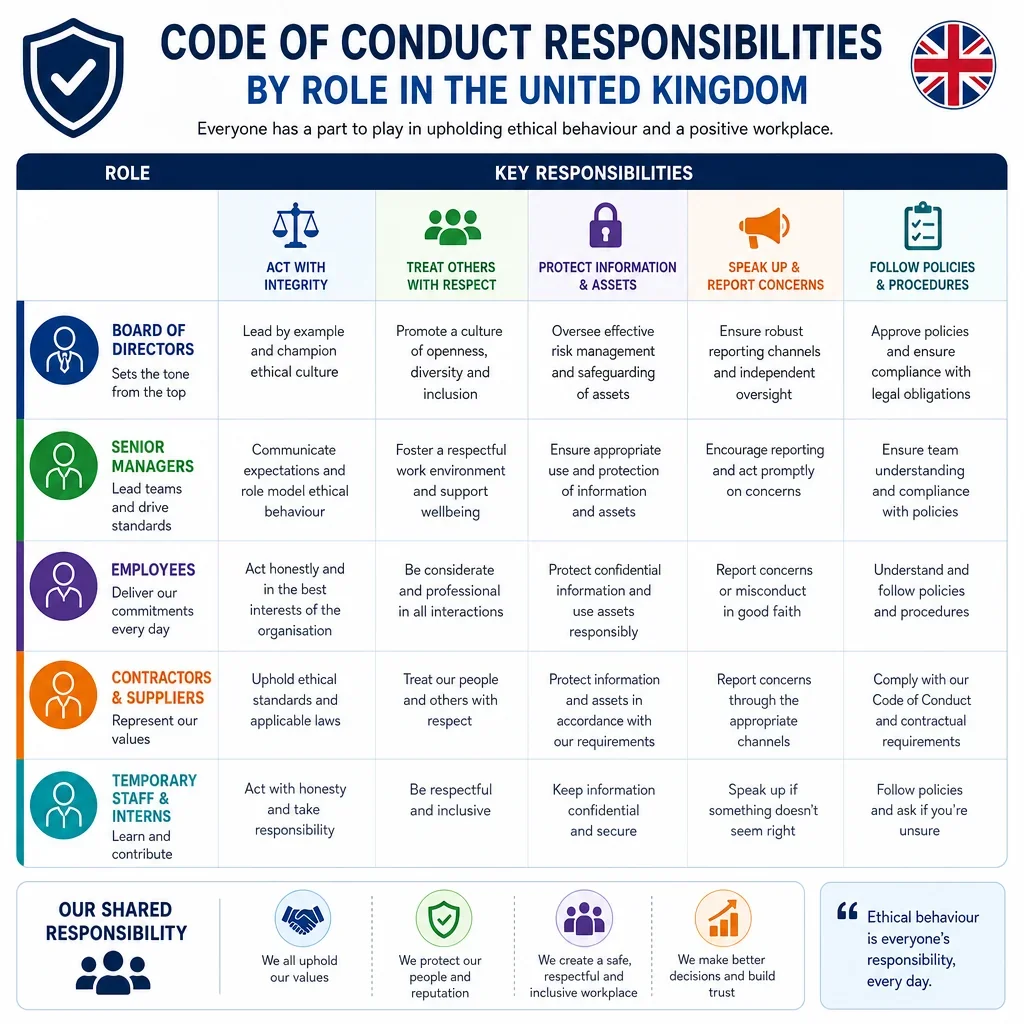
The Board of Directors is responsible for overseeing the implementation of this Code of Conduct and Ethics, setting the tone from the top, approving related policies, and ensuring that adequate resources are provided for effective compliance. This aligns with the UK Corporate Governance Code principles on board leadership and company purpose.
Managers and supervisors are responsible for ensuring that their teams understand and comply with this Code, leading by example, providing guidance on ethical issues, conducting risk assessments within their areas of responsibility, and promptly addressing any reported concerns.
All employees are responsible for familiarising themselves with this Code, applying its principles in their daily work, completing required training, and reporting any suspected breaches or concerns in accordance with the whistleblowing provisions.
The company shall conduct annual risk assessments for ethics and compliance matters, covering areas such as bribery, data protection, modern slavery, conflicts of interest, and other key risks identified. These assessments shall inform the development of mitigation measures, training priorities, and policy updates, with findings reported to the Board.
A communication plan shall be implemented to ensure this Code and related policies are effectively disseminated to all relevant parties. This includes distribution at induction, annual reminders, updates via email and the company intranet, and targeted communications for high-risk areas. Acknowledgment of the Code shall be required upon commencement of employment and at least annually thereafter.
The Compliance Officer shall maintain oversight of implementation, monitor effectiveness through audits and metrics, and report periodically to the Board on compliance matters.
22CORPORATE SOCIAL RESPONSIBILITY
Tech Innovations Ltd is committed to corporate social responsibility (CSR) as an integral part of its business operations, recognising its responsibilities to stakeholders, the community, and the environment beyond strict legal compliance.
The company shall integrate CSR considerations into decision-making processes, including ethical sourcing, community engagement, charitable activities, and support for diversity and inclusion initiatives.
Tech Innovations Ltd shall engage with local communities through volunteering programmes, educational outreach in technology and digital skills, and partnerships with relevant charities, with activities reported annually to the Board.
Progress on CSR objectives shall be monitored through key performance indicators such as community investment amounts, employee volunteering hours, and stakeholder feedback surveys, with results included in annual reporting where appropriate.
This CSR commitment aligns with the UK Corporate Governance Code, the Companies Act 2006 (section 172) duty to promote the success of the company having regard to stakeholders, and relevant international standards such as the UN Sustainable Development Goals.
23ACKNOWLEDGMENT AND AGREEMENT
The individual acknowledges that they have received this Code of Conduct and Ethics.
The individual acknowledges that they understand the provisions of this Code of Conduct and Ethics.
The individual commits to abiding by the provisions of this Code of Conduct and Ethics.
The acknowledgment shall be provided by both electronic signature and physical signature.
This Code of Conduct and Ethics forms part of the employee\’s contract of employment (or terms of engagement for non-employees). Breaches may result in disciplinary action up to and including dismissal. Employees are required to re-acknowledge this Code annually or upon any material updates, with records maintained by HR. Failure to re-acknowledge may result in suspension of certain privileges or other appropriate measures in line with UK employment law best practices.
The date when the individual provides their acknowledgment shall be recorded.
24CONTACT INFORMATION
The ethics officer designated for the organization is Dr. Emily Carter.
The professional email address for the ethics officer is emily.carter@company.co.uk.
The direct phone number for the ethics officer is +44 20 1234 5678.
The lead for the compliance team is Mr. James Patel.
The professional email address for the compliance team is compliance@company.co.uk.
The contact phone number for the compliance team is +44 20 8765 4321.
The telephone number for the external reporting hotline available in the UK is 0800 123 4567.
Anonymous reporting shall be enabled through the hotline and contact points.
The reporting hotline has 24/7 availability.
25GOVERNING LAW
This Code of Conduct and Ethics shall be governed by and construed in accordance with the laws of England and Wales.
26SIGNATURE SECTION
I have read, understood, and agree to comply with the terms of this Code of Conduct and Ethics.
Signed: _______________________________ Date: ________________
Print Name: _______________________________
Position: _______________________________
This example shows approximately 70% of a typical document and is provided for illustrative purposes only. The remaining content has been omitted.
Every document generated by Docaro is tailored to your specific circumstances, jurisdiction and the information you provide. The completed document includes all applicable clauses and provisions required for your situation.
To generate the full, personalised document, answer a short series of questions and your document will be created instantly.
Useful Resources When Considering a Code of Conduct and Ethics in the United Kingdom
United Kingdom Reference Legislation
Code of Conduct and Ethics FAQs
Document Generation FAQs
Related Articles