AI Generated British Settlement Agreement
PDF & Word - 2026 Updated
Docaro Pricing
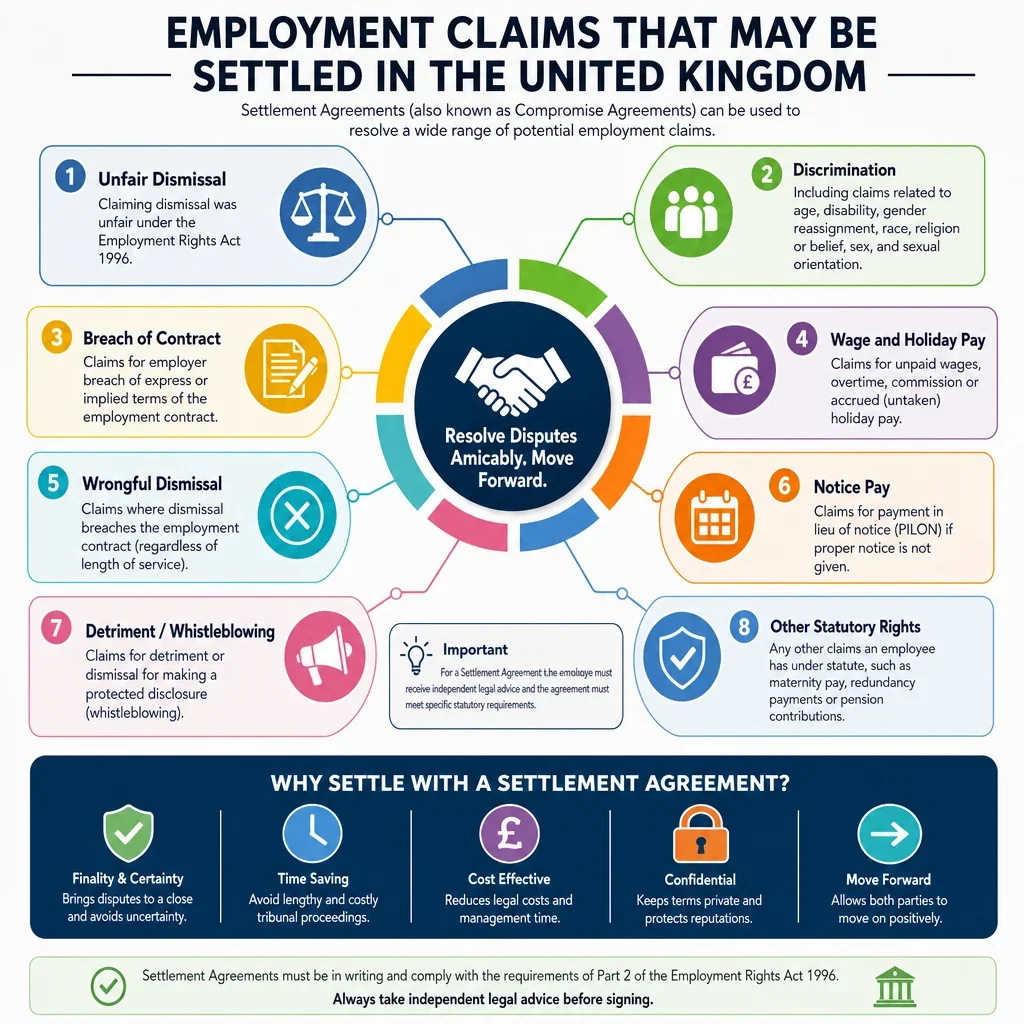
When do you need a Settlement Agreement in the United Kingdom?
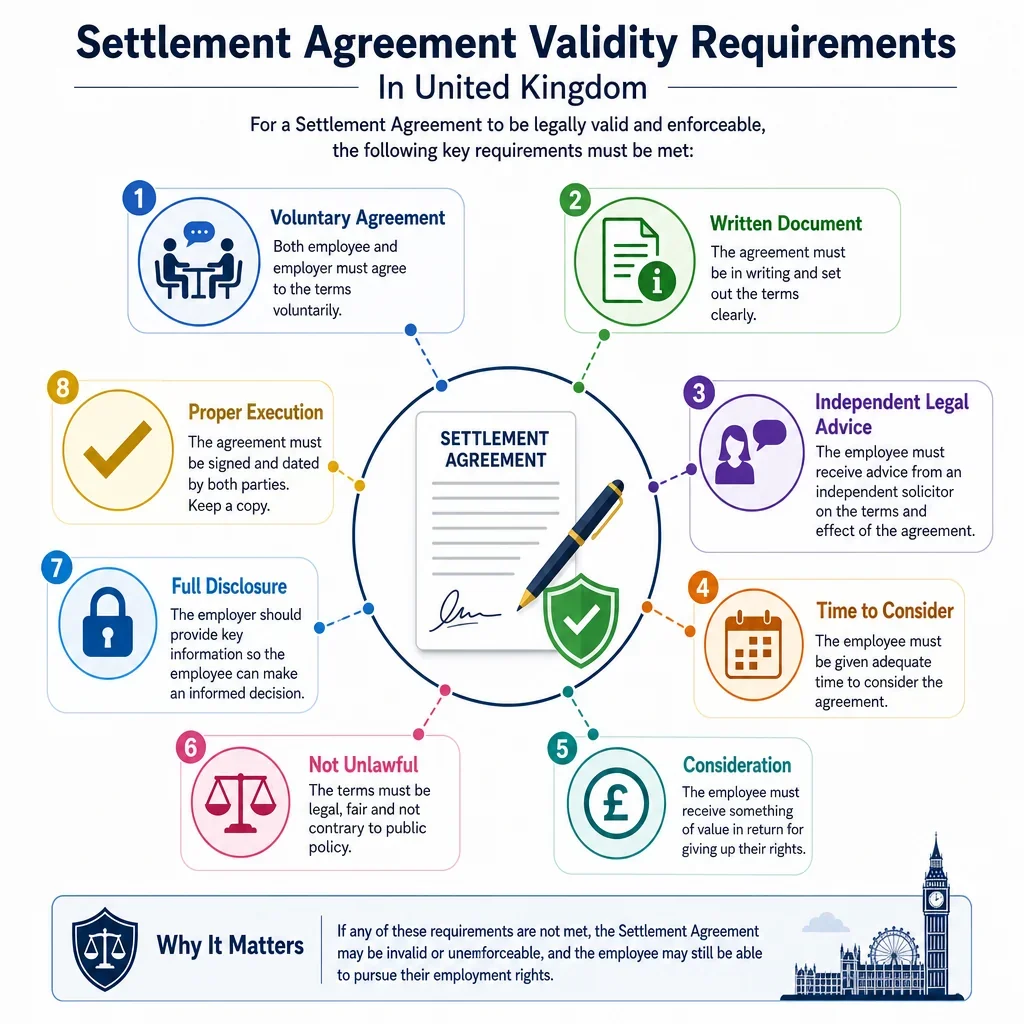
British Legal Rules for a Settlement Agreement
Using the wrong type or structure of settlement agreement can inadvertently waive statutory rights or fail to provide adequate protection.
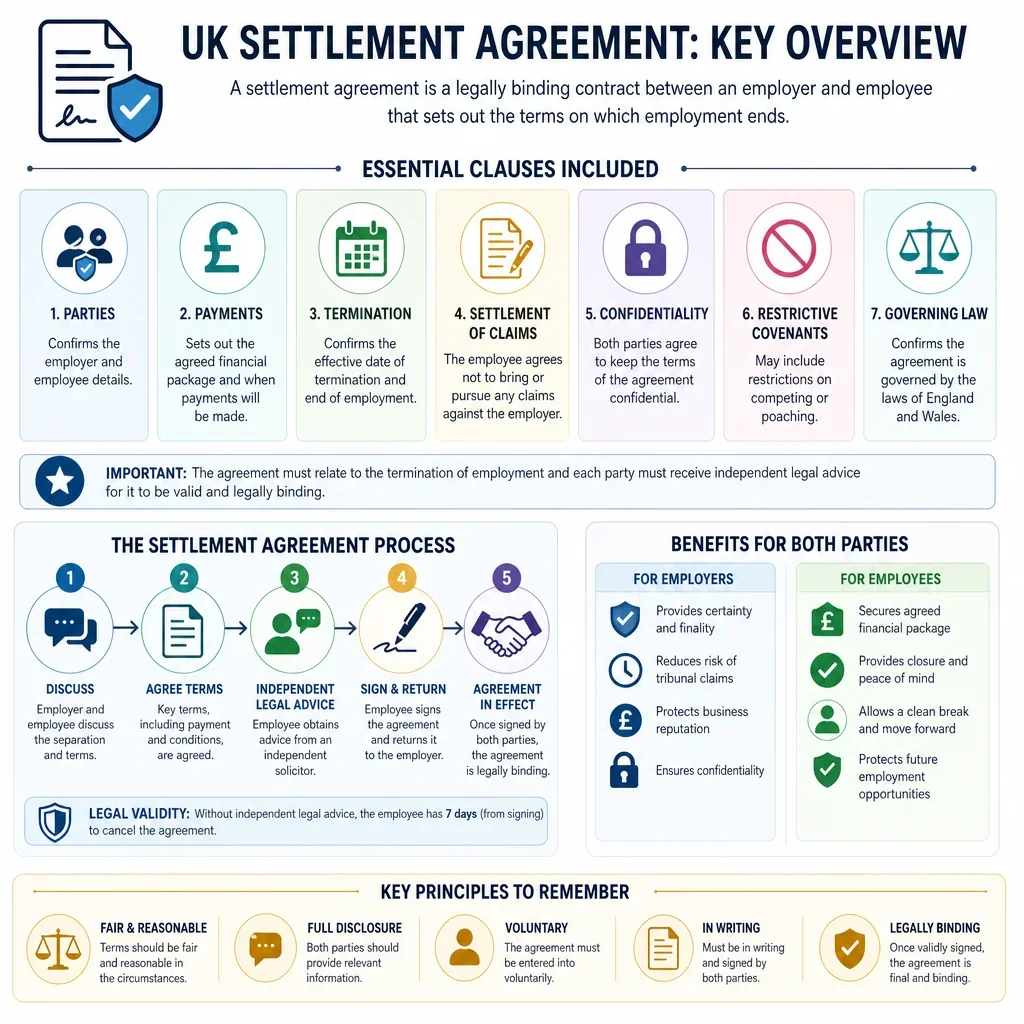
What a Proper Settlement Agreement Should Include
- Parties InvolvedClearly identify the employee and employer entering the agreement.
- Payment DetailsSpecify the exact amount of compensation and how it will be paid.
- What You're Giving UpList the rights or claims you're waiving in exchange for the settlement.
- ConfidentialityAgree to keep the agreement and its details private.
- No Bad-Mouthing ClausePromise not to make negative comments about each other.
- Return of Company ItemsCommit to returning any company property, like documents or equipment.
- Independent Legal AdviceConfirm that you've received advice from a qualified lawyer before signing.
- Signatures and DatesInclude spaces for both parties to sign and date the document.
Generate Your Document in 4 Easy Steps
Why Use Docaro?
 United Kingdom
Free Example Settlement Agreement Template
Below is a free template example of a Settlement Agreement for use in the United Kingdom generated by our AI model.
The clauses in your actual Settlement Agreement will vary from this example as they will be entirely bespoke to your requirements as set out in the questionnaire you complete.
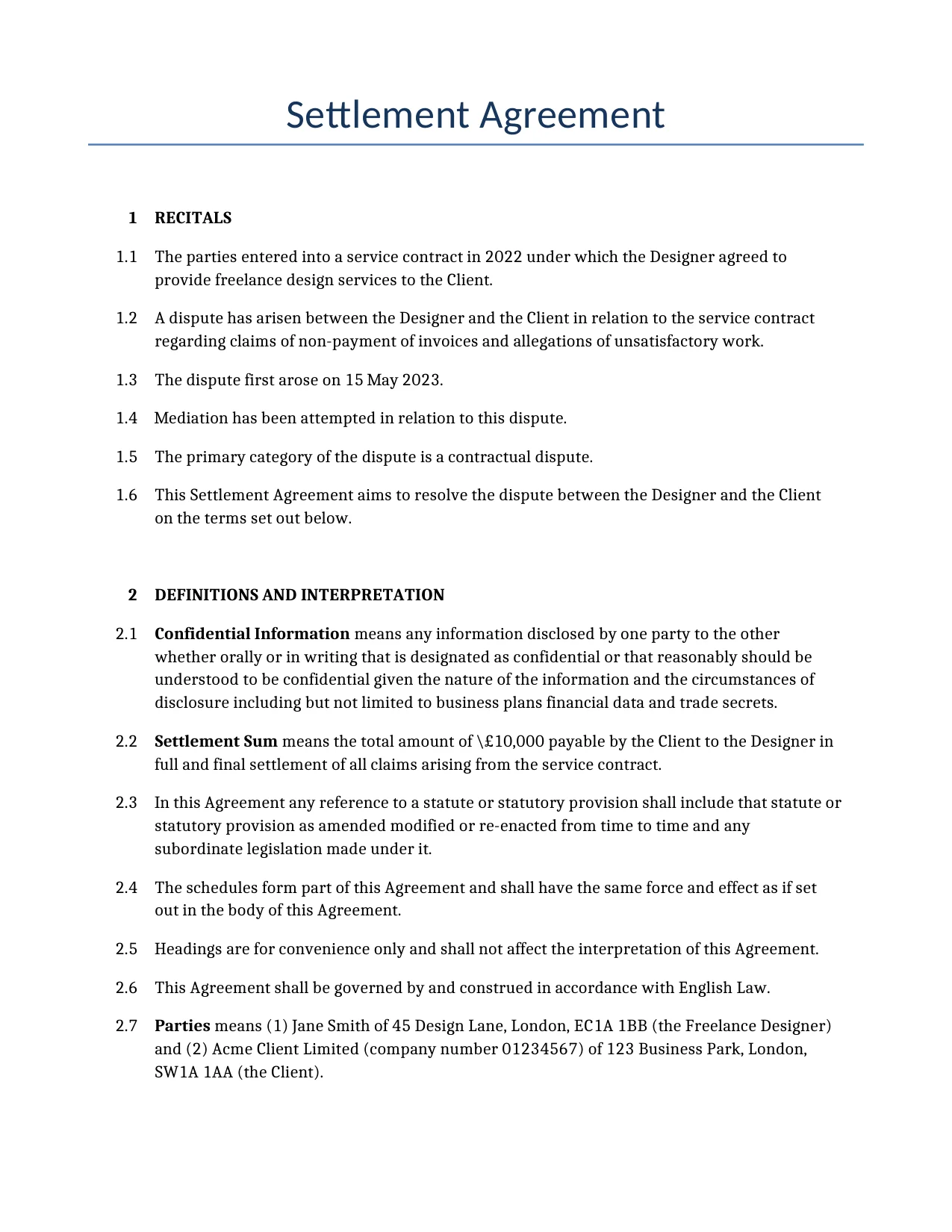
Settlement Agreement
1RECITALS
The parties entered into a service contract in 2022 under which the Designer agreed to provide freelance design services to the Client.
A dispute has arisen between the Designer and the Client in relation to the service contract regarding claims of non-payment of invoices and allegations of unsatisfactory work.
The dispute first arose on 15 May 2023.
Mediation has been attempted in relation to this dispute.
The primary category of the dispute is a contractual dispute.
This Settlement Agreement aims to resolve the dispute between the Designer and the Client on the terms set out below.
2DEFINITIONS AND INTERPRETATION
Confidential Information means any information disclosed by one party to the other whether orally or in writing that is designated as confidential or that reasonably should be understood to be confidential given the nature of the information and the circumstances of disclosure including but not limited to business plans financial data and trade secrets.
Settlement Sum means the total amount of \£10,000 payable by the Client to the Designer in full and final settlement of all claims arising from the service contract.
In this Agreement any reference to a statute or statutory provision shall include that statute or statutory provision as amended modified or re-enacted from time to time and any subordinate legislation made under it.
The schedules form part of this Agreement and shall have the same force and effect as if set out in the body of this Agreement.
Headings are for convenience only and shall not affect the interpretation of this Agreement.
This Agreement shall be governed by and construed in accordance with English Law.
Parties means (1) Jane Smith of 45 Design Lane, London, EC1A 1BB (the Freelance Designer) and (2) Acme Client Limited (company number 01234567) of 123 Business Park, London, SW1A 1AA (the Client).
3AGREEMENT TO SETTLE
The parties agree to settle the dispute without further litigation on the terms set out in this Agreement.
The parties intend to resolve the dispute amicably to avoid the costs and uncertainties of court proceedings and to maintain a positive relationship moving forward.
The date of this Settlement Agreement is 15 October 2023.
This Agreement shall become effective on 15 October 2023.
This Agreement represents a full and final settlement of all claims related to the dispute.
4TERMS OF PAYMENT
The Settlement Sum shall be the total monetary amount of \£10,000.
The Settlement Sum shall be paid by bank transfer.
The payment shall be made to the bank account with Account Name Jane Smith Bank Barclays Sort Code 20-12-34 and Account Number 12345678.
The Settlement Sum shall be paid in instalments in accordance with the schedule set out in the Schedules section with the final payment to be completed by 30 June 2024.
Interest shall accrue on any late payments at the rate of 8 per cent per annum above the Bank of England base rate from time to time.
The due date for payment of the Settlement Sum (or relevant instalment) is as set out in the payment schedule.
5RELEASE OF CLAIMS
Each party releases the other from all known claims and unknown claims arising out of or in connection with the dispute.
The release of claims shall become effective on the date of this Agreement.
Each party confirms that it fully understands the implications of the release of claims under this Agreement.
For the avoidance of doubt the release in this clause does not apply to any claims arising from fraud dishonesty or breach of this Settlement Agreement itself.
6CONFIDENTIALITY
The parties shall keep the terms of this Agreement and all related information confidential.
Disclosure of the settlement terms is permitted if required by law or court order.
Disclosure of confidential information is permitted to legal and financial advisors.
The remedies for breach of this confidentiality section shall include both injunctive relief and damages.
The confidentiality obligations in this clause shall continue for a period of 2 years after the date of this Agreement.
7NON-DISPARAGEMENT
The non-disparagement obligation shall apply mutually to both parties.
The non-disparagement prohibition shall cover public and private statements.
The non-disparagement obligation shall last in perpetuity.
The non-disparagement obligation shall cover officers and directors employees and agents.
The remedies for breach of the non-disparagement clause shall include injunctive relief and damages.
8REPRESENTATIONS AND WARRANTIES
Each party represents and warrants that it has the full legal authority to enter into this Settlement Agreement.
Each party represents and warrants that entering into this Settlement Agreement will not breach any other existing agreements or obligations.
There are no pending legal claims proceedings or disputes involving either party related to the matters settled in this Agreement.
The parties warrant that this is not an employment-related dispute and therefore the settlement does not require compliance with the Employment Rights Act 1996 the Equality Act 2010 or the ACAS Code of Practice on Settlement Agreements.
Each party represents and warrants that there are no undisclosed liabilities debts or obligations related to the settled matters that could affect the other party.
Entering into this Settlement Agreement does not require any regulatory approvals or notifications under applicable law.
Each party represents and warrants that all information provided for this Settlement Agreement is true accurate and complete to the best of its knowledge.
9INDEMNITIES
Each party shall indemnify the other against losses arising from breaches of this Agreement up to a maximum cap of \£50,000.
10TAXATION
The Settlement Sum is exclusive of VAT. If VAT is properly chargeable on the Settlement Sum the Designer shall provide a valid VAT invoice and the Client shall pay the VAT in addition to the Settlement Sum.
Each party shall be responsible for its own tax liabilities arising from the Settlement Sum.
Each party shall indemnify the other against any tax-related claims demands or liabilities arising from its failure to account for tax on the Settlement Sum.
11NO ADMISSION OF LIABILITY
This Settlement Agreement is entered into without any admission of liability by either party. Neither the terms of this Agreement nor its negotiation or performance shall be construed as an admission of liability by the Client or the Designer in relation to the dispute or otherwise.
12GOVERNING LAW
This Agreement and any dispute or claim arising out of or in connection with it or its subject matter or formation (including non-contractual disputes or claims) shall be governed by and construed in accordance with the laws of England and Wales.
Nothing in this Agreement is intended to limit or exclude any liability for death or personal injury caused by negligence.
The parties irrevocably agree that the courts of England and Wales shall have exclusive jurisdiction over any dispute or claim that arises out of or in connection with this Agreement or its subject matter or formation (including non-contractual disputes or claims).
13DISPUTE RESOLUTION
The parties shall first attempt to resolve any dispute arising out of or in connection with this Agreement by negotiation.
If negotiation fails the parties shall attempt to resolve the dispute by mediation before resorting to litigation.
Any dispute resolution proceedings shall be governed by the laws of England and Wales.
14ENTIRE AGREEMENT
This Agreement constitutes the entire understanding between the parties and supersedes all prior agreements negotiations representations or understandings whether oral or in writing relating to the subject matter of this Agreement.
15SEVERABILITY
If any provision of this Agreement is held to be invalid or unenforceable the remaining provisions shall continue in full force and effect.
16WAIVER
No waiver of any breach of this Agreement shall be effective unless it is in writing.
A single waiver of a breach shall not imply or allow future waivers without further written agreement.
The waiver clause shall apply to both parties.
17ASSIGNMENT
Neither party may assign its rights and obligations under this Agreement to third parties without the prior written consent of the other party.
This Agreement shall bind the successors and assignees of the parties if assignment is made in accordance with this clause.
18NOTICES
Any notice under this Agreement shall be in writing and may be served by email or post.
Notices shall be sent to the following addresses: for the Designer jane.smith@design.com or 45 Design Lane London EC1A 1BB; for the Client legal@acmeclient.co.uk or 123 Business Park London SW1A 1AA.
Notices sent by post shall be deemed served two business days after posting.
Notices sent by email shall be deemed served upon transmission provided no bounce-back is received.
Any change to the notice addresses or methods shall require 14 days' notice.
19COUNTERPARTS
This Agreement may be executed in any number of counterparts each of which when executed and delivered shall constitute a duplicate original but all counterparts together shall constitute one agreement.
20THIRD PARTY RIGHTS
The parties agree to exclude the application of the Contracts (Rights of Third Parties) Act 1999 to this Agreement.
The parties may vary or rescind this Agreement without the consent of any third party.
21COSTS
Each party shall bear its own legal costs in relation to the preparation and execution of this Agreement. For the avoidance of doubt the Settlement Sum does not include any amount in respect of costs.
22SCHEDULES
The schedule detailing the payment plan is incorporated into and forms part of this Agreement.
Payment Schedule: Instalment 1 - \£2,500 due on 15 November 2023; Instalment 2 - \£2,500 due on 15 January 2024; Instalment 3 - \£2,500 due on 15 March 2024; Instalment 4 - \£2,500 due on 30 June 2024. The total of all instalments is \£10,000.
23EXECUTION
This Agreement is executed as a simple contract. If the parties wish to extend the limitation period they may execute this Agreement as a deed by amending this clause and ensuring the signatures are witnessed accordingly.
This Agreement complies with the general principles of English contract law. Each party confirms that it has received independent legal advice prior to signing this Agreement.
Signed by Jane Smith (Designer) ___________________________ Date: _______________
Signed by Acme Client Limited (Client) by its authorised signatory ___________________________ Date: _______________
This example shows approximately 70% of a typical document and is provided for illustrative purposes only. The remaining content has been omitted.
Every document generated by Docaro is tailored to your specific circumstances, jurisdiction and the information you provide. The completed document includes all applicable clauses and provisions required for your situation.
To generate the full, personalised document, answer a short series of questions and your document will be created instantly.
Useful Resources When Considering a Settlement Agreement in the United Kingdom
United Kingdom Reference Legislation
Settlement Agreement FAQs
Document Generation FAQs
Related Articles