Docaro

AI Generated British Section 13 Notice - 2026 Updated

A professional scene representing protection from harassment in the UK, showing an adult individual looking relieved and empowered while walking away from a concerned adult figure in an urban London street setting, with iconic UK landmarks like Big Ben in the background, symbolizing the relief provided by a Section 13 Notice against persistent harassment.
Easily create legally compliant Section 13 Notices for rent increase in the UK with the power of AI.
Free instant document creation.
Legally compliant agreements.
No signup required.
Generate your document for free.
Download PDF, Word and email for $4.99 USD.

Generate Your Section 13 Notice in 4 Easy Steps

1
Answer a Few Questions
Our AI guides you through the info required.
2
Generate Your Document
Docaro builds the document based on your requirements.
3
Review & Edit
Review your document and submit any further requested changes.
4
Download & Sign
Download your ready to sign document as a PDF, Word, Txt or HTML.

Why Use Our AI Section 13 Notice Generator?

Fast Generation
Quickly generate a comprehensive Section 13 Notice, eliminating the hassle and time associated with traditional document drafting.
Guided Process
Our user-friendly platform simplifies the document creation process, enabling you to complete agreements with just a few clicks.
Professionally Formatted Document
Your Section 13 Notice will be formatted to professional standards, including headings, clause numbers and structured layout. No further editing is required.
High Accuracy
Our AI ensures high accuracy by using advanced algorithms to craft agreements that perfectly cater to your specific requirements.
Compliance with British Law
Rest assured that all generated documents meet the latest legal standards and regulations of the United Kingdom, enhancing trust and reliability.
Cost-Effective
Save money by generating legally sound tenancy agreements without the need for expensive legal services or consultations.
Get Started for Free - No Sign Up Required
No payment or sign up is required to start generating your Section 13 Notice. Simply answer a few questions and a preview of your final document will be generated.
Looking to Generate a Section 13 Notice in a Different Country?
Choose a different country:

Compliance Legislation

Your AI Generated Section 13 Notice will be checked for compliance against the following legislation and regulations:
This Act governs assured and assured shorthold tenancies in England and Wales, including provisions for rent increases via Section 13 notices, which require landlords to give at least one month's notice for periodic tenancies.
Applies to regulated tenancies in England and Wales, regulating rent increases through notices of increase under Sections 45-48, requiring specific notice periods and fair rent determinations.
Regulates private residential tenancies in Scotland, with rent increase procedures outlined in Sections 42-44, requiring at least three months' notice and potential referral to rent officers.
Introduces the private residential tenancy in Scotland, specifying rent increase notice requirements under Section 22, including a minimum 12-week notice period and limits on increases.
Covers secure tenancies in social housing in England and Wales, with rent increase provisions under Section 124 requiring consultation and notice to tenants.
Applies to most tenancies in England and Wales, mandating service charge consultations that may affect rent increases, with implied requirements for proper notices.

Example Section 13 Notice

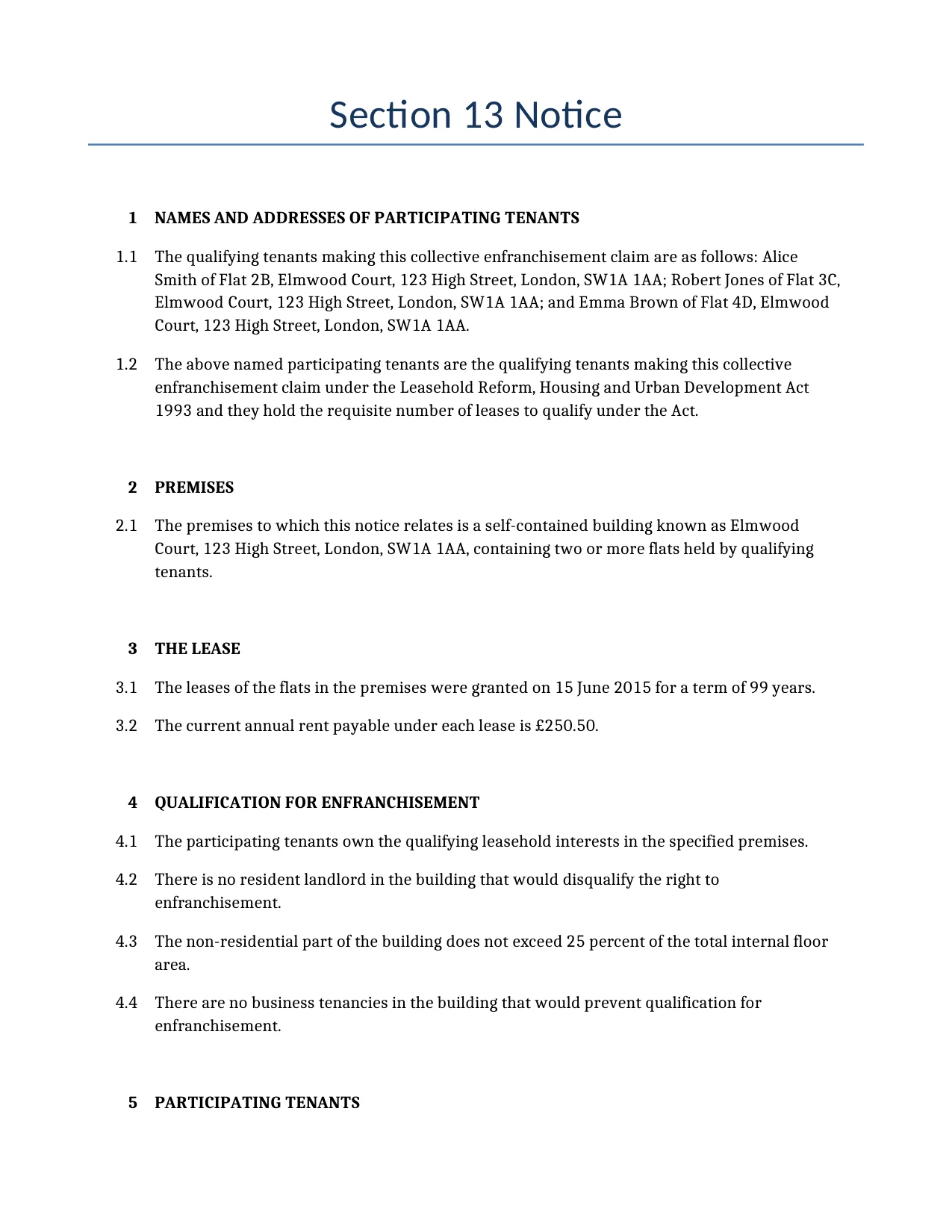
Below is an example of a Section 13 Notice generated by our AI model. The clauses in your Section 13 Notice will vary from this example as they will be entirely bespoke to your requirements as set out in the questionnaire you complete.
Page 1

What is a Section 13 Notice in the United Kingdom?

A Section 13 Notice under UK housing law refers to a specific notice served by landlords to initiate a rent increase for assured periodic tenancies, as outlined in the Housing Act 1988. This provision, primarily in Section 13, ensures that landlords cannot unilaterally raise rent without giving tenants proper notice, thereby protecting tenants from sudden hikes while allowing fair adjustments. The notice is crucial for periodic assured tenancies, which continue month-to-month or week-to-week after the fixed term ends, and it applies to both assured shorthold and assured tenancies.

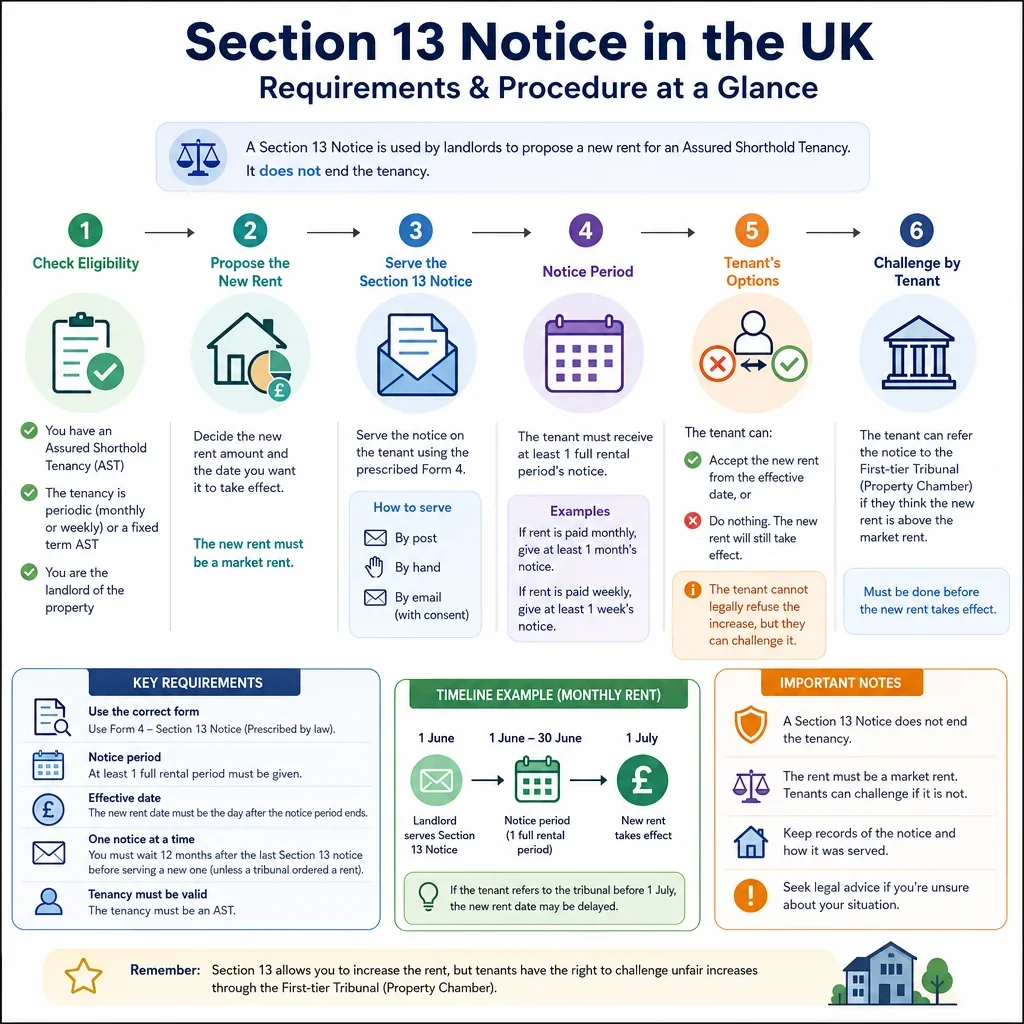
The primary purpose of a Section 13 Notice is to formalize rent increases in a transparent manner, requiring the landlord to propose a new rent amount and specify a start date, typically at least one month after service for monthly tenancies. If the tenant disagrees, they can challenge the increase through a tribunal, ensuring the proposed rent is market rate as per the Housing Act 1988 guidelines.

When should you use a Section 13 Notice?

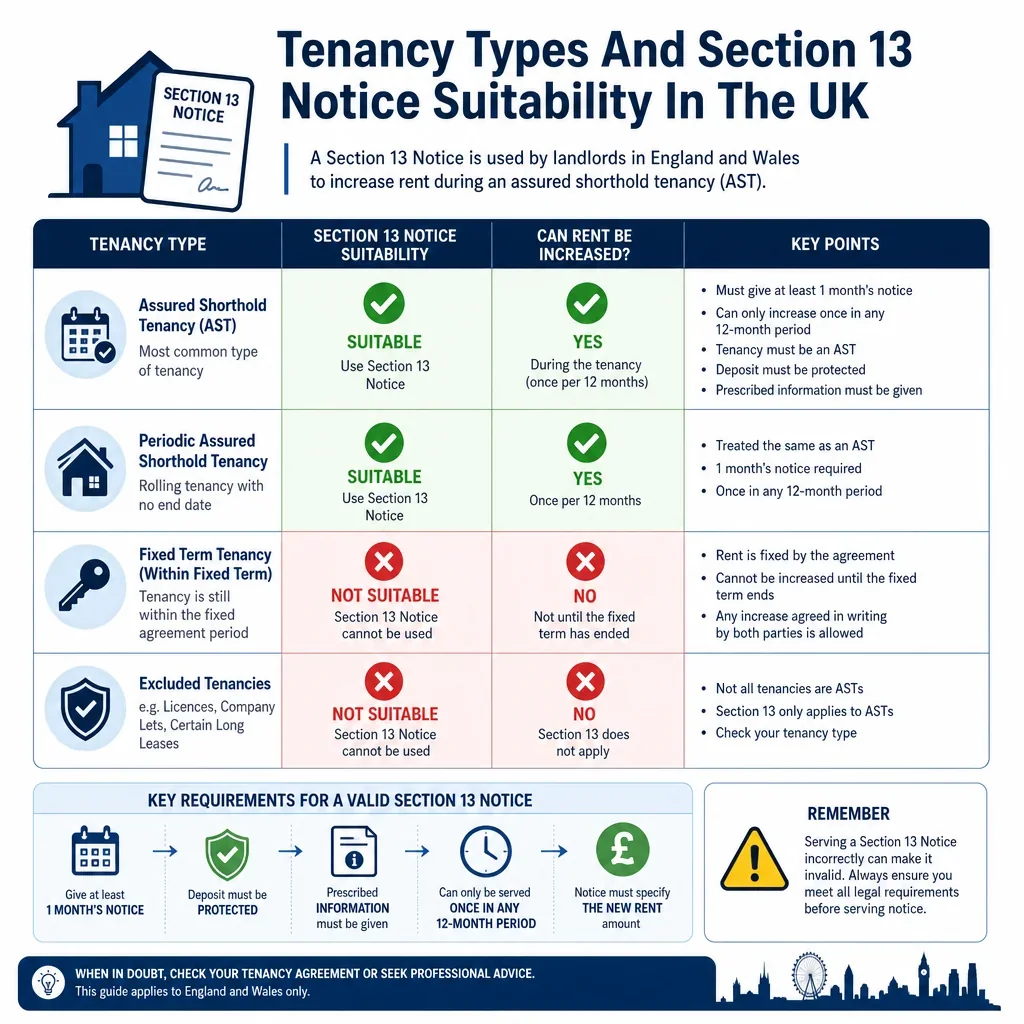
A Section 13 Notice is a crucial tool for landlords in the UK seeking to increase rent on assured shorthold tenancies (ASTs) after the fixed term ends, allowing for periodic tenancies where rent adjustments are needed. For instance, if market conditions change or costs rise, a landlord can propose a rent increase by serving this notice, giving the tenant at least one month's warning for monthly tenancies. This ensures compliance with the Housing Act 1988, and for more details on what is a Section 13 Notice UK guide, landlords should review official guidelines from the UK government at Gov.uk Assured Tenancies Guide.

However, a Section 13 Notice should not be used during a fixed-term tenancy, as rent can only be increased according to the terms in the original agreement, without needing statutory intervention. It is also inappropriate for other tenancy types like assured tenancies or regulated tenancies, where different procedures apply, such as negotiation or tribunal applications. Landlords must avoid using it in these cases to prevent legal challenges, and consulting resources like the Section 13 Notice UK guide helps clarify these boundaries.

Key exclusions for Section 13 Notices

A Section 13 Notice under the Housing Act 1988 is a vital tool for landlords in England and Wales to increase rent for assured shorthold tenancies (ASTs), but it cannot be used for social housing tenancies such as those managed by local authorities or housing associations. These exclusions apply because social rents are regulated under separate legislation like the Housing Act 1996, preventing landlords from unilaterally raising rents via a Section 13 notice. Attempting to do so could lead to legal challenges, invalidating the notice and exposing landlords to disputes over improper rent hikes.

Another key exclusion involves assured tenancies where the rent has been registered with a rent officer, as subsequent increases must follow the formal rent assessment committee process rather than a simple Section 13 notice. Additionally, post-possession proceedings, such as after a court has ordered eviction, render the notice ineffective since the tenancy relationship has fundamentally changed. Landlords ignoring these pitfalls risk court dismissals, wasted legal fees, and potential counterclaims from tenants, emphasizing the need for precise application of housing law.

For more detailed guidance on rent increase exclusions and tenancy types, refer to authoritative resources like the UK Government's housing guidance at GOV.UK Assured Tenancies Guide or Shelter's advice on rent increases for ASTs.

What are the key clauses in a Section 13 Notice?

A Section 13 Notice under the Housing Act 1988 is a crucial document for UK landlords seeking to increase rent for assured periodic tenancies without a break clause. Essential clauses include the proposed new rent amount, which must be clearly stated and justified as fair market value, and the effective date of the increase, typically at least one month from the notice date or aligned with the tenancy's rent period. Additionally, full tenant details such as name, address, and tenancy start date must be included to ensure the notice is properly addressed and valid.

The notice must also specify the landlord's details, including name and contact information, along with a landlord signature or that of an authorized agent to authenticate the document. For guidance on how to serve Section 13 Notice UK steps, refer to our detailed resource at this link. Always consult authoritative sources like the UK Government's housing guidance at Gov.uk Assured Tenancies Guide to ensure compliance with rent increase regulations.

"Precision in drafting Section 13 Notices under the Housing Act 1988 is essential; even minor deviations from the prescribed statutory wording can render the notice invalid, potentially delaying rent increases or leading to costly disputes," advises Dr. Elena Hargreaves, leading UK housing law specialist at the Institute of Housing Law.
UK legal document with gavel

What are the rights and obligations of landlords and tenants?

When a Section 13 Notice is issued under the Housing Act 1988 in the UK, landlords must provide tenants with at least one month's written notice to initiate a rent increase for assured shorthold tenancies. This notice serves as the primary mechanism for landlords to propose a new rent amount, ensuring transparency in the process. Failure to issue it correctly can render the increase invalid, protecting tenants from arbitrary hikes.

Tenants have the right to challenge a Section 13 rent increase by applying to the First-tier Tribunal (Property Chamber) within 28 days of the notice's effective date, allowing an independent review of the proposed rent's market fairness. Landlords are obligated to justify the increase based on comparable local rents, with the tribunal deciding if it's reasonable. This process ensures disputes are resolved equitably without immediate eviction threats.

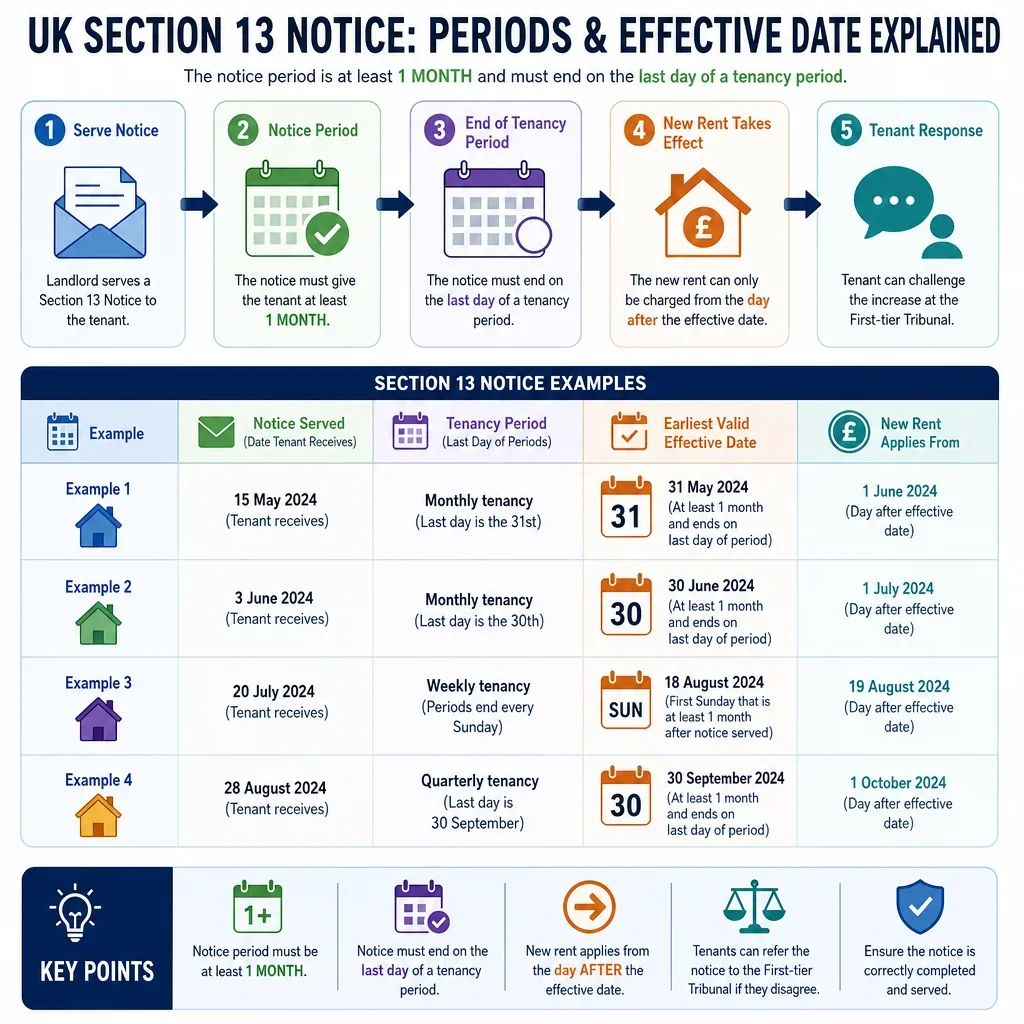
Timelines are critical: the rent increase takes effect one month after the notice is served, but tenants can request a tribunal hearing to pause or adjust it. Landlords must respond promptly to any challenge, typically within specified periods outlined in tribunal rules. For detailed guidance, refer to the official GOV.UK resource on rent increases or the First-tier Tribunal website for procedural timelines and forms.

Solicitor reviewing Section 13 notice

Are there recent or upcoming legal changes affecting Section 13 Notices?

The Renters Reform Bill in the UK is set to introduce significant changes to rental laws, particularly affecting Section 13 Notices, which landlords currently use to increase rents in periodic tenancies. Under the proposed reforms, these notices will be largely replaced by a new system where rent increases must align with market rates and follow a structured process through the First-tier Tribunal for disputes. This aims to provide greater protection for tenants against excessive hikes, with the bill's implementation expected in stages from late 2024, though delays have pushed back full enactment.

Regarding inflation-linked adjustments, there are no specific updates directly tying Section 13 Notices to inflation indices in current UK rental laws. Existing rules allow landlords to propose increases based on market conditions, but the Renters Reform Bill does not introduce automatic inflation adjustments, focusing instead on fairness and tribunal oversight. For the latest details, refer to the official government guidance on the Renters Reform Bill.

Landlords and tenants should monitor updates, as no immediate changes to Section 13 Notices are applicable until the bill passes, but preparatory steps like reviewing tenancy agreements are advisable. This overhaul is part of broader UK rental law reforms to enhance tenant rights in the private rented sector. Consult resources like the Shelter policy library for in-depth analysis.

British courtroom with legal notices

How can you get started with preparing a Section 13 Notice?

1
Check Tenancy Type
Verify the tenancy is assured shorthold (AST) and periodic. Ensure no fixed term remains, as Section 13 applies only to qualifying tenancies.
2
Draft the Notice
Use the correct Section 13 form or template. Specify rent increase amount, effective date (at least one month ahead), and property details. For avoiding errors, see /en-gb/a/section-13-notice-mistakes-avoid-uk.
3
Serve the Notice Correctly
Deliver via hand, post, or in-person with proof. For periodic tenancies, align with rent payment cycle. Retain evidence of service.
4
Prepare for Implementation
After one month, collect new rent. If tenant disputes, be ready for tribunal. Document all communications.

Section 13 Notice FAQs

A Section 13 Notice, under the Housing Act 1988, is a formal notice served by landlords in England and Wales to propose a rent increase for assured or assured shorthold tenancies when the fixed term has ended or the tenancy is periodic. It must give tenants at least one month's notice (or one clear renting period if longer) and cannot take effect within the first 12 months of the tenancy.

Document Generation FAQs

Docaro is an AI-powered legal document generator that helps you create fully formatted, legally sound contracts and agreements in minutes. Just answer a few guided questions and download your document instantly.
You Might Also Be Interested In
Residential Rental Agreement
Room Rental Agreement
House Share Agreement
End Of Tenancy Notice
Lodger Agreement

Related Articles

A photorealistic image of a concerned adult tenant in a modern UK apartment, looking out the window at an eviction notice on the door, symbolizing the need for a Section 13 Notice in housing tenancy situations. The scene captures the stress of rent increases and tenancy changes without showing any legal documents directly.
Discover what a Section 13 Notice is under UK tenancy laws, when landlords must serve it for rent increases, and how it protects tenants. Essential advice for UK property owners.
A photorealistic image of an adult professional landlord and tenant shaking hands in a modern UK apartment, symbolizing the agreement process in serving a Section 13 notice for rent increase, with subtle British elements like a Union Jack flag in the background, no children present.
Learn how to serve a Section 13 notice in the United Kingdom with this comprehensive step-by-step guide. Understand legal requirements, timelines, and best practices for landlords and tenants.
A photorealistic image of a frustrated adult landlord standing in an empty rental apartment, looking at a calendar on the wall, symbolizing the challenges and mistakes in the eviction process under housing laws, with natural light filtering through windows, no children present.
Discover the most common mistakes landlords make when issuing a Section 13 Notice for rent increases. Learn how to avoid pitfalls, ensure compliance, and protect your rights under UK housing law.