AI Generated British Commercial Lease Agreement
PDF & Word - 2026 Updated
Docaro Pricing
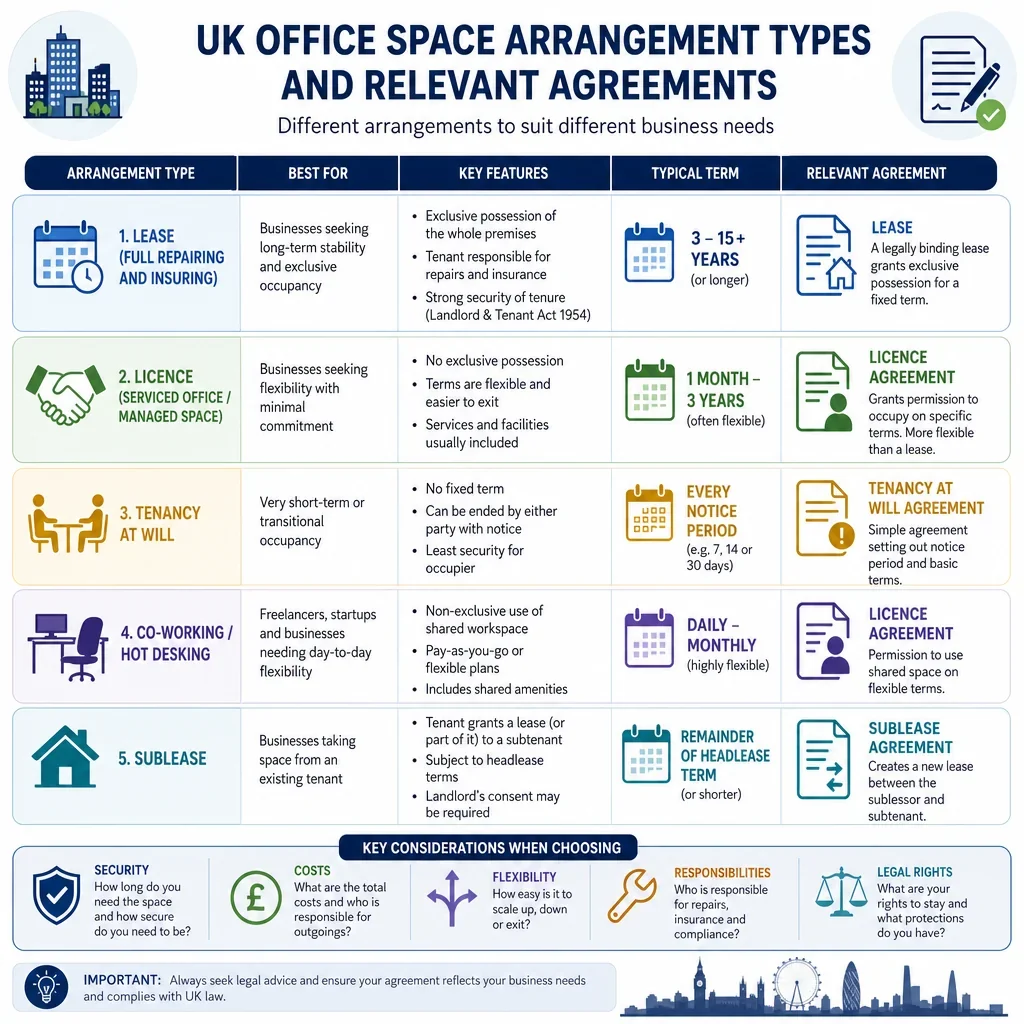
When Do You Need an Office Lease Agreement in the United Kingdom?
British Legal Rules for an Office Lease Agreement
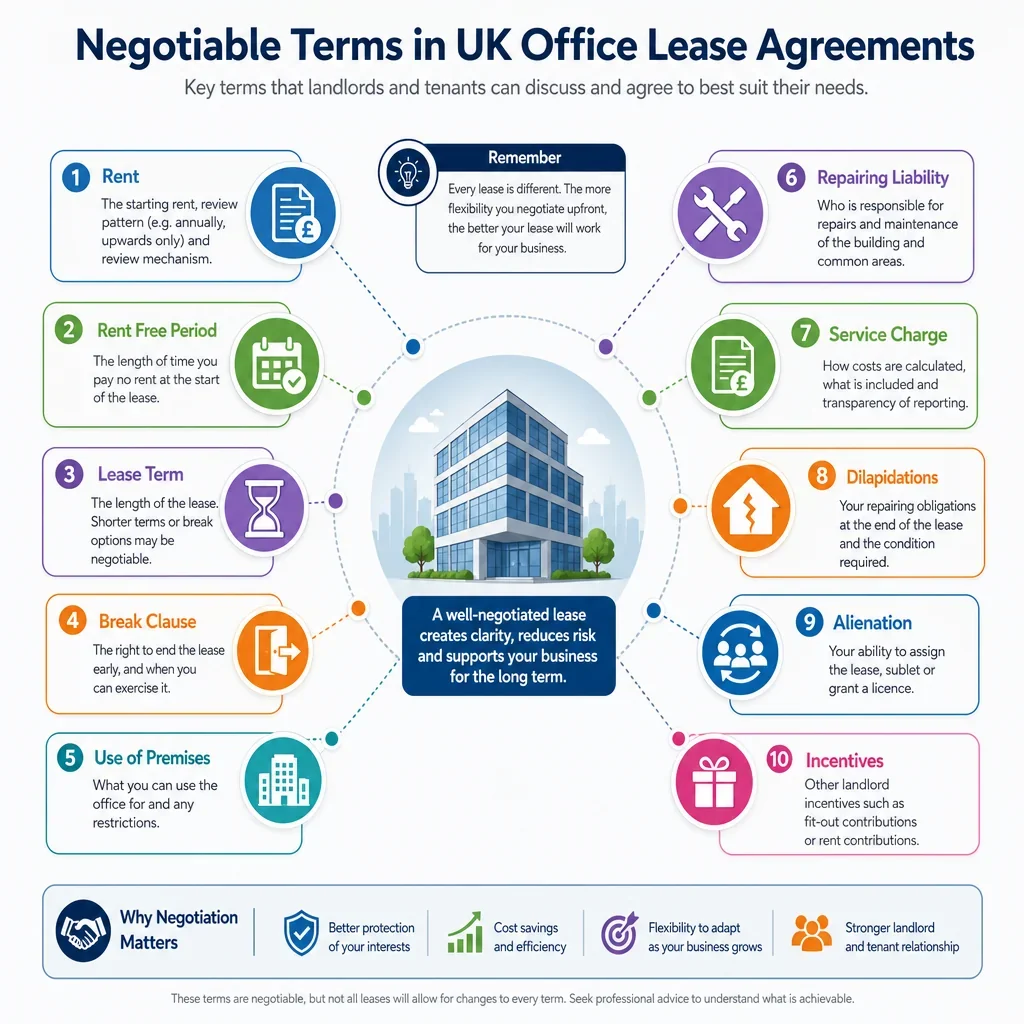
Using the wrong structure for an office space rental agreement can inadvertently create unintended leasehold rights or obligations under UK commercial property law.
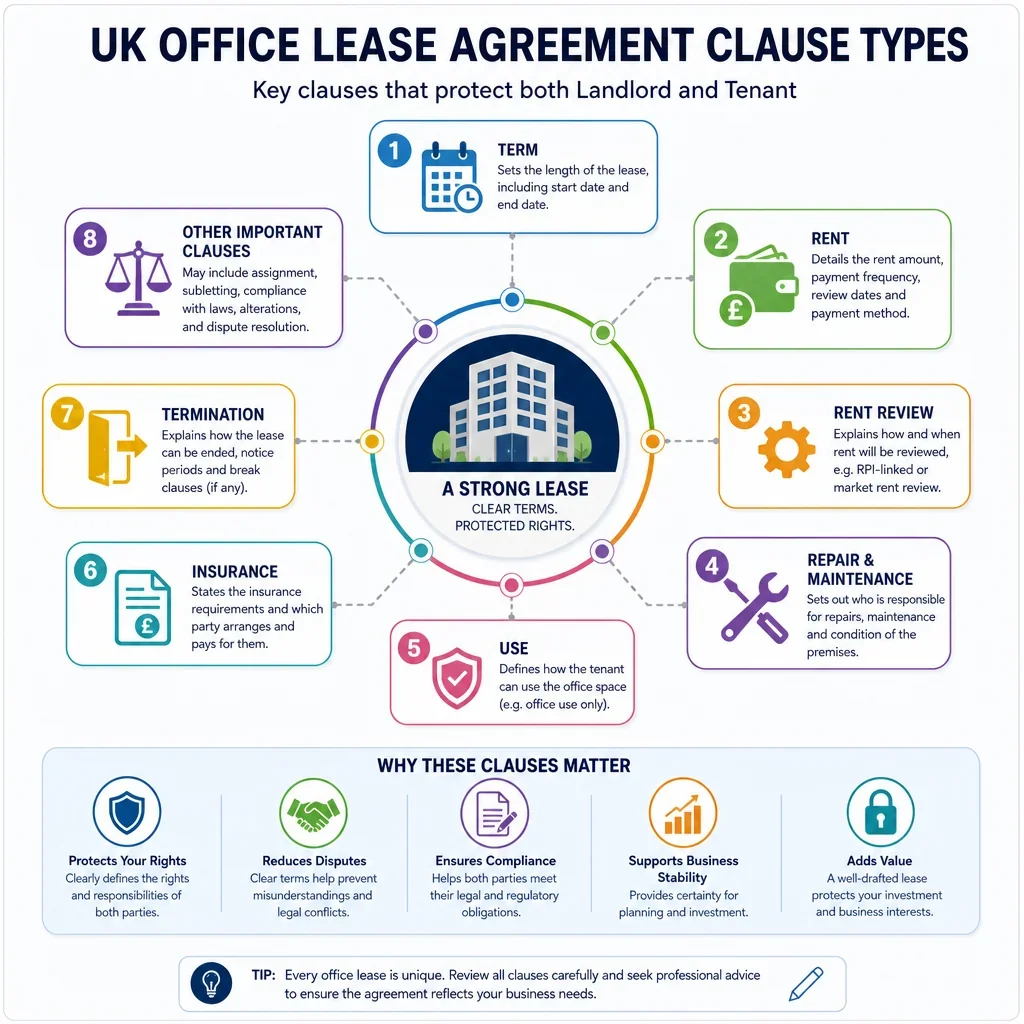
What a Proper Office Lease Agreement Should Include
- Parties InvolvedClearly identifies the landlord and tenant, including their full names and addresses.
- Property DescriptionProvides a detailed description of the office space being leased, including its location and size.
- Lease TermSpecifies the start and end dates of the lease, along with any options for renewal.
- Rent Amount and PaymentOutlines the total rent, payment schedule, and methods of payment.
- Security DepositDetails the amount of the deposit, how it will be held, and conditions for its return.
- Use of SpaceDescribes the permitted uses of the office space and any restrictions.
- Maintenance and RepairsClarifies responsibilities for maintaining the property and handling repairs.
- Utilities and ServicesSpecifies who pays for utilities, cleaning, and other services.
- Insurance RequirementsStates the types of insurance needed and who is responsible for obtaining them.
- Termination ConditionsExplains how the lease can end early and what happens in case of breach.
Generate Your Document in 4 Easy Steps
Why Use Docaro?
 United Kingdom
Free Example Office Lease Agreement Template
Below is a free template example of a Office Lease Agreement for use in the United Kingdom generated by our AI model.
The clauses in your actual Office Lease Agreement will vary from this example as they will be entirely bespoke to your requirements as set out in the questionnaire you complete.
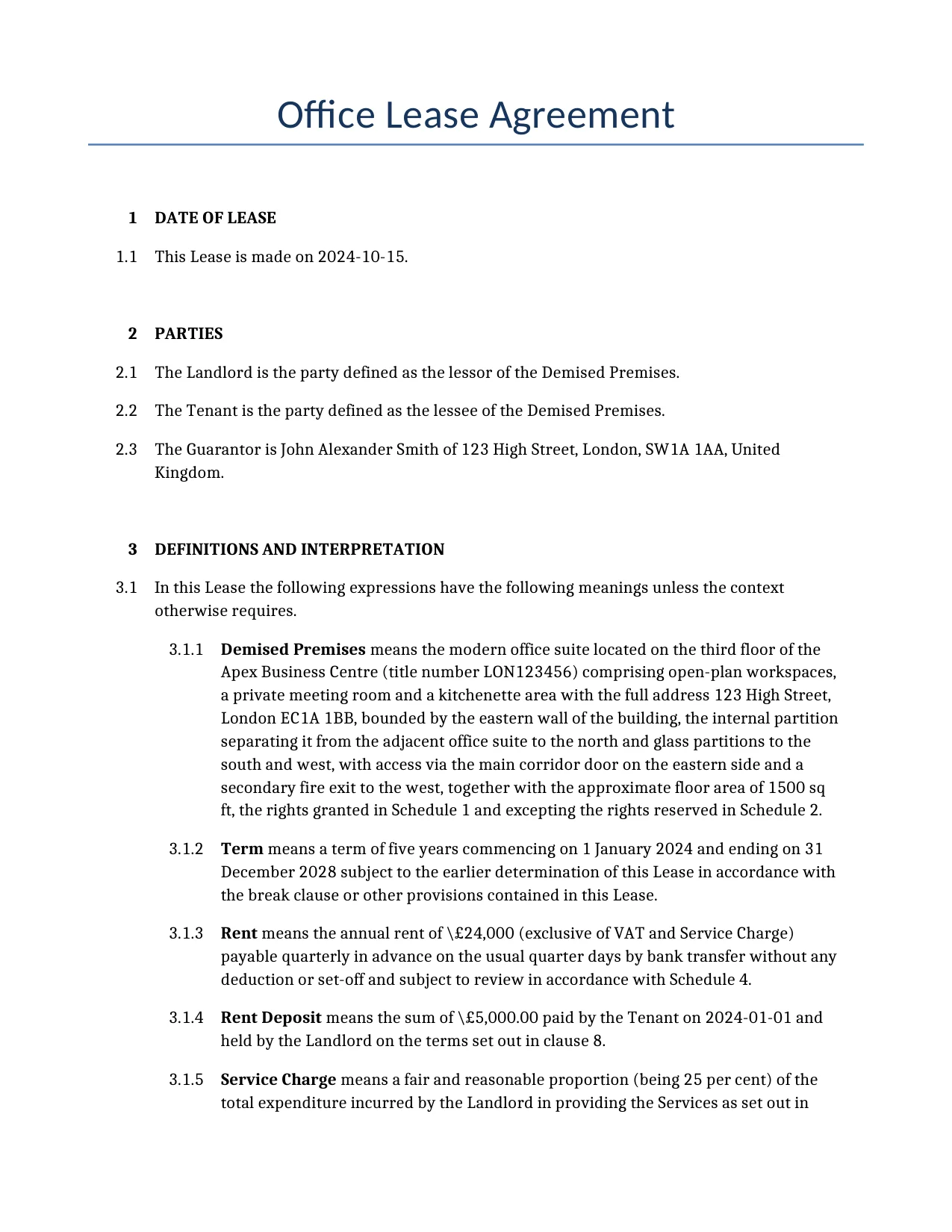
Office Lease Agreement
1DATE OF LEASE
This Lease is made on 2024-10-15.
2PARTIES
The Landlord is the party defined as the lessor of the Demised Premises.
The Tenant is the party defined as the lessee of the Demised Premises.
The Guarantor is John Alexander Smith of 123 High Street, London, SW1A 1AA, United Kingdom.
3DEFINITIONS AND INTERPRETATION
In this Lease the following expressions have the following meanings unless the context otherwise requires.
Demised Premises means the modern office suite located on the third floor of the Apex Business Centre (title number LON123456) comprising open-plan workspaces, a private meeting room and a kitchenette area with the full address 123 High Street, London EC1A 1BB, bounded by the eastern wall of the building, the internal partition separating it from the adjacent office suite to the north and glass partitions to the south and west, with access via the main corridor door on the eastern side and a secondary fire exit to the west, together with the approximate floor area of 1500 sq ft, the rights granted in Schedule 1 and excepting the rights reserved in Schedule 2.
Term means a term of five years commencing on 1 January 2024 and ending on 31 December 2028 subject to the earlier determination of this Lease in accordance with the break clause or other provisions contained in this Lease.
Rent means the annual rent of \£24,000 (exclusive of VAT and Service Charge) payable quarterly in advance on the usual quarter days by bank transfer without any deduction or set-off and subject to review in accordance with Schedule 4.
Rent Deposit means the sum of \£5,000.00 paid by the Tenant on 2024-01-01 and held by the Landlord on the terms set out in clause 8.
Service Charge means a fair and reasonable proportion (being 25 per cent) of the total expenditure incurred by the Landlord in providing the Services as set out in Schedule 5 payable quarterly in advance on account with annual reconciliation.
Insured Risks means fire, storm, tempest, flood, subsidence, explosion, lightning, earthquake, aircraft, riot, civil commotion, malicious damage, terrorism, loss of rent for a minimum of three years and such other risks as the Landlord may from time to time reasonably insure against.
Permitted Use means use as offices within Class E of the Town and Country Planning (Use Classes) Order 1987 (as amended).
Common Parts means the entrances, lobbies, staircases, lifts, corridors, toilets and other areas provided for the common use of occupiers of the Building.
Interest Rate means 4 per cent per annum above the base rate of Barclays Bank plc from time to time.
Words importing one gender include all genders, the singular includes the plural and vice versa, and references to clauses and schedules are to clauses and schedules of this Lease. Headings are for ease of reference only.
4CONTRACTING OUT
The parties have agreed to contract out of sections 24 to 28 (inclusive) of the Landlord and Tenant Act 1954 in respect of this Lease.
A notice in the form set out in section 38A(3) of the Landlord and Tenant Act 1954 was served by the Landlord on the Tenant before the parties entered into this Lease.
The Tenant has made a statutory declaration in the form set out in Schedule 2 to the Regulatory Reform (Business Tenancies) (England and Wales) Order 2003 before the parties entered into this Lease.
The Tenant confirms that it has received independent legal advice before making the statutory declaration referred to in clause 4.3.
5DEMISED PREMISES
In consideration of the Rent and the Tenant’s covenants the Landlord demises to the Tenant the Demised Premises together with the rights specified in Schedule 1 but excepting and reserving the rights specified in Schedule 2 TO HOLD the same to the Tenant for the Term.
The Tenant accepts the Demised Premises in the condition existing at the date of this Lease having inspected them and being satisfied as to their state and condition and having been provided with a copy of the Schedule of Condition annexed at Schedule 6.
6TERM
The Term shall commence on 1 January 2024 and shall continue for the period of five years unless determined earlier in accordance with the break clause contained in clause 6.2 or any other provision of this Lease.
The Tenant may determine this Lease on 31 December 2026 by giving to the Landlord not less than six months’ prior written notice. The break is conditional upon the Tenant having paid all rents due up to the break date, having given vacant possession and having complied with its obligations under clause 18 (Yielding Up).
7RENT
The Tenant must pay the Rent to the Landlord quarterly in advance on the usual quarter days by bank transfer without any deduction or set-off (save as required by law).
If the Tenant fails to pay any sum due under this Lease on the due date the Tenant must pay Interest on that sum from the due date until payment.
The Rent shall be subject to review in accordance with the provisions set out in Schedule 4.
8VAT
All sums payable under this Lease by the Tenant to the Landlord are exclusive of VAT. The Tenant must pay to the Landlord any VAT properly chargeable on those sums at the prevailing rate on the date the payment is due.
The Tenant must pay to the Landlord on demand any VAT payable in respect of any payment made by the Landlord which the Tenant is obliged to reimburse under the terms of this Lease.
9RENT DEPOSIT
The Tenant has paid the Rent Deposit to the Landlord which the Landlord shall hold as security for the performance of the Tenant’s obligations under this Lease.
The Landlord may deduct from the Rent Deposit any sums due from the Tenant which remain unpaid after the due date or any reasonable costs incurred by the Landlord in remedying any breach of the Tenant’s obligations.
The Landlord shall return the balance of the Rent Deposit to the Tenant within 28 days after the end of the Term (or earlier determination) provided that the Tenant has paid all sums due and performed all obligations under this Lease and has vacated the Demised Premises.
10SERVICE CHARGE
The Tenant must pay the Service Charge to the Landlord quarterly in advance on account of the estimated expenditure for the relevant Service Charge Year.
The Landlord shall provide the Tenant with a certificate of the actual expenditure within three months of the end of each Service Charge Year and there shall be an appropriate adjustment between the parties.
The Services to be provided by the Landlord and the provisions relating to the Service Charge are set out in Schedule 5.
11INSURANCE
The Landlord shall insure the Building (including the Demised Premises) against the Insured Risks for the full reinstatement value (including VAT, demolition and professional fees) and for loss of rent for a minimum of three years in an insurance office of repute.
The Tenant must pay to the Landlord on demand a fair and reasonable proportion of the premiums for such insurance together with any insurance premium tax.
The Tenant must maintain public liability insurance in the sum of not less than \£5,000,000 and insure its own contents, trade fixtures and fittings and plate glass (if any) against all usual risks and produce evidence of such insurance to the Landlord on request.
If the Demised Premises or any part of the Building is damaged or destroyed by an Insured Risk then (provided the insurance has not been vitiated by the Tenant) the Landlord shall use reasonable endeavours to reinstate the same as soon as reasonably practicable and the Rent (or a fair proportion) shall be suspended until reinstatement is completed or until the end of the period of loss of rent cover (whichever is earlier).
If the Demised Premises are not reinstated within three years of the date of damage either party may terminate this Lease by giving written notice to the other. Upon termination the insurance proceeds shall belong to the Landlord.
The Landlord and the Tenant must comply with the requirements of the Regulatory Reform (Fire Safety) Order 2005 and any fire risk assessment carried out in respect of the Building.
12REPAIRS AND MAINTENANCE
The Landlord shall keep the structure, exterior, foundations and roof of the Building and the Common Parts in good and substantial repair and condition.
The Tenant shall keep the interior of the Demised Premises and all fixtures and fittings in good and substantial repair and condition (except for damage by the Insured Risks unless the insurance has been vitiated by the Tenant).
The Tenant shall comply with all statutory requirements relating to the Demised Premises including (without limitation) carrying out regular electrical testing (EICR), maintaining an asbestos register where applicable, ensuring compliance with fire safety legislation and the Party Wall etc. Act 1996 where relevant.
The Tenant must notify the Landlord immediately of any defect or want of repair for which the Landlord is responsible.
If the Tenant fails to comply with its repairing obligations the Landlord may carry out the works and recover the cost from the Tenant as a debt.
The condition of the Demised Premises at the date of this Lease is recorded in the Schedule of Condition annexed at Schedule 6 which shall be used as evidence of the state of repair at the commencement of the Term.
13ALTERATIONS AND IMPROVEMENTS
The Tenant shall not make any alterations to the exterior of the Building or any structural alterations to the Demised Premises without the prior written consent of the Landlord (such consent not to be unreasonably withheld or delayed).
The Tenant may carry out internal non-structural alterations provided that they do not affect the structure, the mechanical and electrical services or the fire safety systems of the Building and that the Tenant gives the Landlord at least 14 days’ prior written notice together with plans and specifications.
All alterations must comply with all applicable planning permissions, building regulations, the Regulatory Reform (Fire Safety) Order 2005 and all other statutory requirements.
The Tenant must pay the Landlord’s reasonable and properly incurred legal and surveyor’s costs in connection with any application for consent.
Unless otherwise agreed in writing the Tenant must reinstate the Demised Premises to their original condition (as shown in the Schedule of Condition) at the end of the Term at its own cost.
The Landlord may require the Tenant to pay an increased insurance premium or an increase in the Service Charge resulting from any alterations carried out by the Tenant.
14USE OF THE PREMISES
The Tenant must not use the Demised Premises otherwise than for the Permitted Use.
The Tenant must comply with all planning permissions and all statutes and regulations relating to the Demised Premises including (without limitation) the Environmental Protection Act 1990, the Control of Pollution Act 1974 and all requirements relating to hazardous substances.
The Tenant must not store or use any hazardous substances at the Demised Premises (other than reasonable quantities of ordinary office materials), cause any nuisance or excessive noise, or use the Demised Premises as a data centre or for any noisy or noxious trade.
The Tenant must comply with all requirements of the local planning authority and must obtain and maintain all necessary consents for its use and any Alterations.
15ASSIGNMENT AND SUBLETTING
The Tenant shall not assign the whole of this Lease without the prior written consent of the Landlord which shall not be unreasonably withheld or delayed.
The Landlord may reasonably withhold consent to an assignment unless: (a) all Rent and other sums due under this Lease have been paid; (b) the proposed assignee is of sufficient financial standing (as demonstrated by three years’ audited accounts or equivalent); (c) the Tenant enters into an Authorised Guarantee Agreement in the form required by the Landlord; (d) the assignee enters into a rent deposit deed if required by the Landlord; and (e) the Tenant pays the Landlord’s reasonable legal and surveyor’s costs.
The Tenant shall not underlet the whole or any part of the Demised Premises without the prior written consent of the Landlord which shall not be unreasonably withheld or delayed. Any underlease must be at a rent not less than the full market rent, must contain similar provisions to this Lease (including an absolute prohibition on further underletting) and must be registered with the Landlord within 21 days of grant.
The Tenant must register any assignment, underletting, charge or other dealing with the Landlord within 21 days of the date of the dealing and pay the Landlord’s reasonable registration fee.
This clause is without prejudice to the provisions of the Landlord and Tenant (Covenants) Act 1995.
16YIELDING UP
At the end of the Term the Tenant must yield up the Demised Premises to the Landlord with vacant possession in the condition required by this Lease having removed all tenant’s fixtures, fittings, furniture and equipment, all alterations made during the Term (unless the Landlord requires them to remain) and all rubbish and debris.
The Tenant must make good any damage caused by such removal and reinstate the Demised Premises to the condition shown in the Schedule of Condition (fair wear and tear excepted).
If the Tenant fails to comply with its obligations under this clause the Landlord may carry out the necessary works and the Tenant must reimburse the Landlord on demand for all reasonable costs incurred.
17OUTGOINGS AND EXPENSES
The Tenant must pay all business rates, water rates and all other outgoings payable in respect of the Demised Premises and a fair proportion of any rates levied on the Building.
The Tenant must pay for all utilities consumed at the Demised Premises and must comply with all requirements of the utility suppliers.
18LANDLORD'S COVENANTS
The Landlord covenants with the Tenant that, subject to the Tenant paying the Rent and performing its obligations, the Tenant may quietly enjoy the Demised Premises without interruption by the Landlord or any person claiming under the Landlord.
The Landlord covenants to perform the obligations set out in Schedule 5 in relation to the provision of Services and to insure the Building in accordance with clause 11.
19TENANT'S COVENANTS
The Tenant covenants with the Landlord to pay the Rent, Service Charge and all other sums due under this Lease on the due dates without deduction or set-off.
The Tenant covenants to observe and perform the covenants and obligations set out in this Lease.
20GUARANTOR'S COVENANTS
The Guarantor covenants with the Landlord as a primary obligor that the Tenant will pay the Rent and all other sums due under this Lease and will observe and perform the Tenant’s covenants.
The Guarantor further covenants that if the Tenant fails to pay any sum or breaches any covenant the Guarantor will pay or perform the same on demand.
The Guarantor’s liability shall not be discharged or affected by any variation of this Lease, any grant of time to the Tenant, any disclaimer of this Lease or any other matter which would not discharge a guarantor but for this provision.
21PROVISOS AND CONDITIONS
If any of the following events occur the Landlord may re-enter the Demised Premises or any part of them and immediately thereupon this Lease shall absolutely determine: (a) the Rent or any other sum due under this Lease is unpaid for 14 days after becoming due (whether formally demanded or not); (b) the Tenant is in breach of any of its obligations under this Lease and (if the breach is capable of remedy) fails to remedy it within a reasonable time after service of a notice requiring remedy; or (c) the Tenant enters into any arrangement or composition with its creditors, becomes bankrupt, has a receiver or administrator appointed or (being a company) enters into liquidation (except for the purpose of reconstruction).
No delay or omission by the Landlord in exercising any right under this Lease shall operate as a waiver nor shall any waiver of a breach operate as a waiver of any subsequent or continuing breach.
If the Demised Premises are damaged by an Insured Risk so as to be unfit for use the Rent (or a fair proportion) shall be suspended until the Demised Premises are again fit for use or until the end of the period of loss of rent cover, whichever is earlier.
If the Demised Premises are destroyed or damaged by an Insured Risk and are not reinstated within three years either party may terminate this Lease by notice in writing.
22ENERGY PERFORMANCE AND ENVIRONMENTAL
The Tenant must not carry out any works or alterations which would adversely affect the energy performance or the Energy Performance Certificate (EPC) rating of the Demised Premises or the Building.
The Tenant must comply with the Minimum Energy Efficiency Standards (MEES) Regulations and must not allow the EPC rating to fall below the minimum legal standard.
The Tenant must cooperate with the Landlord in achieving net zero carbon and sustainability objectives including (without limitation) participating in waste recycling schemes and reducing energy consumption.
The Tenant must comply with all environmental laws including the Environment Act 2021 and must not cause any contamination of the Demised Premises or the Building.
23BOILERPLATE PROVISIONS
This Lease constitutes the entire agreement between the parties and supersedes all prior negotiations, representations or agreements.
If any provision of this Lease is held to be invalid or unenforceable the validity of the remaining provisions shall not be affected.
Any notice required to be given under this Lease shall be in writing and shall be served in accordance with section 196 of the Law of Property Act 1925.
No variation of this Lease shall be effective unless it is in writing and signed by or on behalf of each party.
This Lease and any non-contractual obligations arising out of or in connection with it shall be governed by the laws of England and Wales and the parties submit to the exclusive jurisdiction of the English courts.
A person who is not a party to this Lease shall not have any rights under the Contracts (Rights of Third Parties) Act 1999 to enforce any term of this Lease.
Each party shall comply with the Data Protection Legislation (including the UK GDPR) in relation to any personal data processed in connection with this Lease.
Each party shall comply with all applicable anti-bribery and anti-corruption laws including the Bribery Act 2010.
24SCHEDULES
Schedule 1 - Rights Granted
Schedule 2 - Rights Reserved
Schedule 3 - Plan of the Demised Premises
Schedule 4 - Rent Review Provisions (open market rent with assumptions and disregards in accordance with section 34 of the Landlord and Tenant Act 1954)
Schedule 5 - Service Charge Provisions (detailed services, expenditure items, certification by the Landlord’s surveyor, caps on certain expenditure categories where agreed and annual reconciliation process)
Schedule 6 - Schedule of Condition (detailing the condition of the Demised Premises at the date of this Lease and cross-referenced to the inventory of fixtures and fittings)
25EXECUTION
Executed and delivered as a deed by the parties on the date first written above.
| LANDLORD | |
| Signature: | |
| Print Name: | |
| Date: |
| TENANT | |
| Signature: | |
| Print Name: | |
| Date: |
| GUARANTOR | |
| Signature: | |
| Print Name: | |
| Date: |
This example shows approximately 70% of a typical document and is provided for illustrative purposes only. The remaining content has been omitted.
Every document generated by Docaro is tailored to your specific circumstances, jurisdiction and the information you provide. The completed document includes all applicable clauses and provisions required for your situation.
To generate the full, personalised document, answer a short series of questions and your document will be created instantly.
Useful Resources When Considering a Office Lease Agreement in the United Kingdom
United Kingdom Reference Legislation
Office Lease Agreement FAQs
Document Generation FAQs
Related Articles