AI Generated British Confidentiality Agreement
PDF & Word - 2026 Updated
Docaro Pricing
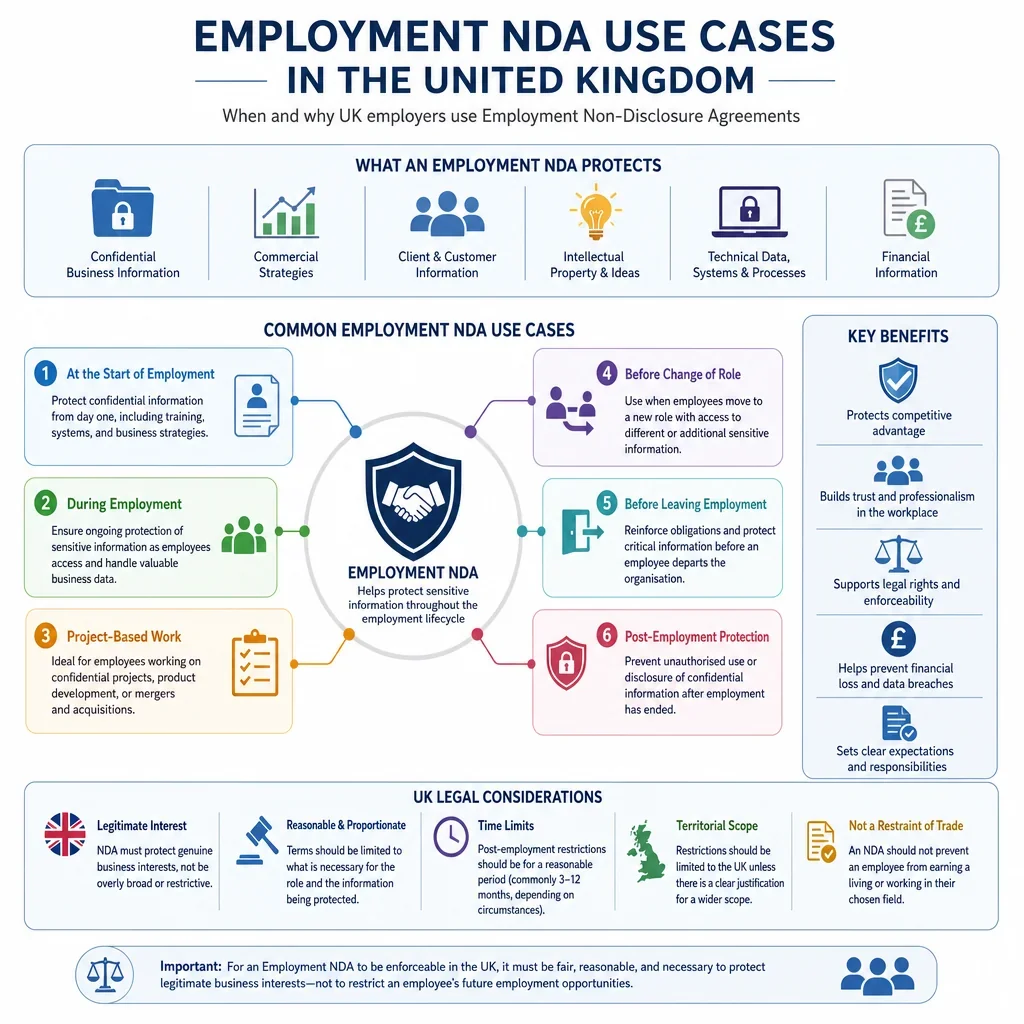
When do you need an Employment Non-Disclosure Agreement in the United Kingdom?
British Legal Rules for an Employment Non-Disclosure Agreement
Using the wrong structure for an employment NDA may fail to comply with UK data protection laws or invalidate enforceability.
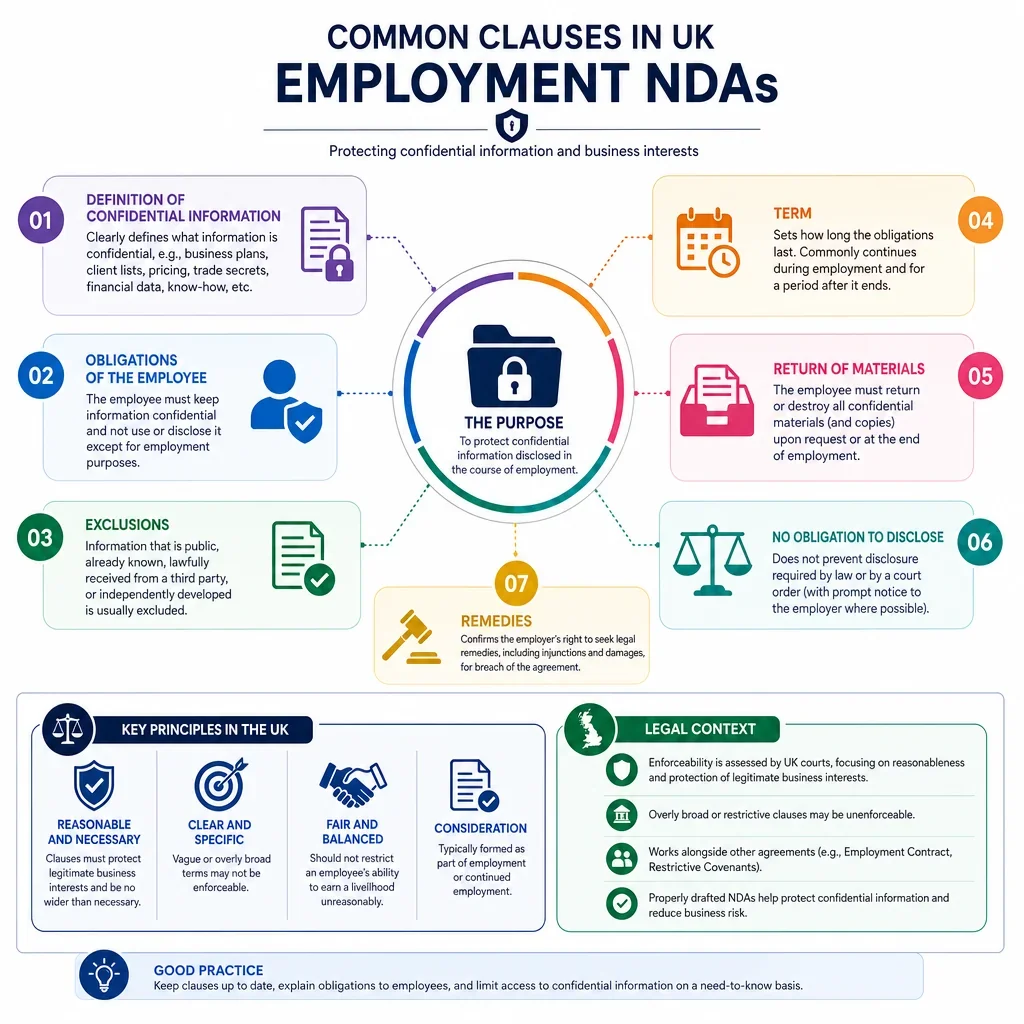
What a Proper Employment Non-Disclosure Agreement Should Include
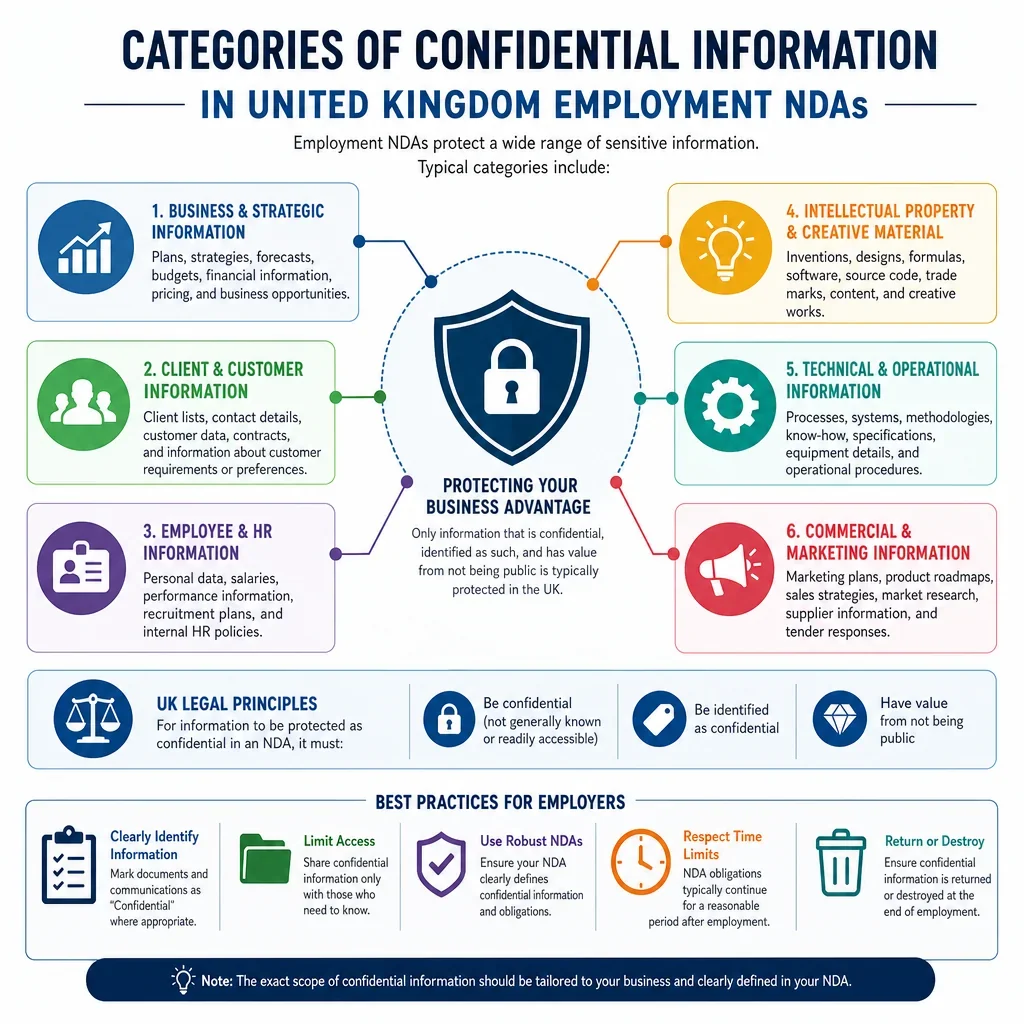
- Definition of Confidential InformationClearly describe what counts as confidential information, such as business plans, client lists, or trade secrets, to set clear boundaries for protection.
- Employee's ObligationsOutline the employee's duty to keep the information secret and not share it with others during and after employment.
- Permitted DisclosuresSpecify situations where disclosure is allowed, like to legal authorities or with the employer's written permission.
- Duration of ProtectionState how long the confidentiality rules apply, often continuing even after the employment ends.
- Consequences of BreachExplain the penalties for breaking the agreement, which may include legal action or compensation to the employer.
- Return of InformationRequire the employee to return or destroy all confidential materials when employment ends.
Generate Your Document in 4 Easy Steps
Why Use Docaro?
 United Kingdom
Free Example Employment Non-Disclosure Agreement Template
Below is a free template example of a Employment Non-Disclosure Agreement for use in the United Kingdom generated by our AI model.
The clauses in your actual Employment Non-Disclosure Agreement will vary from this example as they will be entirely bespoke to your requirements as set out in the questionnaire you complete.
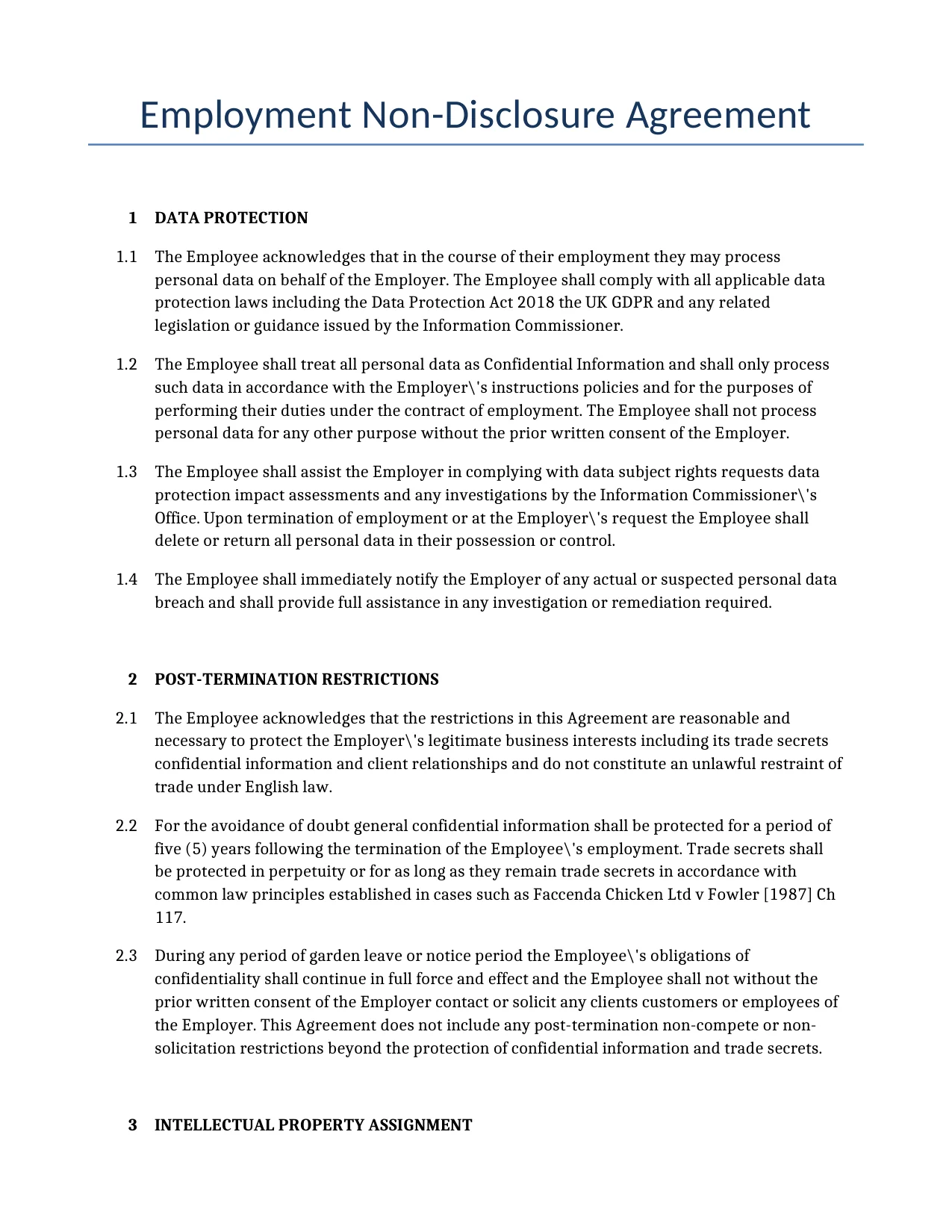
Employment Non-Disclosure Agreement
1DATA PROTECTION
The Employee acknowledges that in the course of their employment they may process personal data on behalf of the Employer. The Employee shall comply with all applicable data protection laws including the Data Protection Act 2018 the UK GDPR and any related legislation or guidance issued by the Information Commissioner.
The Employee shall treat all personal data as Confidential Information and shall only process such data in accordance with the Employer\'s instructions policies and for the purposes of performing their duties under the contract of employment. The Employee shall not process personal data for any other purpose without the prior written consent of the Employer.
The Employee shall assist the Employer in complying with data subject rights requests data protection impact assessments and any investigations by the Information Commissioner\'s Office. Upon termination of employment or at the Employer\'s request the Employee shall delete or return all personal data in their possession or control.
The Employee shall immediately notify the Employer of any actual or suspected personal data breach and shall provide full assistance in any investigation or remediation required.
2POST-TERMINATION RESTRICTIONS
The Employee acknowledges that the restrictions in this Agreement are reasonable and necessary to protect the Employer\'s legitimate business interests including its trade secrets confidential information and client relationships and do not constitute an unlawful restraint of trade under English law.
For the avoidance of doubt general confidential information shall be protected for a period of five (5) years following the termination of the Employee\'s employment. Trade secrets shall be protected in perpetuity or for as long as they remain trade secrets in accordance with common law principles established in cases such as Faccenda Chicken Ltd v Fowler [1987] Ch 117.
During any period of garden leave or notice period the Employee\'s obligations of confidentiality shall continue in full force and effect and the Employee shall not without the prior written consent of the Employer contact or solicit any clients customers or employees of the Employer. This Agreement does not include any post-termination non-compete or non-solicitation restrictions beyond the protection of confidential information and trade secrets.
3INTELLECTUAL PROPERTY ASSIGNMENT
The Employee agrees that all intellectual property rights in any work created by the Employee during the course of their employment including but not limited to proprietary algorithms software code designs and inventions (the Works) shall belong to and vest in the Employer. To the extent that such rights do not automatically vest in the Employer the Employee hereby assigns all such rights to the Employer with full title guarantee.
The Employee shall execute all documents and do all acts as may be necessary in the opinion of the Employer to vest all such intellectual property rights in the Employer and to enable the Employer to obtain and maintain protection for such rights anywhere in the world. This obligation shall continue after termination of the employment.
4NOTIFICATION OF BREACH
The Employee shall promptly notify the Employer in writing of any actual suspected or threatened unauthorised disclosure use or misappropriation of Confidential Information by the Employee or any third party of which the Employee becomes aware.
The Employee shall provide all reasonable assistance to the Employer in investigating and remedying any such breach including providing statements witness evidence and other cooperation in any legal proceedings. This obligation shall survive the termination of the Employee\'s employment.
5MISCELLANEOUS
The headings in this Agreement are for ease of reference only and shall not affect the interpretation or construction of this Agreement. Words importing the singular shall include the plural and vice versa. References to clauses or sections are to clauses or sections of this Agreement.
The following clauses shall survive termination of this Agreement and the Employee\'s employment: clauses relating to Obligations of Confidentiality Permitted Disclosures Exclusions from Confidential Information Duration of Obligations Return of Confidential Information Remedies for Breach Intellectual Property Assignment Notification of Breach Post-Termination Restrictions Data Protection and this Miscellaneous clause.
Nothing in this Agreement shall limit or exclude the Employee\'s statutory rights under the Employment Rights Act 1996 the Equality Act 2010 the National Minimum Wage Act 1998 or any other legislation that cannot lawfully be waived. This Agreement is supplemental to and does not replace the Employee\'s contract of employment dated on or around the date of this Agreement (the Employment Contract). In the event of any conflict between this Agreement and the Employment Contract the terms of the Employment Contract shall prevail to the extent of such conflict.
This Agreement may only be varied by a written agreement signed by or on behalf of both parties.
6PERMITTED DISCLOSURES
The Employee may disclose Confidential Information with the prior written consent of the Employer.
The Employee may disclose Confidential Information as required by law or regulation.
The Employee may disclose Confidential Information pursuant to a court order provided that the Employee notifies the Employer in advance of such disclosure where practicable.
The Employee may disclose Confidential Information to the Employee\'s professional advisers who are bound by a duty of confidentiality no less onerous than that set out in this Agreement provided that the Employee notifies the Employer in advance of such disclosure.
Nothing in this Agreement shall prevent the Employee from making a protected disclosure under section 43A of the Employment Rights Act 1996 (as amended) (a Qualifying Disclosure) to a prescribed person or body or to any other person where the disclosure is protected under the Public Interest Disclosure Act 1998 (as amended by the Enterprise and Regulatory Reform Act 2013). The Employee is encouraged to seek independent advice if they believe they have information that should be disclosed in the public interest.
In the case of legal or court-ordered disclosures and disclosures to professional advisers the Employee shall where practicable notify the Employer before making such disclosure.
7COMPLIANCE WITH LEGISLATION
This Agreement is drafted to comply with the provisions of the Employment Rights Act 1996 the Equality Act 2010 the Data Protection Act 2018 the Human Rights Act 1998 the Public Interest Disclosure Act 1998 and the Enterprise and Regulatory Reform Act 2013.
Nothing in this Agreement shall be construed as limiting the Employee\'s rights under the legislation referred to in clause 21.1 including the right to make a protected disclosure under the Employment Rights Act 1996 (as amended). For the avoidance of doubt nothing in this Agreement prevents or restricts the Employee from making a protected disclosure to a prescribed person regulator or other appropriate body.
This example shows approximately 70% of a typical document and is provided for illustrative purposes only. The remaining content has been omitted.
Every document generated by Docaro is tailored to your specific circumstances, jurisdiction and the information you provide. The completed document includes all applicable clauses and provisions required for your situation.
To generate the full, personalised document, answer a short series of questions and your document will be created instantly.
Useful Resources When Considering a Employment Non-Disclosure Agreement in the United Kingdom
United Kingdom Reference Legislation
Employment Non-Disclosure Agreement FAQs
Document Generation FAQs
Related Articles