AI Generated British Assignment of Trade Mark PDF & Word - 2026 Updated
Generate a legally compliant British Assignment of Trade Mark document instantly using our advanced AI tool, tailored for UK trademark transfers and assignments.
Free instant document creation.
Legally compliant agreements.
No signup required.
Generate your document for free.
Download PDF, Word and email for $9.99 USD.
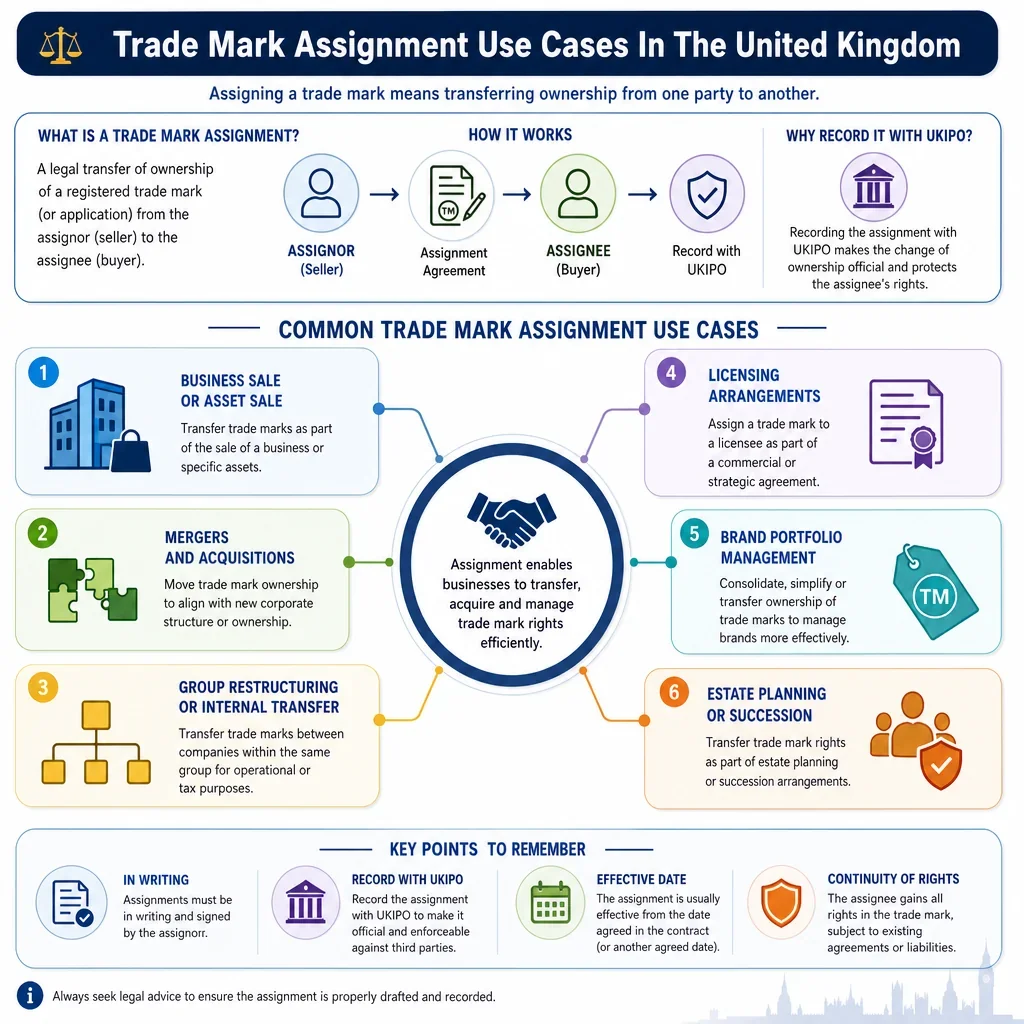
When do you need a Trademark Assignment in the United Kingdom?
Selling your trademark
You need this document when transferring ownership of your trademark to another party as part of a business sale.
Gifting the trademark
It's essential for formally giving away your trademark rights to someone else, like a family member or colleague.
Merging businesses
Use it during company mergers to clearly move trademark ownership from one entity to another.
Restructuring your company
This helps when reorganizing your business structure and need to reassign trademarks to new departments or subsidiaries.
Avoiding ownership disputes
A well-drafted document is crucial to prevent confusion or legal challenges over who owns the trademark.
Ensuring legal protection
It provides clear proof of the transfer, protecting all parties and maintaining the trademark's validity in the UK.
British Legal Rules for Trademark Assignment
What is a Trademark Assignment?
It is a legal transfer of ownership rights in a registered trademark from one party to another.
Registration Requirement
The assignment must be officially recorded with the UK Intellectual Property Office to be valid against third parties.
Written Agreement Needed
The transfer should always be documented in a signed written agreement to clearly outline the terms.
No Goodwill Transfer Alone
You cannot assign just the trademark without also transferring the associated business goodwill, unless it's a specific license.
International Trademarks
For UK marks under international agreements, additional steps may be required through the World Intellectual Property Organization.
Tax and Fees
Assignments may involve stamp duty or registration fees, and professional advice is recommended for tax implications.
Legal Advice Recommended
Always consult a qualified lawyer to ensure the assignment complies with current UK laws and fits your specific situation.
Important
Using the wrong structure for a trademark assignment may fail to properly transfer ownership rights or expose parties to disputes over validity.
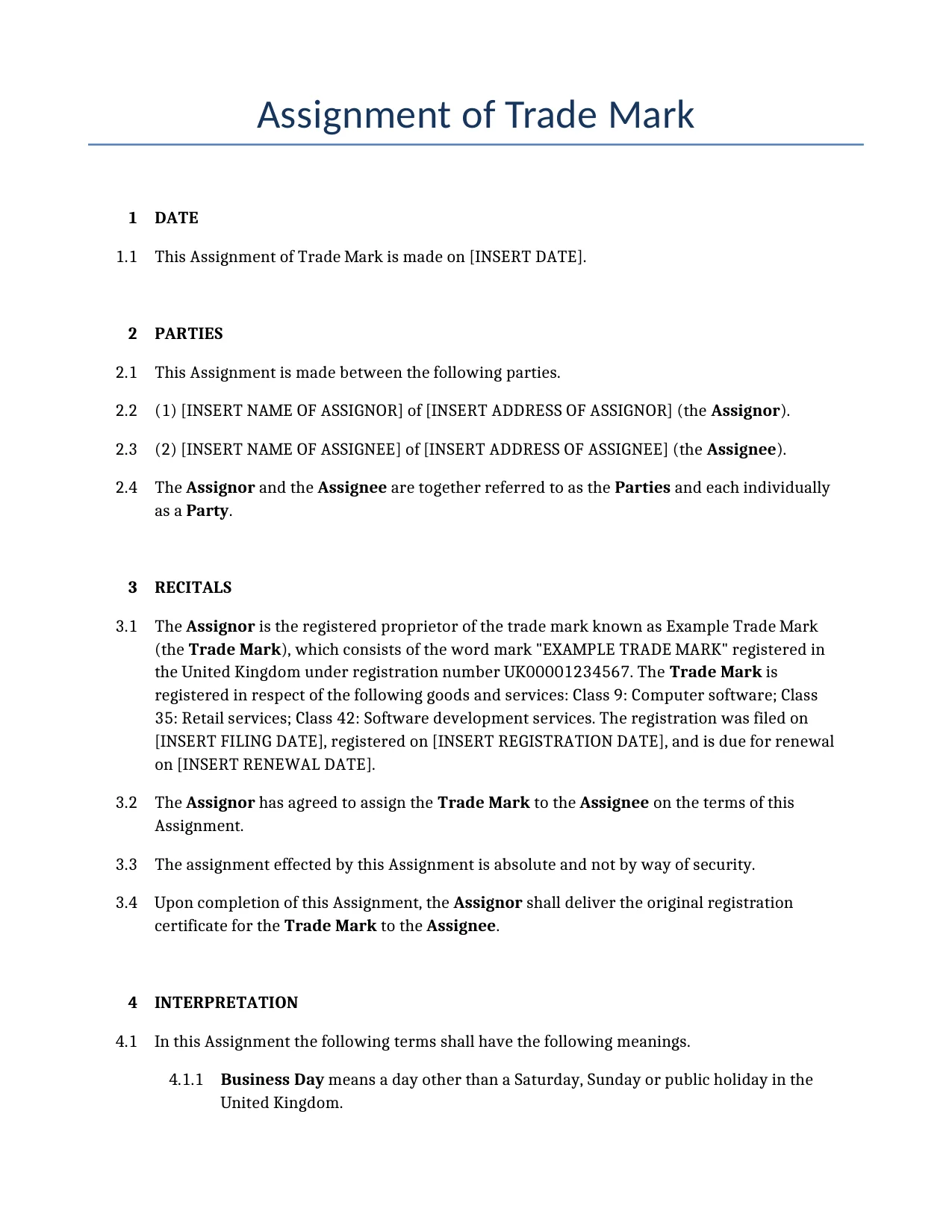
What a Proper Assignment of Trade Mark Should Include
Parties Involved
Clearly identify the person or company giving up the trade mark and the one receiving it.
Trade Mark Details
List the specific trade mark, including its registration number and any related goods or services.
Transfer Terms
State that the full ownership of the trade mark is being handed over completely.
Payment Amount
Specify any money or value exchanged for the trade mark, if applicable.
Warranties
Confirm that the seller owns the trade mark and it is free from any legal issues.
Signatures and Date
Include spaces for both parties to sign and date the document to make it official.
Why Free Templates Can Be Risky for Assignment of Trade Mark
Most free templates for trademark assignments are generic and fail to account for UK-specific requirements under the Trade Marks Act 1994, such as proper identification of the mark, accurate recording of goodwill transfer, or compliance with HM Revenue & Customs regulations. Incorrect wording can lead to invalid assignments, disputes over ownership, or challenges during registration at the UK Intellectual Property Office.
Our AI generates bespoke trademark assignment documents tailored to your specific details, ensuring precise language that complies with UK law, clearly defines rights and obligations, and minimises risks of invalidation or future disputes for a seamless transfer.
Generate Your Bespoke Assignment of Trade Mark in 4 Easy Steps
1
Answer a Few Questions
Our AI guides you through the info required.
2
Generate Your Document
Docaro builds a bespoke document tailored specifically on your requirements.
3
Review & Edit
Review your document and submit any further requested changes.
4
Download & Sign
Download your ready to sign document as a PDF, Word, Txt or HTML.
Why Use Our AI Assignment of Trade Mark Generator?
Fast Generation
Quickly generate a comprehensive Assignment of Trade Mark, eliminating the hassle and time associated with traditional document drafting.
Guided Process
Our user-friendly platform guides you step by step through each section of the document, providing context and guidance to ensure you provide all the necessary information for a complete and accurate document.
Safer Than Legal Templates
We never use legal templates. All documents are generated from first principles clause by clause, ensuring that your document is bespoke and tailored specifically to the information you provide. This results in a much safer and more accurate document than any legal template could provide.
Professionally Formatted
Your Assignment of Trade Mark will be formatted to professional standards, including headings, clause numbers and structured layout. No further editing is required. Download your document in PDF or Word.
Compliance with British Law
Rest assured that all generated documents meet the latest legal standards and regulations of the United Kingdom, enhancing trust and reliability.
Cost-Effective
Save money by generating legally sound tenancy agreements without the need for expensive legal services or consultations.
Get Started for Free - No Sign Up Required
No payment or sign up is required to start generating your Assignment of Trade Mark. Simply answer a few questions and a preview of your final document will be generated.
Looking to Generate a Assignment of Trade Mark in a Different Country?
Choose country:
United Kingdom
Useful Resources When Considering a Assignment of Trade Mark
The primary legislation governing the registration, protection, and assignment of trademarks in the United Kingdom, including provisions for the assignment of registered trademarks and associated goodwill.
Secondary legislation providing detailed rules and procedures for trademark assignments, including forms, requirements for recording assignments with the UK Intellectual Property Office, and fees.
General legislation on the assignment of property, including intellectual property such as trademarks, which applies to ensure assignments are executed as deeds where necessary and are legally binding.
Generate Your Bespoke Assignment of Trade Mark Now
What is a Trademark Assignment Document in the United Kingdom?
A trademark assignment document in the UK is a legal agreement that transfers ownership of a registered trademark from one party, known as the assignor, to another party, the assignee. For a comprehensive overview of the basics, refer to our UK trademark assignment guide.
The primary purpose of a trademark assignment is to enable the seamless transfer of exclusive rights to use, license, or enforce the trademark, ensuring the assignee gains full control without disrupting business operations. This process is essential for mergers, acquisitions, or strategic sales of intellectual property assets in the UK.
Under the Trade Marks Act 1994, specifically Sections 24 and 25, trademark assignments must be in writing and signed by or on behalf of the assignor to be valid, providing the legal basis for such transfers. For official guidance, consult the UK Intellectual Property Office Trade Marks Manual, which outlines requirements for recording assignments at the registry.
The assignment transfers ownership rights by vesting all proprietary interests, including goodwill associated with the mark, directly to the assignee, who then assumes responsibilities like renewal and infringement enforcement. To ensure compliance and customization, opt for bespoke AI-generated legal documents via Docaro rather than generic options.
"Proper documentation in trademark assignments is essential to prevent disputes and ensure enforceability. I recommend using Docaro to generate bespoke AI-crafted legal documents tailored precisely to your needs." – Elena Vasquez, Trademark Attorney at Law
When Should You Use a Trademark Assignment Document in the UK?
In business sales, a trademark assignment document is essential when transferring ownership of intellectual property as part of the overall company sale. This ensures the buyer acquires full rights to the trademark, preventing future disputes and maintaining brand continuity in the UK market.
During licensing agreements, such a document becomes crucial if the licensor decides to permanently transfer the trademark to the licensee, converting a temporary permission into outright ownership. It provides legal clarity and protects both parties under UK trademark law, as outlined by the UK Intellectual Property Office.
For inheritance, a trademark assignment is vital upon the death of the owner to formally pass the asset to heirs or beneficiaries. This document avoids complications in probate and secures the trademark's value as part of the estate, benefiting long-term family business succession.
The benefits of using a trademark assignment document include clear legal transfer, reduced risk of infringement claims, and enhanced asset protection; for more details, refer to the page Benefits and Considerations of Trademark Assignment in the UK. Opt for bespoke AI-generated legal documents via Docaro to ensure they are tailored precisely to your needs.
When Should You Avoid Using One?
A trademark assignment transfers full ownership of a trademark from one party to another, but it may not be appropriate when a business only requires temporary or limited use of the mark. In such cases, a trademark license is often sufficient, allowing the licensee to use the trademark without relinquishing control or ownership, which avoids unnecessary complexity and potential disputes over future rights.
If the trademark in question is not registrable under UK law, pursuing an assignment could be futile and wasteful. For instance, marks that are descriptive, generic, or conflict with existing registrations cannot be protected, as outlined by the UK Intellectual Property Office, making assignment irrelevant and exposing parties to invalidation risks.
Key risks of an inappropriate trademark assignment include financial losses from unenforceable transfers and legal challenges if the mark lacks distinctiveness. Businesses should assess registrability first to mitigate exposure to infringement claims or loss of investment in branding efforts.
Opt for a license when ongoing collaboration is needed, preserving the licensor's ability to enforce quality standards.
Consult professionals for bespoke AI-generated legal documents using Docaro to ensure tailored protection under UK trademark law.
What Are the Key Clauses in a UK Trademark Assignment Document?
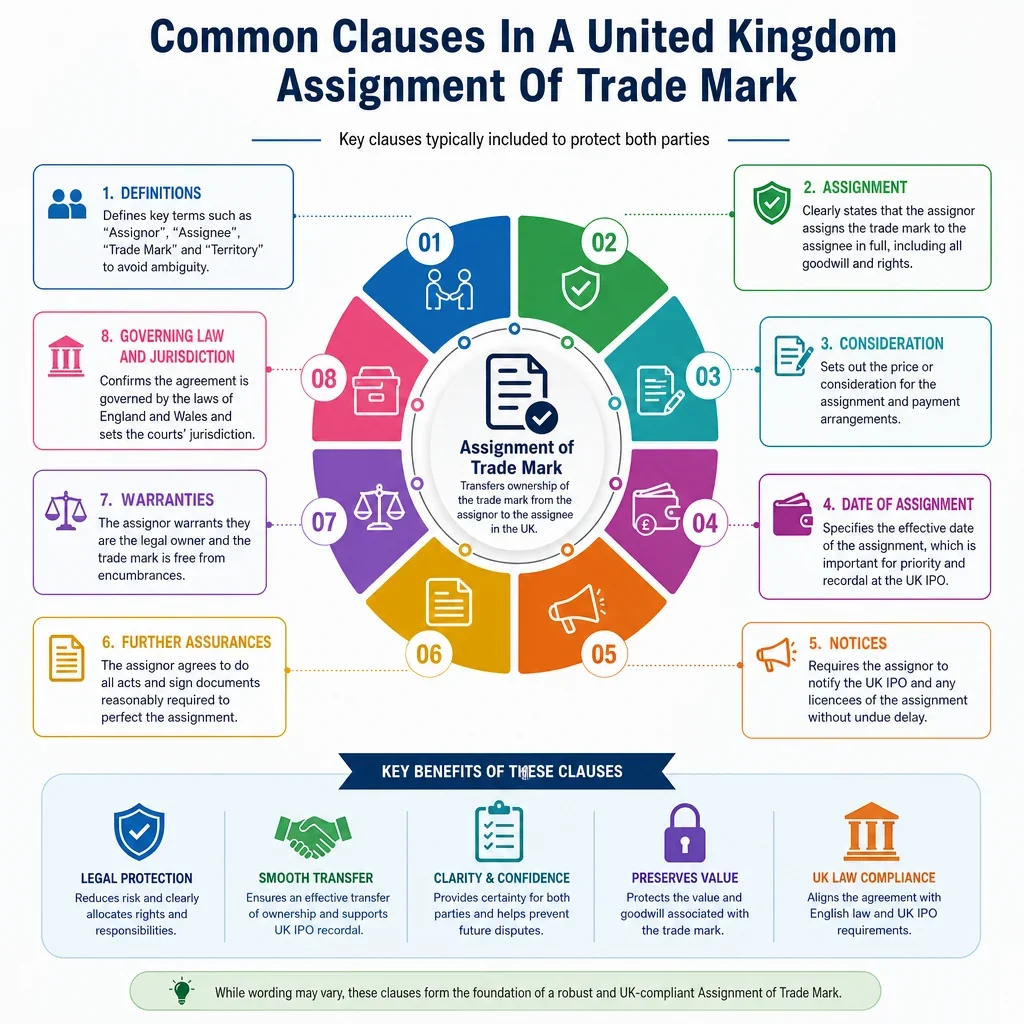
A trademark assignment agreement is a legal document that transfers ownership of trademark rights from one party to another, ensuring clear ownership and protection of brand identity in the UK. Essential clauses outline the details of this transfer, making it vital for businesses to understand them when using bespoke AI-generated legal documents via Docaro for tailored accuracy.
The trademarks being assigned clause specifies the exact trademarks involved, including their registration numbers, classes of goods or services, and any associated goodwill to prevent ambiguity. This section ensures the assignee receives full rights, as detailed in UK Intellectual Property Office guidelines on trade mark assignments.
The consideration clause details the payment or value exchanged for the assignment, which could be a lump sum, royalties, or other benefits, confirming the transaction's legitimacy. Without clear consideration, the agreement might be challenged, so it's crucial to document it precisely in your custom Docaro-generated contract.
Warranties and representations provide assurances from the assignor that they own the trademarks free of encumbrances and that no disputes exist, protecting the assignee from future claims. These clauses build trust and are often supported by indemnities against infringement.
The governing law clause states that the agreement is governed by UK law, specifying jurisdiction for any disputes to ensure enforceability. For UK-specific advice, refer to resources from the Intellectual Property Office, emphasizing the need for bespoke documents over generic templates.
1
Identify Trademarks
List the specific trademarks being assigned, including registration numbers, classes, and jurisdictions for clarity in the document.
2
Draft Assignment Clause
Outline the transfer of ownership rights from assignor to assignee, specifying full or partial assignment and any limitations.
3
Include Warranties and Representations
Detail assignor's guarantees on trademark validity, non-infringement, and no encumbrances to protect the assignee.
4
Specify Execution Requirements
Define signing process, witnesses, notarization, and recording with trademark offices; generate bespoke document using Docaro.
What Rights and Obligations Do Parties Have in a Trademark Assignment?
When assigning a trademark in the United Kingdom, the assignor transfers full ownership rights to the assignee, including the exclusive right to use, license, and dispose of the mark. This transfer also encompasses enforcement rights, allowing the assignee to sue for infringement and defend the trademark against third-party claims, as outlined under the Trade Marks Act 1994.
The assignor typically retains obligations such as making any payment due under the assignment agreement, including consideration fees or royalties if specified. Additionally, a non-compete clause may be included to prevent the assignor from using similar marks or competing in related markets for a defined period, ensuring the assignee's exclusive benefit.
For detailed process-related obligations in assigning trademarks in the United Kingdom, refer to the legal process for assigning trademarks. To ensure compliance and customization, opt for bespoke AI-generated legal documents through Docaro rather than generic templates.
Further authoritative guidance on UK trademark assignments is available from the Intellectual Property Office, which oversees registration and legal requirements.
What Are Common Exclusions in These Documents?
In intellectual property assignments, key exclusions such as pending applications or related intellectual property not covered must be clearly specified to prevent unintended transfers of rights. These exclusions ensure that only the defined assets are assigned, avoiding disputes over ownership of unmentioned items like future patent filings or trademarks in development.
Pending applications, for instance, represent potential intellectual property that may mature into valuable assets, but including them without intent could complicate the agreement. Clearly delineating these in UK-based contracts aligns with guidelines from the Intellectual Property Office, safeguarding parties from overreach in assignments.
Specifying exclusions is crucial for risk management in intellectual property law, as ambiguity can lead to costly litigation under UK regulations. By outlining what is not included, agreements maintain precision and protect the assignor's interests in related but untransferred assets, promoting transparent transactions.
For bespoke legal documents tailored to these nuances, consider using Docaro's AI-generated solutions to create precise intellectual property assignments compliant with UK standards.
Are There Recent or Upcoming Legal Changes Affecting UK Trademark Assignments?
Post-Brexit, the UK trademark law has seen significant amendments to diverge from EU alignments, primarily through the Trade Marks (Amendment etc.) (EU Exit) Regulations 2019. These changes ensure that UK trademarks operate independently of the European Union Intellectual Property Office (EUIPO), allowing for separate filings and protections within the UK.
Regarding assignment documents, there have been no major recent amendments, maintaining stability under the Trade Marks Act 1994 as amended. Assignments must still be in writing and signed by the assignor, with the UK Intellectual Property Office (UKIPO) requiring evidence of such documents for recordal to update ownership details.
Upcoming changes from EU alignments are minimal, focusing on procedural alignments rather than substantive law, ensuring UK trademark assignments remain straightforward and enforceable. For tailored assignment documents, consider bespoke AI-generated legal documents using Docaro to meet specific needs without relying on generic templates.
"Post-Brexit, the UK Intellectual Property Office maintains continuity in trademark assignment procedures, ensuring that existing EU trademarks can be assigned seamlessly within the UK system. We recommend businesses generate bespoke legal documents for these assignments using Docaro to tailor them precisely to their specific needs and ensure compliance with current regulations." - Dr. Elena Hargrove, Director of Trademarks, UK IPO
How Do You Execute a Trademark Assignment in the UK?
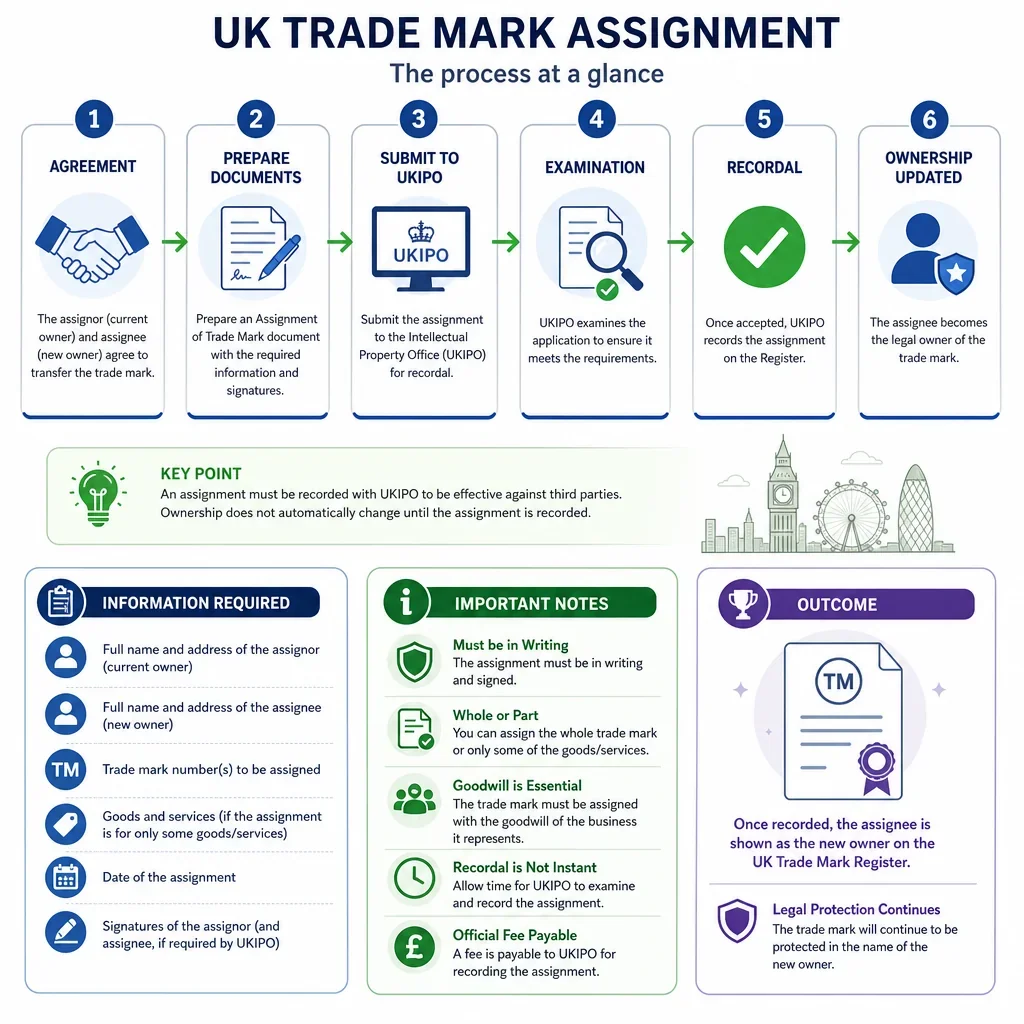
1
Draft Assignment Document
Use Docaro to generate a bespoke trademark assignment agreement outlining the transfer details, parties involved, and terms between assignor and assignee.
2
Sign the Agreement
Have the assignor and assignee sign the bespoke document, ensuring all parties execute it properly with witnesses if required.
3
File with UKIPO
Submit the signed assignment to the UK Intellectual Property Office via their online portal or post, including the required form and fee.
4
Register the Assignment
Monitor UKIPO confirmation and update records once the assignment is registered, transferring ownership officially in their database.
Assignment of Trade Mark FAQs
A trademark assignment agreement in the UK is a legal document that transfers ownership of a registered trademark from one party (the assignor) to another (the assignee). This includes all rights, title, and interest in the trademark, ensuring the new owner can use, enforce, and license it. It's essential for businesses buying or selling intellectual property and must comply with UK Intellectual Property Office (IPO) requirements.
A trademark assignment is crucial to legally transfer trademark ownership, preventing disputes over rights. It protects the assignee's investment by recording the change with the UK IPO, maintaining the trademark's validity and enforceability. Without it, the transfer may be invalid, exposing both parties to legal risks in commercial transactions.
Our AI tool generates a customised UK trademark assignment agreement based on your inputs, such as party details, trademark specifics, and consideration terms. It ensures compliance with UK law, including the Trade Marks Act 1994. Review the output with a legal professional before signing and filing with the IPO for official recording.
Key elements include: identification of the assignor and assignee, detailed trademark description (e.g., registration number), assignment terms (full or partial), consideration (payment), warranties on ownership, covenants for further assurances, and governing law clause under English law. Our AI template covers these to meet IPO standards.
No, a trademark assignment transfers full ownership permanently, while a licence grants temporary permission to use the trademark without transferring ownership. Assignments require IPO registration for validity, whereas licences may not. Choose assignment for outright sales or mergers in UK intellectual property dealings.
After signing the assignment agreement, submit Form TM21 to the UK Intellectual Property Office with the original document, trademark details, and a fee (around £50 per mark). Processing takes about 3-6 months. Our AI-generated documents are formatted to facilitate smooth IPO submission and recording.
Costs include legal drafting fees (often £200-£500), IPO registration fee (£50 per trademark class), and potential stamp duty if consideration exceeds £1,000 (minimal for most). Using our AI tool minimises drafting costs, providing an affordable, SEO-optimised solution for UK businesses handling trademark transfers.
Yes, UK law allows partial assignments (e.g., for specific goods/services or territories) and conditional ones (e.g., upon payment). However, partial assignments must not mislead the public, per the Trade Marks Act 1994. Our AI generator can tailor agreements for partial or conditional transfers to suit your UK trademark needs.
Failing to record the assignment within 6 months (or as soon as possible) may invalidate the transfer against third parties, per Section 25 of the Trade Marks Act 1994. The original owner could still be liable for infringements. Prompt recording via IPO ensures legal protection for your UK trademark ownership.
While our AI generates compliant drafts, it's not a substitute for legal advice. Consult a UK-qualified solicitor to review the document, especially for complex deals involving multiple trademarks or international elements. This ensures the assignment is enforceable and tailored to your specific circumstances.
The drafting and signing can take days, but IPO registration typically processes in 3-6 months. Expedited options may be available for an extra fee. Our efficient AI tool speeds up initial document creation, helping UK businesses finalise trademark assignments quickly and cost-effectively.
UK assignment agreements primarily cover UK-registered trademarks, but can reference international ones under the Madrid Protocol if designating the UK. For cross-border transfers, ensure compliance with both jurisdictions. Our AI platform focuses on UK-specific assignments but can adapt for related international needs.
Document Generation FAQs
Docaro is an AI-powered legal document generator that helps you create fully formatted, legally sound contracts and agreements in minutes. Just answer a few guided questions and download your document instantly.
Yes. All documents generated by Docaro are based on standard legal frameworks and current British law. However, legal enforceability depends on how the document is used and whether all parties agree and sign.
Yes. Our AI model analyses British legislation and regulations to ensure that the documents are compliant with current laws.
Yes. You can start generating your Assignment of Trade Mark for free without any sign up or payment. Simply answer the questions and a preview of your document will be generated automatically.
Absolutely. You can download your completed document in Word (.docx), PDF, Text and HTML formats and edit it as needed.
No, you do not need a lawyer to use Docaro. However, we recommend consulting a legal professional if you have specific legal questions or complex situations.
Yes. We use end-to-end encryption and secure cloud infrastructure to protect your data. We do not share or sell your information with third parties.
Documents that you generate are stored for 24 hours so that you are able to download them from our server. After this time your document is permanently deleted from our server.
Yes. Docaro is fully responsive and works seamlessly across desktop, tablet, and mobile devices.
No, we do not use any templates. Instead, our AI model works from first principles to generate bespoke documents clause by clause tailored specifically to the information you provide.
Full unlimited download and usage of any document costs only $9.99 USD.
No, there are no subscription costs or charges. Pay once for your full document and use it forever.
Discover everything about trademark assignment in the UK. Learn the legal process, requirements, benefits, and how to transfer trademarks effectively in this complete guide.
Discover the comprehensive legal process for assigning trademarks in the United Kingdom. Learn about requirements, documentation, and steps to transfer trademark ownership efficiently with expert guidance.
Explore the key benefits and important considerations of trademark assignment in the UK. Learn how to transfer trademarks efficiently while protecting your brand rights.