AI Generated British Commercial Lease Agreement
PDF & Word - 2026 Updated
Docaro Pricing
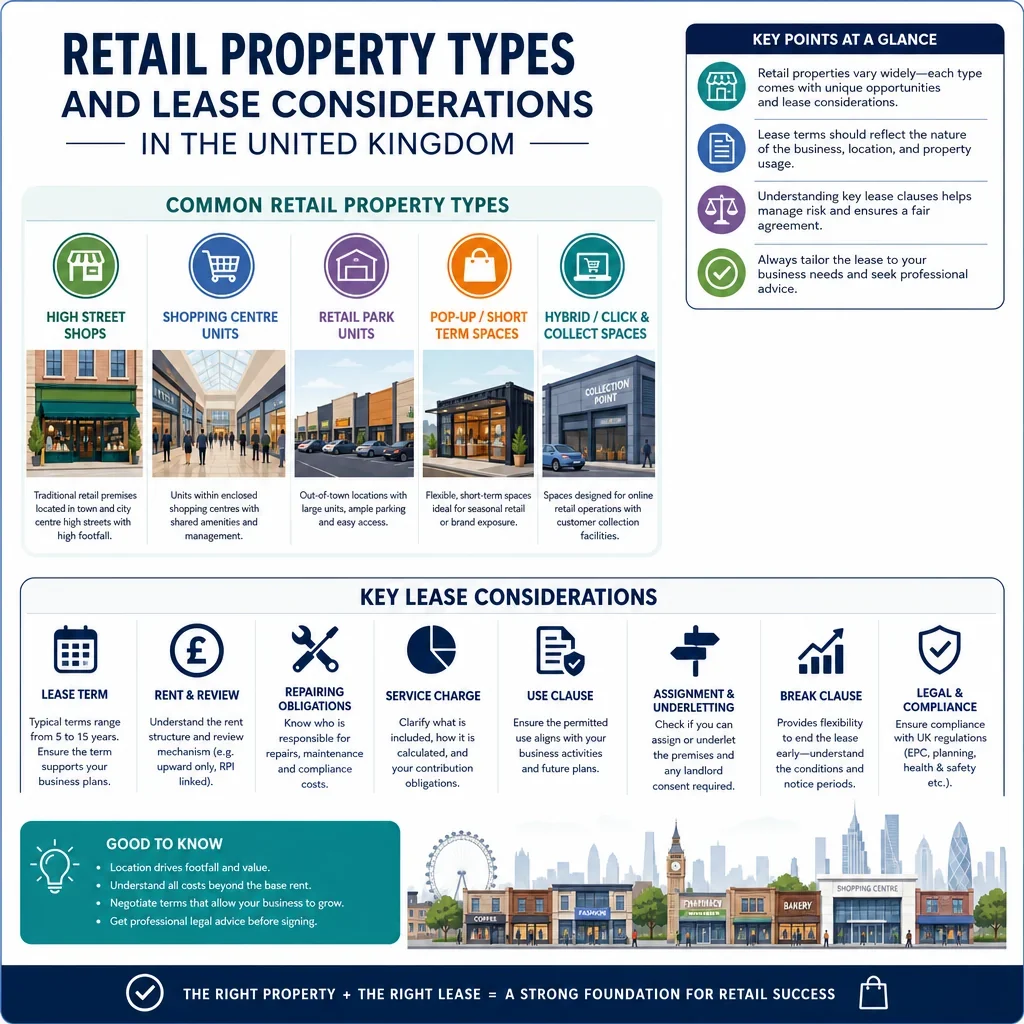
When do you need a Retail Lease Agreement in the United Kingdom?
British Legal Rules for a Retail Lease Agreement
Using the wrong type of lease structure, such as an assured shorthold tenancy instead of a business lease, can inadvertently grant the tenant unintended statutory protections under UK property law.
What a Proper Retail Lease Agreement Should Include
- Parties InvolvedClearly identifies the landlord and tenant, including their full names and addresses.
- Property DetailsDescribes the rented retail space, including its location, size, and any included features.
- Lease DurationSpecifies the start and end dates of the lease, along with any renewal options.
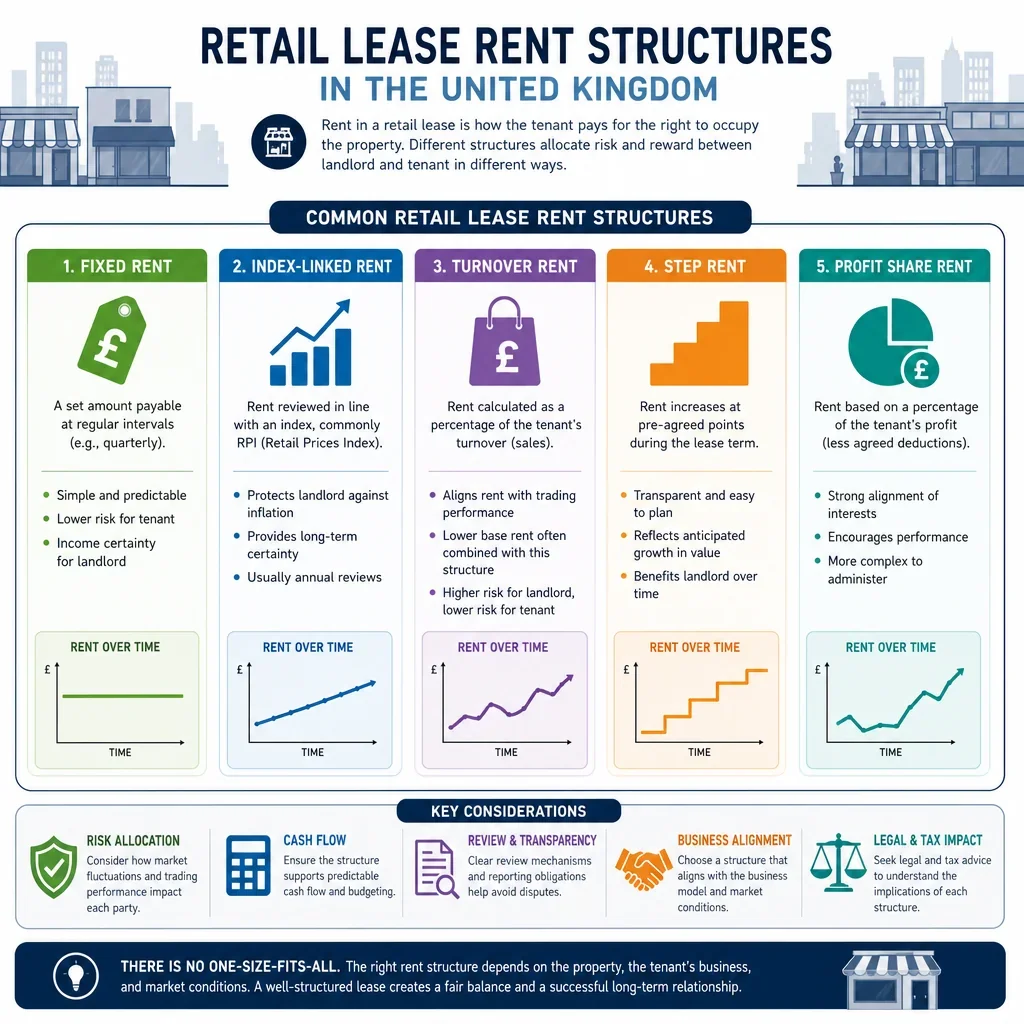
- Rent Amount and PaymentOutlines the total rent, payment schedule, and methods for increases over time.
- Deposit RequirementsDetails the security deposit amount, how it's held, and conditions for its return.
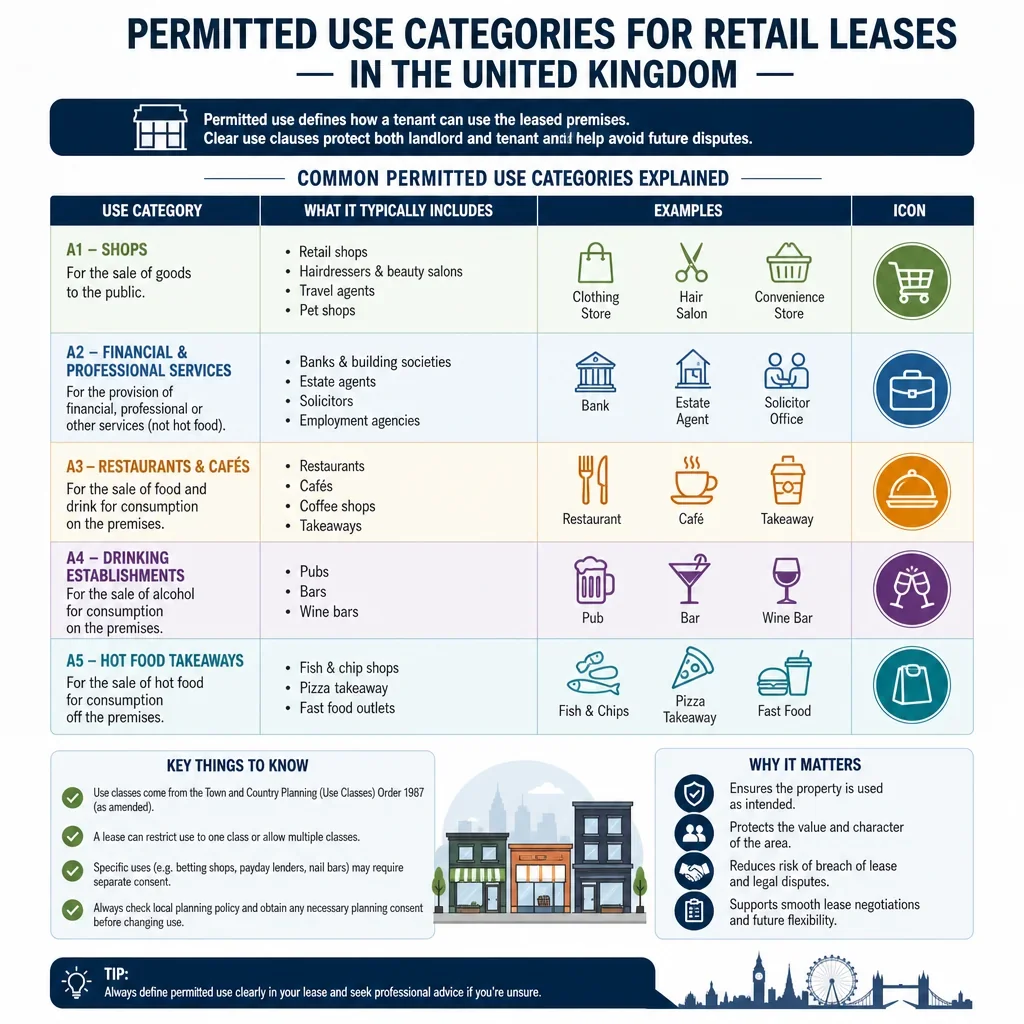
- Permitted UseDefines what business activities are allowed in the retail space.
- Maintenance DutiesExplains who is responsible for repairs and upkeep of the property.
- Insurance ObligationsRequires coverage for the property and business, specifying what each party must insure.
- Termination RulesCovers how the lease can end early and notice periods required.
- Dispute ResolutionProvides steps for handling disagreements, such as mediation or legal processes.
Generate Your Document in 4 Easy Steps
Why Use Docaro?
 United Kingdom
Free Example Retail Lease Agreement Template
Below is a free template example of a Retail Lease Agreement for use in the United Kingdom generated by our AI model.
The clauses in your actual Retail Lease Agreement will vary from this example as they will be entirely bespoke to your requirements as set out in the questionnaire you complete.
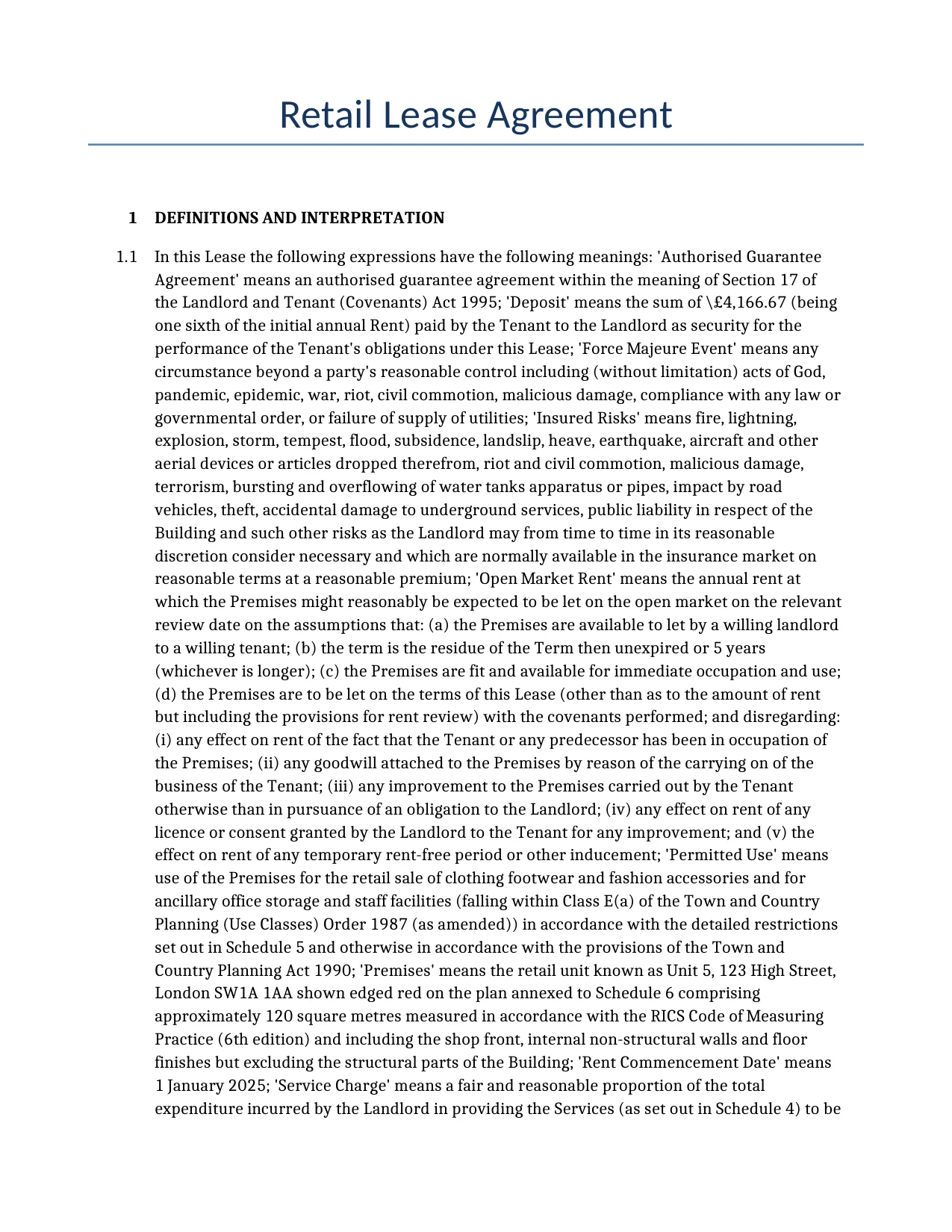
Retail Lease Agreement
1DEFINITIONS AND INTERPRETATION
In this Lease the following expressions have the following meanings: 'Authorised Guarantee Agreement' means an authorised guarantee agreement within the meaning of Section 17 of the Landlord and Tenant (Covenants) Act 1995; 'Deposit' means the sum of \£4,166.67 (being one sixth of the initial annual Rent) paid by the Tenant to the Landlord as security for the performance of the Tenant's obligations under this Lease; 'Force Majeure Event' means any circumstance beyond a party's reasonable control including (without limitation) acts of God, pandemic, epidemic, war, riot, civil commotion, malicious damage, compliance with any law or governmental order, or failure of supply of utilities; 'Insured Risks' means fire, lightning, explosion, storm, tempest, flood, subsidence, landslip, heave, earthquake, aircraft and other aerial devices or articles dropped therefrom, riot and civil commotion, malicious damage, terrorism, bursting and overflowing of water tanks apparatus or pipes, impact by road vehicles, theft, accidental damage to underground services, public liability in respect of the Building and such other risks as the Landlord may from time to time in its reasonable discretion consider necessary and which are normally available in the insurance market on reasonable terms at a reasonable premium; 'Open Market Rent' means the annual rent at which the Premises might reasonably be expected to be let on the open market on the relevant review date on the assumptions that: (a) the Premises are available to let by a willing landlord to a willing tenant; (b) the term is the residue of the Term then unexpired or 5 years (whichever is longer); (c) the Premises are fit and available for immediate occupation and use; (d) the Premises are to be let on the terms of this Lease (other than as to the amount of rent but including the provisions for rent review) with the covenants performed; and disregarding: (i) any effect on rent of the fact that the Tenant or any predecessor has been in occupation of the Premises; (ii) any goodwill attached to the Premises by reason of the carrying on of the business of the Tenant; (iii) any improvement to the Premises carried out by the Tenant otherwise than in pursuance of an obligation to the Landlord; (iv) any effect on rent of any licence or consent granted by the Landlord to the Tenant for any improvement; and (v) the effect on rent of any temporary rent-free period or other inducement; 'Permitted Use' means use of the Premises for the retail sale of clothing footwear and fashion accessories and for ancillary office storage and staff facilities (falling within Class E(a) of the Town and Country Planning (Use Classes) Order 1987 (as amended)) in accordance with the detailed restrictions set out in Schedule 5 and otherwise in accordance with the provisions of the Town and Country Planning Act 1990; 'Premises' means the retail unit known as Unit 5, 123 High Street, London SW1A 1AA shown edged red on the plan annexed to Schedule 6 comprising approximately 120 square metres measured in accordance with the RICS Code of Measuring Practice (6th edition) and including the shop front, internal non-structural walls and floor finishes but excluding the structural parts of the Building; 'Rent Commencement Date' means 1 January 2025; 'Service Charge' means a fair and reasonable proportion of the total expenditure incurred by the Landlord in providing the Services (as set out in Schedule 4) to be determined by the Landlord's surveyor acting reasonably and properly; 'Term' means a term of 5 years commencing on 1 January 2025 and expiring on 31 December 2029 (subject to the earlier termination of this Lease in accordance with its terms). In this Lease: (a) references to clauses, sections, paragraphs and Schedules are to clauses, sections, paragraphs and Schedules in this Lease; (b) headings are for ease of reference only and do not affect interpretation; (c) words importing one gender include all genders and the singular includes the plural and vice versa; (d) references to any statute include any modification extension or re-enactment of it and any subordinate legislation made under it; (e) obligations on the Tenant not to do any act or thing include an obligation not to permit or suffer that act or thing to be done; and (f) references to 'the Landlord' and 'the Tenant' include their respective successors in title.
2DATE AND PARTIES
This Lease is dated the 15th day of October 2024 and is made by way of deed between the parties identified below.
The Landlord is the party whose name address company registration number and contact details are set out in Schedule 1 to this Lease.
The Tenant is the party whose name address company registration number and contact details are set out in Schedule 1 to this Lease.
The Guarantor (if any) is the party whose name address and contact details are set out in Schedule 1 to this Lease.
3DEMISE AND TERM
In consideration of the rents covenants and agreements on the part of the Tenant hereinafter reserved and contained the Landlord hereby demises to the Tenant the Premises together with the rights set out in Schedule 2 but except and reserving to the Landlord the rights set out in Schedule 3 to hold the same to the Tenant for the Term.
The Premises are more particularly described in the definition of 'Premises' in clause 0.1 and shown edged red on the plan in Schedule 6.
The Premises include the right to use the common parts of the Building for the purposes of access to and from the Premises.
This Lease has been granted pursuant to section 38A of the Landlord and Tenant Act 1954 (as amended) and the parties have complied with the requirements of that section and the Regulatory Reform (Business Tenancies) (England and Wales) Order 2003. The Tenant confirms that before entering into this Lease it received independent legal advice from a qualified solicitor and a copy of the notice served under section 38A and the declaration made by the Tenant are annexed to this Lease.
4RENT AND OTHER PAYMENTS
The Tenant must pay to the Landlord during the Term without any deduction or set-off (except as provided in this Lease) the annual Rent of \£25,000.00 (subject to review in accordance with clause 4) such rent to be paid by equal monthly instalments in advance on the first day of each month the first such payment being a proportionate sum for the period from the Rent Commencement Date until the day before the next payment date.
The Rent Commencement Date is 1 January 2025.
The Tenant must pay all other sums due under this Lease on the dates and in the manner specified in this Lease.
If any sum payable under this Lease is not paid on the due date the Tenant shall pay interest on that sum at 4\% above the base rate of Barclays Bank plc from time to time from the due date until the date of actual payment (both before and after any judgment).
5RENT REVIEW
The Rent shall be reviewed on 1 January 2027 (the 'Review Date') to the higher of the Rent payable immediately before the Review Date and the Open Market Rent.
The Open Market Rent shall be determined in accordance with the definition in clause 0.1 on the basis of the assumptions and disregards set out in that definition.
The Landlord may initiate the rent review by serving on the Tenant not less than 6 months before the Review Date a notice in writing specifying the rent which the Landlord considers to be the Open Market Rent.
If the Landlord and the Tenant have not agreed the reviewed rent by the Review Date either party may refer the matter to an independent surveyor (acting as an expert and not as an arbitrator) to be appointed by agreement between the parties or in default of agreement by the President for the time being of the Royal Institution of Chartered Surveyors on the application of either party. The expert's decision shall be final and binding on the parties (save in the case of manifest error) and his costs shall be borne by the parties in such proportions as the expert shall direct (or equally in default of direction).
Pending determination of the reviewed rent the Tenant shall continue to pay rent at the rate then current. As soon as the reviewed rent has been determined any balance due to the Landlord (together with interest at the rate specified in clause 3.4 from the Review Date until payment) shall be paid by the Tenant to the Landlord within 14 days of determination.
6DEPOSIT
The Tenant has paid the Deposit to the Landlord on or before the date of this Lease. The Landlord shall hold the Deposit as stakeholder.
The Landlord shall hold the Deposit in an interest-bearing account with a UK clearing bank. The Landlord shall pay any interest accrued to the Tenant on an annual basis (after deduction of any tax).
If the Landlord applies any part of the Deposit in accordance with clause 5.4 the Tenant shall on demand pay to the Landlord such sum as is necessary to restore the Deposit to its original amount.
The Landlord may apply the Deposit or any part of it in or towards satisfaction of any breach by the Tenant of its obligations under this Lease (including any arrears of Rent or Service Charge) provided that the Landlord shall give the Tenant not less than 14 days' prior written notice of its intention to do so and shall provide a detailed breakdown of the amounts to be deducted. Any balance of the Deposit remaining after all proper deductions shall be returned to the Tenant (together with any accrued interest) within 28 days after the end of the Term (or earlier termination) and compliance by the Tenant with its obligations under this Lease.
7SERVICE CHARGE
The Tenant shall pay to the Landlord by way of additional rent the Service Charge which shall be a fair and reasonable proportion of the total costs and expenses incurred by the Landlord in providing the Services set out in Schedule 4 to be determined by the Landlord's surveyor acting reasonably and properly. The proportion shall be calculated by reference to the floor area of the Premises relative to the total floor area of the lettable parts of the Building (excluding common parts).
The Landlord shall prepare and deliver to the Tenant not later than 1 month before the start of each service charge year a budget of the estimated Service Charge for that year. The Tenant shall pay the estimated Service Charge by equal quarterly instalments in advance on the usual quarter days.
As soon as reasonably practicable after the end of each service charge year the Landlord shall provide the Tenant with a certified statement of the actual expenditure incurred together with supporting documentation and vouchers. There shall be an adjustment between the parties so that any overpayment by the Tenant shall be credited against the next Service Charge payment and any underpayment shall be paid by the Tenant within 14 days of demand.
The Service Charge shall exclude: (a) the costs of remedying any structural defects or inherent defects in the Building; (b) any costs incurred by the Landlord in connection with the grant of any lease or dealing with its own reversion; (c) any costs for which the Landlord is reimbursed under any insurance policy; and (d) any VAT chargeable in respect of the Services to the extent that the Landlord can recover the same.
Where the Service Charges (Consultation Requirements) (England) Regulations 2003 apply the Landlord shall comply with those requirements before incurring any qualifying works or entering into a qualifying long term agreement. The Service Charge is capped at an annual increase of no more than 5\% above the RPI for the preceding year (save in respect of insurance premiums which shall not be capped).
The service charge year shall commence on 1 January in each year.
8INSURANCE
The Landlord shall use its best endeavours to insure and keep insured the Building (including the Premises) against the Insured Risks in the full reinstatement value (plus VAT) with a reputable insurance office or underwriters and shall produce to the Tenant on request a copy of the policy and the last premium receipt.
The Tenant shall pay to the Landlord on demand a due proportion (calculated in the same manner as the Service Charge) of the premiums for such insurance and any related insurance valuation fees.
The Tenant shall insure and keep insured its own contents fixtures fittings stock and plate glass in the Premises and shall maintain public and employers' liability insurance in respect of its use of the Premises in an amount of not less than \£5,000,000. The Tenant shall provide evidence of such insurances to the Landlord on request.
If the Premises or any part of the Building are damaged or destroyed by an Insured Risk then (provided that the insurance has not been vitiated by any act neglect or default of the Tenant its employees or agents) the Landlord shall use all reasonable endeavours to reinstate the same as soon as reasonably practicable. The Landlord shall not be obliged to reinstate if: (a) planning permission for reinstatement is refused; (b) any superior landlord or mortgagee reasonably withholds consent; or (c) reinstatement is prevented by any circumstance beyond the Landlord's reasonable control. In any such case this Lease shall automatically determine.
If the Premises are damaged or destroyed by an Insured Risk then (subject as provided below) the Rent and Service Charge (or a fair proportion according to the nature and extent of the damage) shall be suspended from the date of damage until the earlier of: (a) the date on which the reinstatement is completed; or (b) the date 3 years after the date of damage. If the damage is caused by an act neglect or default of the Tenant its employees or agents then the suspension shall not apply and the Tenant shall pay to the Landlord on demand the amount of any uninsured loss suffered by the Landlord.
The Tenant shall comply with all requirements of the insurers and shall not do anything which may invalidate the insurance of the Building.
The Landlord shall comply with the requirements of the Regulatory Reform (Fire Safety) Order 2005 and shall provide the Tenant with copies of all fire risk assessments relating to the Building.
9REPAIR AND MAINTENANCE
The Tenant shall keep the Premises in good and substantial repair and condition except for: (a) damage by Insured Risks (unless the insurance has been vitiated by the Tenant); (b) inherent or latent defects; (c) structural repairs; and (d) fair wear and tear.
The Tenant shall not be liable for structural or external repairs (which shall be the responsibility of the Landlord subject to recovery through the Service Charge where appropriate). The Landlord shall be responsible for external decorations of the Building and the Tenant shall be responsible for internal non-structural decorations of the Premises as often as reasonably necessary.
The Tenant's liability under this clause 8 shall be limited by reference to the Schedule of Condition annexed to this Lease (which shall be prepared by the Landlord's surveyor and signed by the parties on or before the date of this Lease). The Tenant shall not be required to put the Premises into any better state of repair or condition than is evidenced by the Schedule of Condition.
The Tenant shall maintain the heating ventilation plumbing drainage and electrical installations within the Premises (but not the structural parts).
The Landlord shall maintain the common areas of the Building and shall comply with its obligations under the Equality Act 2010 in respect of reasonable adjustments for disabled persons.
The Tenant shall comply with all obligations relating to the management of asbestos (if any is identified in the Premises) under the Control of Asbestos Regulations 2012 and shall comply with all health and safety legislation.
At the end of the Term the Tenant shall yield up the Premises to the Landlord in the repair and condition required by this clause 8 (having regard to the Schedule of Condition) and with all fixtures and fittings belonging to the Landlord in situ.
10ALTERATIONS AND IMPROVEMENTS
The Tenant may carry out non-structural internal alterations without the consent of the Landlord provided that the Tenant gives the Landlord prior written notice of the works together with plans and specifications and complies with all statutory requirements (including obtaining all necessary planning permissions building regulation approvals and consents under the Party Wall etc. Act 1996).
The Tenant shall not carry out any other alterations or additions to the Premises without the prior written consent of the Landlord (such consent not to be unreasonably withheld or delayed). The Landlord may impose reasonable conditions on any consent including the requirement to provide collateral warranties from contractors and to reinstate at the end of the Term if required.
The Tenant shall comply with the Equality Act 2010 in respect of any alterations which affect access or facilities for disabled persons.
11USE OF THE PROPERTY
The Tenant shall not use the Premises otherwise than for the Permitted Use and shall comply with all planning permissions relating to the Premises under the Town and Country Planning Act 1990 (as amended) and the Town and Country Planning (Use Classes) Order 1987 (as amended).
The Tenant shall not use the Premises for any purpose which is noxious noisome or offensive or which may cause a nuisance or annoyance to the Landlord or the owners or occupiers of any adjoining property.
The Tenant shall comply with all obligations relating to energy performance certificates (EPCs) under the Energy Performance of Buildings (England and Wales) Regulations 2012 (as amended) and shall not carry out any works which would adversely affect the EPC rating of the Premises or the Building. The Tenant shall not do anything which would cause the Landlord to be in breach of the Minimum Energy Efficiency Standards Regulations.
The detailed description of the Permitted Use and any user restrictions are set out in Schedule 5.
12ASSIGNMENT AND SUBLETTING
The Tenant shall not assign the whole of this Lease without the prior written consent of the Landlord (such consent not to be unreasonably withheld or delayed). The Landlord may as a condition of giving consent require: (a) that all arrears of Rent and other sums due under this Lease are paid; (b) that the proposed assignee enters into a direct covenant with the Landlord to observe and perform the Tenant's covenants in this Lease; (c) that the proposed assignee demonstrates to the reasonable satisfaction of the Landlord that it is of good financial standing (by reference to audited accounts or bank references); (d) that the Tenant enters into an Authorised Guarantee Agreement in a form reasonably required by the Landlord; and (e) that the Tenant pays the Landlord's reasonable and proper legal and surveyor's costs in connection with the application for consent.
The Tenant shall not underlet the whole or any part of the Premises without the prior written consent of the Landlord (such consent not to be unreasonably withheld or delayed). Any underlease must: (a) be excluded from sections 24 to 28 of the Landlord and Tenant Act 1954 in accordance with the requirements of that Act; (b) contain covenants by the undertenant no less onerous than those contained in this Lease; (c) prohibit any further underletting or assignment of part only; and (d) require the undertenant to enter into direct covenants with the Landlord.
The Tenant shall not charge or part with possession of the Premises or any part of them.
Any change of control of the Tenant (if a company) shall be deemed to be an assignment for the purposes of this clause.
13COMPLIANCE WITH LAWS
The Tenant shall at all times comply with all applicable laws and regulations relating to its use and occupation of the Premises including (without limitation) the Regulatory Reform (Fire Safety) Order 2005 the Equality Act 2010 the Environmental Protection Act 1990 the Control of Asbestos Regulations 2012 the Energy Act 2011 and the Minimum Energy Efficiency Standards Regulations the Data Protection Act 2018 and UK GDPR.
The Tenant shall be responsible for obtaining and maintaining all necessary planning permissions licences and consents required for its use of the Premises under the Town and Country Planning Act 1990.
The Tenant shall comply with all obligations relating to disability access under the Equality Act 2010 and shall carry out at its own cost any alterations reasonably required to the Premises to comply with that Act.
The Tenant shall maintain a fire risk assessment for the Premises and shall comply with all requirements of the Landlord's fire risk assessment for the Building.
14UTILITIES AND OUTGOINGS
The Tenant shall be responsible for paying all utilities charges (including electricity gas water and telecommunications) and all business rates and other outgoings payable in respect of the Premises from the Rent Commencement Date.
The Tenant shall pay all such charges directly to the relevant suppliers or authorities.
15ACCESS FOR LANDLORD
The Landlord and its agents may enter the Premises at any reasonable time on giving not less than 48 hours' prior written notice (except in emergency when no notice is required) for the purposes of inspecting repairing or maintaining the Premises the Building or any adjoining property or for any other purpose connected with the Landlord's interest in the Premises.
The Landlord shall make good any damage caused to the Premises by such entry as soon as reasonably practicable.
16BREAK CLAUSES
The Tenant may terminate this Lease on 31 December 2027 (the 'Break Date') by giving to the Landlord not less than 6 months' prior written notice.
The break notice shall be in writing and shall be irrevocable. The break shall be conditional upon: (a) the Tenant having paid all Rent Service Charge and other sums due under this Lease up to and including the Break Date; (b) the Tenant having given vacant possession of the Premises on the Break Date; and (c) the Tenant having complied with all material covenants and obligations under this Lease up to the Break Date.
If the Tenant has overpaid any Rent or Service Charge in respect of any period after the Break Date the Landlord shall repay such overpayment to the Tenant within 14 days of the Break Date.
The break right granted to the Tenant is personal to the original Tenant and shall not enure for the benefit of any assignee.
17RENEWAL RIGHTS
The parties agree to contract out of the provisions of sections 24 to 28 (inclusive) of the Landlord and Tenant Act 1954. Before the grant of this Lease the Landlord served on the Tenant a notice in accordance with section 38A(3)(a) of that Act and the Tenant (or a person duly authorised by the Tenant) made a statutory declaration in accordance with the requirements of Schedule 2 to the Regulatory Reform (Business Tenancies) (England and Wales) Order 2003. A copy of the notice and the statutory declaration are annexed to this Lease. The Tenant confirms that it has received independent legal advice prior to entering into this Lease.
Both parties acknowledge that this Lease is excluded from the security of tenure protection of the Landlord and Tenant Act 1954.
18FORFEITURE
If any Rent or other sum payable under this Lease remains unpaid for 14 days after becoming due (whether formally demanded or not) or if the Tenant commits any other material breach of its obligations under this Lease and (if the breach is capable of remedy) fails to remedy the same within a reasonable time after service of a notice from the Landlord requiring remedy or if the Tenant becomes insolvent or enters into any arrangement or composition with its creditors then the Landlord may re-enter the Premises or any part of them and thereupon this Lease shall absolutely determine without prejudice to any claim by the Landlord for arrears of rent or for damages.
The Tenant shall have the right to apply to the Court for relief against forfeiture.
19TERMINATION AND YIELD UP
On the expiry or earlier termination of this Lease the Tenant shall yield up the Premises to the Landlord with vacant possession in the condition required by clause 8 and having removed all its fixtures fittings stock and debris and having made good any damage caused by such removal.
The Tenant shall deliver all keys to the Premises to the Landlord on termination.
20LANDLORD'S COVENANTS
The Landlord covenants with the Tenant that the Tenant may quietly hold and enjoy the Premises during the Term without any lawful interruption by the Landlord or any person claiming through under or in trust for the Landlord.
The Landlord covenants to carry out structural and external repairs to the Building (subject to recovery of the cost through the Service Charge where permitted by this Lease).
The Landlord covenants to insure the Building in accordance with clause 7.
The Landlord covenants to comply with all laws and regulations affecting the Building (including the Equality Act 2010 and the Regulatory Reform (Fire Safety) Order 2005).
The Landlord covenants to provide the Services set out in Schedule 4 in a reasonable and efficient manner.
21TENANT'S COVENANTS
The Tenant covenants with the Landlord to pay the Rent and all other sums due under this Lease on the days and in the manner specified in this Lease.
The Tenant covenants with the Landlord to pay all rates taxes and other outgoings payable in respect of the Premises.
The Tenant covenants with the Landlord to observe and perform all the covenants on its part contained in this Lease.
The Tenant covenants with the Landlord to comply with all statutes orders rules and regulations affecting the Premises or their use.
The Tenant covenants with the Landlord to permit the Landlord and its agents to enter the Premises in accordance with clause 14.
The Tenant covenants with the Landlord to keep the Premises in the repair and condition required by clause 8.
The Tenant covenants with the Landlord not to make any alterations to the Premises except in accordance with clause 9.
The Tenant covenants with the Landlord to use the Premises only for the Permitted Use.
The Tenant covenants with the Landlord not to assign underlet charge or part with possession of the Premises except in accordance with clause 11.
The Tenant covenants with the Landlord at the end of the Term to yield up the Premises in accordance with clause 18.
22GUARANTOR'S COVENANTS
The Guarantor covenants with the Landlord as a primary obligation that the Tenant will duly perform and observe all the covenants on the part of the Tenant contained in this Lease.
The Guarantor shall be jointly and severally liable with the Tenant.
If this Lease is disclaimed or forfeited the Guarantor shall on demand enter into a new lease of the Premises for the residue of the Term on the same terms as this Lease.
23VAT
All sums payable under this Lease are exclusive of VAT which shall be payable by the Tenant at the appropriate rate in addition to the sums themselves.
The Landlord has elected to waive exemption from VAT in respect of the Premises.
The Landlord shall issue valid VAT invoices to the Tenant.
24COSTS AND STAMP DUTY
Each party shall pay its own legal costs in connection with the preparation and completion of this Lease.
The Tenant shall pay the Stamp Duty Land Tax and Land Registry fees (if any) payable in respect of this Lease.
25NOTICES
Any notice under this Lease shall be in writing and shall be served in accordance with section 196 of the Law of Property Act 1925 (as amended by the Recorded Delivery Service Act 1962).
Notices to the Landlord shall be sent to the address set out in Schedule 1 or such other address as the Landlord may notify to the Tenant.
Notices to the Tenant shall be sent to the Premises or such other address as the Tenant may notify to the Landlord.
26DISPUTE RESOLUTION
Any dispute arising out of or in connection with this Lease shall be governed by and construed in accordance with the laws of England and Wales and the parties submit to the exclusive jurisdiction of the English courts.
27FORCE MAJEURE
Neither party shall be liable for any failure to perform its obligations under this Lease (other than the obligation to pay Rent or Service Charge) if such failure is due to a Force Majeure Event.
The affected party shall give written notice to the other party as soon as reasonably practicable after the occurrence of the Force Majeure Event.
If a Force Majeure Event continues for a period of more than 6 months either party may terminate this Lease by giving written notice to the other.
28SEVERANCE
If any provision of this Lease is held to be invalid or unenforceable such provision shall be severed from this Lease and the remaining provisions shall continue in full force and effect.
29WAIVER
No waiver by either party of any breach of any obligation under this Lease shall constitute a waiver of any other breach. Any waiver shall only be effective if given in writing.
30ENTIRE AGREEMENT
This Lease constitutes the entire agreement between the parties and supersedes all prior agreements understandings or arrangements whether oral or in writing. The Tenant acknowledges that it has not relied on any representations made by the Landlord outside this Lease.
31REGISTRATION AT HM LAND REGISTRY
If this Lease is capable of registration at HM Land Registry the Tenant shall within 14 days of the date of this Lease apply to register it at HM Land Registry and shall provide the Landlord with official copies of the registered title within 28 days of completion of registration.
32COUNTERPARTS
This Lease may be executed in any number of counterparts each of which when executed and delivered shall constitute a duplicate original but all the counterparts shall together constitute one and the same agreement.
33SCHEDULES
The Schedules attached to this Lease are incorporated into this Lease by reference.
34SCHEDULE 1 - PARTIES AND GUARANTOR
Landlord: [Full name] of [address] (Company Registration No. [number] if applicable). Tenant: [Full name] of [address] (Company Registration No. [number] if applicable). Guarantor: [Full name and address] (if applicable).
35SCHEDULE 2 - RIGHTS GRANTED
The rights granted to the Tenant include: (a) the right of way over the common parts of the Building for the purpose of access to and from the Premises; (b) the right to use the toilets and other facilities in the common parts; and (c) the right to the passage of services through the conduits in the Building.
36SCHEDULE 3 - EXCEPTIONS AND RESERVATIONS
The rights excepted and reserved to the Landlord include: (a) the right to enter the Premises for the purposes set out in clause 14; (b) the right to carry out works to any adjoining property; (c) all rights of light air support and shelter; and (d) the right to the passage of services through the conduits in the Premises.
37SCHEDULE 4 - SERVICES FOR SERVICE CHARGE
The Services include: (a) maintenance repair and decoration of the structure and common parts of the Building; (b) cleaning of the common parts; (c) provision of security; (d) maintenance of lifts and plant; (e) insurance of the Building; (f) management fees; and (g) such other services as the Landlord may reasonably consider necessary for the benefit of the tenants of the Building.
38SCHEDULE 5 - PERMITTED USE AND USER CLAUSE RESTRICTIONS
The Permitted Use is limited to the retail sale of clothing footwear and fashion accessories only. The Tenant shall not sell food alcohol tobacco or any goods which may emit odours or cause a nuisance. The Tenant shall comply with all trading hours and other restrictions imposed by the Landlord for the benefit of the Building as a whole.
39SCHEDULE 6 - PLAN
The plan of the Premises is annexed to this Lease and edged red. (In the absence of a physical plan the Premises are as described in the definition in clause 0.1.)
40EXECUTION
This document is executed and delivered as a deed. Executed as a deed by the Landlord acting by a director in the presence of a witness: Director: _______________________ (print name) Witness signature: _______________________ Witness name: _______________________ Witness address: _______________________
Executed as a deed by the Tenant acting by a director in the presence of a witness: Director: _______________________ (print name) Witness signature: _______________________ Witness name: _______________________ Witness address: _______________________
| GUARANTOR | |
| Signature: | |
| Print Name: | |
| Date: |
This example shows approximately 70% of a typical document and is provided for illustrative purposes only. The remaining content has been omitted.
Every document generated by Docaro is tailored to your specific circumstances, jurisdiction and the information you provide. The completed document includes all applicable clauses and provisions required for your situation.
To generate the full, personalised document, answer a short series of questions and your document will be created instantly.
Useful Resources When Considering a Retail Lease Agreement in the United Kingdom
United Kingdom Reference Legislation
Retail Lease Agreement FAQs
Document Generation FAQs
Related Articles