AI Generated British Shareholders' Agreement
PDF & Word - 2026 Updated
Docaro Pricing
When do you need a Shareholders' Agreement in the United Kingdom?
British Legal Rules for a Shareholders' Agreement
Selecting the incorrect structure for a shareholders' agreement may fail to adequately protect shareholders' rights or expose the company to unnecessary liabilities.
What a Proper Shareholders' Agreement Should Include
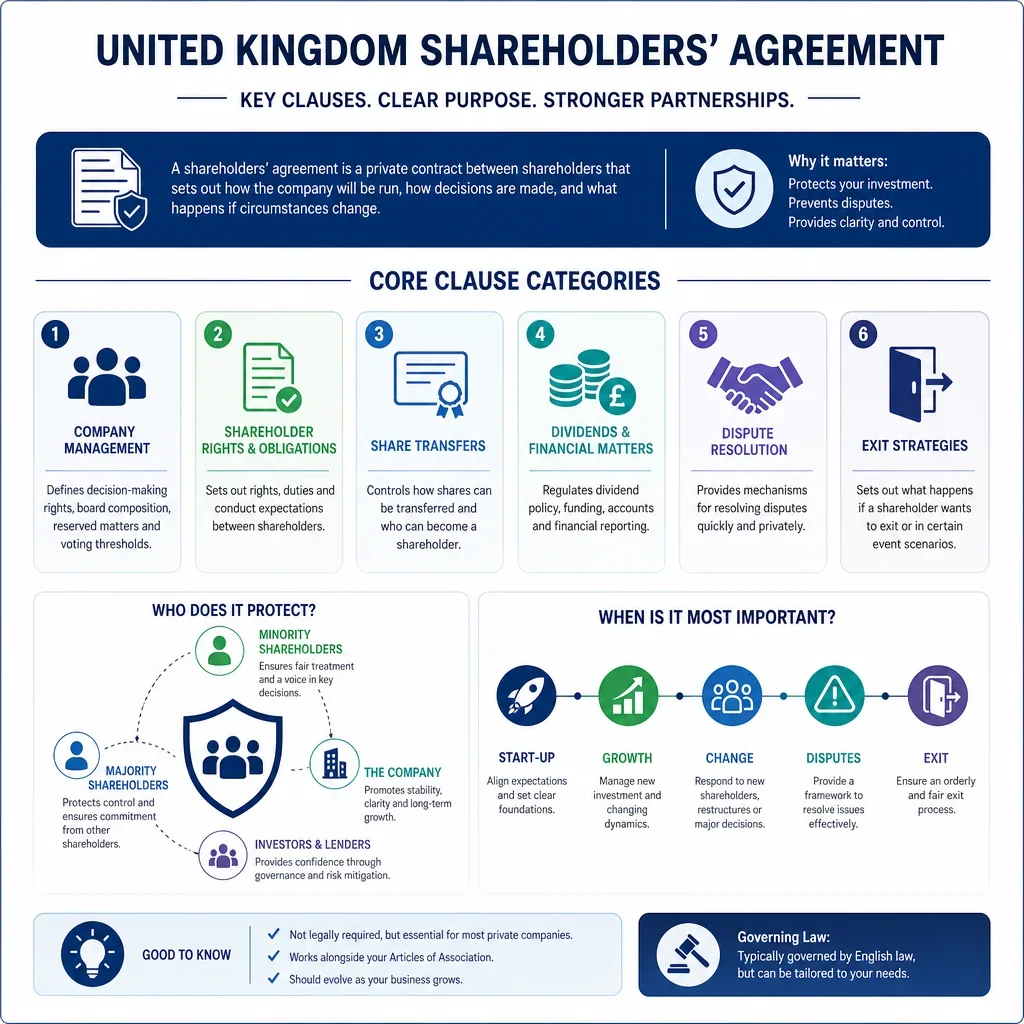
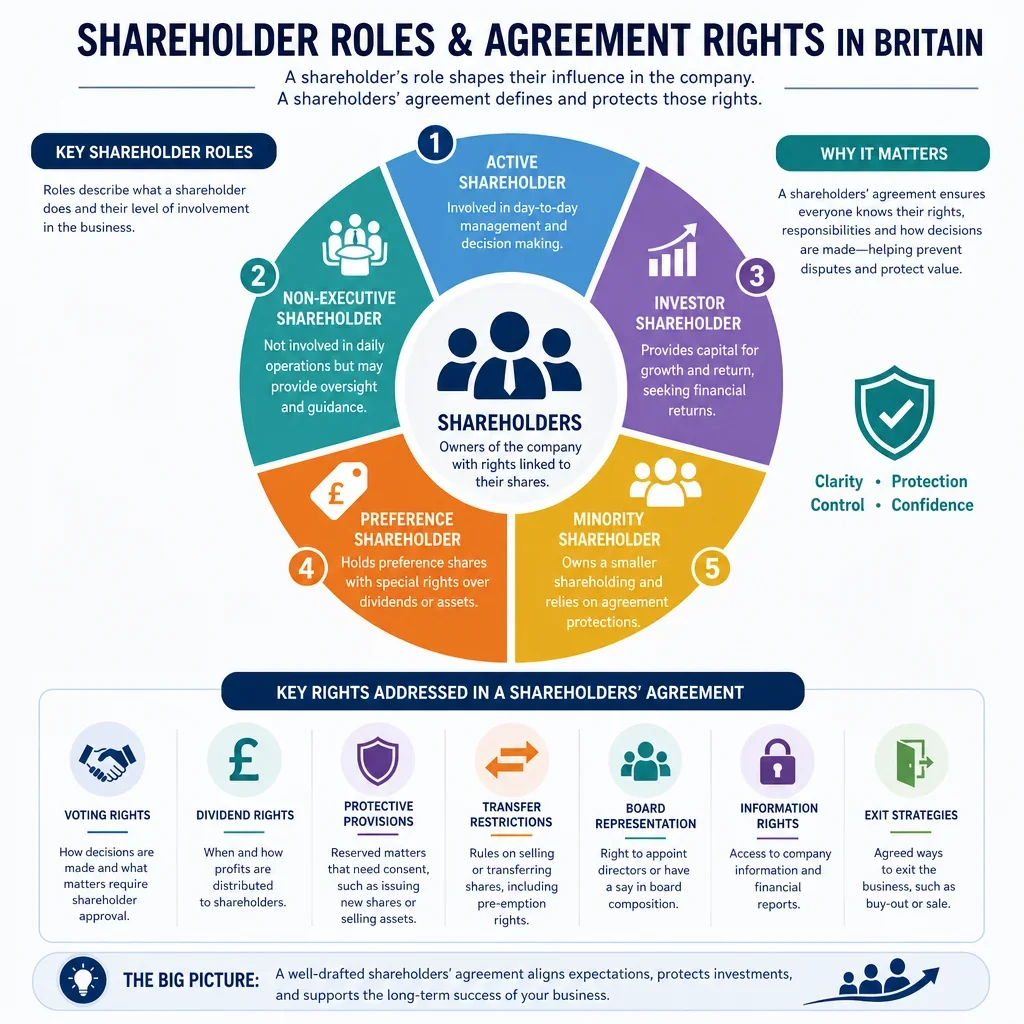
- Shareholder DetailsList all shareholders and their ownership percentages to clearly define who owns what in the company.
- Decision-Making RulesSet out how major decisions, like approving budgets or hiring key staff, will be made by shareholders.
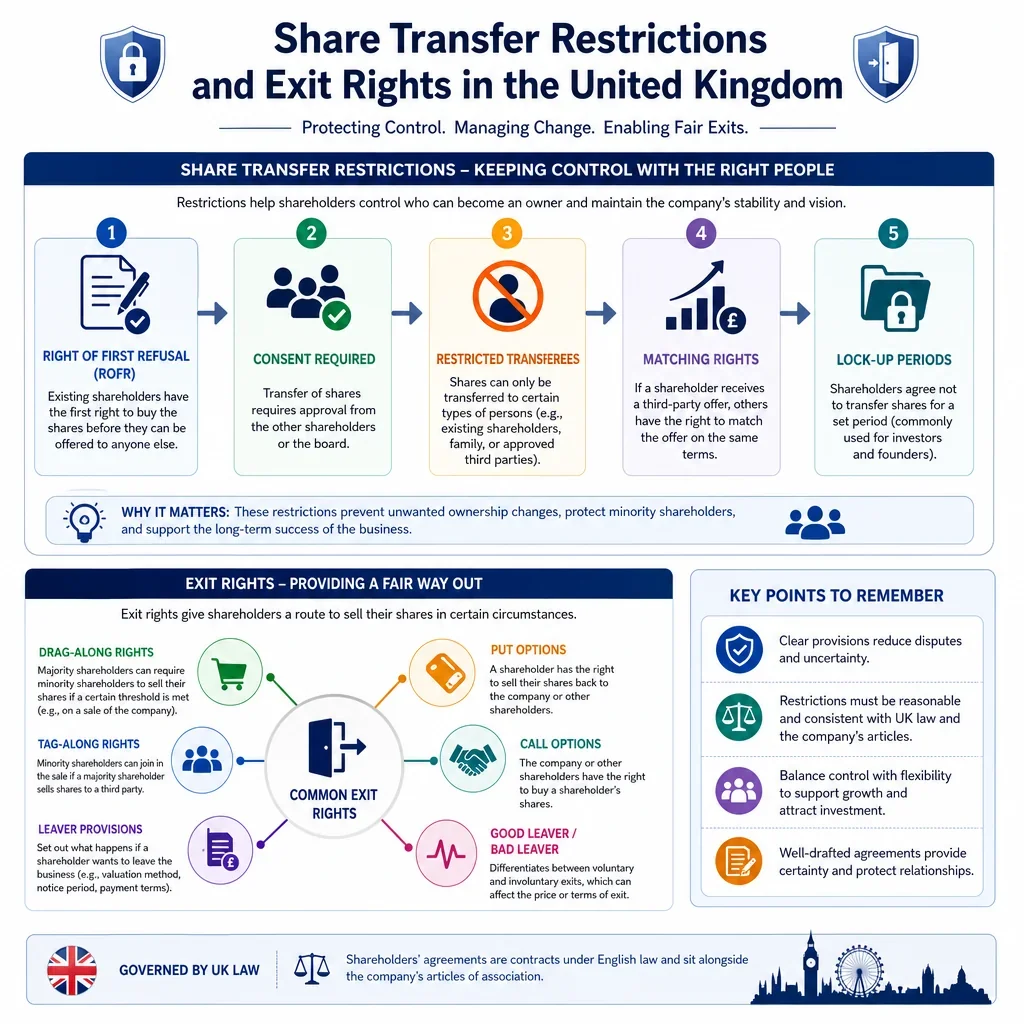
- Share Transfer ProcessExplain the steps for selling or transferring shares, including any rights of first refusal for existing shareholders.
- Dispute ResolutionOutline simple ways to handle disagreements between shareholders to avoid costly legal fights.
- Exit StrategiesDescribe options for shareholders leaving the company, such as buyouts or what happens if the business is sold.
- Non-Compete ClausesPrevent shareholders from starting rival businesses or poaching customers for a set period after leaving.
- Confidentiality RulesProtect the company's sensitive information by requiring shareholders to keep business secrets private.
- Dividend PoliciesDefine how and when profits will be shared among shareholders as dividends.
Generate Your Document in 4 Easy Steps
Why Use Docaro?
 United Kingdom
Free Example Shareholders' Agreement Template
Below is a free template example of a Shareholders' Agreement for use in the United Kingdom generated by our AI model.
The clauses in your actual Shareholders' Agreement will vary from this example as they will be entirely bespoke to your requirements as set out in the questionnaire you complete.
Shareholders' Agreement
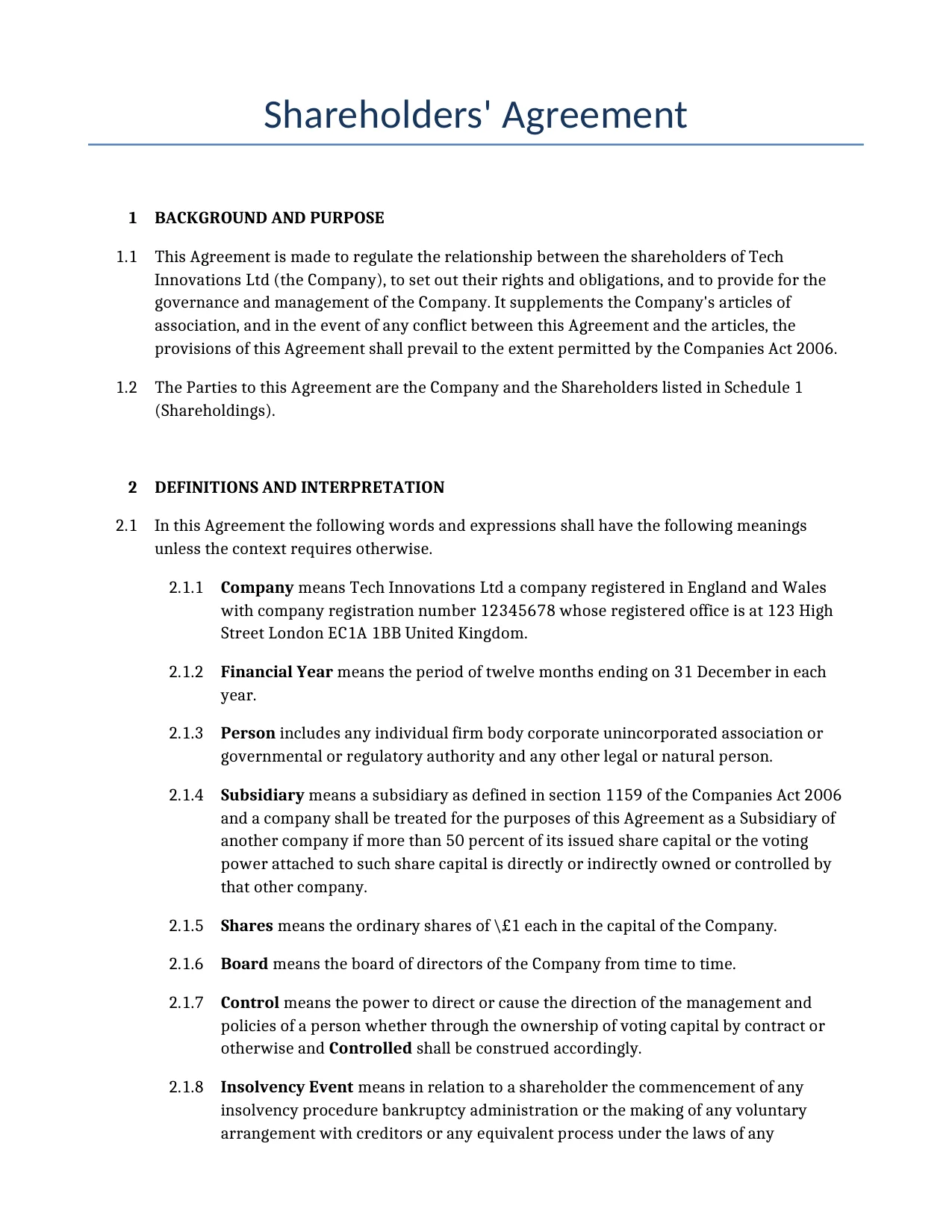
1BACKGROUND AND PURPOSE
This Agreement is made to regulate the relationship between the shareholders of Tech Innovations Ltd (the Company), to set out their rights and obligations, and to provide for the governance and management of the Company. It supplements the Company's articles of association, and in the event of any conflict between this Agreement and the articles, the provisions of this Agreement shall prevail to the extent permitted by the Companies Act 2006.
The Parties to this Agreement are the Company and the Shareholders listed in Schedule 1 (Shareholdings).
2DEFINITIONS AND INTERPRETATION
In this Agreement the following words and expressions shall have the following meanings unless the context requires otherwise.
Company means Tech Innovations Ltd a company registered in England and Wales with company registration number 12345678 whose registered office is at 123 High Street London EC1A 1BB United Kingdom.
Financial Year means the period of twelve months ending on 31 December in each year.
Person includes any individual firm body corporate unincorporated association or governmental or regulatory authority and any other legal or natural person.
Subsidiary means a subsidiary as defined in section 1159 of the Companies Act 2006 and a company shall be treated for the purposes of this Agreement as a Subsidiary of another company if more than 50 percent of its issued share capital or the voting power attached to such share capital is directly or indirectly owned or controlled by that other company.
Shares means the ordinary shares of \£1 each in the capital of the Company.
Board means the board of directors of the Company from time to time.
Control means the power to direct or cause the direction of the management and policies of a person whether through the ownership of voting capital by contract or otherwise and Controlled shall be construed accordingly.
Insolvency Event means in relation to a shareholder the commencement of any insolvency procedure bankruptcy administration or the making of any voluntary arrangement with creditors or any equivalent process under the laws of any jurisdiction.
Parties means the parties to this Agreement being the Company and the Shareholders.
Shareholders means the holders of Shares in the Company from time to time who are parties to this Agreement.
Headings are included for convenience only and shall not affect the interpretation of this Agreement.
References to clauses schedules and paragraphs are to the clauses schedules and paragraphs of this Agreement.
References to any statute or statutory provision shall include any modification amendment consolidation or re-enactment thereof for the time being in force.
3PARTIES
The Parties to this Agreement are:
Tech Innovations Ltd (the Company) whose registered office is at 123 High Street London EC1A 1BB United Kingdom.
John Alexander Smith of 45 Oak Avenue London N1 2AB (founder holding 250 Shares representing 50\% of the issued share capital).
Emma Louise Patel of 78 Pine Road Manchester M2 4CD (founder holding 125 Shares representing 25\% of the issued share capital).
Michael James Wong of 12 Elm Street Bristol BS1 5EF (founder holding 125 Shares representing 25\% of the issued share capital).
Sarah Elizabeth Smith (spouse of John Alexander Smith) of 45 Oak Avenue London N1 2AB (holding 20 Shares).
David Robert Patel (father of Emma Louise Patel) of 22 Maple Close Birmingham B3 7GH (holding 30 Shares).
And any other person who becomes a Shareholder and executes a deed of adherence to this Agreement.
This Agreement is made between the Parties to regulate their relationship as shareholders in the Company and to set out their respective rights and obligations.
4RECITALS
The Company was incorporated on 10 May 2020 under the Companies Act 2006 with registered number 12345678.
The principal activity of the Company is software development and IT consulting and the Company develops and sells software solutions for small businesses in the tech sector.
The current shareholdings of the Shareholders are as set out in Schedule 1 to this Agreement which also details the date of acquisition consideration paid and percentage ownership of each Shareholder. The share capital of the Company consists of 500 ordinary shares of \£1 each all of which are fully paid up.
The Company was founded by the three founders (John Alexander Smith Emma Louise Patel and Michael James Wong) in 2020 with subsequent investments from family members.
The Parties have agreed to enter into this Agreement to formalise the rights and obligations of the Shareholders to ensure smooth governance of the Company to regulate decision-making voting rights share transfers and exits and to protect the legitimate interests of all Shareholders.
5SHARE CAPITAL AND SHARES
The authorised share capital of the Company is \£1000 divided into 1000 ordinary shares of \£1 each.
The issued share capital of the Company consists of 500 ordinary shares of \£1 each all of which are fully paid up. The current shareholdings are set out in Schedule 1.
The Company has issued only ordinary shares and no other classes of shares have been issued.
All references to shareholdings in this Agreement shall be to the holdings set out in Schedule 1 as updated from time to time.
6ISSUE OF NEW SHARES
The Company shall not issue any new shares unless the pre-emption rights set out in this clause 6 have first been complied with.
The Company shall give each existing Shareholder not less than 14 days notice of its intention to issue new shares specifying the number of shares proposed to be issued and the price at which they are to be issued which price shall be the fair market value as determined by the Board acting reasonably.
Each existing Shareholder shall have the right to subscribe for a proportion of the new shares equal to the proportion which the number of shares held by that Shareholder bears to the total number of issued shares in the Company at the date of the notice.
Any offer made pursuant to this clause 6 shall remain open for acceptance for a period of 21 days from the date of the notice.
The Board shall approve the issue of new shares by simple majority vote at a scheduled board meeting of which not less than 7 days notice has been given.
New shares may be subscribed for in cash or by set off against any debt owed by the Company to the subscriber.
Existing Shareholders may waive their pre-emption rights by notice in writing to the Company.
7TRANSFER OF SHARES
No Shareholder shall transfer any Shares in the Company except in accordance with the provisions of this clause 7. Any transfer of Shares shall comply with the provisions of the Company's articles of association and the Companies Act 2006.
The following transfers shall be permitted transfers and shall not be subject to the pre-emption provisions of this clause 7 namely transfers to family members (as defined in the articles) transfers to existing Shareholders and transfers upon the death or incapacity of a Shareholder or pursuant to a will or intestacy.
Any Shareholder proposing to transfer Shares other than by way of a permitted transfer shall give not less than 30 days notice to the other Shareholders of the proposed transfer specifying the number of Shares the price and the identity of the proposed transferee (a Transfer Notice).
The other Shareholders shall have the right to purchase the Shares proposed to be transferred in proportion to their existing shareholdings (or in such other proportions as they may agree) such right to be exercised by notice within 21 days of receipt of the Transfer Notice (the Pre-Emption Right).
If not all Shares are purchased pursuant to the Pre-Emption Right the proposing transferor may transfer the remaining Shares to the proposed transferee within 30 days at the price and on the terms specified in the Transfer Notice provided that the transferee executes a deed of adherence to this Agreement.
Any non-permitted transfer shall require the prior approval of the Board which approval may be withheld in the absolute discretion of the Board.
If Shareholders holding at least 75 percent of the Shares in the Company (the Dragging Shareholders) agree to sell all of their Shares to a third party purchaser (a Drag Along Sale) then all other Shareholders shall be required to sell their Shares to the same purchaser on the same terms and conditions (including price) as the Dragging Shareholders. The Dragging Shareholders shall procure that the buyer executes a deed of adherence if required. This is the drag-along right.
The fair valuation process for any compulsory sale shall be determined by an independent valuer appointed by the Board (acting reasonably) whose decision shall be final and binding.
Payment terms shall be as agreed with the third party purchaser but in any event completion shall occur within 60 days of the Drag Along Sale notice.
Completion mechanics shall include execution of stock transfer forms delivery of share certificates and payment of the purchase price.
If a Shareholder proposes to sell Shares to a third party then the other Shareholders shall have the right to require that their Shares are also sold to the same third party on the same terms and conditions (including price) which provision shall constitute the tag-along right. This right must be exercised within 21 days of the Transfer Notice.
All share certificates shall be endorsed with a legend stating that the Shares are subject to the transfer restrictions and pre-emption rights contained in this Agreement.
Leaver provisions shall apply as follows: (a) a Good Leaver (e.g. redundancy ill health or retirement at normal retirement age) may transfer Shares at fair market value determined by an independent valuer; (b) a Bad Leaver (e.g. dismissal for cause breach of this Agreement or competing with the Company) shall be required to transfer Shares at the lower of fair market value or the price originally paid for the Shares. The Board shall determine in good faith whether a leaver is a Good Leaver or Bad Leaver. Compulsory transfer events also include an Insolvency Event or material breach of this Agreement.
8MANAGEMENT AND DECISION-MAKING
The Board of the Company shall consist of a fixed number of 5 directors. Directors shall be nominated as follows: up to 3 directors may be nominated by Shareholders holding a majority of the Shares and the remaining directors shall be nominated by the other Shareholders in proportion to their shareholdings (subject to the articles of association). This Agreement amends and supplements the Company's articles of association to the extent necessary to give effect to these nomination rights and any conflict shall be resolved in favour of this Agreement.
Directors shall be appointed by ordinary resolution of the Shareholders at a general meeting. A director may be removed by a resolution passed by at least 75 percent of the Shareholders present and voting at a general meeting.
Board meetings shall require not less than 7 days written notice to all directors specifying the date time place and agenda. Shorter notice may be given with the consent of all directors.
Voting at board meetings shall be on a one director one vote basis. In the event of an equality of votes the chair shall have a casting vote.
The following matters shall be reserved matters which shall require the unanimous consent of all Shareholders (rather than 75 percent) before they may be undertaken by the Company (in addition to any matters reserved in the articles):
The approval of the annual business plan and budget.
The borrowing of any sum in excess of \£10000.
The acquisition or disposal of any material asset (exceeding \£5000 in value).
Any change to the articles of association of the Company.
The appointment or removal of any director (other than as provided in this Agreement).
Any transaction with a connected person (as defined in the Companies Act 2006).
Voting rights at general meetings shall be proportional to shareholding.
The quorum for board meetings shall be 3 directors present in person or by alternate.
Each director owes fiduciary duties to the Company under the Companies Act 2006. In the event of a conflict of interest a director must declare the conflict and shall not vote on the matter unless authorised by the Board or Shareholders in accordance with the articles and the Companies Act 2006.
9SHAREHOLDERS' MEETINGS
Not less than 14 days notice shall be given of any shareholders meeting.
Shareholders meetings may be convened on shorter notice if all Shareholders agree in writing.
The quorum for shareholders meetings shall be 2 Shareholders present in person or by proxy (representing at least 50 percent of the Shares).
The Company shall hold an annual general meeting in each calendar year.
Shareholders meetings may be held virtually or by electronic means provided that all participants can communicate with each other simultaneously.
Notices of shareholders meetings may be given by post email or hand delivery to the address of each Shareholder appearing in the register of members.
Ordinary resolutions at shareholders meetings shall be passed by a simple majority of more than 50 percent of the votes cast. Special resolutions shall require at least 75 percent.
10DIVIDENDS AND DISTRIBUTIONS
Dividends shall be declared annually by the Company.
Dividends may only be declared if the Company has sufficient distributable profits and has achieved a minimum profit threshold of \£50000 as shown in the latest audited accounts (or such other threshold as the Shareholders may agree).
Dividends shall be distributed pro rata to the shareholdings of the Shareholders.
Shareholders may waive their right to receive dividends by notice in writing to the Company.
11DEADLOCK
In the event of a deadlock in decision-making at board or shareholder level either Shareholder may initiate the buy-sell provision by serving not less than 30 days notice on the other Shareholders.
The notice shall specify the price at which the initiating Shareholder is willing either to buy the Shares of the other Shareholders or to sell its own Shares to the other Shareholders.
The recipient of the notice shall within 30 days elect either to buy or to sell at the price specified in the notice. If no election is made the initiating Shareholder shall have the right to buy the Shares at the specified price.
12CONFIDENTIALITY
Each Shareholder shall keep confidential all information relating to the business and affairs of the Company and shall not disclose such information to any third party without the prior written consent of the other Shareholders.
The confidentiality obligations shall not apply to information which is already in the public domain or which is required to be disclosed by law or regulation.
The confidentiality obligations shall continue for a period of 5 years after termination of this Agreement or the relevant Shareholder ceasing to hold Shares (whichever is later).
Shareholders may disclose confidential information without prior consent to their professional advisors and to regulatory authorities where required provided that they procure that such advisors are bound by equivalent confidentiality obligations.
Upon termination of this Agreement the receiving party shall return or destroy all confidential information within 30 days and shall provide written confirmation of such destruction to the disclosing party.
The parties agree that damages may not be an adequate remedy for breach of this clause 12 and that injunctive relief may be sought to prevent any actual or threatened breach.
13NON-COMPETE AND NON-SOLICITATION
Each Shareholder undertakes that for a period of 12 months after ceasing to be a Shareholder or employee of the Company it will not directly or indirectly engage in any competing business which is similar to the business of the Company (being software development and IT consulting for small businesses) within the United Kingdom only provided that this restriction shall only apply to protect the legitimate business interests of the Company and shall be limited to activities in which the Shareholder was materially involved.
Each Shareholder undertakes that for a period of 12 months after ceasing to be a Shareholder or employee of the Company it will not solicit or entice away any employee customer or supplier of the Company with whom the Shareholder had material dealings in the 12 months prior to cessation.
If any of the restrictions in this clause 13 is held to be invalid or unenforceable the parties agree that the court may apply the blue pencil test to delete words or phrases to make the restriction reasonable and enforceable to the maximum extent permitted by law (including under the principles in Tillman v Egon Zehnder [2019] UKSC 32). Each restriction is intended to be separate and severable.
The Shareholders acknowledge that these restrictions are reasonable necessary to protect the legitimate business interests of the Company (including goodwill confidential information and customer connections) and the consideration for these covenants is the mutual promises in this Agreement.
14INTELLECTUAL PROPERTY
The Company owns a registered trademark TechInnovate (UK Trade Mark No. 1234567) for software services and a patent for its core algorithm (UK Patent No. GB7890123A) and uses licensed software from third parties under standard agreements.
Any intellectual property created by Shareholders in the course of their duties to the Company shall be automatically assigned to the Company with full title guarantee.
Shareholders shall grant the Company a perpetual royalty-free irrevocable licence to use any background intellectual property necessary for the business of the Company.
The Company shall be responsible for registering and maintaining all intellectual property rights and for handling all enforcement and defence of such rights including any infringement claims by or against third parties.
Shareholders shall comply with the confidentiality obligations in clause 12 to protect trade secrets and other intellectual property of the Company.
15WARRANTIES AND REPRESENTATIONS
Each Shareholder warrants to the Company only (and not to the other Shareholders) on the date of this Agreement that:
it has full power and authority to enter into this Agreement and to perform its obligations hereunder;
it has valid and unencumbered title to all the Shares which it holds in the Company and there are no encumbrances liens or charges on any of the Shares;
the warranties in this clause 15 are given subject to the matters disclosed in the disclosure letter/schedule delivered to the Company on the date of this Agreement (the Disclosure Letter).
The fundamental warranties in this clause 15 are the only warranties given in this Agreement. No other representations or warranties are made or implied. Liability for breach of these warranties shall be limited as set out in clause 16.
16INDEMNITIES AND LIMITATION OF LIABILITY
Each Shareholder shall indemnify the Company against any losses arising directly from any breach of the warranties in clause 15 or from any third party claims resulting from such breach.
The total liability of each Shareholder under this clause 16 shall not exceed the aggregate amount paid by that Shareholder for its Shares (or \£100000 whichever is lower).
The indemnities and warranties shall survive for a period of 2 years from the date of this Agreement except for claims in respect of title to Shares or tax matters which shall survive for 7 years.
Any party claiming under this indemnity shall notify the indemnifying party promptly and in any event within 30 days of becoming aware of the claim. The indemnifying party shall have the right to control the defence of any claim (at its cost).
Liability under this Agreement is subject to the following limitations: (a) no liability for indirect or consequential loss; (b) de minimis threshold of \£1000 per claim and \£5000 in aggregate; (c) the claimant must mitigate its losses; (d) no double recovery.
Schedule 2 contains the Disclosure Letter qualifying the warranties in clause 15.
17TERMINATION
This Agreement shall commence on the date of this Agreement and shall continue until terminated in accordance with this clause 17 or until all Shares are held by one Shareholder.
This Agreement may be terminated by mutual consent of all Shareholders or upon the death bankruptcy Insolvency Event or material breach of this Agreement by a Shareholder which breach is not remedied within 30 days of notice.
A Shareholder may voluntarily cease to be a party to this Agreement by transferring all its Shares in accordance with clause 7 and executing a deed of adherence with any new Shareholder (if applicable).
Upon termination due to death bankruptcy Insolvency Event or leaver provisions the Shares of that Shareholder shall be bought out at fair market value (or discounted value for Bad Leavers) as determined by an independent valuer appointed by the Board whose decision shall be final.
The provisions of clauses 12 (Confidentiality) 13 (Non-Compete and Non-Solicitation) 14 (Intellectual Property) and 16 (Indemnities and Limitation of Liability) shall survive termination of this Agreement.
18GOVERNING LAW AND JURISDICTION
This Agreement and any dispute or claim arising out of or in connection with it or its subject matter or formation (including non-contractual disputes or claims) shall be governed by and construed in accordance with the laws of England and Wales.
The parties irrevocably agree that the courts of England and Wales shall have exclusive jurisdiction to settle any dispute or claim that arises out of or in connection with this Agreement or its subject matter or formation (including non-contractual disputes or claims).
19DISPUTE RESOLUTION
Any dispute arising out of or in connection with this Agreement shall first be referred to mediation in accordance with the London Court of International Arbitration mediation rules.
If the dispute is not resolved by mediation within 30 days it shall be referred to and finally resolved by arbitration under the London Court of International Arbitration rules which rules are deemed to be incorporated by reference into this clause.
The seat of arbitration shall be London and the arbitration shall be conducted by a single arbitrator.
The language of the arbitration shall be English and the arbitration award shall be final and binding.
All dispute resolution proceedings shall be confidential.
20ASSIGNMENT
No party may assign transfer or otherwise deal with any of its rights or obligations under this Agreement without the prior unanimous consent of all Shareholders.
No party may delegate any of its obligations under this Agreement without the prior unanimous consent of all Shareholders.
21ENTIRE AGREEMENT
This Agreement constitutes the entire agreement between the parties and supersedes all prior understandings whether oral or written relating to its subject matter. This Agreement is not intended to create a partnership or agency relationship between the parties.
This clause 21 is governed by English law.
22SEVERABILITY
If any provision of this Agreement is held to be invalid or unenforceable then such provision shall be severable from the remaining provisions of this Agreement which shall continue to be valid and enforceable to the fullest extent permitted by law.
23NOTICES
Any notice required to be given under this Agreement shall be in writing and shall be sent by post email or hand delivery to the address of the relevant party which address for the Company and Shareholders shall be as set out in clause 3 or the register of members or such other address as may be notified from time to time.
Notices sent by post shall be deemed served 48 hours after posting. Notices sent by email shall be deemed served immediately upon transmission provided no delivery failure message is received.
24COUNTERPARTS
This Agreement may be executed in any number of counterparts each of which when executed and delivered shall constitute one and the same instrument.
Electronic signatures shall be permitted and shall have the same effect as original signatures.
25BOILERPLATE PROVISIONS
No variation of this Agreement shall be effective unless it is in writing and signed by or on behalf of each of the parties.
The rights of the parties under this Agreement may be waived only by notice in writing signed by the party granting the waiver.
This Agreement is binding on and shall enure for the benefit of the successors in title and permitted assigns of the parties.
Each party shall at its own cost do all such further acts and things and execute all such further documents as may be necessary to give effect to the provisions of this Agreement (further assurance).
Each party shall bear its own costs in relation to the negotiation preparation and execution of this Agreement.
Nothing in this Agreement is intended to or shall operate to create a partnership or joint venture of any kind between the parties or to authorise any party to act as agent for any other party. No party shall have authority to act in the name or on behalf of or otherwise to bind any other party.
A person who is not a party to this Agreement shall have no right under the Contracts (Rights of Third Parties) Act 1999 to enforce any term of this Agreement. This clause does not affect any right or remedy of any person which exists or is available otherwise than pursuant to that Act.
Each party shall comply with all applicable requirements of the General Data Protection Regulation (GDPR) and the Data Protection Act 2018 in relation to any personal data processed in connection with this Agreement.
Each party shall comply with all applicable laws relating to anti-bribery and anti-corruption including the Bribery Act 2010 and shall not engage in any activity that would constitute an offence under that Act.
No party shall be liable for any failure to perform or delay in performing its obligations under this Agreement to the extent that such failure or delay is caused by a force majeure event (being any event beyond a party's reasonable control including acts of God war riot or civil unrest).
This Agreement has been entered into on the date first written above.
26EXECUTION
This Agreement is executed and delivered as a deed by the parties on the date of this Agreement. It is intended to be and is executed and delivered as a deed pursuant to section 1 of the Law of Property (Miscellaneous Provisions) Act 1989.
SIGNED as a deed by Tech Innovations Ltd acting by a director in the presence of a witness:
Director: _______________________________
Witness signature: _______________________________
Witness name: _______________________________
Witness address: _______________________________
SIGNED as a deed by John Alexander Smith in the presence of a witness:
Signature: _______________________________
Witness signature: _______________________________
Witness name: _______________________________
Witness address: _______________________________
SIGNED as a deed by Emma Louise Patel in the presence of a witness:
Signature: _______________________________
Witness signature: _______________________________
Witness name: _______________________________
Witness address: _______________________________
SIGNED as a deed by Michael James Wong in the presence of a witness:
Signature: _______________________________
Witness signature: _______________________________
Witness name: _______________________________
Witness address: _______________________________
SIGNED as a deed by Sarah Elizabeth Smith in the presence of a witness:
Signature: _______________________________
Witness signature: _______________________________
Witness name: _______________________________
Witness address: _______________________________
SIGNED as a deed by David Robert Patel in the presence of a witness:
Signature: _______________________________
Witness signature: _______________________________
Witness name: _______________________________
Witness address: _______________________________
This example shows approximately 70% of a typical document and is provided for illustrative purposes only. The remaining content has been omitted.
Every document generated by Docaro is tailored to your specific circumstances, jurisdiction and the information you provide. The completed document includes all applicable clauses and provisions required for your situation.
To generate the full, personalised document, answer a short series of questions and your document will be created instantly.
Useful Resources When Considering a Shareholders' Agreement in the United Kingdom
United Kingdom Reference Legislation
Shareholders' Agreement FAQs
Document Generation FAQs
Related Articles