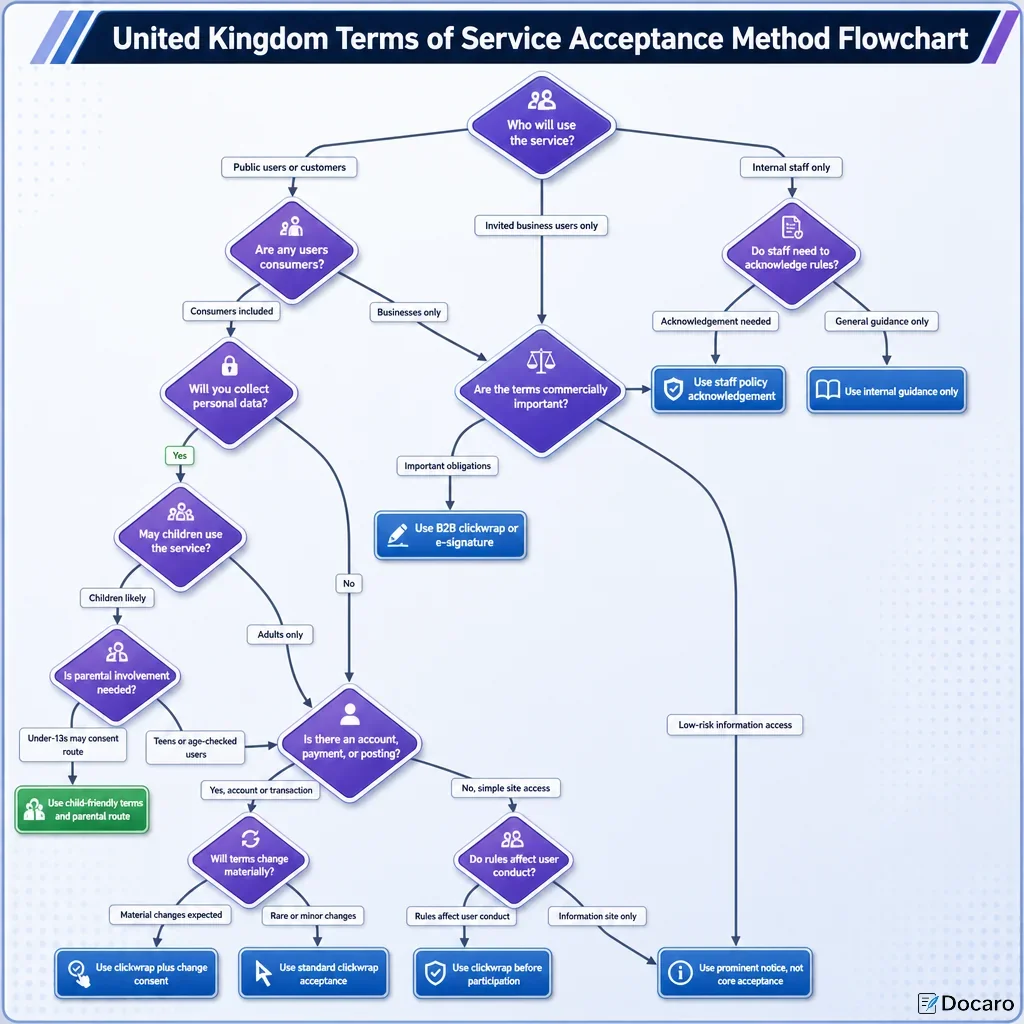
AI Generated Terms of Service for use in the United Kingdom
PDF & Word - 2026 Updated
Docaro Pricing
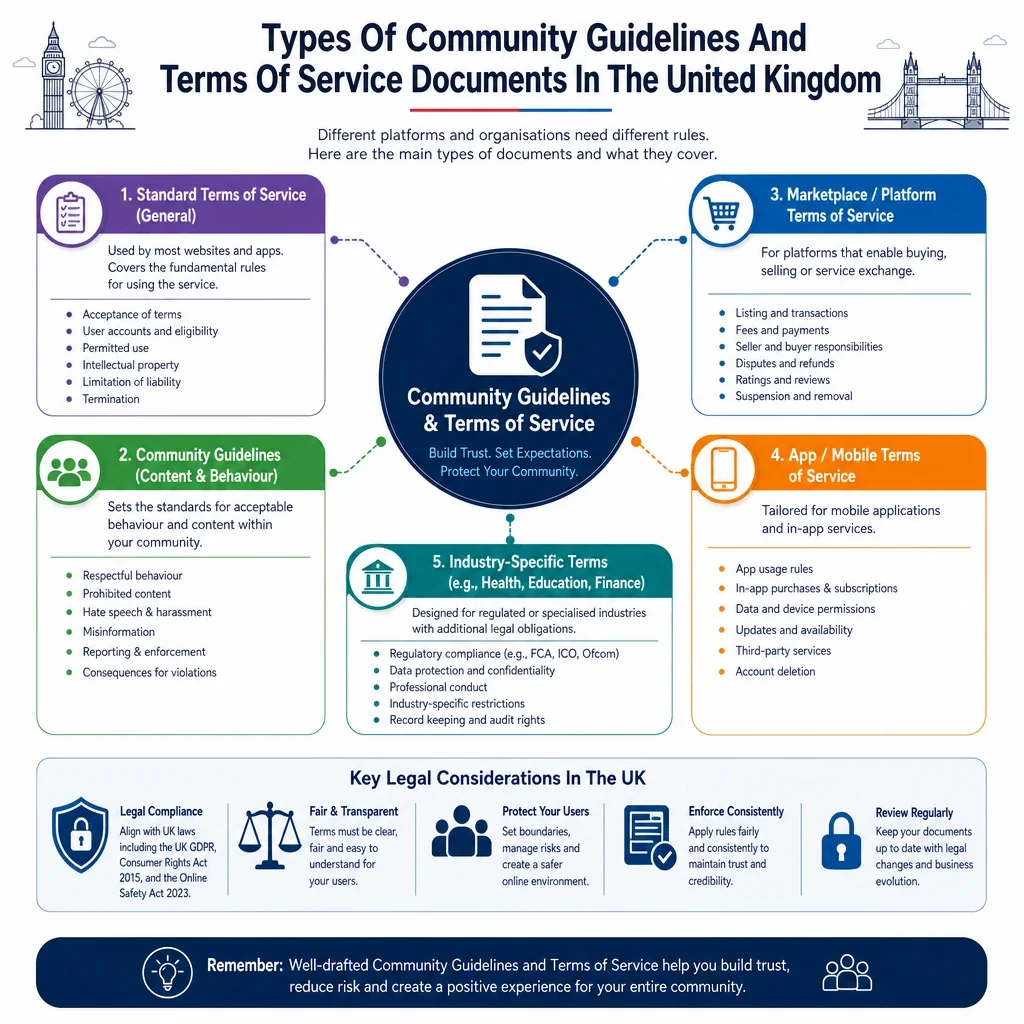
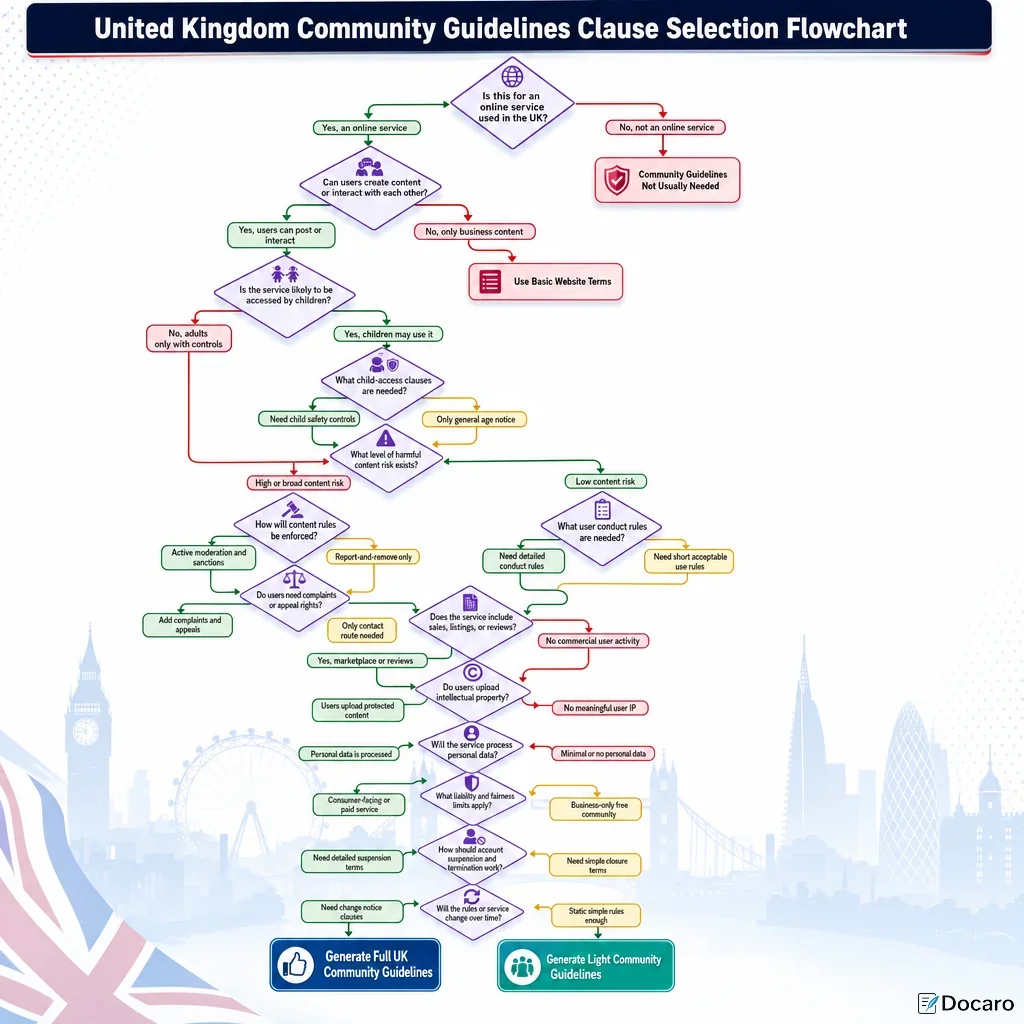
When do you need a Terms of Service in the United Kingdom?
Key UK Legal Rules for Terms of Service
Failing to tailor community guidelines to the specific legal context of the United Kingdom may result in unenforceability or unintended liabilities under UK consumer protection and data privacy laws.
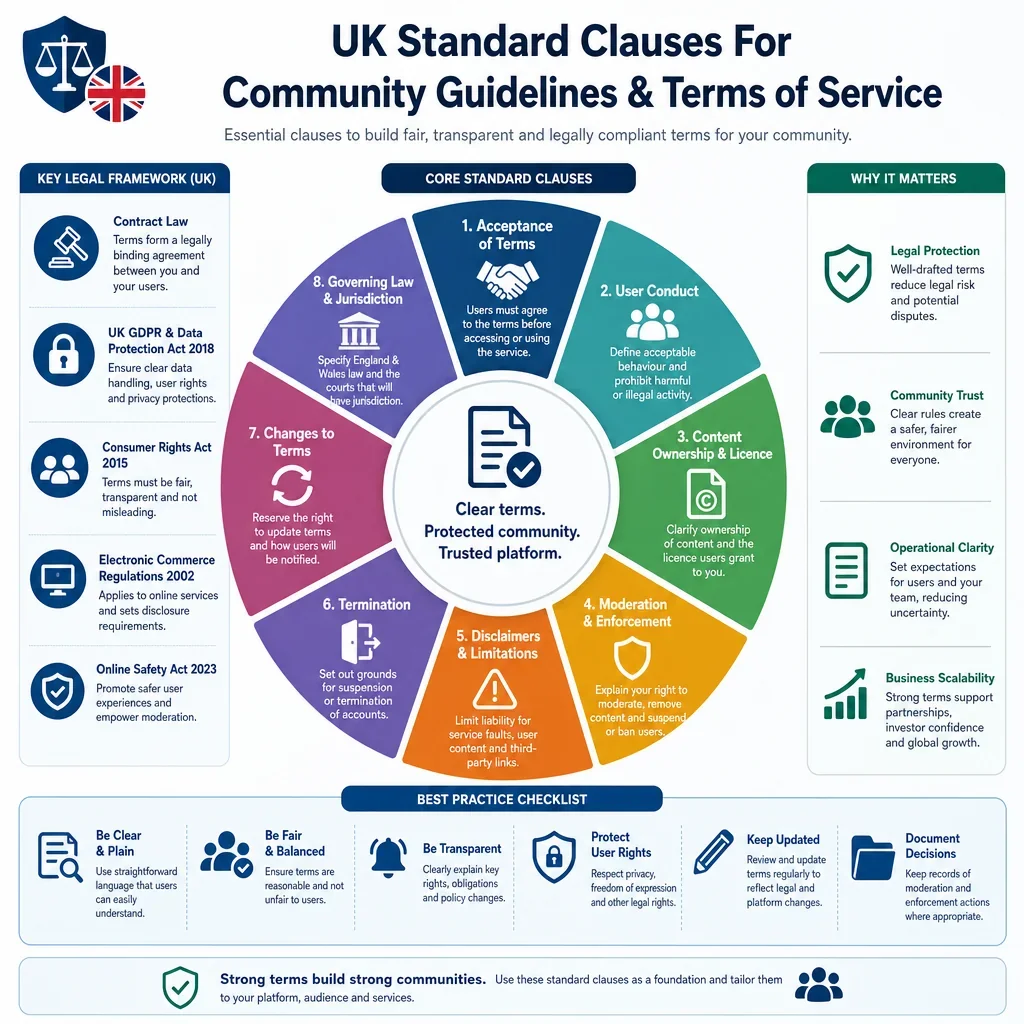
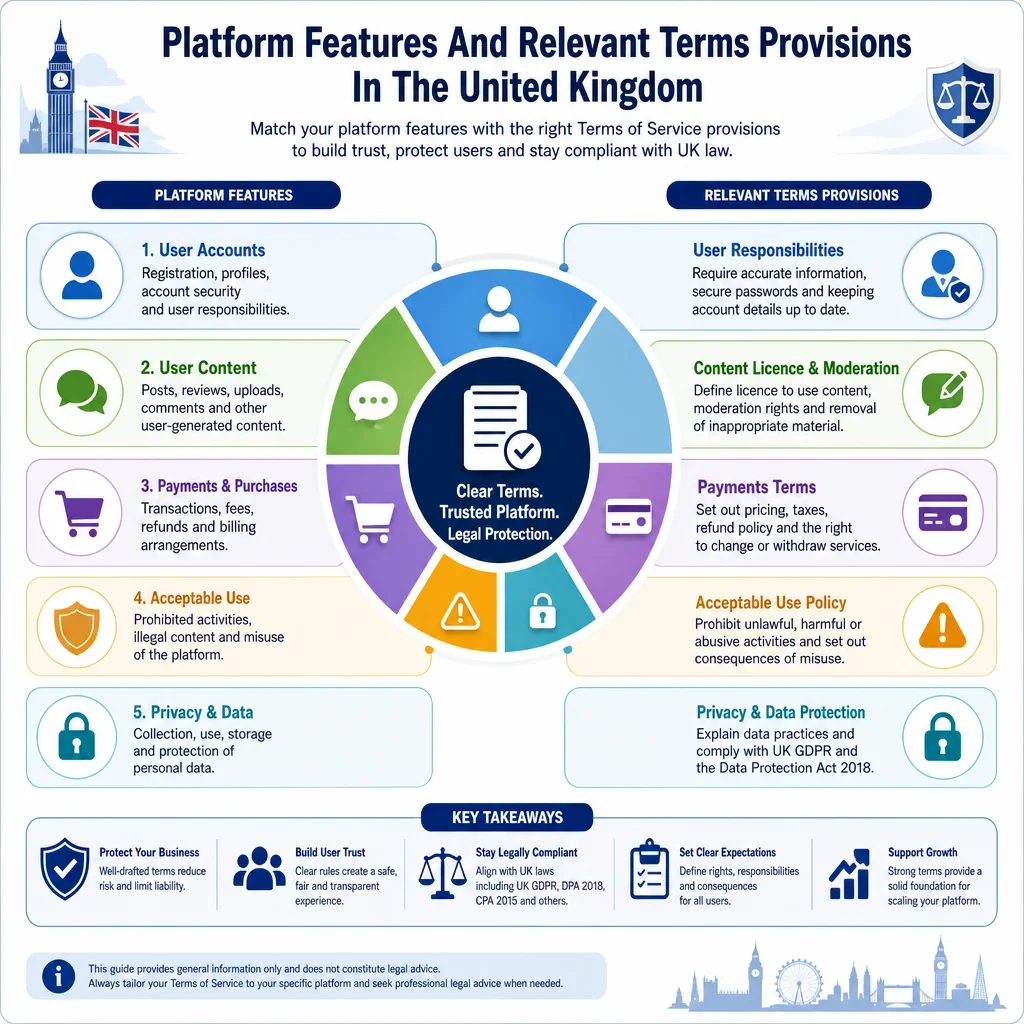
What a Proper Terms of Service Should Include
- Introduction and AcceptanceClearly state what the terms cover and require users to agree before using your service.
- User ResponsibilitiesOutline what users must do, like providing accurate information and not misusing the platform.
- Intellectual Property RightsExplain who owns the content users create or upload on your site.
- Privacy and Data HandlingDescribe how user data is collected, used, and protected in line with UK privacy laws.
- Prohibited ActivitiesList actions that are not allowed, such as illegal use or spamming.
- Termination of ServiceDetail when and how accounts can be suspended or closed by you or the user.
- Liability LimitsSet boundaries on your responsibility for any issues or losses from using the service.
- Dispute ResolutionSpecify how disagreements will be handled, often through UK courts or mediation.
- Governing LawDeclare that the terms are governed by UK law to ensure legal clarity.
- Updates to TermsExplain how and when you might change the terms and notify users.
Generate Your Document in 4 Easy Steps
Why Use Docaro?
 United Kingdom
Free Example Terms of Service Template
Below is a free template example of a Terms of Service for use in the United Kingdom generated by our AI model.
The clauses in your actual Terms of Service will vary from this example as they will be entirely bespoke to your requirements as set out in the questionnaire you complete.
Terms of Service
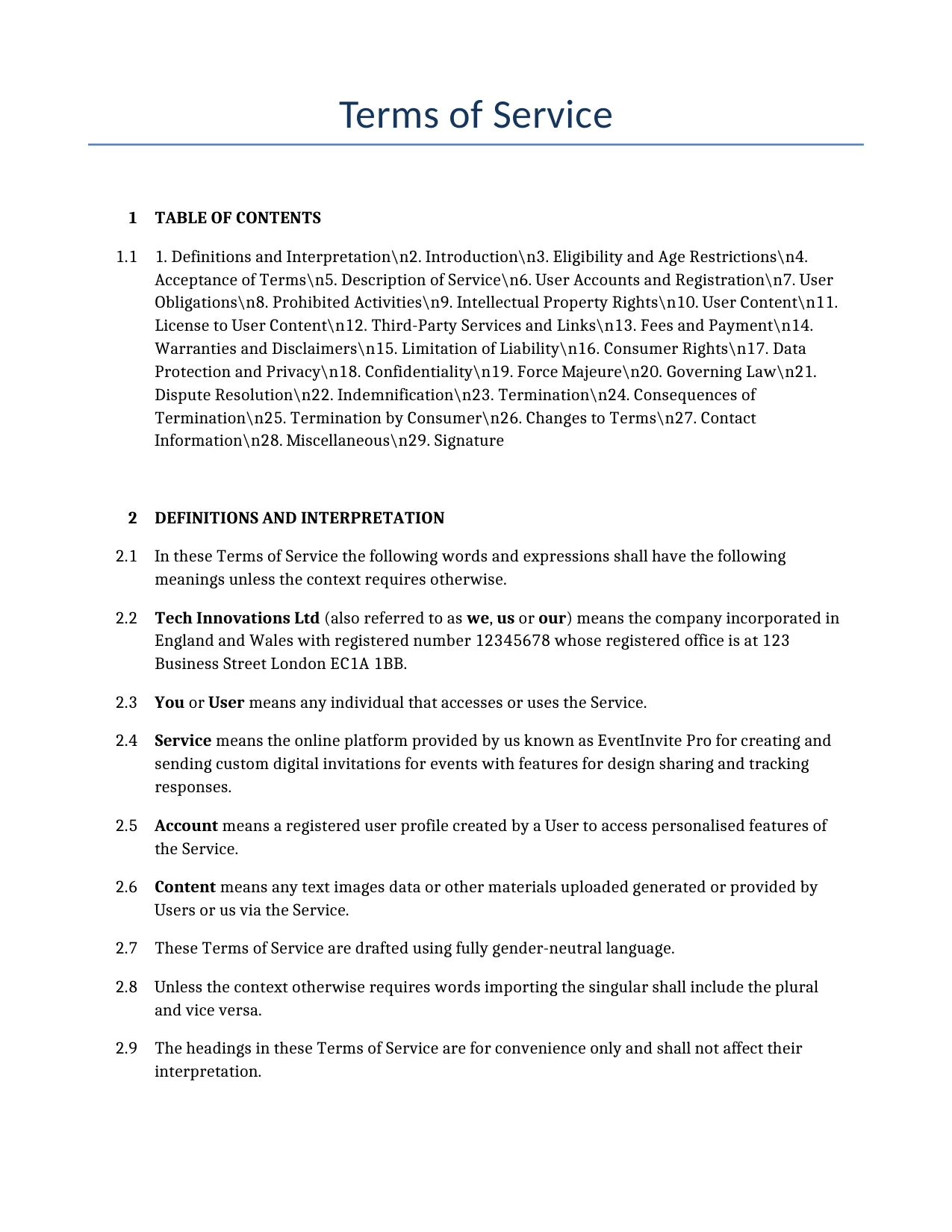
1TABLE OF CONTENTS
1. Definitions and Interpretation
2. Introduction
3. Eligibility and Age Restrictions
4. Acceptance of Terms
5. Description of Service
6. User Accounts and Registration
7. User Obligations
8. Prohibited Activities
9. Intellectual Property Rights
10. User Content
11. License to User Content
12. Third-Party Services and Links
13. Fees and Payment
14. Warranties and Disclaimers
15. Limitation of Liability
16. Consumer Rights
17. Data Protection and Privacy
18. Confidentiality
19. Force Majeure
20. Governing Law
21. Dispute Resolution
22. Indemnification
23. Termination
24. Consequences of Termination
25. Termination by Consumer
26. Changes to Terms
27. Contact Information
28. Miscellaneous
29. Signature
2DEFINITIONS AND INTERPRETATION
In these Terms of Service the following words and expressions shall have the following meanings unless the context requires otherwise.
Tech Innovations Ltd (also referred to as we, us or our) means the company incorporated in England and Wales with registered number 12345678 whose registered office is at 123 Business Street London EC1A 1BB.
You or User means any individual that accesses or uses the Service.
Service means the online platform provided by us known as EventInvite Pro for creating and sending custom digital invitations for events with features for design sharing and tracking responses.
Account means a registered user profile created by a User to access personalised features of the Service.
Content means any text images data or other materials uploaded generated or provided by Users or us via the Service.
These Terms of Service are drafted using fully gender-neutral language.
Unless the context otherwise requires words importing the singular shall include the plural and vice versa.
The headings in these Terms of Service are for convenience only and shall not affect their interpretation.
3INTRODUCTION
These Terms of Service are effective as of 1 January 2024.
These Terms of Service govern the relationship between Tech Innovations Ltd and each User in respect of the Service.
The initial version of these Terms of Service became effective on 1 December 2023.
4ELIGIBILITY AND AGE RESTRICTIONS
You must be at least 18 years old to use the Service.
The Service is only available to consumers resident in the United Kingdom or European Union.
By using the Service or registering an Account you confirm that you meet these eligibility criteria. See also sections on User Accounts and Registration and User Obligations.
5ACCEPTANCE OF TERMS
By registering an Account using the Service or clicking an \'I Agree\' button you accept these Terms of Service.
A notice of these Terms of Service is displayed on the homepage and during the account registration process.
These Terms of Service become effective upon your acceptance.
6DESCRIPTION OF SERVICE
EventInvite Pro is an easy-to-use online tool for creating and sending custom digital invitations for events with features for design sharing and tracking responses.
The Service is primarily offered in the United Kingdom with availability extended to consumers in the European Union.
The Service operates on a freemium model with free and paid features.
We deliver the Service via a web-based platform a mobile application and email or digital communications.
You have the option to customise certain features of the Service.
7USER ACCOUNTS AND REGISTRATION
You must be at least 18 years old to create an Account (see also our Eligibility and Age Restrictions section).
You must provide your full name email address and username during the registration process.
Email verification is mandatory as part of the account registration process.
You must create a password that meets the following requirements: minimum length of 8 characters inclusion of uppercase letters inclusion of numbers and inclusion of special characters.
We may suspend your Account in the event of violation of these Terms community guidelines suspicious activity or repeated failed login attempts.
We may permanently terminate your Account in the event of severe breaches of these Terms illegal activities or upon your request after verification.
You may request deletion of your Account at any time (see also our Termination by Consumer section).
8USER OBLIGATIONS
You must be at least 18 years of age and meet our eligibility criteria to access the Service.
You must create an Account before using the Service.
You must provide and maintain accurate personal information when using the Service.
You must respect intellectual property rights and must not infringe copyrights or trademarks while using the Service.
You must comply with all applicable laws when using the Service.
You must not reverse engineer the Service.
9PROHIBITED ACTIVITIES
You shall not engage in illegal activities while using the Service.
You shall not engage in harassment or abuse while using the Service.
You shall not engage in spamming or unsolicited communications while using the Service.
You shall not infringe intellectual property rights such as copyrights or trademarks when using the Service.
You shall not engage in fraudulent activities such as scams or misrepresentation on the Service.
You shall not reverse engineer decompile or disassemble the Service.
You shall not use bots scripts or automated tools to access the Service.
10INTELLECTUAL PROPERTY RIGHTS
You retain ownership of the intellectual property rights in the Content you submit to the Service subject to the License to User Content below.
We own all intellectual property rights in EventInvite Pro including proprietary software custom algorithms and unique branding designs associated with the Service.
We grant you a limited personal non-commercial revocable licence to use the Service for its intended purpose.
11USER CONTENT
You may upload or submit Content to the Service.
User Content means any text images videos or other materials uploaded or submitted by you to the platform including invitation designs comments posts and profile information.
You retain ownership of your User Content upon submission to the platform subject to the licence you grant us.
You must not submit as User Content any infringing or illegal material any defamatory or harmful statements or any offensive or discriminatory content.
You must ensure that all submitted content is original does not violate any laws or third-party rights and is not misleading or harmful.
You agree to indemnify us against any claims arising from your User Content to the extent permitted by law.
You represent and warrant that your User Content does not infringe third-party intellectual property rights.
12LICENSE TO USER CONTENT
By submitting User Content to the Service you grant us a worldwide non-exclusive royalty-free perpetual irrevocable licence to host reproduce distribute modify translate and display your User Content solely as necessary to provide promote and improve the Service (including for AI training where applicable).
This licence is limited to what is reasonably necessary for us to operate the Service and does not transfer ownership of your content to us.
We may moderate edit or remove User Content at our discretion if it violates these Terms.
13THIRD-PARTY SERVICES AND LINKS
We are not responsible for any content provided by third parties accessible via the Service.
We are not responsible for any third-party services or external links accessible via the Service.
You access third-party services and links at your own risk.
We make no representations or warranties as to the accuracy completeness viruses security privacy availability or performance of third-party content or services.
14FEES AND PAYMENT
The Service is provided on a freemium basis. Certain basic features are available free of charge while premium features require a paid subscription.
Premium subscriptions are charged on a monthly or annual basis as clearly displayed at the time of purchase. All prices include VAT at the applicable rate.
Subscriptions automatically renew at the end of each billing period unless you cancel before the renewal date.
You may cancel your subscription at any time via your Account settings. Cancellation will take effect at the end of the current billing period and no further charges will be made.
You may be entitled to a refund during any applicable cooling-off period or if the Service does not conform with your statutory consumer rights under the Consumer Rights Act 2015. See our Consumer Rights section for details. To request a refund contact us at billing@techinnovations.co.uk.
We accept payment by credit card or other methods displayed during checkout. We do not use bank transfers for consumer payments.
15WARRANTIES AND DISCLAIMERS
The Service is provided \'as is\' and \'as available\'. To the maximum extent permitted by law we disclaim all warranties express or implied including but not limited to warranties of accuracy uninterrupted access error-free operation merchantability satisfactory quality and fitness for a particular purpose.
Nothing in these Terms excludes or limits our liability for any non-excludable guarantees or warranties implied by law under the Consumer Rights Act 2015 or other statutes. Your statutory consumer rights are not affected by these disclaimers.
16LIMITATION OF LIABILITY
Nothing in these Terms limits or excludes our liability for death or personal injury resulting from our negligence for fraud or fraudulent misrepresentation or for any other liability that cannot be limited or excluded under the Consumer Rights Act 2015 or other applicable law.
Subject to the above for any other losses our total liability to you shall not exceed the higher of fifty pounds (GBP 50) or the total amount paid by you to us in the preceding 12 months. This limit applies only to the extent permitted by law.
We shall not be liable for indirect or consequential losses loss of data loss of profits or special or punitive damages except where such limitation is unfair under the Consumer Rights Act 2015.
You must bring any claims against us within 12 months of the event giving rise to the claim to the extent permitted by law.
17CONSUMER RIGHTS
These Terms do not affect your statutory rights as a consumer under the Consumer Rights Act 2015 or any other applicable law. You have rights including the right to a refund or remedy if the Service is not provided with reasonable care and skill or does not conform with the description.
For digital subscriptions you may have a 14-day cooling-off period from the date of purchase during which you can cancel for a full refund provided you have not started using the premium features. Once you begin using premium features your right to cancel and obtain a refund may be limited.
If you experience any issues with the Service please contact us so we can resolve the problem. If we cannot our liability is as set out in these Terms and under law.
18DATA PROTECTION AND PRIVACY
We process your personal data in accordance with our Privacy Policy available at https://www.examplecompany.co.uk/privacy-policy (last updated 15 May 2023) and in full compliance with the UK GDPR and Data Protection Act 2018.
Our lawful bases for processing include contract performance legitimate interests and consent where applicable. We collect basic identification data usage data and behavioural data.
You have rights under the UK GDPR including the right to access rectification erasure restriction objection and data portability. To exercise these rights contact us at privacy@techinnovations.co.uk.
All personal data is processed within the United Kingdom or European Economic Area.
You have the right to complain to the Information Commissioner\'s Office (ICO) if you have concerns about how we handle your data. See ico.org.uk for details.
19CONFIDENTIALITY
Confidential Information shall exclude publicly available information and information independently developed by a party.
Permitted disclosures of Confidential Information include disclosures required by law and disclosures to legal advisors.
The receiving party shall use at least the same degree of care to protect Confidential Information as it uses for its own similar information.
The confidentiality obligations shall last for 5 years after termination.
The receiving party shall return or destroy all copies of Confidential Information upon request or termination.
The remedies for breach of confidentiality obligations shall include injunctive relief where permitted by law.
No licence or rights are granted in Confidential Information except as expressly provided in these Terms of Service.
20FORCE MAJEURE
Neither party shall be liable for any delay or failure to perform its obligations under these Terms of Service to the extent that such delay or failure is caused by an event of force majeure including but not limited to acts of God war terrorism civil unrest strikes epidemics pandemics or any other event beyond the reasonable control of that party.
The affected party shall give notice of a force majeure event within a reasonable period.
The affected party shall take reasonable steps to mitigate the effects of the force majeure event.
Either party may terminate these Terms of Service if a force majeure event continues for a period exceeding 30 days.
Payment obligations shall be suspended during a force majeure event to the extent permitted by law.
This force majeure clause applies equally.
21GOVERNING LAW
These Terms of Service are governed by the laws of England and Wales.
The governing law applies as applicable to the relevant UK jurisdiction.
22DISPUTE RESOLUTION
Any dispute arising out of or in connection with these Terms of Service shall first attempt to be resolved amicably. If not resolved you may refer the dispute to the courts of England and Wales which shall have exclusive jurisdiction.
The laws of England and Wales shall govern all disputes.
23INDEMNIFICATION
To the extent permitted by law you shall indemnify us against all claims losses damages liabilities costs and expenses (including reasonable legal fees) arising from your User Content breach of these Terms data privacy violations your use of the Service violation of applicable laws or infringement of third-party rights.
24TERMINATION
We may terminate or suspend your access to the Service immediately without notice in the event of breach of these Terms illegal activities or non-payment of any fees due.
Subscriptions automatically renew unless cancelled in accordance with the Fees and Payment section.
25CONSEQUENCES OF TERMINATION
Upon termination your access to the Service will be suspended or revoked. Intellectual property licences (except for your licence to us) will end.
We will retain your data for a period of 30 days after termination after which it may be deleted. You may request earlier deletion (see Termination by Consumer).
Refunds for prepaid subscriptions will only be provided where required by your statutory consumer rights or our refund policy.
Accrued rights and obligations shall survive termination to the extent permitted by law.
26TERMINATION BY CONSUMER
You may cancel your Account or subscription at any time via your Account settings or by contacting us. No notice period is required beyond the end of your current billing cycle for subscriptions.
If you cancel within any applicable cooling-off period or where the Service does not meet our description or is faulty you may be entitled to a refund under the Consumer Rights Act 2015.
Upon account deletion we will delete your personal data as soon as reasonably practicable subject to any legal retention obligations. See our Privacy Policy and Data Protection section for more details.
27CHANGES TO TERMS
We may update these Terms of Service and shall notify you of such updates by email or website posting.
We shall provide you with at least 30 days\' notice before material changes to these Terms of Service take effect unless the change is required for legal or safety reasons in which case it may take effect immediately.
Your continued use of the Service following the posting of any changes to these Terms will mean you accept and agree to those changes.
28CONTACT INFORMATION
The full legal name of the provider is Tech Innovations Ltd.
The registered office address of the provider is 123 Business Street London EC1A 1BB United Kingdom.
You may contact us by email at contact@techinnovations.co.uk by phone at +44 20 1234 5678 or via the online form on our website.
29MISCELLANEOUS
These Terms are drafted in English and any disputes shall be interpreted according to the English language version.
In the event of any conflict between these Terms and any other policies (such as the Privacy Policy) these Terms shall prevail to the extent of the conflict.
The Service and these Terms are not intended to involve export controls but you agree to comply with all applicable export and sanctions laws.
We comply with applicable anti-bribery and anti-corruption laws.
If any provision of these Terms is held to be invalid or unenforceable such provision shall be severed and the remaining provisions shall continue in full force and effect.
30SIGNATURE
These Terms of Service are accepted electronically. By registering for an Account using the Service or clicking \'I Agree\' you agree to be bound by all the provisions contained herein. No physical or electronic signature is required.
This example shows approximately 70% of a typical document and is provided for illustrative purposes only. The remaining content has been omitted.
Every document generated by Docaro is tailored to your specific circumstances, jurisdiction and the information you provide. The completed document includes all applicable clauses and provisions required for your situation.
To generate the full, personalised document, answer a short series of questions and your document will be created instantly.
Useful Resources When Considering a Terms of Service in the United Kingdom
United Kingdom Reference Legislation
Terms of Service FAQs
Document Generation FAQs
Related Articles