What is a codicil and why does it matter in UK law?
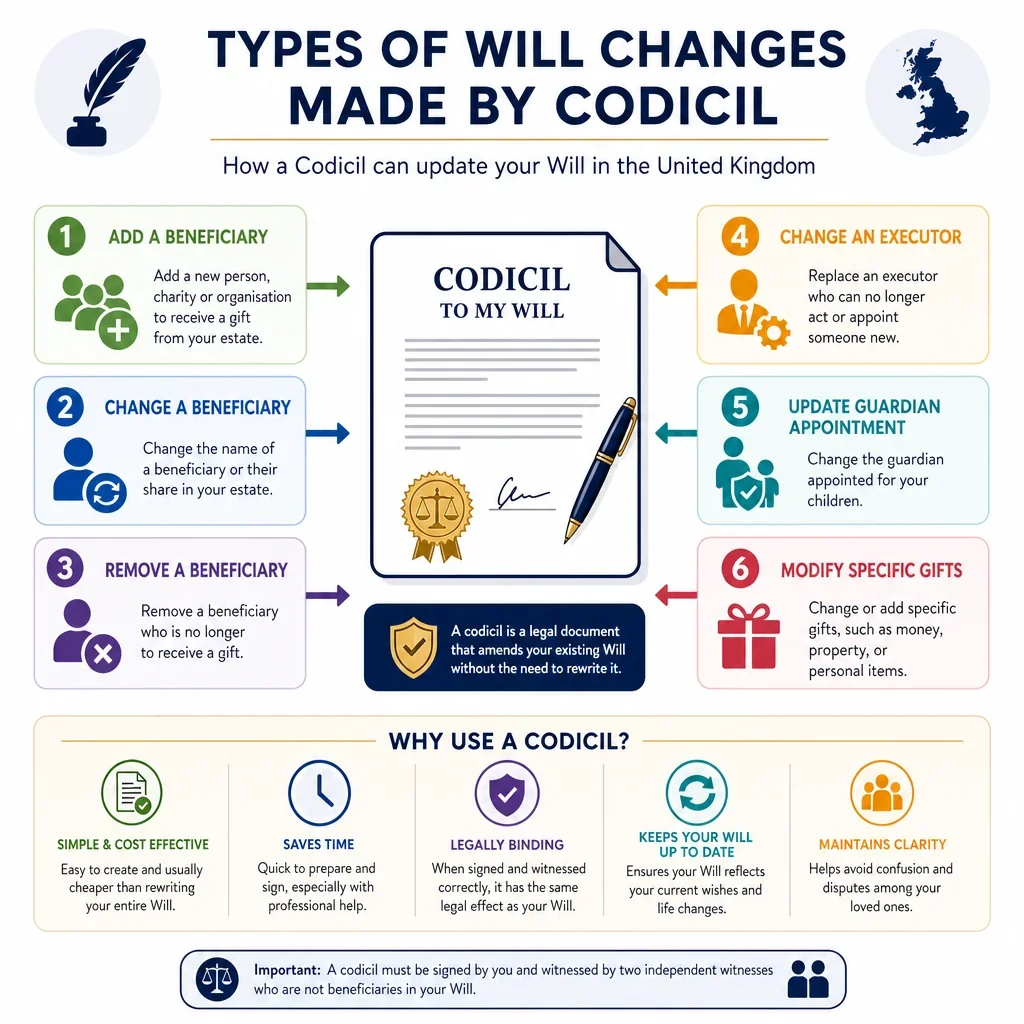
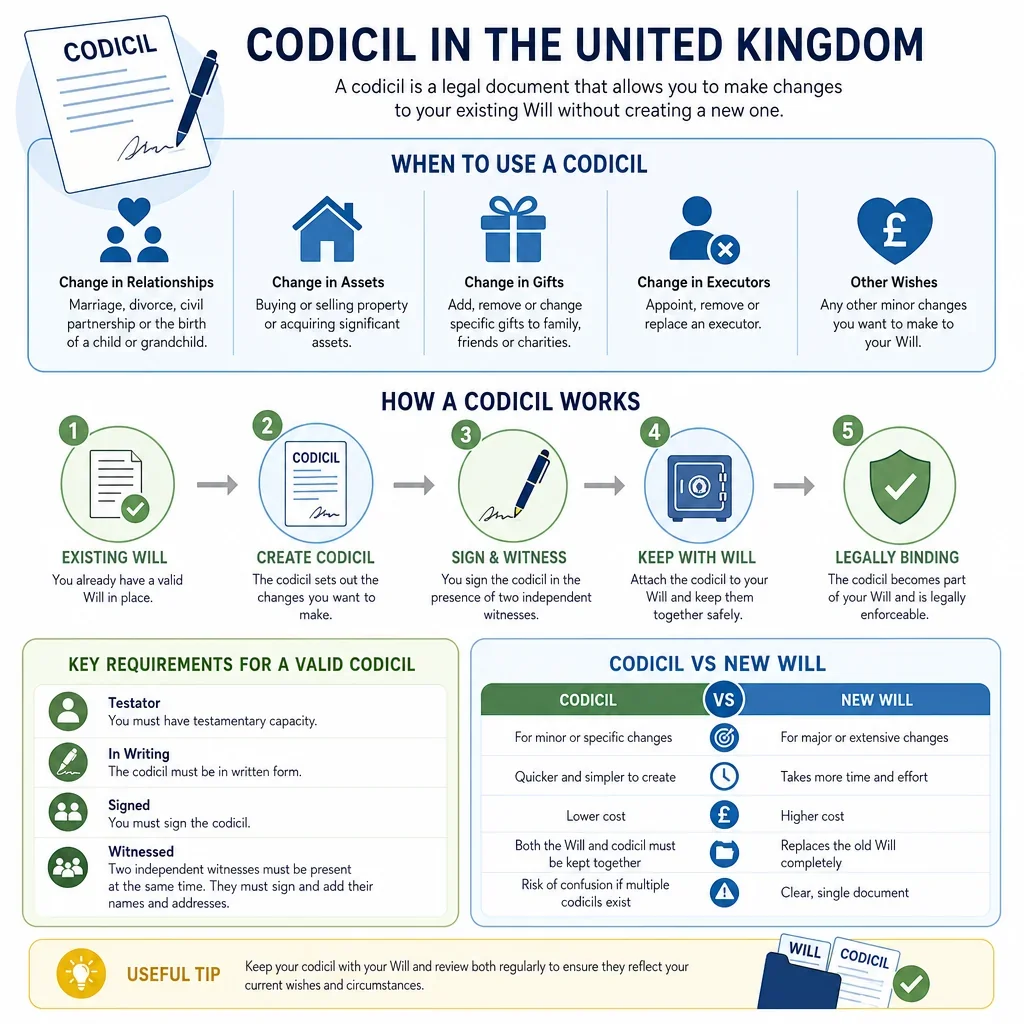
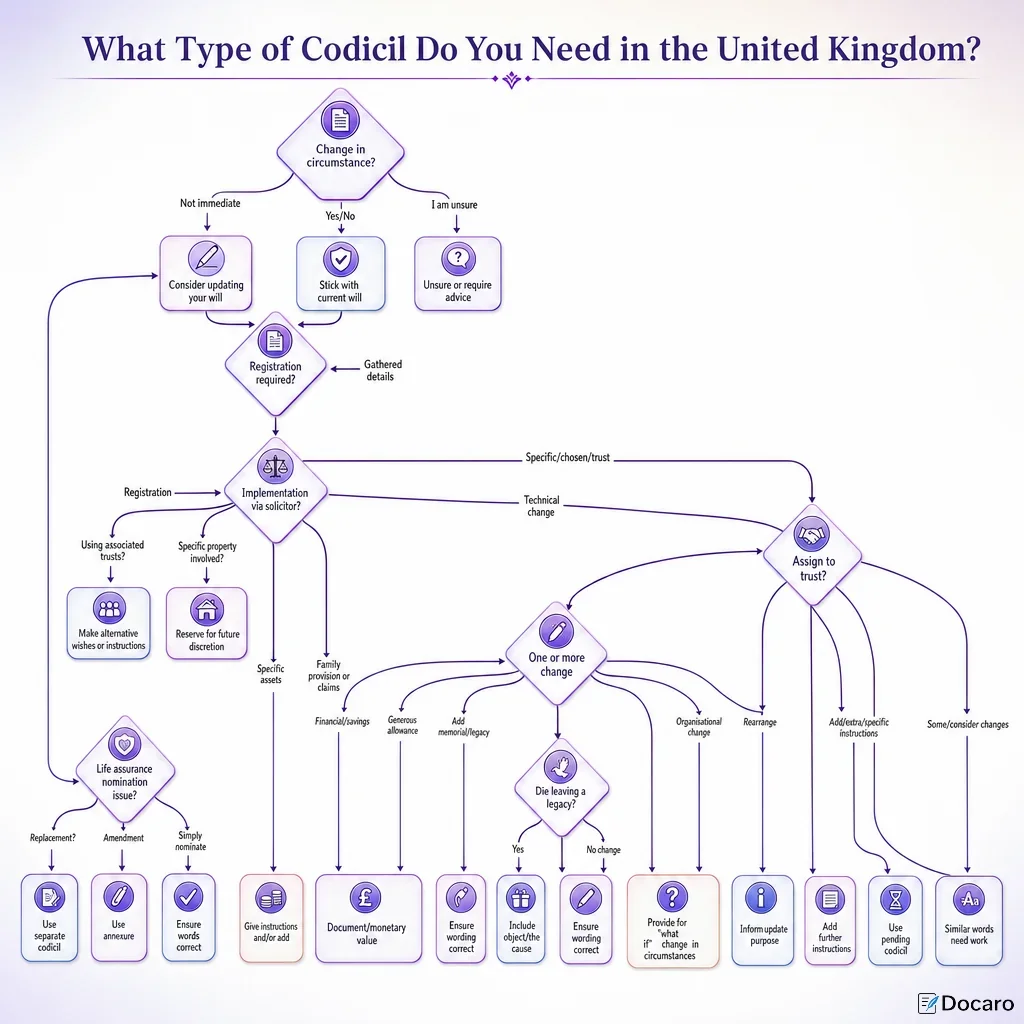
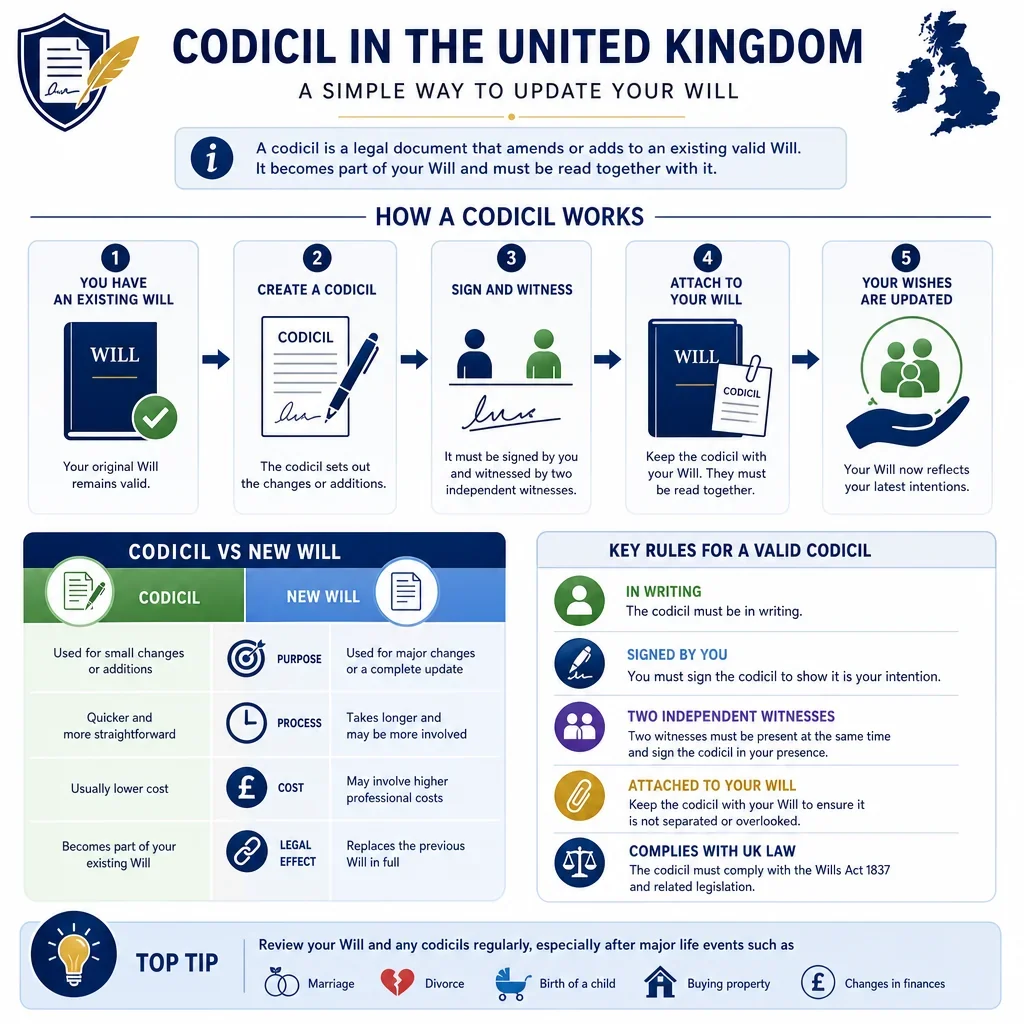
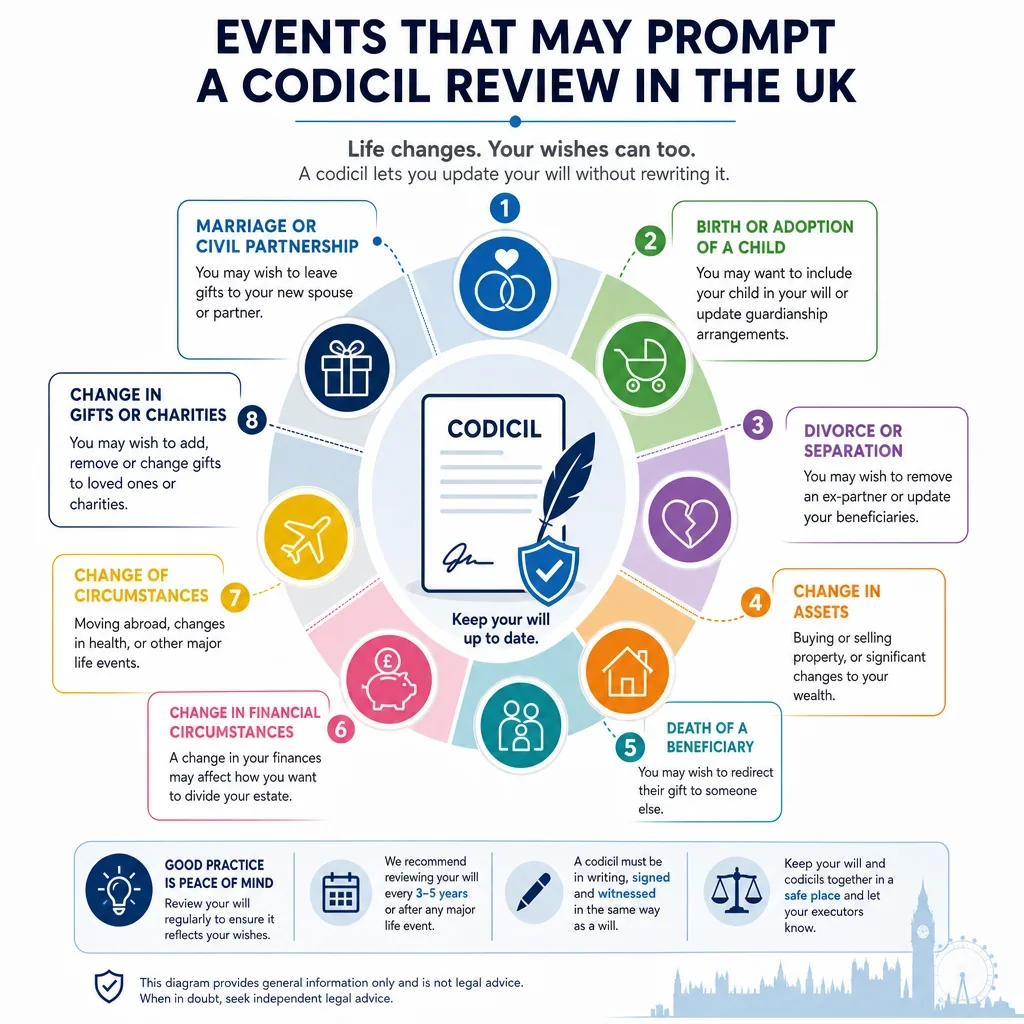
A codicil to a will is a legal document in the UK that allows you to make amendments or additions to an existing will without the need to rewrite the entire document. This straightforward method ensures that your estate planning remains up-to-date with life changes, such as the birth of a new beneficiary or shifts in asset distribution.
The primary purpose of a codicil is to provide a flexible way to update your UK will, maintaining its validity while incorporating specific changes efficiently. By using a codicil, you avoid the complexities and costs associated with drafting a new will from scratch.
Understanding codicils in UK law is crucial for effective estate planning, as it helps ensure your final wishes are accurately reflected and legally enforceable. For a deeper dive, explore our complete guide to codicils.
To create reliable codicils or wills, opt for bespoke AI-generated legal documents through Docaro, tailored precisely to your needs under UK regulations. For official guidance, refer to the UK Government's resource on making a will.
"For minor amendments to an existing will, a codicil remains the simplest and most cost-effective option, avoiding the need to rewrite the entire document," says estate planning attorney Jane Hargrove. "I recommend consulting a professional to generate a bespoke codicil tailored to your needs via Docaro for precise, personalized results."
When should you use a codicil for your will?
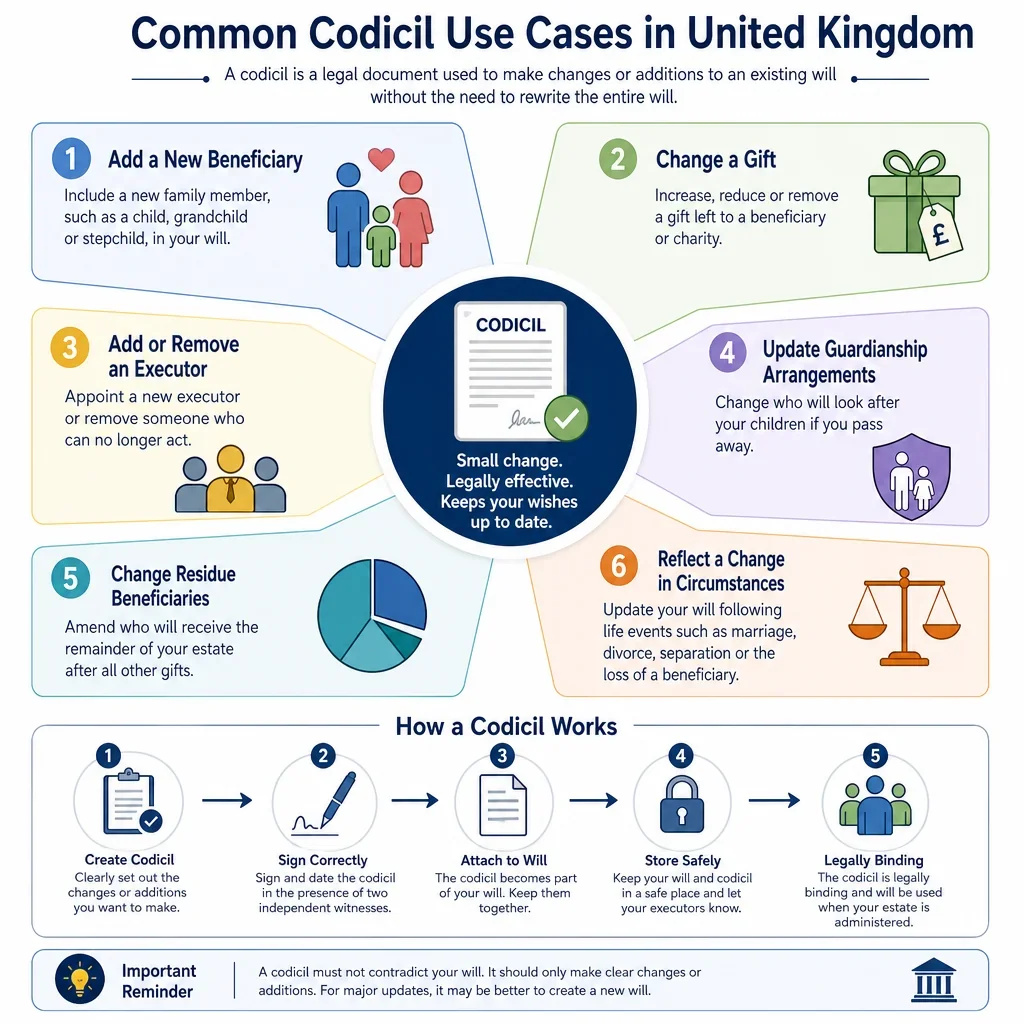
A codicil to a will is a useful legal document in the UK for making minor amendments to an existing will without the need to draft a completely new one. It is particularly appropriate in scenarios such as adding a small bequest to a beneficiary, like leaving a specific sum of money or an item to a family member or charity that was overlooked in the original will.
Another common situation for using a codicil is changing the executor of the will, for instance, if the named executor becomes unable or unwilling to serve due to health issues or relocation. Codices can also address simple updates, such as correcting a beneficiary's name or adjusting minor asset distributions, ensuring the will remains current while preserving its core structure.
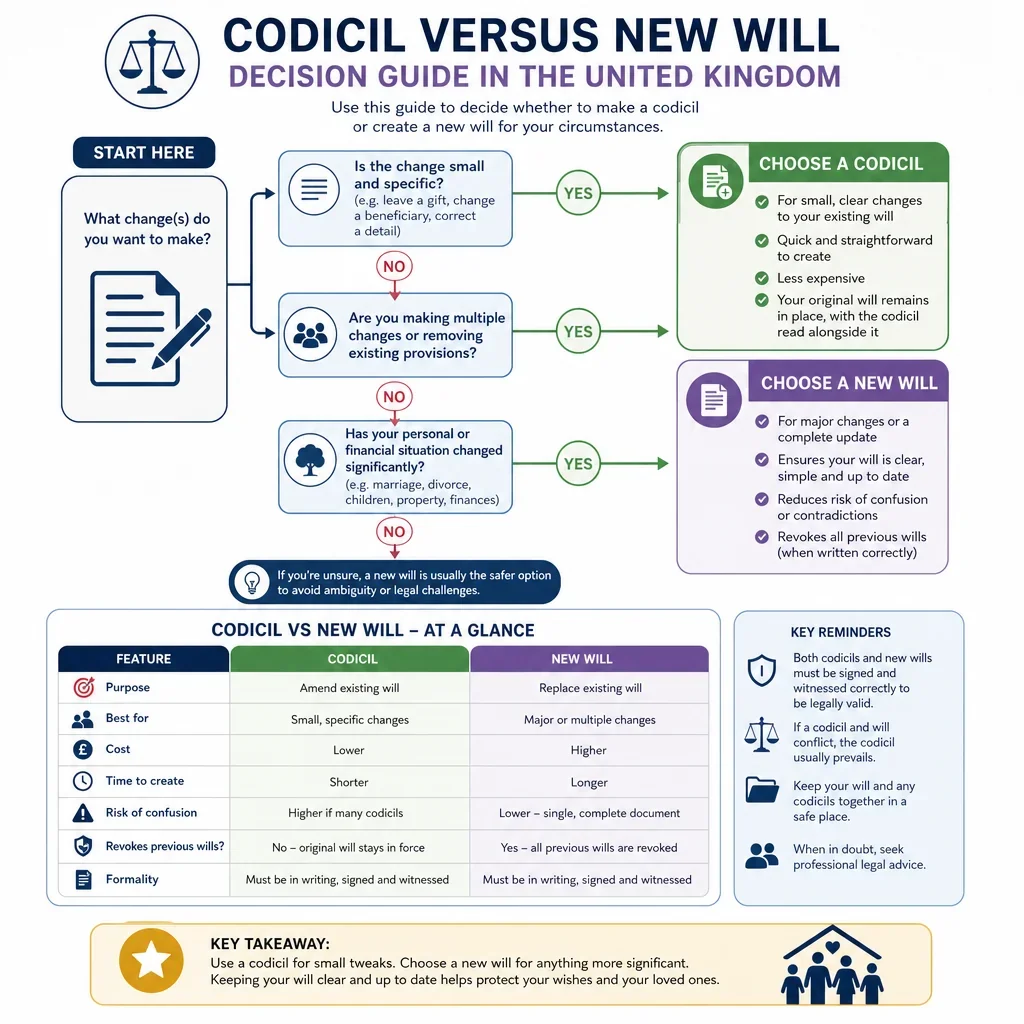
The primary benefits of a codicil over creating a new will include significant cost and time savings, as it requires less legal effort and documentation. For UK residents, using a codicil maintains the validity of the original will while allowing quick adjustments; however, for more complex changes, consulting a professional is essential to avoid invalidation.
To create a tailored codicil, consider bespoke AI-generated legal documents through services like Docaro, which ensure compliance with UK law. For official guidance, refer to the GOV.UK page on making a will, which outlines requirements for valid amendments.
When should you avoid using a codicil?
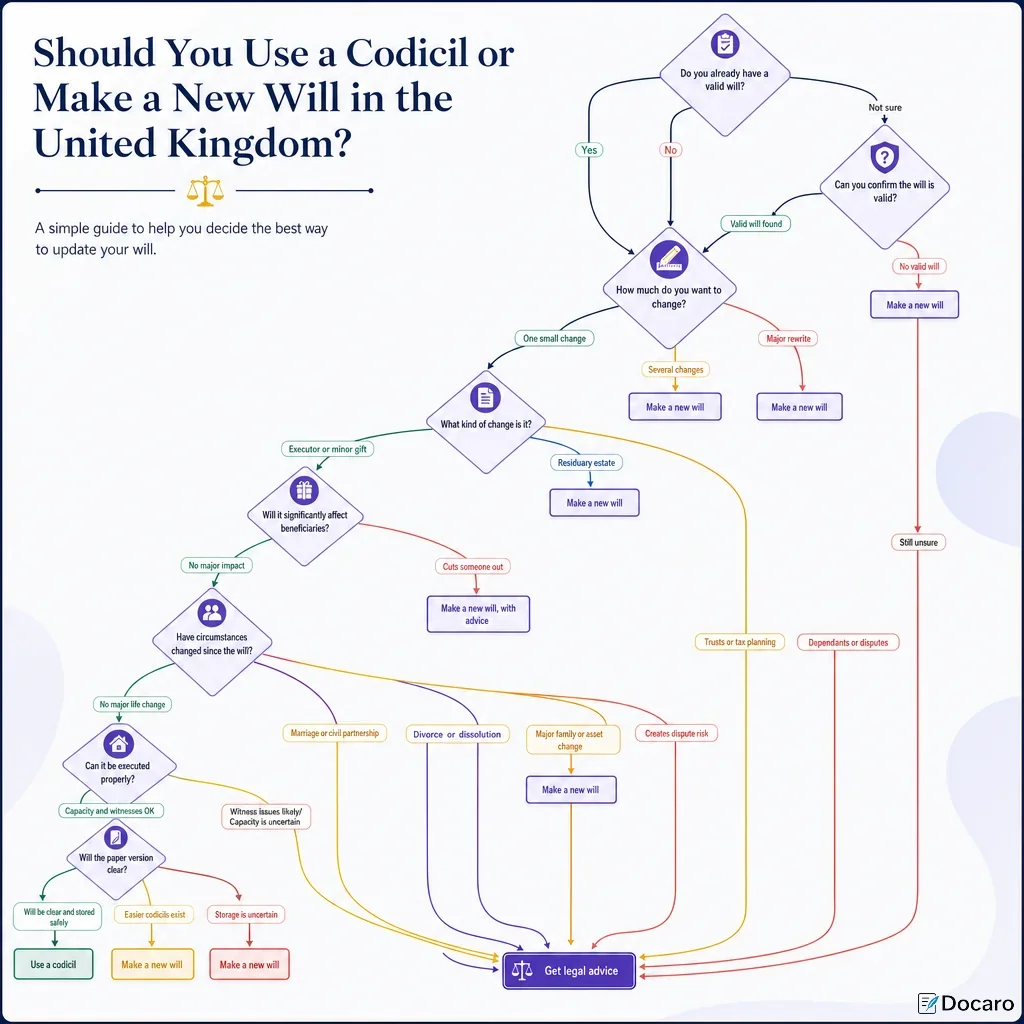
A codicil to a will is a useful tool for minor amendments, but it should not be used for major changes to the original document. Significant alterations, such as adding or removing substantial beneficiaries or revoking large portions of the estate plan, can lead to confusion and potential invalidation of the entire will if the codicil conflicts with the original terms.
If the original will is lost or destroyed, relying on a codicil is inadvisable as it depends on the existence of the primary document for validity. In such cases, courts may struggle to interpret the combined intentions, increasing the risk of disputes among heirs and possible invalidation of the estate plan.
Other situations to avoid codicils include when the testator's circumstances have drastically changed, like marriage, divorce, or the birth of new children, which require a comprehensive update. The primary risks involve legal challenges that could nullify the will, leading to intestacy laws applying instead, where assets are distributed by default rather than the testator's wishes.
For these scenarios, the recommended alternative is drafting a new will to ensure clarity and enforceability. Consult a professional service like Docaro for bespoke AI-generated legal documents tailored to UK law, or refer to guidance from the UK Government on making a will to avoid complications.

What are the key clauses in a codicil document?
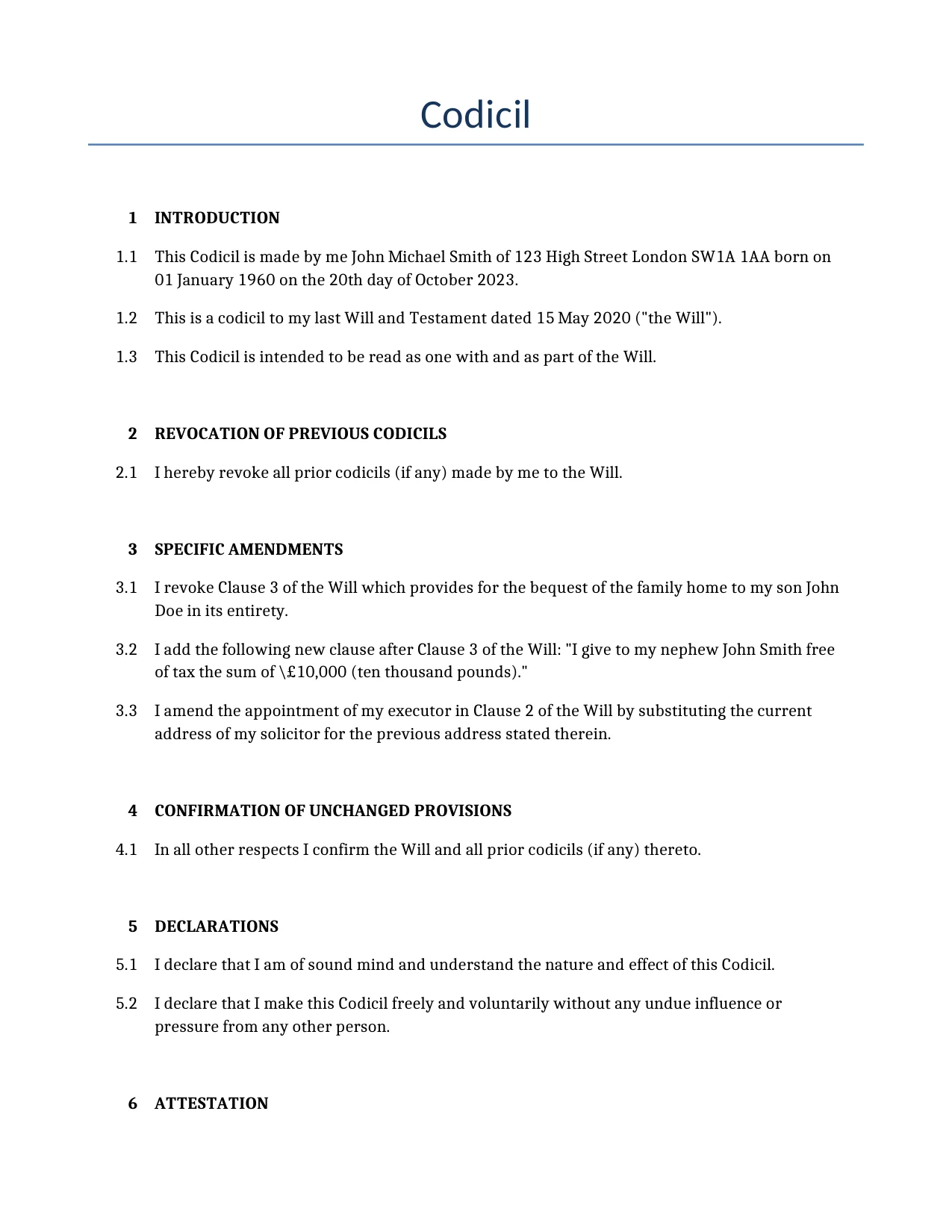
A UK codicil is a legal document that amends an existing will without revoking it entirely, ensuring changes are properly recorded for estate planning. Essential clauses in a codicil typically begin with a clear reference to the original will, stating the date it was executed and confirming its ongoing validity to avoid confusion in probate proceedings.
The specific amendments clause details the precise changes, such as altering beneficiary distributions or executor appointments, and serves to update the will's terms without rewriting the entire document. This clause must be explicit to prevent misinterpretation, maintaining the legal enforceability of the modifications.
Inclusion of a revocation statement is crucial, as it explicitly revokes only the affected parts of the original will while affirming the rest remains in force. This prevents unintended nullification of the entire will, upholding the testator's intentions during inheritance law applications.
For reliable UK will amendments, consult authoritative guidance from the GOV.UK Make a Will page. Opt for bespoke AI-generated legal documents via Docaro to ensure personalized, compliant codicils tailored to your needs.

What rights and obligations do parties have with a codicil?
In the United Kingdom, the testator's rights in creating a codicil to a will allow them to make amendments or additions to their existing will, provided they have the necessary mental capacity and the document is properly executed under the Wills Act 1837. A codicil must be signed by the testator in the presence of two witnesses, ensuring it legally supplements the original will without invalidating it.
Executors bear significant obligations when interpreting a codicil, requiring them to read it alongside the will to ascertain the testator's true intentions and administer the estate accordingly, as guided by UK probate law. They must act impartially, resolve any ambiguities through court if needed, and ensure the codicil's provisions are carried out faithfully to avoid personal liability for mismanagement.
Beneficiary rights under a codicil include entitlement to the altered inheritance as specified, with the ability to challenge the document if it was made under undue influence or lacks validity, protected by UK inheritance laws. Beneficiaries also have duties to provide accurate information during estate administration and comply with tax obligations on their inheritance.
To ensure compliance with UK law, all parties should seek professional advice; for bespoke legal documents, consider using AI-generated options through Docaro tailored to individual needs. For authoritative guidance, refer to the GOV.UK page on making a will or the Citizens Advice resource on wills.
Are there key exclusions to consider?
Codicils in UK wills are amendments that allow changes to an existing will without rewriting it entirely, but they come with common exclusions to ensure legal validity. Certain statutory requirements under the Wills Act 1837 cannot be altered, such as the need for the codicil to be in writing, signed by the testator in the presence of two witnesses, and clearly referencing the original will.
Limitations also apply to revocable elements; for instance, a codicil cannot override non-revocable trusts or appointments already in effect unless specifically designed to do so. Attempting to exclude or modify these can render the codicil invalid, highlighting the importance of consulting professionals for UK codicil drafting.
One major potential pitfall in codicils is unintentionally excluding important assets, such as property acquired after the original will, which might not be covered without explicit mention. This oversight can lead to assets passing under intestacy rules, causing unintended distribution and family disputes.
To avoid such issues, opt for bespoke AI-generated legal documents using Docaro, tailored precisely to your UK estate needs rather than generic options. This ensures comprehensive coverage of all assets and compliance with British inheritance laws, providing peace of mind.
How do recent legal changes affect codicils in the UK?
As of 2023, there are no major recent changes to UK laws governing codicils under the Wills Act 1837, which continues to regulate amendments to wills through simple written instruments signed by the testator and witnesses. This stability ensures that codicils remain a straightforward way to update existing wills without drafting a new one, provided they meet formal validity requirements.
Inheritance tax rules, as outlined by HM Revenue & Customs (HMRC), have seen minor adjustments in recent budgets, such as the nil-rate band freeze extended until 2028, but these do not directly impact the creation or use of codicils. For the latest on inheritance tax thresholds, consult the official HMRC inheritance tax guidance.
Given the stability of current laws on codicils and wills, individuals should periodically review their estate plans with qualified professionals. For bespoke legal documents tailored to your needs, consider using Docaro's AI-generated solutions to ensure compliance and personalization.
How can you get started with creating a codicil?
1
Consult a Solicitor
Schedule a meeting with a qualified solicitor to discuss your will and the changes needed for the codicil. This ensures legal compliance in the UK.
2
Draft the Codicil Using Docaro
Use Docaro to generate a bespoke AI-powered codicil document tailored to your specific requirements and solicitor's advice.
3
Review and Sign the Document
Carefully review the draft with your solicitor, then sign the codicil in the presence of two witnesses. See [How to Legally Add a Codicil to Your Will in the United Kingdom](/en-gb/a/how-to-legally-add-a-codicil-to-your-will-in-the-united-kingdom) for details.
4
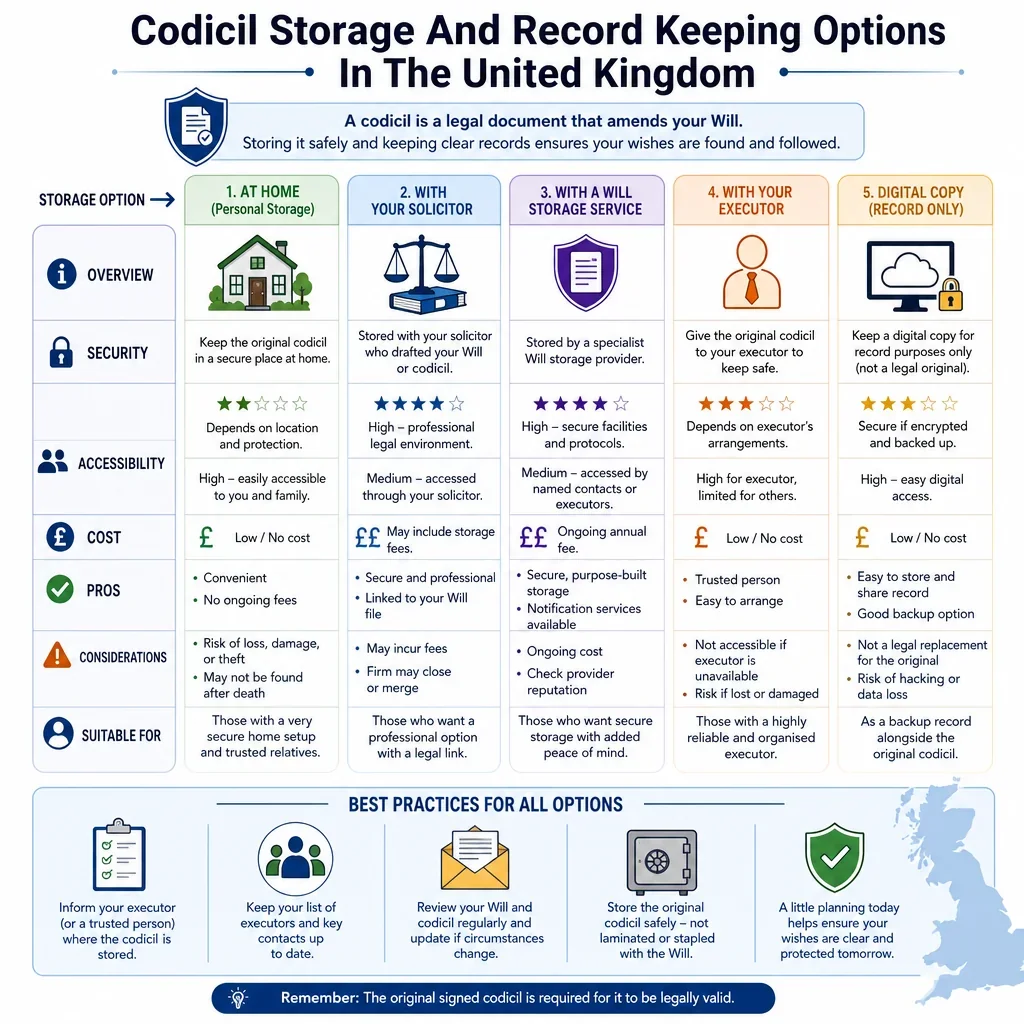
Attach and Store Securely
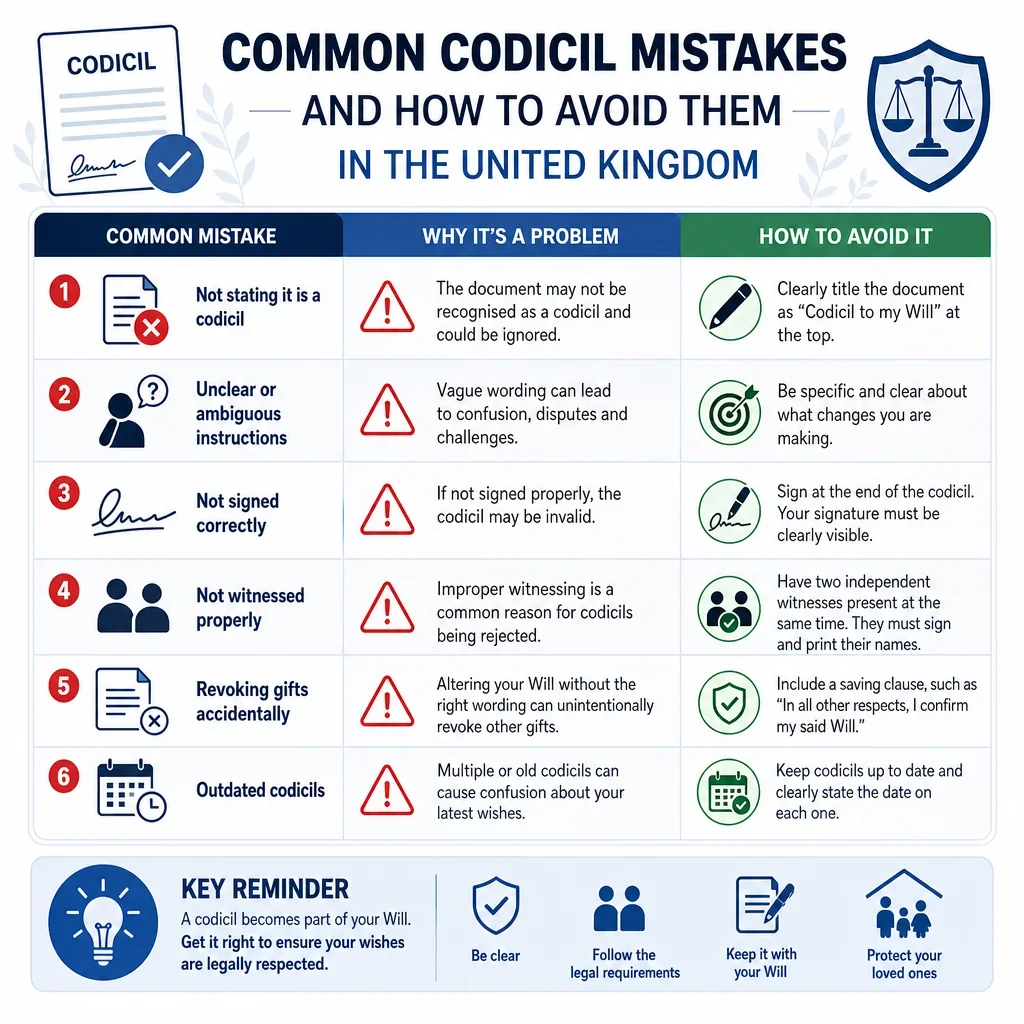
Attach the codicil to your original will and store both in a safe place. Avoid common pitfalls outlined in [Common Mistakes to Avoid When Creating a Codicil in the UK](/en-gb/a/common-mistakes-to-avoid-when-creating-a-codicil-in-the-uk).
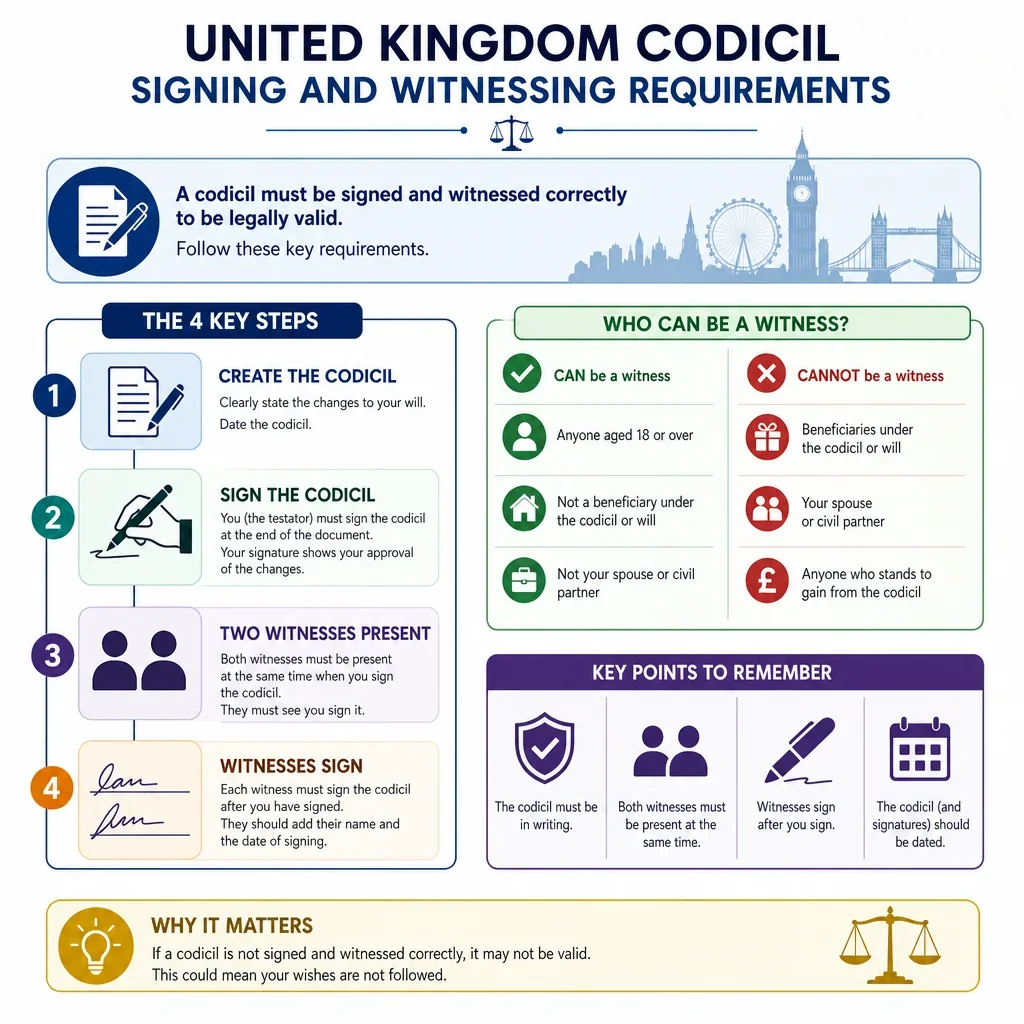
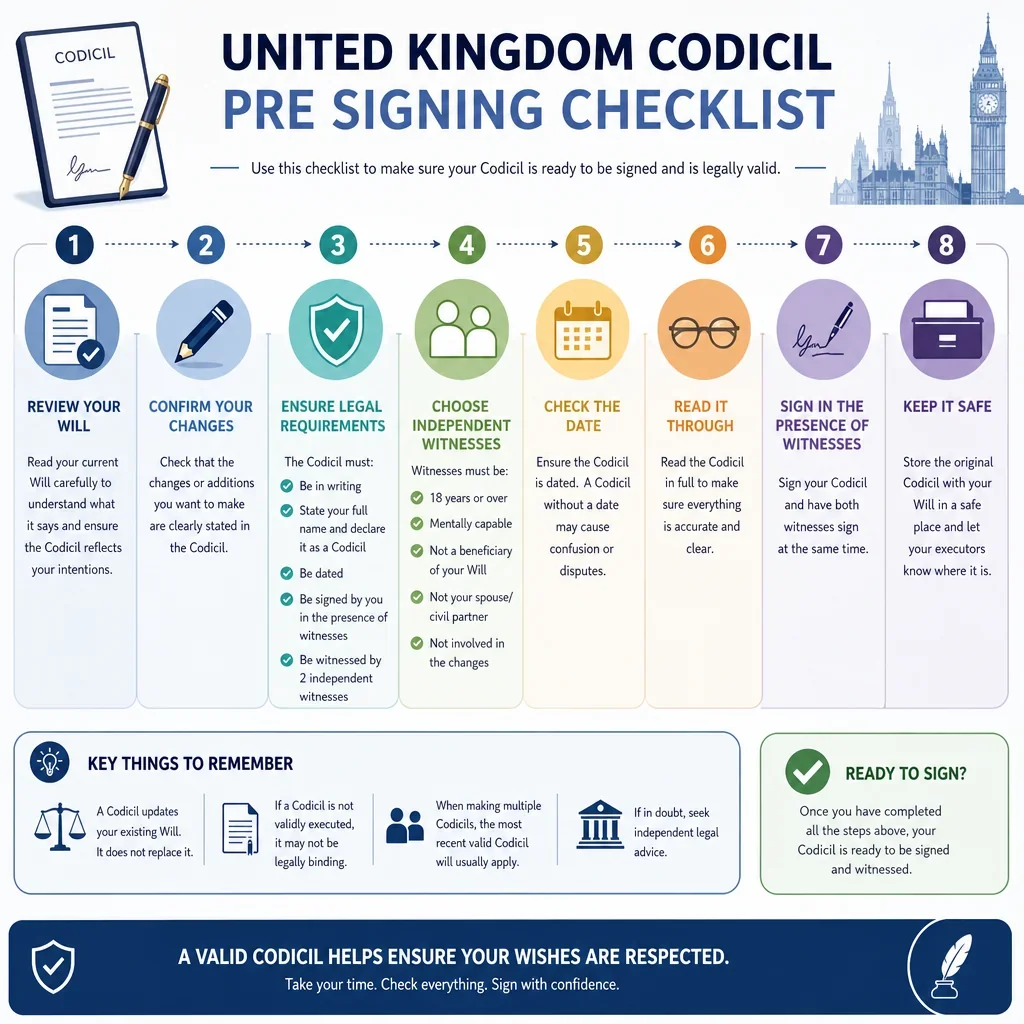
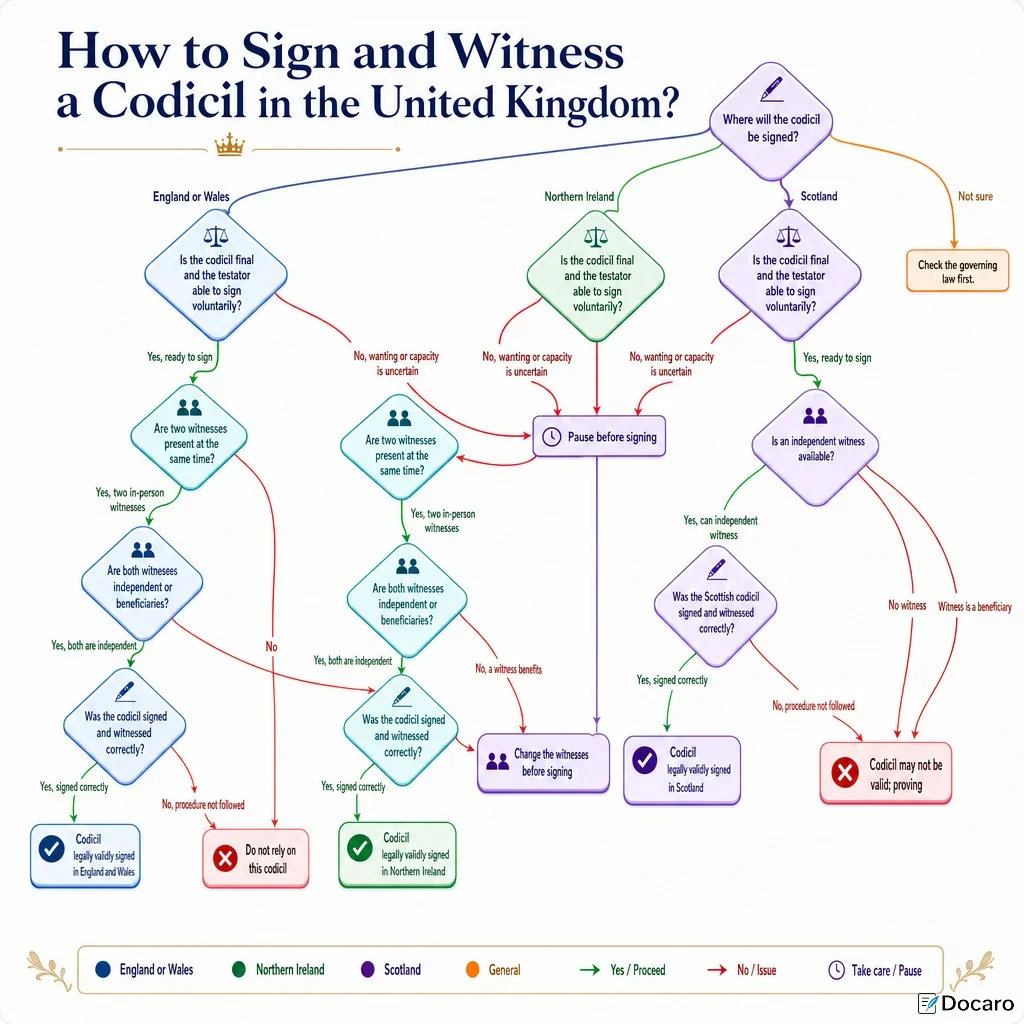
To ensure the validity of a codicil under UK law, it must be executed with the same formalities as a will, including the presence of two independent witnesses who are not beneficiaries. Proper execution involves the testator signing the codicil in the witnesses' presence, followed by the witnesses signing it themselves, all while confirming the testator's sound mind and free from undue influence.
Witnesses play a crucial role in preventing disputes, so choose adults over 18 who are impartial and available to verify the document later if needed. For authoritative guidance on codicil requirements, refer to the GOV.UK page on making a will.
Consider using bespoke AI-generated legal documents from Docaro to create a tailored codicil that complies with UK inheritance laws, ensuring clarity and precision over generic options. Always consult a qualified solicitor to review the final document before execution.
You Might Also Be Interested In
A Legal Document Specifying How A Person's Assets Should Be Distributed After Their Death.
A Legal Document Specifying An Individual's Medical Treatment Preferences In Case They Become Unable To Communicate.
A Legal Document Authorizing One Person To Act On Behalf Of Another In Specified Matters.
A Revocable Living Trust Is A Legal Arrangement Where Assets Are Transferred To A Trustee To Manage For Beneficiaries, With The Creator Retaining The Ability To Modify Or Revoke It During Their Lifetime.
A Legal Document Allowing Individuals To Specify Future Medical Treatment Refusals If They Lose Decision-making Capacity.
A Legal Document Listing All Assets And Property Of A Deceased Person's Estate For Probate Purposes.