AI Generated British LLP Partnership Agreement
PDF & Word - 2026 Updated
Docaro Pricing
When do you need a Limited Liability Partnership Agreement in the United Kingdom?
British Legal Rules for a Limited Liability Partnership Agreement
Using an LLC operating agreement for a UK business may not comply with local company law requirements, potentially leading to invalid structures or disputes.
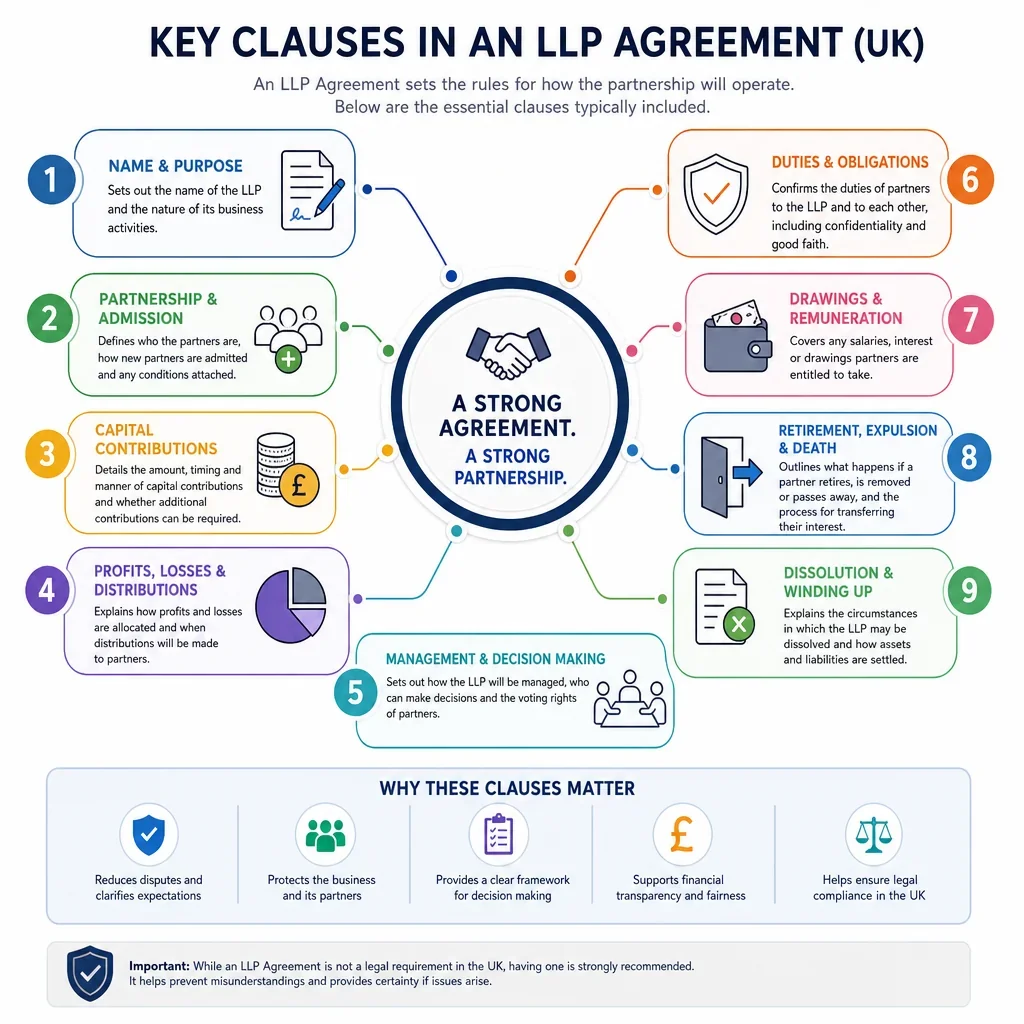
What a Proper Limited Liability Partnership Agreement Should Include
- Partner DetailsList the full names, addresses, and roles of all partners to clearly identify who is involved.
- Business PurposeDescribe what the partnership aims to achieve and the type of business it will run.
- Capital ContributionsSpecify the money, property, or services each partner will provide to start the business.
- Profit and Loss SharingOutline how profits and losses will be divided among the partners.
- Management and Decision-MakingDefine how the partnership will be managed and major decisions will be made.
- Duties and ResponsibilitiesSet out the everyday tasks and obligations of each partner.
- Books and RecordsExplain how financial records will be kept and shared with partners.
- New Partners and WithdrawalsDetail the process for adding new partners or allowing existing ones to leave.
- Dissolution RulesDescribe the steps to end the partnership and handle remaining assets.
- Dispute ResolutionProvide a way to resolve disagreements between partners without going to court.
Generate Your Document in 4 Easy Steps
Why Use Docaro?
 United Kingdom
Free Example Limited Liability Partnership Agreement Template
Below is a free template example of a Limited Liability Partnership Agreement for use in the United Kingdom generated by our AI model.
The clauses in your actual Limited Liability Partnership Agreement will vary from this example as they will be entirely bespoke to your requirements as set out in the questionnaire you complete.
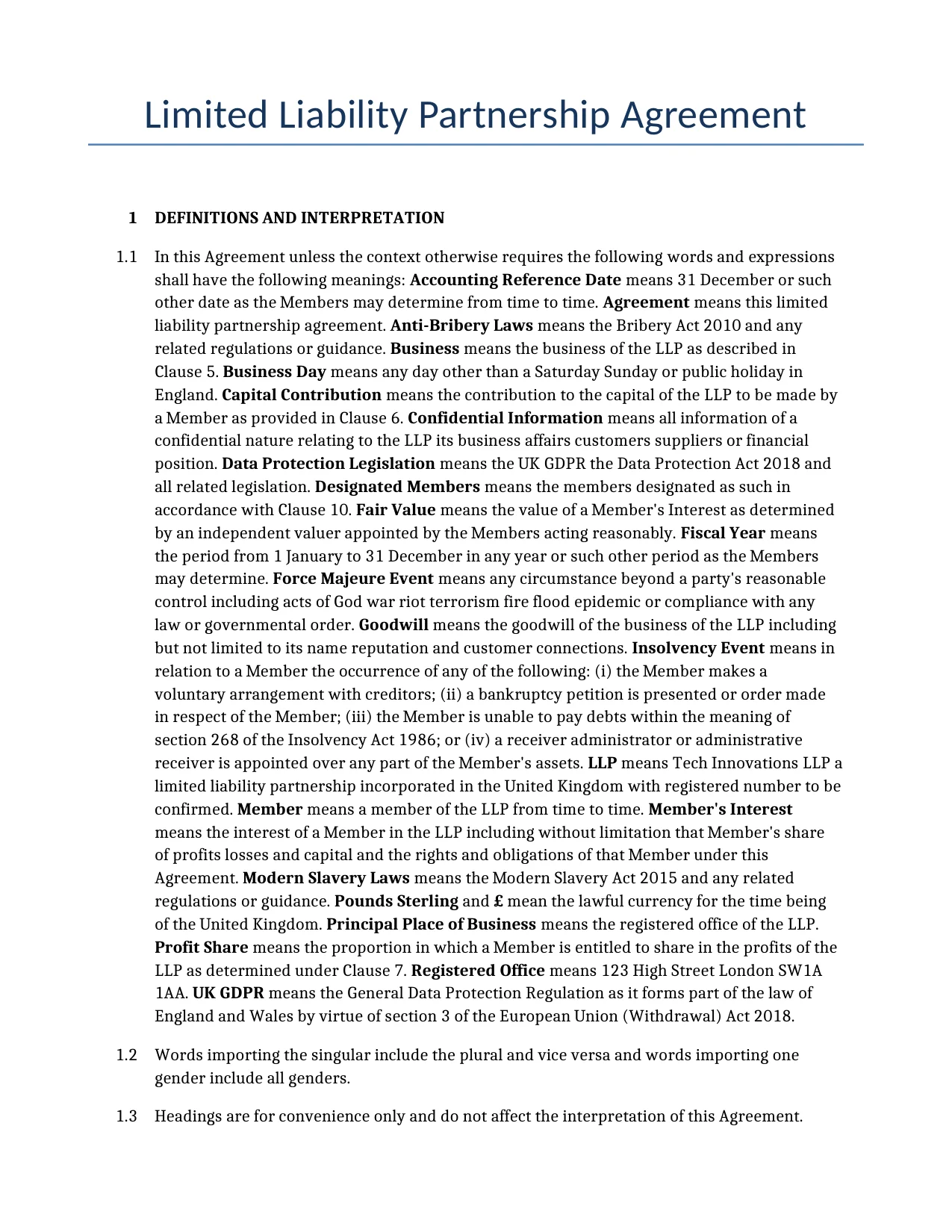
Limited Liability Partnership Agreement
1DEFINITIONS AND INTERPRETATION
In this Agreement unless the context otherwise requires the following words and expressions shall have the following meanings: Accounting Reference Date means 31 December or such other date as the Members may determine from time to time. Agreement means this limited liability partnership agreement. Anti-Bribery Laws means the Bribery Act 2010 and any related regulations or guidance. Business means the business of the LLP as described in Clause 5. Business Day means any day other than a Saturday Sunday or public holiday in England. Capital Contribution means the contribution to the capital of the LLP to be made by a Member as provided in Clause 6. Confidential Information means all information of a confidential nature relating to the LLP its business affairs customers suppliers or financial position. Data Protection Legislation means the UK GDPR the Data Protection Act 2018 and all related legislation. Designated Members means the members designated as such in accordance with Clause 10. Fair Value means the value of a Member's Interest as determined by an independent valuer appointed by the Members acting reasonably. Fiscal Year means the period from 1 January to 31 December in any year or such other period as the Members may determine. Force Majeure Event means any circumstance beyond a party's reasonable control including acts of God war riot terrorism fire flood epidemic or compliance with any law or governmental order. Goodwill means the goodwill of the business of the LLP including but not limited to its name reputation and customer connections. Insolvency Event means in relation to a Member the occurrence of any of the following: (i) the Member makes a voluntary arrangement with creditors; (ii) a bankruptcy petition is presented or order made in respect of the Member; (iii) the Member is unable to pay debts within the meaning of section 268 of the Insolvency Act 1986; or (iv) a receiver administrator or administrative receiver is appointed over any part of the Member's assets. LLP means Tech Innovations LLP a limited liability partnership incorporated in the United Kingdom with registered number to be confirmed. Member means a member of the LLP from time to time. Member's Interest means the interest of a Member in the LLP including without limitation that Member's share of profits losses and capital and the rights and obligations of that Member under this Agreement. Modern Slavery Laws means the Modern Slavery Act 2015 and any related regulations or guidance. Pounds Sterling and £ mean the lawful currency for the time being of the United Kingdom. Principal Place of Business means the registered office of the LLP. Profit Share means the proportion in which a Member is entitled to share in the profits of the LLP as determined under Clause 7. Registered Office means 123 High Street London SW1A 1AA. UK GDPR means the General Data Protection Regulation as it forms part of the law of England and Wales by virtue of section 3 of the European Union (Withdrawal) Act 2018.
Words importing the singular include the plural and vice versa and words importing one gender include all genders.
Headings are for convenience only and do not affect the interpretation of this Agreement.
Any reference to a statute or statutory provision includes that statute or provision as amended modified or re-enacted from time to time and includes any subordinate legislation made under it.
The schedules appendices and annexures to this Agreement form part of this Agreement.
2FORMATION OF THE LLP
The LLP was incorporated on 20 October 2023 under the Limited Liability Partnerships Act 2000 by registration with the Registrar of Companies for England and Wales with registered number to be confirmed.
The name of the LLP is Tech Innovations LLP.
The registered office of the LLP is at 123 High Street London SW1A 1AA.
The initial Members of the LLP at incorporation are: (a) Alice Johnson of 45 Oak Avenue London W1K 2AB who contributed £5,000 in cash; (b) Bob Smith of 67 Elm Drive Manchester M1 3CD who contributed £7,500.50 by way of equipment valued at that amount by the Members; (c) Carol Williams of 89 Pine Road Birmingham B1 2EF who contributed £5,000 in cash; and (d) David Brown of 12 Maple Lane Edinburgh EH1 3GH who contributed £5,000 in cash. The initial Designated Members are Alice Johnson and Bob Smith.
3NATURE OF THE LLP
The LLP is a body corporate with separate legal personality and limited liability formed under the Limited Liability Partnerships Act 2000.
The LLP shall at all times have at least two Designated Members. The liability of each Member is limited to the amount of that Member's Capital Contribution and any further amount that Member has agreed to contribute.
The mutual rights and duties of the Members and the mutual rights and duties of the LLP and the Members shall be as set out in this Agreement and subject to the Limited Liability Partnerships Act 2000 and the Limited Liability Partnerships Regulations 2001 (as amended).
4COMMENCEMENT AND TERM
This Agreement shall take effect from the date of incorporation of the LLP.
The LLP shall continue until it is dissolved in accordance with this Agreement the Limited Liability Partnerships Act 2000 or any other applicable law. There is no fixed term.
5PURPOSE AND BUSINESS OF THE LLP
The LLP is formed for the purpose of carrying on the business of developing and providing innovative technology solutions and professional services relating to software artificial intelligence and digital transformation (the Business).
The LLP shall not carry on any other business without the prior unanimous consent of the Members.
6CAPITAL CONTRIBUTIONS
The initial Capital Contributions of the Members are set out in Schedule 1 to this Agreement. All initial Capital Contributions have been made in full.
All property contributed to the LLP by any Member shall be and remain the property of the LLP. Title to any non-cash contribution shall be transferred to the LLP upon contribution.
Non-cash contributions shall be valued by the Members or by an independent valuer appointed by the Members acting reasonably. The value agreed or determined shall be the value for the purposes of this Agreement.
Additional Capital Contributions may be required from the Members from time to time by unanimous decision of the Members. Each Member shall contribute in accordance with their Profit Share unless otherwise agreed.
If any Member fails to make a required Capital Contribution on time that Member shall not be entitled to any distributions until the contribution is made shall pay interest on the overdue amount at 8 per cent per annum and the other Members may elect to treat the failure as giving rise to a compulsory transfer of that Member's Interest under Clause 12.
No Member shall be entitled to interest on their Capital Contribution except as provided in this Agreement.
7PROFIT SHARING AND DISTRIBUTIONS
Profits and losses of the LLP shall be allocated among the Members in accordance with their Profit Shares. Unless otherwise agreed the initial Profit Shares shall be equal.
On a change in membership the profits and losses shall be allocated on a time-apportioned basis up to the date of change unless the Members unanimously agree otherwise.
Prior losses shall be offset against current profits before any distribution is made. The Members may establish reserves as they determine necessary.
Distributions of available profits shall be made at such times and in such amounts as the Members shall determine by majority decision provided that no distribution shall be made if it would render the LLP unable to pay its debts as they fall due.
The LLP shall withhold from distributions such amounts as are necessary to cover each Member's estimated tax liabilities in accordance with Clause 15.
The accounting reference date for calculating profits and losses shall be the Accounting Reference Date.
The LLP is transparent for UK tax purposes. Profits and losses shall be allocated to the Members for tax purposes in accordance with their Profit Shares for each tax year.
8MANAGEMENT AND DECISION MAKING
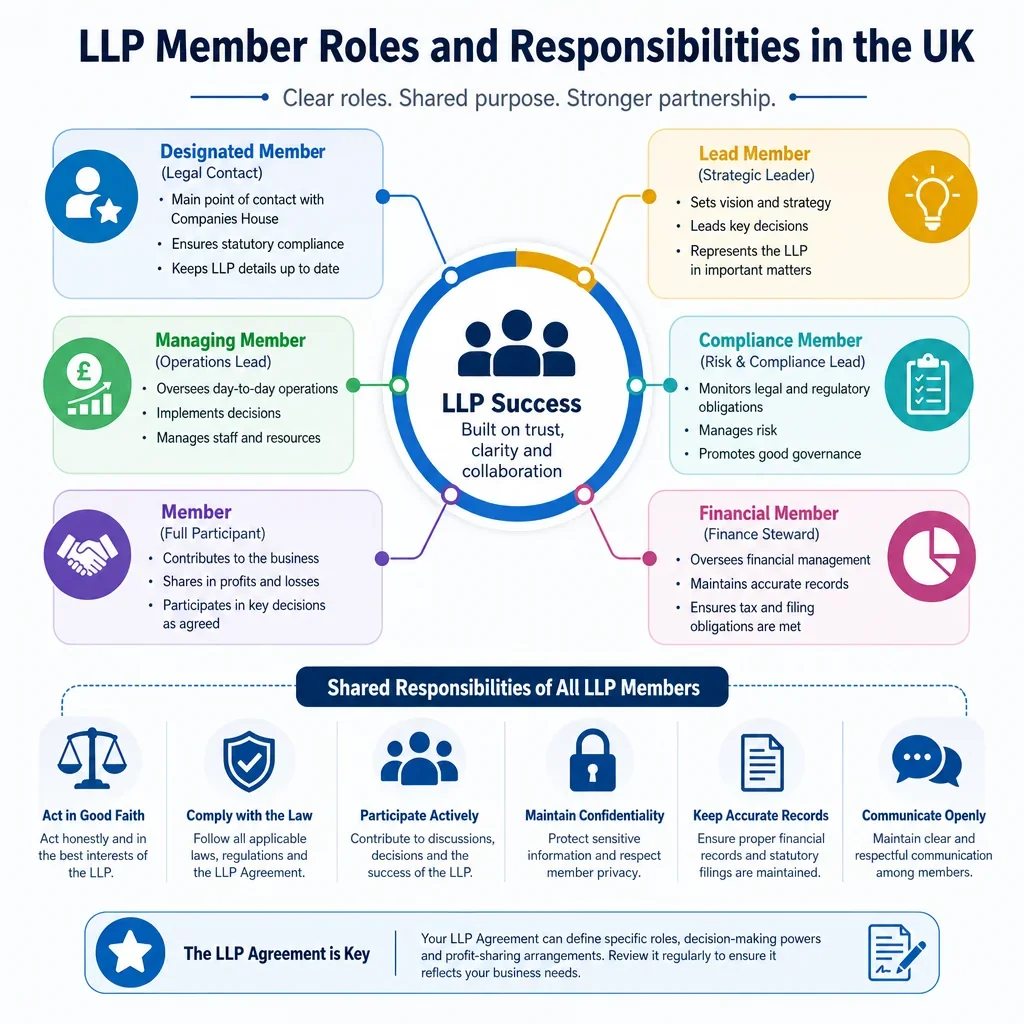
The Members shall be responsible for the management of the LLP. Day-to-day management may be delegated to the Designated Members or to employees or committees as the Members decide.
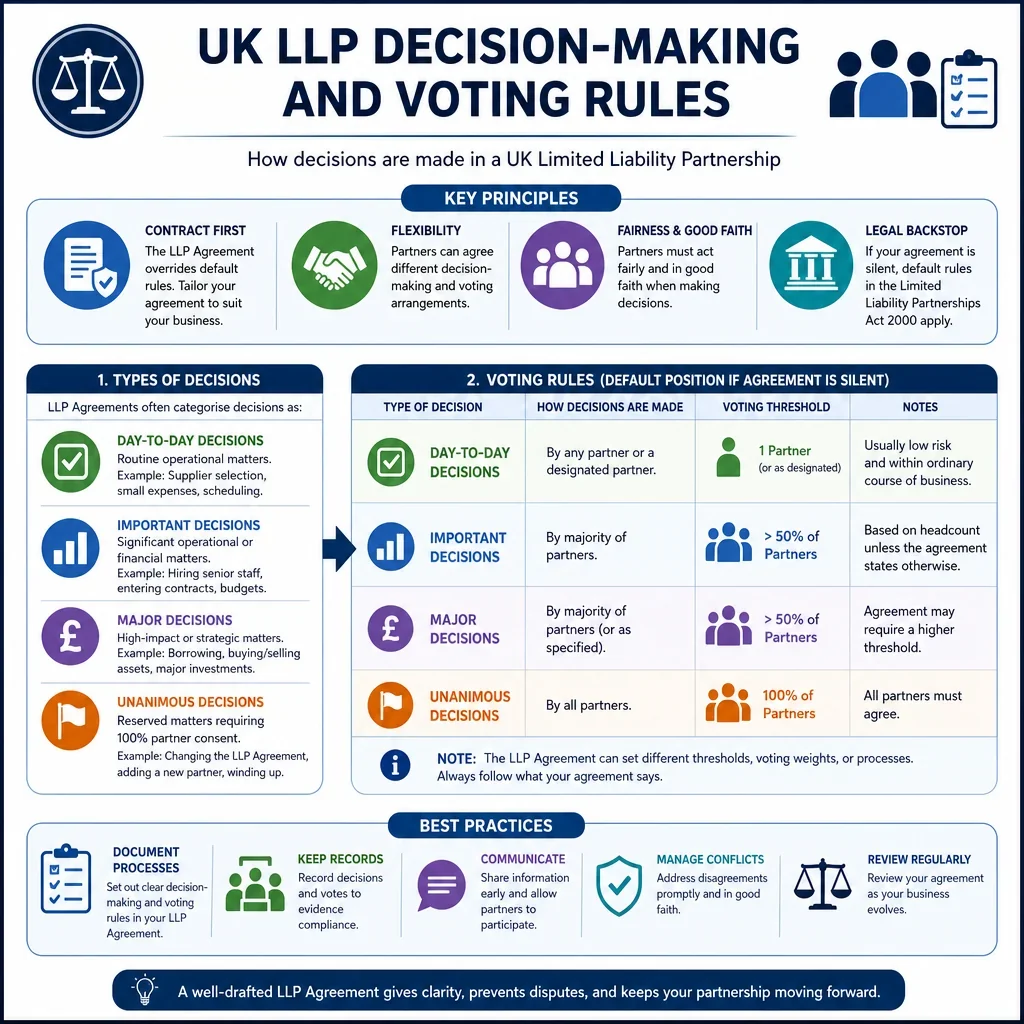
No Member acting alone shall have authority to bind the LLP except to the extent expressly authorised by this Agreement a decision of the Members or a separate written authority signed by a Designated Member.
Decisions shall be taken as follows: (a) unanimous consent of all Members for Reserved Matters (including admission of new Members amendment of this Agreement change to the Profit Shares and dissolution of the LLP other than as provided in this Agreement); (b) majority decision (more than 50 per cent of Profit Shares) for all other matters not delegated to the Designated Members; and (c) the Designated Members shall have authority for day-to-day decisions below such financial limits as the Members may set from time to time.
In the event of a deadlock on a matter requiring majority decision (other than a Reserved Matter) the matter shall first be referred to mediation. If not resolved within 30 days any Member may give notice that the LLP shall be wound up in accordance with Clause 17.
9DESIGNATED MEMBERS
The initial Designated Members are named in Clause 2.4. There shall at all times be at least two Designated Members.
Designated Members shall be appointed and removed by decision of the Members. A Member shall cease to be a Designated Member upon ceasing to be a Member or upon removal by the Members.
The Designated Members shall act as agents of the LLP and shall be responsible for: (a) ensuring compliance with all filing and registration requirements under the Limited Liability Partnerships Act 2000 and the Companies Act 2006 as applied to LLPs; (b) maintaining the statutory registers; (c) executing documents on behalf of the LLP where required; and (d) such other duties as are imposed on designated members by law or as delegated by the Members.
Each Member hereby grants to the Designated Members (and each of them) a power of attorney to execute on that Member's behalf all documents required to be filed at Companies House or otherwise in connection with the membership of that Member or the LLP (including forms LL IN01 LL AP01 LL CH01 LL TM01 and any notice of cessation). This power shall be irrevocable and shall survive the incapacity of the Member.
10MEETINGS
Meetings of the Members shall be held at least quarterly or more frequently as required. Meetings may be held in person by telephone or by video conference.
Not less than 14 days' notice shall be given for any meeting unless all Members agree to shorter notice. Notice may be given by email or in writing to the address of each Member last notified to the LLP.
The quorum for any meeting shall be Members holding at least 75 per cent of the Profit Shares present in person or by proxy. Written resolutions signed by all Members shall be as valid as resolutions passed at a duly convened meeting.
Each Member shall have one vote per 1 per cent of Profit Share. Decisions shall be taken by the voting thresholds set out in Clause 8.3. Minutes of all meetings shall be kept and circulated to all Members within 14 days.
The provisions of the Companies Act 2006 as applied to LLPs shall apply to meetings of the LLP to the extent not inconsistent with this Agreement.
11DUTIES AND OBLIGATIONS OF MEMBERS
Each Member owes to the LLP and to the other Members the fiduciary duties and duty of care that would be owed by a director to a company under the Companies Act 2006 as modified by the Limited Liability Partnerships Act 2000 and common law including the duties to act in good faith in the best interests of the LLP to avoid conflicts of interest and not to make unauthorised profits.
Each Member shall devote such time and attention to the Business as is reasonably necessary for the proper conduct of the LLP and shall not without the prior written consent of the other Members engage in any competing business during the term of membership.
Each Member shall comply with all applicable laws including the Data Protection Legislation Anti-Bribery Laws and Modern Slavery Laws and shall ensure that the LLP maintains a modern slavery statement where required by law.
Breach of any duty under this Clause shall entitle the LLP and the other Members to all remedies available at law including damages and (where appropriate) expulsion under Clause 13.
12BOOKS ACCOUNTS AND RECORDS
The LLP shall maintain proper books of account and statutory records in accordance with the Companies Act 2006 as applied to LLPs by the Limited Liability Partnerships (Application of Companies Act 2006) Regulations 2009 (as amended).
The books accounts and records shall be kept at the Registered Office or such other place as the Members decide and shall be available for inspection by any Member or the LLP's accountants at any reasonable time.
The accounting reference date shall be the Accounting Reference Date.
13AUDITS AND FINANCIAL STATEMENTS
The Designated Members shall procure that annual accounts are prepared in accordance with applicable law and UK GAAP (or such other accounting standards as the Members may decide) and that they are approved by the Members and filed at Companies House within the statutory time limits.
An auditor shall be appointed only if required by law or if the Members decide by majority that an audit is desirable. The approved accounts shall be circulated to all Members within 30 days of approval.
14TAX MATTERS
The LLP is transparent for UK income tax and capital gains tax purposes. Taxable profits and losses shall be allocated to the Members in accordance with their Profit Shares.
The Designated Members shall cause the LLP to file a partnership tax return (form SA800) and any other required returns by the due dates. Each Member shall be responsible for making their own self-assessment tax return and paying their own tax liabilities.
The LLP shall register for VAT if required by law and shall comply with all VAT PAYE National Insurance and stamp duty land tax obligations. The Members shall provide all information required for the LLP's tax compliance by 31 January following the end of each tax year.
Each Member shall indemnify the LLP and the other Members against any tax liability interest or penalty arising from that Member's failure to comply with their tax obligations or to provide required information.
The tax representative for the LLP shall be the Designated Members or such other person as they may appoint.
15INTELLECTUAL PROPERTY
All intellectual property created by any Member in the course of the Business or using the resources of the LLP shall belong to and vest in the LLP. Each Member hereby assigns all such rights to the LLP with full title guarantee and shall execute all documents and do all acts necessary to perfect the LLP's title.
Each Member grants the LLP an irrevocable royalty-free licence to use any pre-existing intellectual property necessary for the Business.
16INDEMNIFICATION AND INSURANCE
The LLP shall indemnify each Member against all liabilities losses and reasonable expenses incurred by that Member in the performance of their duties as a Member except to the extent that such liabilities arise from that Member's fraud dishonesty breach of duty or wilful default.
The LLP shall maintain appropriate insurance including professional indemnity insurance public liability insurance directors' and officers' liability insurance (covering Designated Members) and employers' liability insurance at levels determined by the Members. The Members shall notify the LLP promptly of any claim or circumstance that may give rise to a claim under any insurance policy.
17ADMISSION OF NEW MEMBERS
A new Member may be admitted only with the unanimous consent of all existing Members and upon execution of a deed of adherence to this Agreement in a form approved by the Members.
Any new Member shall make such Capital Contribution and be admitted on such terms (including as to Profit Share) as the existing Members shall unanimously decide. The admission shall take effect on the date the deed of adherence is executed or such later date as the Members decide.
18WITHDRAWAL RETIREMENT EXPULSION AND COMPULSORY TRANSFERS
A Member may retire by giving not less than six months' written notice to the other Members. The retirement shall take effect at the end of the notice period or such earlier date as all Members agree.
Upon retirement expulsion or any other cessation of membership (other than by transfer under Clause 19) the LLP shall pay to the outgoing Member (or their estate or trustee) the Fair Value of that Member's Interest determined as at the cessation date. The valuation shall include the Member's Capital Contribution plus their Profit Share of undistributed profits and reserves less their Profit Share of losses and liabilities and shall take into account the value of Goodwill on a going-concern basis unless the Members unanimously decide otherwise. Payment shall be made in instalments as follows: 50 per cent within 30 days and the balance in three equal instalments at 6 12 and 18 months after cessation with interest at 2 per cent above Bank of England base rate on the outstanding amount.
A Member may be expelled by unanimous decision of the other Members (excluding the Member proposed for expulsion) if that Member: (a) commits a material breach of this Agreement; (b) is guilty of conduct that brings the LLP or any Member into disrepute; (c) suffers an Insolvency Event; or (d) is incapacitated for a continuous period of 6 months. The Member shall be given not less than 30 days' written notice of the proposed expulsion the reasons for it and the right to make representations (including at a meeting) and to appeal the decision within 14 days. The decision on any appeal shall be final.
Membership shall automatically cease upon the death or bankruptcy of a Member or upon the occurrence of any Insolvency Event. In such cases the provisions of Clause 18.2 shall apply and the LLP shall continue as between the remaining Members.
Upon cessation the outgoing Member shall be bound by the restrictive covenants in Clause 20 for the periods stated therein. The outgoing Member shall execute all documents and do all things necessary to give effect to the cessation including assigning any interest in LLP property to the LLP or the remaining Members.
19TRANSFER OF MEMBERSHIP INTEREST
No Member may sell assign transfer charge or otherwise dispose of their Member's Interest (in whole or in part) without the prior unanimous written consent of the other Members. Any purported transfer without such consent shall be void.
Where consent is given the transfer shall be effected by a deed of transfer in a form approved by the Members and the transferee (if not already a Member) must execute a deed of adherence to this Agreement.
20DISSOLUTION AND WINDING UP
The LLP shall be dissolved only: (a) by unanimous decision of the Members; (b) upon the occurrence of an event specified in section 14 of the Limited Liability Partnerships Act 2000; or (c) by order of the court.
Upon dissolution a liquidator shall be appointed by the Members or in default by the court. The liquidator shall realise the assets pay the creditors in accordance with the Insolvency Act 1986 as applied to LLPs and distribute any surplus first to repay Capital Contributions then in accordance with the Members' Profit Shares.
Final accounts shall be prepared and filed at Companies House together with the necessary forms to record the dissolution.
21CONFIDENTIALITY NON-COMPETE AND RESTRICTIVE COVENANTS
Each Member shall keep confidential all Confidential Information and shall not disclose it to any third party without the prior written consent of the other Members except as required by law or to professional advisers bound by equivalent duties of confidence. This obligation survives termination of membership indefinitely.
During the term of membership and for 12 months after ceasing to be a Member no Member shall directly or indirectly: (a) carry on or be engaged in any business that competes with the Business within the United Kingdom; (b) solicit or canvass any client customer supplier or employee of the LLP; or (c) interfere with the LLP's relationships with its clients customers or suppliers. The Members acknowledge that these restrictions are reasonable in duration scope and geography to protect the legitimate interests of the LLP and the other Members including the Goodwill.
Upon cessation each Member shall return or destroy all Confidential Information in their possession and shall confirm compliance in writing if requested.
Any breach of this Clause shall entitle the LLP to seek injunctive relief in addition to damages.
22DATA PROTECTION ANTI-BRIBERY MODERN SLAVERY AND COMPLIANCE
Each Member shall comply with the Data Protection Legislation in relation to any personal data processed in connection with the LLP. The LLP shall maintain appropriate policies and where required register with the Information Commissioner's Office.
The LLP and each Member shall comply with all Anti-Bribery Laws and shall not engage in any corrupt practices. The LLP shall maintain anti-bribery and anti-corruption policies.
Where required by the Modern Slavery Act 2015 the LLP shall publish an annual slavery and human trafficking statement.
Each Member shall comply with all other applicable laws and regulations relevant to the Business.
23FORCE MAJEURE
No party shall be liable for any failure or delay in performing its obligations under this Agreement to the extent that such failure or delay is caused by a Force Majeure Event provided that the affected party notifies the others promptly and uses reasonable endeavours to mitigate the effects.
24DISPUTE RESOLUTION
Any dispute arising out of or in connection with this Agreement shall first be referred to mediation by a mediator appointed by the Members or in default by the Centre for Effective Dispute Resolution (CEDR).
If the dispute is not resolved by mediation within 30 days it shall be referred to and finally resolved by arbitration under the rules of the London Court of International Arbitration. The seat of arbitration shall be London the language shall be English and the tribunal shall consist of a single arbitrator.
All dispute resolution proceedings shall be confidential.
25GOVERNING LAW AND JURISDICTION
This Agreement and any dispute or claim arising out of or in connection with it or its subject matter or formation (including non-contractual disputes or claims) shall be governed by and construed in accordance with the law of England and Wales.
The parties irrevocably agree that the courts of England and Wales shall have exclusive jurisdiction to settle any dispute or claim arising out of or in connection with this Agreement.
26MISCELLANEOUS
This Agreement constitutes the entire agreement between the parties and supersedes all prior understandings representations or agreements whether oral or in writing. The parties acknowledge that they have not relied on any representation not expressly set out in this Agreement.
No variation of this Agreement shall be effective unless it is in writing and signed by or on behalf of all the Members.
If any provision of this Agreement is held to be invalid or unenforceable the validity of the remaining provisions shall not be affected.
No failure or delay by any party in exercising any right power or remedy under this Agreement shall operate as a waiver of that right power or remedy.
A person who is not a party to this Agreement shall have no rights under the Contracts (Rights of Third Parties) Act 1999 to enforce any term of this Agreement.
Notices under this Agreement shall be in writing and may be delivered personally sent by pre-paid first class post or sent by email to the address of the relevant Member or to the Registered Office. A notice sent by post shall be deemed served two Business Days after posting. A notice sent by email shall be deemed served on the date of transmission provided no error message is received. The address of the LLP for service of notices is the Registered Office.
This Agreement may be executed in any number of counterparts each of which when executed and delivered shall constitute a duplicate original but all the counterparts together shall constitute one agreement. Transmission of an executed counterpart by email or electronic means shall take effect as delivery of an executed original.
Each Member shall bear their own costs in relation to the negotiation preparation and execution of this Agreement.
Nothing in this Agreement shall create a partnership between the Members other than the LLP itself.
This Agreement is personal to the Members and no Member may assign the benefit of this Agreement without the prior written consent of all other Members.
27SCHEDULE 1 - INITIAL MEMBERS AND CAPITAL CONTRIBUTIONS
The initial Members their addresses Capital Contributions and initial Profit Shares are as follows: (1) Alice Johnson 45 Oak Avenue London W1K 2AB £5,000 cash 25%; (2) Bob Smith 67 Elm Drive Manchester M1 3CD £7,500.50 equipment 25%; (3) Carol Williams 89 Pine Road Birmingham B1 2EF £5,000 cash 25%; (4) David Brown 12 Maple Lane Edinburgh EH1 3GH £5,000 cash 25%.
28EXECUTION
Executed and delivered as a deed on the date first written above.
SIGNED as a deed by Tech Innovations LLP acting by its Designated Members: Alice Johnson and Bob Smith in the presence of witnesses.
SIGNED as a deed by Alice Johnson in the presence of a witness.
SIGNED as a deed by Bob Smith in the presence of a witness.
SIGNED as a deed by Carol Williams in the presence of a witness.
SIGNED as a deed by David Brown in the presence of a witness.
This example shows approximately 70% of a typical document and is provided for illustrative purposes only. The remaining content has been omitted.
Every document generated by Docaro is tailored to your specific circumstances, jurisdiction and the information you provide. The completed document includes all applicable clauses and provisions required for your situation.
To generate the full, personalised document, answer a short series of questions and your document will be created instantly.
Useful Resources When Considering a Limited Liability Partnership Agreement in the United Kingdom
United Kingdom Reference Legislation
Limited Liability Partnership Agreement FAQs
Document Generation FAQs
Related Articles