Docaro

AI Generated British Will
PDF & Word - 2026 Updated
A photorealistic image representing legacy planning and inheritance in the UK, showing a thoughtful adult individual in a modern British home, looking at a family photo album with subtle elements like a Union Jack flag in the background, evoking security and future planning without displaying any documents.
Generate your personalised last will and testament for the United Kingdom effortlessly with our advanced AI tool, ensuring your estate is distributed according to your wishes while complying with UK inheritance laws.
Free instant document creation.
Compliant with United Kingdom law.
No sign up or monthly subscription.

Docaro Pricing

Basic
Free
Document Generation
No Sign Up
No Subscription
Download Watermarked PDF
Premium
$4.99 USD
Document Generation
No Sign Up
No Subscription
Download Clean PDF
Download Microsoft Word
Download HTML
Download Text
Email Document
Generate your document for free. Only pay if you like the result and need an un-watermarked version.

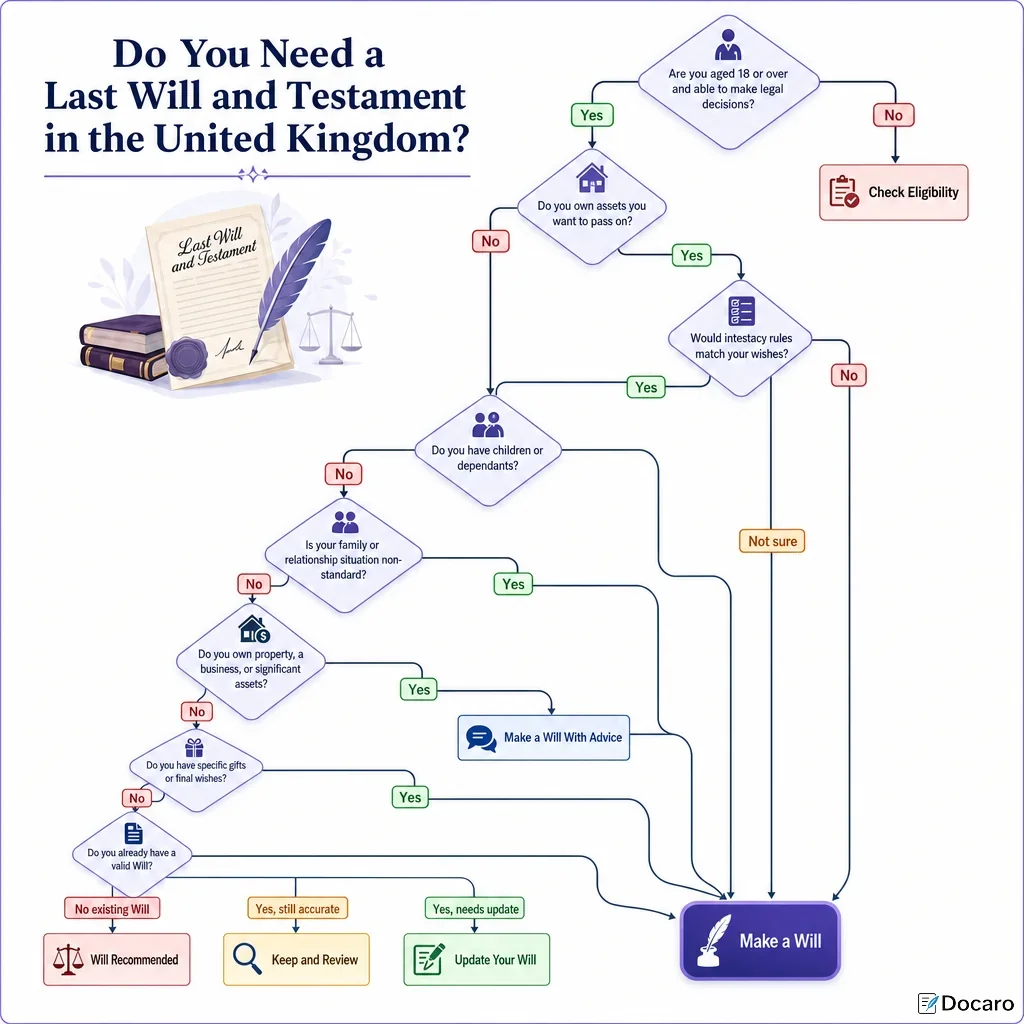
When do you need a Will in the United Kingdom?

  • You own property or assets
    A Will ensures your home, savings, or belongings go to the people you choose, rather than following default rules.
  • You have a partner or spouse
    Without a Will, your partner might not automatically inherit everything, so it protects their rights to your estate.
  • You have children or dependents
    A Will lets you appoint guardians and provide for your children's future care and inheritance.
  • Your family situation is complex
    If you have children from previous relationships or blended families, a Will clarifies who gets what to avoid disputes.
  • You want to donate to charity
    A Will allows you to leave gifts to causes you support, which might not happen without one.
  • You plan for the unexpected
    Anyone over 18 should consider a Will because life is unpredictable, and it gives you peace of mind.
  • A well-drafted Will prevents problems
    It avoids family arguments, delays, and extra costs after you're gone by clearly stating your wishes.

British Legal Rules for a Will

  • Age Requirement
    You must be at least 18 years old to make a valid will, unless you're in the armed forces or married.
  • Mental Capacity
    You need to understand what you're doing, know what property you own, and recognize who might benefit from your will.
  • Written Form
    The will must be written on paper; oral or video wills are not valid in most cases.
  • Signature Needed
    You must sign the will yourself at the end, or direct someone to sign for you in your presence.
  • Witnesses Required
    Two independent witnesses over 18 must watch you sign and then sign the will themselves in your presence.
  • No Beneficiary as Witness
    Witnesses cannot be people who will receive anything from your will, or they won't get their inheritance.
  • Revocation Rules
    A new will automatically cancels old ones, but you can also revoke a will by destroying it with intent.
  • Protecting Your Estate
    The law ensures your spouse, children, or dependents get a reasonable share if the will doesn't provide for them adequately.
Important

Using the wrong structure for a last will and testament can result in it being invalid or contested in court.

What a Proper Will Should Include

  • Who Gets What
    Clearly state who should receive your money, property, and possessions to ensure your wishes are followed.
  • Guardians for Children
    Name a trusted person to care for any children under 18 if both parents pass away.
  • Funeral Wishes
    Outline your preferences for burial, cremation, or any specific ceremonies to guide your family.
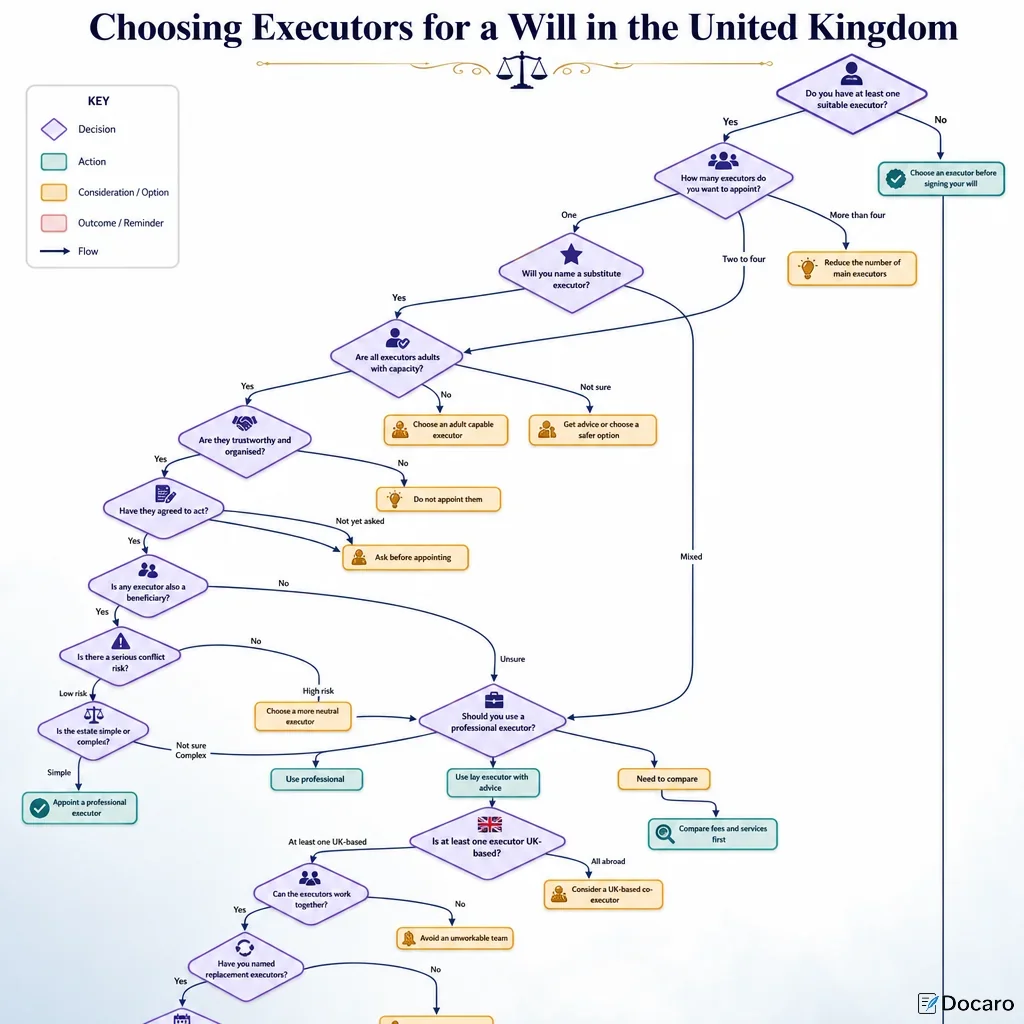
  • Appointing an Executor
    Choose someone reliable to manage and distribute your estate according to your instructions.
  • Trusts for Beneficiaries
    Set up ways to protect assets for young or vulnerable people until they can manage them.
  • Signing and Witnesses
    Sign the will in front of two independent witnesses to make it legally valid.

Why Free Templates Can Be Risky for Wills

Free will templates often use generic language that fails to account for UK-specific inheritance laws, such as intestacy rules or tax implications. This can lead to unintended disinheritance of beneficiaries, disputes among heirs, or the will being declared invalid by probate courts.

AI-generated bespoke wills are tailored to your unique circumstances, incorporating precise UK legal phrasing to ensure your assets are distributed exactly as intended, minimising disputes and maximising enforceability.

Generate Your Bespoke Will in 4 Easy Steps

1
Answer a Few Questions
Our AI guides you through the info required.
2
Generate Your Document
Docaro builds a bespoke document tailored specifically on your requirements.
3
Review & Edit
Review your document and submit any further requested changes.
4
Download & Sign
Download your ready to sign document as a PDF, Microsoft Word, Txt or HTML.

Why Use Our AI Will Generator?

Fast Generation
Quickly generate a comprehensive Will, eliminating the hassle and time associated with traditional document drafting.
Guided Process
Our user-friendly platform guides you step by step through each section of the document, providing context and guidance to ensure you provide all the necessary information for a complete and accurate Will.
Safer Than Legal Templates
We never use legal templates. All documents are generated from first principles clause by clause, ensuring that your document is bespoke and tailored specifically to the information you provide. This results in a much safer and more accurate document than any legal template could provide.
Professionally Formatted
Your Will will be formatted to professional standards, including headings, clause numbers and structured layout. No further editing is required. Download your document in PDF, Microsoft Word, TXT or HTML.
Compliance with British Law
Rest assured that all generated documents meet the latest legal standards and regulations of the United Kingdom, enhancing trust and reliability.
Cost-Effective
Save money by generating legally sound Will without the need for expensive legal services or consultations.
Get Started for Free - No Sign Up or Monthly Subscription Required
No payment or sign up is required to start generating your Will. Generate and download a watermarked version of your document for free. Pay only if you want to remove the watermark and gain full access to your document. No monthly subscriptions or hidden fees. Pay once and use your document forever.
Need to Generate a Will in a Different Country?
Choose country:

Free Example Will Template

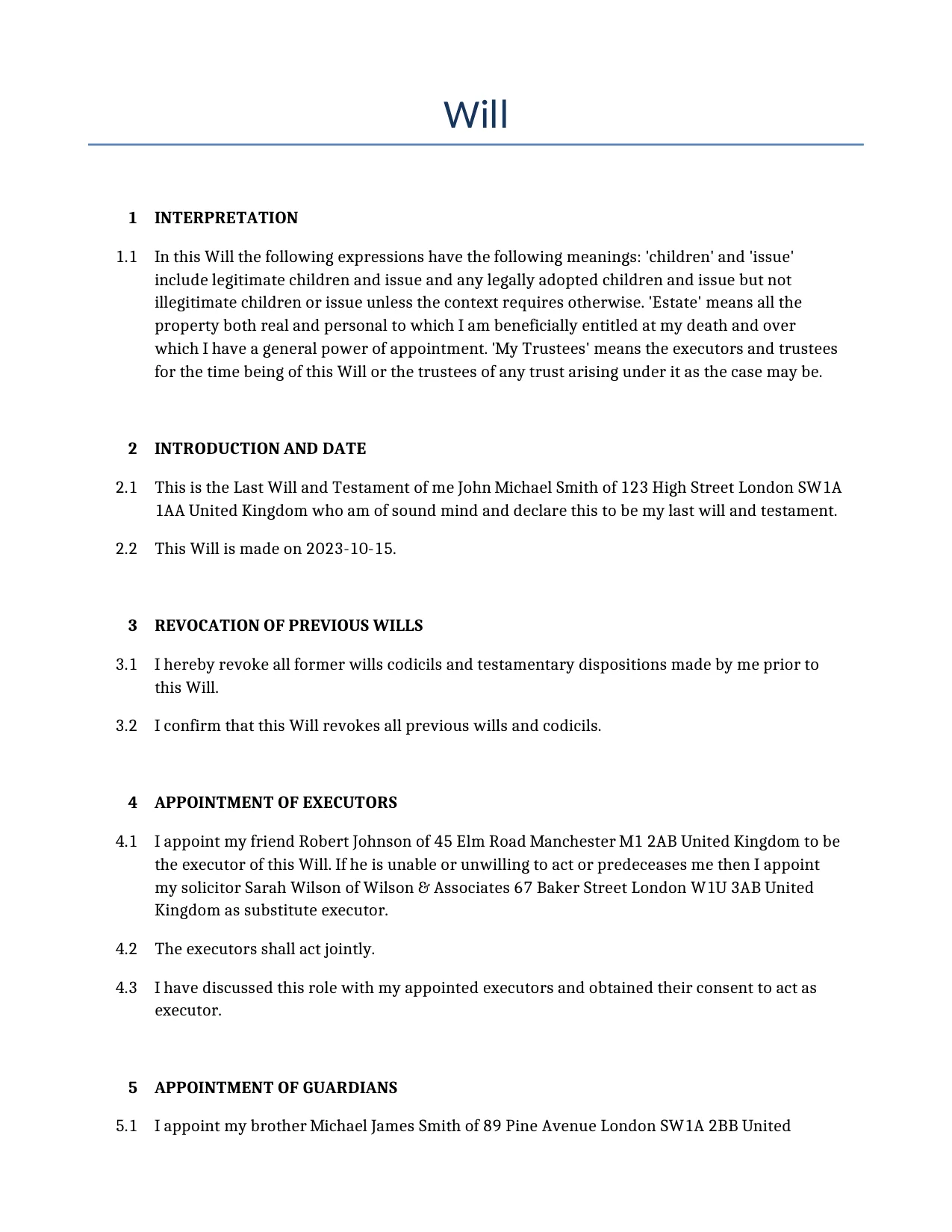
Below is a free template example of a Will for use in the United Kingdom generated by our AI model.

The clauses in your actual Will will vary from this example as they will be entirely bespoke to your requirements as set out in the questionnaire you complete.

Page 1

United Kingdom Compliance Legislation

Your AI Generated Will will be checked for compliance against the following legislation and regulations:
The primary statute governing the validity, execution, and revocation of wills in England and Wales. It sets out requirements for making a valid will, including age, capacity, and formalities like signing in the presence of witnesses.
Regulates the administration of estates of deceased persons, including intestacy rules when there is no valid will, and the granting of probate for wills.
Allows certain family members and dependants to claim reasonable financial provision from a deceased person's estate if the will (or intestacy rules) does not adequately provide for them.
Permits members of the armed forces on active service to make privileged wills without the usual formalities required by the Wills Act 1837.
Amends rules on survivorship and revocation of wills, particularly addressing situations where a beneficiary predeceases the testator.
Affects wills that create trusts of land, updating powers of trustees and beneficiaries in relation to property dispositions via wills.

What is a Will in the United Kingdom?

In UK law, a Will is a legal document that outlines how an individual's assets, known as their estate, should be distributed after their death. It allows the testator—the person making the Will—to specify beneficiaries for property, money, and possessions, ensuring their wishes are followed rather than relying on default intestacy rules.

The primary purpose of a Will is to provide clarity and control over asset distribution, minimising disputes among family members and reducing the administrative burden on executors. Without a valid Will, the estate may be divided according to the Administration of Estates Act 1925, which prioritises spouses, children, and other relatives in a fixed order, potentially excluding intended recipients.

Having a valid Will is crucial to protect loved ones, appoint guardians for minor children, and potentially reduce inheritance tax liabilities through strategic planning. For a deeper dive into creating and managing Wills under UK law, explore our comprehensive guide on understanding Wills in the UK.

To ensure your Will meets legal standards, consider using bespoke AI-generated legal documents from Docaro, tailored to your unique circumstances for maximum effectiveness.

When should you use a Will, and when should you avoid it?

Creating a Will is essential in various scenarios to ensure your assets are distributed according to your wishes, particularly if you have dependents such as minor children who require guardianship provisions. It becomes crucial when owning property, like real estate or investments, to specify beneficiaries and avoid disputes. In complex family situations, such as blended families or estranged relatives, a Will prevents unintended inheritance under intestacy laws, safeguarding your legacy.

A Will might not be necessary for individuals with minimal assets, where state intestacy rules automatically distribute small estates to close family members without complications. For those without dependents or significant property, relying on default laws can suffice, though consulting a professional is advisable to confirm eligibility.

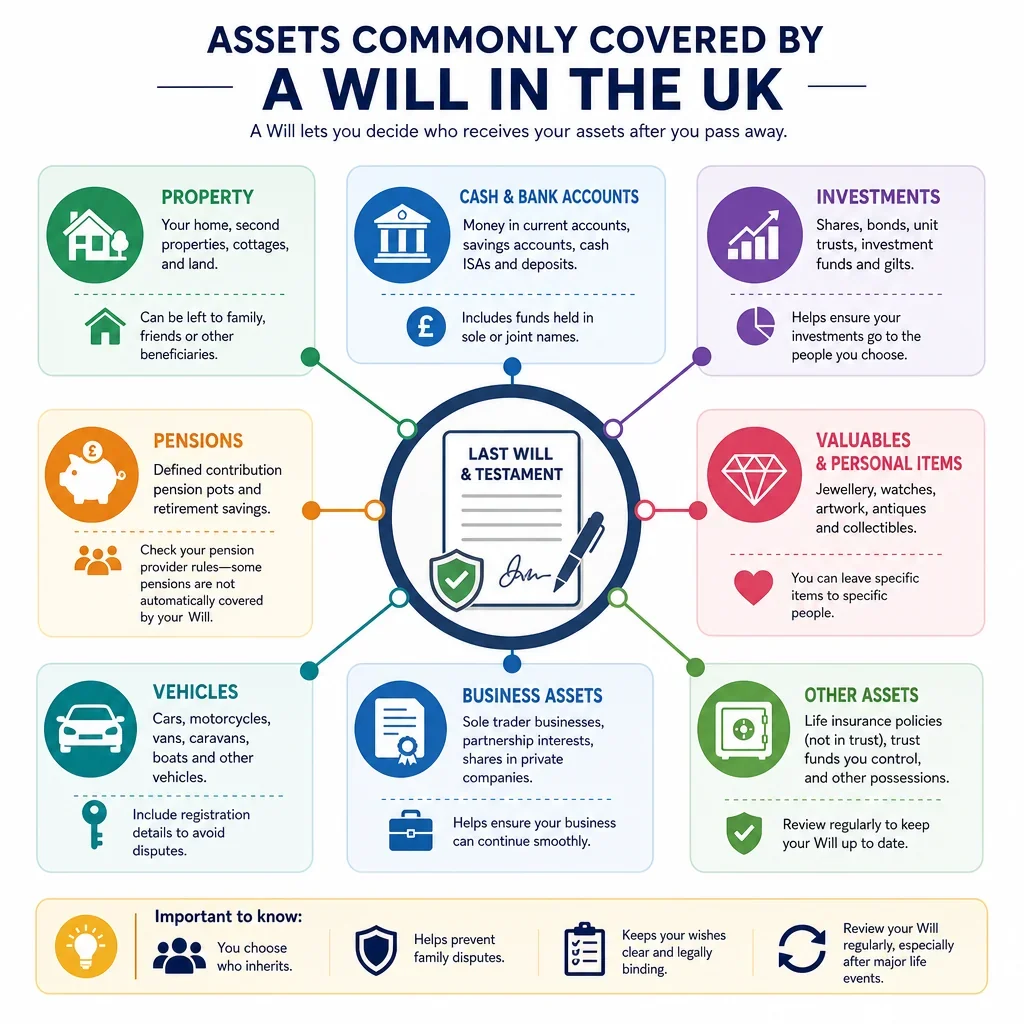
Key exclusions from a Will include assets that pass outside of it, such as joint property with rights of survivorship or pensions with nominated beneficiaries. Other exclusions encompass life insurance policies payable to named individuals and trust-held assets. For detailed guidance on UK inheritance rules, refer to the GOV.UK Wills and probate page. When preparing your Will, opt for bespoke AI-generated legal documents using Docaro to tailor it precisely to your needs.

"Without a Will, UK intestacy rules may distribute your estate in ways that do not align with your intentions, often sparking family conflicts and financial hardship for loved ones," warns Sarah Jenkins, a leading inheritance law specialist at the Law Society. I strongly recommend creating a bespoke Will using Docaro's AI-generated legal documents to ensure your wishes are precisely and professionally captured.

What are the key clauses to include in a UK Will?

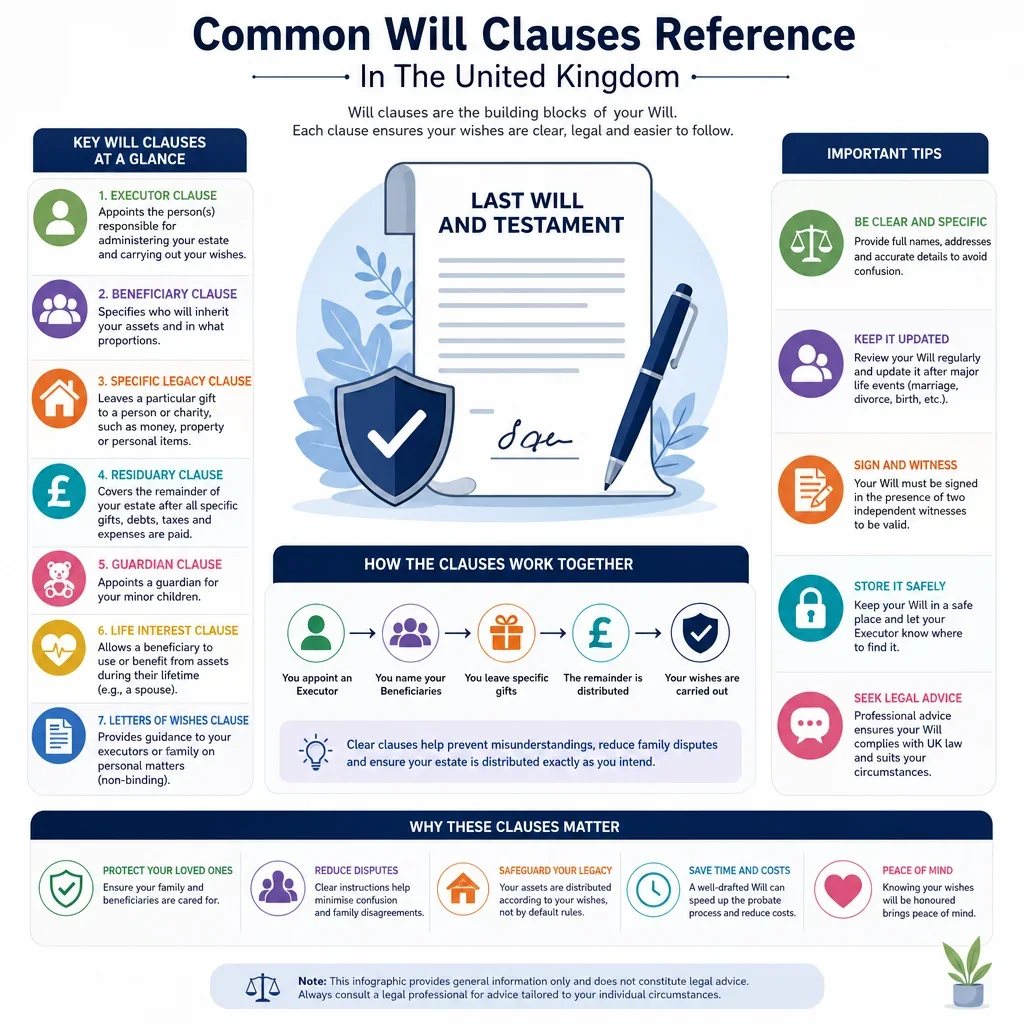
The essential clauses in a valid will UK form the backbone of estate planning, ensuring your assets are distributed according to your wishes. Key elements include the appointment of executors, specific bequests, residuary estate distribution, guardianship for minors, and revocation of previous wills. For detailed guidance on drafting one, refer to our guide on how to write a valid will in the United Kingdom.

Appointment of executors is a crucial clause where you name trusted individuals or professionals to administer your estate after death, handling tasks like paying debts and distributing assets. This role requires reliability, as executors have legal duties under UK law; it's wise to appoint alternates in case the primary cannot serve.

Specific bequests allow you to allocate particular items or sums of money to named beneficiaries, such as leaving a family heirloom to a child or a cash gift to a charity. These clauses take priority over general distributions and help personalise your legacy while minimising disputes.

The residuary estate distribution clause covers everything not specifically bequeathed, dividing the remainder among beneficiaries as percentages or shares. This ensures no assets are left unallocated, providing a catch-all for your UK inheritance planning; for official rules, see the GOV.UK guidance on wills and probate.

Guardianship for minors appoints a guardian to care for any underage children, specifying their upbringing and financial support from the estate. This clause is vital for parents, safeguarding children's welfare if both parents pass away.

Finally, the revocation of previous wills clause explicitly cancels all prior wills and codicils, confirming the current document as your sole testamentary intention. This prevents conflicts from outdated versions and is essential for a clear, enforceable will.

While templates may seem convenient, opt for bespoke AI-generated legal documents through Docaro to tailor your will precisely to UK requirements and your unique circumstances.

Rights and obligations of parties involved

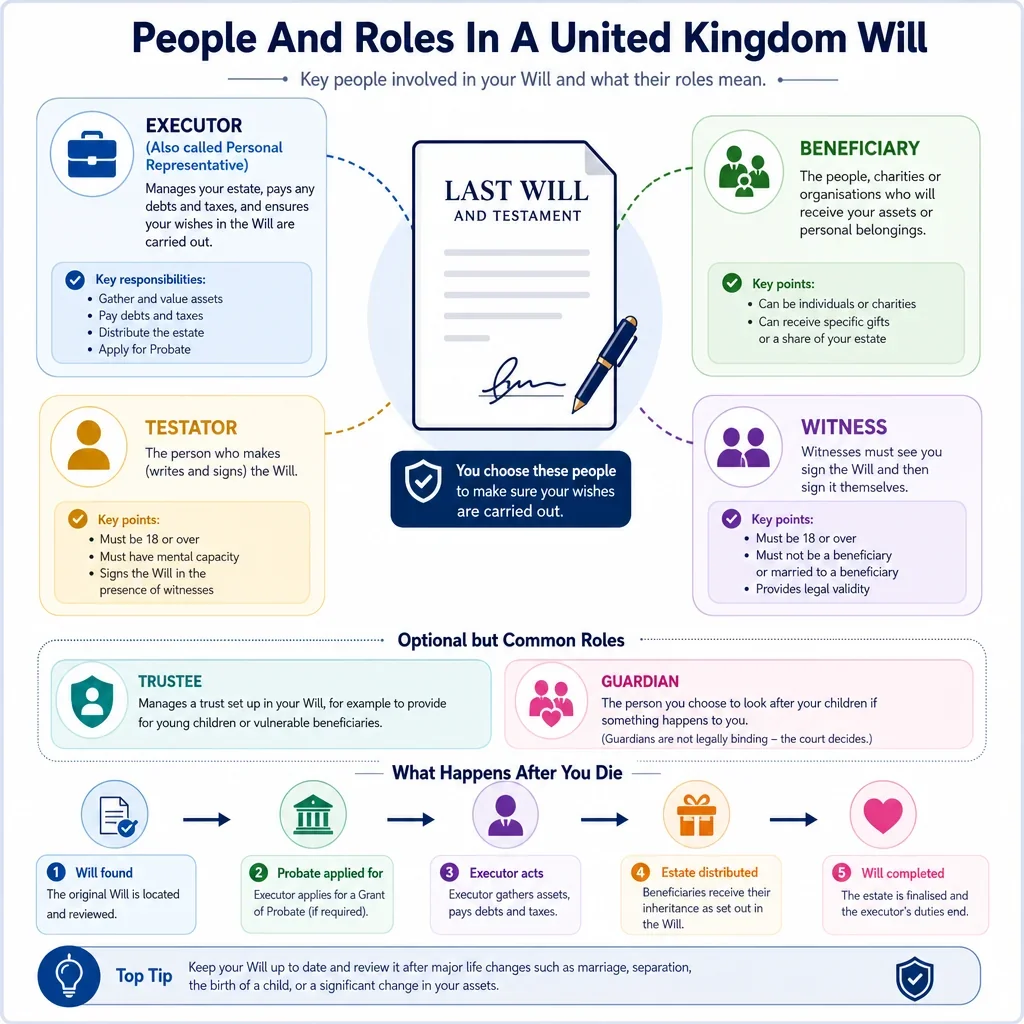
In a UK Will, the testator—the person creating the will—has the right to freely distribute their estate according to their wishes, provided they are of sound mind and the document meets legal requirements under the Wills Act 1837. The testator's primary obligation is to ensure the will is validly executed, including signing in the presence of two witnesses, and to act in good faith by making reasonable provisions for dependents to minimize challenges.

Beneficiaries in a UK Will hold the right to receive their specified inheritance and can challenge the will under the Inheritance (Provision for Family and Dependants) Act 1975 if they believe the provision is inadequate, such as spouses or children claiming reasonable financial provision. Their obligations are minimal but include acting in good faith during any disputes, avoiding frivolous claims that could deplete the estate.

The executor, appointed by the testator, has the duty to manage the estate responsibly, including gathering assets, paying debts and taxes, and distributing inheritances without undue delay, all while upholding fiduciary duties of loyalty and impartiality as outlined by the UK government probate guidelines. Executors have the right to seek professional advice and reimbursement for reasonable expenses but must avoid conflicts of interest and can be held accountable for breaches through court oversight.

For personalized estate planning, consider bespoke AI-generated legal documents using Docaro to ensure compliance with UK inheritance laws and tailor provisions to your specific needs.

Are there any recent or upcoming changes to UK Will laws?

The core framework governing wills in the UK remains stable under the Wills Act 1837, which mandates that wills must be in writing, signed by the testator in the presence of two witnesses, with no major amendments since 2020. This stability ensures continuity in estate planning, but ongoing discussions around modernising inheritance laws highlight the need for clarity in areas like digital assets, as noted in recent consultations by the Law Commission.

Post-2020, electronic signing of wills has seen pilot programs and legislative pilots, particularly influenced by the COVID-19 pandemic, though full digital will provisions are not yet enacted. For those seeking efficient will creation, bespoke AI-generated legal documents via Docaro offer a tailored alternative to traditional methods, ensuring compliance with UK regulations.

How do you get started with creating your Will?

1
Assess Your Assets
List all your assets including property, savings, investments, and personal items. Estimate their values to understand your estate's scope.
2
Choose Executors
Select trusted individuals, such as family or friends, to act as executors. Discuss their willingness to handle your estate administration.
3
Seek Legal Advice
Consult a qualified solicitor to ensure your Will complies with UK laws. Get personalized guidance on guardians and inheritance tax.
4
Draft the Document
Use Docaro to generate a bespoke AI-powered Will based on your details. Review and sign it with witnesses for validity.

What common pitfalls should you watch out for?

Creating a UK Will requires precision to ensure your wishes are followed after death. Common mistakes include unclear language that leads to disputes among beneficiaries and failing to update the Will after major life events like marriage, divorce, or the birth of children, which can render parts invalid under UK law.

To avoid these pitfalls, clearly define terms and specify exact distributions of assets, and review your Will regularly, especially after significant changes. For more details, read our comprehensive guide on common mistakes to avoid when making a Will in the UK.

Instead of using generic legal templates, opt for bespoke AI-generated legal documents through Docaro to tailor your Will precisely to your needs. Consult authoritative sources like the GOV.UK guidance on making a Will for additional UK-specific advice to ensure compliance and clarity.

Will FAQs

A last will and testament, commonly known as a will, is a legal document that outlines how your assets, property, and possessions should be distributed after your death. In the UK, it allows you to appoint guardians for minor children, name executors, and specify funeral wishes, ensuring your estate is handled according to your preferences.

Document Generation FAQs

Docaro is an AI-powered legal and corporate document generator that helps you create fully formatted, legally sound contracts and agreements in minutes. Just answer a few guided questions and download your document instantly.
You Might Also Be Interested In
A Legal Document Specifying An Individual's Medical Treatment Preferences In Case They Become Unable To Communicate.
A Legal Document Authorizing One Person To Act On Behalf Of Another In Specified Matters.
A Revocable Living Trust Is A Legal Arrangement Where Assets Are Transferred To A Trustee To Manage For Beneficiaries, With The Creator Retaining The Ability To Modify Or Revoke It During Their Lifetime.
A Legal Document Allowing Individuals To Specify Future Medical Treatment Refusals If They Lose Decision-making Capacity.
A Codicil Is A Legal Document That Amends, Modifies, Or Adds Provisions To An Existing Will Without Revoking The Entire Will.
A Legal Document Listing All Assets And Property Of A Deceased Person's Estate For Probate Purposes.

Related Articles

A photorealistic image of a thoughtful adult senior citizen sitting in a cozy living room, looking at family photos on a mantel, symbolizing legacy and inheritance planning without any legal documents visible.
Discover everything about wills in the UK with our comprehensive guide. Learn how to write a valid will, what happens without one, contesting wills, probate process, and expert tips to protect your legacy.
A photorealistic image depicting a thoughtful middle-aged adult sitting at a wooden desk in a cozy home study, gazing contemplatively at a family photo frame on the desk, symbolizing legacy planning and inheritance without focusing on any legal documents. The scene conveys serenity and forward-thinking, with warm natural light filtering through a window.
Learn how to write a valid will in the United Kingdom with our comprehensive guide. Discover essential steps, legal requirements, and tips to ensure your wishes are honored after death.
A photorealistic image of a thoughtful middle-aged adult sitting at a wooden desk in a cozy home office, gazing contemplatively at a family photo frame on the desk, symbolizing legacy and future planning, with warm natural light filtering through a window, no children or documents visible.
Discover the most common mistakes to avoid when creating a will in the UK. Learn how to ensure your will is valid, up-to-date, and protects your loved ones from unnecessary complications.