Cease And Desist Letter Delivery Methods In The United Kingdom
Delivery Method | Proof Available | Advantages | Limitations | Proof Strength |
|---|---|---|---|---|
Post | ||||
Royal Mail Special Delivery Guaranteed | Tracking, delivery confirmation and signature where available | Strong postal evidence and fast delivery | Costs more than standard post | High |
Royal Mail Signed For First Class | Online delivery confirmation and signature where available | Affordable proof of delivery | Not guaranteed next day | High |
Royal Mail Signed For Second Class | Online delivery confirmation and signature where available | Lower cost with delivery evidence | Slower than first class or courier | High |
Royal Mail Tracked 24 | End-to-end tracking and delivery confirmation | Detailed tracking without guaranteed time | Signature may require added option | High |
Royal Mail Tracked 48 | Tracking events and delivery confirmation | Cost-effective tracking | Slower and less formal than signed service | Medium |
Royal Mail First Class post | Proof of posting if obtained at Post Office | Cheap and familiar | No delivery confirmation | Medium |
Royal Mail Second Class post | Proof of posting if requested | Very low cost | Slow and no receipt evidence | Low |
Post with Certificate of Posting | Certificate showing item was posted | Free evidence of dispatch | Does not prove receipt | Medium |
Ordinary post without proof | Sender diary note only | Quick to send and inexpensive | Hard to prove sending or receipt | Low |
Duplicate copies by first and signed post | Proof of posting plus signed delivery evidence | Reduces avoidance arguments | Costs more and duplicates administration | High |
Courier | ||||
Next-day courier delivery | Tracking, delivery scan and signature | Fast and commercially reliable | May be costly for individuals | High |
Same-day courier delivery | Courier receipt, tracking and delivery confirmation | Useful for urgent disputes | Expensive and location dependent | High |
Courier delivery requiring signature | Named signature and timestamp | Clear receipt evidence | Recipient may refuse signature | High |
Courier delivery without signature | Tracking scan or delivery photo | Works when signatures are unavailable | Weaker proof of personal receipt | Medium |
International tracked courier | International tracking and delivery record | Useful where recipient is abroad | Customs, delay and local rules issues | Medium |
Hand delivery | ||||
Professional process server hand delivery | Certificate, statement or affidavit of service | Strong evidence from independent server | More expensive than post | High |
Personal hand delivery by sender | Sender note, photo or acknowledgement | Immediate and inexpensive | May inflame dispute or be denied | Medium |
Hand delivery with independent witness | Witness statement and delivery note | Stronger than self-delivery alone | Witness may later be needed | High |
Letterbox hand delivery | Photo, timestamp and delivery note | Avoids need for recipient interaction | Does not prove actual reading | Medium |
Delivery to business reception | Reception signature or visitor log | Practical for company recipients | May not reach decision-maker | Medium |
Email | ||||
Email with saved sent copy | Sent email, timestamp and attachments | Fast and easy to archive | Does not prove receipt or reading | Medium |
Email with delivery receipt request | Delivery receipt if generated | May confirm server delivery | Receipts may be blocked or unreliable | Medium |
Email with read receipt request | Read receipt if accepted | Can indicate the email was opened | Recipient can refuse or disable receipts | Medium |
Email requesting acknowledgement | Reply confirming receipt | Direct evidence from recipient | Recipient may ignore request | High |
Email with tracked document link | Open, click or download logs | May show access to the letter | Tracking can raise privacy and reliability issues | Medium |
Email with PDF attachment | Sent email and attached PDF metadata | Preserves formatting and content | Attachment may be filtered or blocked | Medium |
Email to known business address | Sent email plus prior correspondence evidence | Targets an address already used by recipient | Mailbox monitoring may be disputed | Medium |
Email to published company contact address | Sent email and screenshot of published address | Useful where no named contact exists | Generic inbox may not be monitored | Medium |
Email via secure legal document portal | Access logs, timestamps and download records | Good audit trail for sensitive documents | Recipient may not access portal | High |
Solicitor-to-solicitor communication | ||||
Solicitor letter sent by post | Solicitor file note and postal proof | Formal and professionally recorded | Depends on solicitor turnaround time | High |
Solicitor-to-solicitor email | Professional correspondence record and reply chain | Fast and usually well documented | Requires correct solicitor authority | High |
Solicitor DX document exchange | DX despatch and delivery records | Established legal sector delivery route | Only useful if recipient uses DX | High |
Solicitor secure portal exchange | Portal audit trail and access logs | Good for confidential or large files | Needs agreed portal access | High |
Email, Post | ||||
Email plus signed post | Sent email, postal tracking and signature | Combines speed with delivery evidence | Requires managing two evidence trails | High |
Email, Courier | ||||
Email plus courier copy | Email record and courier delivery evidence | Useful for urgent high-value disputes | Higher cost and duplication | High |
Post | ||||
Post to company registered office | Postal proof and Companies House address record | Uses official company address | May not be trading address | High |
Post, Courier, Hand delivery | ||||
Delivery to trading address | Tracking, signature or witness note | Likely reaches operational staff | Address accuracy may be disputed | Medium |
Post | ||||
Post to last known residential address | Proof of posting and address evidence | Useful where no email is available | Recipient may have moved | Medium |
What Is The Best Way To Send A Cease And Desist Letter In The UK?
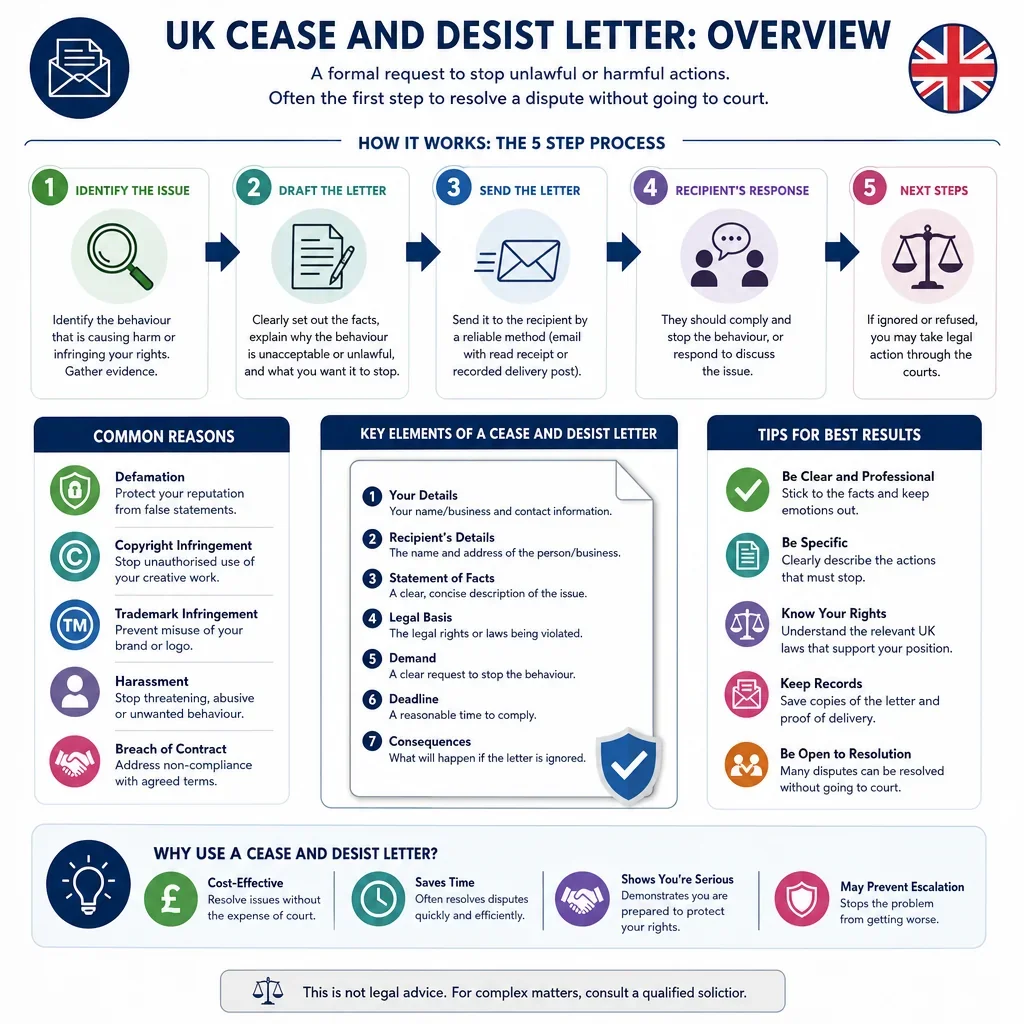
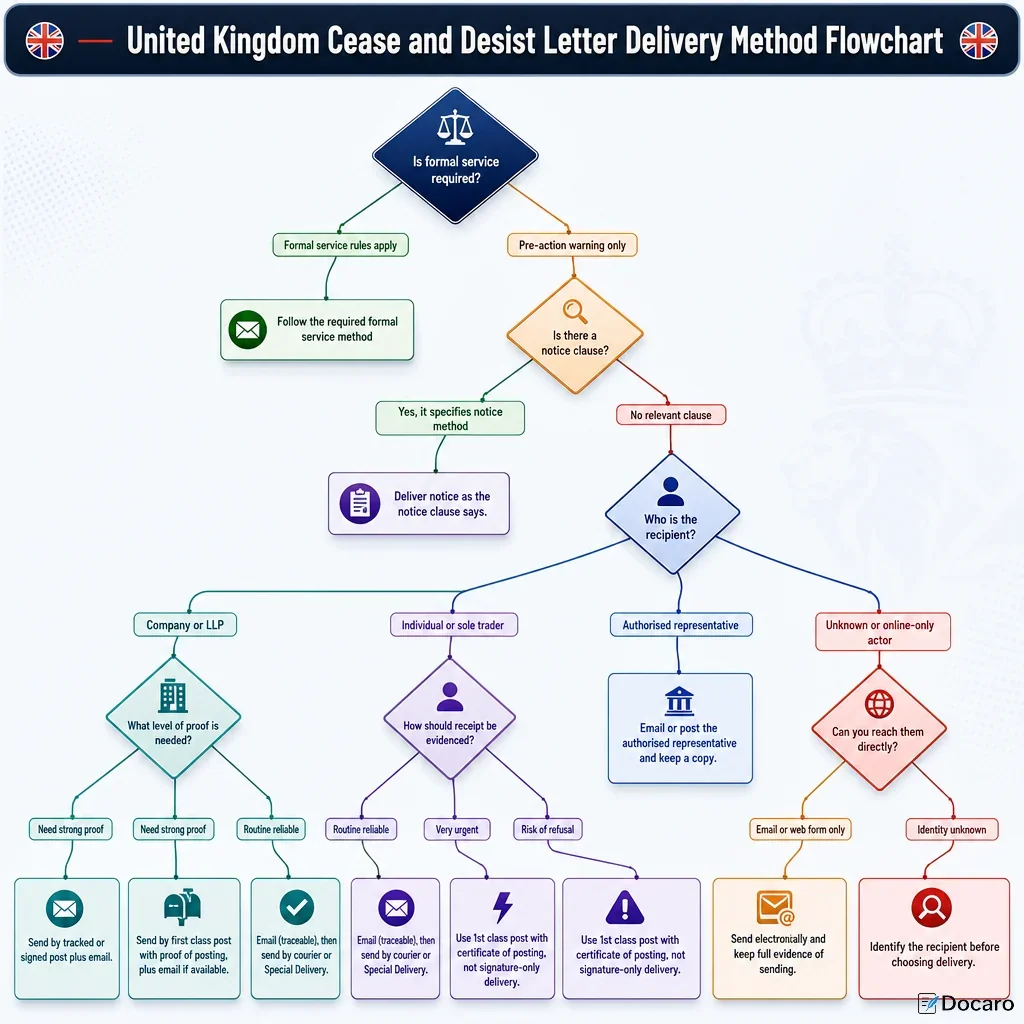
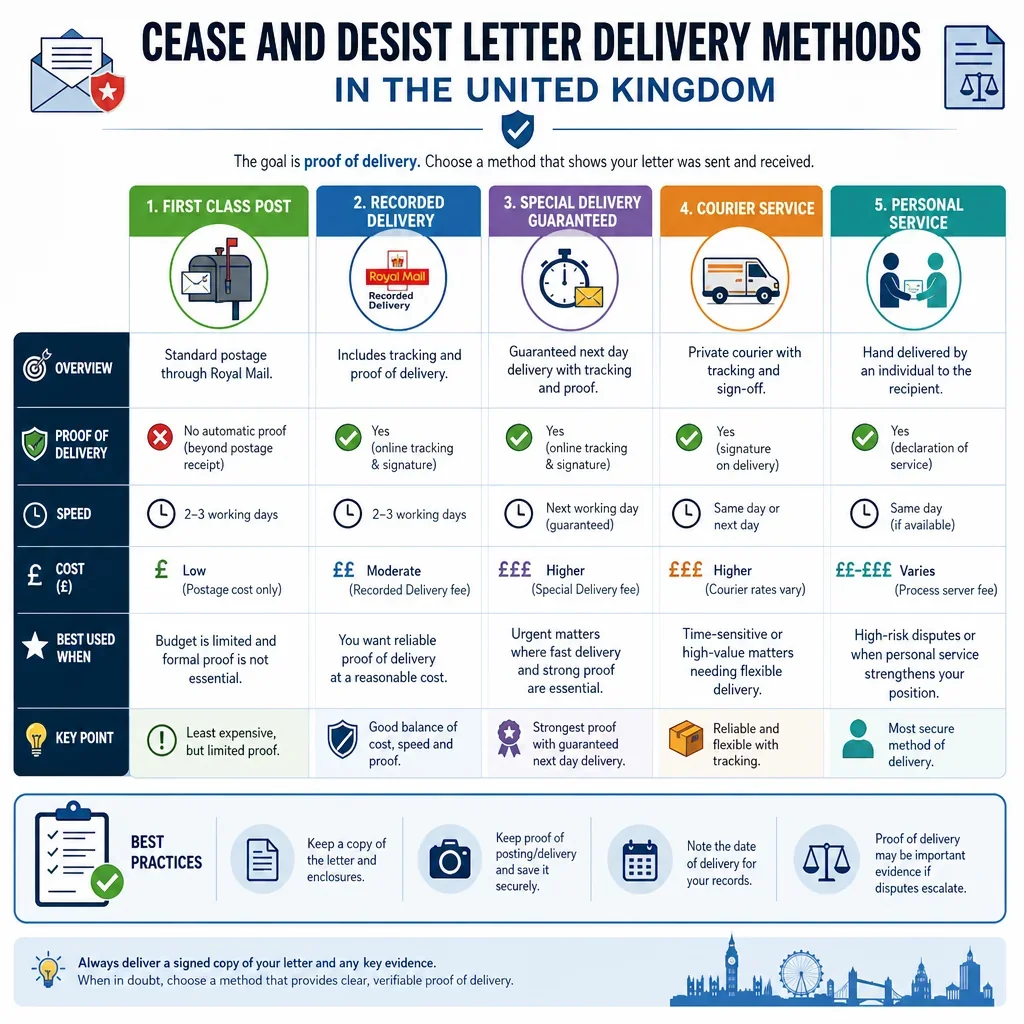
Use a method that proves both content and delivery. For important cease and desist letters, a tracked postal service, signed courier, process server, or solicitor-to-solicitor email is usually stronger than ordinary post or informal messaging because it creates a clearer evidence trail.
Should You Send A Cease And Desist Letter By Email Or Post?
Email is fast, but postal proof is often more robust. Email delivery receipts and read receipts can be useful, but they may be refused, disabled, or technically uncertain. A combined approach, such as email plus Royal Mail Signed For or Special Delivery, reduces arguments about whether the recipient received the letter.
When Is Hand Delivery Useful For A Cease And Desist Letter?
Hand delivery is strongest when witnessed or carried out by a professional process server. Simply putting a letter through a door may prove delivery only if there is good evidence, such as a witness note, photograph, time record, or certificate of service.
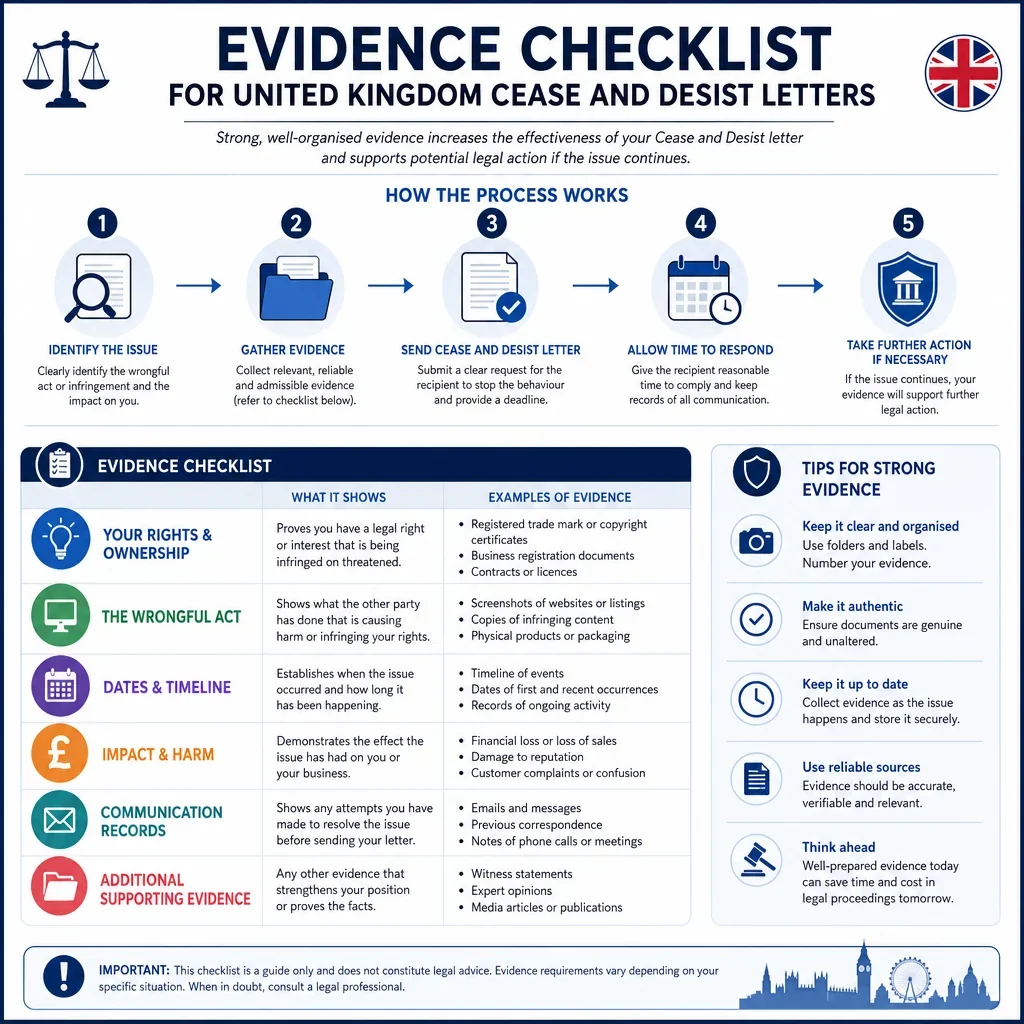
What Delivery Evidence Should You Keep?
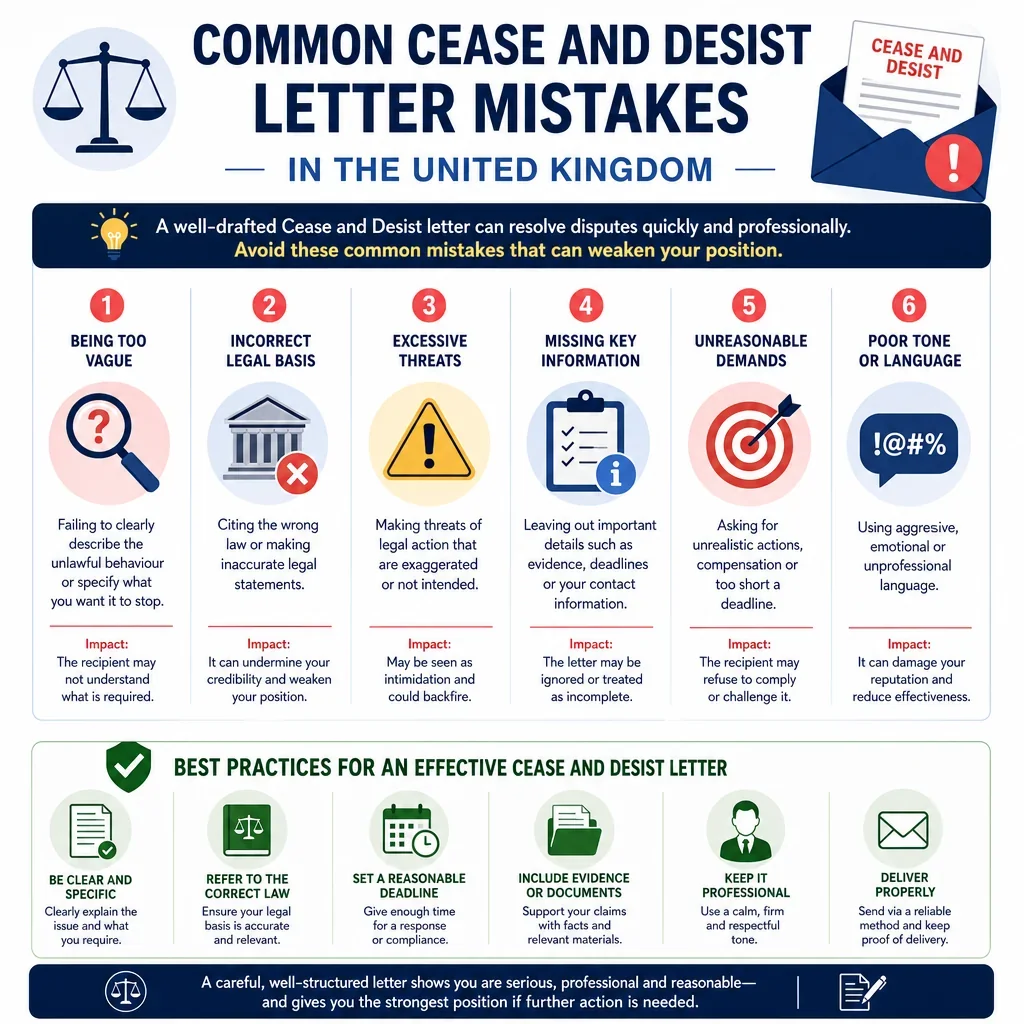
- Keep the final signed letter, attachments, and any covering email.
- Keep proof of posting, tracking pages, delivery confirmations, courier receipts, and signatures.
- For email, keep full sent-message headers, timestamps, bounce notifications, and any reply.
- For solicitor communications, keep correspondence records and any acknowledgement.
Do not choose a delivery method solely because it feels confrontational. The best method is usually the one that is proportionate, reliable, and capable of being evidenced later if the dispute escalates.
FAQs
You Might Also Be Interested In