AI Generated British Child Arrangements Order
PDF & Word - 2026 Updated
Docaro Pricing
When do you need a Child Arrangements Order in the United Kingdom?
British Legal Rules for a Child Arrangements Order
Using the wrong type of parenting agreement can fail to adequately protect children's welfare or enforce parental responsibilities.
What a Proper Child Arrangements Order Should Include
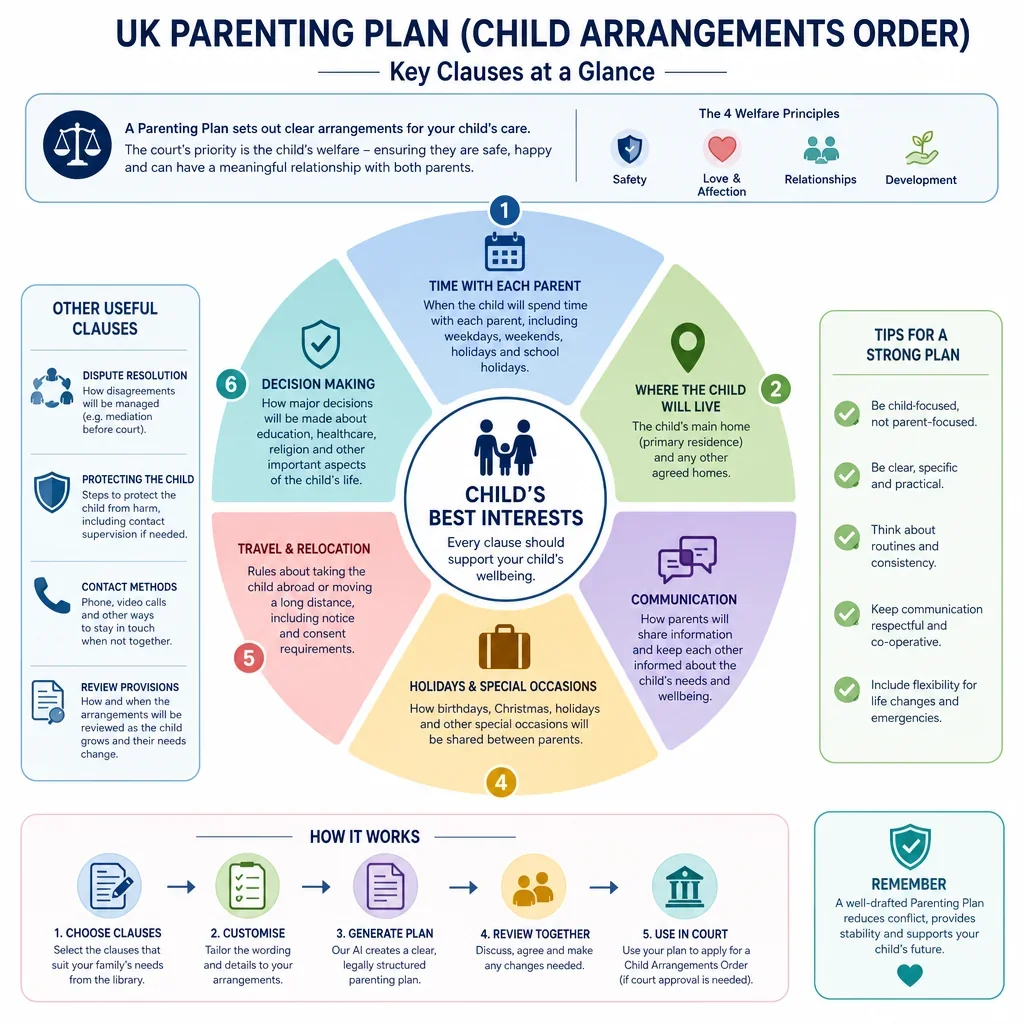
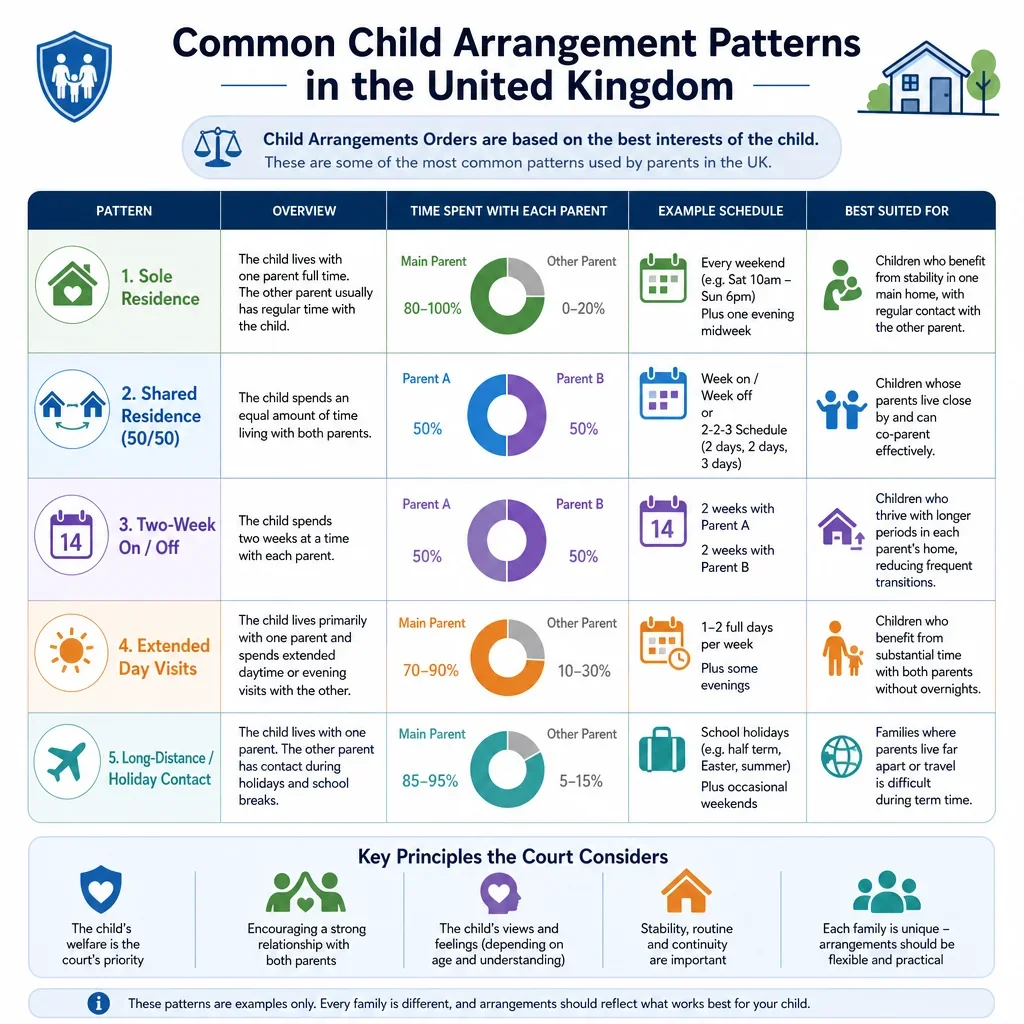
- Where the Child LivesThis specifies which parent the child will live with primarily, or if they will split time between both parents.
- Visitation TimesIt outlines the schedule for when and how the non-resident parent can spend time with the child, including weekends and holidays.
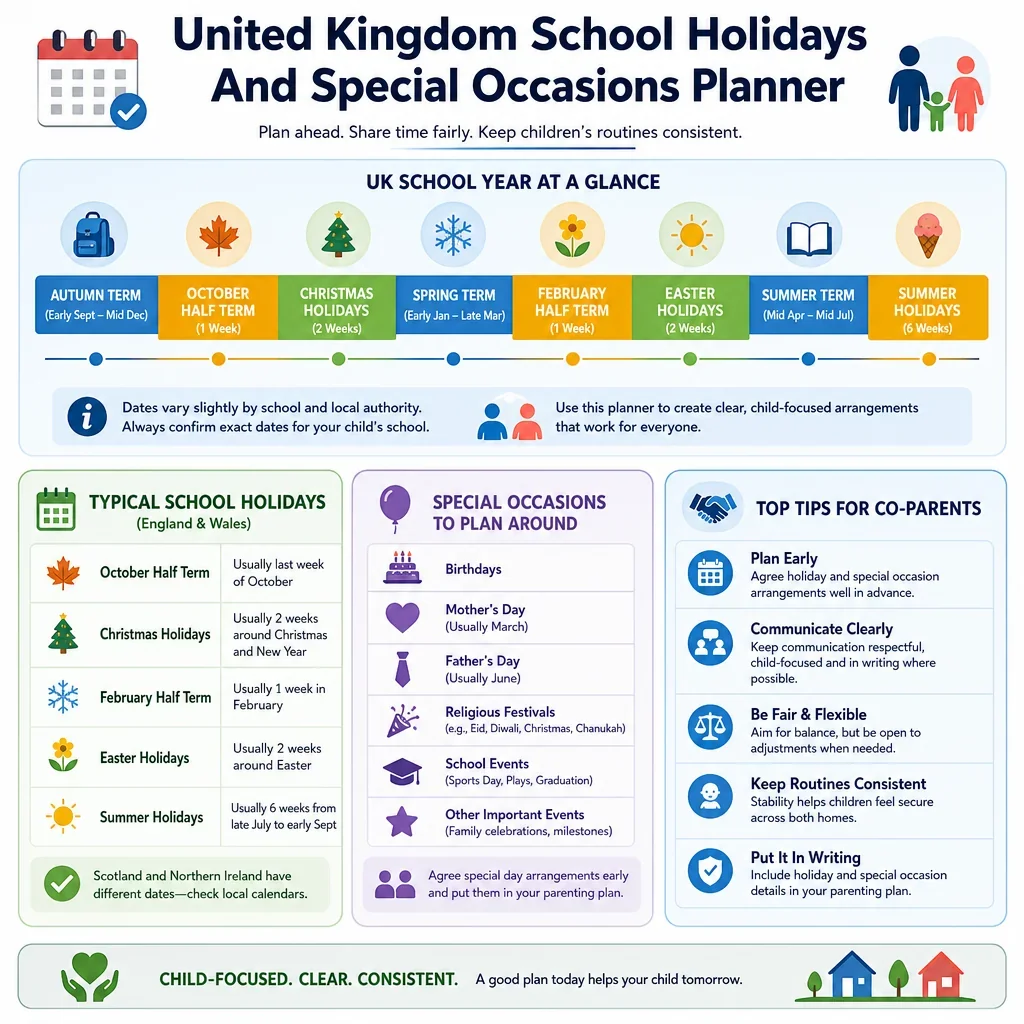
- Holiday and Special Occasion PlansThis covers arrangements for school breaks, birthdays, and other important events to ensure fair sharing.
- Decision-Making ResponsibilitiesIt details which parent makes key choices about the child's education, health, and religion.
- Communication GuidelinesThis sets rules for how parents will talk to each other about the child, like using apps or emails.
- Financial Support DetailsIt may include agreements on child maintenance payments to cover living costs.
- Travel and Relocation RulesThis addresses permissions for holidays abroad or moving house that could affect arrangements.
- Dispute Resolution MethodsIt suggests ways to handle disagreements, such as mediation, before returning to court.
Generate Your Document in 4 Easy Steps
Why Use Docaro?
 United Kingdom
Free Example Child Arrangements Order Template
Below is a free template example of a Child Arrangements Order for use in the United Kingdom generated by our AI model.
The clauses in your actual Child Arrangements Order will vary from this example as they will be entirely bespoke to your requirements as set out in the questionnaire you complete.
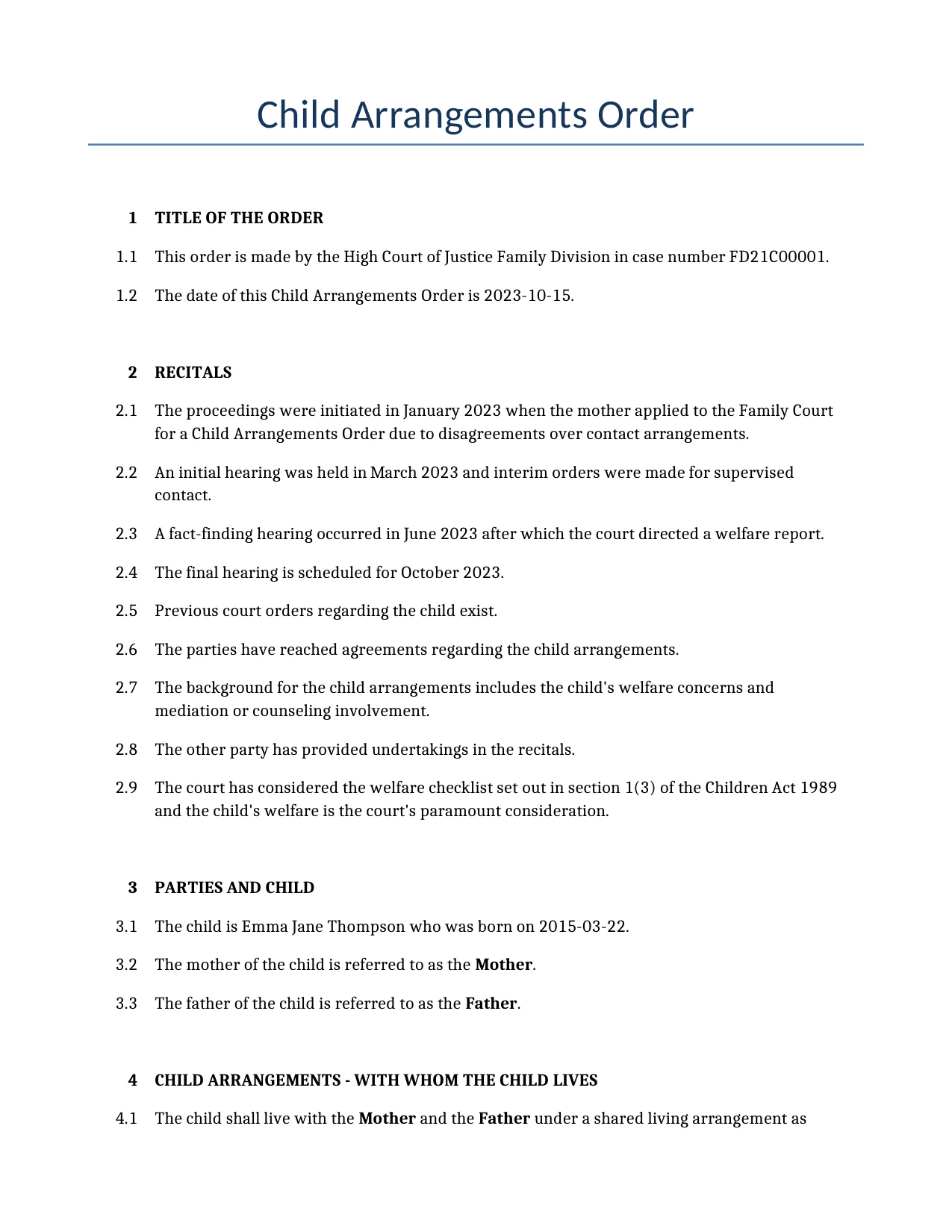
Child Arrangements Order
1TITLE OF THE ORDER
This order is made by the High Court of Justice Family Division in case number FD21C00001.
The date of this Child Arrangements Order is 2023-10-15.
2RECITALS
The proceedings were initiated in January 2023 when the mother applied to the Family Court for a Child Arrangements Order due to disagreements over contact arrangements.
An initial hearing was held in March 2023 and interim orders were made for supervised contact.
A fact-finding hearing occurred in June 2023 after which the court directed a welfare report.
The final hearing is scheduled for October 2023.
Previous court orders regarding the child exist.
The parties have reached agreements regarding the child arrangements.
The background for the child arrangements includes the child's welfare concerns and mediation or counseling involvement.
The other party has provided undertakings in the recitals.
The court has considered the welfare checklist set out in section 1(3) of the Children Act 1989 and the child's welfare is the court's paramount consideration.
3PARTIES AND CHILD
The child is Emma Jane Thompson who was born on 2015-03-22.
The mother of the child is referred to as the Mother.
The father of the child is referred to as the Father.
4CHILD ARRANGEMENTS - WITH WHOM THE CHILD LIVES
The child shall live with the Mother and the Father under a shared living arrangement as follows: with the Mother from Monday to Wednesday each week and with the Father from Wednesday to Friday each week alternating thereafter.
Shared living between both parents is feasible and allows the child to maintain strong relationships with both parents promotes stability and supports her emotional well-being by ensuring equal involvement from the Mother and the Father.
The transition to the shared living arrangement shall be gradual over a period of weeks.
5CHILD ARRANGEMENTS - SPENDS TIME WITH
The child shall spend time with the Father as follows: every Saturday from 10:00 AM to 6:00 PM and every Sunday from 10:00 AM to 6:00 PM commencing on 2024-01-15.
The child shall spend time with the non-resident parent at the non-resident parent's home or local park.
Each regular period that the child spends time with a parent shall last for the periods set out above.
Holiday and special occasion schedules shall be as set out in the attached Schedule 1 which forms part of this order.
The non-resident parent shall be responsible for transporting the child to and from contact with handovers to take place at the child's school or a neutral location if school is not in session.
The parties shall communicate via a parenting app to discuss arrangements and any changes.
In the event of a dispute regarding the arrangements the parties shall attend mediation before making an application to the court.
6SPECIFIC ISSUE ORDERS
The child shall attend the local state school due to its proximity and better support for the child's special educational needs as the parents disagree on whether the child should attend the local state school or a private academy.
The child shall receive education in both Christian and Muslim traditions including participation in key ceremonies like Christmas and Eid to respect both heritages as the parents follow different religions.
The child's surname shall remain Thompson and neither parent shall change the child's surname without the written consent of the other parent or an order of the court.
The Mother shall have responsibility for day to day medical decisions and the parents shall consult on major health decisions with neither able to act unilaterally.
7PROHIBITED STEPS ORDERS
The Mother and the Father are prohibited from removing the child from the jurisdiction without the written consent of the other parent or an order of the court.
The Mother and the Father are prohibited from changing the child's surname without the written consent of the other parent or an order of the court.
These prohibited steps are necessary for the child's welfare due to the risk of child abduction and a history of non-cooperation.
Neither parent shall discuss these proceedings with the child or allow the child to read any court documents.
8PARENTAL RESPONSIBILITY
The Father shall have parental responsibility for the child pursuant to section 4 of the Children Act 1989.
9INTERNATIONAL TRAVEL AND PASSPORTS
The parties shall cooperate to renew the child's passport every 5 years with the costs shared equally.
For international travel each parent must provide at least 28 days notice and provide a detailed itinerary contact details and copy of travel insurance to the other parent.
The child may travel abroad with either parent for holidays provided it is within the jurisdiction of the Hague Convention on Child Abduction or with written consent.
10NOTIFICATION OF CHANGES
Each parent shall notify the other in writing of any change in address telephone number or email address at least 7 days in advance.
Each parent shall keep the other informed of the child's medical educational and general welfare matters.
11FINANCIAL PROVISION FOR THE CHILD
This order does not include any financial provision for the child. Any application for child maintenance shall be made to the Child Maintenance Service or the court in separate proceedings as appropriate.
12COSTS
There shall be no order for costs.
13ENFORCEMENT PROVISIONS
A penal notice is attached to the provisions relating to with whom the child shall live and spend time with. Failure to comply with those provisions may result in you being committed to prison for contempt of court.
In the event of non-compliance the matter may be referred to enforcement officers or the court may make an enforcement order under section 11J of the Children Act 1989.
The enforcement provisions shall be triggered by failure to return the child on time or denial of contact time.
14SERVICE OF THE ORDER
This order shall be served by the applicant on the respondent by first class post within 7 days of the date of this order.
The Mother and the Father confirm that they have received a copy of this Child Arrangements Order and understand the service requirements.
15DURATION AND VARIATION
This order shall start on 2024-01-15 and shall remain in force until varied or discharged by the court or until the child reaches the age of 18 years.
This order may be varied or discharged upon application to the court if there is a significant change in circumstances affecting the child's welfare.
16LIBERTY TO RESTORE
The Mother and the Father have liberty to restore the matter to the court in the event that the child's educational needs change significantly or if there is a substantial alteration in the parents' living arrangements.
17REASONS
The court has considered all the circumstances of the case the welfare checklist and the recommendations in the welfare report. The orders made are in the best interests of the child and proportionate. Shared living has been ordered as it best promotes the child's welfare given the parties' ability to cooperate following the fact finding hearing. The specific issue and prohibited steps orders are necessary to prevent conflict and ensure stability.
18GENERAL PROVISIONS
This Child Arrangements Order is a legal document issued by the court with full authority under the Children Act 1989 and is governed by British law.
This order constitutes the entire agreement between the parties relating to the child arrangements and supersedes all prior agreements understandings or representations whether oral or in writing.
If any provision of this order is held to be invalid or unenforceable the remaining provisions shall continue in full force and effect.
Any notice required to be given under this order shall be in writing and shall be served by first class post or by hand delivery to the last known address of the party to be served.
This order may not be varied except by a further order of the court or by written agreement of the parties which is then approved by the court.
19SCHEDULE 1 - HOLIDAYS AND SPECIAL OCCASIONS
Christmas: The child shall live with the Mother from 24 December to 27 December in even numbered years and with the Father from 24 December to 27 December in odd numbered years.
Birthdays: The child shall spend at least 4 hours with the non-resident parent on the child's birthday and each parent's birthday.
Easter and Summer holidays shall be shared equally with the parents alternating the first half and second half each year.
Mother's Day and Father's Day: The child shall spend the day with the respective parent.
20SIGNATURES
Signed by the Mother: ___________________________ Date: _______________
Signed by the Father: ___________________________ Date: _______________
Approved by the Court: ___________________________ Date: _______________
This example shows approximately 70% of a typical document and is provided for illustrative purposes only. The remaining content has been omitted.
Every document generated by Docaro is tailored to your specific circumstances, jurisdiction and the information you provide. The completed document includes all applicable clauses and provisions required for your situation.
To generate the full, personalised document, answer a short series of questions and your document will be created instantly.
Useful Resources When Considering a Child Arrangements Order in the United Kingdom
United Kingdom Reference Legislation
Child Arrangements Order FAQs
Document Generation FAQs
Related Articles