AI Generated British Licence Agreement
PDF & Word - 2026 Updated
Docaro Pricing
When do you need a Lodger Agreement in the United Kingdom?
British Legal Rules for a Lodger Agreement
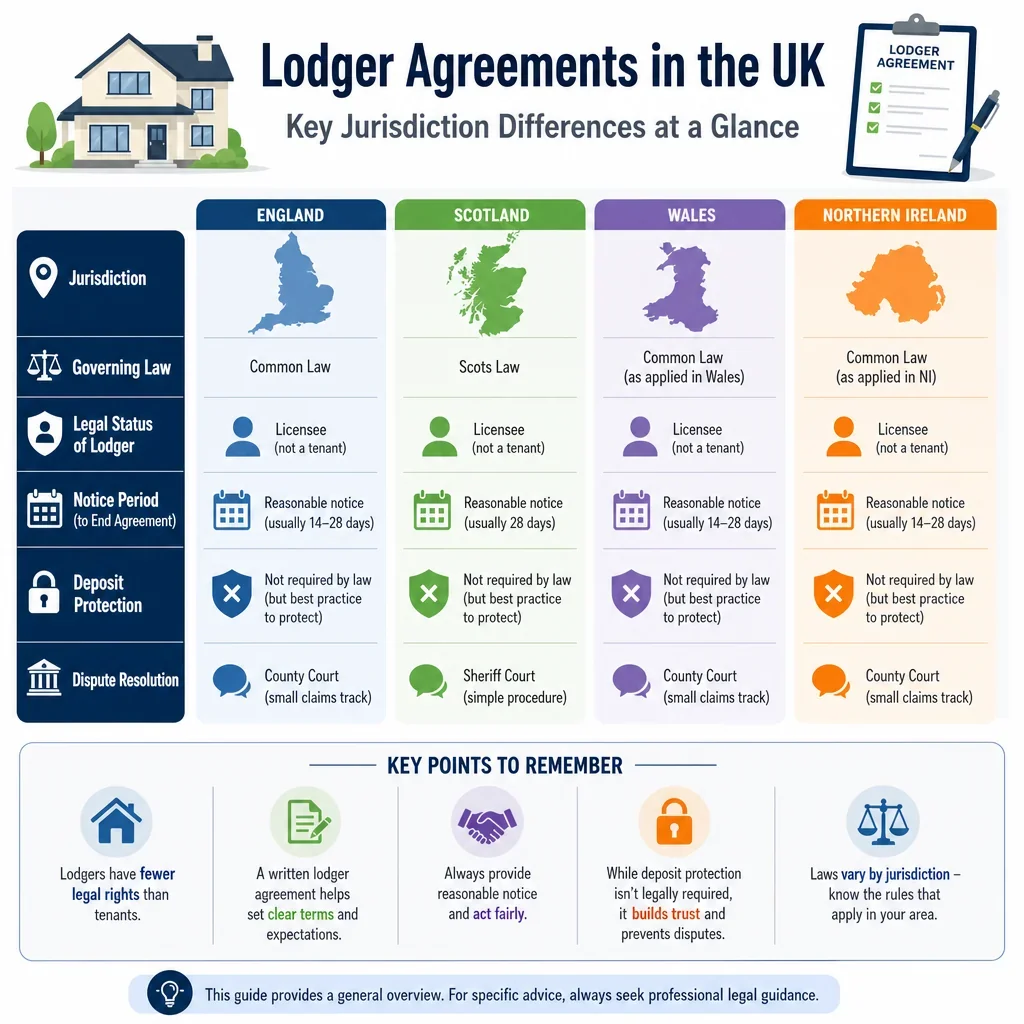
Using an incorrect lodger agreement structure may inadvertently grant the lodger full tenancy rights under UK law.
What a Proper Lodger Agreement Should Include
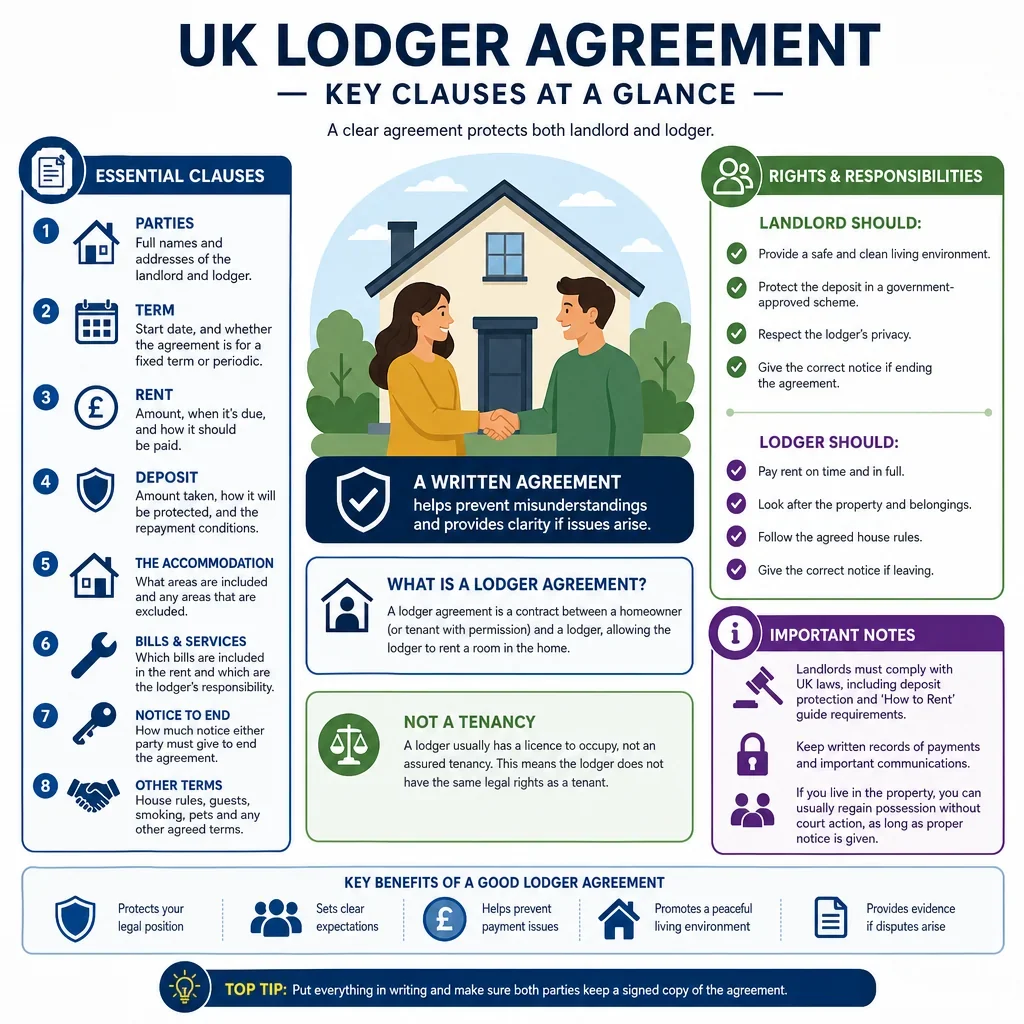
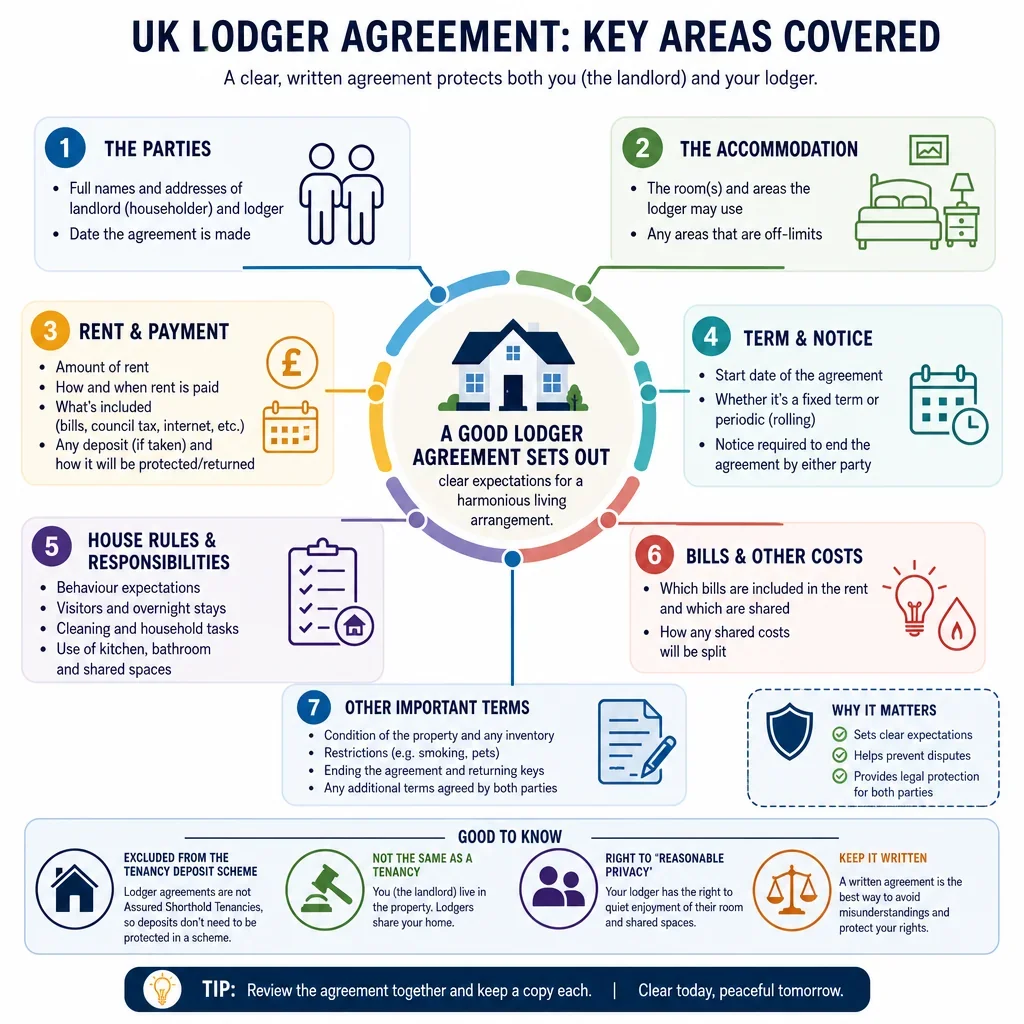
- Parties InvolvedClearly state the names and addresses of the landlord and the lodger to identify everyone entering the agreement.
- Rental DetailsSpecify the property address, the room being rented, and the start and end dates of the agreement.
- Rent Amount and PaymentOutline the total rent, how and when it must be paid, and any late payment fees.
- Deposit InformationDetail any security deposit required, how it will be protected, and the conditions for its return.
- House RulesList basic expectations like quiet hours, guest visits, and cleanliness to ensure harmonious living.
- Notice PeriodDefine how much notice either party needs to give to end the agreement, typically at least one month.
- Utilities and BillsClarify which bills (like electricity or internet) are included in the rent and which the lodger must pay separately.
- Maintenance ResponsibilitiesExplain who handles repairs and upkeep, with the landlord responsible for major issues and the lodger for minor ones.
Generate Your Document in 4 Easy Steps
Why Use Docaro?
 United Kingdom
Free Example Lodger Agreement Template
Below is a free template example of a Lodger Agreement for use in the United Kingdom generated by our AI model.
The clauses in your actual Lodger Agreement will vary from this example as they will be entirely bespoke to your requirements as set out in the questionnaire you complete.
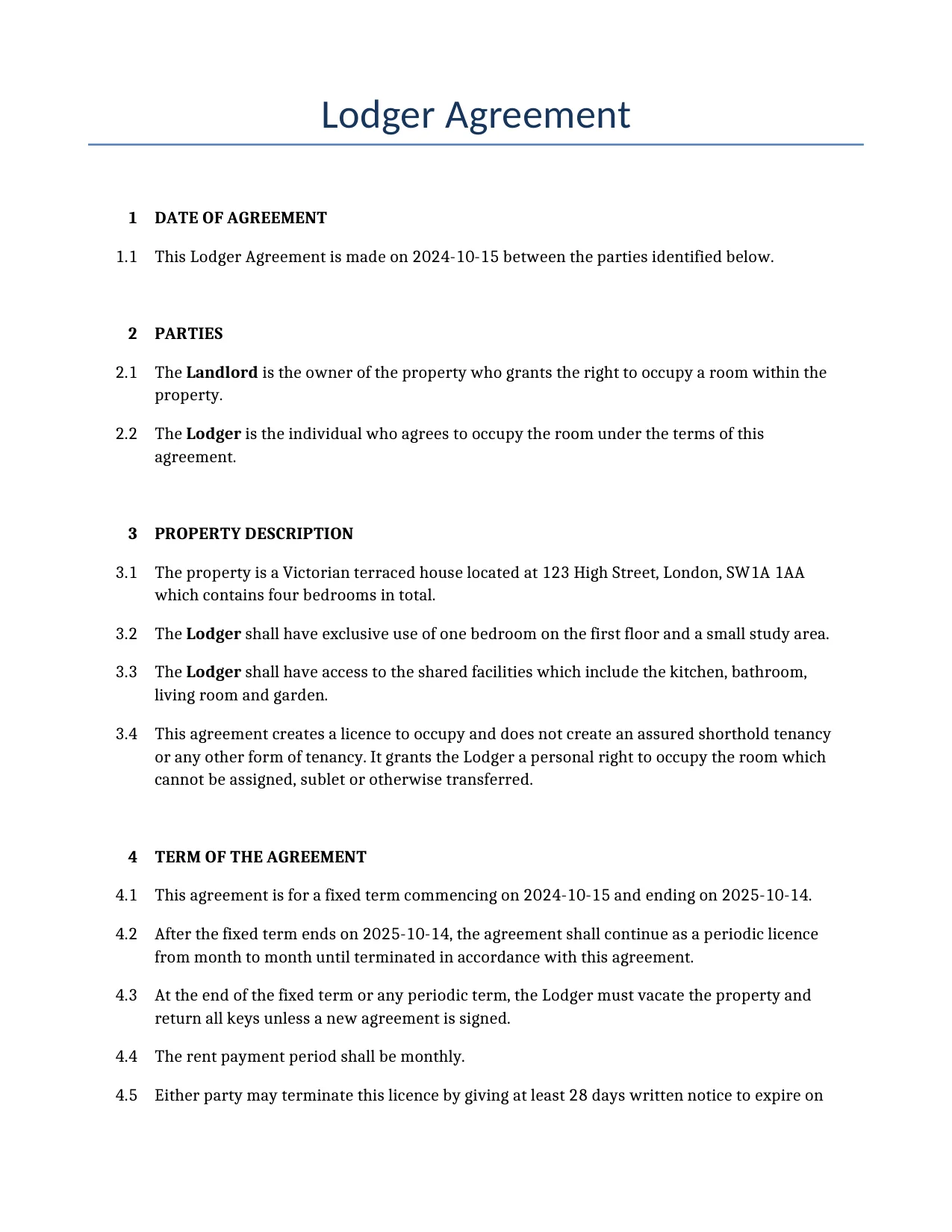
Lodger Agreement
1DATE OF AGREEMENT
This Lodger Agreement is made on 2024-10-15 between the parties identified below.
2PARTIES
The Landlord is the owner of the property who grants the right to occupy a room within the property.
The Lodger is the individual who agrees to occupy the room under the terms of this agreement.
3PROPERTY DESCRIPTION
The property is a Victorian terraced house located at 123 High Street, London, SW1A 1AA which contains four bedrooms in total.
The Lodger shall have exclusive use of one bedroom on the first floor and a small study area.
The Lodger shall have access to the shared facilities which include the kitchen, bathroom, living room and garden.
This agreement creates a licence to occupy and does not create an assured shorthold tenancy or any other form of tenancy. It grants the Lodger a personal right to occupy the room which cannot be assigned, sublet or otherwise transferred.
4TERM OF THE AGREEMENT
This agreement is for a fixed term commencing on 2024-10-15 and ending on 2025-10-14.
After the fixed term ends on 2025-10-14, the agreement shall continue as a periodic licence from month to month until terminated in accordance with this agreement.
At the end of the fixed term or any periodic term, the Lodger must vacate the property and return all keys unless a new agreement is signed.
The rent payment period shall be monthly.
Either party may terminate this licence by giving at least 28 days written notice to expire on any day.
Notices for termination shall be served in writing by hand delivery or recorded post to the address specified in this agreement.
5RENT AND PAYMENT TERMS
The Lodger shall pay rent in the amount of 750.00 per month.
The Lodger shall pay the rent on the first day of each month.
Rent payments shall commence on 2024-10-15.
The Lodger may pay rent by bank transfer or cash.
The Lodger shall pay rent in advance for the first period.
6DEPOSIT
The Lodger shall pay a security deposit of 500.00 on or before the commencement date of this agreement.
This deposit is not required to be protected in a government-approved tenancy deposit scheme as this agreement creates a licence to occupy rather than a tenancy.
The deposit may be used by the Landlord to cover any unpaid rent, damage to the property or furniture beyond fair wear and tear, or reasonable cleaning costs.
The Landlord and Lodger shall jointly inspect the room and shared areas within 7 days before or after the Lodger vacates the property to agree on the condition and any deductions from the deposit.
The Landlord shall return the deposit (less any reasonable deductions) to the Lodger within 21 days of the Lodger vacating the property and providing a forwarding address.
The Landlord shall provide the Lodger with a written statement detailing any deductions and the reasons for them.
No interest shall be paid to the Lodger on the security deposit held during their stay.
Any disputes regarding the deposit shall be discussed between the parties and, if necessary, resolved through an independent dispute resolution service or the courts.
7LICENCE TO OCCUPY
This agreement is a licence to occupy and does not create an assured shorthold tenancy or any other form of tenancy. The Lodger is granted a personal, non-exclusive right to occupy the specified room.
The licence is personal to the Lodger and cannot be assigned, sublet or transferred in any way. The Lodger has no right to exclusive possession of any part of the property.
8USE OF THE PROPERTY
The Lodger may use the property solely as a private residence for themselves and must not use it for any commercial, business, or trade purposes.
The Lodger shall not make any alterations, additions, redecoration or fix any fittings to the room or property without the prior written consent of the Landlord.
The Lodger shall not install any locks or change existing locks on the room door or any other door in the property without the prior written permission of the Landlord.
9HOUSE RULES
Smoking is not permitted indoors but is allowed in designated outdoor areas.
Pets are not permitted in the property.
The Lodger may have occasional overnight guests for up to two nights per month with at least twenty four hours notice to the Landlord.
The maximum number of guests the Lodger can have at the property at any time is three people.
The Lodger shall not sublet any part of the property or allow any other person to occupy the room.
The Lodger shall not use the property for any business activities.
Quiet hours shall be observed from 10:00 PM to 7:00 AM each day.
The Lodger shall clean their room weekly and shall share responsibility for cleaning shared areas on a rota basis with other residents.
The Lodger shall be responsible for their own waste disposal and recycling.
No parking is available at the property for the Lodger or their guests.
10UTILITIES AND BILLS
The Landlord shall be responsible for payment of all utilities and bills including gas, electricity, water, council tax, broadband internet, TV licence and any other charges relating to the property.
As a resident in a house in multiple occupation the Lodger is exempt from council tax.
Water and broadband internet are included in the rent.
The Lodger shall be responsible for any charges for telephone calls made from a landline (if applicable) and for any pay-per-view or premium TV services.
The responsibilities under this section commence on 2024-10-15.
11MAINTENANCE AND REPAIRS
Day to day maintenance of the property shall be shared between the Landlord and the Lodger.
Major repairs to the property shall be the responsibility of the Landlord only.
The Lodger shall report any faults or damage in the property promptly to the Landlord.
The Lodger shall report maintenance or repair issues by email or text message to the Landlord.
The Landlord shall respond to reported repair issues within seven days.
The Landlord shall exclusively be responsible for arranging emergency repairs such as in cases of flooding or electrical faults.
12ACCESS TO THE ROOM
The Landlord shall provide twenty four hours notice before accessing the Lodgers room for inspections or repairs except in the case of an emergency.
The Landlord may access the Lodgers room for inspections, repairs and maintenance or emergencies.
The Landlord may access the room when the Lodger is absent such as on holiday in the case of an emergency only.
13FURNITURE AND EQUIPMENT
The Landlord shall provide furniture to the Lodger.
The Landlord shall provide equipment to the Lodger.
The Lodger must keep all furniture and equipment clean and in good condition, report any damage immediately, and not make any alterations without prior written consent from the Landlord.
The Lodger shall be liable for any damage to the furniture and equipment beyond fair wear and tear.
14INSURANCE
The Lodger shall obtain their own insurance for personal belongings.
The Lodger shall obtain contents insurance and personal liability insurance for their personal belongings.
The Lodger shall provide proof of their personal insurance by 2024-12-31.
15HEALTH AND SAFETY
The Landlord shall install and maintain smoke alarms in the property in accordance with the Smoke and Carbon Monoxide Alarm (England) Regulations 2015.
The Landlord shall install and maintain carbon monoxide alarms in rooms with fuel burning appliances in accordance with the Smoke and Carbon Monoxide Alarm (England) Regulations 2015.
The emergency exit routes are the main staircase to front door and the back door through kitchen.
The Lodger shall follow the health and safety rules which include no smoking inside the property, keep fire doors closed at all times and report any hazards immediately to the Landlord.
The last fire safety inspection of the property was conducted on 2023-06-15.
The property has three emergency exits.
16DATA PROTECTION AND PRIVACY
The Lodger explicitly consents to the processing of their personal data by the Landlord for the purposes of administering the tenancy, compliance with legal obligations and contact and emergency purposes.
The Landlord shall retain the Lodgers personal data for six years after the agreement ends.
The Lodger is notified of their rights under UK data protection laws such as the right to access or erase their data.
17TERMINATION OF THE AGREEMENT
The minimum notice period that the Lodger must provide to terminate the agreement is 28 days.
The minimum notice period that the Landlord must provide to terminate the agreement is 28 days.
The Lodger shall continue paying rent during the notice period.
The Landlord may terminate the agreement early on the grounds of breach of agreement by Lodger or the Landlords need for the property.
No early termination fee shall apply if the Lodger ends the agreement before the full term.
The Landlord shall not evict the Lodger without a court order in any circumstances in accordance with the Protection from Eviction Act 1977.
18BREACH OF AGREEMENT
The Lodger shall have seven days notice to remedy a breach before further consequences apply.
The full remaining rent shall become due upon a serious breach by the Lodger.
Serious breaches include non payment of rent for over fourteen days, causing damage to property and illegal or nuisance activities.
The Lodger must receive written notice of the breach and have a reasonable opportunity to remedy it within the specified notice period after which failure to remedy may lead to termination or other consequences.
The Landlord may recover legal costs from the Lodger if the Landlord pursues action for a breach.
19DISPUTE RESOLUTION
Mediation shall be the first step in resolving any disputes under this Lodger Agreement.
The jurisdiction for any legal recourse in disputes not resolved by mediation shall be England and Wales.
The Lodger shall provide fourteen days notice of any disputes before escalation.
The costs of mediation shall be equally shared between the parties.
20GOVERNING LAW
This agreement is governed by the laws of England and Wales.
The parties agree that the courts of England and Wales shall have exclusive jurisdiction to settle any dispute or claim arising out of this agreement.
21ENTIRE AGREEMENT
This agreement constitutes the entire agreement between the parties and supersedes any prior written or oral understandings or agreements between the Landlord and the Lodger regarding the lodger arrangement effective from 2024-10-01.
This agreement explicitly excludes any warranties or representations not stated in this document.
22SEVERABILITY
If any provision of this agreement is held to be invalid or unenforceable then such provision shall be struck out and the remaining provisions shall remain in full force and effect.
23NOTICES
Formal notices to the Lodger shall be served at Flat 2, 123 High Street, London, SW1A 1AA.
Formal notices to the Landlord shall be served at 456 Oak Avenue, Manchester, M1 1AB.
All formal notices must be given by first class post, recorded delivery or hand delivery.
Postal notices shall be deemed served after two business days.
All formal notices must follow the methods specified in this section.
24VARIATION
No variation of this agreement shall be effective unless it is in writing and signed by both the Landlord and the Lodger.
25COMPLIANCE WITH LEGISLATION
This agreement is compliant with the Housing Act 1988, the Protection from Eviction Act 1977, the Landlord and Tenant Act 1985, the Houses in Multiple Occupation (HMOs) Regulations 2006 as amended, the Deregulation Act 2015, the Tenant Fees Act 2019 and the Smoke and Carbon Monoxide Alarm (England) Regulations 2015.
The Landlord confirms that the property is not a house in multiple occupation requiring licensing under the relevant regulations or that such licensing has been obtained.
No prohibited payments under the Tenant Fees Act 2019 have been or shall be required from the Lodger.
This agreement creates a licence to occupy the room and shared areas and does not create an assured shorthold tenancy or any other form of tenancy under the Housing Act 1988.
26INVENTORY AND CONDITION REPORT
An inventory and condition report detailing the furnishings, furniture, equipment and condition of the room, shared areas and the property is attached as Appendix A to this agreement.
The inventory must be checked and signed by both the Landlord and the Lodger on or before the commencement date.
Both parties agree that the signed inventory forms part of this agreement and shall be used as evidence of the condition at the start of the licence.
27SIGNATURES
| LANDLORD | |
| Signature: | |
| Print Name: | |
| Date: |
| LODGER | |
| Signature: | |
| Print Name: | |
| Date: |
This example shows approximately 70% of a typical document and is provided for illustrative purposes only. The remaining content has been omitted.
Every document generated by Docaro is tailored to your specific circumstances, jurisdiction and the information you provide. The completed document includes all applicable clauses and provisions required for your situation.
To generate the full, personalised document, answer a short series of questions and your document will be created instantly.
Useful Resources When Considering a Lodger Agreement in the United Kingdom
United Kingdom Reference Legislation
Lodger Agreement FAQs
Document Generation FAQs
Related Articles