AI Generated British Shareholders Agreement
PDF & Word - 2026 Updated
Docaro Pricing
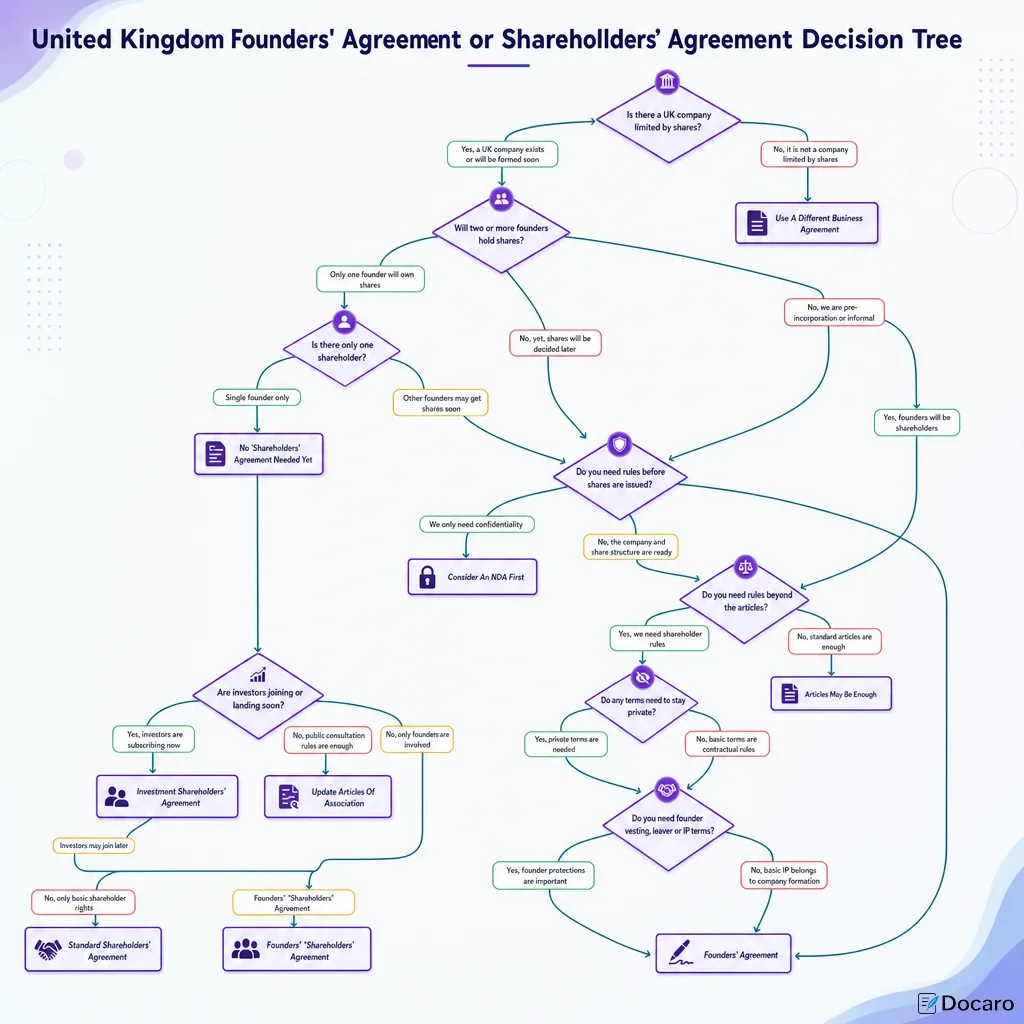
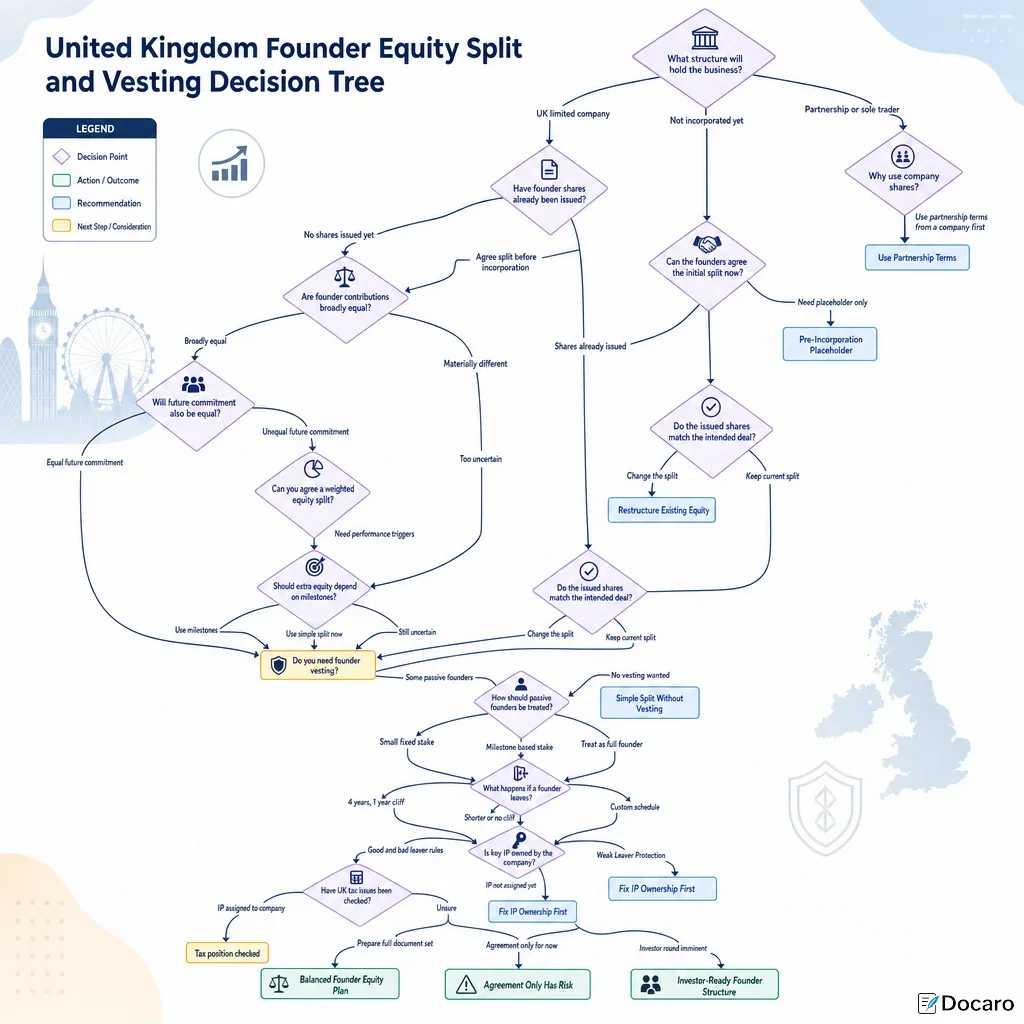
When do you need a Founders' Agreement in the United Kingdom?
British Legal Rules for a Founders' Agreement
Using the wrong structure for a founders' agreement can lead to unintended disputes over ownership, control, or exit rights.
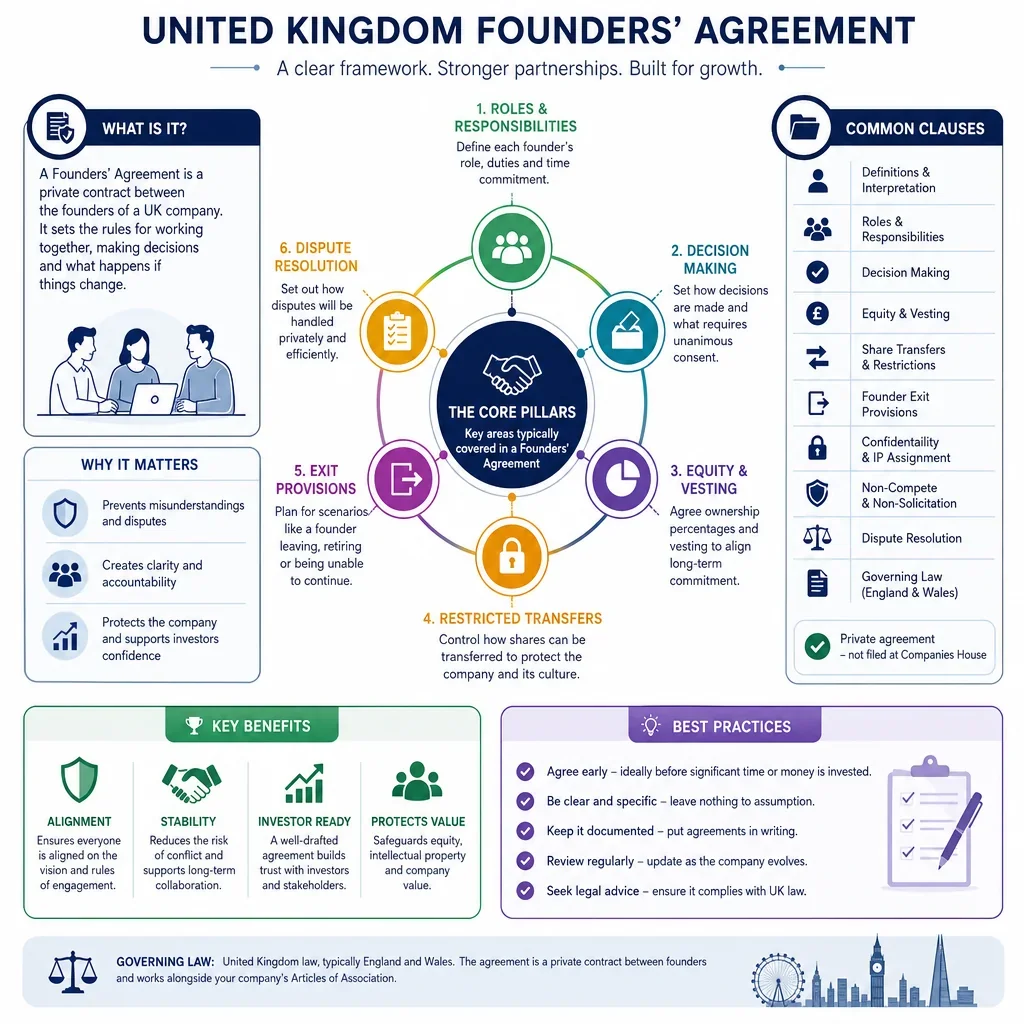
What a Proper Founders' Agreement Should Include
- Roles and ResponsibilitiesClearly define what each founder will do in the business to avoid confusion and ensure everyone contributes effectively.
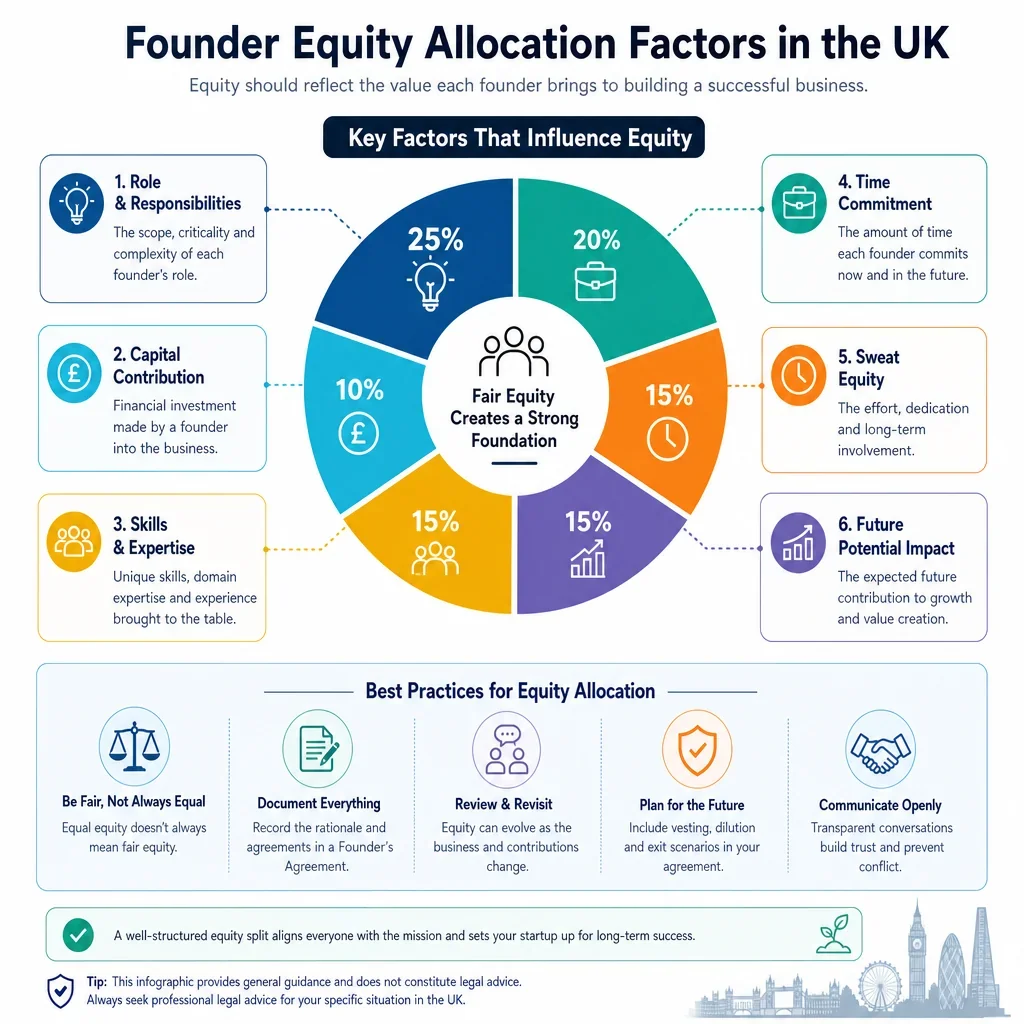
- Ownership SharesSpecify how much of the company each founder owns, including how shares are divided based on contributions.
- Decision-Making ProcessOutline how major business decisions will be made, such as voting rights or unanimous agreement requirements.
- Joining and Leaving the CompanyDetail the rules for a founder leaving the business, including what happens to their shares.
- Handling DisputesProvide steps to resolve disagreements between founders, like mediation or arbitration, to keep the company running smoothly.
- Confidentiality and Competition RulesProtect the company's secrets by agreeing not to share information or start competing businesses.
- Salary and ExpensesSet out how founders will be paid and reimbursed for business-related costs during the early stages.
Generate Your Document in 4 Easy Steps
Why Use Docaro?
 United Kingdom
Free Example Founders' Agreement Template
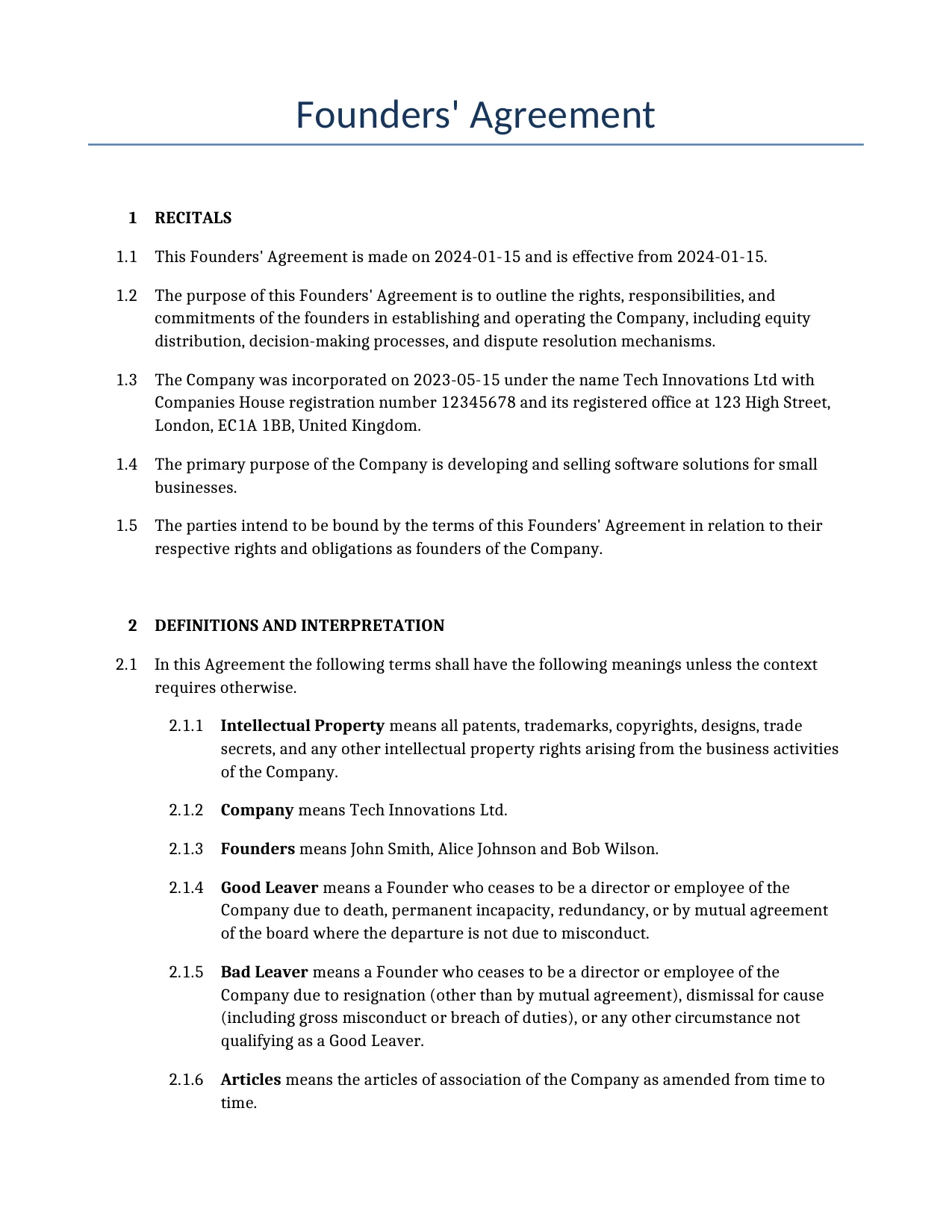
Below is a free template example of a Founders' Agreement for use in the United Kingdom generated by our AI model.
The clauses in your actual Founders' Agreement will vary from this example as they will be entirely bespoke to your requirements as set out in the questionnaire you complete.
Founders' Agreement for Tech Innovations Ltd.
1RECITALS
This Founders' Agreement is made on 2024-01-15 and is effective from 2024-01-15.
The purpose of this Founders' Agreement is to outline the rights, responsibilities, and commitments of the founders in establishing and operating the Company, including equity distribution, decision-making processes, and dispute resolution mechanisms.
The Company was incorporated on 2023-05-15 under the name Tech Innovations Ltd with Companies House registration number 12345678 and its registered office at 123 High Street, London, EC1A 1BB, United Kingdom.
The primary purpose of the Company is developing and selling software solutions for small businesses.
The parties intend to be bound by the terms of this Founders' Agreement in relation to their respective rights and obligations as founders of the Company.
2DEFINITIONS AND INTERPRETATION
In this Agreement the following terms shall have the following meanings unless the context requires otherwise.
Intellectual Property means all patents, trademarks, copyrights, designs, trade secrets, and any other intellectual property rights arising from the business activities of the Company.
Company means Tech Innovations Ltd.
Founders means John Smith, Alice Johnson and Bob Wilson.
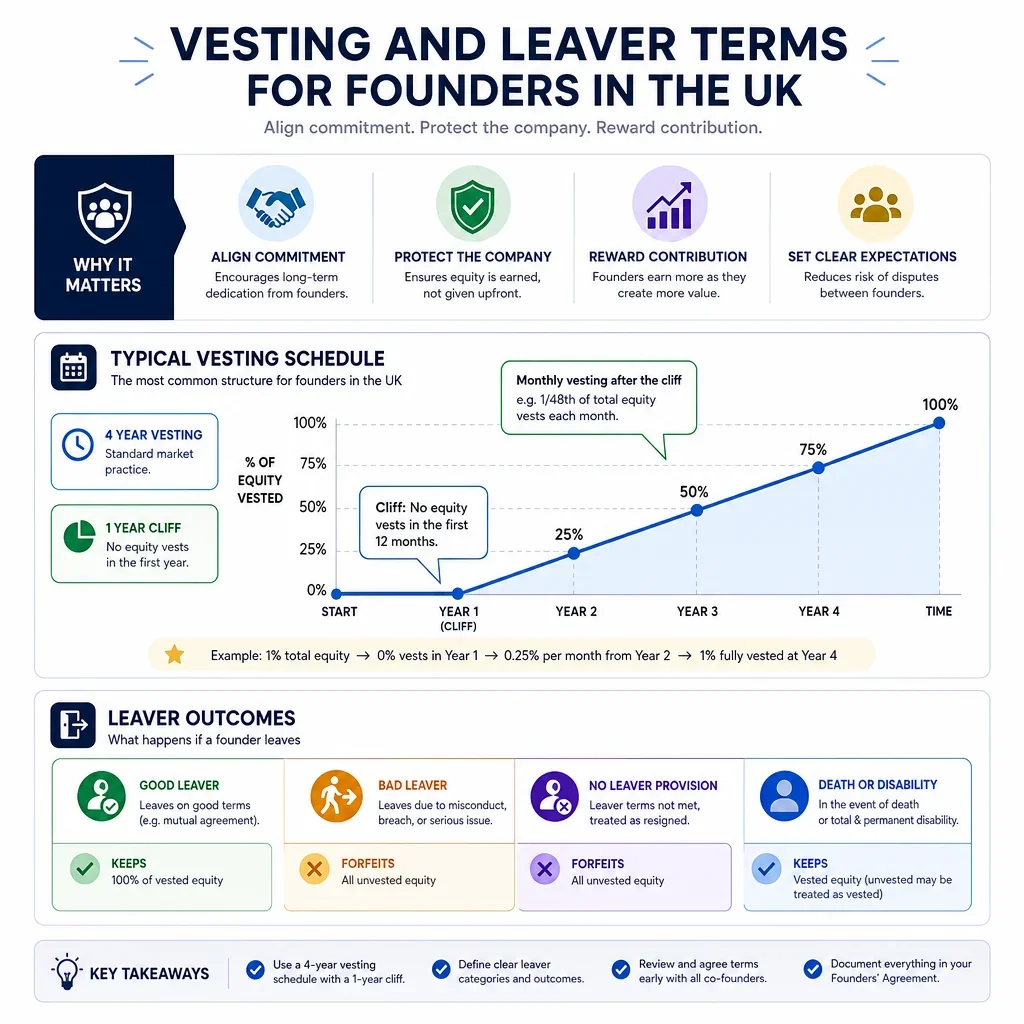
Good Leaver means a Founder who ceases to be a director or employee of the Company due to death, permanent incapacity, redundancy, or by mutual agreement of the board where the departure is not due to misconduct.
Bad Leaver means a Founder who ceases to be a director or employee of the Company due to resignation (other than by mutual agreement), dismissal for cause (including gross misconduct or breach of duties), or any other circumstance not qualifying as a Good Leaver.
Articles means the articles of association of the Company as amended from time to time.
This Agreement shall be governed by and interpreted in accordance with the laws of England and Wales.
Words importing the singular shall include the plural and vice versa.
The schedules and appendices to this Agreement form an integral part of this Agreement.
References to any statute or statutory provision shall include any modification, amendment, extension or re-enactment thereof.
References to Clauses and Schedules are to clauses and schedules of this Agreement.
3FORMATION OF THE COMPANY
The Company was incorporated on 2023-05-15 under the Companies Act 2006.
The initial authorised share capital of the Company is \£1000.
The Company has issued 1000 ordinary shares of \£1.00 each.
The shares were issued as follows: John Smith (Founder One) received 400 shares in exchange for a \£400 cash contribution, Alice Johnson (Founder Two) received 400 shares for intellectual property valued at \£400, and Bob Wilson (Founder Three) received 200 shares for services rendered valued at \£200.
The Founders confirm that all pre-incorporation actions have been ratified by the Company.
4CAPITAL CONTRIBUTIONS
John Smith has provided a cash contribution of \£400 on 2024-01-15 and has received 400 shares in exchange.
Alice Johnson has provided intellectual property valued at \£400 and has received 400 shares in exchange.
Bob Wilson has provided services valued at \£200 and has received 200 shares in exchange.
The Founders shall not be required to make any further capital contributions to the Company without the prior written consent of all Founders.
Any non-cash contributions shall, if disputed, be valued by an independent valuer appointed by the board of the Company.
5SHARE OWNERSHIP AND VESTING
The Founders shall hold ordinary shares in the Company, which shares shall be subject to the rights and restrictions set out in this Agreement and the Articles.
The Company is authorised to issue up to 1,000,000 shares in total.
The initial ownership percentages are as follows: John Smith 40\%, Alice Johnson 40\%, and Bob Wilson 20\%.
The shares issued to the Founders shall be subject to a vesting schedule whereby twenty-five percent (25\%) of the shares shall vest on the first anniversary of the effective date and the remaining shares shall vest in equal monthly instalments over the following thirty-six (36) months, subject to the Founder continuing to provide services to the Company.
Unvested shares shall be subject to compulsory transfer to the Company or the other Founders (at the Company\’s election) in the event that a Founder ceases to provide services to the Company, in accordance with the leaver provisions in Clause 12.
The Founders acknowledge that this Agreement does not override the Articles, which take precedence in respect of share rights, transfers and governance matters. If there is any conflict between this Agreement and the Articles, the parties agree to procure any necessary amendments to the Articles to give effect to the terms of this Agreement.
6MANAGEMENT AND DECISION-MAKING
The board of the Company shall initially consist of the three Founders as directors. The board may be expanded to include up to two additional non-executive directors, subject to approval by shareholders holding at least 75\% of the shares.
Directors shall be appointed and removed in accordance with the Articles and the Companies Act 2006, including by ordinary resolution of the shareholders where required. Each Founder shall have the right to nominate one director (including themselves initially).
Each director shall owe fiduciary duties to the Company under the Companies Act 2006 (sections 170-177) and shall act in good faith in the best interests of the Company.
Each director shall have one vote on the board.
The quorum for board meetings shall be a majority of the directors, including at least one Founder director.
Decisions of the board shall be taken by simple majority unless otherwise specified in this Agreement or the Articles.
The following reserved matters shall require the prior approval of shareholders holding at least 75\% of the shares (in addition to any requirements under the Companies Act 2006 or the Articles): (a) approving annual budgets; (b) issuing new shares or creating new classes of shares; (c) entering into contracts or commitments exceeding \£50,000; (d) appointing or removing key executives; (e) incurring indebtedness above \£100,000; (f) amending the Articles; (g) declaring dividends; (h) entering into related party transactions; and (i) approving any exit event (including sale of the Company).
Board meetings shall be held at least quarterly and may be held remotely via video conference or telephone provided that all participants can simultaneously hear and be heard by the others. Shareholder decisions shall be taken in accordance with the Companies Act 2006 and the Articles.
7ROLES AND RESPONSIBILITIES
Alice Johnson shall serve as CEO of the Company with effect from 2024-01-01.
The CEO shall oversee daily operations, manage financial planning, and lead business development initiatives and shall commit to full-time involvement in the Company.
John Smith shall serve as Chief Technology Officer and shall be responsible for all technical development, product architecture and IT infrastructure, committing to full-time involvement.
Bob Wilson shall serve as Chief Marketing Officer and shall be responsible for marketing, sales, customer acquisition and business development, committing to full-time involvement.
Each Founder shall report to the board and devote their full time, attention and skill to the business of the Company. Key strategic decisions shall be made by the board.
8INTELLECTUAL PROPERTY
Each Founder who developed any software, algorithms, documentation or other works prior to incorporation (including but not limited to the data encryption algorithm developed by Alice Johnson on 2022-05-15) confirms sole ownership of such Intellectual Property with no third-party rights, licenses or encumbrances and warrants that its use by the Company will not infringe any third-party rights.
Each Founder shall fully assign all such pre-formation Intellectual Property to the Company with effect from the date of incorporation by way of a formal IP assignment deed in the form set out in Schedule 1.
Each Founder agrees to assign all Intellectual Property developed in the course of their involvement with the Company to the Company immediately upon creation.
Each Founder grants a perpetual, irrevocable, royalty-free licence to the Company to use any background Intellectual Property brought to the Company.
Each Founder waives any moral rights in the Intellectual Property assigned or licensed to the Company, to the extent permitted under the Copyright, Designs and Patents Act 1988.
Each Founder warrants that they have not granted any licences or rights in the assigned Intellectual Property to any third party and that the Company will receive good title free from encumbrances.
Each Founder agrees not to disclose any confidential information related to the Company\’s Intellectual Property to third parties without prior written consent and to maintain confidentiality during and after involvement with the Company.
9CONFIDENTIALITY
Each Founder shall keep confidential any information disclosed by the Company that is proprietary including business plans, financial data, customer lists and technical know-how whether marked as confidential or not with effect from 2023-10-01.
Confidential information may be disclosed if required by law (with prior notice to the Company where practicable), with the Company\’s prior written consent, or to professional advisors bound by equivalent confidentiality obligations.
In the event of breach of this clause the Company shall be entitled to seek an injunction and damages.
The confidentiality obligations in respect of trade secrets shall be perpetual. All other obligations shall survive for a period of five years after a Founder ceases to be involved with the Company.
All non-public information relating to the Company\’s business, operations, products, services, strategies, finances or Intellectual Property disclosed to the Founders during their involvement with the Company shall constitute confidential information.
Each Founder shall comply with all applicable data protection laws, including the UK GDPR and the Data Protection Act 2018, in relation to any personal data processed in connection with the Company\’s business. The Founders shall enter into any data processing agreements required by the Company.
10NON-COMPETITION AND NON-SOLICITATION
For a period of twelve (12) months after ceasing to be a director or employee of the Company, no Founder shall, within the United Kingdom, directly or indirectly engage in, or have any interest in, any business that develops or sells software solutions for small businesses that competes with the Company\’s principal activities at the time of departure (the restraint being limited to activities in which the Founder was materially involved).
For a period of twelve (12) months after ceasing to be a director or employee of the Company, no Founder shall solicit or entice away any employee of the Company with whom they had material dealings in the twelve months prior to departure.
For a period of twelve (12) months after ceasing to be a director or employee of the Company, no Founder shall solicit or entice away any customer or client of the Company with whom they had material dealings in the twelve months prior to departure.
The Founders acknowledge that these restrictions are reasonable in scope, duration and geography to protect the legitimate interests of the Company and are enforceable under English law, having regard to the principles in cases such as Tillman v Egon Zehnder Ltd [2019] UKSC 32.
If any restriction is found to be unenforceable, the parties agree it shall be deemed amended to the minimum extent necessary to make it enforceable.
11TRANSFER OF SHARES
No Founder shall transfer any shares without first offering them to the other Founders on the same terms pursuant to a right of first refusal, in accordance with the procedure set out in the Articles.
Co-sale (tag-along) rights shall apply so that if a Founder proposes to transfer shares, the other Founders may require a proportional share of such transfer on the same terms.
Transfers to immediate family members or family trusts shall be permitted without triggering the restrictions in this clause, provided the transferee agrees in writing to be bound by this Agreement.
No Founder shall encumber any shares by way of pledge or otherwise without the prior written consent of the other Founders.
If shareholders holding at least seventy-five percent (75\%) of the shares agree to a sale of the Company, the remaining shareholders shall be required to sell their shares on the same terms pursuant to drag-along rights. This is without prejudice to any drag-along provisions in the Articles.
On a Founder becoming a Bad Leaver or otherwise ceasing to provide services, their shares (whether vested or unvested) shall be subject to compulsory transfer to the Company or the continuing Founders at the price determined under Clause 12.
12TERMINATION OF EMPLOYMENT OR INVOLVEMENT
The events that shall trigger termination of a Founder\’s involvement are voluntary resignation, dismissal for cause, death or incapacity. These provisions are without prejudice to the terms of any separate employment contract between the Founder and the Company.
A Good Leaver is a Founder who leaves the Company due to death, incapacity, redundancy, or by mutual agreement of the board where the departure is not due to misconduct.
A Bad Leaver is a Founder who is dismissed for cause (such as gross misconduct or breach of duties) or who voluntarily resigns (other than by mutual agreement).
During any notice period the Company may place the Founder on garden leave.
The Company or the other Founders shall have the right (and, in the case of a Bad Leaver, the obligation on the leaver) to purchase the shares of any departing Founder at the valuation determined as follows: for a Good Leaver, at fair market value determined by an independent accountant; for a Bad Leaver, at the lower of fair market value and the nominal value of the shares.
The leaver provisions shall be documented by way of a compulsory transfer notice under the Articles. Unvested shares of any leaver shall automatically lapse and transfer for nil consideration.
13DEADLOCK RESOLUTION
In the event of a deadlock on any matter requiring board or shareholder approval, the parties shall first seek resolution by mediation under the CEDR Model Mediation Procedure.
If mediation fails within 30 days, the deadlock shall be resolved by a buy-sell provision whereby one Founder may offer to buy out the other Founders at a specified price, and the other Founders may either accept the offer or buy out the offeror at that price. If no offer is made within 60 days, any Founder may apply to the court for an order for the just and equitable winding up of the Company under section 122(1)(g) of the Insolvency Act 1986.
14TAX IMPLICATIONS
The Founders acknowledge that the allocation of shares and any vesting arrangements may have tax implications under UK tax law, including potential charges under ITEPA 2003. The Company may put in place an EMI share option scheme (or such other tax-advantaged scheme as may be appropriate) to optimise tax treatment for future issuances, subject to compliance with HMRC requirements.
Each Founder shall be responsible for their own tax liabilities arising from their involvement with the Company, including income tax, National Insurance contributions and capital gains tax on any share disposals. The Company shall provide reasonable assistance in relation to any tax clearances or filings.
15DIVIDEND POLICY
Dividends shall only be declared in accordance with the Companies Act 2006 (including the requirement for distributable reserves) and the Articles. The board shall adopt a dividend policy that balances reinvestment in the business with returns to shareholders. No dividends shall be paid without the approval of shareholders holding at least 75\% of the shares until the Company has repaid any shareholder loans or met agreed financial thresholds.
16ACCOUNTING AND FINANCIAL REPORTING
The Company shall maintain proper accounting records in accordance with the Companies Act 2006 and shall prepare annual accounts in compliance with applicable accounting standards. The board shall provide the Founders with quarterly management accounts and annual audited accounts (once the Company is of a size requiring an audit) within three months of the financial year end.
17INSURANCE REQUIREMENTS
The Company shall maintain appropriate insurance policies, including directors\’ and officers\’ liability insurance with a minimum cover of \£2,000,000, professional indemnity insurance, and public liability insurance. The Founders shall be named as insured persons under the D\&O policy. The Company shall also maintain key person insurance on the lives of the Founders where commercially reasonable.
18ANTI-BRIBERY AND CORRUPTION
Each Founder shall comply with all applicable anti-bribery and anti-corruption laws, including the Bribery Act 2010. The Founders shall not offer, give, solicit or accept any bribe or other improper advantage in connection with the Company\’s business. The Company shall implement reasonable policies and procedures to prevent bribery.
19HEALTH AND SAFETY
The Company shall comply with all applicable health and safety laws, including the Health and Safety at Work etc. Act 1974. The Founders shall take reasonable steps to ensure the health, safety and welfare of all employees and contractors.
20EXIT STRATEGIES
The Founders shall work towards a mutually agreed exit event (such as a trade sale, IPO or management buy-out) within five years of the effective date, or such other period as agreed by shareholders holding at least 75\% of the shares. In the absence of agreement, any Founder may initiate the deadlock resolution procedure in Clause 13.
The drag-along rights in Clause 11.5 shall apply to any exit event. In addition, the parties shall procure the execution of any necessary documentation to effect an exit, including warranties and indemnities on customary terms, provided that the liability of each Founder shall be several and limited to an amount not exceeding the proceeds they receive from the exit.
21WARRANTIES
Each Founder warrants to the Company and to each other Founder that: (a) they have full power and authority to enter into this Agreement; (b) all information provided in relation to their capital contributions and background IP is accurate and not misleading; (c) they are not subject to any restrictions that would prevent them from performing their obligations under this Agreement; and (d) their entry into this Agreement will not breach any prior agreement or court order.
The warranties are given on the date of this Agreement and shall be deemed repeated on any date on which new shares are issued to a Founder.
22INDEMNIFICATION
The Company shall indemnify each Founder and director against liabilities arising from third-party claims and regulatory investigations, to the extent permitted by the Companies Act 2006, with effect from 2024-01-01. This indemnity shall be supported by the D\&O insurance policy maintained by the Company.
Indemnification shall not apply in cases of gross negligence, wilful misconduct, criminal acts, breach of fiduciary duties or where recovery is made under an insurance policy. The indemnity shall be limited to reasonable legal costs and amounts paid in settlement approved by the Company.
23AMENDMENTS
No amendment to this Agreement shall be effective unless it is in writing and signed by or on behalf of all the parties. Any amendment that affects rights under the Articles shall also require an amendment to the Articles by special resolution.
24FORCE MAJEURE
No party shall be liable for any failure to perform its obligations under this Agreement if such failure is caused by an event beyond its reasonable control, including but not limited to acts of God, war, riot, civil commotion, fire, flood, epidemic, or governmental act (a Force Majeure Event). The affected party shall promptly notify the others and shall use reasonable endeavours to mitigate the effects of the Force Majeure Event. If the Force Majeure Event continues for more than three months, any party may terminate this Agreement by giving written notice.
25RELATIONSHIP WITH ARTICLES
This Agreement is entered into pursuant to and supplemental to the Articles. In the event of any conflict between the provisions of this Agreement and the Articles, the provisions of the Articles shall prevail as between the Company and the Founders in their capacity as shareholders. However, the Founders agree to exercise their rights as shareholders to amend the Articles (by special resolution where required) to resolve any such conflict and to give full effect to the terms of this Agreement. The parties shall procure that the Company complies with the terms of this Agreement.
The ordinary shares issued to the Founders shall be subject to the vesting and leaver provisions set out in this Agreement, which shall be reflected in the Articles by way of appropriate transfer restrictions and compulsory transfer provisions.
26BOILERPLATE PROVISIONS
Each party shall pay its own costs and expenses incurred in connection with the negotiation, preparation and execution of this Agreement.
A person who is not a party to this Agreement shall have no right to enforce any of its terms under the Contracts (Rights of Third Parties) Act 1999.
Nothing in this Agreement is intended to, or shall be deemed to, constitute a partnership or joint venture between any of the parties, nor constitute any party the agent of another party.
This Agreement may be executed in any number of counterparts, each of which when executed and delivered shall constitute a duplicate original, but all the counterparts shall together constitute one agreement.
No variation of this Agreement shall be effective unless it is in writing and signed by the parties (or their authorised representatives).
If any provision of this Agreement is held to be invalid or unenforceable, the remaining provisions shall continue in full force and effect. The parties shall negotiate in good faith to replace any invalid provision with a valid one that achieves the same commercial effect.
27GOVERNING LAW AND JURISDICTION
This Agreement and any dispute or claim arising out of or in connection with it shall be governed by and construed in accordance with the laws of England and Wales.
The parties agree that the courts of England and Wales shall have exclusive jurisdiction to settle any dispute or claim arising out of or in connection with this Agreement.
28DISPUTE RESOLUTION
Any dispute arising out of or in connection with this Agreement shall first be referred to mediation under the CEDR Model Mediation Procedure.
If the dispute is not resolved by mediation within thirty (30) days it shall be referred to binding arbitration under the rules of the London Court of International Arbitration.
All dispute resolution proceedings shall be conducted in confidence.
29SCHEDULES
Schedule 1: Form of Intellectual Property Assignment Deed. [Insert template deed including assignment of all right, title and interest in the IP, warranty of ownership, moral rights waiver, and further assurances clause.]
Schedule 2: Valuation Methodology for Non-Cash Contributions and Leaver Share Valuations. [Insert detailed methodology referencing independent valuer and applicable accounting standards.]
30SIGNATURES
Signed by John Smith in the presence of witness: ___________________________ Witness name: ________________ Address: ________________ Occupation: ________________
Signed by Alice Johnson in the presence of witness: ___________________________ Witness name: ________________ Address: ________________ Occupation: ________________
Signed by Bob Wilson in the presence of witness: ___________________________ Witness name: ________________ Address: ________________ Occupation: ________________
Signed on behalf of Tech Innovations Ltd by a duly authorised director: ___________________________ Director name: ________________
This example shows approximately 70% of a typical document and is provided for illustrative purposes only. The remaining content has been omitted.
Every document generated by Docaro is tailored to your specific circumstances, jurisdiction and the information you provide. The completed document includes all applicable clauses and provisions required for your situation.
To generate the full, personalised document, answer a short series of questions and your document will be created instantly.
Useful Resources When Considering a Founders' Agreement in the United Kingdom
United Kingdom Reference Legislation
Founders' Agreement FAQs
Document Generation FAQs
Related Articles