AI Generated Remote and Hybrid Working Policy for use in the United Kingdom
PDF & Word - 2026 Updated
Docaro Pricing
When do you need a Remote and Hybrid Working Policy in the United Kingdom?
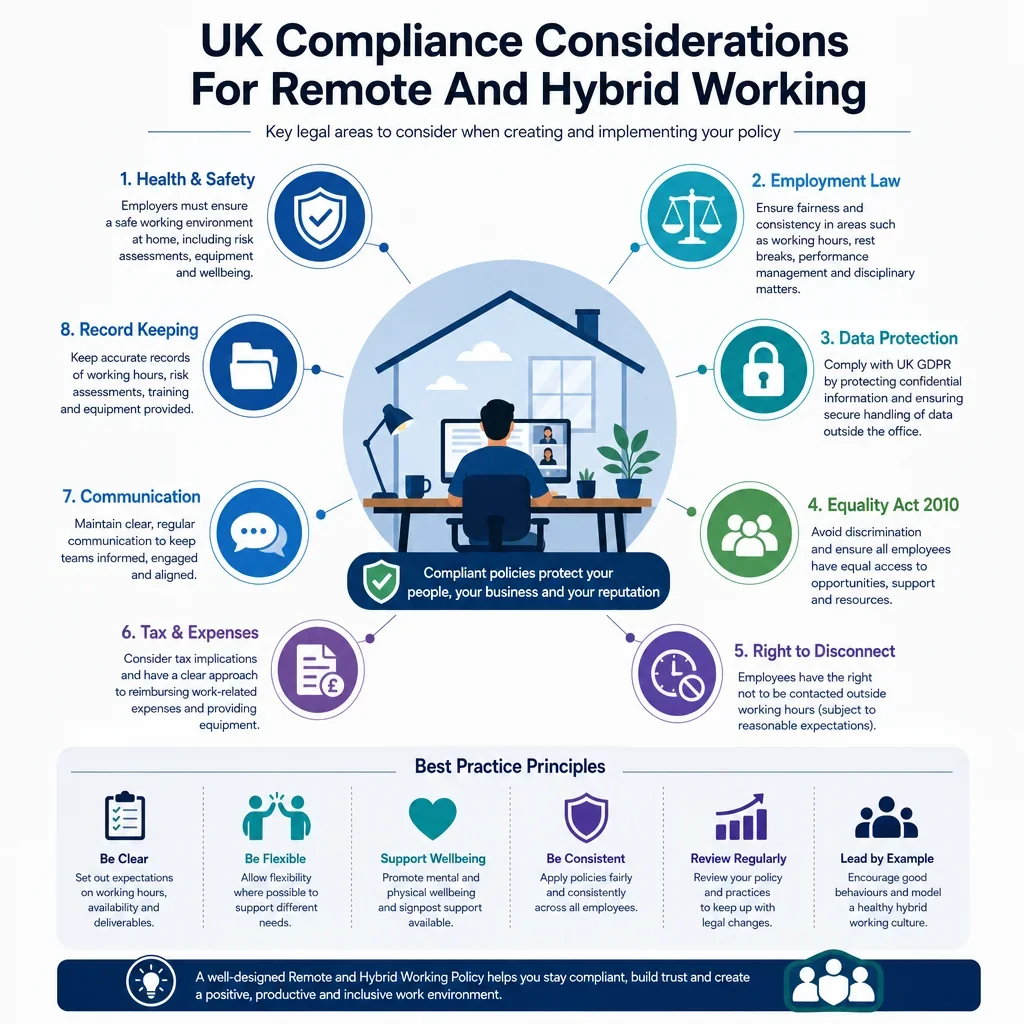
British Legal Rules for a Remote and Hybrid Working Policy
Using the wrong structure for a remote or hybrid work policy can inadvertently create liabilities under UK employment law.
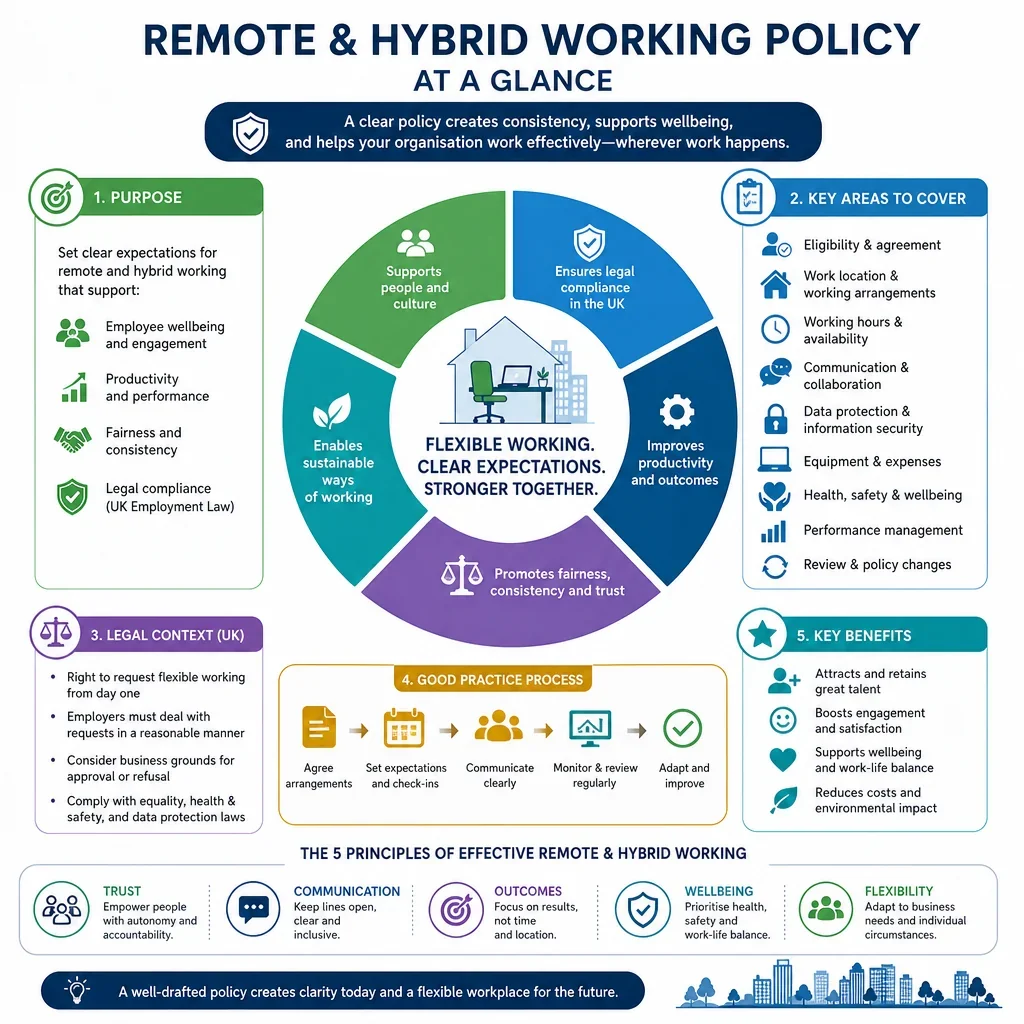
What a Proper Remote and Hybrid Working Policy Should Include
- Eligibility RulesDefine who can work remotely or in a hybrid setup, based on job role, location, and performance.
- Work Hours and AvailabilitySet clear expectations for working hours, response times, and how to report availability when not in the office.
- Equipment and SetupOutline what tools, software, and home office setups the company provides or requires employees to arrange.
- Communication GuidelinesSpecify preferred tools for meetings, updates, and collaboration to keep everyone connected.
- Data Security MeasuresDetail steps to protect company information, like using secure networks and handling sensitive files safely.
- Health and SafetyRequire employees to maintain a safe home workspace and report any risks, in line with UK regulations.
- Performance ExpectationsExplain how productivity will be measured and reviewed, regardless of work location.
- Expense ReimbursementsCover what costs, such as internet or travel, can be claimed and the process for getting reimbursed.
- Support and TrainingProvide resources and training to help employees succeed in remote or hybrid roles.
- Review and ChangesState how often the policy will be updated and how employees will be informed of changes.
Generate Your Document in 4 Easy Steps
Why Use Docaro?
 United Kingdom
Free Example Remote and Hybrid Working Policy Template
Below is a free template example of a Remote and Hybrid Working Policy for use in the United Kingdom generated by our AI model.
The clauses in your actual Remote and Hybrid Working Policy will vary from this example as they will be entirely bespoke to your requirements as set out in the questionnaire you complete.
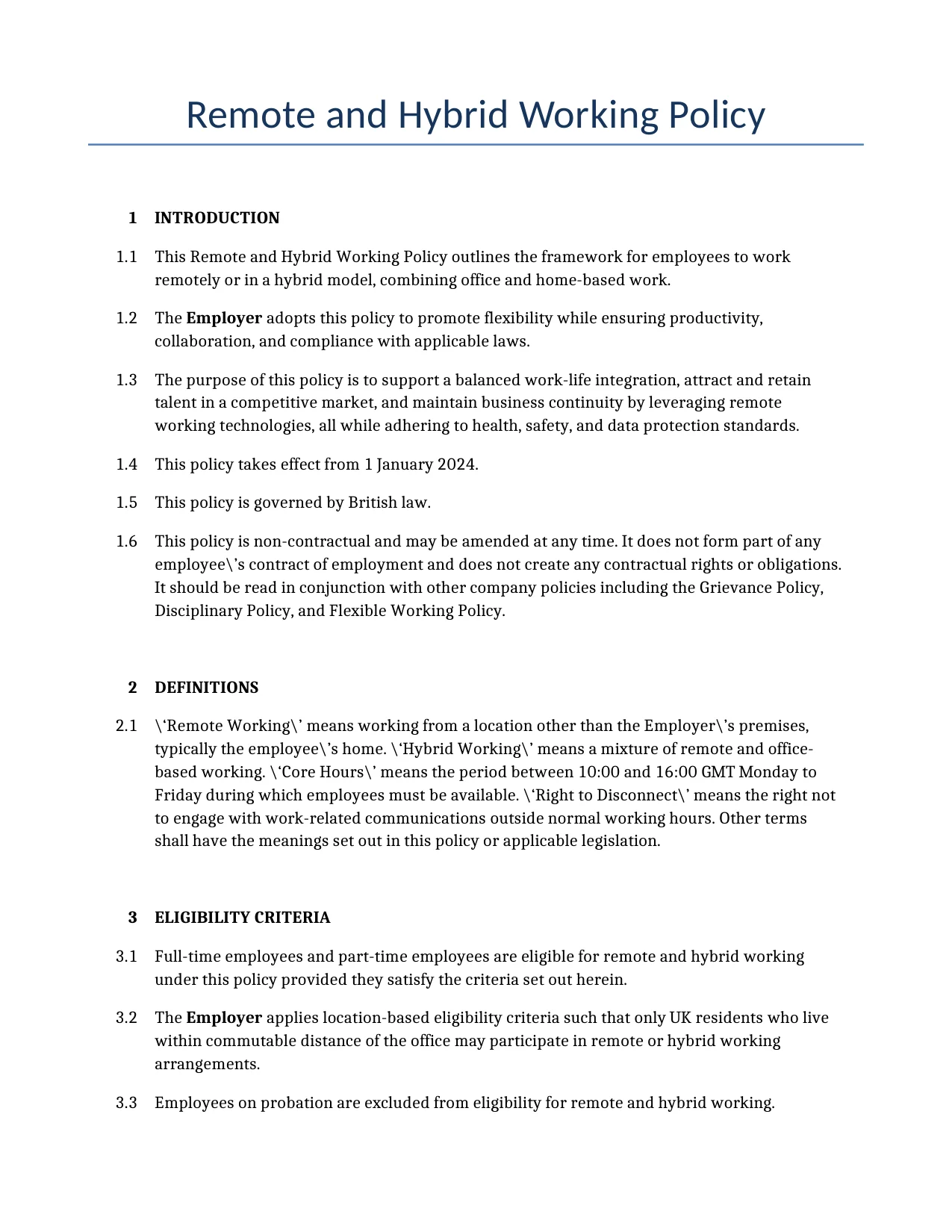
Remote and Hybrid Working Policy
1INTRODUCTION
This Remote and Hybrid Working Policy outlines the framework for employees to work remotely or in a hybrid model, combining office and home-based work.
The Employer adopts this policy to promote flexibility while ensuring productivity, collaboration, and compliance with applicable laws.
The purpose of this policy is to support a balanced work-life integration, attract and retain talent in a competitive market, and maintain business continuity by leveraging remote working technologies, all while adhering to health, safety, and data protection standards.
This policy takes effect from 1 January 2024.
This policy is governed by British law.
This policy is non-contractual and may be amended at any time. It does not form part of any employee\’s contract of employment and does not create any contractual rights or obligations. It should be read in conjunction with other company policies including the Grievance Policy, Disciplinary Policy, and Flexible Working Policy.
2DEFINITIONS
\‘Remote Working\’ means working from a location other than the Employer\’s premises, typically the employee\’s home. \‘Hybrid Working\’ means a mixture of remote and office-based working. \‘Core Hours\’ means the period between 10:00 and 16:00 GMT Monday to Friday during which employees must be available. \‘Right to Disconnect\’ means the right not to engage with work-related communications outside normal working hours. Other terms shall have the meanings set out in this policy or applicable legislation.
3ELIGIBILITY CRITERIA
Full-time employees and part-time employees are eligible for remote and hybrid working under this policy provided they satisfy the criteria set out herein.
The Employer applies location-based eligibility criteria such that only UK residents who live within commutable distance of the office may participate in remote or hybrid working arrangements.
Employees on probation are excluded from eligibility for remote and hybrid working.
Employees subject to active disciplinary proceedings or who hold a final written warning are excluded from eligibility for remote and hybrid working.
The Employer shall review employee eligibility for remote and hybrid working annually.
4TYPES OF REMOTE AND HYBRID WORKING
The Employer supports full remote working arrangements for eligible employees.
The Employer supports hybrid working arrangements for eligible employees.
The Employer supports full remote, part-time hybrid, and flexible hybrid models of working.
Desk-based roles only shall be eligible for remote and hybrid working subject to managerial discretion.
5STATUTORY FLEXIBLE WORKING REQUESTS PROCEDURE
Employees have a statutory right under section 80F of the Employment Rights Act 1996 to make a formal flexible working request. Such requests must be made in writing, dated, and specify the change requested, the date from which it is to take effect, the impact on the business and how this may be dealt with, and state that it is a statutory request. The Employer must arrange a meeting to discuss the request within 28 days of receipt (unless extended by agreement). The Employer must notify the employee of the decision in writing within 2 months of receipt of the request (or such longer period as agreed). The request may only be refused on one or more of the eight statutory business grounds set out in section 80G(1)(b) of the Employment Rights Act 1996 (including burden of additional costs, detrimental effect on ability to meet customer demand, inability to reorganise work among existing staff, insufficiency of work during the periods the employee proposes to work, and planned structural changes). Employees have the right to appeal a refusal within 14 days. Appeals will be heard by a more senior manager and a decision provided within 14 days of the appeal. This procedure is separate from any informal hybrid working requests under this policy.
6APPLICATION AND APPROVAL PROCESS
In addition to the statutory flexible working request procedure, employees may make informal requests for remote or hybrid working via the company HR portal. Applications must include name, position, proposed arrangement, reasons, start date and home office details. The Employer will aim to respond within 14 days. Approval is at the discretion of the line manager subject to business needs and this policy. Where an application is refused for non-statutory reasons the employee may discuss the outcome with HR.
7WORKPLACE AND EQUIPMENT
The Employer shall provide all equipment necessary for remote and hybrid working.
Employees must set up an ergonomic workspace at home that constitutes a dedicated, quiet area with adequate lighting, a stable internet connection, and sufficient space for ergonomic equipment such as an adjustable chair and desk.
The Employer and the employee shall share responsibility for the maintenance and repairs of remote work equipment in accordance with issued guidelines.
The Employer shall provide reimbursement to employees for home office expenses in accordance with the provisions of this policy.
Employees must implement security measures for remote equipment including VPN access, antivirus software, and multi-factor authentication.
The Employer maintains appropriate insurance cover for company equipment provided to employees for home use. Employees are responsible for ensuring their own home insurance provides adequate cover for any personal items or for any liability arising from remote working. Employees must notify their home insurer that their property is used for occasional business purposes. The Employer shall not be liable for any loss or damage to personal property unless caused by its negligence.
8HEALTH AND SAFETY
The Employer shall conduct risk assessments for remote workers\' home offices in compliance with the Health and Safety at Work etc. Act 1974 and the Management of Health and Safety at Work Regulations 1999.
Remote workers shall complete an initial self-assessment form and submit it to HR via email whereupon the Employer shall review it within 7 days, provide feedback, and if necessary arrange a virtual consultation to address any identified risks.
The Employer shall provide guidance on ergonomic setups for remote workers.
The Employer shall provide or reimburse adjustable chairs and monitor stands or arms for remote workers.
The Employer shall establish a mechanism for remote workers to report health and safety incidents.
Remote workers must report incidents immediately using the dedicated online portal or by emailing safety@company.com including details such as date, time, description of the incident, and any injuries sustained.
The Employer shall acknowledge receipt of such reports within 24 hours and initiate an investigation as per HSE guidelines.
The Employer shall provide online ergonomic training and mental health awareness sessions to remote workers.
The Employer shall ensure compliance with the Display Screen Equipment Regulations by conducting suitable DSE assessments (via self-assessment followed by review), providing appropriate equipment and training, and ensuring employees take adequate breaks. For lone working, the Employer shall carry out specific lone worker risk assessments, implement contact procedures such as regular check-ins or buddy systems, and establish emergency protocols including clear escalation paths and sharing of emergency contact details. Employees must not undertake high-risk activities while working alone remotely.
9DATA PROTECTION AND CONFIDENTIALITY
Employees must complete mandatory training on data protection and confidentiality before starting remote work in compliance with the Data Protection Act 2018 and UK GDPR. The Employer processes personal data relating to remote working arrangements on the lawful basis of legitimate interests and/or legal obligation. Employees have rights under the UK GDPR including access, rectification, erasure, restriction and portability. Any monitoring of remote workers shall be conducted only after completion of a Data Protection Impact Assessment where required, shall be limited to what is necessary and proportionate, and employees shall receive a privacy notice detailing the monitoring. All data processing shall comply with the principles of lawfulness, fairness, transparency, purpose limitation, data minimisation, accuracy, storage limitation, integrity, confidentiality and accountability.
Employees must use company-approved secure systems such as VPNs for accessing company data when working remotely or in a hybrid capacity.
Employees may access company data using company-issued laptops and tablets or company-issued laptops, tablets, and smartphones.
Employees must encrypt all company data stored or transmitted on remote devices.
Employees must report suspected data breaches to the Employer within 24 hours of suspicion.
Employees must adhere to secure location guidelines that prohibit working from public places like cafes, require private home offices with locked storage, and mandate use of secure, password-protected networks only.
Employees must adhere to the data minimization principle when working remotely.
10INFORMATION SECURITY
Employees must use a Virtual Private Network for all remote access to company networks.
Employees must use multi-factor authentication for all company system logins when working remotely.
Employees must install and maintain up-to-date antivirus software on all remote work devices.
Employees must apply full disk encryption to remote work devices handling sensitive information.
Employees are prohibited from using public Wi-Fi networks for accessing company systems or handling sensitive information.
Employees must use encrypted email services for sending sensitive data and share files only via approved secure platforms like company-provided cloud storage with access controls.
Employees must observe password management requirements that include a minimum length of 12 characters, prohibition of password reuse across systems, and use of password managers.
Employees must report any suspected security incidents within 24 hours of detection.
Remote sessions shall automatically log out after 15 minutes of idle time.
11RIGHT TO DISCONNECT
The Employer recognises employees\’ right to disconnect in accordance with the Working Time Regulations 1998 and to protect wellbeing. Employees are not expected to respond to work-related communications (including emails, calls, messages or meetings) outside their normal working hours, during rest periods, holidays or other time off. Managers must respect this right and must not penalise or subject to detriment any employee who exercises it. Employees are encouraged to switch off notifications outside working hours. Any concerns about workload or inability to complete work within normal hours should be raised with the line manager. This policy does not create a contractual right but sets out the Employer\’s expectations.
12COMMUNICATION AND AVAILABILITY
Employees shall use Microsoft Teams for instant messaging and video calls, email for formal communications, and Slack for project-specific discussions during remote and hybrid work.
Employees must respond to communications within 4 hours during normal working hours.
Core working hours are defined as 10:00 AM to 4:00 PM GMT, Monday to Friday, during which employees are expected to be available for collaboration. Outside these hours employees may exercise their right to disconnect.
Employees must make themselves available outside core hours for genuine emergencies only, with prior agreement where possible.
Employees shall indicate their availability status during remote work by setting online status in chat tools and providing shared calendar updates.
Employees must set an out-of-office auto-reply on email, update their status in chat tools to \'away\', and notify their manager and team via shared calendar at least 24 hours in advance for planned absences.
13WORKING HOURS AND TIME TRACKING
Employees are expected to work no more than 48 hours per week on average (unless they have opted out) in compliance with the Working Time Regulations 1998. Standard contractual hours are 40 hours per week (8 hours per day, Monday to Friday) with a minimum 20-minute unpaid break after 6 hours. Employees may agree flexible start and finish times provided core hours are observed and total weekly hours do not exceed the limit. All working time, including overtime where agreed, must be accurately recorded using the company time-tracking system. The Employer will monitor compliance to ensure adequate daily and weekly rest periods are taken.
14PERFORMANCE MANAGEMENT
The Employer shall use project management software such as Asana and Trello for task tracking and time-tracking tools such as Toggl for monitoring the performance of remote and hybrid workers.
The Employer shall implement regular check-in meetings as a feedback mechanism for remote and hybrid workers.
The Employer shall provide feedback to remote and hybrid workers monthly.
Key performance indicators for evaluating remote and hybrid workers shall include completion of assigned tasks on time, achievement of project milestones, customer satisfaction scores from feedback surveys, and team collaboration metrics measured by participation in shared platforms.
The full performance evaluation cycle for remote and hybrid workers shall span 12 months.
The Employer shall address underperformance through informal discussion, performance improvement plan, or training provision.
15EXPENSES AND REIMBURSEMENTS
The Employer shall reimburse employees for expenses related to remote working in line with HMRC rules. Eligible expenses include additional household costs where employees work from home regularly. The Employer applies the HMRC approved flat-rate homeworking allowance of \£6 per week (\£26 per month) without the need for receipts. Higher amounts may be claimed with evidence of actual additional expenditure. The Employer will report homeworking allowances correctly to HMRC via payroll. Employees are responsible for their own tax affairs in respect of any personal tax relief claims.
16TRAINING AND SUPPORT
The internal HR department shall provide training for remote working tools.
Employees may contact the training provider at training@company.co.uk or on 020 1234 5678.
The training available for remote working tools such as software and hardware setup includes interactive online modules covering setup and troubleshooting for tools like Microsoft Teams, Zoom, VPN software, and ergonomic home office hardware with sessions lasting 2-4 hours and available on-demand via the company LMS.
The Employer shall provide 24/7 IT support for remote and hybrid employees with responses provided within 4 hours.
Employees may contact IT support at itsupport@company.co.uk, on 020 8765 4321, or via the portal at support.company.co.uk.
The Employer shall provide online courses and certifications, webinars and virtual workshops, and mentoring programs as ongoing development opportunities for hybrid employees.
The Employer shall allocate 20 hours of training per year for each hybrid employee.
Initial remote working training shall be mandatory for all new hybrid employees.
17WELLBEING AND SUPPORT
The Employer shall provide specific resources for mental health support including an employee assistance programme and mental health first aiders.
The Employer shall include guidelines on maintaining work-life balance including a right to disconnect policy and flexible working hours.
The Employer shall provide specific measures to support employees experiencing isolation in remote work including regular virtual team building events and wellbeing check in meetings.
The HR wellbeing coordinator shall be the primary contact for wellbeing support and may be contacted at wellbeing@company.co.uk.
18DOMESTIC ABUSE AND SAFEGUARDING
The Employer recognises that remote and hybrid working may present additional challenges for employees experiencing domestic abuse. Employees are encouraged to speak in confidence to their manager, HR or the designated safeguarding lead. The Employer will provide appropriate support including flexible working adjustments, access to specialist external support services, and measures to ensure safety while working from home (such as secure communication channels). All disclosures will be treated confidentially in accordance with the Data Protection Act 2018 and UK GDPR. This policy links to the Employer\’s Domestic Abuse Policy.
19EQUALITY, DIVERSITY AND INCLUSION
The Employer shall provide accessibility tools and software for remote workers with disabilities in accordance with the Equality Act 2010. Reasonable adjustments will be made for employees with disabilities. The policy has been equality impact assessed. The Employer shall monitor uptake of remote and hybrid working across protected characteristics (including age, disability, gender, pregnancy/maternity, race, religion, sex, sexual orientation, gender reassignment and marriage/civil partnership) to identify and address any disparities. Monitoring data shall be held anonymously and in compliance with the Data Protection Act 2018 and UK GDPR. This section should be read with the Employer\’s Equality, Diversity and Inclusion Policy.
20COMPLIANCE WITH UK EMPLOYMENT LAW
The Employer shall track employees\' working hours for remote and hybrid workers to ensure compliance with the Working Time Regulations 1998.
Remote and hybrid workers may opt out of the 48-hour weekly working limit under the Working Time Regulations 1998.
The Employer shall provide rest breaks for remote and hybrid workers as required by the Working Time Regulations 1998.
The policy shall address disability adjustments and gender and family status to comply with the Equality Act 2010.
The Employer shall conduct individual health and safety risk assessments for each remote and hybrid worker\'s home workspace in accordance with the Health and Safety at Work etc. Act 1974 and the Management of Health and Safety at Work Regulations 1999.
The Employer shall provide training on data protection for remote and hybrid workers handling sensitive information in compliance with the Data Protection Act 2018.
Remote and hybrid workers may raise grievances related to their working arrangements under the Employment Rights Act 1996 by following the Employer\'s grievance procedure.
The Employer shall review the Compliance with UK Employment Law section of the Remote and Hybrid Working Policy annually.
21MONITORING AND SURVEILLANCE
Employees must provide explicit consent for any monitoring of their remote activities.
The Employer shall disclose all monitoring practices to employees in advance.
The Employer shall implement email and communication monitoring and internet and application usage tracking for remote and hybrid workers.
The Employer shall conduct monitoring and surveillance of remote activities to ensure productivity, protect company assets, comply with legal requirements, and maintain security of sensitive information.
The Employer shall retain data collected through monitoring for a maximum of 30 days before deletion.
The Employer shall conduct monitoring of remote activities by periodic sampling.
The Employer shall adhere to the UK GDPR and Data Protection Act 2018 by conducting Data Protection Impact Assessments for all monitoring activities, limiting data collection to what is necessary and proportionate, and providing clear privacy notices to employees.
22TERMINATION OF REMOTE WORKING ARRANGEMENT
A remote or hybrid working arrangement may be terminated where business needs change, performance issues arise, or there is misuse of the arrangement.
The Employer shall provide the employee with 30 days\' notice when terminating the remote working arrangement.
The employee shall provide the Employer with 14 days\' notice when requesting termination of the remote working arrangement.
Return to full-time office working shall be mandatory upon termination of the remote arrangement.
Upon termination the Employer shall notify the employee in writing of the termination decision and effective date, schedule a meeting to discuss the transition plan and address any concerns, provide at least 30 days for the employee to prepare including arranging necessary equipment return, and confirm the employee\'s return to the office on the specified date and update HR records accordingly.
The Employer shall deliver notice of termination of the remote working arrangement by written letter or email.
23REVIEW AND UPDATES
The Remote and Hybrid Working Policy shall be reviewed every 12 months.
The next review of the Remote and Hybrid Working Policy shall occur on 2025-01-01.
The HR director shall be responsible for conducting the periodic reviews of the Remote and Hybrid Working Policy.
The process for reviewing the Remote and Hybrid Working Policy shall include gathering feedback from employees and managers, assessing compliance with current regulations, consulting with HR and legal teams, drafting proposed changes, and approving and finalizing the updated policy.
The Employer shall communicate updates to the Remote and Hybrid Working Policy to employees by email notifications, company intranet posting, and team meetings.
Employees shall be required to acknowledge receipt of Remote and Hybrid Working Policy updates.
The Employer shall maintain records of policy updates and communications by maintaining a centralized digital repository in the HR management system including version histories, update dates, communication logs, and employee acknowledgments with access restricted to authorized personnel for compliance purposes.
24CONTACT INFORMATION
The HR contact person for remote working queries is Jane Smith who may be contacted at jane.smith@company.co.uk or on +44 20 1234 5678.
The IT support contact person for remote working queries is John Doe who may be contacted at john.doe@company.co.uk or on +44 20 8765 4321.
25SIGNATURE
I acknowledge that I have read, understood, and agree to comply with the terms of this Remote and Hybrid Working Policy.
Employee Name: _______________________________
Employee Signature: _______________________________ Date: ________________
On behalf of the Employer: _______________________________
Signature: _______________________________ Date: ________________
This example shows approximately 70% of a typical document and is provided for illustrative purposes only. The remaining content has been omitted.
Every document generated by Docaro is tailored to your specific circumstances, jurisdiction and the information you provide. The completed document includes all applicable clauses and provisions required for your situation.
To generate the full, personalised document, answer a short series of questions and your document will be created instantly.
Useful Resources When Considering a Remote and Hybrid Working Policy in the United Kingdom
United Kingdom Reference Legislation
Remote and Hybrid Working Policy FAQs
Document Generation FAQs
Related Articles