UK Cease And Desist Letter Glossary
Term | Plain English Definition | Use In Context | Complexity Level | Clarification Note |
|---|---|---|---|---|
Letter terminology | ||||
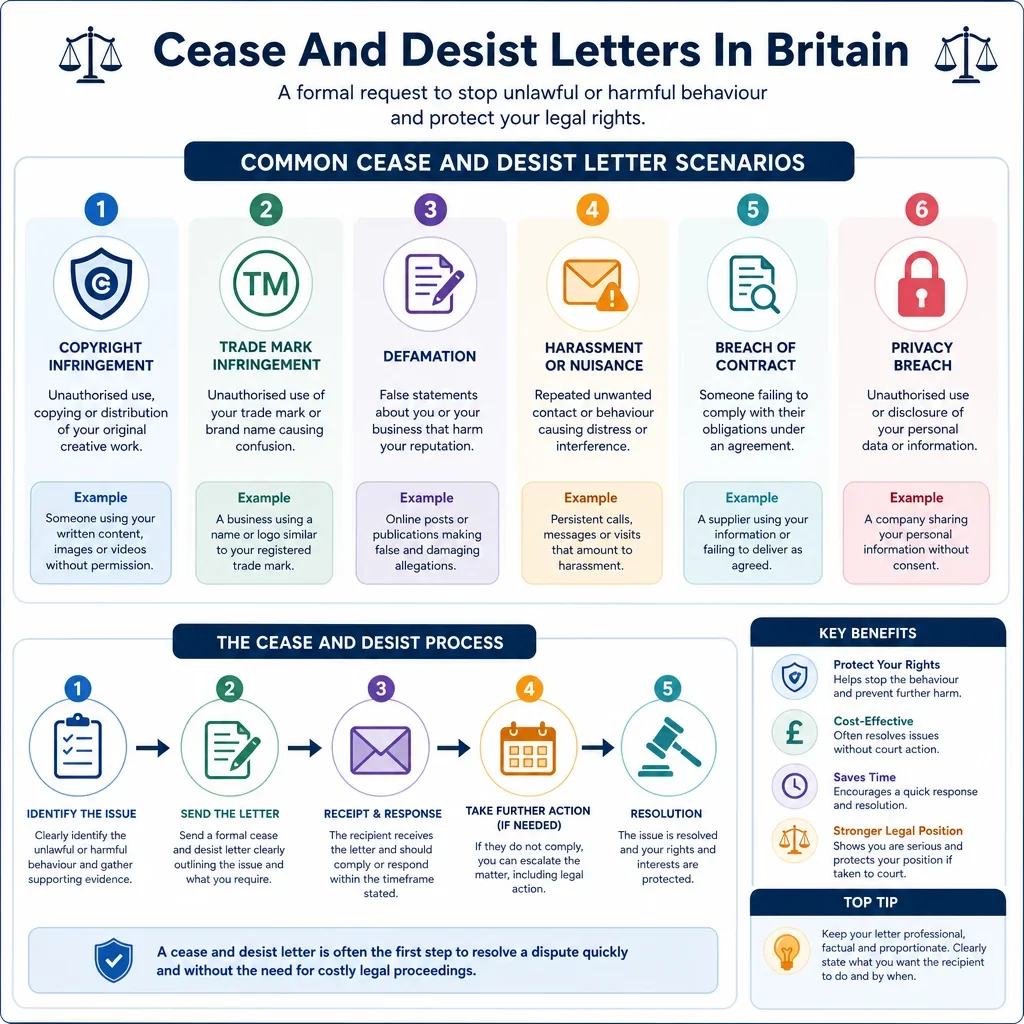
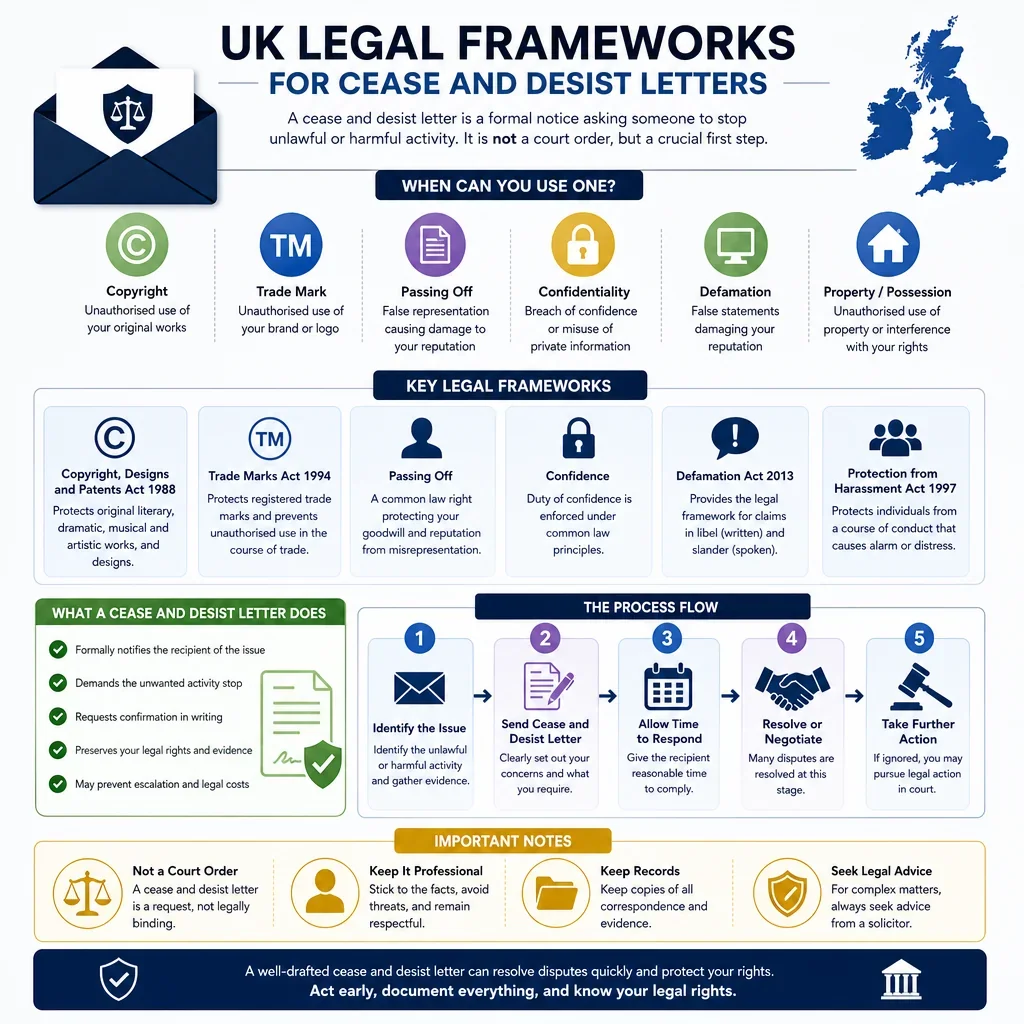
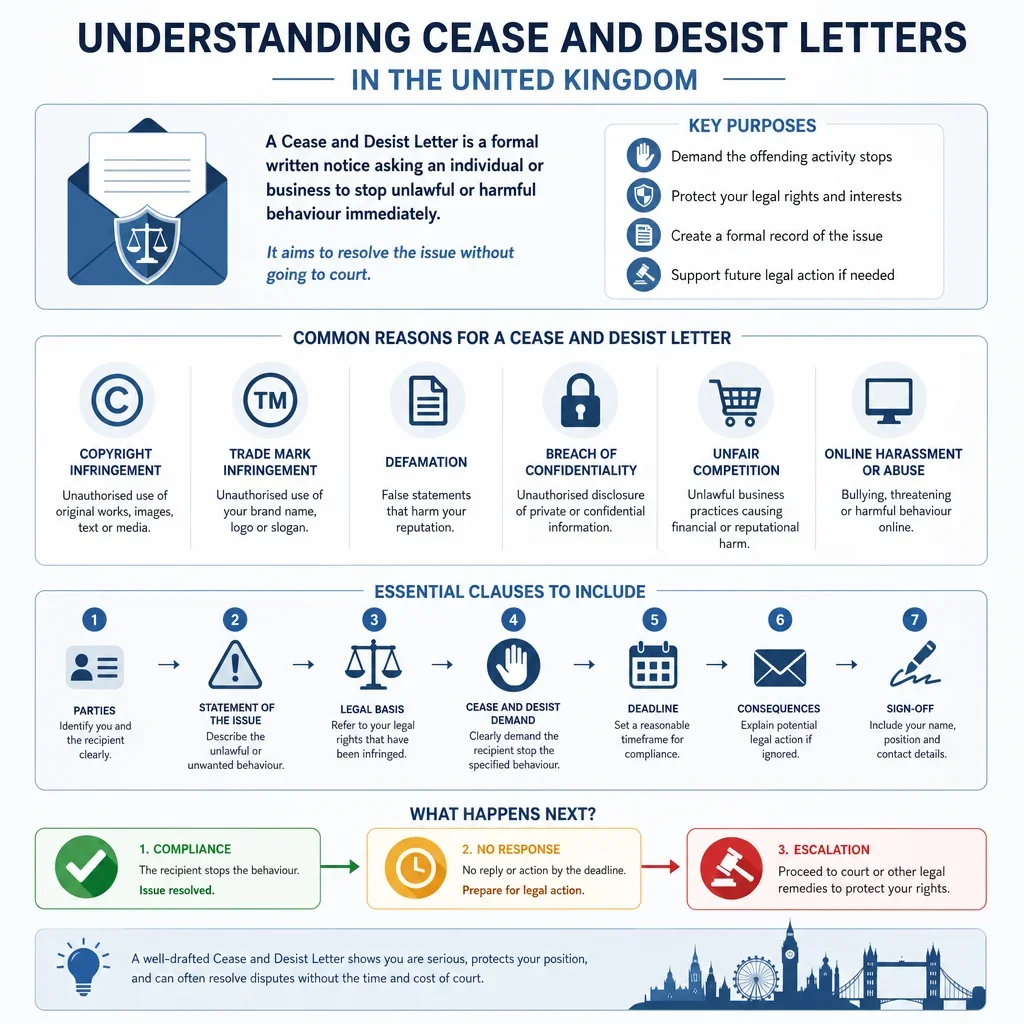
Cease And Desist Letter | A formal letter demanding that someone stop doing something unlawful or harmful. | Used to ask a recipient to stop infringement, harassment, misuse of data, or other disputed conduct. | Beginner | It is not a court order, but it may be used as evidence of notice. |
Procedure | ||||
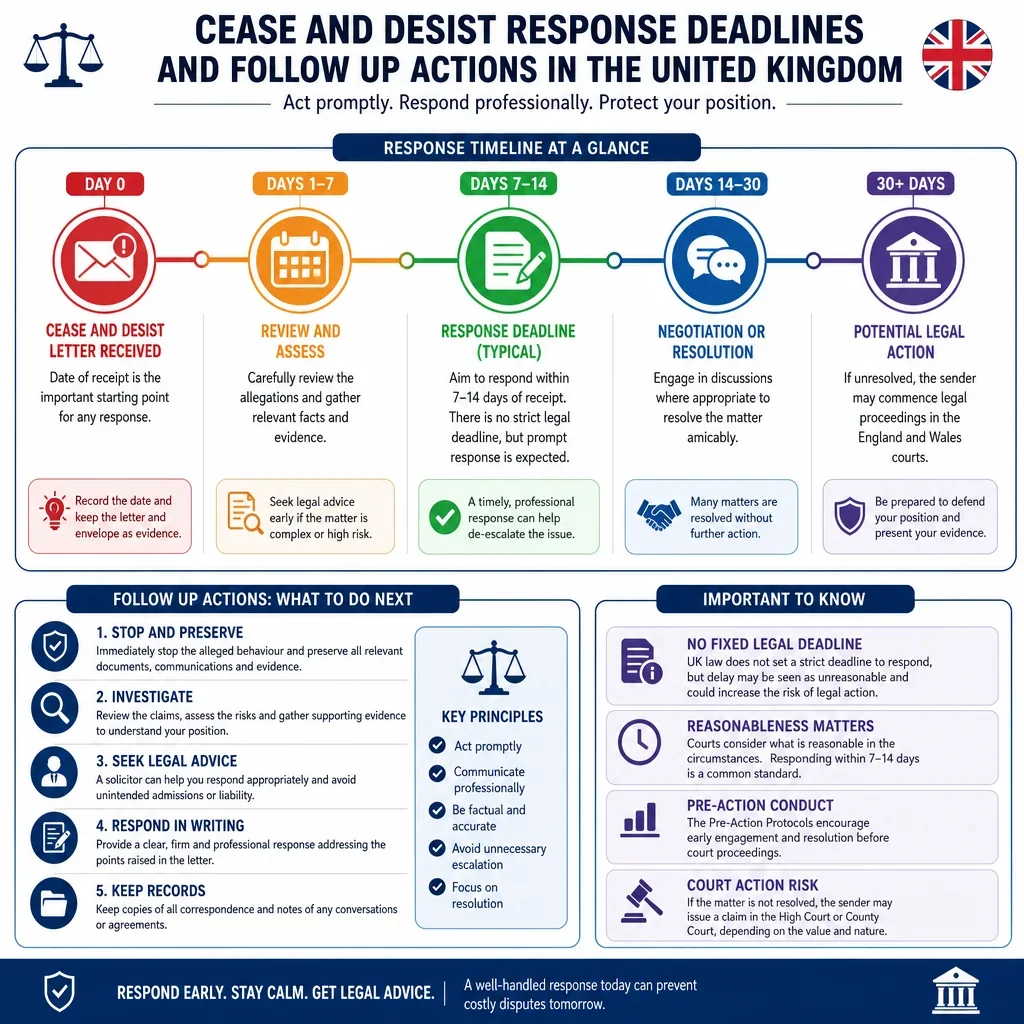
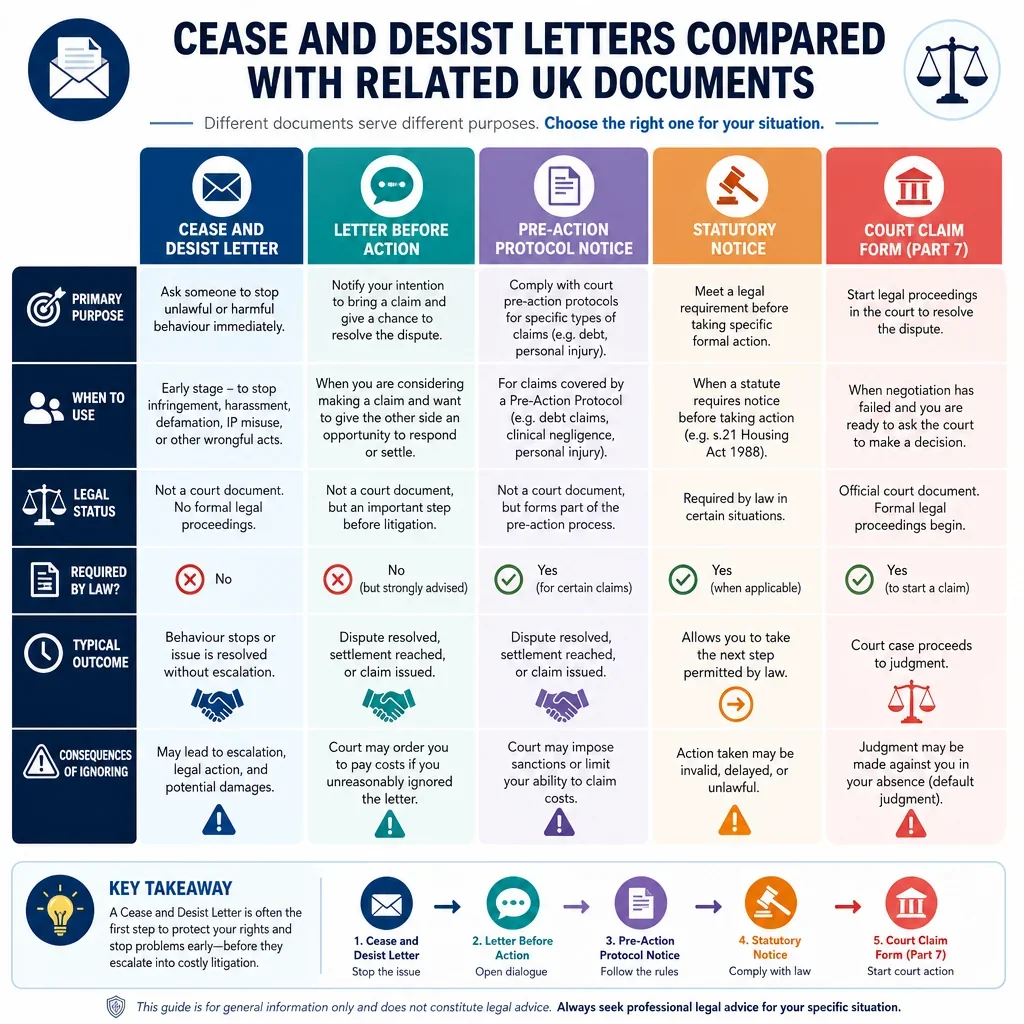
Letter Before Action | A formal warning letter sent before starting a civil court claim. | A cease and desist letter may also operate as a letter before action if it sets out the claim and deadline. | Beginner | It should comply with relevant pre-action conduct rules where litigation is possible. |
Pre-Action Protocol | Rules and guidance about steps parties should take before starting court proceedings. | The sender may need to exchange information and consider settlement before issuing a claim. | Intermediate | Different disputes may have different protocols not every dispute has a specific one. |
Parties | ||||
Sender | The person or organisation sending the cease and desist letter. | The sender identifies their rights and the conduct they want stopped. | Beginner | The sender should have authority to assert the rights relied on. |
Recipient | The person or organisation accused of the disputed conduct. | The letter should name the recipient clearly and use correct contact details. | Beginner | Sending to the wrong person may delay resolution or weaken the letter. |
Letter terminology | ||||
Alleged Conduct | The behaviour the sender says is wrongful or unlawful. | The letter should describe what happened, when, where, and why it is objectionable. | Beginner | Vague accusations are easier to dispute and harder to enforce. |
Demand | The action the sender asks the recipient to take or stop taking. | Demands may include removal, deletion, non-contact, payment, disclosure, or written undertakings. | Beginner | A demand should be proportionate and legally supportable. |
Deadline For Compliance | The date or time by which the recipient is asked to comply. | The letter may require confirmation within a set number of days. | Beginner | Unreasonably short deadlines may look oppressive unless urgency is justified. |
Without Prejudice | A label used for genuine settlement communications that are usually not shown to the court on liability. | May be used for settlement offers connected to the cease and desist dispute. | Intermediate | The label does not work automatically the communication must be a genuine settlement attempt. |
Open Letter | A letter that can generally be shown to the court or relied on openly. | Key allegations and formal demands are often sent on an open basis. | Intermediate | Do not mix confidential settlement wording with open demands without care. |
Remedies | ||||
Undertaking | A formal promise to do or stop doing something. | The recipient may be asked to sign undertakings not to repeat the conduct. | Intermediate | A signed undertaking can have serious consequences if breached. |
Injunction | A court order requiring someone to do or stop doing something. | A letter may warn that the sender will seek an injunction if the conduct continues. | Intermediate | Only a court can grant an injunction a letter cannot impose one. |
Interim Injunction | A temporary court order made before the final trial or settlement. | Used where urgent action is needed to prevent continuing harm. | Advanced | Applicants may need to give a cross-undertaking in damages. |
Damages | Money claimed or awarded as compensation for loss. | A letter may reserve the sender's right to claim damages. | Beginner | Loss should be evidenced damages are not automatic in every dispute. |
Account Of Profits | A remedy requiring a wrongdoer to give up profits made from the wrongdoing. | Often mentioned in IP claims where the recipient profited from infringement. | Advanced | It is usually an alternative to damages, not an extra automatic payment. |
Costs | Legal expenses incurred in dealing with the dispute. | A letter may state that the sender will seek costs if proceedings are needed. | Intermediate | The court has discretion on costs recovery is not guaranteed. |
Delivery Up | Handing over infringing items or materials to the rights holder or as ordered by a court. | The sender may demand delivery up of counterfeit goods or infringing copies. | Intermediate | The right depends on the type of claim and the legal basis asserted. |
Takedown Request | A request to remove online content, listings, files, or posts. | Common where disputed material appears on websites, marketplaces, or social media. | Beginner | Platforms may have separate notice procedures and evidence requirements. |
Legal rights | ||||
Copyright Infringement | Using protected creative work without permission where copyright law restricts that use. | A letter may demand removal of copied text, images, music, software, or videos. | Intermediate | Copyright protects expression, not bare ideas or facts. |
Trade Mark Infringement | Unauthorised use of a protected brand sign in a way restricted by trade mark law. | A letter may demand that the recipient stop using a confusingly similar name, logo, or sign. | Intermediate | Registration, similarity, goods or services, and confusion are often important. |
Passing Off | A claim that someone misleads customers into thinking their goods or services are connected with another business. | Used where a business has goodwill but may not have a registered trade mark. | Advanced | Usually requires goodwill, misrepresentation, and damage. |
Patent Infringement | Using, making, selling, or importing a patented invention without permission. | A letter may allege that a product or process falls within patent claims. | Advanced | Patent allegations need care because unjustified threats rules may apply. |
Design Right Infringement | Unauthorised copying or use of a protected design. | A letter may demand withdrawal of products copying the shape or appearance of a design. | Advanced | UK registered designs, supplementary unregistered designs, and design right differ. |
Defamation | A false statement that seriously harms a person's or business's reputation. | A letter may demand removal, correction, apology, and no further publication. | Advanced | England and Wales require serious harm honest opinion and truth may be defences. |
Harassment | A course of conduct that alarms, distresses, or oppresses another person. | A letter may tell the recipient to stop contacting, following, posting about, or intimidating the sender. | Intermediate | Urgent threats or abuse may require police help or protective orders, not only a letter. |
Breach Of Confidence | Misusing information that was shared in circumstances requiring confidentiality. | A letter may demand that confidential information is not used, disclosed, or retained. | Advanced | The information must normally have a confidential quality and be misused without authority. |
Non-Disclosure Agreement | A contract requiring information to be kept confidential. | A cease and desist letter may rely on an NDA to demand that disclosure stops. | Beginner | An NDA cannot lawfully prevent certain protected disclosures, such as whistleblowing. |
Breach Of Contract | Failing to do something required by a contract, or doing something the contract prohibits. | A letter may demand that a party stop breaching restrictive, confidentiality, or use clauses. | Beginner | The contract wording and available remedies matter greatly. |
Restrictive Covenant | A contractual restriction on what someone may do, often after employment or a business sale. | A letter may demand that an ex-worker stops soliciting clients or using confidential information. | Advanced | Restrictive covenants must usually protect a legitimate interest and be reasonable. |
Data Protection Infringement | Misusing personal data or failing to comply with UK data protection law. | A letter may demand deletion, correction, restriction, or an explanation of personal data use. | Intermediate | The ICO can handle complaints, but private claims may need separate legal steps. |
Misuse Of Private Information | Wrongfully publishing or using information over which a person has a reasonable expectation of privacy. | A letter may demand removal of private photos, messages, medical details, or personal information. | Advanced | Privacy rights may be balanced against freedom of expression and public interest. |
Nuisance | Unreasonable interference with the use or enjoyment of land, such as persistent noise or smells. | A letter may demand that a neighbour or business stops the nuisance-causing activity. | Intermediate | Local councils may deal with statutory nuisance separately from private legal claims. |
Trespass | Entering or interfering with land without permission or legal right. | A letter may demand that someone stops entering land, parking, dumping, or placing items there. | Beginner | Some trespass issues are civil threats, damage, or squatting may involve separate rules. |
Malicious Falsehood | Publishing false statements maliciously that cause financial loss or likely financial loss. | A business may use a letter to demand removal of false claims about its products or services. | Advanced | It is different from defamation and usually focuses on economic harm. |
Procedure | ||||
Unjustified Threats | Rules allowing a person to challenge certain groundless threats of IP infringement proceedings. | IP cease and desist letters should be drafted carefully to avoid actionable threats. | Advanced | The rules differ by IP right and include permitted communications. |
Permitted Communication | A type of IP communication allowed under unjustified threats rules when it is made for a permitted purpose. | A letter may seek information about suppliers or primary infringers without making improper threats. | Advanced | Calling a letter permitted does not make it lawful if its substance goes too far. |
Evidence | ||||
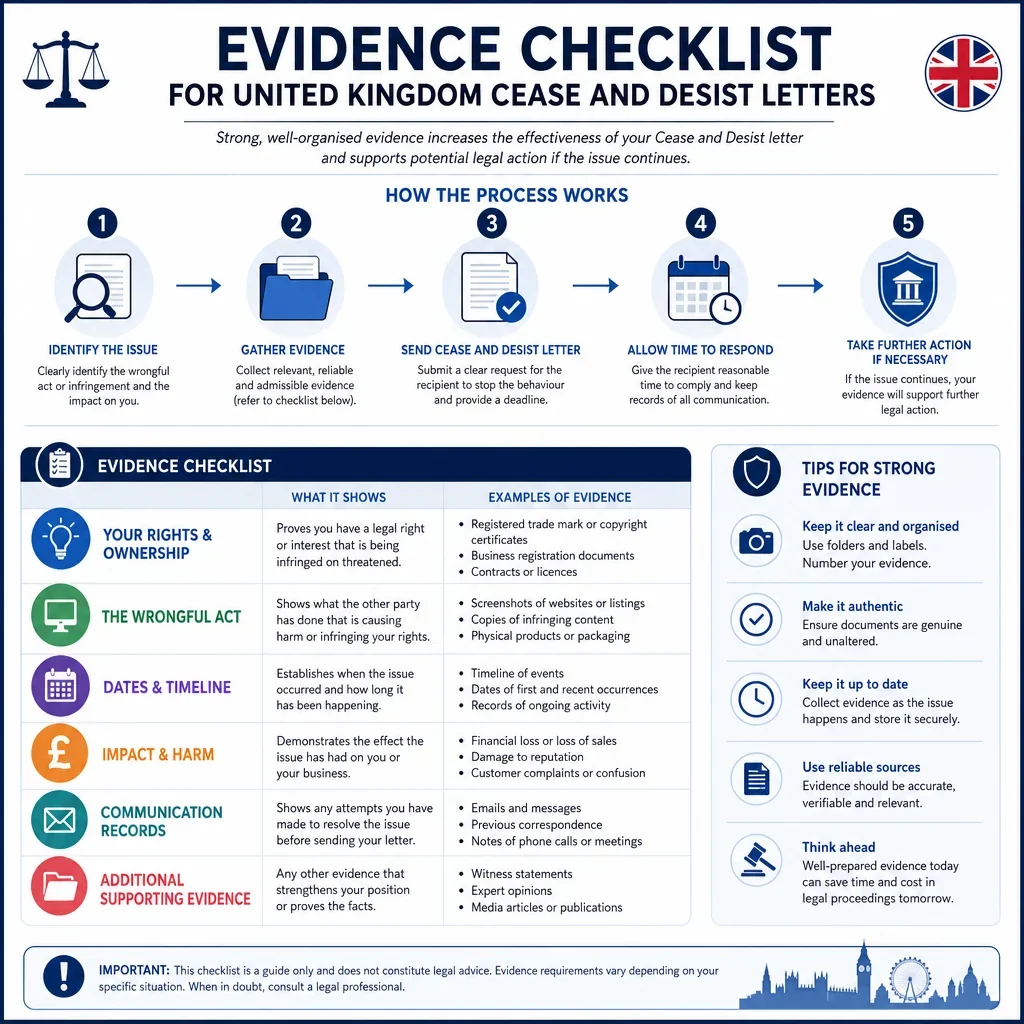
Evidence | Information, documents, images, witness accounts, or records used to prove facts. | A letter may refer to screenshots, copies, dates, correspondence, and other proof. | Beginner | Evidence should be accurate, preserved, and not altered. |
Screenshot Evidence | Images capturing online content at a particular time. | Used to show online posts, listings, messages, copied content, or misuse of branding. | Beginner | Record dates, URLs, usernames, and context as screenshots alone may be incomplete. |
Witness Statement | A written account of facts from someone with relevant knowledge. | May support claims about events, communications, confusion, threats, or loss. | Intermediate | Court witness statements have formal requirements and a statement of truth. |
Statement Of Truth | A formal confirmation that facts in a court document are believed to be true. | Not usually needed in an ordinary letter, but relevant if the dispute becomes court proceedings. | Intermediate | False statements verified by a statement of truth can have serious consequences. |
Documentary Evidence | Documents or records used to prove a fact, including emails, contracts, invoices, and notices. | A letter may attach or reference documents supporting ownership, loss, or wrongdoing. | Beginner | Confidential or privileged documents should not be shared carelessly. |
Preservation Of Evidence | Keeping relevant material safe and unchanged for later use. | The sender may ask the recipient not to delete emails, files, posts, or records. | Intermediate | Destroying relevant evidence can seriously harm a party's position in litigation. |
Procedure | ||||
Disclosure | The process of identifying and sharing relevant documents in a dispute. | A letter may request information before proceedings or warn that disclosure may be sought later. | Advanced | Formal disclosure duties mainly arise once court proceedings or specific rules apply. |
Admission | A statement accepting that a fact, allegation, or claim is true. | The sender may ask the recipient to admit wrongdoing or confirm facts. | Intermediate | Recipients should be cautious about admitting liability without advice. |
Denial | A statement rejecting an allegation or claim. | The recipient may deny the allegations and explain why the demand is not accepted. | Beginner | A bare denial is less persuasive than a denial supported by facts and evidence. |
Settlement | An agreement resolving the dispute without a final court decision. | A cease and desist exchange may end with undertakings, payment, apology, or agreed wording. | Beginner | Settlement terms should be clear, complete, and recorded in writing. |
Alternative Dispute Resolution | Ways to resolve a dispute without trial, such as negotiation or mediation. | The letter may invite discussion, mediation, or another route before proceedings. | Intermediate | Refusing ADR without good reason can affect costs in civil litigation. |
Mediation | A confidential process where an independent mediator helps parties try to settle. | Parties may mediate after a cease and desist letter if direct talks fail. | Beginner | The mediator does not usually decide who is legally right. |
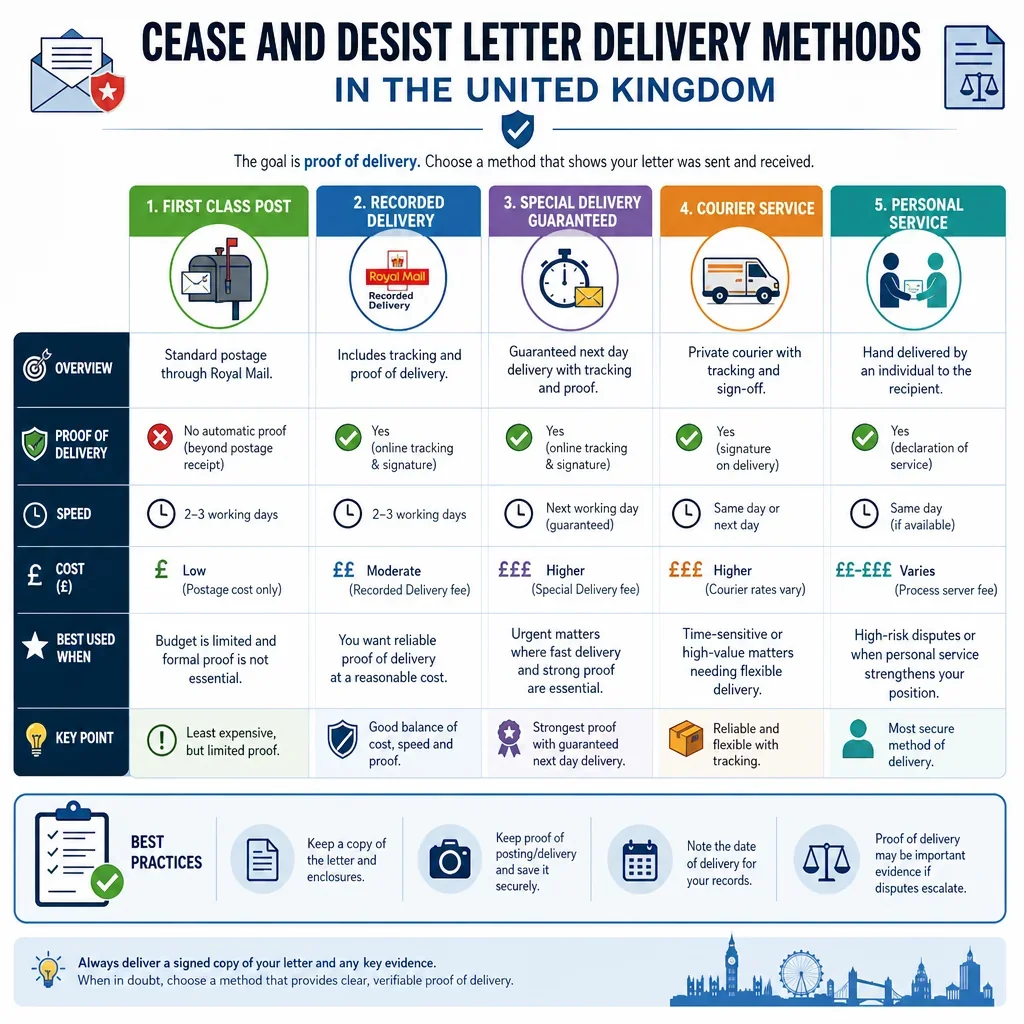
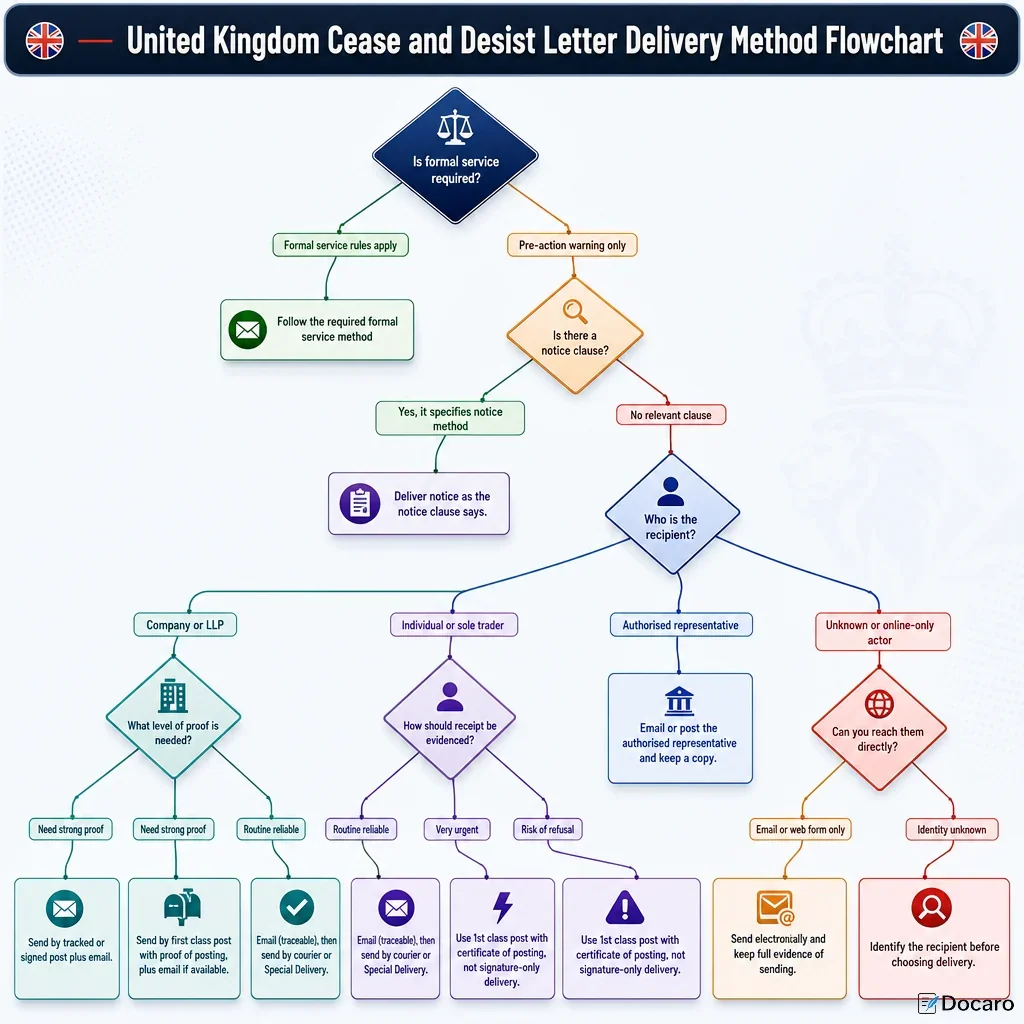
Service | Formal delivery of documents to another party. | Although a cease and desist letter is not always formally served, proof of delivery is useful. | Intermediate | Court documents have stricter service rules than ordinary letters. |
Evidence | ||||
Proof Of Delivery | Evidence that a letter or document was delivered or received. | Useful to show the recipient had notice of the allegations and demands. | Beginner | Signed delivery proves delivery, not that the recipient agrees with the contents. |
Parties | ||||
Solicitor | A regulated legal professional who can advise and act for clients. | A solicitor may draft, review, or send a cease and desist letter on behalf of a client. | Beginner | A solicitor's letter may carry weight but must still be accurate and justified. |
Litigant In Person | Someone who deals with a legal dispute or court case without a lawyer. | A person can send a cease and desist letter themselves without using a solicitor. | Beginner | Self-drafted letters should still avoid false allegations or unlawful threats. |
Claimant | The person or organisation bringing a civil court claim. | If the dispute goes to court, the sender may become the claimant. | Beginner | Before court action, the sender is usually better described as a potential claimant. |
Defendant | The person or organisation defending a civil court claim. | If proceedings are issued, the recipient may become the defendant. | Beginner | Receiving a letter does not automatically make someone a defendant. |
Rights Holder | The person or organisation that owns or controls a legal right. | Often used in IP letters to identify who owns the copyright, trade mark, patent, or design. | Beginner | A licensee may need authority to enforce rights in its own name. |
Agent | Someone authorised to act for another person or organisation. | A solicitor, trade mark attorney, or enforcement agent may send the letter for the rights holder. | Beginner | The letter should make the agent's authority clear where relevant. |
Third Party Platform | An online service hosting or enabling the disputed content or activity. | The sender may notify a marketplace, web host, registrar, or social media platform. | Beginner | A platform is not always legally responsible for a user's conduct. |
Remedies | ||||
Apology | A statement expressing regret or accepting that harm was caused. | Often requested in defamation, harassment, privacy, or business reputation disputes. | Beginner | The wording of an apology can affect whether it implies legal liability. |
Retraction | A public withdrawal or correction of a previous statement. | A defamation letter may demand a retraction and correction of the disputed publication. | Intermediate | A retraction may reduce harm but does not always end a legal claim. |
Correction | Changing inaccurate information so it is accurate. | May be demanded for false publications, inaccurate records, or incorrect personal data. | Beginner | For personal data, correction may also relate to the UK GDPR right to rectification. |
Deletion | Removing information, content, data, or files. | A letter may demand deletion of copied works, confidential material, or personal data. | Beginner | Deletion rights are not absolute and may depend on the legal context. |
Legal rights | ||||
Licence | Permission to use someone else's rights or property on agreed terms. | A recipient may argue that their use was authorised by a licence. | Beginner | The scope, duration, territory, and permitted use of the licence are crucial. |
Fair Dealing | Certain limited copyright exceptions allowing use without permission in defined situations. | A recipient may rely on fair dealing for criticism, review, quotation, news reporting, or research. | Advanced | Fair dealing is narrower than the US concept of fair use. |
Honest Opinion | A defence to defamation where the statement was an honestly held opinion based on indicated facts. | A recipient may say a review or comment was protected opinion rather than a false factual allegation. | Advanced | Calling something an opinion does not automatically make it legally protected. |
Truth Defence | A defamation defence where the defendant shows the statement complained of was substantially true. | A recipient may refuse to retract if they can prove the substance of the statement is true. | Advanced | The defence depends on evidence, not merely belief that the statement is true. |
Public Interest Defence | A defamation defence for statements on matters of public interest where publication was reasonably believed to be in the public interest. | Relevant where the disputed publication concerns journalism, public bodies, safety, or public wrongdoing. | Advanced | Public interest is not the same as what the public finds interesting. |
Procedure | ||||
Limitation Period | The time limit for starting a legal claim. | A letter does not usually stop the clock for bringing a claim. | Intermediate | Different claims have different limitation periods, and urgent advice may be needed. |
Remedies | ||||
Mitigation Of Loss | Taking reasonable steps to reduce the harm caused by another party's wrongdoing. | A sender may need to act promptly to limit losses after discovering the conduct. | Intermediate | You cannot usually recover avoidable losses that you unreasonably allowed to grow. |
Letter terminology | ||||
Reservation Of Rights | Wording saying the sender is not giving up any legal rights or remedies. | Often included at the end of a cease and desist letter. | Intermediate | It helps preserve position but does not create rights that do not exist. |
Legal rights | ||||
Liability | Legal responsibility for wrongdoing, loss, or breach of duty. | The sender may allege liability the recipient may deny liability. | Beginner | Complying with a demand does not always mean admitting liability if stated clearly. |
Letter terminology | ||||
Without Admission Of Liability | Wording saying a person is acting or settling without accepting legal responsibility. | A recipient may agree to remove content without admitting the allegation is correct. | Intermediate | The wording should be used consistently with any settlement or undertaking terms. |
Legal rights | ||||
Authorised Use | Use that is permitted by the rights holder, contract, law, or another valid authority. | A recipient may respond that the disputed use was authorised. | Beginner | Permission may be limited, conditional, revocable, or hard to prove. |
Continuing Breach | Wrongful conduct that is still happening or repeatedly occurring. | A letter may demand immediate cessation of an ongoing infringement or harassment campaign. | Beginner | Ongoing harm may support urgency, but evidence is still needed. |
Future Breach | Wrongful conduct that has not yet happened but is threatened or likely. | The letter may demand assurances that the recipient will not repeat or escalate the conduct. | Intermediate | Courts usually need evidence of a real risk, not speculation. |
What Should A UK Cease And Desist Letter Clearly Identify?
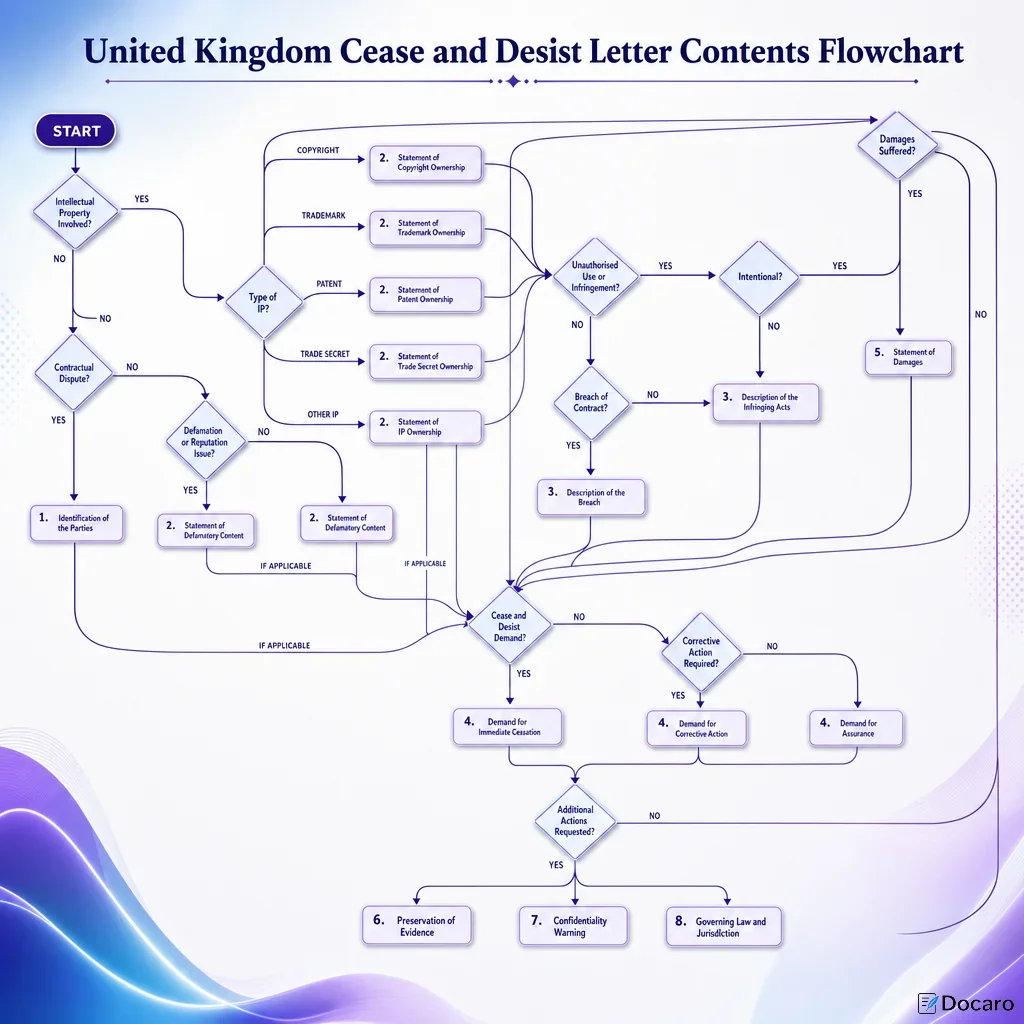
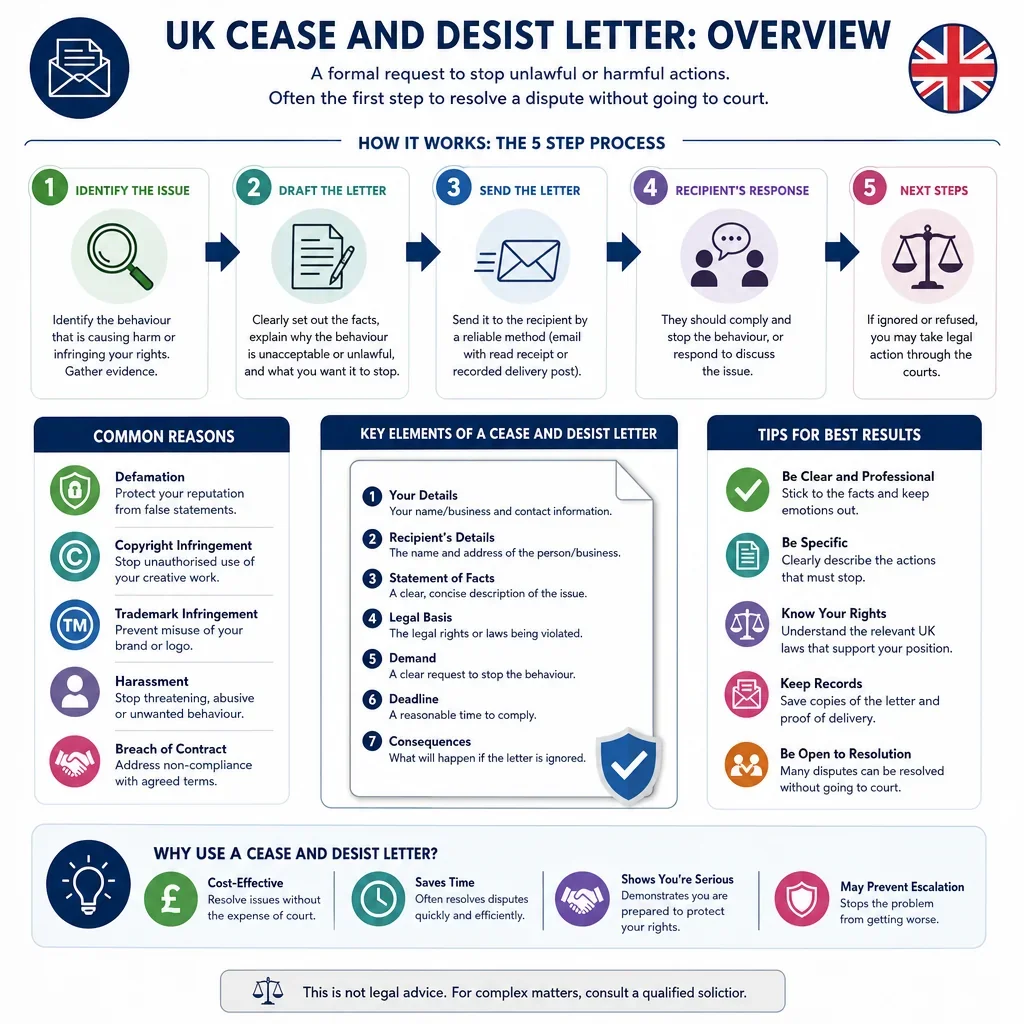
A strong UK cease and desist letter should identify the sender, the recipient, the disputed conduct, the rights relied on, the evidence available, and the action required. Where the complaint concerns intellectual property, defamation, harassment, data protection, passing off, or breach of confidence, the letter should link the demand to the specific legal right and avoid overstating the claim.
When Can A Cease And Desist Letter Create Legal Risk?
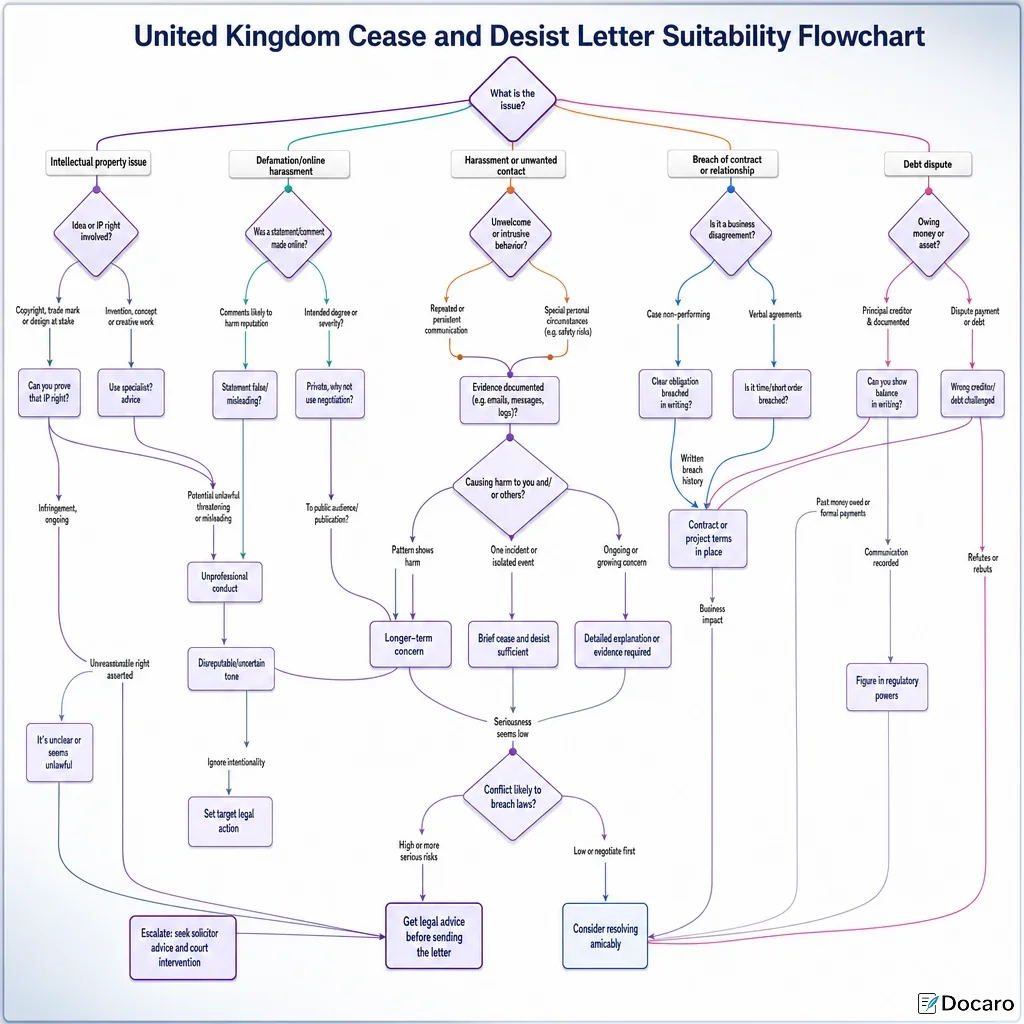
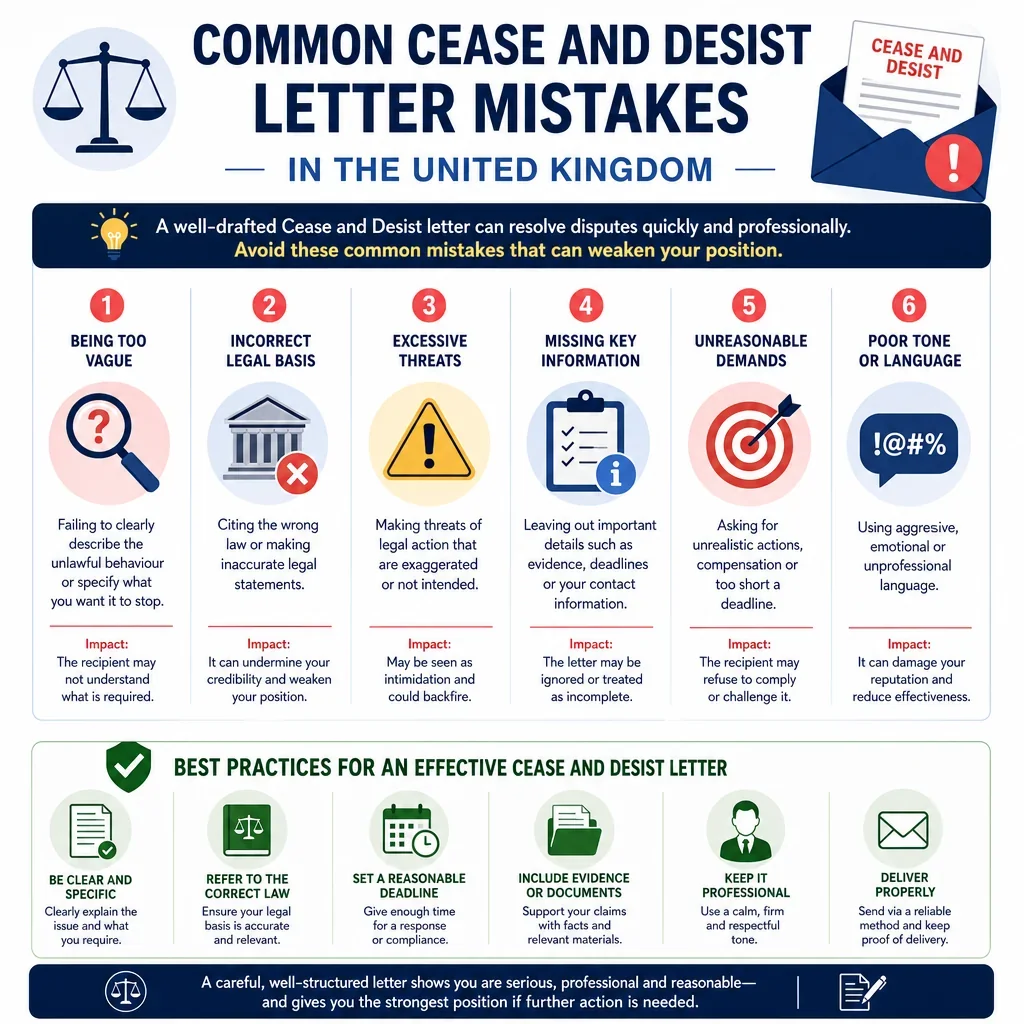
A letter can backfire if it contains threats that are unjustified, inaccurate, or too broad. In intellectual property disputes, UK law contains rules on unjustified threats, so the wording should be carefully limited to protect legitimate rights without making improper threats of proceedings.
What Evidence Should Be Preserved Before Sending A Letter?
Useful evidence commonly includes screenshots, dated URLs, product listings, social media posts, correspondence, witness details, purchase records, domain records, and copies of the disputed material. Evidence should be preserved before the recipient has a chance to delete or alter the material.
What Remedies Are Commonly Requested In The UK?
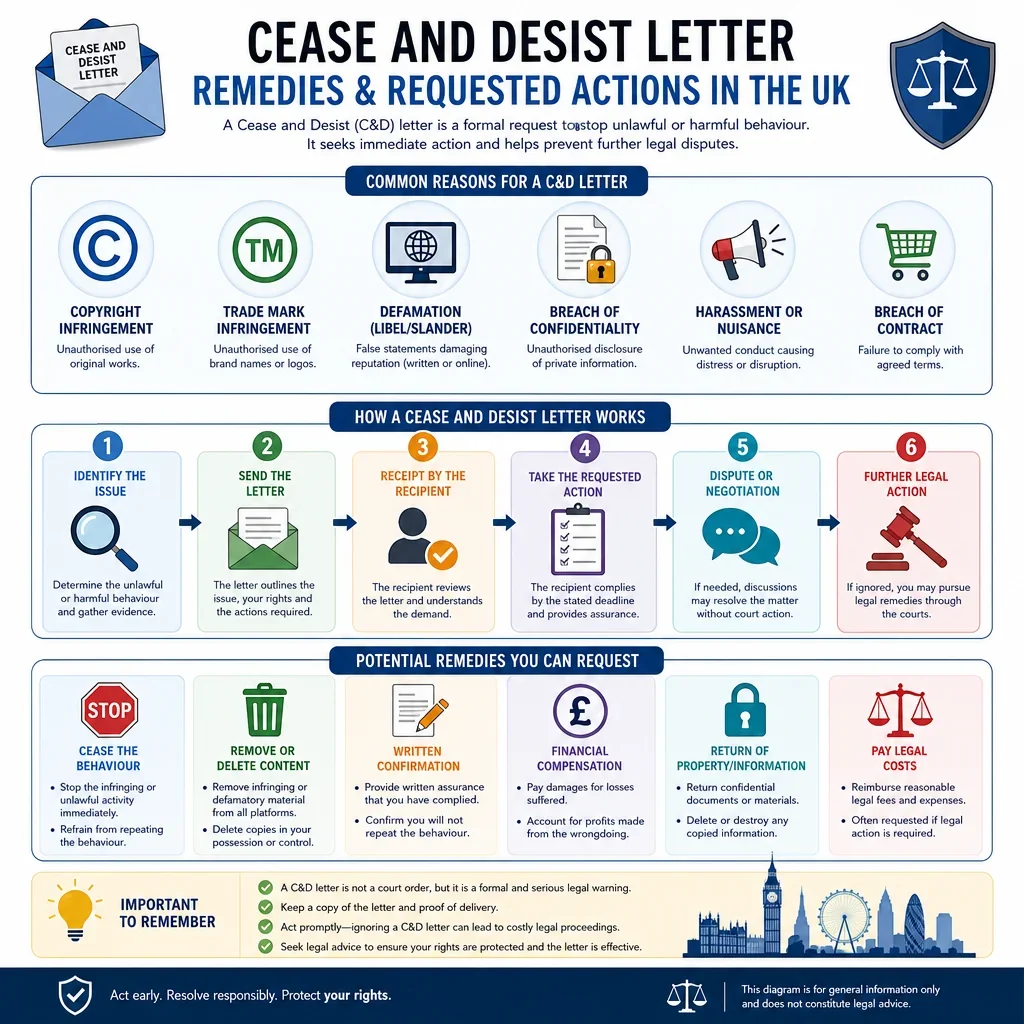
Common demands include stopping the conduct, removing content, giving undertakings, delivering up infringing goods, disclosing information, paying damages or an account of profits, correcting records, and confirming compliance by a deadline. The remedy should match the right being enforced.
Is A Cease And Desist Letter The Same As Court Action?
No. A cease and desist letter is usually a pre-action step, not a court order. It may help resolve a dispute without litigation, but only a court can grant remedies such as an injunction, damages, or an order for costs if the matter is litigated.
FAQs
You Might Also Be Interested In