AI Generated Performance Improvement Plan for use in the United Kingdom
PDF & Word - 2026 Updated
Docaro Pricing
When do you need a Performance Improvement Plan in the United Kingdom?
British Legal Rules for a Performance Improvement Plan
Using an incorrect structure for a performance improvement plan can undermine its enforceability and expose the employer to unfair dismissal claims.
What a Proper Performance Improvement Plan Should Include
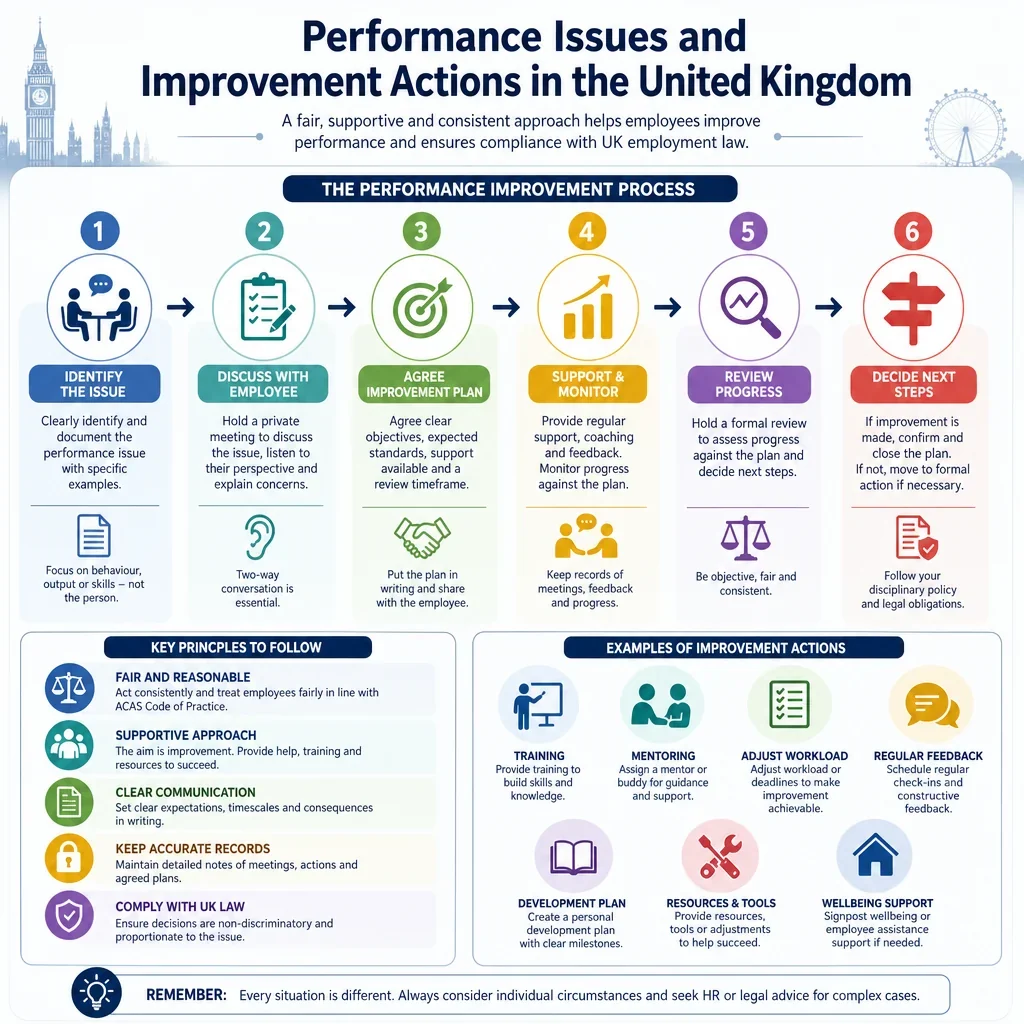
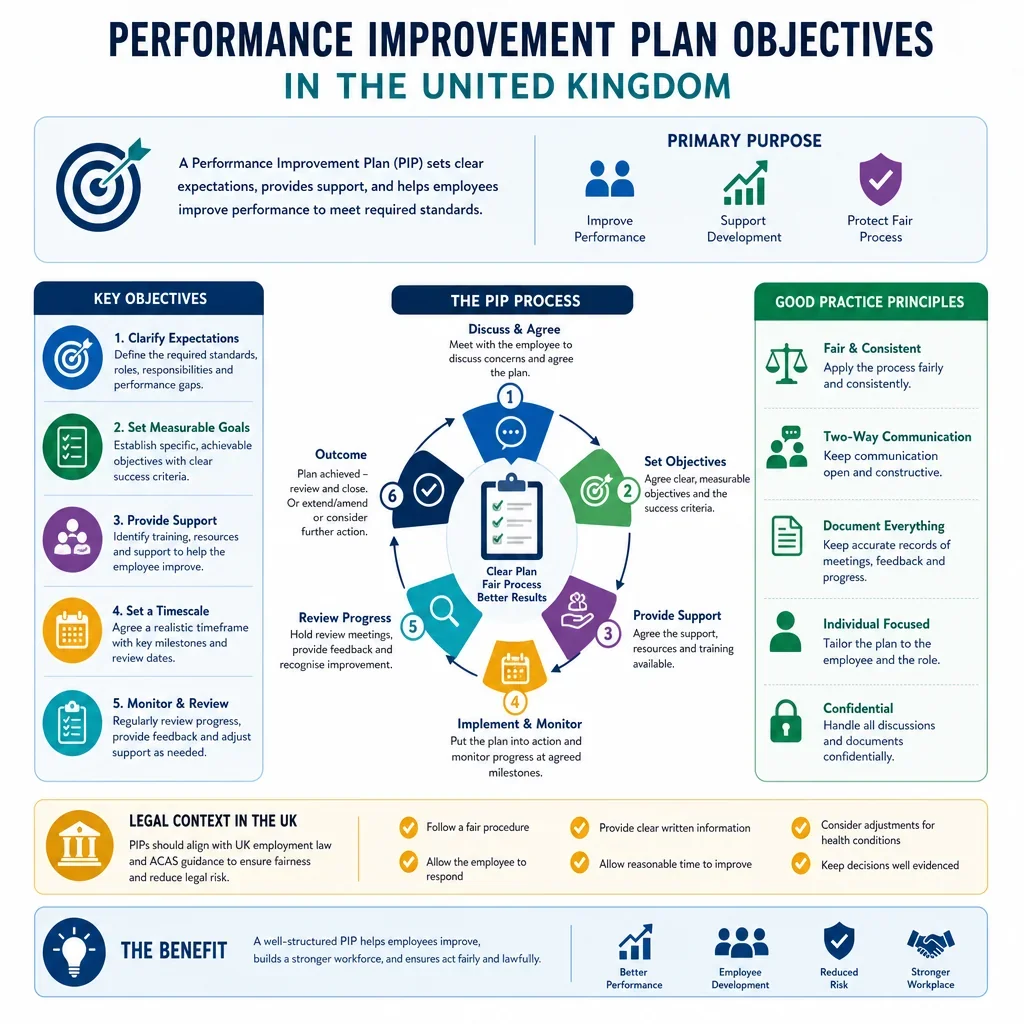
- Clear Performance IssuesIdentify specific areas where performance is falling short, with examples to make it easy to understand.
- Specific Goals and TargetsSet achievable objectives that outline what good performance looks like in the role.
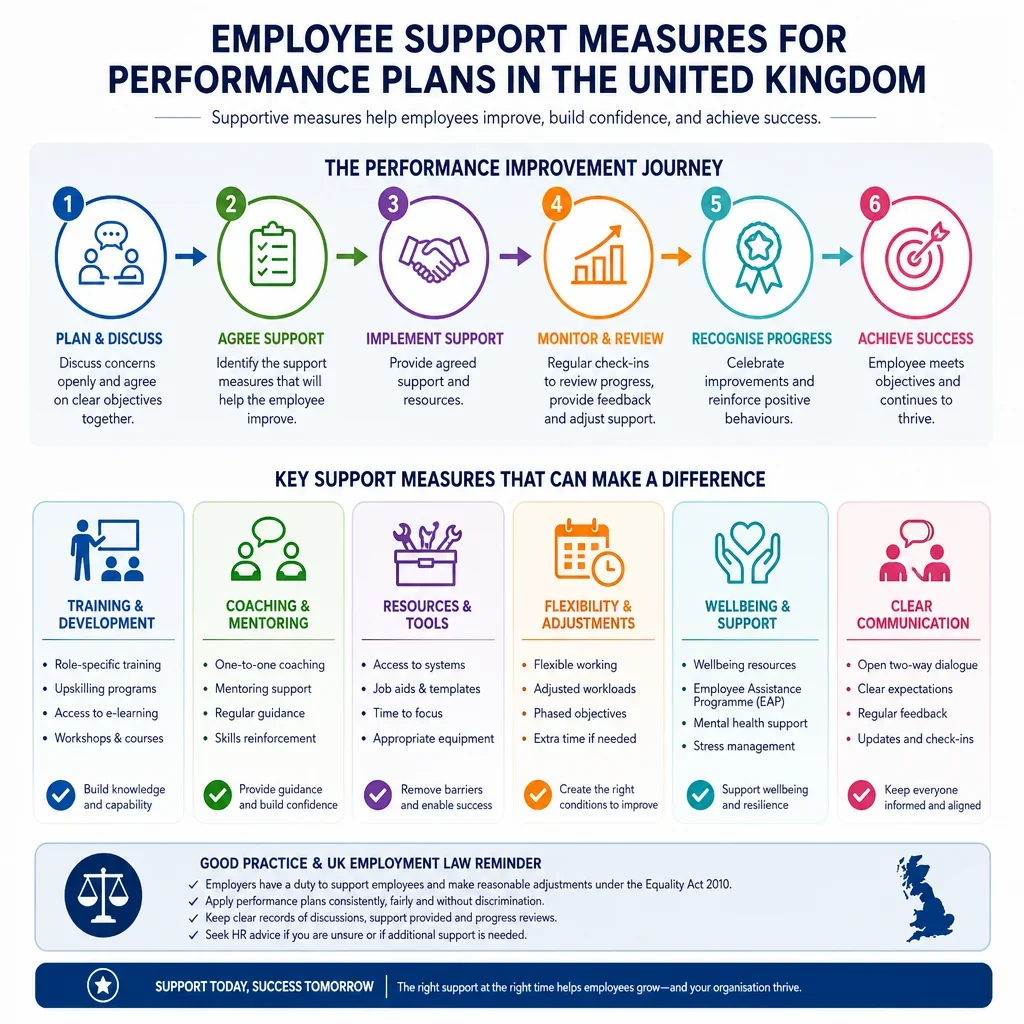
- Support and ResourcesDetail any training, mentoring, or tools provided to help reach the goals.
- Timeline for ImprovementSpecify a reasonable period, like 3-6 months, for showing progress.
- Regular Check-insSchedule meetings to review progress and adjust the plan if needed.
- Consequences of No ImprovementExplain possible outcomes, such as further action or dismissal, if goals are not met.
- Employee Rights and AppealInform the employee of their right to discuss concerns or appeal the plan.
Generate Your Document in 4 Easy Steps
Why Use Docaro?
 United Kingdom
Free Example Performance Improvement Plan Template
Below is a free template example of a Performance Improvement Plan for use in the United Kingdom generated by our AI model.
The clauses in your actual Performance Improvement Plan will vary from this example as they will be entirely bespoke to your requirements as set out in the questionnaire you complete.
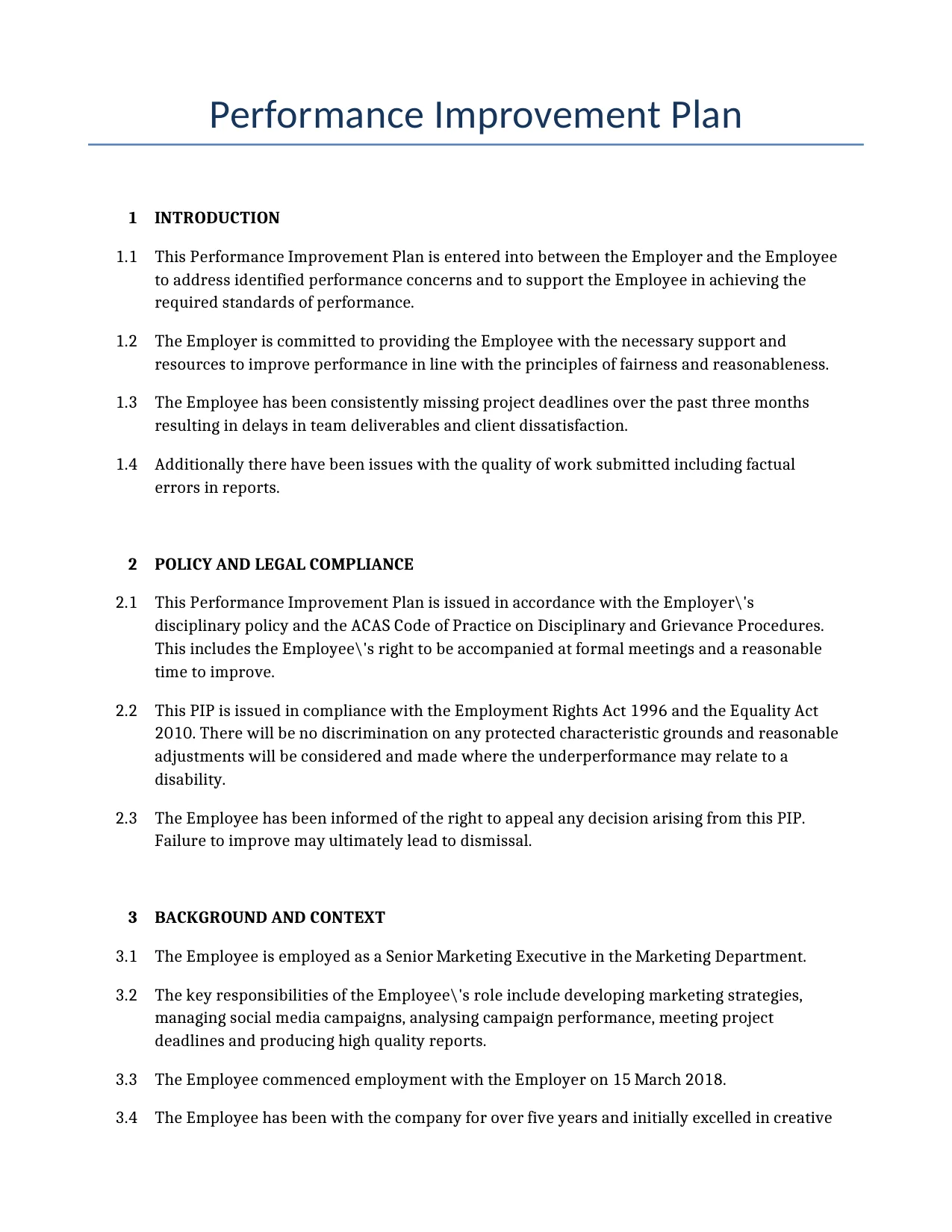
Performance Improvement Plan
1INTRODUCTION
This Performance Improvement Plan is entered into between the Employer and the Employee to address identified performance concerns and to support the Employee in achieving the required standards of performance.
The Employer is committed to providing the Employee with the necessary support and resources to improve performance in line with the principles of fairness and reasonableness.
The Employee has been consistently missing project deadlines over the past three months resulting in delays in team deliverables and client dissatisfaction.
Additionally there have been issues with the quality of work submitted including factual errors in reports.
2POLICY AND LEGAL COMPLIANCE
This Performance Improvement Plan is issued in accordance with the Employer\'s disciplinary policy and the ACAS Code of Practice on Disciplinary and Grievance Procedures. This includes the Employee\'s right to be accompanied at formal meetings and a reasonable time to improve.
This PIP is issued in compliance with the Employment Rights Act 1996 and the Equality Act 2010. There will be no discrimination on any protected characteristic grounds and reasonable adjustments will be considered and made where the underperformance may relate to a disability.
The Employee has been informed of the right to appeal any decision arising from this PIP. Failure to improve may ultimately lead to dismissal.
3BACKGROUND AND CONTEXT
The Employee is employed as a Senior Marketing Executive in the Marketing Department.
The key responsibilities of the Employee\'s role include developing marketing strategies, managing social media campaigns, analysing campaign performance, meeting project deadlines and producing high quality reports.
The Employee commenced employment with the Employer on 15 March 2018.
The Employee has been with the company for over five years and initially excelled in creative campaign development receiving commendations for innovative ideas in 2019 and 2020.
However the Employee\'s performance has declined in the last 18 months with missed deadlines on multiple projects and feedback from team leads regarding inconsistent output quality.
All prior actions taken by the Employer in relation to the Employee\'s performance have complied with the ACAS Code of Practice on Disciplinary and Grievance Procedures.
4DESCRIPTION OF PERFORMANCE CONCERNS
The main performance issues faced by the Employee relate to consistently missing deadlines on marketing projects and poor time management.
The Employee has missed deadlines on four key projects over the past six months resulting in delays to team deliverables and client dissatisfaction.
This underperformance has been observed in project management where follow-up actions are often delayed or incomplete and reports contain factual errors.
This is evidenced by incomplete campaign plans and a lack of proactive time management leading to lost opportunities with two key campaigns.
In Q2 2023 the Employee was assigned to deliver a social media strategy for Client X by 15 May 2023 but failed to submit the required plan by the deadline resulting in a two week delay to the campaign launch.
Project management system records show the plan was not submitted until 29 May 2023. The submitted plan also contained factual errors in audience metrics.
Manager feedback from the weekly team meeting on 15 June 2023 noted the delay and a client email dated 20 June 2023 confirmed dissatisfaction with the late and inaccurate deliverables.
The performance issue first became noticeable on 1 April 2023 and the most recent occurrence was on 15 September 2023. The concerns were first discussed with the Employee in a meeting on 15 January 2023 where prior support in the form of workload review was offered. The Employee was given the opportunity to respond and provide any mitigating factors.
Despite this the issues have continued demonstrating that the concerns are ongoing.
5PERFORMANCE STANDARDS AND EXPECTATIONS
The Employee is required to achieve the following key performance indicators in line with the job description for the Senior Marketing Executive role and the Company\'s Project Management Policy.
Deadline compliance rate of 100 percent i.e. all marketing projects and reports completed on or before the agreed deadline.
Quality error rate of less than 2 percent in all submitted reports and campaign plans measured by internal review.
These standards are specific measurable achievable relevant and time-bound (SMART). Performance will be assessed fairly and objectively using project management system data weekly progress reports and feedback from the line manager and clients.
The Employee must demonstrate the following core competencies: time management project delivery skills attention to detail communication skills and teamwork.
The Employee is expected to demonstrate professionalism punctuality and a proactive attitude in all interactions while adhering to company policies and collaborating effectively with colleagues to foster a positive work environment.
6IMPROVEMENT GOALS AND OBJECTIVES
This Performance Improvement Plan addresses the performance concern that the Employee has been consistently missing deadlines for marketing project deliverables leading to delays in team progress and client dissatisfaction.
The Employee needs to improve in the areas of time management productivity output quality and project delivery.
The specific goals for improvement are: (1) Complete all assigned marketing projects and reports within the set deadlines (2) Ensure all deliverables have a quality error rate below 2 percent.
Achievement of these goals will be measured by tracking the percentage of tasks completed on or before the deadline (target 100 percent) and quality error rate via internal audits (target less than 2 percent).
These goals are specific measurable achievable relevant and time-bound (SMART). They are relevant to addressing the performance concern as they directly focus on timely completion and quality which will improve overall team efficiency and client satisfaction.
The target date for achieving these goals is 11 March 2024. Success looks like 100 percent deadline compliance and quality error rate below 2 percent sustained over the PIP period with no client complaints related to delays or errors.
7ACTION PLAN
The Employee shall: (1) Attend time management and project delivery training (2) Use provided project management templates for all tasks (3) Submit a weekly progress report every Friday outlining achievements challenges and any support needs (4) Attend weekly one-on-one coaching sessions with their manager.
This Action Plan shall commence on 15 January 2024 and shall end on 11 March 2024.
8SUPPORT AND RESOURCES
The Employer shall provide the following support measures to assist the Employee: (1) Enrolment in an online time management and project delivery training course to be completed within the first two weeks (2) Weekly one-on-one coaching sessions with the line manager (3) Mentoring from a senior colleague (4) Access to project management software templates and tools (5) Workload review and reasonable adjustments if any underlying health or disability factors are identified.
The Employer will provide training sessions mentoring programme and regular feedback meetings to help the Employee achieve the improvement goals. The plan is supportive and provides reasonable time and resources for improvement.
9MONITORING AND MEASUREMENT
The Employee\'s progress shall be monitored on a weekly basis using the project management system weekly reports and feedback from clients and team members.
The Manager shall use regular meetings and performance metrics tracking (deadline compliance rate and quality error rate) to monitor progress.
Evidence of progress shall be collected through weekly progress reports submitted by the Employee review of completed tasks in the project management system and client feedback forms.
Regular feedback sessions shall be scheduled as part of the monitoring process. Indicators of successful performance improvement shall include 100 percent deadline compliance quality error rate below 2 percent and no related client complaints.
Further action shall be triggered if no improvement is shown after the first four weeks or if the Employee fails to meet the agreed standards by the end of the Performance Improvement Plan period.
10TIMELINE AND REVIEW SCHEDULE
This Performance Improvement Plan shall become effective on 15 January 2024.
The Performance Improvement Plan shall have a duration of 8 weeks commencing on 15 January 2024 and ending on 11 March 2024.
There will be a formal mid-point review meeting on 12 February 2024 and a final assessment meeting on 11 March 2024.
The Employer shall schedule bi-weekly review meetings with the Employee. The first review meeting shall take place on 29 January 2024.
The final assessment meeting to review the Employee\'s overall performance under this Performance Improvement Plan shall take place on 11 March 2024.
The overall review date for this Performance Improvement Plan is 11 March 2024.
The Employer may extend this Performance Improvement Plan under predefined conditions where reasonable and in accordance with the ACAS Code of Practice on Disciplinary and Grievance Procedures.
11CONSEQUENCES OF NON-IMPROVEMENT
If the Employee\'s performance does not improve by the end of the review period the Employee may face further actions including extension of the Performance Improvement Plan a formal written warning further disciplinary action or ultimately dismissal for capability reasons.
Any dismissal would follow a fair procedure in line with the ACAS Code of Practice on Disciplinary and Grievance Procedures and the Employment Rights Act 1996.
The Employer may extend this Performance Improvement Plan if performance does not improve.
The Employer may issue a formal warning if performance does not improve.
The Employer may progress to full disciplinary procedures if performance does not improve.
12EMPLOYEE RIGHTS AND GRIEVANCE PROCEDURE
The Employee has the right to appeal any consequences arising from non-improvement.
The Employee has access to the company\'s grievance procedures which comply with the ACAS Code of Practice.
Employees should submit a written grievance to their line manager within 14 days of the issue arising. The manager will arrange a meeting within 7 days to discuss followed by a written response within 7 days. If unsatisfied the employee may appeal to HR for a final review.
The Employee has the right to appeal any decisions made under this Performance Improvement Plan.
The Employee shall sign an acknowledgement that they have received and understood this Performance Improvement Plan.
13RIGHT TO BE ACCOMPANIED
The Employee has the right to be accompanied at all formal PIP meetings by a colleague or trade union representative in accordance with Section 10 of the Employment Relations Act 1999.
14CONFIDENTIALITY
This Performance Improvement Plan and all related discussions shall be treated confidentially with information shared on a need-to-know basis only.
Confidentiality is subject to any legal requirements.
15DATA PROTECTION
The processing of personal data related to this Performance Improvement Plan shall comply with the UK GDPR and the Data Protection Act 2018. Only necessary data for the legitimate purpose of managing performance improvement will be processed.
Jane Smith is the Data Protection Officer responsible for overseeing compliance and may be contacted at jane.smith@company.co.uk.
The lawful basis for processing personal data related to the Employee\'s Performance Improvement Plan is Contract and Legitimate Interests.
The categories of personal data that will be handled include performance reviews employee contact details and records related to this PIP.
Appropriate technical and organisational measures are in place to secure personal data including encryption and access controls. The PIP document will be retained for six years post-termination in line with legitimate business needs and legal requirements for defending employment claims.
The Employee has been informed of their rights under the UK GDPR including rights of access rectification erasure restriction and objection.
16GOVERNING LAW
This Performance Improvement Plan shall be governed by and construed in accordance with the laws of England and Wales.
17ENTIRE AGREEMENT
This Performance Improvement Plan constitutes the entire agreement between the parties relating to the subject matter hereof and supersedes all prior agreements understandings or arrangements whether oral or in writing.
18SEVERABILITY
If any provision of this Performance Improvement Plan is held to be invalid or unenforceable such provision shall be severed and the remaining provisions shall continue in full force and effect.
19NOTICES
Any notice required to be given under this Performance Improvement Plan shall be in writing and shall be sent by email or recorded delivery to the address of the party as set out in this document or such other address as may be notified from time to time.
20VARIATION
No variation of this Performance Improvement Plan shall be effective unless it is in writing and signed by or on behalf of each of the parties.
21ACKNOWLEDGMENT AND AGREEMENT
I acknowledge that I have read and understood this Performance Improvement Plan. I have had an opportunity to discuss it with my manager and agree to the goals support and resources offered. I understand the consequences of not achieving the required improvement which may include dismissal.
Employee Name: _______________________________ Signature: _______________________________ Date: ________________________________
Manager Name: _______________________________ Signature: _______________________________ Date: ________________________________
22EXECUTION
Signed for and on behalf of the Employer:
Name: _______________________________
Position: ____________________________
Date: ________________________________
Signed by the Employee:
Name: _______________________________
Date: ________________________________
This example shows approximately 70% of a typical document and is provided for illustrative purposes only. The remaining content has been omitted.
Every document generated by Docaro is tailored to your specific circumstances, jurisdiction and the information you provide. The completed document includes all applicable clauses and provisions required for your situation.
To generate the full, personalised document, answer a short series of questions and your document will be created instantly.
Useful Resources When Considering a Performance Improvement Plan in the United Kingdom
United Kingdom Reference Legislation
Performance Improvement Plan FAQs
Document Generation FAQs
Related Articles