AI Generated British Share Purchase Agreement
PDF & Word - 2026 Updated
Docaro Pricing
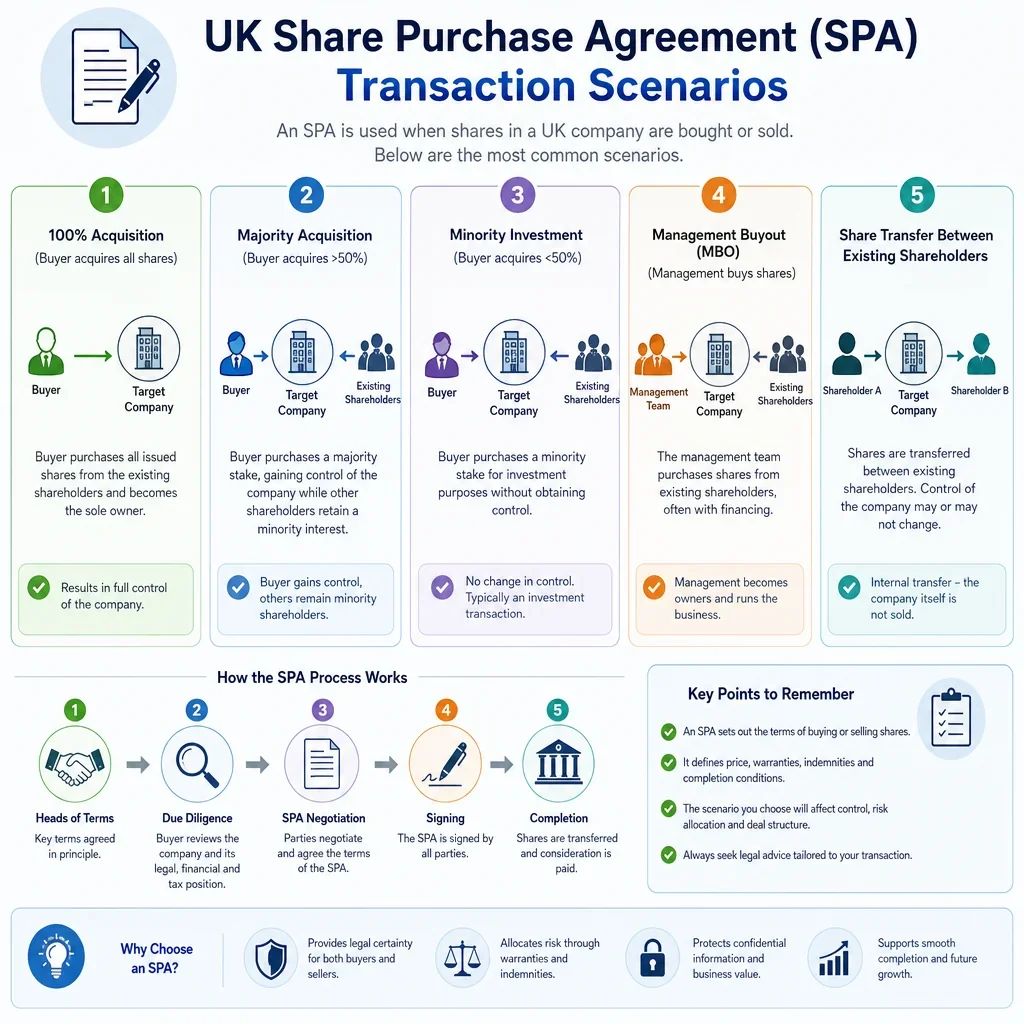
When do you need a Share Purchase Agreement in the United Kingdom?
British Legal Rules for a Share Purchase Agreement
Using the wrong structure for a stock purchase agreement can lead to unintended tax liabilities or invalid transfers of ownership.
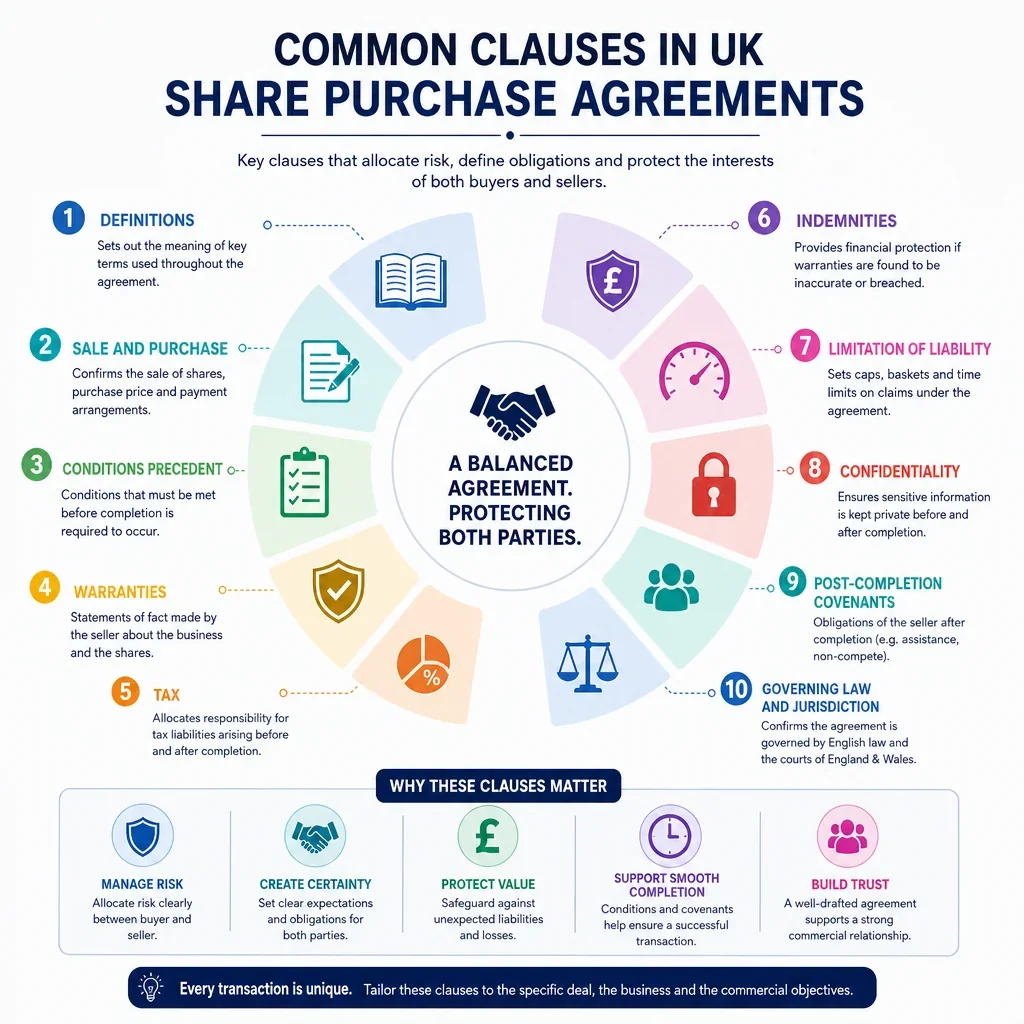
What a Proper Share Purchase Agreement Should Include
- Parties InvolvedClearly identifies the buyer, seller, and the company whose shares are being sold.
- Share DetailsSpecifies the number, type, and value of shares being transferred.
- Purchase PriceOutlines the total amount to be paid and the payment method.
- Payment TermsDetails when and how the payment will be made, including any deposits.
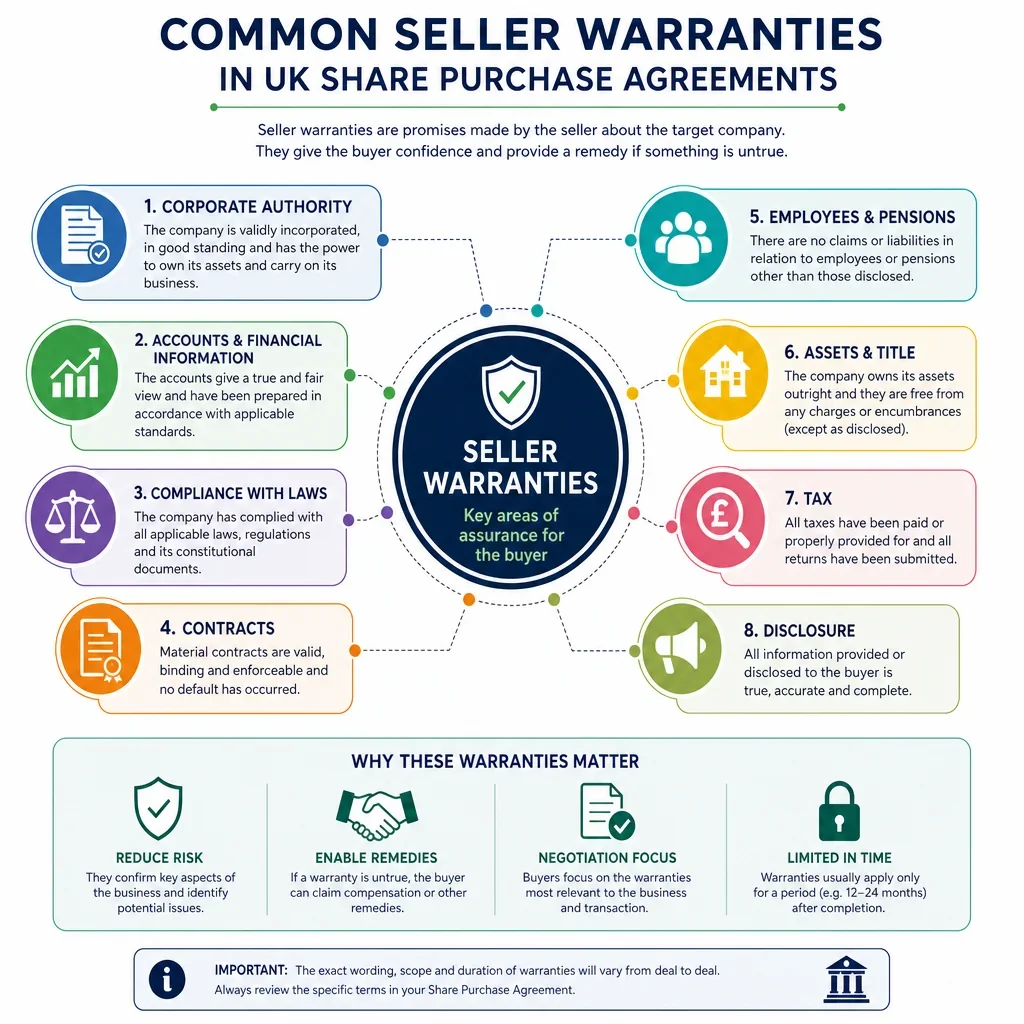
- Warranties and RepresentationsProvides assurances from the seller about the company's condition and no hidden issues.
- Conditions PrecedentLists requirements that must be met before the sale can complete, like approvals.
- IndemnitiesAgrees to compensate for any losses due to breaches or undisclosed problems.
- Completion DetailsSets out the steps and timeline for finalizing the share transfer.
- ConfidentialityRequires keeping the deal and company information private.
- Governing LawStates that UK law applies to the agreement and any disputes.
Generate Your Document in 4 Easy Steps
Why Use Docaro?
 United Kingdom
Free Example Share Purchase Agreement Template
Below is a free template example of a Share Purchase Agreement for use in the United Kingdom generated by our AI model.
The clauses in your actual Share Purchase Agreement will vary from this example as they will be entirely bespoke to your requirements as set out in the questionnaire you complete.
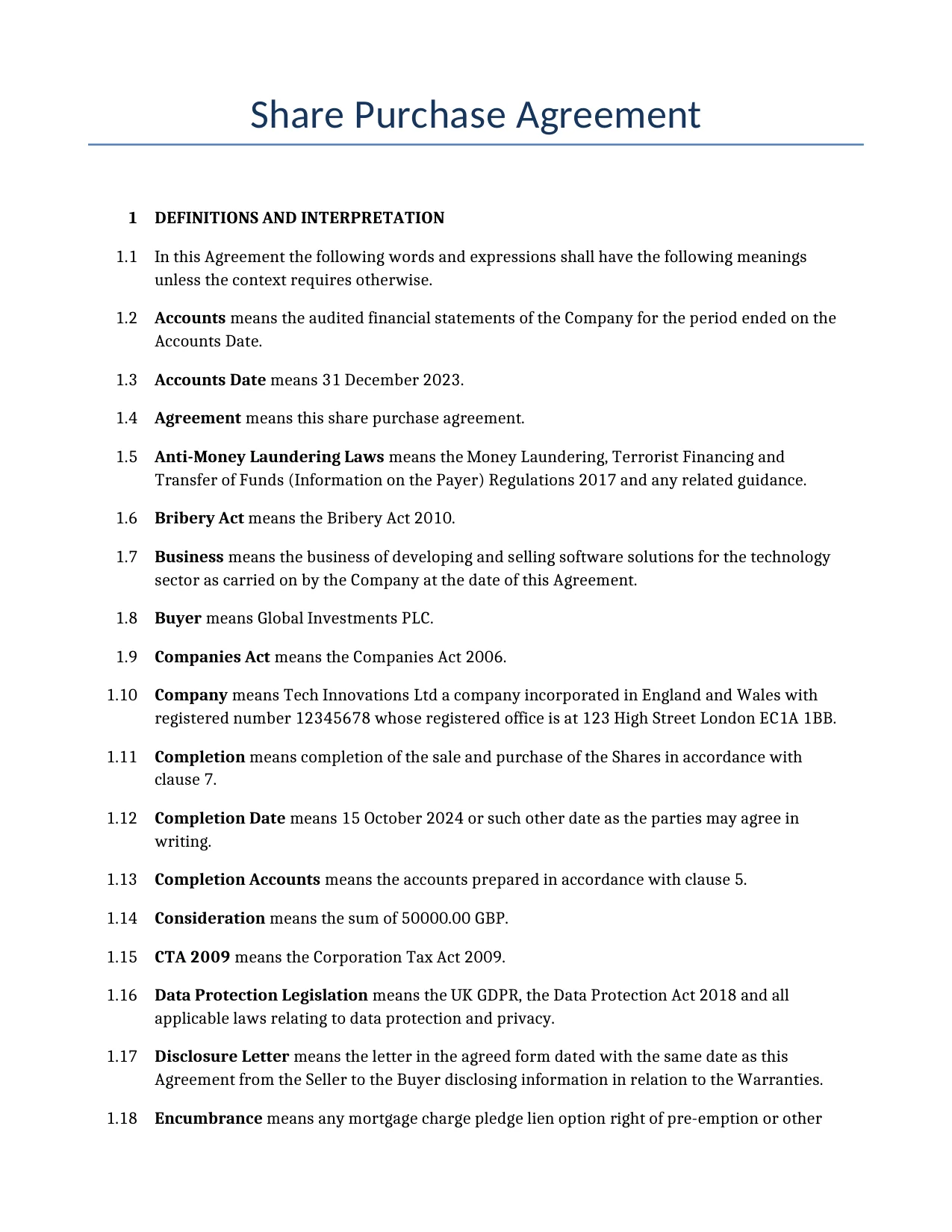
Share Purchase Agreement
1DEFINITIONS AND INTERPRETATION
In this Agreement the following words and expressions shall have the following meanings unless the context requires otherwise.
Accounts means the audited financial statements of the Company for the period ended on the Accounts Date.
Accounts Date means 31 December 2023.
Agreement means this share purchase agreement.
Anti-Money Laundering Laws means the Money Laundering, Terrorist Financing and Transfer of Funds (Information on the Payer) Regulations 2017 and any related guidance.
Bribery Act means the Bribery Act 2010.
Business means the business of developing and selling software solutions for the technology sector as carried on by the Company at the date of this Agreement.
Buyer means Global Investments PLC.
Companies Act means the Companies Act 2006.
Company means Tech Innovations Ltd a company incorporated in England and Wales with registered number 12345678 whose registered office is at 123 High Street London EC1A 1BB.
Completion means completion of the sale and purchase of the Shares in accordance with clause 7.
Completion Date means 15 October 2024 or such other date as the parties may agree in writing.
Completion Accounts means the accounts prepared in accordance with clause 5.
Consideration means the sum of 50000.00 GBP.
CTA 2009 means the Corporation Tax Act 2009.
Data Protection Legislation means the UK GDPR, the Data Protection Act 2018 and all applicable laws relating to data protection and privacy.
Disclosure Letter means the letter in the agreed form dated with the same date as this Agreement from the Seller to the Buyer disclosing information in relation to the Warranties.
Encumbrance means any mortgage charge pledge lien option right of pre-emption or other security interest howsoever created or arising or any interest or claim of a third party.
Environmental Law means the Environmental Protection Act 1990 and all other applicable environmental laws and regulations.
HMRC means His Majesty\’s Revenue and Customs.
Long Stop Date means 31 December 2024.
Purchase Price means the sum of 50000.00 GBP subject to adjustment in accordance with clause 5.
Seller means Original Founders Ltd.
Shares means all of the issued and outstanding ordinary shares in the capital of the Company comprising 1000 shares of \£1 each.
Tax or Taxation means any form of tax levy impost duty or withholding of any nature whatsoever whether direct or indirect and whether levied by reference to income profits gains distributions receipts or other reference and including corporation tax income tax capital gains tax value added tax stamp duty land tax national insurance contributions and any penalty fine surcharge interest or addition to any of them.
Tax Authority includes HMRC.
UK GDPR means the General Data Protection Regulation as it forms part of the law of England and Wales by virtue of the European Union (Withdrawal) Act 2018.
VATA 1994 means the Value Added Tax Act 1994.
The headings in this Agreement are for ease of reference only and shall be ignored in construing or interpreting this Agreement.
Words importing one gender shall include all other genders.
Words importing the singular shall include the plural and vice versa.
References to a person shall include any individual firm body corporate or unincorporated association and any government state or agency of a state.
This Agreement shall be governed by and construed in accordance with the laws of England and Wales.
2RECITALS
The Seller is the registered holder of the Shares which comprise the whole of the issued share capital of the Company.
The Seller has agreed to sell and the Buyer has agreed to purchase the Shares on the terms and subject to the conditions of this Agreement.
The primary purpose of this share purchase agreement is to facilitate the sale and transfer of 100 percent of the issued share capital in the Company from the Seller to the Buyer enabling the Buyer to acquire full ownership and control of the Company.
3AGREEMENT TO SELL AND PURCHASE
The Seller agrees to sell with full title guarantee and free from all Encumbrances the Shares to the Buyer and the Buyer agrees to purchase the Shares from the Seller on the terms of this Agreement.
The Seller shall sell 1000 Ordinary Shares to the Buyer.
4PURCHASE PRICE AND PAYMENT TERMS
The Purchase Price for the Shares shall be \£50,000 subject to adjustment in accordance with clause 4.4 based on the Completion Accounts.
The entire consideration for the Shares shall be paid in cash by bank transfer on the Completion Date.
The Buyer shall pay the Purchase Price by bank transfer to the following account: Account Name: Original Founders Ltd, Bank: HSBC UK, Sort Code: 40-12-34, Account Number: 12345678, IBAN: GB29 RBOS 6016 1331 9268 19.
The Purchase Price shall be adjusted post-Completion based on the net assets of the Company as shown in the Completion Accounts. If the net assets are less than \£20,000 the Purchase Price shall be reduced by the difference. If the net assets exceed \£30,000 the Purchase Price shall be increased by the difference. The adjustment shall be paid within 5 Business Days of the Completion Accounts becoming final and binding.
If any sum due under this Agreement is not paid on the due date the party in default shall pay interest on such sum at the rate of 8 percent per annum over the base rate of the Bank of England from time to time from the due date until the date of actual payment both before and after judgment.
5COMPLETION ACCOUNTS
The Seller shall procure that draft Completion Accounts are prepared by the Company\’s accountants and delivered to the Buyer within 30 days after Completion. The Completion Accounts shall be prepared in accordance with the accounting policies principles and practices adopted in the preparation of the Accounts consistently applied and shall comprise a statement of the net assets of the Company as at the Completion Date.
The Buyer shall within 20 Business Days of receipt of the draft Completion Accounts notify the Seller of any objections. If no objections are raised the draft shall constitute the Completion Accounts. If objections are raised the parties shall attempt to resolve them in good faith within 10 Business Days. If they cannot agree any disputed matters shall be referred to an independent firm of chartered accountants (the Expert) for determination. The Expert shall act as expert and not as arbitrator and its decision shall be final and binding on the parties. The costs of the Expert shall be borne by the parties in such proportions as the Expert determines.
6CONDITIONS PRECEDENT
Completion shall be conditional upon the satisfaction or waiver of the following conditions precedent: (a) the Buyer having completed satisfactory financial commercial and legal due diligence on the Company; (b) all Warranties being true and accurate in all material respects as at the date of this Agreement and at Completion as if repeated at Completion; (c) no material breach of the Pre-Completion Undertakings; (d) execution of all related documents including the Disclosure Letter; (e) receipt of any required regulatory approvals including from the Competition and Markets Authority (CMA) or any relevant sector regulator if applicable; and (f) no Material Adverse Change in the Business since the date of this Agreement.
Each party shall use reasonable endeavours to procure the satisfaction of the Conditions as soon as possible and in any event by the Long Stop Date.
The Buyer may at its absolute discretion waive any of the conditions precedent by notice in writing to the Seller.
If the conditions precedent have not been satisfied or waived by the Long Stop Date either party may terminate this Agreement by notice in writing to the other party. Upon termination no party shall have any claim against any other party under this Agreement save for any antecedent breach.
7COMPLETION
Completion shall take place on the Completion Date at the offices of the Seller\’s lawyers in London.
At Completion the Seller shall deliver to the Buyer: (a) executed share transfer forms in respect of the Shares in favour of the Buyer or its nominee; (b) the share certificates for the Shares or an indemnity for any lost certificates; (c) the Disclosure Letter executed by the Seller; (d) certified copies of the board resolutions of the Seller and the Company approving the transaction; and (e) evidence of discharge of any Encumbrances over the Shares.
Simultaneously with the delivery of the Shares the Buyer shall pay the Purchase Price to the Seller in accordance with clause 4.
The transfer of the Shares shall comply with the requirements of the Companies Act 2006 including entry of the Buyer\’s name in the Company\’s register of members.
8WARRANTIES AND REPRESENTATIONS
The Seller warrants and represents to the Buyer on the date of this Agreement and on the Completion Date (in each case by reference to the facts and circumstances then subsisting) in the terms set out in this clause 8 and in the Schedules.
The Company was incorporated on 15 May 2020 with registered number 12345678 and is a private limited company.
The registered office of the Company is at 123 High Street London EC1A 1BB.
The Company is validly existing and duly incorporated under the laws of England and Wales and has full power and authority to carry on its business.
The Seller is the legal and beneficial owner of the Shares and the Shares are fully paid and free from all Encumbrances.
The Company has 1000 shares in issue all of which are ordinary shares of \£1 each.
There are no options warrants or other rights to acquire shares in the Company.
The Company is solvent and in good standing with no outstanding compliance issues under the Companies Act 2006.
The Company has taken all necessary corporate action to authorise the sale of the Shares.
The Business has been operated in the ordinary course since incorporation.
There has been no material adverse change in the Business since the Accounts Date.
The principal activities of the Business are software development and IT consulting.
The accounts of the Company for the period ended on the Accounts Date give a true and fair view of the financial position of the Company and there are no undisclosed liabilities.
The Company holds all necessary licences permits and approvals for the conduct of the Business.
The Company and its officers employees and agents have at all times complied with all applicable laws and regulations including but not limited to the Bribery Act 2010 the UK GDPR the Data Protection Act 2018 the Money Laundering Regulations 2017 and the Economic Crime (Transparency and Enforcement) Act 2022. The Company maintains a register of persons with significant control which is accurate and has been filed with Companies House as required.
The Company has not been and is not currently the subject of any sanctions administered by any Sanctions Authority and has not engaged in any transactions with any sanctioned persons or entities.
The Company owns or has valid licences to use all assets necessary for the conduct of the Business. The assets are in good condition and are free from any material defects.
The Company is a party to certain material contracts. Each such contract is valid binding and in full force and effect. There has been no breach of any material contract by the Company or to the Seller\’s knowledge by any other party to it.
The Company has no pension schemes other than those required for auto-enrolment under the Pensions Act 2008. There are no defined benefit pension schemes and no liabilities in respect of such schemes. The Company has complied with all obligations under the Pensions Act 2008 and related legislation. There are no TUPE implications in relation to the sale of the Shares.
The Company has adequate insurance cover against all risks that a prudent company carrying on the Business would normally insure. All insurance policies are in full force and effect. There are no outstanding claims and the claims history for the last 5 years has been disclosed.
The Company\’s IT systems are adequate for the Business and have appropriate cybersecurity measures in place. There have been no material cybersecurity breaches in the last 3 years.
The Warranties are given subject to the matters disclosed in the Disclosure Letter. The Disclosure Letter shall not qualify the Warranties unless it is specifically referenced.
Detailed warranties are set out in the Schedules to this Agreement as follows: Schedule 1 (Tax Matters); Schedule 2 (Intellectual Property); Schedule 3 (Properties); Schedule 4 (Employees); Schedule 5 (Material Contracts); Schedule 6 (Intellectual Property Register); Schedule 7 (Properties Details); Schedule 8 (Accounts).
9LIMITATIONS ON LIABILITY FOR WARRANTIES
The Seller shall not be liable in respect of any claim under the Warranties: (a) unless the amount of an individual claim exceeds \£5,000 (the de minimis threshold); and (b) unless the aggregate amount of all such claims exceeds \£25,000 (the basket threshold) in which event the Seller shall be liable for the whole amount and not just the excess. These thresholds are market standard for a transaction of this size.
The total liability of the Seller for all claims under the Warranties and indemnities shall not exceed the amount of the Purchase Price.
The Buyer shall notify the Seller of any claim under the Warranties as soon as reasonably practicable and in any event within 20 Business Days of becoming aware of the matter giving rise to the claim. The notification shall include full details of the claim the basis for it the amount claimed (so far as ascertainable) and all supporting evidence then available. Failure to comply with this clause shall preclude the Buyer from bringing the claim.
The Buyer shall take all reasonable steps to mitigate any loss in respect of which a claim may be made under the Warranties.
The Buyer shall not be entitled to recover damages or obtain payment more than once in respect of the same loss or damage (no double recovery).
The Seller shall have no liability for any claim to the extent that the matter is within the Buyer\’s actual knowledge at the date of this Agreement or is fairly disclosed in the Disclosure Letter or in the documents provided in the data room.
Any claim under the general Warranties must be brought within 18 months after Completion. Any claim under the Tax Warranties or under the Tax Covenant must be brought by the fourth anniversary of the Completion Date. These time limits are aligned with the statutory limitation periods under the Limitation Act 1980 as modified by the terms of this Agreement.
10RETENTIONS AND SECURITY FOR WARRANTIES
The sum of \£7,500 (the Retention) shall be retained by the Buyer from the Purchase Price and held in an escrow account with the Buyer\’s solicitors for a period of 18 months after Completion (the Escrow Period) to secure any claims under the Warranties and indemnities.
The Retention shall be held in accordance with an escrow agreement to be entered into on Completion. Any claims notified in accordance with clause 9 before the expiry of the Escrow Period shall continue to be secured by the Retention until resolved.
At the end of the Escrow Period the balance of the Retention (less any amounts claimed or agreed as payable to the Buyer) shall be released to the Seller. The arrangements comply with all applicable UK financial regulations including those relating to client money.
In addition to the Retention the Seller shall procure the delivery at Completion of a parent company guarantee from its ultimate holding company (if any) or a bank guarantee in a form acceptable to the Buyer to further secure the Seller\’s obligations under the Warranties and indemnities.
11TAX MATTERS
The Seller warrants to the Buyer that: (a) the Company has duly and punctually paid all Tax for which it is liable and has made all deductions and withholdings required by law; (b) all Tax returns filings and payments required under the CTA 2009 VATA 1994 and all other applicable legislation have been submitted and paid on a timely basis and are accurate and complete; (c) there are no outstanding disputes or investigations with HMRC in relation to the Company; (d) the Company has not entered into any notifiable arrangements for the purposes of the Disclosure of Tax Avoidance Schemes rules; and (e) there are no circumstances which could give rise to a de-grouping charge under TCGA 1992 or CTA 2009 as a result of the sale of the Shares.
The Seller covenants with the Buyer that it will indemnify and hold harmless the Buyer and the Company against all Tax liabilities of the Company arising in respect of any period ending on or before Completion (or for the period up to Completion in the case of a straddle period) including but not limited to corporation tax under the CTA 2009 value added tax under the VATA 1994 PAYE national insurance contributions stamp duties and all related interest penalties and costs. This covenant shall survive until the expiry of 7 years from Completion or longer if required by law.
The Seller shall at its own cost prepare and submit all Tax returns of the Company for all periods ending on or before Completion and shall provide the Buyer with a reasonable opportunity to comment on them before submission. The Seller shall keep the Buyer informed of all communications with HMRC in relation to such periods.
The parties shall cooperate to obtain any applicable tax clearances from HMRC in relation to the transaction including in respect of any potential degrouping charges if the Company was previously a member of a group.
The liability of the Seller under this clause 11 shall not be subject to the limitations in clause 9 save that the overall cap on liability shall be the Purchase Price. The Buyer shall notify the Seller of any Tax claim as soon as reasonably practicable and shall allow the Seller to have conduct of any dispute with HMRC at the Seller\’s cost.
12INDEMNITIES
The Seller shall indemnify the Buyer and the Company against all losses suffered or incurred by them as a result of any breach of this Agreement any breach of the Warranties or any pre-Completion liabilities including but not limited to any Tax liabilities covered by the Tax Covenant in clause 11.
The indemnities in this Agreement shall survive Completion and shall not be affected by any investigation made by the Buyer.
13CONFIDENTIALITY
The Seller shall keep confidential all information relating to the Buyer the Company and the transactions contemplated by this Agreement and shall not disclose it without the prior written consent of the Buyer.
The Buyer shall keep confidential all information relating to the Seller and shall not disclose it without the prior written consent of the Seller.
The confidentiality obligations shall not apply to disclosures required by law disclosures to professional advisers subject to confidentiality undertakings or disclosures made with the prior written consent of the other party.
The Buyer shall additionally be permitted to make disclosures for the purposes of its business operations provided that it informs the Seller in advance where practicable.
The confidentiality obligations shall survive the termination of this Agreement for a period of 5 years.
14NON-COMPETE AND RESTRICTIVE COVENANTS
In order to assure the value of the goodwill in the Business and to be enforceable under English law in accordance with cases such as Tillman v Egon Zehnder Ltd [2019] UKSC 32 the covenants in this clause 14 are considered reasonable in scope duration and geography.
For a period of 12 months after Completion the Seller shall not (whether directly or indirectly by itself its employees agents or otherwise howsoever) carry on or be engaged or concerned in any business which competes with the Business within the United Kingdom provided that this shall not prevent the Seller from holding less than 5 percent of the shares in a listed company.
For a period of 12 months after Completion the Seller shall not solicit canvass or approach any person who was a customer or client of the Company in the 12 months prior to Completion for the purpose of offering competing products or services.
For a period of 12 months after Completion the Seller shall not solicit or induce any person who was an employee officer or consultant of the Company at Completion to cease working for or providing services to the Company (non-poaching).
For a period of 12 months after Completion the Seller shall not deal with any person who was a customer or client of the Company in the 12 months prior to Completion (non-dealing).
The Seller agrees that the covenants in this clause 14 are reasonable and shall not contest their validity. If any covenant is found to be unenforceable it shall be deemed reduced to the minimum extent necessary to make it enforceable. The obligations under this clause shall survive Completion.
15INTELLECTUAL PROPERTY
The Company is the sole legal and beneficial owner of or has valid licences to use all Intellectual Property necessary for the conduct of the Business (the IP).
All registered IP is valid subsisting and in full force and effect has been properly registered maintained and renewed and all renewal fees have been paid.
No third party has challenged the validity or ownership of the IP and there are no circumstances which could give rise to any such challenge. The use of the IP by the Company does not and has not infringed the rights of any third party and no claims have been received or threatened in this regard.
The Company has not infringed and does not infringe any third party intellectual property rights. There are no pending or threatened claims against the Company in respect of any alleged infringement.
All IP created by employees or contractors has been validly assigned to the Company in accordance with section 11 of the Copyright Designs and Patents Act 1988 and all moral rights have been waived.
The Company has complied with all obligations in relation to open source software and has appropriate policies to ensure ongoing compliance.
Full details of the IP are set out in Schedule 6.
16PENSIONS
The Company has no pension schemes other than those required to comply with its auto-enrolment obligations under the Pensions Act 2008.
The Company has fully complied with all auto-enrolment obligations under the Pensions Act 2008 and all related regulations. All eligible employees have been enrolled and the Company has made all required contributions.
The Company has no liability in respect of any defined benefit pension scheme and has never been connected with or an associate of any employer in relation to such a scheme for the purposes of sections 38 to 57 of the Pensions Act 2004.
The sale of the Shares will not trigger any liability under the Pensions Act 2004 or otherwise in respect of pensions. There are no TUPE-related pension implications as there are no transferring employees with protected pension benefits.
Full details of the Company\’s pension arrangements are set out in Schedule 4.
17PROPERTIES
The Company has good and marketable title to all freehold properties and valid leasehold interests in all leasehold properties used in the Business as detailed in Schedule 7 (the Properties).
There are no disputes claims or proceedings in respect of the Properties and the Company has not received any notices alleging breach of any lease covenants.
The Company has obtained all necessary planning permissions consents and approvals for the current use of the Properties and complies with all applicable planning laws.
The Company has at all times complied with all applicable Environmental Law including the Environmental Protection Act 1990. There is no contamination of the Properties and the Company has no liability for any remediation works or environmental claims.
Full details of the Properties are set out in Schedule 7.
18PRE-COMPLETION UNDERTAKINGS
Between the date of this Agreement and Completion the Seller shall procure that the Company operates the Business in the ordinary course and shall not without the prior written consent of the Buyer permit the Company to enter into any transaction outside the ordinary course hire or dismiss any senior employees change the terms of employment of any employees incur new debt or guarantees or make any capital expenditure in excess of \£5,000.
The Seller shall not permit the Company to declare or pay any dividends between the date of this Agreement and Completion.
From the date of this Agreement the Seller shall provide the Buyer and its advisers with reasonable access to the premises books and records of the Company to enable the Buyer to prepare for Completion.
19POST-COMPLETION OBLIGATIONS
Following Completion each party shall provide all reasonable assistance to the other in relation to the transfer of the Shares and the making of all necessary regulatory or statutory filings including under the Companies Act 2006 and in respect of the register of persons with significant control under the Economic Crime (Transparency and Enforcement) Act 2022.
20ANNOUNCEMENTS
No public announcement shall be made by either the Buyer or the Seller concerning the transactions contemplated by this Agreement without the prior written approval of the other party such approval not to be unreasonably withheld.
All public announcements must be approved in writing by both the Buyer and the Seller at least 48 hours prior to release.
Where a public announcement is required by law the party required to make the announcement shall notify and consult with the other party in advance to the extent permitted by law.
21ASSIGNMENT AND NOVATION
Neither the Seller nor the Buyer may assign any of its rights under this Agreement without the prior written consent of the other party such consent not to be unreasonably withheld.
Neither the Seller nor the Buyer may novate any of its obligations under this Agreement without the prior written consent of the other party such consent not to be unreasonably withheld.
22FURTHER ASSURANCE
Each of the Seller and the Buyer shall at its own cost take all such steps and execute all such documents as may be reasonably necessary to give full effect to the terms of this Agreement.
The obligations under this clause 22 shall survive Completion indefinitely.
23COSTS AND EXPENSES
Each party shall bear its own costs and expenses incurred in connection with the negotiation preparation and execution of this Agreement.
Each party shall be responsible for any value added tax chargeable on its own costs and expenses.
24NOTICES
Any notice given under this Agreement shall be in writing and shall be delivered personally sent by pre-paid first class post or by email to the address or email address of the relevant party set out in this clause.
Notices shall be sent to the Buyer at 123 Business Street London EC1A 1BB United Kingdom email legal@buyer.co.uk and to the Seller at its registered office email legal@seller.co.uk or such other address or email address as may be notified from time to time.
Notices shall be deemed served upon personal delivery upon posting or upon email transmission provided that a confirmatory copy is sent by post. Any response to a notice shall be provided within 10 business days.
25ENTIRE AGREEMENT
This Agreement together with the Disclosure Letter and the Schedules constitutes the entire agreement between the parties and supersedes all prior agreements understandings or representations relating to the subject matter of this Agreement.
Each party acknowledges that it has not entered into this Agreement in reliance upon any warranty or representation not expressly set out in this Agreement. The only remedies available in respect of any misrepresentation or untrue statement shall be for breach of contract. This clause does not exclude liability for fraudulent misrepresentation.
26VARIATION
No variation of this Agreement shall be effective unless it is in writing and signed by or on behalf of each of the parties.
27NO PARTNERSHIP OR AGENCY
Nothing in this Agreement is intended to or shall operate to create a partnership or joint venture of any kind between the parties or to authorise either party to act as agent for the other. Neither party shall have authority to act in the name or on behalf of or otherwise to bind the other in any way.
28FORCE MAJEURE
Neither party shall be liable to the other for any delay or non-performance of its obligations under this Agreement to the extent that such delay or non-performance is due to a Force Majeure Event. If a Force Majeure Event continues for more than 30 days the unaffected party may terminate this Agreement by notice.
29LANGUAGE
This Agreement is drawn up in the English language. If this Agreement is translated into any other language the English language version shall prevail.
30SEVERANCE
If any provision of this Agreement is held to be invalid or unenforceable the remaining provisions shall continue in full force and effect.
31WAIVER
No waiver of any right under this Agreement shall be effective unless it is in writing and signed by or on behalf of the party waiving the right. A waiver shall not be deemed to be a waiver of any subsequent breach.
32COUNTERPARTS
This Agreement may be executed in any number of counterparts each of which when executed shall constitute a duplicate original but all the counterparts shall together constitute one agreement.
33THIRD PARTY RIGHTS
The parties agree to exclude the application of the Contracts (Rights of Third Parties) Act 1999 to this Agreement.
34GOVERNING LAW AND JURISDICTION
This Agreement and any dispute or claim arising out of or in connection with it or its subject matter or formation shall be governed by and construed in accordance with the laws of England and Wales.
The parties irrevocably agree that the courts of England and Wales shall have exclusive jurisdiction to settle any dispute or claim that arises out of or in connection with this Agreement or its subject matter or formation.
The address for service of process on the Seller is 123 High Street London England SW1A 1AA.
35SCHEDULES
The following documents are Schedules to this Agreement and form part of it: Schedule 1 (Tax Warranties and Covenant); Schedule 2 (Intellectual Property Warranties); Schedule 3 (Properties Warranties); Schedule 4 (Employee List and Terms); Schedule 5 (Material Contracts List); Schedule 6 (Intellectual Property Register); Schedule 7 (Properties Details); Schedule 8 (Accounts); Schedule 9 (Form of Disclosure Letter).
36SIGNATURES
Executed and delivered as a deed by the parties on the date of this Agreement.
SIGNED as a deed by Original Founders Ltd acting by a director in the presence of a witness: Director ___________________________ Witness signature ___________________________ Witness name ___________________________ Witness address ___________________________
SIGNED as a deed by Global Investments PLC acting by a director in the presence of a witness: Director ___________________________ Witness signature ___________________________ Witness name ___________________________ Witness address ___________________________
This example shows approximately 70% of a typical document and is provided for illustrative purposes only. The remaining content has been omitted.
Every document generated by Docaro is tailored to your specific circumstances, jurisdiction and the information you provide. The completed document includes all applicable clauses and provisions required for your situation.
To generate the full, personalised document, answer a short series of questions and your document will be created instantly.
Useful Resources When Considering a Share Purchase Agreement in the United Kingdom
United Kingdom Reference Legislation
Share Purchase Agreement FAQs
Document Generation FAQs
Related Articles