AI Generated British Inventory Report
PDF & Word - 2026 Updated
Docaro Pricing
When do you need an Inventory Report in the United Kingdom?
British Legal Rules for an Inventory Report
Using the wrong format for a move-in/move-out condition report may lead to disputes over property condition or liability in UK tenancy law.
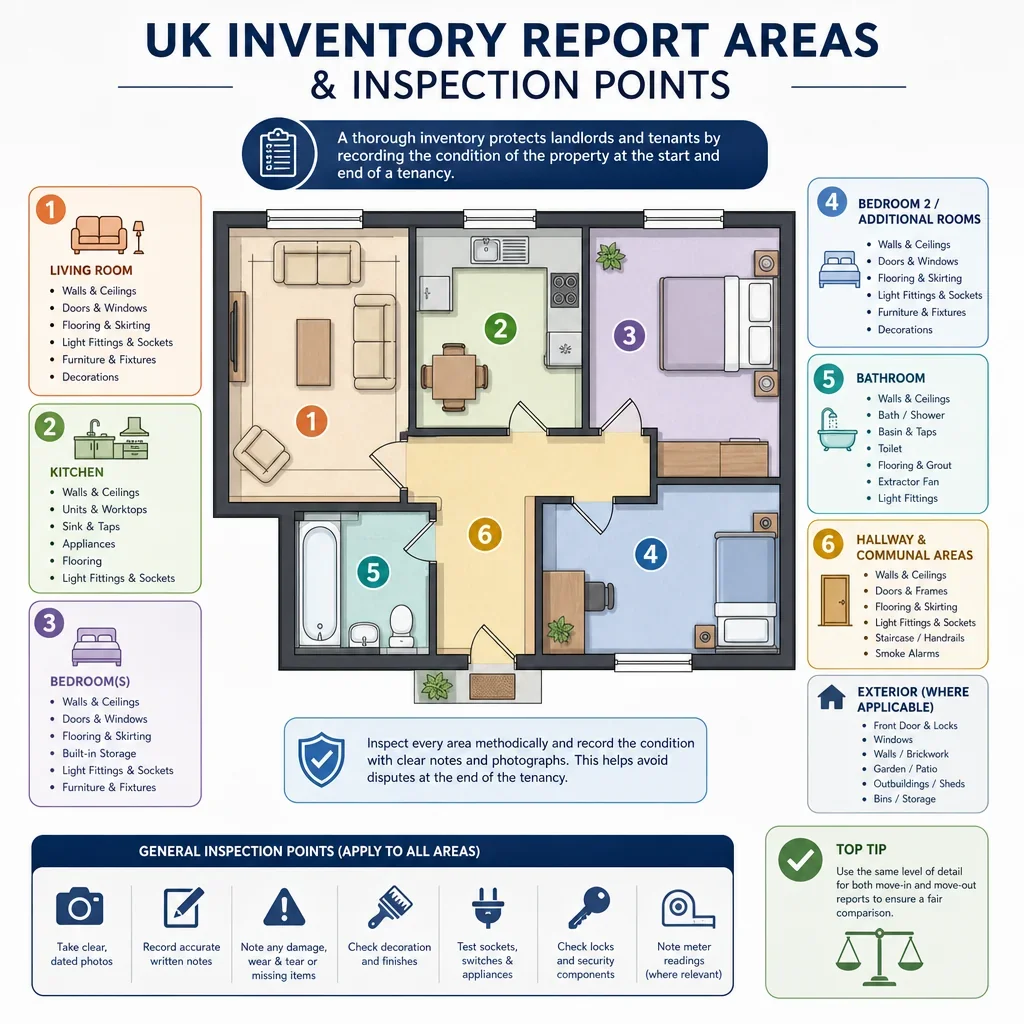
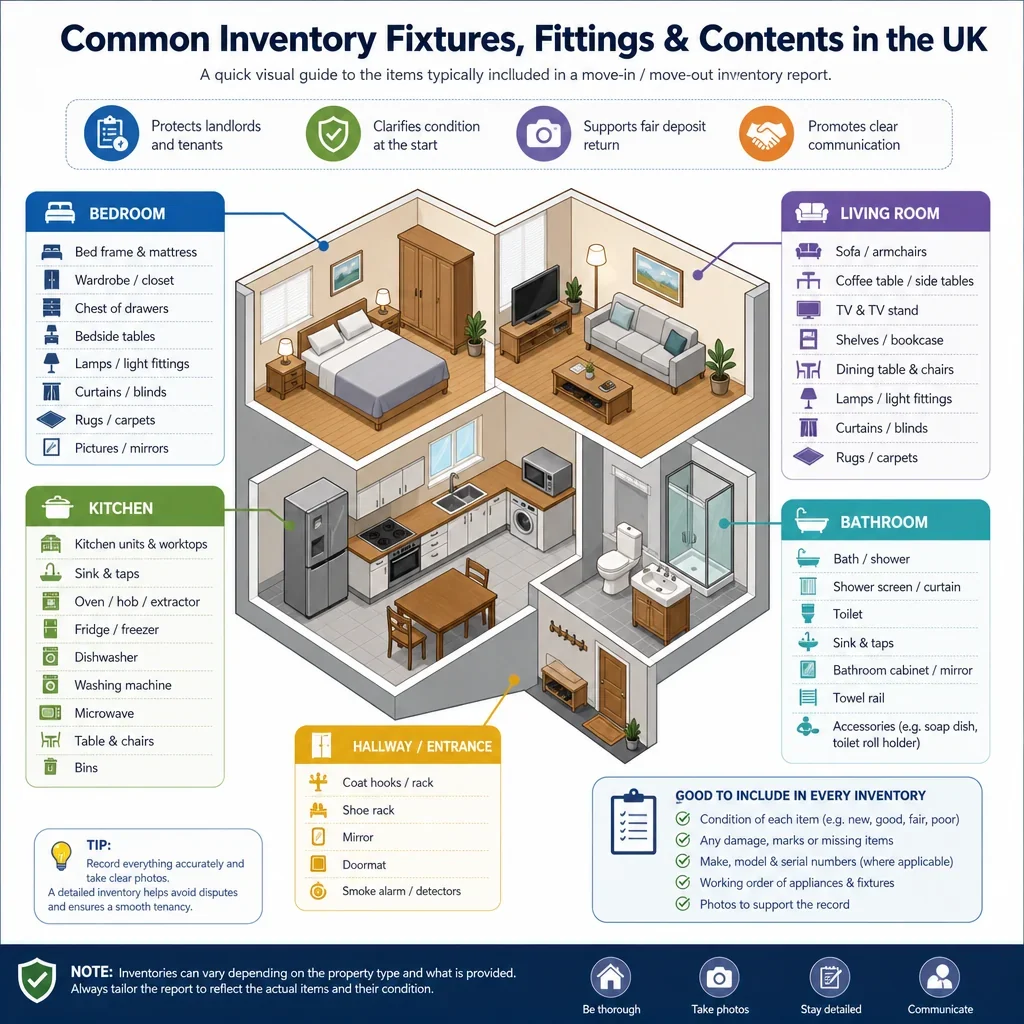
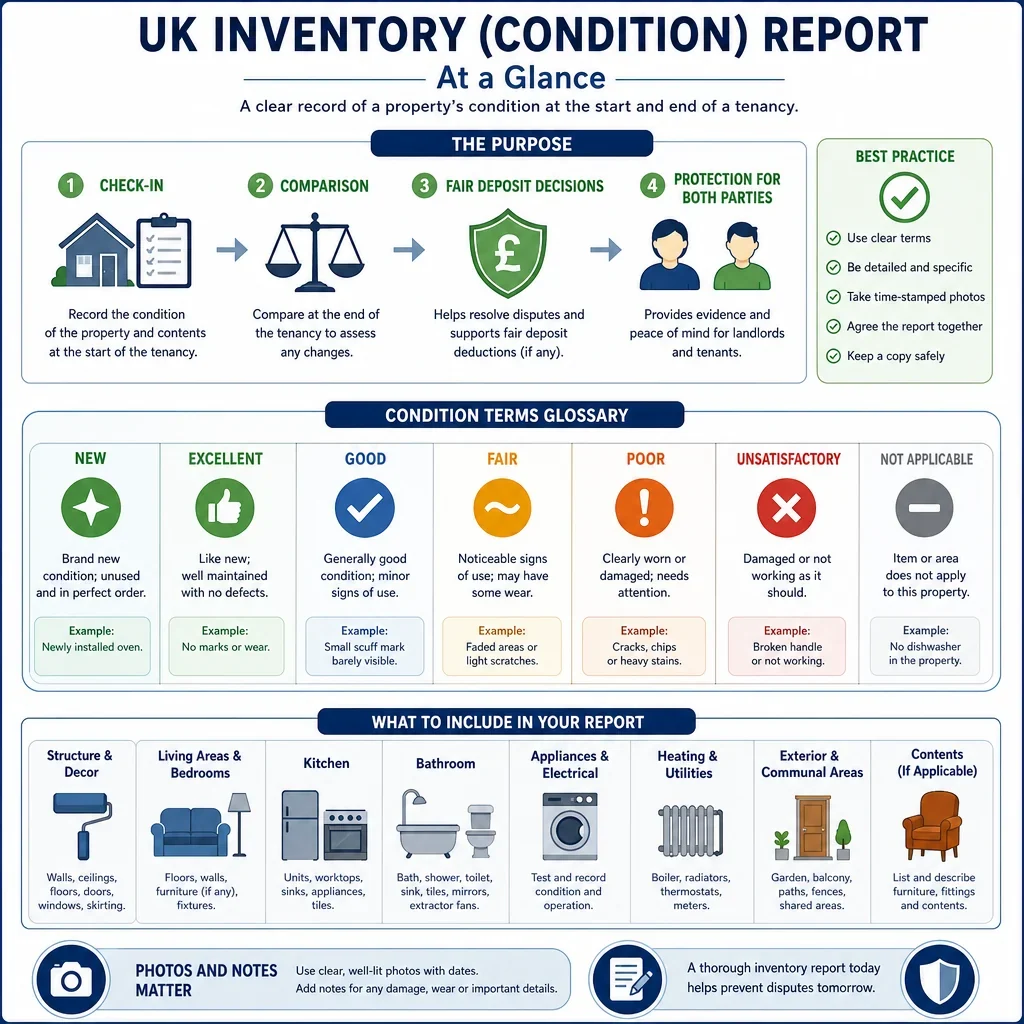
What a Proper Inventory Report Should Include
- Property DetailsInclude the full address of the property, the date of the inspection, and details of the landlord and tenant.
- Room-by-Room DescriptionsList each room and describe its condition, noting any existing damage or wear and tear.
- Furniture and FixturesCatalog all provided furniture, appliances, and fittings, specifying their type, location, and current state.
- Decor and WallsDescribe the condition of walls, floors, ceilings, doors, and any decorations like paint or wallpaper.
- Outdoor AreasIf applicable, cover gardens, driveways, or shared spaces, including their condition and any features.
- Photos and EvidenceAttach dated photographs of the property's condition to support the written descriptions.
- SignaturesHave both landlord and tenant sign and date the report to confirm agreement on the starting condition.
Generate Your Document in 4 Easy Steps
Why Use Docaro?
 United Kingdom
Free Example Inventory Report Template
Below is a free template example of a Inventory Report for use in the United Kingdom generated by our AI model.
The clauses in your actual Inventory Report will vary from this example as they will be entirely bespoke to your requirements as set out in the questionnaire you complete.
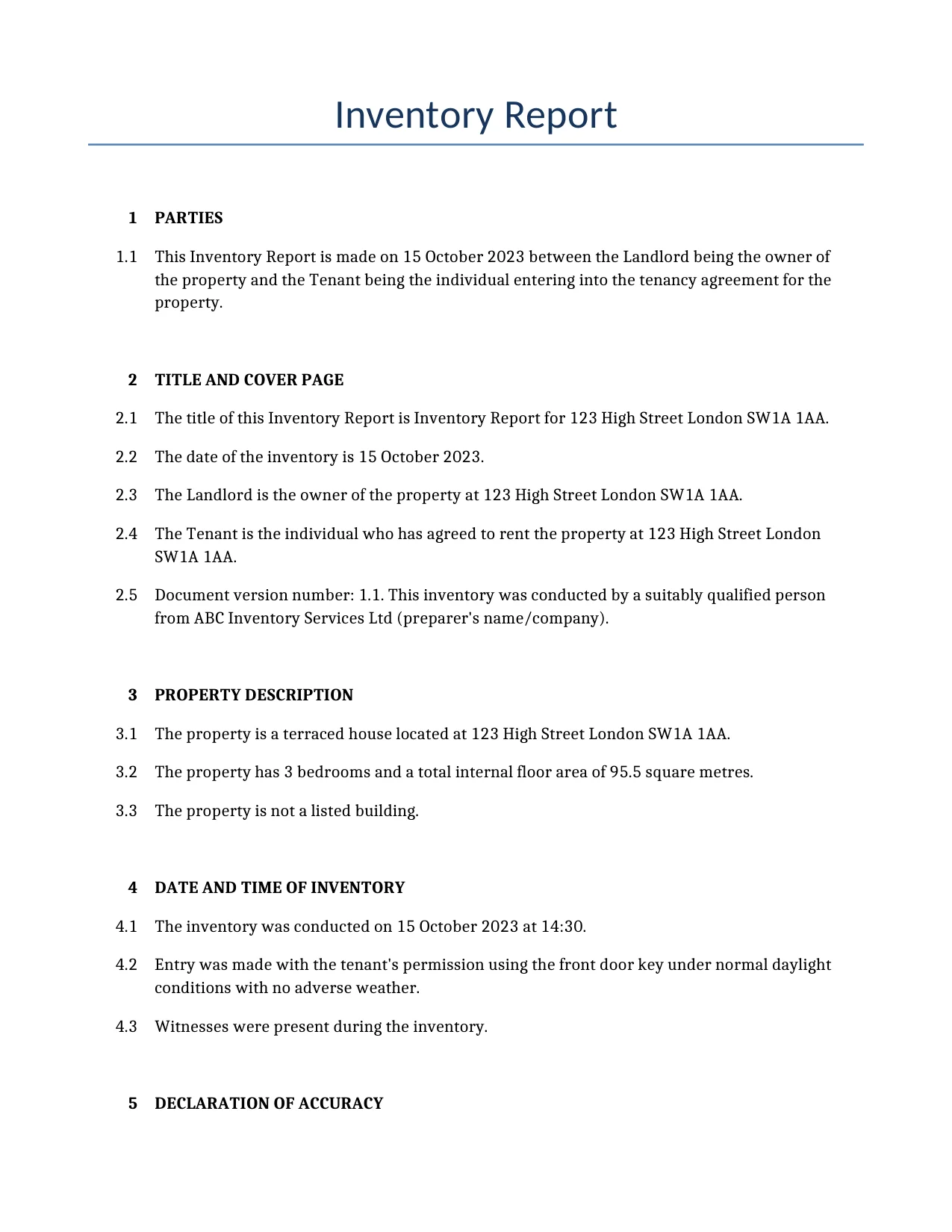
Inventory Report
1PARTIES
This Inventory Report is made on 15 October 2023 between the Landlord being the owner of the property and the Tenant being the individual entering into the tenancy agreement for the property.
2TITLE AND COVER PAGE
The title of this Inventory Report is Inventory Report for 123 High Street London SW1A 1AA.
The date of the inventory is 15 October 2023.
The Landlord is the owner of the property at 123 High Street London SW1A 1AA.
The Tenant is the individual who has agreed to rent the property at 123 High Street London SW1A 1AA.
Document version number: 1.1. This inventory was conducted by a suitably qualified person from ABC Inventory Services Ltd (preparer's name/company).
3PROPERTY DESCRIPTION
The property is a terraced house located at 123 High Street London SW1A 1AA.
The property has 3 bedrooms and a total internal floor area of 95.5 square metres.
The property is not a listed building.
4DATE AND TIME OF INVENTORY
The inventory was conducted on 15 October 2023 at 14:30.
Entry was made with the tenant's permission using the front door key under normal daylight conditions with no adverse weather.
Witnesses were present during the inventory.
5DECLARATION OF ACCURACY
The inventory has been prepared with due care and accuracy to the best of the preparer's knowledge.
Both parties agree to the contents as a true record at the commencement of the tenancy.
The parties have been given the opportunity to review, add comments, and sign the inventory before the tenancy starts.
6SCOPE AND METHODOLOGY
The inspected premises is a 3-bedroom terraced house located at 123 High Street London SW1A 1AA including the living room kitchen three bedrooms bathroom and small rear garden.
The inventory inspection included full interior and exterior coverage.
Photographs were taken during the inventory inspection.
Measurements of the inspected items or spaces were recorded.
The tools or equipment used during the inventory process were a digital camera for photographs a retractable tape measure for dimensions a notepad and pen for notes and a laser distance measurer for larger spaces.
The method applied to conduct the inventory was a room by room walkthrough.
The inventory process started on 15 October 2023 and ended on 15 October 2023.
The inventory follows the guidelines of the Tenancy Deposit Scheme (TDS) or equivalent and the principles in the Inventory Best Practice Guidance.
7ENTRANCE HALLWAY AND COMMON AREAS
The condition of the floor in the entrance hallway is good with minor wear present.
The condition of the walls in the entrance hallway shows minor marks or scuffs.
The lighting in the entrance hallway is fully functional.
The overall condition of the stairs in the common areas is secure and intact.
Handrails are present and secure on all stairs in the common areas.
The condition of the floor in the lobby is clean with minor scuffs.
The lighting in the lobby is not fully operational.
The overall cleanliness of the common areas including hallways stairs and lobbies is moderately clean.
8LIVING ROOM
The sofa in the living room is a three-seater fabric sofa in grey colour with wooden legs and removable cushions.
The current condition of the sofa in the living room is good.
The walls in the living room are emulsion painted walls in neutral beige with a smooth matte finish and one feature wall with framed artwork.
The current condition of the walls in the living room is good.
The floors in the living room are laminate wood-effect flooring with a large area rug in the centre.
The current condition of the floors in the living room is good.
The ceilings in the living room are a white emulsion painted ceiling with a smooth finish and decorative coving around the edges.
The current condition of the ceilings in the living room is pristine.
The windows in the living room consist of two double-glazed sash windows with cream linen curtains and wooden sills.
The current condition of the windows in the living room is excellent.
There are 6 electrical outlets in the living room and their current condition is all functional.
There is a fireplace or chimney in the living room.
9KITCHEN
The kitchen units present in the property are white shaker-style base and wall units including two double base cabinets with drawers one single wall cabinet above the sink and a corner larder unit.
All kitchen units are in good condition with no visible damage.
An oven is included in the kitchen inventory.
A fridge is included in the kitchen inventory.
A dishwasher is not included in the kitchen inventory.
The work surfaces in the kitchen are granite worktops in black with subtle speckles covering approximately 3 meters along the main run including an integrated breakfast bar area.
The sinks in the kitchen consist of a single stainless steel sink with a modern curved design mounted under the window accompanied by a chrome mixer tap.
The type of flooring specified for the kitchen is tiles.
The condition notes for the kitchen flooring are that the ceramic tiles in a grey slate effect are fully intact with no cracks or chips recently grouted and sealed.
10DINING ROOM
The dining table is a rectangular oak wood table in a traditional Victorian style seating up to eight people with carved legs and a polished finish.
The current condition of the dining table is good.
Dining chairs are present in the dining room.
There is a dedicated lighting fixture in the dining room.
The walls in the dining room are painted in a soft cream colour on smooth plaster with no wallpaper or panelling but featuring a simple picture rail around the perimeter.
The current condition of the dining room walls is excellent.
The flooring in the dining room is hardwood oak in a medium brown colour laid in a herringbone pattern with a protective varnish finish.
The current condition of the dining room floors is fair.
11BEDROOMS
Bedroom 1 is the master bedroom located on the first floor at the front of the property featuring a bay window and built-in storage.
A bed is included in the inventory for Bedroom 1.
A wardrobe is included in the inventory for Bedroom 1.
Curtains are included in the inventory for Bedroom 1.
Carpet is included in the inventory for Bedroom 1.
The walls in Bedroom 1 are painted in a light blue emulsion with no wallpaper and there is a wooden dado rail around the perimeter.
The condition of the walls in Bedroom 1 is good.
There are 6 electrical points in Bedroom 1.
The electrical points in Bedroom 1 consist of two double sockets on the right wall near the bed one single socket by the window two double sockets on the back wall and one USB-enabled socket near the door.
The overall condition of the electrical points in Bedroom 1 is excellent.
12BATHROOMS
The sanitary ware in Bathroom One is in good overall condition with no major cracks or chips.
The white porcelain tiles on the walls and floor in Bathroom One are clean and intact showing minimal wear from regular use.
The shower cubicle in Bathroom One has a modern glass enclosure that is free of leaks though the sealant around the edges could use refreshing.
The toilet in Bathroom One is a standard white unit with a functioning flush mechanism and no visible stains.
The pedestal sink in Bathroom One is sturdy with a clean basin and working taps but the faucet shows slight limescale buildup.
The wall-mounted mirror in Bathroom One is clear and undamaged.
Ventilation in Bathroom One is provided by an electric extractor fan that operates effectively removing steam quickly.
There are fitted wooden vanity units under the sink in Bathroom One with soft-close drawers all in a white finish with no signs of water damage.
The condition level for the shower or bath in Bathroom One is good.
The condition level for the toilet in Bathroom One is excellent.
The condition level for the sink in Bathroom One is fair.
The condition level for the tiles in Bathroom One is good.
The condition level for the mirrors in Bathroom One is excellent.
The condition level for the ventilation in Bathroom One is good.
13UTILITY ROOMS AND STORAGE
There is a dedicated laundry area in the property.
The laundry area is located in the ground floor utility room off the kitchen.
14GARDEN AND OUTDOOR AREAS
The garden is a medium-sized enclosed rear garden approximately 50 square meters laid mainly to lawn with flower beds along the borders.
It features a paved patio area adjacent to the property for outdoor seating bordered by wooden fencing on all sides.
There is a small vegetable patch in one corner and a gravelled path leading to the shed.
There is a lawn in the garden.
There is fencing around the garden or outdoor areas.
There are sheds in the garden or outdoor areas.
There is a patio in the garden or outdoor areas.
The outdoor equipment included in the tenancy is garden furniture and barbecue grill.
The plants or garden features included in the tenancy are mature trees and shrubs and flower beds.
15ELECTRICAL AND GAS INSTALLATIONS
There is an Electrical Installation Condition Report for the property.
There is a Gas Safety Certificate for the property.
The overall condition of the electrical installations in the property is good.
The overall condition of the gas installations in the property is fair.
16PLUMBING AND HEATING SYSTEMS
There is a central heating system in the property.
The type of fuel used for the central heating system is gas.
There is a boiler in the property.
The boiler has been serviced within the last 12 months.
There is not a separate water heater in the property.
The number of radiators in the central heating system is 8.
All radiators are in good working condition without leaks.
All visible pipes are in good condition without signs of leaks or corrosion.
The total number of taps in the property is 12.
All taps are functioning properly without drips or low pressure.
17KEYS AND SECURITY
The types of keys provided to the tenant are front door key back door key and window keys.
The number of keys of each type provided to the tenant is 2 front door keys 2 back door keys and 4 window keys.
The instructions given to the tenant regarding the keys are that the tenant must keep the keys secure and not duplicate them without permission all keys must be returned at the end of the tenancy and any lost keys will result in a replacement fee.
The types of locks installed on the property are Yale lock deadbolt lock and window lock.
The locations of each type of lock in the property are Yale lock on the front door deadbolt lock on the back door and window locks on all ground floor windows.
The property has an alarm system installed.
The additional security features installed on the property are CCTV cameras motion sensor lights and smoke detectors.
Confirmation is required that all keys have been returned at the end of the tenancy.
18METERS AND UTILITIES
There is an electricity meter at the property located in the kitchen cupboard under the sink with meter number E123456789.
The current reading on the electricity meter is 12456 and the reading was taken on 1 October 2023.
There is a gas meter at the property located outside the property near the front entrance with meter number G987654321.
The current reading on the gas meter is 3456 and the reading was taken on 1 October 2023.
There is not a water meter at the property.
19FURNISHINGS AND CONTENTS SCHEDULE
The furniture items in the living room are sofa (3-seater) armchair coffee table TV cabinet and bookshelf.
The overall condition of the living room furniture is good with an estimated current value of 850.00.
The furniture items in the kitchen are dining table (for 6) 6 chairs kitchen island and wall-mounted cabinets.
The overall condition of the kitchen furniture is excellent with an estimated current value of 1200.50.
The furniture items in the bedroom are double bed wardrobe chest of drawers and bedside tables (x2).
The overall condition of the bedroom furniture is fair with an estimated current value of 600.00.
The white goods are refrigerator electric oven washing machine and dishwasher.
The overall condition of the white goods is good with an estimated current value of 950.75.
The soft furnishings are curtains (living room and bedroom) wool carpet (hallway) area rug (living room) and scatter cushions (x4).
The overall condition of the soft furnishings is fair with an estimated current value of 250.00.
All listed furnishings and contents are covered under current home insurance.
20DECOR AND FIXTURES
The current condition of the paintwork throughout the property is generally in good condition with minor scuffs in high-traffic areas like hallways but no major peeling or damage.
The overall condition of the paintwork in the property is good.
The current condition of the wallpaper throughout the property is that the wallpaper in the bedrooms is intact with slight fading in the living room due to sunlight exposure.
The overall condition of the wallpaper in the property is fair.
Wallpaper is present throughout the entire property.
The current condition of the carpets throughout the property is that carpets are clean and well-maintained with some wear on the stairs and landing from regular use.
The overall condition of the carpets in the property is good.
The current condition of the curtains throughout the property is that curtains are in excellent shape recently dry-cleaned with no tears or discoloration.
The overall condition of the curtains in the property is excellent.
There are 6 sets of curtains throughout the property.
The current condition of the blinds throughout the property is that blinds are functional but some cords are frayed in the kitchen window.
The overall condition of the blinds in the property is fair.
The type of blinds installed throughout the property is roller and Venetian.
Additional decorative elements are present throughout the property.
21CLEANLINESS AND GENERAL CONDITION
The overall level of cleanliness observed in the property during the inspection is good.
The kitchen and bathrooms were generally clean with no visible dirt or grime however the living room had some dust accumulation on shelves and light fixtures.
The overall state of maintenance for the property's fixtures and fittings is adequately maintained.
Minor wear on door handles and a loose tap in the kitchen sink were observed with no major structural defects noted.
No evidence of damp or mould was observed during the inspection.
No evidence of pests or infestations was observed during the inspection.
The inspection for cleanliness and condition was conducted on 15 October 2023.
22PHOTOGRAPHS AND EVIDENCE
Photographs and diagrams are referenced to support the condition descriptions in the inventory report.
The photographs show the living room furniture in good condition with no visible damage while the diagrams illustrate the layout of the kitchen including all appliances.
All referenced visual evidence includes timestamps or dates to verify when it was taken.
The visual evidence was created or taken on 15 October 2023.
The areas of the property covered by the visual evidence are interior rooms fixtures and fittings.
23RECOMMENDATIONS AND NOTES
All safety features have been checked and are functional before the tenancy starts.
Recommendations: refresh sealant in the bathroom, address limescale on the faucet, repair frayed blind cords in the kitchen, and repair minor wear on door handles and loose tap in the kitchen sink.
The property meets all required safety standards under the Furniture and Furnishings (Fire) (Safety) Regulations 1988 (as amended), the Smoke and Carbon Monoxide Alarm (England) Regulations 2015, and the Electrical Safety Standards in the Private Rented Sector (England) Regulations 2020.
24TERMS OF THE INVENTORY
The purpose of this inventory is to provide a detailed record of the condition and contents of the property at the start of the tenancy serving as a baseline for assessing any damage or discrepancies at the end of the tenancy.
The inventory relates directly to the tenancy agreement.
The inventory forms an integral part of the tenancy agreement by documenting the property's initial state and it should be referenced in clauses related to tenant responsibilities for maintenance and repairs as well as end-of-tenancy inspections under Section 12 of the Landlord and Tenant Act 1985.
The dispute resolution processes referenced in the terms of the inventory are tenancy deposit scheme adjudication and mediation through local authority.
25COMPLIANCE WITH LEGISLATION
This Inventory Report has been prepared in compliance with the Housing Act 1988, the Landlord and Tenant Act 1985 sections 11-14, the Tenant Fees Act 2019, the Homes (Fitness for Human Habitation) Act 2018, the Energy Performance of Buildings Regulations, and the Deposit Protection Service Regulations 2007.
The deposit if any has been protected in accordance with the Deposit Protection Service Regulations 2007.
The Landlord confirms that all obligations under the Landlord and Tenant Act 1985 regarding the condition of the property have been met. An EPC certificate has been provided to the tenant.
26GOVERNING LAW
This Inventory Report and any dispute or claim arising out of or in connection with it or its subject matter or formation shall be governed by and construed in accordance with the laws of England and Wales. The courts of England and Wales shall have exclusive jurisdiction.
27ENTIRE AGREEMENT
This Inventory Report constitutes the entire agreement between the parties and supersedes and extinguishes all previous agreements promises assurances warranties representations and understandings between them whether written or oral relating to its subject matter.
28SEVERABILITY
If any provision of this Inventory Report is held by any court or other competent authority to be invalid or unenforceable in whole or in part the validity of the other provisions of this Inventory Report and the remainder of the provision in question shall not be affected.
29NOTICES
Any notice required to be given under this Inventory Report shall be in writing and shall be delivered by hand or sent by pre-paid first-class post or recorded delivery post to the party at the address set out in this Inventory Report or such other address as may have been notified in accordance with this clause.
A notice delivered by hand is deemed to have been received when delivered or if delivery is not in business hours at the start of the next business day.
A correctly addressed notice sent by pre-paid first-class post or recorded delivery post is deemed to have been received two business days after posting.
30VARIATION
No variation of this Inventory Report shall be effective unless it is in writing and signed by the parties or their authorised representatives.
31SIGNATURES AND DATES
Landlord signature: ________________ Printed name: ________________ Date: ________________
Tenant signature: ________________ Printed name: ________________ Date: ________________
If applicable, Inventory Clerk or Agent signature: ________________ Printed name: ________________ Company: ________________ Date: ________________
32SCHEDULE OF CONDITION - ADDITIONAL ITEMS
Smoke alarms: Installed in hallway and landing, condition good, tested and functional.
Carbon monoxide detectors: Installed in kitchen and living room, condition good, tested and functional.
Fire safety equipment: Fire blanket in kitchen (condition good), fire extinguisher in hallway (condition good).
Loft access: Hatch in landing ceiling, condition good, no items stored.
White goods serial numbers: Refrigerator SN: REF-456789, Oven SN: OV-123456, Washing machine SN: WM-987654.
Full list of all rooms inspected: Entrance hallway, living room, kitchen, dining room, three bedrooms, bathroom, utility room, garden.
Every major fixture, fitting, and appliance has a condition rating as detailed in the relevant room sections above (all ratings good, fair, or excellent with specific notes on minor defects).
This example shows approximately 70% of a typical document and is provided for illustrative purposes only. The remaining content has been omitted.
Every document generated by Docaro is tailored to your specific circumstances, jurisdiction and the information you provide. The completed document includes all applicable clauses and provisions required for your situation.
To generate the full, personalised document, answer a short series of questions and your document will be created instantly.
Useful Resources When Considering a Inventory Report in the United Kingdom
United Kingdom Reference Legislation
Inventory Report FAQs
Document Generation FAQs
Related Articles