AI Generated House Rules for use in the United Kingdom
PDF & Word - 2026 Updated
Docaro Pricing
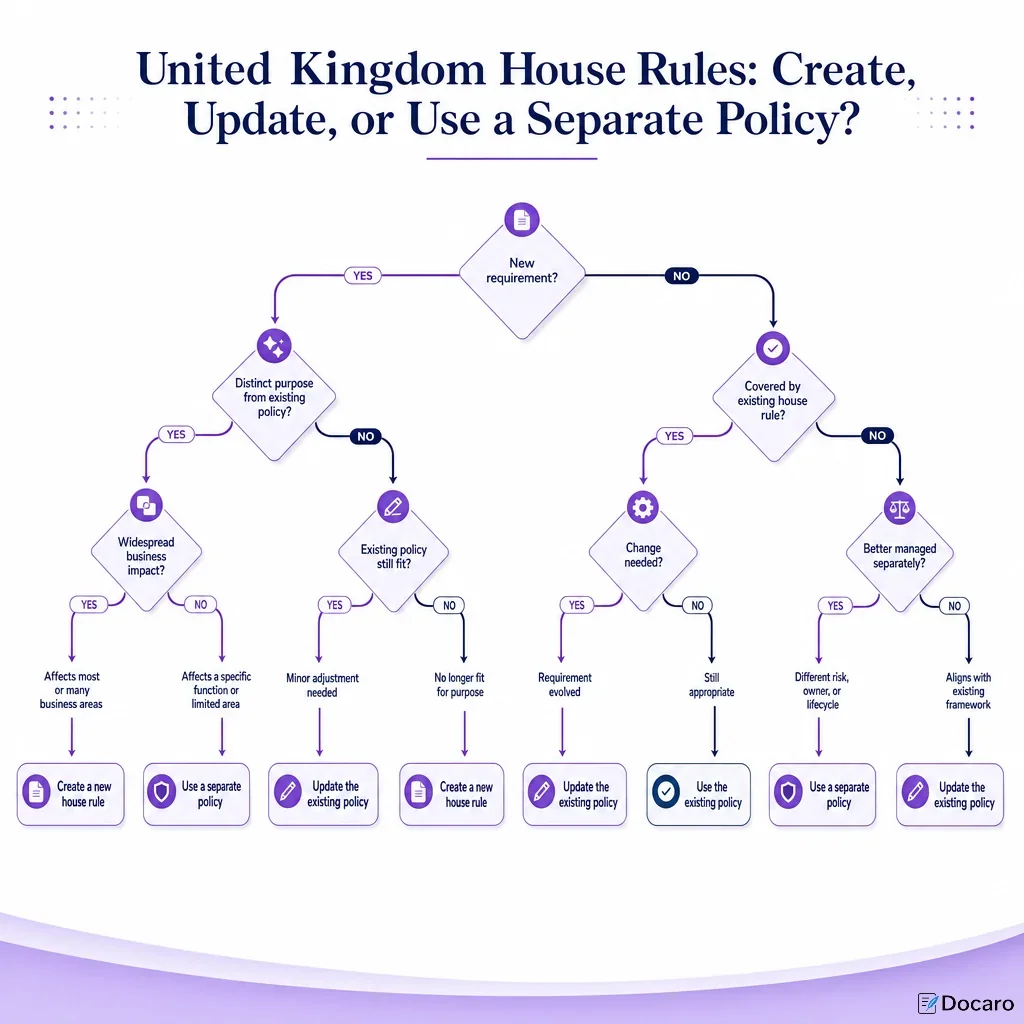
When do you need House Rules in the United Kingdom?
Key Legal Guidelines for House Rules in the UK
Using the wrong structure for house rules can inadvertently create enforceable rights or obligations under UK tenancy laws.
What a Proper House Rules Document Should Include
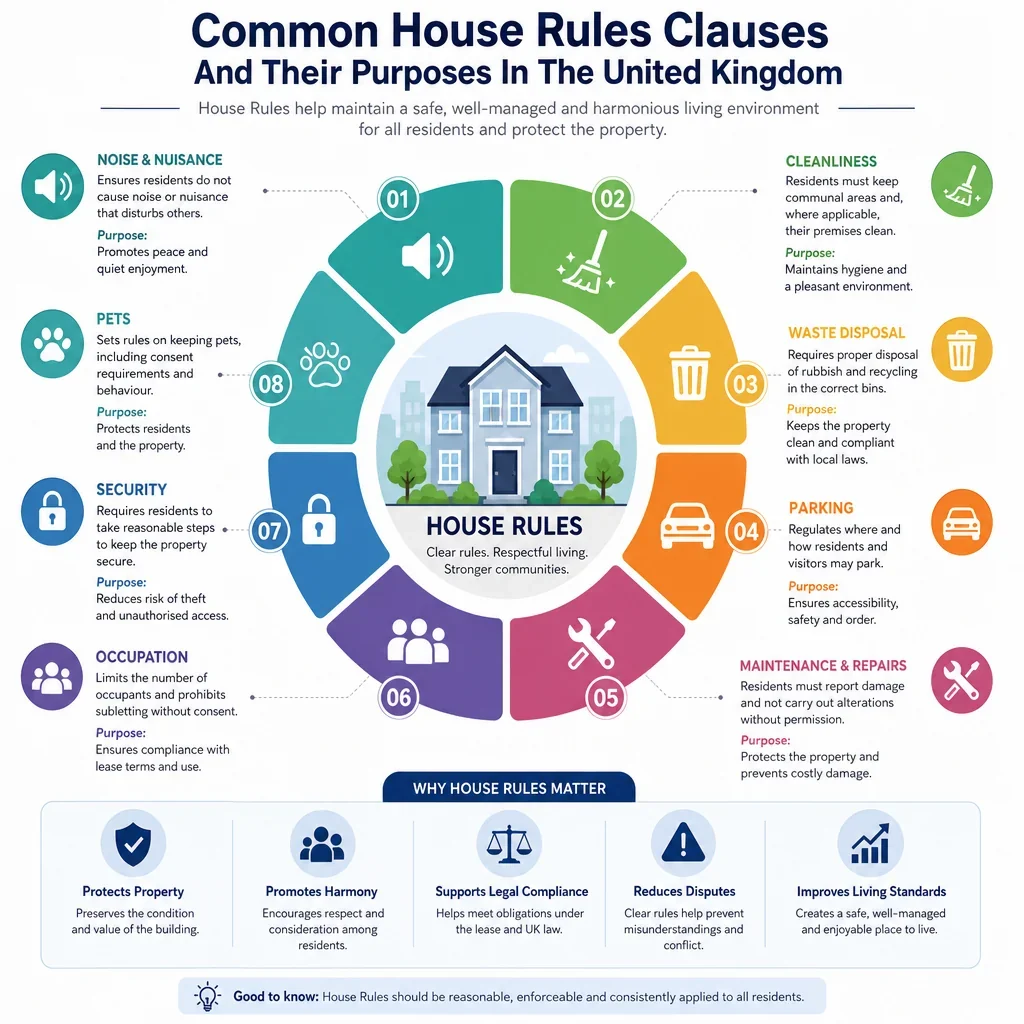
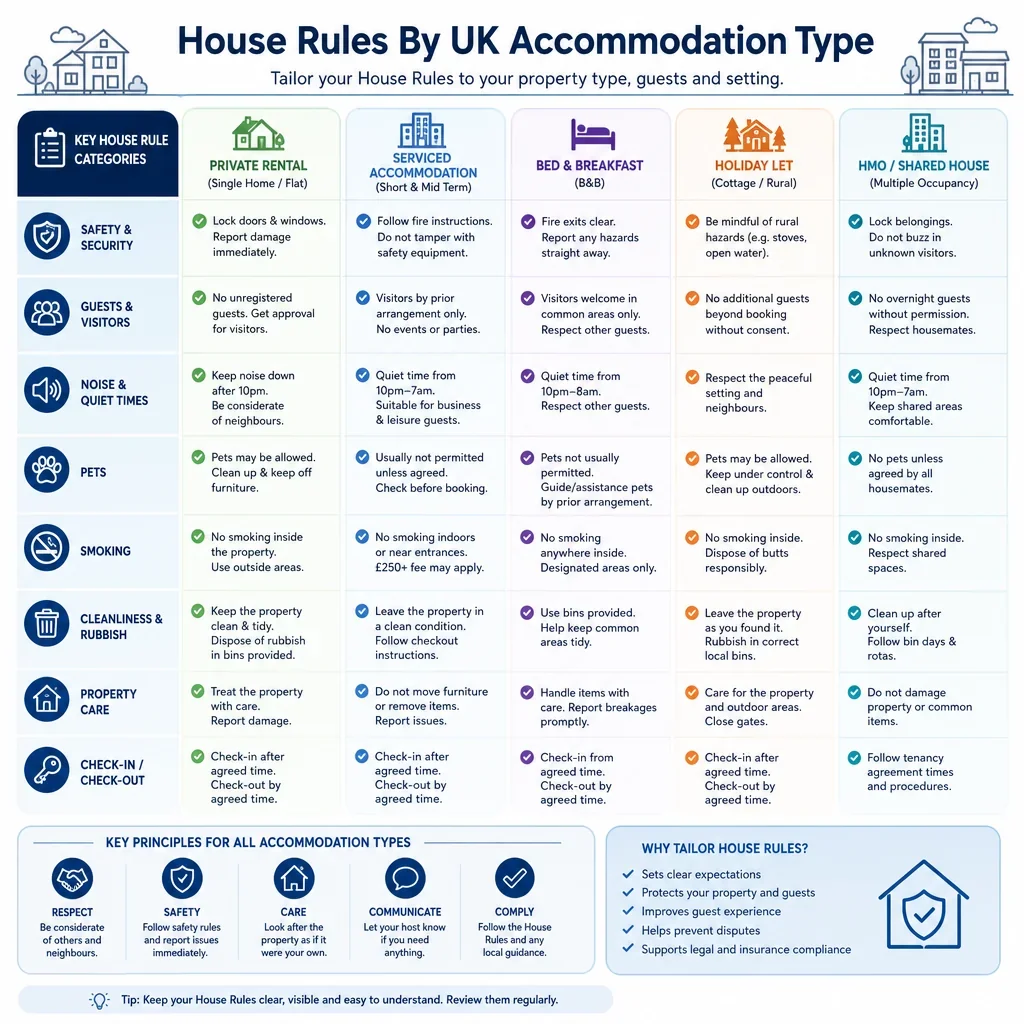
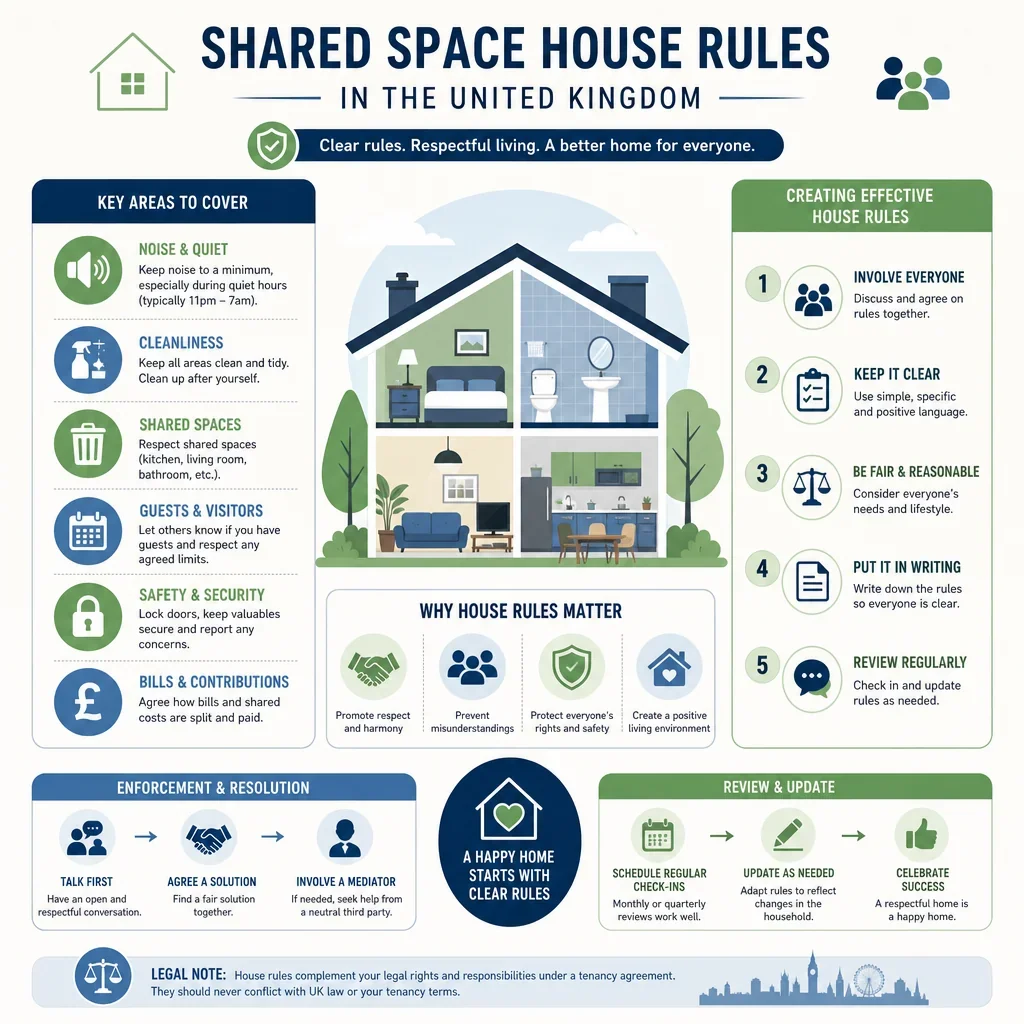
- Quiet HoursSet specific times when noise must be kept low to ensure residents can rest peacefully.
- Guest PolicyOutline rules for visitors, including how many can stay and any notice required.
- Cleaning DutiesDefine responsibilities for keeping shared areas clean and tidy.
- Rent and BillsSpecify payment schedules for rent, utilities, and other shared costs.
- Property CareRequire residents to treat the home and belongings with respect and report any damage.
- No Smoking or PetsState any bans on smoking, pets, or other activities that could affect the household.
- Conflict ResolutionProvide steps for resolving disagreements between residents fairly.
Generate Your Document in 4 Easy Steps
Why Use Docaro?
 United Kingdom
Free Example House Rules Template
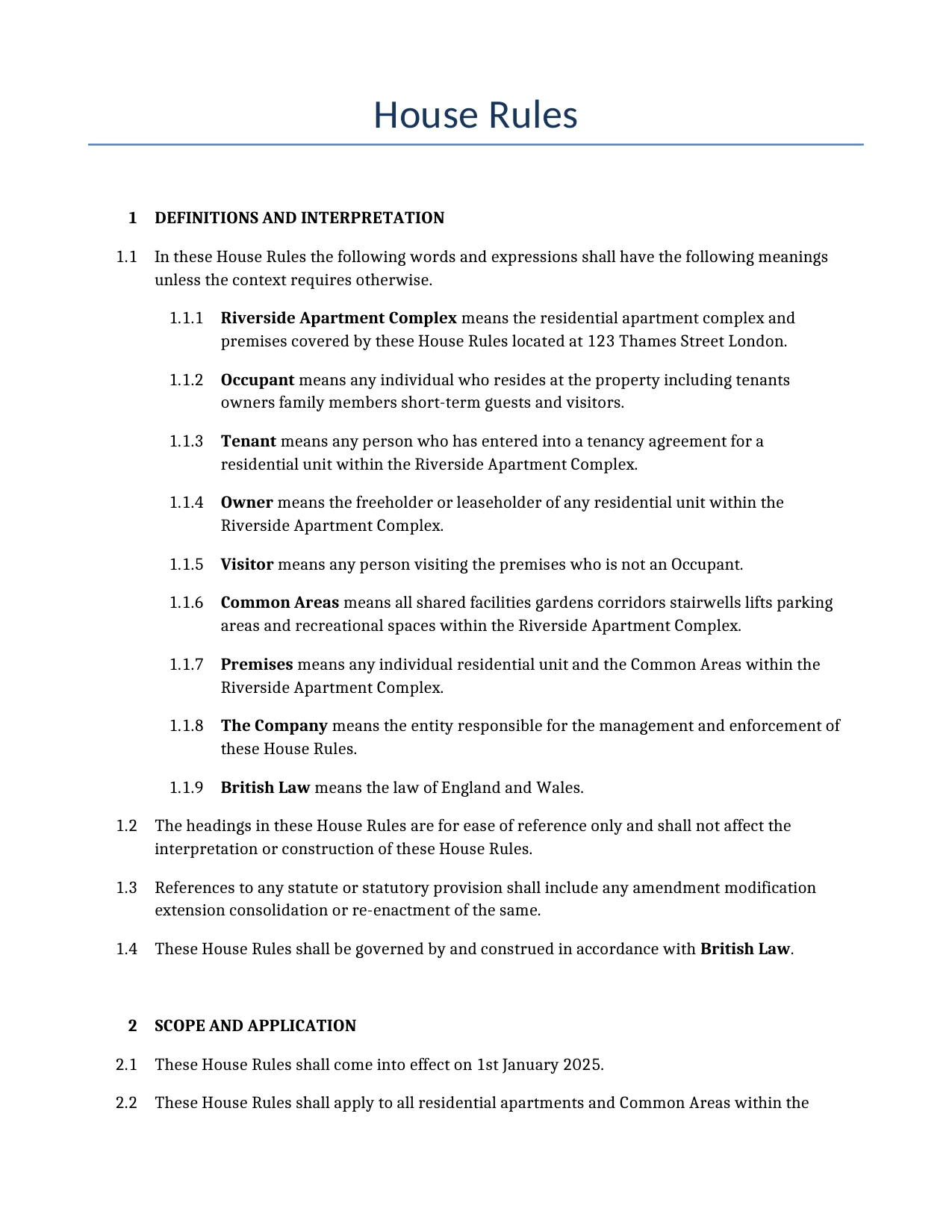
Below is a free template example of a House Rules for use in the United Kingdom generated by our AI model.
The clauses in your actual House Rules will vary from this example as they will be entirely bespoke to your requirements as set out in the questionnaire you complete.
House Rules
1DEFINITIONS AND INTERPRETATION
In these House Rules the following words and expressions shall have the following meanings unless the context requires otherwise.
Riverside Apartment Complex means the residential apartment complex and premises covered by these House Rules located at 123 Thames Street London.
Occupant means any individual who resides at the property including tenants owners family members short-term guests and visitors.
Tenant means any person who has entered into a tenancy agreement for a residential unit within the Riverside Apartment Complex.
Owner means the freeholder or leaseholder of any residential unit within the Riverside Apartment Complex.
Visitor means any person visiting the premises who is not an Occupant.
Common Areas means all shared facilities gardens corridors stairwells lifts parking areas and recreational spaces within the Riverside Apartment Complex.
Premises means any individual residential unit and the Common Areas within the Riverside Apartment Complex.
The Company means the entity responsible for the management and enforcement of these House Rules.
British Law means the law of England and Wales.
The headings in these House Rules are for ease of reference only and shall not affect the interpretation or construction of these House Rules.
References to any statute or statutory provision shall include any amendment modification extension consolidation or re-enactment of the same.
These House Rules shall be governed by and construed in accordance with British Law.
2SCOPE AND APPLICATION
These House Rules shall come into effect on 1st January 2025.
These House Rules shall apply to all residential apartments and Common Areas within the Riverside Apartment Complex located at 123 Thames Street London.
These House Rules shall bind all Tenants Owners Occupants and Visitors.
Each Occupant agrees to comply with these House Rules as a condition of their occupancy.
The Company (or where applicable the landlord) shall ensure that these House Rules are applied in a manner consistent with the Equality Act 2010 and the Consumer Rights Act 2015.
These House Rules supplement and are subordinate to the terms of any individual tenancy agreement or lease. In the event of any conflict the tenancy agreement or lease shall prevail.
These House Rules apply to all current and future Occupants Visitors and other persons using the Premises.
The Company or the landlord is responsible for the enforcement of these House Rules.
3COMPLIANCE WITH LEGISLATION
These House Rules are drafted to comply with the Landlord and Tenant Act 1985 the Housing Act 1988 the Homes (Fitness for Human Habitation) Act 2018 the Smoke and Carbon Monoxide Alarm (England) Regulations 2015 the Equality Act 2010 the Data Protection Act 2018 and all other applicable legislation.
All Occupants must comply with all applicable UK laws including but not limited to the Environmental Protection Act 1990 the Fire Safety Act 2021 the Regulatory Reform (Fire Safety) Order 2005 the Anti-social Behaviour Crime and Policing Act 2014 and any local council regulations.
The Company shall maintain the Premises in a condition compliant with the Landlord and Tenant Act 1985 and the Homes (Fitness for Human Habitation) Act 2018.
Nothing in these House Rules shall be construed as permitting any discrimination prohibited by the Equality Act 2010.
The Company shall process all personal data in accordance with the UK GDPR and the Data Protection Act 2018.
4PROHIBITED ACTIVITIES
No Occupant or Visitor shall engage in any illegal activity within the Riverside Apartment Complex or the Premises.
Smoking is prohibited in all Common Areas. Smoking within individual apartments must not cause a nuisance to other Occupants.
Illegal subletting of any apartment is strictly prohibited.
No Occupant or Visitor shall cause a nuisance or engage in anti-social behaviour (as defined by the Anti-social Behaviour Crime and Policing Act 2014) including but not limited to excessive noise shouting harassment or disruptive behaviour.
No animals or pets may be kept at the Premises without the prior written approval of the Company or landlord.
No alterations additions or improvements may be made to the Premises without the prior written consent of the Company or landlord.
The Premises shall not be used for any business trade or commercial purposes without the prior written consent of the Company or landlord.
The Company may issue warnings for breaches of these rules. Persistent breaches may lead to legal action including proceedings for possession under the Housing Act 1988 and associated UK eviction laws.
The Company shall be entitled to take appropriate action in the event of any breach of this section 4.
5HEALTH AND SAFETY
All Occupants and Visitors must comply with all health and safety instructions issued by the Company.
Occupants must not obstruct fire exits stairwells corridors or any emergency equipment.
Occupants must dispose of waste properly and not allow rubbish to accumulate in a manner that poses a fire hazard or health risk.
Occupants must promptly report any hazards maintenance issues or damage to the Company.
Occupants must comply with fire safety regulations under the Regulatory Reform (Fire Safety) Order 2005 including keeping fire doors closed and not interfering with fire alarms or safety equipment.
Occupants are responsible for ensuring that smoke alarms and carbon monoxide detectors within their apartment remain functional and must report any faults immediately. The Company shall ensure that all alarms are installed and maintained in accordance with the Smoke and Carbon Monoxide Alarm (England) Regulations 2015 and the Landlord and Tenant Act 1985.
No Occupant shall undertake any activity that poses a risk to the health and safety of others without the prior written consent of the Company.
6QUIET ENJOYMENT AND NOISE CONTROL
To ensure the quiet enjoyment of all residents noise must be kept to a minimum between 11pm and 7am.
Loud music television or other amplified sound must not be audible outside the apartment at any time. Parties and gatherings must not cause disturbance to neighbours.
Parents or guardians are responsible for ensuring that children do not cause excessive noise or nuisance in Common Areas or neighbouring apartments.
The use of power tools garden machinery washing machines or other noisy equipment is prohibited during quiet hours.
Occupants must comply with the Environmental Protection Act 1990 and any local council noise nuisance rules. Persistent noise nuisance may result in action by the local authority or the Company.
7DATA PROTECTION
The Company shall collect and process personal data relating to Occupants and Visitors only in accordance with the UK GDPR and the Data Protection Act 2018.
Personal data may be collected for purposes including building security maintenance tenant management and enforcement of these House Rules. Data will not be shared with third parties except where legally required or necessary for these purposes.
Occupants have the right to access their personal data request corrections or request deletion in accordance with their rights under the UK GDPR. Requests should be made in writing to the Company.
By agreeing to these House Rules Occupants consent to the processing of their data for the purposes outlined above. CCTV may be in operation in Common Areas for security purposes and signage will be displayed in compliance with data protection requirements.
8EQUALITY AND NON-DISCRIMINATION
The Company shall apply these House Rules without discrimination on any grounds prohibited by the Equality Act 2010 including age disability gender reassignment marriage and civil partnership pregnancy and maternity race religion or belief sex and sexual orientation.
The Company is committed to promoting an inclusive and respectful residential community where all residents are treated with dignity.
Any complaint of discrimination shall be investigated promptly fairly and in accordance with the requirements of the Equality Act 2010. Complaints should be made in writing to the Company and will be handled confidentially.
9GENERAL PROVISIONS
Any disputes arising from these House Rules shall first attempt resolution through the Company\'s internal complaints procedure. Unresolved disputes may be referred to the Property Ombudsman or pursued through the courts in accordance with British Law.
Any notices required under these House Rules shall be in writing and may be served by post hand delivery or email to the last known address of the Occupant.
The invalidity or unenforceability of any provision of these House Rules shall not affect the validity or enforceability of the remaining provisions.
These House Rules may be updated by the Company from time to time with reasonable notice (at least 28 days) provided to Occupants in line with the Consumer Rights Act 2015.
These House Rules supplement any tenancy agreement and do not constitute the entire agreement between the parties.
These House Rules shall be governed by and interpreted in accordance with British Law.
10MAINTENANCE AND REPAIRS
The Company or landlord is responsible for structural repairs and maintaining the Premises in a habitable condition in accordance with the Landlord and Tenant Act 1985.
Occupants must keep their apartment clean and tidy report any repairs needed promptly and not cause damage through negligence or misuse. Occupants are responsible for the cost of repairing any damage caused by them their family guests or pets.
Occupants must allow access for inspections repairs or maintenance with reasonable notice (except in emergencies).
11WASTE DISPOSAL AND RECYCLING
Occupants must dispose of all household waste using the designated bins and follow the local council\'s recycling requirements.
Rubbish must not be left in Common Areas. Large items must be disposed of in accordance with local council bulky waste collection rules and not fly-tipped.
12PETS AND ANIMALS
No pets or animals may be kept without the prior written consent of the Company or landlord. Consent may be subject to conditions including size breed and behaviour.
Approved pets must not cause a nuisance to other residents and owners are responsible for cleaning up after their pets in all Common Areas.
Failure to control pets or clean up after them may result in withdrawal of permission to keep the animal.
13PARKING AND VEHICLE RULES
Parking is permitted only in designated spaces. Vehicles must not obstruct access roads fire exits or other residents\' spaces.
Only private cars and motorcycles belonging to Occupants or their Visitors may be parked. Commercial vehicles caravans boats or trailers require prior approval.
Vehicles must be taxed insured and in roadworthy condition. The Company accepts no liability for damage to vehicles parked on the Premises.
14USE OF COMMON AREAS AND FACILITIES
Common Areas must be kept clean tidy and free of obstruction. They are for the reasonable use and enjoyment of all residents.
No loitering noisy behaviour storage of personal items or misuse of facilities is permitted. Any shared facilities such as gyms or gardens must be used responsibly and in accordance with posted rules.
The Company may close Common Areas temporarily for maintenance or other reasonable purposes.
15GUESTS AND SUBLETTING
Occupants are responsible for the behaviour of their guests and Visitors at all times.
Short-term letting or subletting of apartments is only permitted with the prior written consent of the landlord and must comply with the Deregulation Act 2015 and any local authority requirements (including licensing where applicable).
Long-term guests staying more than 14 days must be registered with the Company.
16INSURANCE RESPONSIBILITIES
The Company or landlord will maintain buildings insurance for the structure of the Premises. Occupants are strongly advised to obtain contents insurance for their personal belongings.
Occupants are responsible for any increase in insurance premiums caused by their actions or omissions.
17EMERGENCY PROCEDURES
In case of fire or other emergency Occupants should evacuate immediately using the nearest safe exit and call the emergency services. Do not use lifts.
Emergency contact numbers and evacuation procedures are displayed in Common Areas and should be familiarised by all Occupants.
Occupants must not block or obstruct any fire exits or safety equipment at any time.
18ACKNOWLEDGMENT AND AGREEMENT
I acknowledge that I have received a copy of these House Rules and agree to abide by them. I understand that these rules supplement my tenancy agreement and do not replace or override it.
Signed by the Occupant: _______________________________ Printed Name: ________________ Date: ________________
Signed for and on behalf of the Company: _______________________________ Printed Name: ________________ Date: ________________
Witnessed by: _______________________________ Printed Name: ________________ Date: ________________
All new Occupants must sign this acknowledgment upon moving in.
This example shows approximately 70% of a typical document and is provided for illustrative purposes only. The remaining content has been omitted.
Every document generated by Docaro is tailored to your specific circumstances, jurisdiction and the information you provide. The completed document includes all applicable clauses and provisions required for your situation.
To generate the full, personalised document, answer a short series of questions and your document will be created instantly.
Useful Resources When Considering a House Rules in the United Kingdom
United Kingdom Reference Legislation
House Rules FAQs
Document Generation FAQs
Related Articles