AI Generated British Mediation Agreement
PDF & Word - 2026 Updated
Docaro Pricing
When do you need a Mediation Agreement in the United Kingdom?
British Legal Rules for a Mediation Agreement
Using the wrong structure for a mediation agreement can undermine its enforceability and fail to meet UK legal requirements.
What a Proper Mediation Agreement Should Include
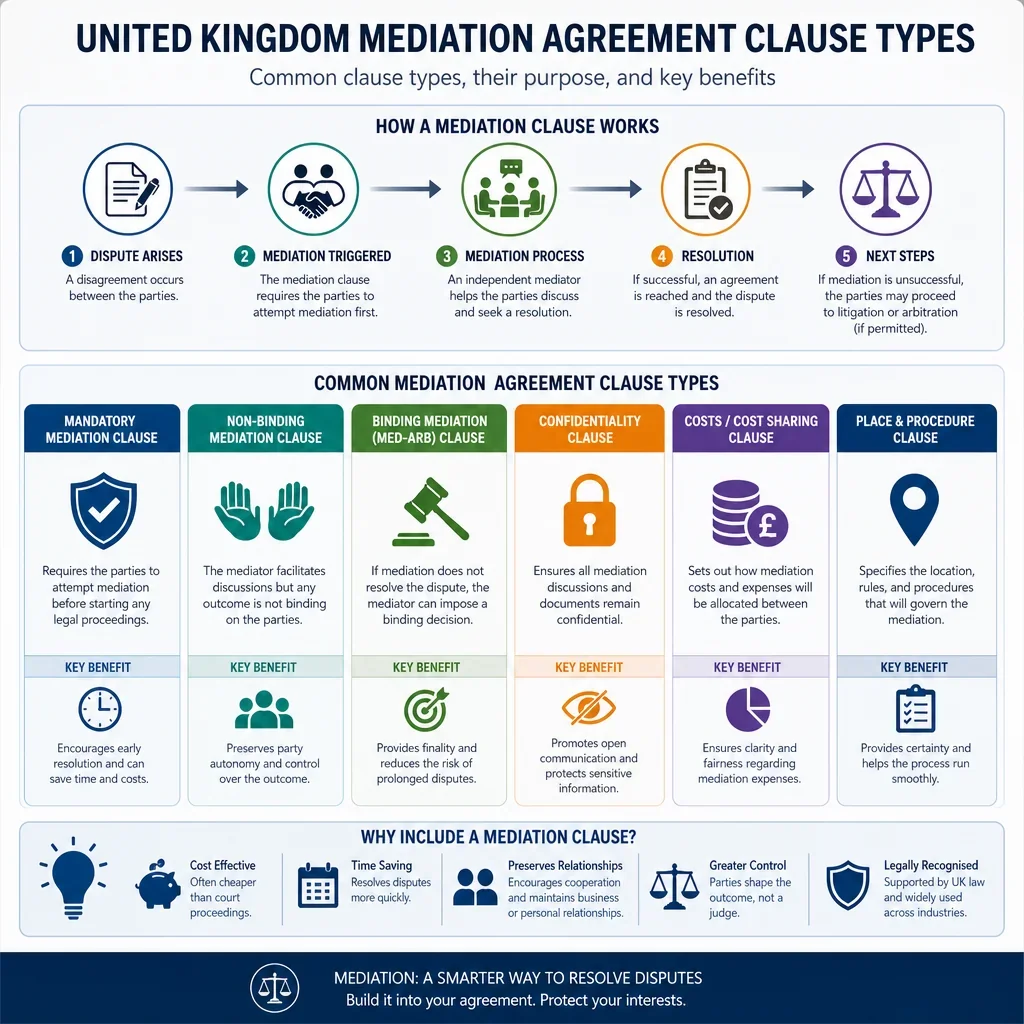
- Parties InvolvedClearly identify all people or groups participating in the mediation.
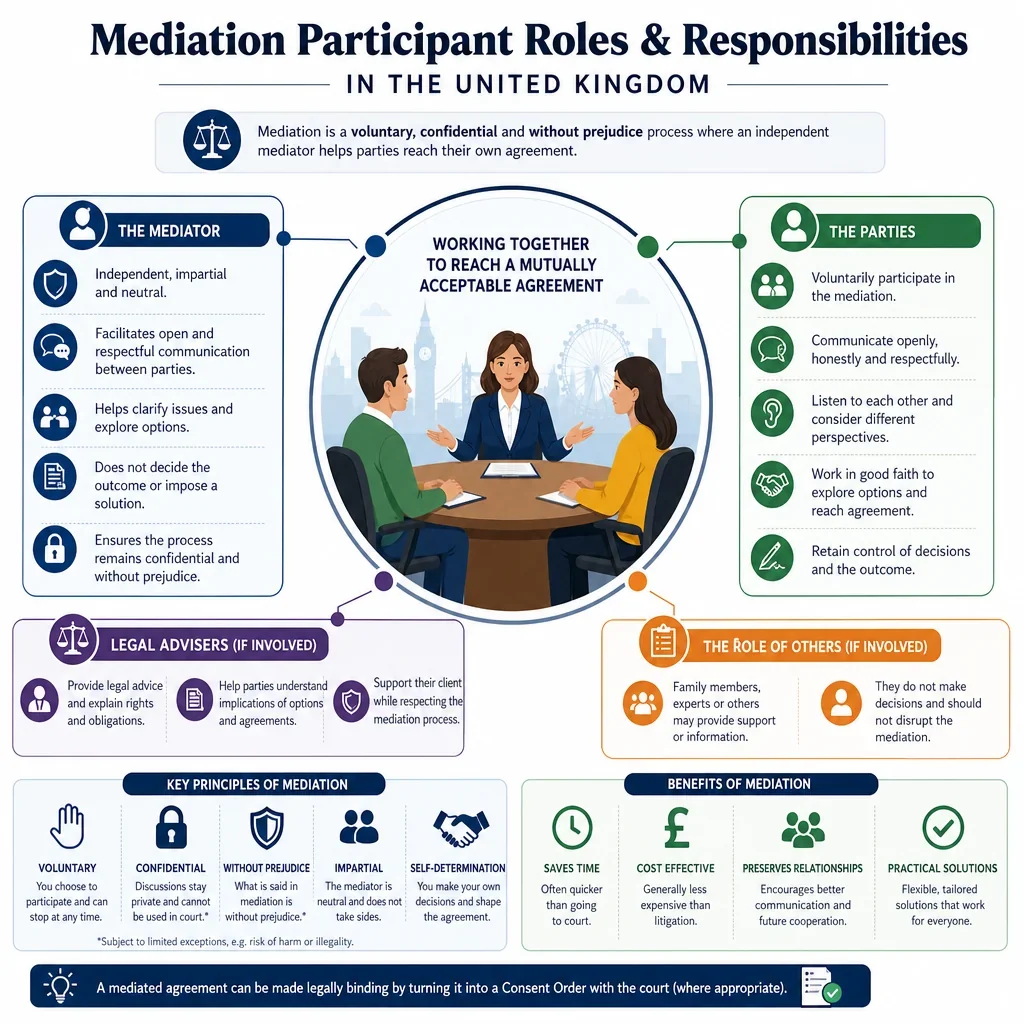
- Mediator's RoleDescribe who the mediator is and their job in guiding the discussions.
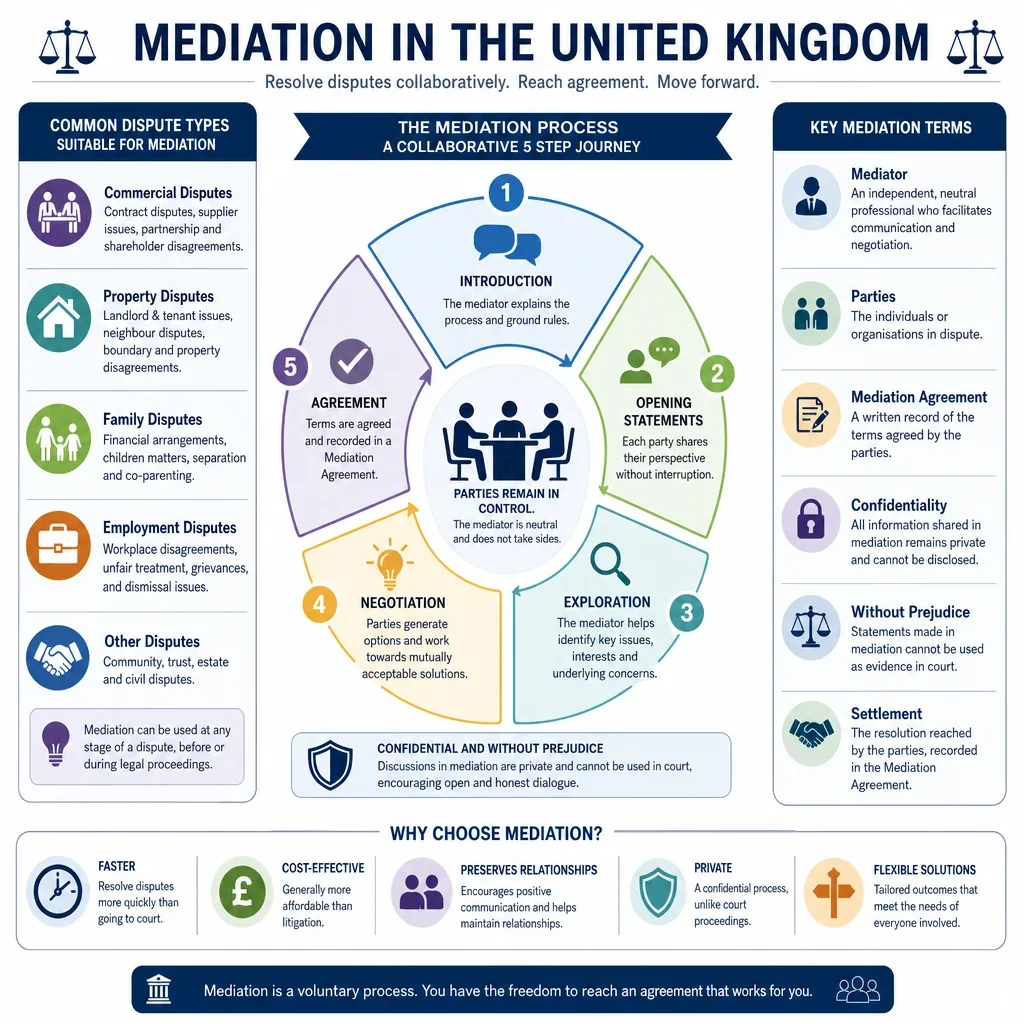
- Mediation ProcessOutline the steps, schedule, and location for the mediation sessions.
- Confidentiality RulesState that all talks and information shared during mediation stay private.
- Agreement on OutcomeExplain how any final deal reached will be written down and made binding.
- Costs and FeesDetail who pays for the mediation and how costs are split.
- Ending the MediationSpecify when and how the mediation can stop if no agreement is reached.
Generate Your Document in 4 Easy Steps
Why Use Docaro?
 United Kingdom
Free Example Mediation Agreement Template
Below is a free template example of a Mediation Agreement for use in the United Kingdom generated by our AI model.
The clauses in your actual Mediation Agreement will vary from this example as they will be entirely bespoke to your requirements as set out in the questionnaire you complete.
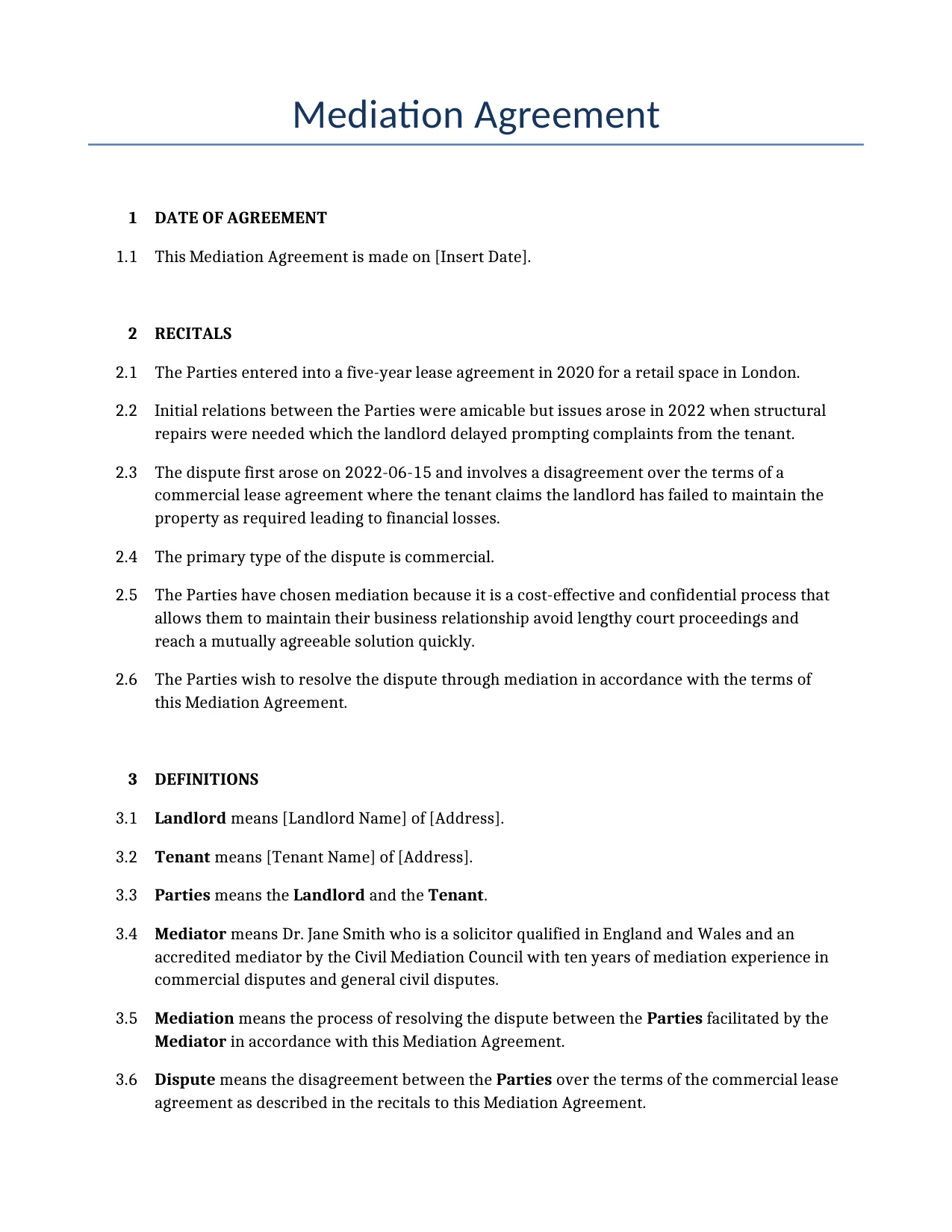
Mediation Agreement
1DATE OF AGREEMENT
This Mediation Agreement is made on [Insert Date].
2RECITALS
The Parties entered into a five-year lease agreement in 2020 for a retail space in London.
Initial relations between the Parties were amicable but issues arose in 2022 when structural repairs were needed which the landlord delayed prompting complaints from the tenant.
The dispute first arose on 2022-06-15 and involves a disagreement over the terms of a commercial lease agreement where the tenant claims the landlord has failed to maintain the property as required leading to financial losses.
The primary type of the dispute is commercial.
The Parties have chosen mediation because it is a cost-effective and confidential process that allows them to maintain their business relationship avoid lengthy court proceedings and reach a mutually agreeable solution quickly.
The Parties wish to resolve the dispute through mediation in accordance with the terms of this Mediation Agreement.
3DEFINITIONS
Landlord means [Landlord Name] of [Address].
Tenant means [Tenant Name] of [Address].
Parties means the Landlord and the Tenant.
Mediator means Dr. Jane Smith who is a solicitor qualified in England and Wales and an accredited mediator by the Civil Mediation Council with ten years of mediation experience in commercial disputes and general civil disputes.
Mediation means the process of resolving the dispute between the Parties facilitated by the Mediator in accordance with this Mediation Agreement.
Dispute means the disagreement between the Parties over the terms of the commercial lease agreement as described in the recitals to this Mediation Agreement.
4APPOINTMENT OF MEDIATOR
The Parties hereby jointly appoint Dr. Jane Smith as the Mediator for the purposes of conducting the Mediation of the Dispute.
The Mediator shall be appointed by no later than [Insert Date].
The Mediator possesses the qualifications of a solicitor qualified in England and Wales and accreditation as a mediator by the Civil Mediation Council with expertise in commercial disputes and general civil disputes.
The contact details for the Mediator are as follows: email jane.smith@mediationuk.co.uk phone +44 20 1234 5678 and address 123 Mediation Street London UK.
The Mediator confirms that the Mediator has no prior relationships with the Parties that would affect the Mediator's impartiality and the Mediator shall make a formal declaration of impartiality prior to the commencement of the Mediation.
5SCOPE OF MEDIATION
The Mediation shall cover only the commercial lease dispute between the Landlord and the Tenant as described in the Recitals including the disagreement over the terms of the commercial lease agreement where the tenant claims the landlord has failed to maintain the property as required leading to financial losses. For the avoidance of doubt this Mediation does not extend to any disputes involving business partners profits joint ventures intellectual property or any other matters.
The nature of the Dispute is a commercial lease dispute.
6GOOD FAITH
The Parties agree to participate in the Mediation in good faith. This includes an obligation to attend all scheduled sessions cooperate with the Mediator provide relevant documents and information in a timely manner and engage constructively with a view to resolving the Dispute. Failure to act in good faith may result in termination of the Mediation and may be taken into account in any subsequent costs applications to the Court.
7MEDIATOR'S ROLE AND AUTHORITY
The Mediator's role is to facilitate discussions between the Parties to assist them in reaching their own voluntary agreement. The Mediator has no authority to impose a settlement or make decisions on behalf of the Parties. The Mediator shall conduct the Mediation in accordance with the Civil Mediation Council Code of Conduct.
8MEDIATION PROCESS
The Mediator shall control the conduct of the Mediation. The process may include joint sessions and/or private caucuses (meetings) with one Party at a time as the Mediator deems appropriate. The format (in person remote via video conferencing or hybrid) timing and duration of sessions shall be flexible and determined by the Mediator in consultation with the Parties. The Mediation shall proceed at a pace agreed by the Parties or as directed by the Mediator and there shall be no fixed completion deadline unless specifically agreed in writing by all Parties.
9CONFIDENTIALITY
All communications and documents relating to the Mediation (including the fact that the Mediation is taking place) shall be confidential and shall not be disclosed to any third party without the prior written consent of all Parties except as required by law court order or regulatory authority (including for the purposes of enforcing any settlement agreement or as necessary for child protection or safeguarding if ever relevant though not applicable to this commercial Dispute). This confidentiality obligation extends to the Mediator who shall not disclose any information obtained during the Mediation except as permitted above.
Any breach of confidentiality may result in legal remedies including damages and/or injunction. The confidentiality obligations survive the termination of the Mediation.
10PRIVILEGE
All communications made during the Mediation are protected by without prejudice privilege and common law privilege in accordance with the Civil Procedure Rules and the law of England and Wales. This privilege applies to all discussions documents and communications relating to the Mediation.
11WITHOUT PREJUDICE
All discussions negotiations offers and admissions made during the Mediation are without prejudice to the Parties' rights and shall be inadmissible in any subsequent court or arbitration proceedings except as necessary to enforce a settlement agreement reached. The without prejudice protection shall continue to apply after the Mediation has concluded in accordance with the principles established in Rush & Tompkins Ltd v Greater London Council [1989] AC 1280 and the Civil Procedure Rules.
12NEUTRALITY AND IMPARTIALITY
The Mediator shall remain neutral and impartial throughout the Mediation process and shall make a formal declaration of impartiality.
The Mediator shall disclose any prior relationships with the Parties and shall continuously throughout the Mediation check and confirm that no conflicts of interest exist.
13DATA PROTECTION AND GDPR COMPLIANCE
The Parties consent to the Mediator processing their personal data for the purposes of conducting the Mediation. The Mediator shall act as a data controller and shall comply with all obligations under the UK GDPR the Data Protection Act 2018 and any other applicable data protection legislation. Personal data shall only be processed as necessary for the Mediation shared only with the consent of the relevant Party or as required by law and shall be securely deleted or returned upon conclusion of the Mediation unless retention is required for legal reasons. The Parties shall ensure that any personal data they provide complies with data protection requirements.
14FEES AND EXPENSES
The Mediator's fees shall be as agreed in writing with the Parties (including any applicable VAT). The fees shall be shared equally between the Parties unless otherwise agreed. Each Party shall bear its own legal and other costs associated with the Mediation.
Payment terms shall be as agreed with the Mediator. In the event of termination of the Mediation before completion the Mediator shall be entitled to payment for work done and expenses incurred up to the date of termination on a pro-rata or time-spent basis as notified to the Parties.
15TERMINATION OF MEDIATION
The Mediation may be terminated at any time by any Party upon written notice to the other Party and the Mediator or by the Mediator upon written notice to the Parties if in the Mediator's opinion the Mediation is no longer productive or if a Party is not acting in good faith. The Mediator does not have sole authority to determine impasse; this must be by agreement of the Parties or notice from a Party.
Upon termination the Parties shall pay the Mediator's fees and expenses in accordance with clause 14. Termination shall be without prejudice to any rights or remedies of the Parties. The provisions of this Agreement relating to confidentiality privilege and without prejudice shall continue to apply after termination. The Mediator shall act in accordance with the Civil Mediation Council Code of Conduct regarding termination.
16AGREEMENT IF SETTLEMENT REACHED
If a settlement is reached it may be recorded immediately in a written settlement agreement signed by the Parties (and if required their legal representatives). Any such signed settlement agreement shall be binding and enforceable as a contract. The settlement agreement shall not be required to be in the form of a deed unless there are specific reasons to do so (for example to bind third parties or for other legal requirements). The settlement agreement shall remain confidential save as necessary for enforcement.
If a Party fails to comply with the terms of the settlement agreement the other Party may apply to the court to enforce it in accordance with CPR Part 78 or otherwise as permitted by law.
17NO BINDING EFFECT
The Mediation itself shall not create any binding obligations upon the Parties unless and until a settlement is agreed and formalized in accordance with clause 16 of this Mediation Agreement.
This no binding effect shall apply to all discussions and documents exchanged during the Mediation and is without prejudice to any settlement agreement reached.
18EXCLUSION OF MEDIATOR LIABILITY
The Mediator shall not be liable to the Parties for any act or omission in connection with the Mediation unless such act or omission is shown to have been in bad faith or constitutes gross negligence or wilful misconduct. The Parties agree to indemnify the Mediator against any claims arising from the Mediation except in cases of the Mediator's bad faith gross negligence or wilful misconduct. This limitation of liability is in accordance with the Civil Mediation Council standards and English law.
19REPRESENTATION
Each Party has the right to be accompanied and represented at the Mediation by legal advisors. A Party may also be accompanied by a support person or other non-legal representative with the prior consent of the Mediator and the other Party. The Mediator shall have control over attendance at sessions to ensure the process remains effective and confidential. Any representatives or support persons attending must agree to be bound by the confidentiality and other relevant provisions of this Agreement by signing a copy of it or an appropriate undertaking before participating.
20DOCUMENTS AND INFORMATION
All documents exchanged during the Mediation must be marked as confidential and shall be used exclusively for mediation discussions.
The Parties shall not make copies of exchanged documents without the prior consent of the disclosing Party.
Upon conclusion of the Mediation all documents shall be returned to the disclosing Party or securely destroyed.
21GOVERNING LAW
This Mediation Agreement and any disputes arising out of or in connection with it shall be governed by and construed in accordance with the law of England and Wales. The Parties agree to submit to the exclusive jurisdiction of the English courts for any matters relating to this Agreement (except for the Dispute itself which is the subject of the Mediation). This Agreement is subject to the Civil Procedure Rules (including CPR Part 78) and common law principles applicable to mediation in England and Wales.
22ENTIRE AGREEMENT
This Mediation Agreement constitutes the entire agreement between the Parties and supersedes all prior representations statements and understandings whether oral or written.
The Parties acknowledge that they have not relied on any prior representations or statements and this entire agreement takes effect from [Insert Date] and is governed by the law of England and Wales.
23SEVERABILITY
If any provision of this Mediation Agreement is held to be invalid or unenforceable the remaining provisions shall continue in full force and effect in accordance with the standard scope of severability.
24WAIVER
No waiver of any rights under this Mediation Agreement shall be effective unless it is made in writing and signed by the waiving Party.
A waiver of any breach shall not prejudice future rights under this Mediation Agreement.
25NOTICES
Any notice or communication under this Mediation Agreement shall be served by post or email to the addresses specified for each Party.
Notices sent by post to 123 High Street London SW1A 1AA United Kingdom for the Landlord or to 456 Oxford Road Manchester M1 1AA United Kingdom for the Tenant shall be deemed received two business days after posting.
Notices sent by email shall be deemed received upon sending provided that the conditions for valid service on the deemed date are met.
26DISPUTE RESOLUTION
Any disputes arising from this Mediation Agreement (other than the Dispute which is the subject of the Mediation) shall be subject to the exclusive jurisdiction of the English courts.
27FORCE MAJEURE
Neither Party shall be liable for any failure to perform its obligations under this Mediation Agreement if such failure is due to a force majeure event including natural disasters pandemics or epidemics or government actions or restrictions.
The affected Party shall give written notice of the force majeure event to the other Party within seven days of its occurrence.
The Parties shall take all reasonable steps to mitigate the effects of the force majeure event and resume performance as soon as possible and this clause shall be governed by English law.
28COUNTERPARTS
This Mediation Agreement may be executed in any number of counterparts each of which when executed and delivered shall constitute an original but all the counterparts shall together constitute one and the same instrument.
29SIGNATURES
Signed by [Landlord Name] on the date of this Mediation Agreement.
Signed by [Tenant Name] on the date of this Mediation Agreement.
Signed by Dr. Jane Smith as Mediator on the date of this Mediation Agreement.
This example shows approximately 70% of a typical document and is provided for illustrative purposes only. The remaining content has been omitted.
Every document generated by Docaro is tailored to your specific circumstances, jurisdiction and the information you provide. The completed document includes all applicable clauses and provisions required for your situation.
To generate the full, personalised document, answer a short series of questions and your document will be created instantly.
Useful Resources When Considering a Mediation Agreement in the United Kingdom
United Kingdom Reference Legislation
Mediation Agreement FAQs
Document Generation FAQs
Related Articles