AI Generated Letter of Claim for use in the United Kingdom
PDF & Word - 2026 Updated
Docaro Pricing
When do you need a Letter of Claim in the United Kingdom?
British Legal Rules for a Letter of Intent
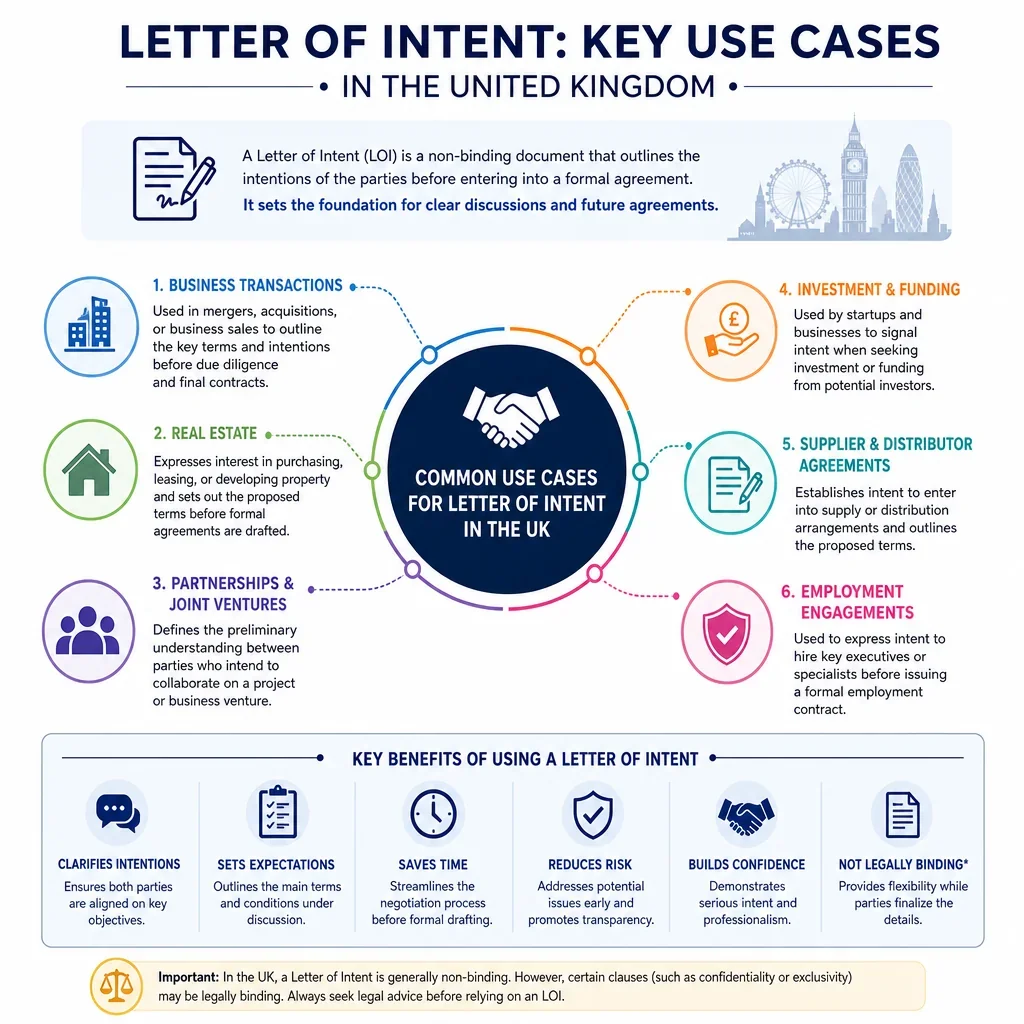
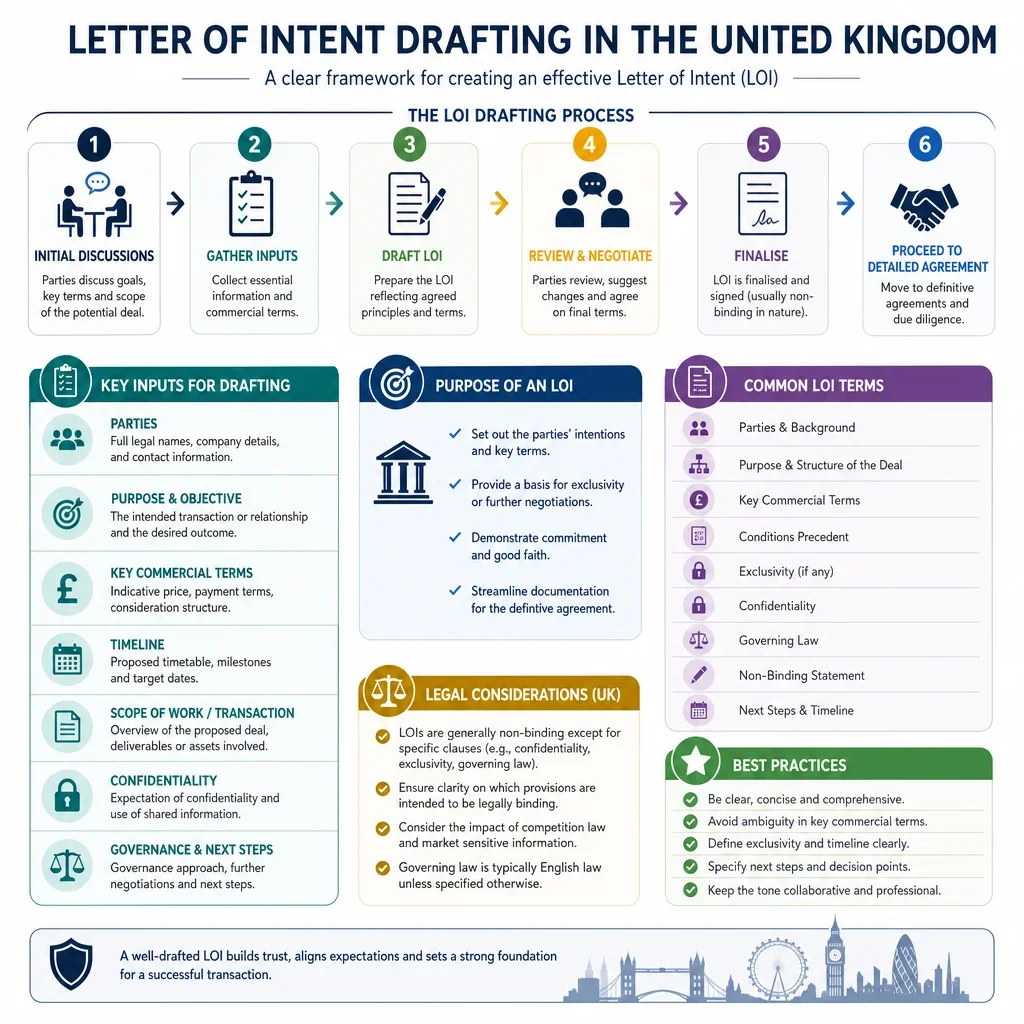
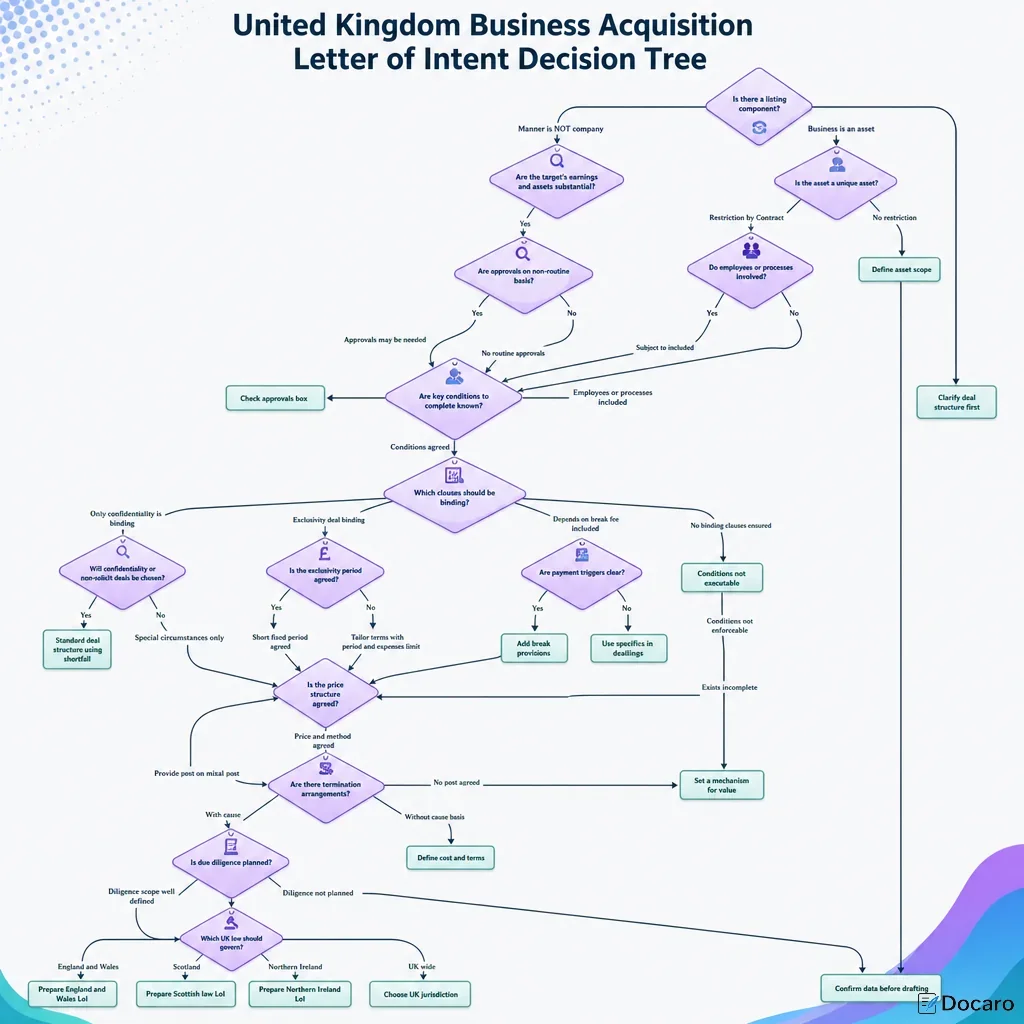
Using a letter of intent instead of a binding contract may inadvertently create enforceable obligations or fail to protect your interests adequately.
What a Proper Letter of Claim Should Include
- Your DetailsInclude your full name, address, and contact information at the top to identify you clearly.
- Recipient's DetailsState the full name and address of the person or company you are claiming against.
- Clear Description of the IssueBriefly explain what went wrong, such as a faulty product or unpaid service, with relevant dates.
- What You WantSpecify the remedy you seek, like a refund, repair, or payment of a certain amount.
- Amount ClaimedIf money is involved, state the exact amount you are claiming, including any interest or costs.
- Deadline for ResponseGive them a reasonable time, usually 14 or 28 days, to reply or meet your demands.
- Next Steps WarningMention that if they do not respond or act, you may take further action like court proceedings.
- Date and SignatureEnd with the date of the letter and your signature to make it official.
Generate Your Document in 4 Easy Steps
Why Use Docaro?
 United Kingdom
Free Example Letter of Intent Template
Below is a free template example of a Letter of Intent for use in the United Kingdom generated by our AI model.
The clauses in your actual Letter of Intent will vary from this example as they will be entirely bespoke to your requirements as set out in the questionnaire you complete.
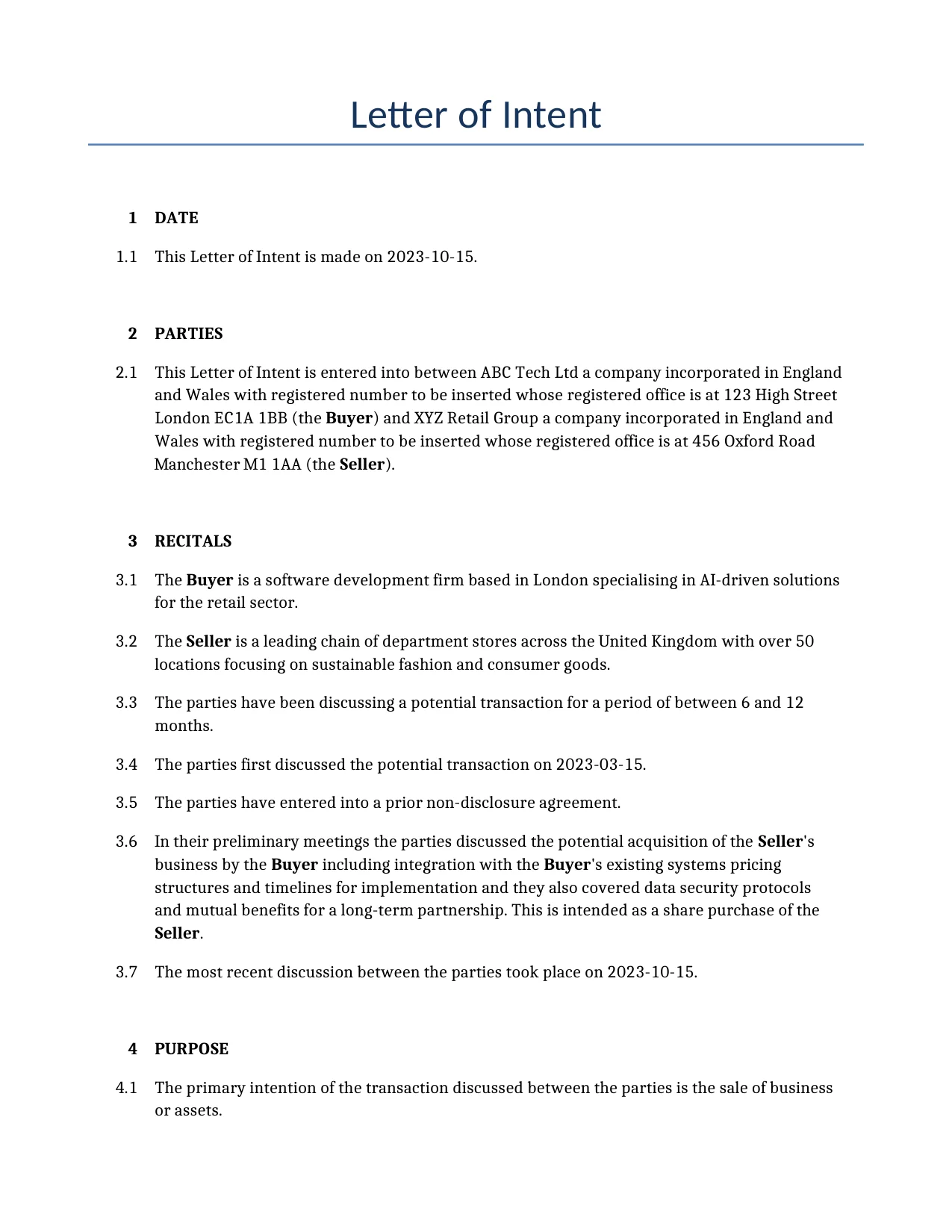
Letter of Intent
1DATE
This Letter of Intent is made on 2023-10-15.
2PARTIES
This Letter of Intent is entered into between ABC Tech Ltd a company incorporated in England and Wales with registered number to be inserted whose registered office is at 123 High Street London EC1A 1BB (the Buyer) and XYZ Retail Group a company incorporated in England and Wales with registered number to be inserted whose registered office is at 456 Oxford Road Manchester M1 1AA (the Seller).
3RECITALS
The Buyer is a software development firm based in London specialising in AI-driven solutions for the retail sector.
The Seller is a leading chain of department stores across the United Kingdom with over 50 locations focusing on sustainable fashion and consumer goods.
The parties have been discussing a potential transaction for a period of between 6 and 12 months.
The parties first discussed the potential transaction on 2023-03-15.
The parties have entered into a prior non-disclosure agreement.
In their preliminary meetings the parties discussed the potential acquisition of the Seller's business by the Buyer including integration with the Buyer's existing systems pricing structures and timelines for implementation and they also covered data security protocols and mutual benefits for a long-term partnership. This is intended as a share purchase of the Seller.
The most recent discussion between the parties took place on 2023-10-15.
4PURPOSE
The primary intention of the transaction discussed between the parties is the sale of business or assets.
The overall objective of this Letter of Intent is to express interest in the sale of the target business and to outline the key terms for commencing exclusive negotiations.
5NO OBLIGATION TO PROCEED
This Letter of Intent does not create any obligation for either party to enter into the proposed transaction and either party may withdraw at any time prior to signing a formal agreement subject to the binding provisions of this Letter of Intent.
6KEY TERMS OF THE PROPOSED TRANSACTION
The Buyer is interested in acquiring the target business to expand its market presence in the United Kingdom retail sector and to leverage synergies with its existing operations.
The type of transaction proposed is a share purchase.
The proposed purchase price for the transaction is \£1,500,000 (one million five hundred thousand pounds sterling) which is exclusive of VAT. The price is fixed with no adjustments unless otherwise agreed in writing between the parties.
The payment structure for the purchase price shall be a lump sum on completion.
The target date for completion of the transaction is 2024-12-31.
The parties shall negotiate in good faith the framework for negotiations as outlined in this Letter of Intent.
7EXCLUSIVITY
The Seller grants to the Buyer a period of exclusivity of 30 days during which the Seller shall not negotiate with any third parties regarding the subject matter of this Letter of Intent.
The exclusivity covers the negotiation and potential acquisition of the entire business operations including all tangible and intangible assets such as property intellectual property and customer contracts.
The Buyer shall keep the exclusivity and all negotiations confidential in accordance with the Confidentiality section of this Letter of Intent. In the event of any breach of this exclusivity the Buyer shall be entitled to seek injunctive relief or damages. At the end of the 30-day period this exclusivity shall expire unless the parties agree in writing to an extension.
8DUE DILIGENCE
The Buyer shall be entitled to conduct a due diligence investigation of the target business commencing on 2024-01-15 and ending on 2024-03-15.
During the due diligence period the Buyer shall have access to the financial statements customer contracts intellectual property records and operational data of the target business.
The Buyer shall sign a separate confidentiality agreement before accessing any information during the due diligence process.
The Seller will provide reasonable assistance and access to information and personnel during due diligence subject to the confidentiality obligations. The Buyer will conduct due diligence at its own risk and expense.
9CONFIDENTIALITY
The parties shall observe mutual confidentiality obligations in respect of this Letter of Intent and all related information.
Confidential information means any information disclosed by one party to the other whether orally or in writing that is designated as confidential or that reasonably should be understood to be confidential given the nature of the information and the circumstances of disclosure including but not limited to business plans financial data and technical specifications.
The confidentiality obligations shall commence on 2024-01-01.
The confidentiality obligations shall continue indefinitely until the completion of the transaction.
Confidential information may be disclosed if required by law to professional advisors or with the prior written consent of the disclosing party.
Upon request the receiving party shall return or destroy all confidential information.
This clause 9 shall be governed by the laws of England and Wales.
10NON-BINDING AND BINDING PROVISIONS
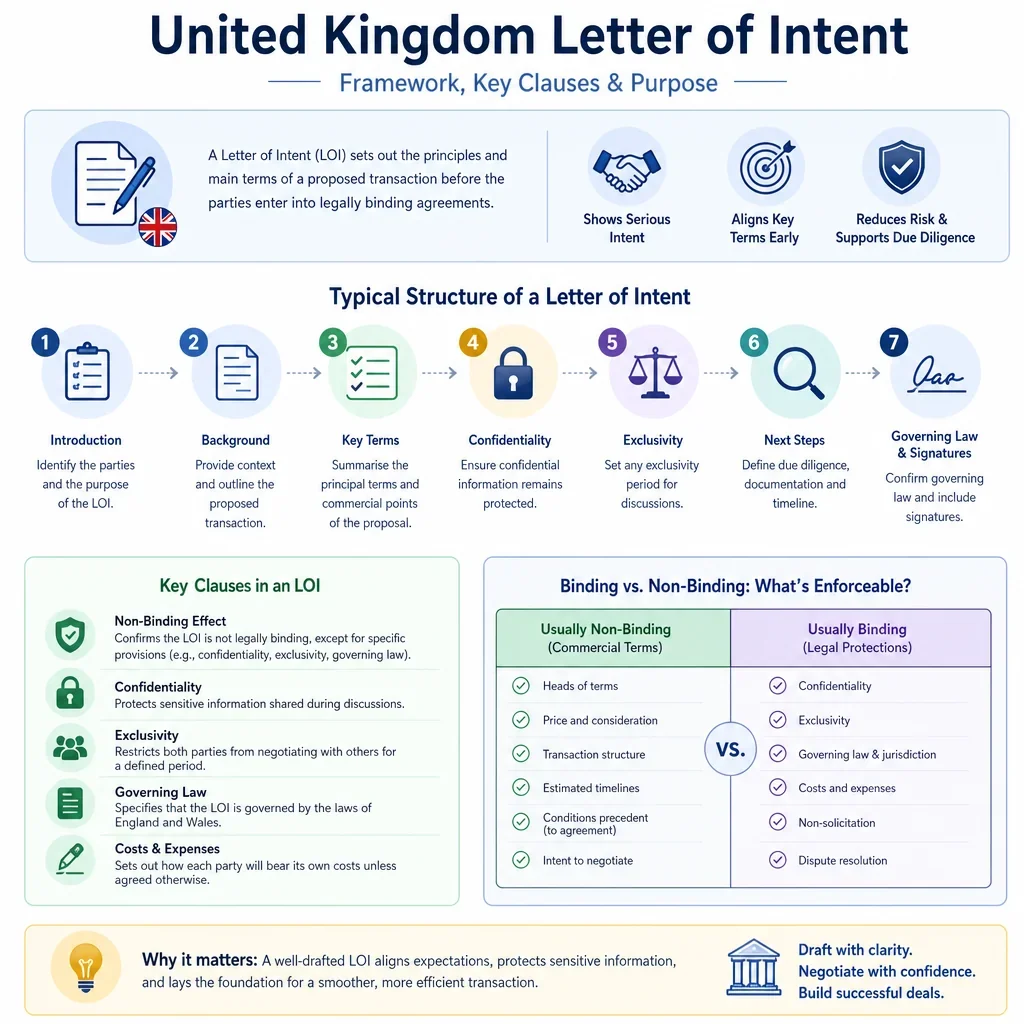
This Letter of Intent is non-binding except for the provisions relating to Exclusivity (section 7) Confidentiality (section 9) Costs and Expenses (section 13) Governing Law (section 23) Notices (section 16) Variation (section 18) Entire Agreement (section 14) Severability (section 15) Termination (section 12) Contracts (Rights of Third Parties) (section 19) Dispute Resolution (section 22) Break Fee (section 14) and Representations and Warranties (section 12) which provisions (to the extent expressed as binding) shall be binding on the parties. The rest of the Letter of Intent is non-binding.
11CONDITIONS PRECEDENT
The proposed transaction shall be conditional upon the satisfactory completion of due diligence regulatory approvals no material adverse change in the condition of the target and the obtaining of all necessary third-party consents.
All conditions precedent must be satisfied by the long stop date of 2024-12-31.
12REPRESENTATIONS AND WARRANTIES
The final sale and purchase agreement will contain standard representations and warranties from the Seller regarding the business including but not limited to authority to sell accounts accuracy no undisclosed liabilities and IP ownership. These will be subject to limitations on liability to be negotiated in the final agreement.
13TERMINATION
This Letter of Intent may be terminated by either party upon the occurrence of a material breach by the other party by mutual agreement failure to satisfy conditions precedent by the long stop date or if due diligence reveals material issues which are unacceptable to the Buyer.
Termination shall require a notice period to be given in accordance with clause 16.
Upon termination the parties shall return or destroy all confidential information in accordance with clause 9 the exclusivity period shall end and no further obligations shall arise except for those that are expressed to survive termination.
14COSTS AND EXPENSES
Each party shall bear its own costs and expenses incurred during the negotiations and the due diligence process.
The costs and expenses referred to in this clause 14 shall include legal fees due diligence costs and travel and accommodation expenses.
There is no cap on such costs and expenses unless separately agreed in writing between the parties.
15BREAK FEE
No break fee shall apply if one party withdraws without cause. Each party shall bear its own costs as set out in the Costs and Expenses section.
16ENTIRE AGREEMENT
This Letter of Intent constitutes the entire agreement between the parties and supersedes all prior written correspondence oral discussions and preliminary drafts relating to the subject matter hereof.
Any future modifications to this Letter of Intent must be in writing and signed by both parties.
17SEVERABILITY
If any provision of this Letter of Intent is held to be invalid or unenforceable the remaining provisions shall continue in full force and effect.
18NOTICES
Any notice required to be given under this Letter of Intent shall be in writing and shall be served by post or by email.
Notices to the Buyer shall be sent to 123 High Street London EC1A 1BB United Kingdom for the attention of The Company Secretary.
Notices to the Seller shall be sent to 456 Oxford Road Manchester M1 1AA United Kingdom for the attention of John Smith.
A notice shall be deemed served if sent by post on the second business day after posting and if sent by email on the date of transmission provided that such day is not a Saturday Sunday or bank holiday in which case the notice shall be deemed served on the next following business day.
19VARIATION
No variation of this Letter of Intent shall be effective unless it is in writing and signed by the parties.
20CONTRACTS (RIGHTS OF THIRD PARTIES) ACT 1999
A person who is not a party to this Letter of Intent shall have no rights under the Contracts (Rights of Third Parties) Act 1999 to enforce any term of this Letter of Intent.
21COMPLIANCE WITH LEGISLATION
The parties agree to comply with all applicable laws in connection with this Letter of Intent and the proposed transaction including but not limited to the Bribery Act 2010 the Data Protection Act 2018 and GDPR (given the AI and software context) the Competition Act 1998 the Unfair Contract Terms Act 1977 the Misrepresentation Act 1967 the Sale of Goods Act 1979 and the Law of Property (Miscellaneous Provisions) Act 1989.
22GOVERNING LAW AND JURISDICTION
This Letter of Intent and any dispute or claim arising out of or in connection with it or its subject matter or formation shall be governed by and construed in accordance with the laws of England and Wales.
The parties agree that the courts of England and Wales shall have exclusive jurisdiction to settle any dispute or claim that arises out of or in connection with this Letter of Intent or its subject matter or formation.
23DISPUTE RESOLUTION
The parties shall first attempt to resolve any dispute arising out of or in connection with this Letter of Intent by good faith negotiations. If the dispute is not resolved within 14 days either party may refer it to mediation under the CEDR Model Mediation Procedure. If the dispute is not resolved by mediation either party may commence litigation. This clause is binding on the parties.
24SIGNATURES
Signed for and on behalf of ABC Tech Ltd by ___________________________ Name: Title: Date:
Signed for and on behalf of XYZ Retail Group by ___________________________ Name: Title: Date:
This example shows approximately 70% of a typical document and is provided for illustrative purposes only. The remaining content has been omitted.
Every document generated by Docaro is tailored to your specific circumstances, jurisdiction and the information you provide. The completed document includes all applicable clauses and provisions required for your situation.
To generate the full, personalised document, answer a short series of questions and your document will be created instantly.
Useful Resources When Considering a Letter of Intent in the United Kingdom
United Kingdom Reference Legislation
Letter of Intent FAQs
Document Generation FAQs
Related Articles