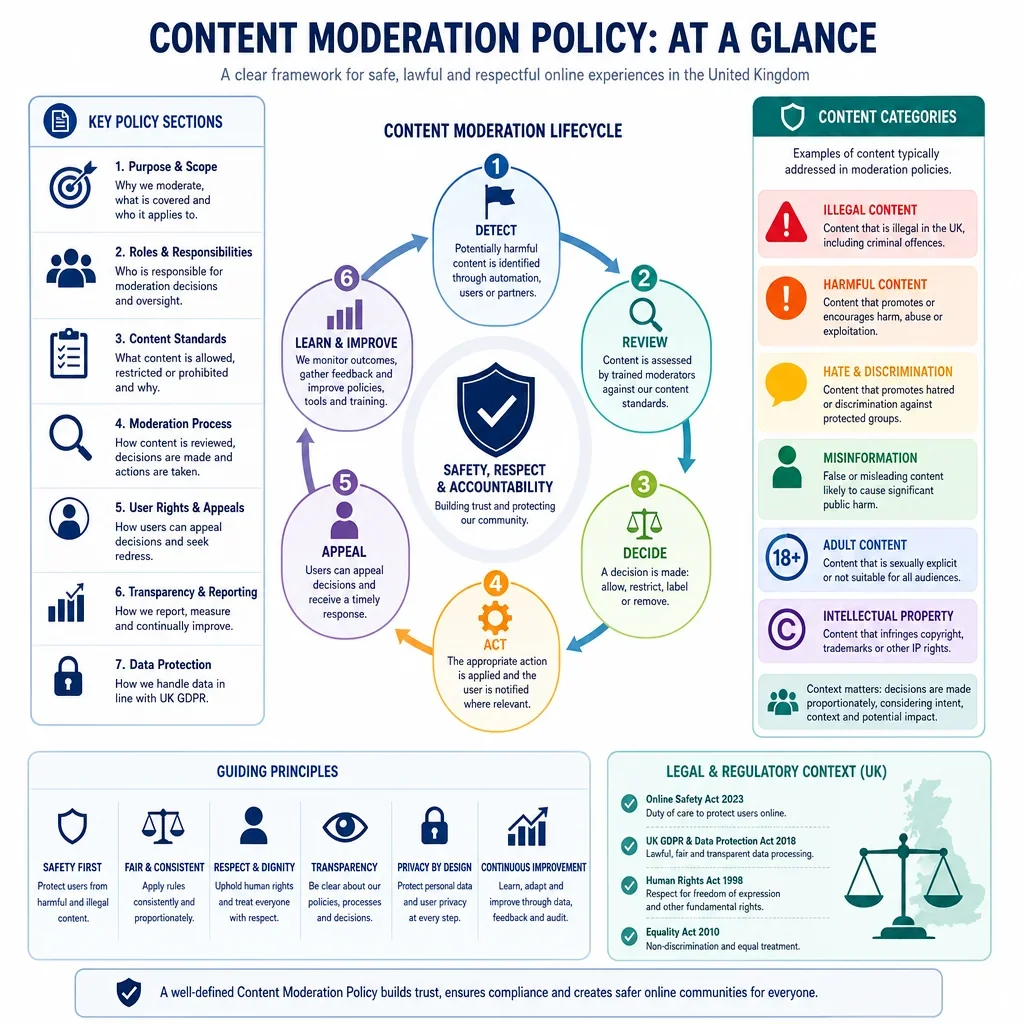
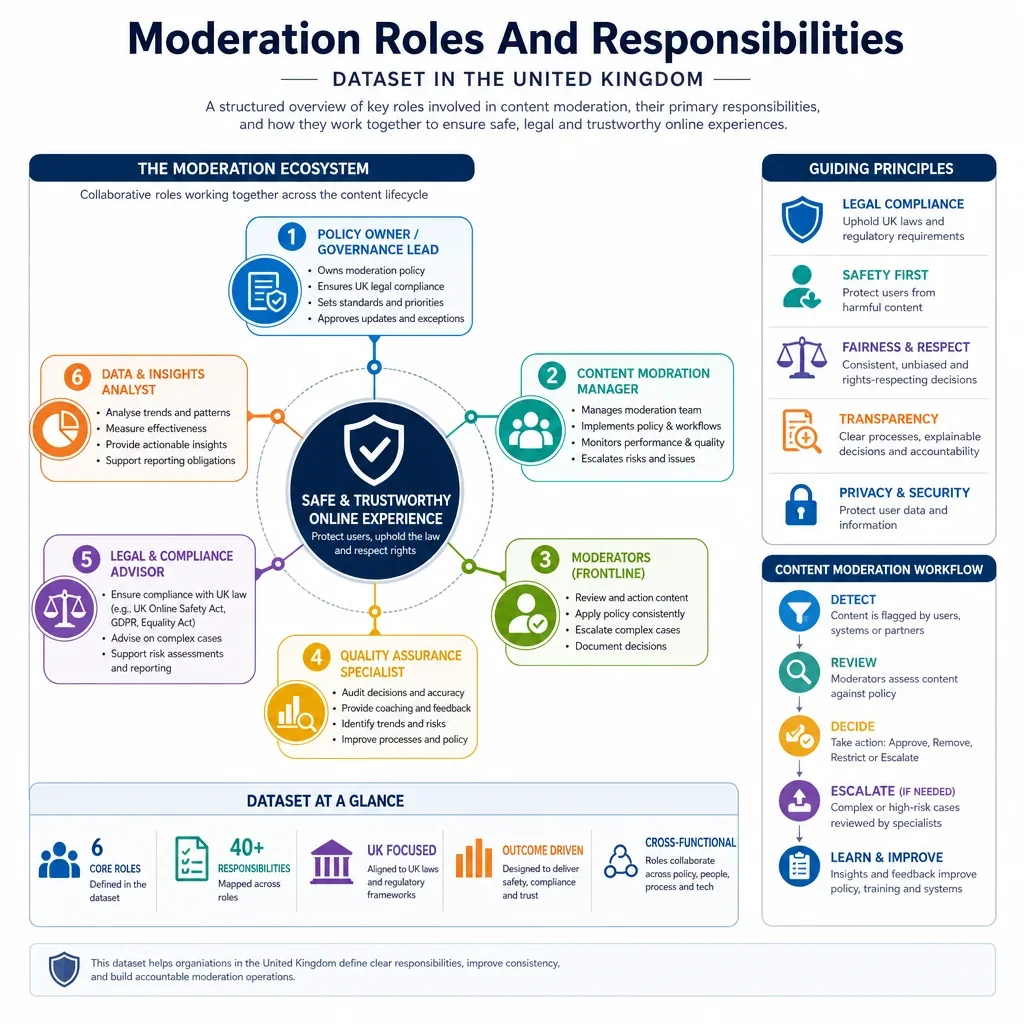
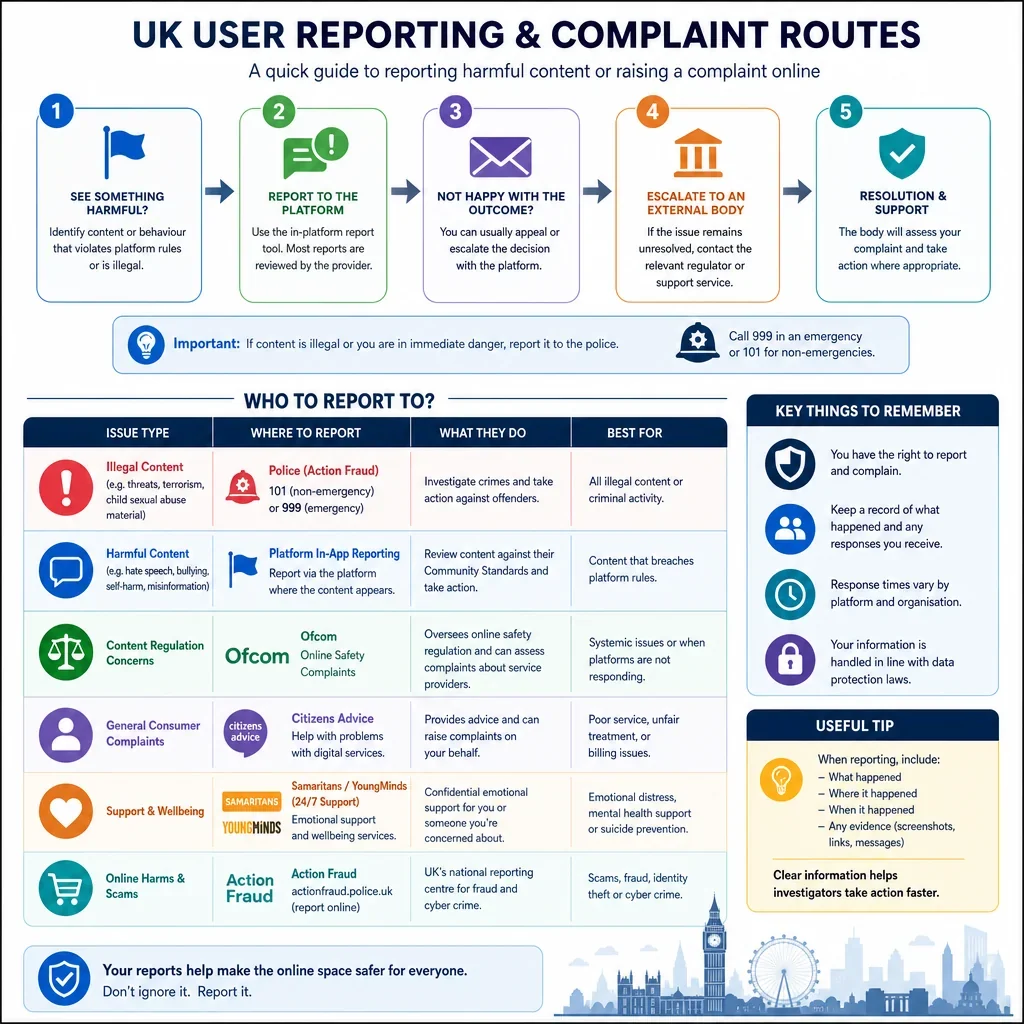
AI Generated Content Moderation Policy for use in the United Kingdom
PDF & Word - 2026 Updated
Docaro Pricing
When do you need a Content Moderation Policy in the United Kingdom?
British Legal Rules for a Content Moderation Policy
Using the wrong structure for a moderation policy can expose your organization to legal risks under UK data protection and equality laws.
What a Proper Content Moderation Policy Should Include
- Clear Rules on Allowed ContentDefine what types of content are permitted on your platform to set user expectations.
- Prohibited Content ListSpecify harmful or illegal materials, such as hate speech, violence, or illegal activities, that users must not post.
- User Reporting MechanismsProvide easy ways for users to report potential violations so issues can be addressed quickly.
- Moderation Review ProcessOutline how reported content is reviewed, including who handles it and the timeline for decisions.
- Consequences for ViolationsExplain the steps taken against rule-breakers, from warnings to account removal.
- Appeals and FairnessDescribe how users can challenge moderation decisions to ensure transparency and fairness.
- Data Protection ComplianceState how user data is handled during moderation in line with UK privacy laws.
- Updates and CommunicationDetail how the policy will be updated and how changes are communicated to users.
Generate Your Document in 4 Easy Steps
Why Use Docaro?
 United Kingdom
Free Example Content Moderation Policy Template
Below is a free template example of a Content Moderation Policy for use in the United Kingdom generated by our AI model.
The clauses in your actual Content Moderation Policy will vary from this example as they will be entirely bespoke to your requirements as set out in the questionnaire you complete.
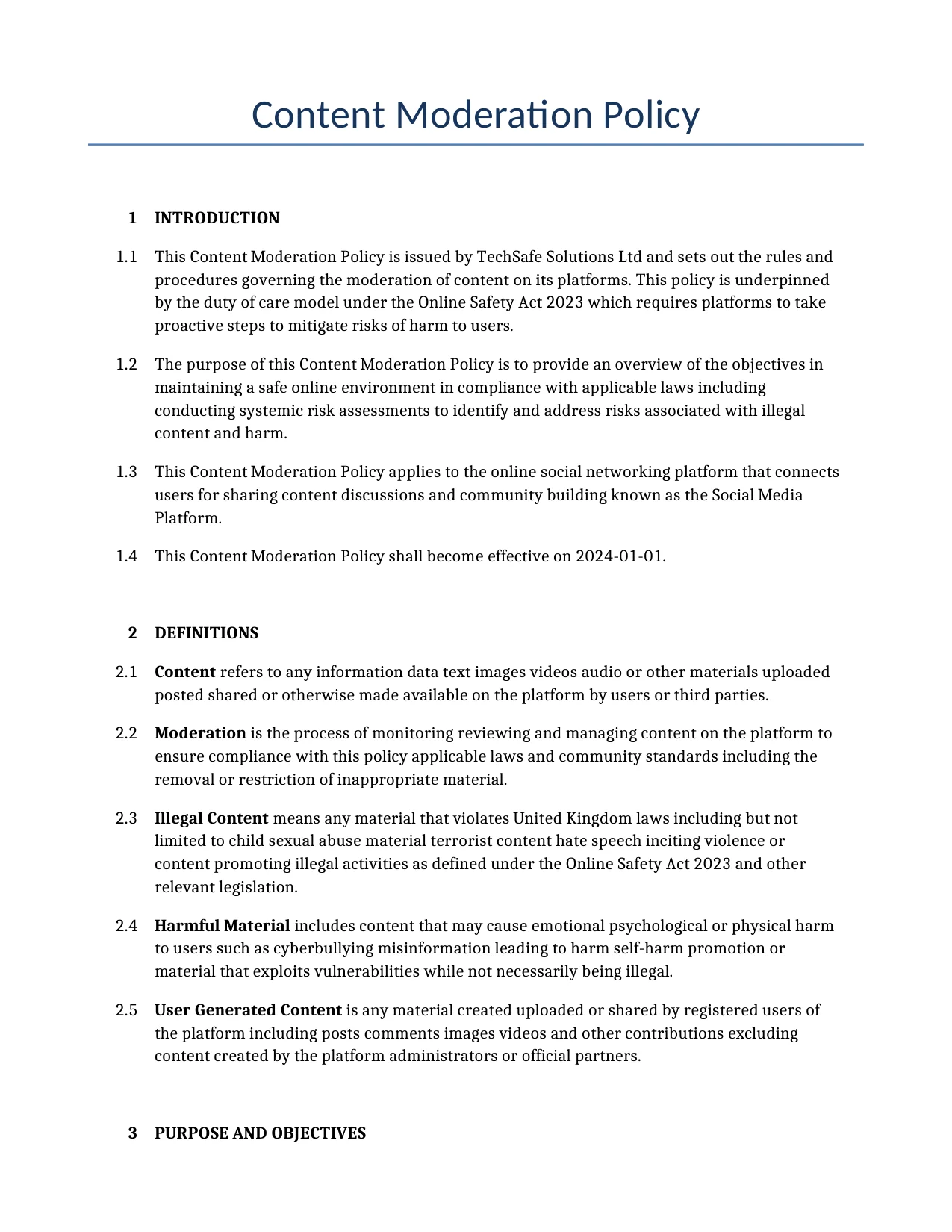
Content Moderation Policy
1INTRODUCTION
This Content Moderation Policy is issued by TechSafe Solutions Ltd and sets out the rules and procedures governing the moderation of content on its platforms. This policy is underpinned by the duty of care model under the Online Safety Act 2023 which requires platforms to take proactive steps to mitigate risks of harm to users.
The purpose of this Content Moderation Policy is to provide an overview of the objectives in maintaining a safe online environment in compliance with applicable laws including conducting systemic risk assessments to identify and address risks associated with illegal content and harm.
This Content Moderation Policy applies to the online social networking platform that connects users for sharing content discussions and community building known as the Social Media Platform.
This Content Moderation Policy shall become effective on 2024-01-01.
2DEFINITIONS
Content refers to any information data text images videos audio or other materials uploaded posted shared or otherwise made available on the platform by users or third parties.
Moderation is the process of monitoring reviewing and managing content on the platform to ensure compliance with this policy applicable laws and community standards including the removal or restriction of inappropriate material.
Illegal Content means any material that violates United Kingdom laws including but not limited to child sexual abuse material terrorist content hate speech inciting violence or content promoting illegal activities as defined under the Online Safety Act 2023 and other relevant legislation.
Harmful Material includes content that may cause emotional psychological or physical harm to users such as cyberbullying misinformation leading to harm self-harm promotion or material that exploits vulnerabilities while not necessarily being illegal.
User Generated Content is any material created uploaded or shared by registered users of the platform including posts comments images videos and other contributions excluding content created by the platform administrators or official partners.
3PURPOSE AND OBJECTIVES
The primary purpose of this Content Moderation Policy is to create a safe and inclusive online environment for all users by proactively identifying and removing illegal or harmful content while balancing the promotion of free expression and compliance with United Kingdom regulatory requirements such as the Online Safety Act. This includes fulfilling the duty of care by conducting systemic risk assessments to identify and mitigate risks of harm from illegal content and other priority harms.
The key objectives of this Content Moderation Policy are preventing illegal content mitigating harmful content ensuring user privacy and promoting transparency.
Under the Online Safety Act 2023 the platform commits to assessing and mitigating systemic risks including those related to illegal content and harm to children.
4SCOPE OF APPLICATION
This Content Moderation Policy applies to all users of the online platforms including registered members and anonymous visitors.
This Content Moderation Policy covers user-generated text images videos and audio content as well as any third-party embedded materials such as links or iframes from external sources.
The platforms covered by this Content Moderation Policy are SocialConnect App ForumHub Website and VideoShare Platform.
The types of content covered under this Content Moderation Policy are user-generated text content user-generated multimedia content third-party embedded content and advertised content.
This Content Moderation Policy covers user-generated content on the platforms.
This Content Moderation Policy covers third-party materials hosted or displayed on the platforms.
This Content Moderation Policy applies strictly to the United Kingdom.
5LEGAL AND REGULATORY FRAMEWORK
TechSafe Solutions Ltd complies with the Online Safety Act 2023 by implementing measures to identify and mitigate risks of illegal and harmful content including proactive monitoring and reporting mechanisms.
This Content Moderation Policy is also guided by the Data Protection Act 2018 the Defamation Act 2013 the Malicious Communications Act 1988 the Counter-Terrorism and Border Security Act 2019 the Counter-Terrorism and Sentencing Act 2021 and the Investigatory Powers Act 2016.
TechSafe Solutions Ltd intends to register with Ofcom as required under relevant United Kingdom legislation for the platform.
The approach to conducting risk assessments as mandated by United Kingdom legislation involves annual comprehensive risk assessments conducted by a dedicated compliance team utilizing data analytics to evaluate potential harms followed by the implementation of mitigation strategies and regular reviews to ensure ongoing adherence to United Kingdom legislation.
The platform aligns with Ofcom\’s codes of practice under the Online Safety Act 2023 including risk assessment methodologies safety duties for priority illegal content and transparency reporting requirements to ensure effective compliance and harm mitigation.
6PROHIBITED CONTENT
TechSafe Solutions Ltd prohibits child sexual abuse content on the platform.
TechSafe Solutions Ltd prohibits terrorism-related material on the platform.
TechSafe Solutions Ltd prohibits hate speech on the platform.
TechSafe Solutions Ltd prohibits harassment on the platform.
Child Sexual Exploitation and Abuse Material (CSEA): The platform prohibits all forms of child sexual exploitation and abuse material including any content depicting sexual activity with minors grooming or exploitation. Proactive detection measures include AI-based hashing (e.g. PhotoDNA) and machine learning classifiers for image video and text analysis. All detected or reported CSEA will be reported to the National Crime Agency (NCA) and the Internet Watch Foundation (IWF) in line with obligations under the Online Safety Act 2023 which designates CSEA as priority illegal content requiring swift removal and risk mitigation.
Fraud and Scams: The platform prohibits content promoting or facilitating fraud scams or phishing activities as defined under the Fraud Act 2006 and Online Safety Act 2023 priority illegal content. Examples include fake investment schemes phishing links or deceptive advertisements intended to defraud users.
Cybercrime: The platform prohibits content that promotes or enables cybercrime such as hacking malware distribution or denial-of-service attacks in line with the Computer Misuse Act 1990 and Online Safety Act 2023. This includes tutorials on exploiting vulnerabilities or sharing malicious code.
Revenge Pornography and Non-Consensual Intimate Images: The platform prohibits the sharing of revenge pornography or intimate images without consent as criminalised under the Criminal Justice and Courts Act 2015 and designated as priority illegal content under the Online Safety Act 2023. This includes deepfakes or edited intimate material distributed without permission.
Other Priority Illegal Content: The platform prohibits additional priority illegal content under the Online Safety Act 2023 including content promoting self-harm or suicide assisting in criminal activity such as drug trafficking or inciting violence. Examples include detailed self-harm instructions or content glorifying violent extremism.
Terrorist Content: In compliance with the Counter-Terrorism and Border Security Act 2019 and Online Safety Act 2023 the platform prohibits all terrorist content including glorification of terrorism recruitment material or instructions for terrorist acts. Such content will be removed within 1 hour of detection or report with immediate referral to relevant authorities including the police and Ofcom where required.
7CONTENT MODERATION PRINCIPLES
The platform will ensure transparency in content moderation decisions by publishing quarterly reports on moderation actions including anonymized statistics on content removals and the reasons behind them.
The platform will also provide users with clear notifications explaining the specific policy violation when their content is moderated along with information on how to appeal.
The platform enforces proportionality in moderation actions meaning responses are scaled to the severity of the content violation.
The fairness mechanisms included in the content moderation principles are an appeal process bias audits and a diverse moderation team.
The platform respects freedom of expression as a fundamental right allowing diverse viewpoints to flourish on the platform.
This respect for freedom of expression is balanced with user safety by prohibiting content that incites violence harassment or discrimination ensuring a safe environment for all users while upholding democratic values.
The platform prioritizes user safety over unrestricted expression in cases of potential harm.
8MODERATION PROCESSES AND PROCEDURES
The method used for the initial triage of potentially violating content is automated keyword scanning combined with user reports for flagging potential issues.
Automated tools are incorporated in the initial triage process.
The roles involved in the human review process after initial triage are the internal moderation team and senior management oversight.
The maximum time limit for completing the initial triage of content is 24 hours.
The criteria used for escalating content from initial review to higher levels are content involving severe hate speech threats of violence or legal compliance issues that require expert input.
There are three levels of escalation in the moderation process.
The specific actions taken on confirmed violating content are content removal user account suspension and notification to relevant authorities if required by United Kingdom law.
9HUMAN AND AUTOMATED MODERATION
The platform plans to use AI tools in the content moderation workflow.
The platform intends to employ machine learning algorithms for moderating content.
The moderation workflow includes human reviewers to assess content.
The primary role of AI tools in the moderation workflow is initial flagging and automated removal.
The responsibilities of human reviewers in the moderation process are final decision making and appeal handling.
The key limitations of AI tools in the planned moderation workflow are that AI tools may struggle with contextual nuances sarcasm or culturally specific content potentially leading to false positives or negatives in flagging.
The limitations of human reviewers in the moderation setup are that human reviewers can be subject to fatigue bias or inconsistencies in judgment especially under high volumes of content.
The order of the elements in the moderation workflow is AI first then human.
10REPORTING MECHANISMS
The platform enables in-app reporting tools for users to report content for review.
The platform establishes an external hotline for stakeholders to report content for review.
The external reporting channels included for users and stakeholders are an email address a phone hotline and an online web form.
The specific contact details for the external hotline are email moderation@company.co.uk phone 0800 123 4567 available 24/7.
The platform commits to a standard response time for reported content reviews of initial acknowledgment within 24 hours and full review within 48 hours.
The platform allows anonymous reporting through the mechanisms.
The categories of content that users may select when submitting reports are illegal content harmful but legal content and misinformation.
The platform takes measures to ensure reporting mechanisms are accessible to all users by providing support for screen readers keyboard navigation multiple language options and compliance with WCAG 2.1 standards.
11INVESTIGATION AND DECISION-MAKING
The time limit set for completing investigations of user reports is within 48 hours of receiving the report.
The methods that the moderation team uses for acknowledging receipt of user reports are email notification and in-platform message.
A formal escalation procedure is included for complex investigations.
The senior moderation team authorizes the final moderation decisions.
The moderation team documents for each investigation outcome the date and time of investigation details of the report actions taken rationale for the decision and any appeals filed.
12ACTIONS AND REMEDIES
Content removal is included as a possible response to violations.
Upon detection of a violation the moderation team will review the content within 24 hours.
If confirmed the content will be immediately removed from the platform and the user will be notified via email with details of the violation and the reason for removal.
Account suspension is included as a possible response to violations.
The type of duration for account suspensions is a fixed duration.
Warnings are included as a possible response to violations.
Warnings will be issued via in-app notifications and email clearly outlining the nature of the violation and instructions on how to comply.
Escalations from warnings to more severe actions occur if violations persist.
The moderation team is required to report serious incidents to external United Kingdom authorities.
13APPEALS PROCESS
The review of appeals is authorized by senior management and an external independent reviewer.
The methods that users may use for submitting appeals are an online form and email.
To submit an appeal users must complete the online form on the website providing their username the original moderation decision details and any supporting evidence.
Alternatively users may send an email to appeals@company.co.uk with the subject line \'Moderation Appeal\' including the same information.
The platform acknowledges receipt of an appeal within 2 days.
The platform completes the review of an appeal within 14 days.
The criteria categories used for reviewing appeals are error in moderation decision new evidence provided and human rights consideration.
Appeals will be reviewed based on whether there was a clear error in the initial moderation decision such as misapplication of policy rules presentation of new evidence not considered previously issues with policy interpretation that may have led to unfair enforcement and considerations under human rights laws including freedom of expression under the Human Rights Act 1998.
Users are notified of appeal outcomes.
14TRANSPARENCY AND REPORTING
The platform commits to publishing regular transparency reports on the moderation activities.
The transparency reports are published on a quarterly frequency.
The first transparency report is published on 2024-06-30.
The specific metrics included in the transparency reports regarding moderation activities are number of removals reasons for removals and user appeals outcomes.
The transparency reports include details on compliance with United Kingdom regulatory obligations.
15USER RESPONSIBILITIES
Users are required to actively monitor their own content and interactions to ensure compliance with the Content Moderation Policy.
This includes refraining from posting any material that violates legal standards or platform rules promptly reporting any observed violations and cooperating with moderation teams during investigations.
Users must also respect the rights and privacy of other users while engaging with the platform.
Users are obligated to comply with the platform's terms of service agreement as part of their responsibilities.
Users are required to follow the community guidelines outlined in the Content Moderation Policy.
Users are explicitly responsible for avoiding hate speech and harassment illegal or harmful material misinformation and disinformation and spam and commercial abuse in their posts and interactions.
Users should report violations by using the \'Report\' button located next to the offending content or profile.
Users should provide a clear description of the issue including screenshots if possible and submit via the platform's dedicated reporting form.
All reports will be reviewed confidentially within 24-48 hours.
The age-related responsibilities imposed on users regarding content moderation compliance are a minimum age of 13 with parental consent.
Users acknowledge their responsibilities upon registration or first use.
16PLATFORM RESPONSIBILITIES
The tools and technologies that the platform uses to implement content moderation are advanced AI-driven tools such as machine learning algorithms for automated content scanning natural language processing for detecting hate speech and misinformation and image recognition software to identify illegal imagery.
The platform also integrates third-party APIs like those from Google Cloud Vision for enhanced detection capabilities.
The platform employs human moderators to assist in content moderation.
The last comprehensive risk assessment for the platform's content moderation was conducted on 2023-06-15.
The platform plans to conduct risk assessments for content moderation annually.
The platform has a formal policy for cooperating with United Kingdom law enforcement on content-related investigations.
Upon receiving a request from United Kingdom law enforcement the designated compliance officer reviews the request within 24 hours to verify its legitimacy and scope.
The platform then provides the requested data or content details in accordance with legal requirements while maintaining user privacy where possible and documents the interaction for audit purposes.
The types of content moderation that the platform implements to address United Kingdom-specific risks are automated AI filtering human review process user reporting mechanisms and proactive monitoring.
17DATA PROTECTION AND PRIVACY
Dr. Emily Carter is appointed as the specific Data Protection Officer for handling personal data during content moderation.
The contact email address for the Data Protection Officer is emily.carter@company.co.uk.
The legal bases under UK GDPR that the organization relies on for processing personal data during content moderation are legitimate interests and legal obligation.
A specific retention period is defined for personal data collected during content moderation.
Personal data will be retained for 6 months after the moderation process is complete unless required for ongoing legal investigations.
The security measures that the organization implements to protect personal data during content moderation are encryption access controls regular audits and staff training.
The organization does not share personal data from content moderation with any third parties.
The organization does not plan to transfer personal data from content moderation outside the UK or EEA.
The organization handles data subject rights requests related to content moderation data via email support.
A procedure is established for reporting data protection incidents during content moderation.
For automated decision-making in content moderation under UK GDPR Article 22 users have the right to obtain an explanation of the decision and to request human oversight or review. The platform ensures meaningful human involvement in all significant moderation decisions involving automated tools.
The platform commits to conducting Data Protection Impact Assessments (DPIAs) for content moderation systems involving personal data especially where automated processing is used to evaluate risks to users\’ rights and freedoms.
18TRAINING AND RESOURCES FOR MODERATORS
Training programs are provided for the moderation staff on United Kingdom legal requirements related to content moderation.
The training programs implemented for moderation staff on United Kingdom legal requirements cover key United Kingdom laws such as the Online Safety Act 2023 the Communications Act 2003 and the Equality Act 2010 with interactive sessions on identifying illegal content like hate speech and child exploitation material.
The frequency of United Kingdom legal training for the moderation staff is upon hiring and annually.
Training on bias mitigation is included in the programs for moderation staff.
The bias mitigation training for the moderation staff includes workshops on recognizing unconscious biases case studies from diverse cultural contexts and exercises using AI tools to audit moderation decisions for fairness.
Training on best practices for content moderation is provided to the staff.
The topics included in the best practices training for the moderation staff are decision-making protocols escalation procedures and tool usage and technology.
The resources provided to support the training of moderation staff include access to an online learning platform with video modules downloadable guides on United Kingdom regulations regular webinars with legal experts and a shared internal wiki for quick reference.
Ongoing updates and refresher training are committed to for moderation staff.
19MONITORING AND EVALUATION
Ongoing monitoring of the content moderation policy's effectiveness is implemented.
The company conducts monitoring activities for the content moderation policy monthly.
The company performs internal audits as part of monitoring the content moderation policy.
Feedback loops from users and moderators are established for the content moderation policy.
The company follows the procedure for updating the content moderation policy based on monitoring results by reviewing monitoring results quarterly and convening a cross-functional team to assess any identified gaps or emerging threats.
If updates are needed a draft revision will be prepared reviewed by legal and compliance teams for United Kingdom regulatory alignment and then approved by senior management before implementation with all changes communicated to staff and users.
20ENFORCEMENT AND COMPLIANCE
The internal enforcement mechanisms included in the Content Moderation Policy for handling violations by staff are regular audits of moderation decisions a whistleblower reporting system for anonymous tips and an internal review board to investigate violations.
Specific penalties are included for staff non-compliance in the Content Moderation Policy.
The United Kingdom authorities that the Content Moderation Policy specifies collaboration with regarding enforcement and compliance are Ofcom the Information Commissioner's Office (ICO) and the National Crime Agency (NCA).
The specific procedures for collaborating with United Kingdom authorities in the Content Moderation Policy are prompt reporting of serious violations within 24 hours sharing of relevant data upon formal request and participation in joint training sessions with authorities.
Staff training on enforcement and compliance occurs upon hiring and annually.
21UPDATES AND REVISIONS
The periodic review of the Content Moderation Policy occurs annually.
A specific individual or role within the company is designated to be responsible for conducting the policy reviews.
The trigger events included for initiating unscheduled reviews of the Content Moderation Policy are significant legislative changes technological advancements and incidents or breaches.
The company follows the procedure for implementing updates to the Content Moderation Policy by having any updates to the policy drafted by the designated reviewer reviewed by the legal team for compliance with United Kingdom regulations approved by senior management and then communicated to all employees via email and the company intranet.
The updated policy takes effect immediately upon approval.
A version control system is implemented to track all updates and revisions to the Content Moderation Policy.
The company retains records of all policy updates and revisions for 7 years.
22CONTACT INFORMATION
Dr. Emily Carter is designated as the contact person for inquiries and complaints regarding the Content Moderation Policy.
The email address provided for users to send inquiries and complaints about the Content Moderation Policy is moderation@ukcompany.co.uk.
The physical mailing address included for formal complaints or correspondence about the Content Moderation Policy is 123 Policy Street London SW1A 1AA United Kingdom.
The response time commitment set for acknowledging complaints under the Content Moderation Policy is within 48 hours.
An escalation procedure for unresolved complaints is included in the Contact Information section.
23GOVERNING LAW
This Content Moderation Policy is governed by the laws of England and Wales.
The policy specifies exclusive jurisdiction in the courts of England and Wales.
24SEVERABILITY
If any provision of this Content Moderation Policy is found to be invalid or unenforceable under English law the remainder of the policy remains enforceable.
A savings clause is included in the severability section to attempt reformation of invalid provisions.
25PROTECTIONS FOR CHILDREN AND AGE VERIFICATION
The platform complies with the Age Appropriate Design Code (AADC) and Online Safety Act 2023 by implementing age verification mechanisms such as Yoti or other certified tools to confirm user age at registration.
Default privacy settings for users under 18 are set to the highest level of protection including limiting visibility of profiles and content to approved contacts only.
The platform restricts harmful content targeting children by using AI classifiers to detect and block material related to self-harm eating disorders or bullying with zero tolerance for content that could cause significant harm to under-18s.
Parental controls and tools are provided allowing guardians to monitor and manage children\’s accounts including activity reports and content filters aligned with AADC principles.
The platform conducts child-specific risk assessments under the Online Safety Act 2023 and implements mitigations such as prohibiting targeted advertising to under-18s and ensuring high-risk features are disabled by default for younger users.
User education on online safety is promoted through in-app resources tailored for different age groups in compliance with the AADC\’s emphasis on age-appropriate design.
26COMPLAINTS HANDLING AND OFCOM ESCALATION
Users may submit complaints about content moderation decisions or illegal content via the in-app form email or hotline. All complaints regarding illegal content will be acknowledged within 2 working days.
Complaints will be investigated within 7 days with priority given to reports of priority illegal content under the Online Safety Act 2023. Users will be informed of the outcome and any actions taken.
If a complaint is not resolved satisfactorily within 14 days users may escalate the matter to Ofcom in accordance with the regulator\’s procedures under the Online Safety Act.
The platform maintains detailed records of all complaints and escalations for Ofcom inspection and publishes anonymised complaint statistics in its transparency reports.
Internal procedures ensure that complaints involving child safety or terrorist content are escalated immediately to senior compliance staff and relevant authorities.
27RECORD KEEPING AND AUDITS
The platform retains records of all moderation decisions user reports appeals and risk assessments for a minimum of 2 years or as required for Ofcom inspections in compliance with the Online Safety Act 2023 transparency and information duties.
Internal audits of moderation processes and compliance will be conducted at least annually with external audits commissioned every two years or upon significant regulatory changes.
Audit trails include timestamps decision rationales moderator identities and evidence considered ensuring full accountability during regulatory reviews.
The platform commits to full cooperation with Ofcom and other regulators providing requested records promptly and implementing recommendations from audit findings to improve systems.
28SIGNATURE
This Content Moderation Policy is executed on behalf of TechSafe Solutions Ltd by its authorized representative.
Name: _______________________________
Title: _______________________________
Date: _______________________________
Signature: _______________________________
This example shows approximately 70% of a typical document and is provided for illustrative purposes only. The remaining content has been omitted.
Every document generated by Docaro is tailored to your specific circumstances, jurisdiction and the information you provide. The completed document includes all applicable clauses and provisions required for your situation.
To generate the full, personalised document, answer a short series of questions and your document will be created instantly.
Useful Resources When Considering a Content Moderation Policy in the United Kingdom
United Kingdom Reference Legislation
Content Moderation Policy FAQs
Document Generation FAQs
Related Articles