AI Generated Information Security Policy for use in the United Kingdom
PDF & Word - 2026 Updated
Docaro Pricing
When Do You Need an Information Security Policy in the United Kingdom?
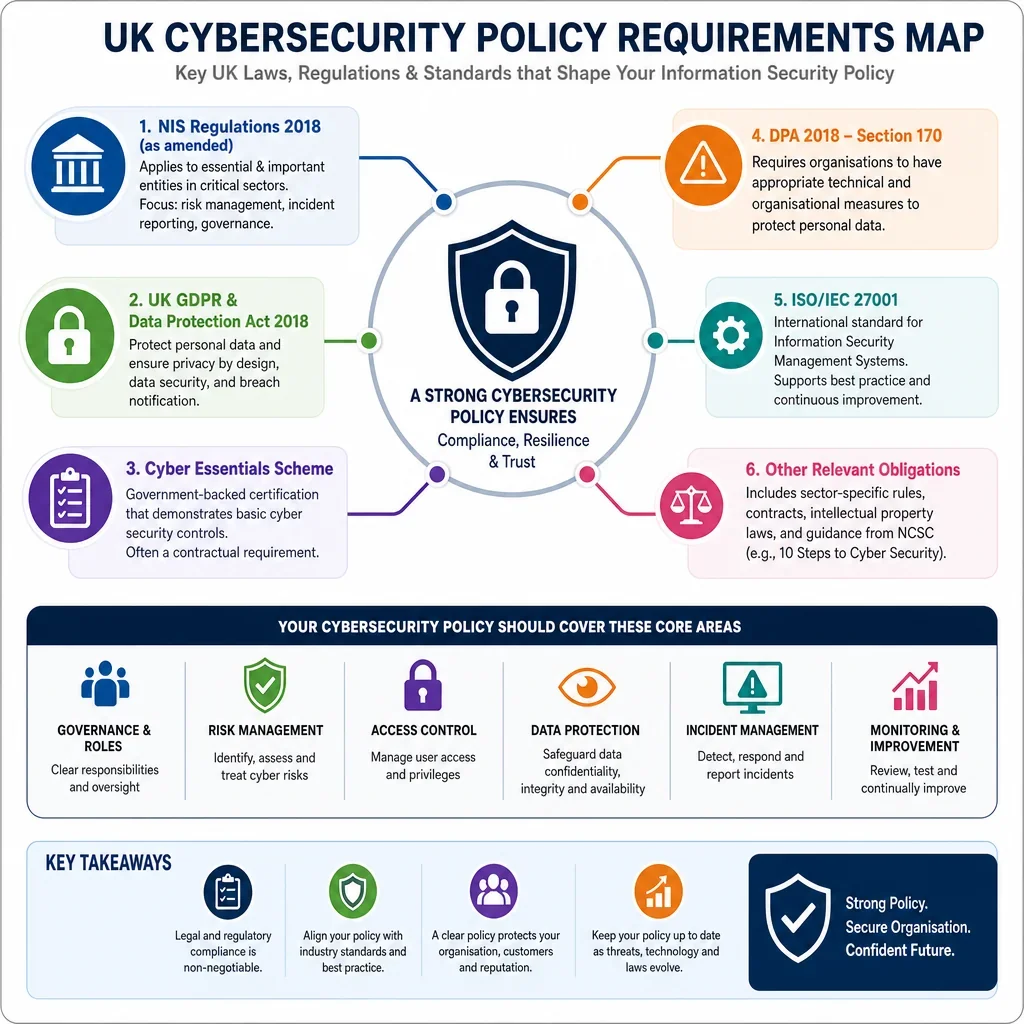
UK Legal Rules for an Information Security Policy
Using the wrong structure for a cybersecurity policy may fail to comply with UK data protection regulations like the UK GDPR.
What a Proper Information Security Policy Should Include
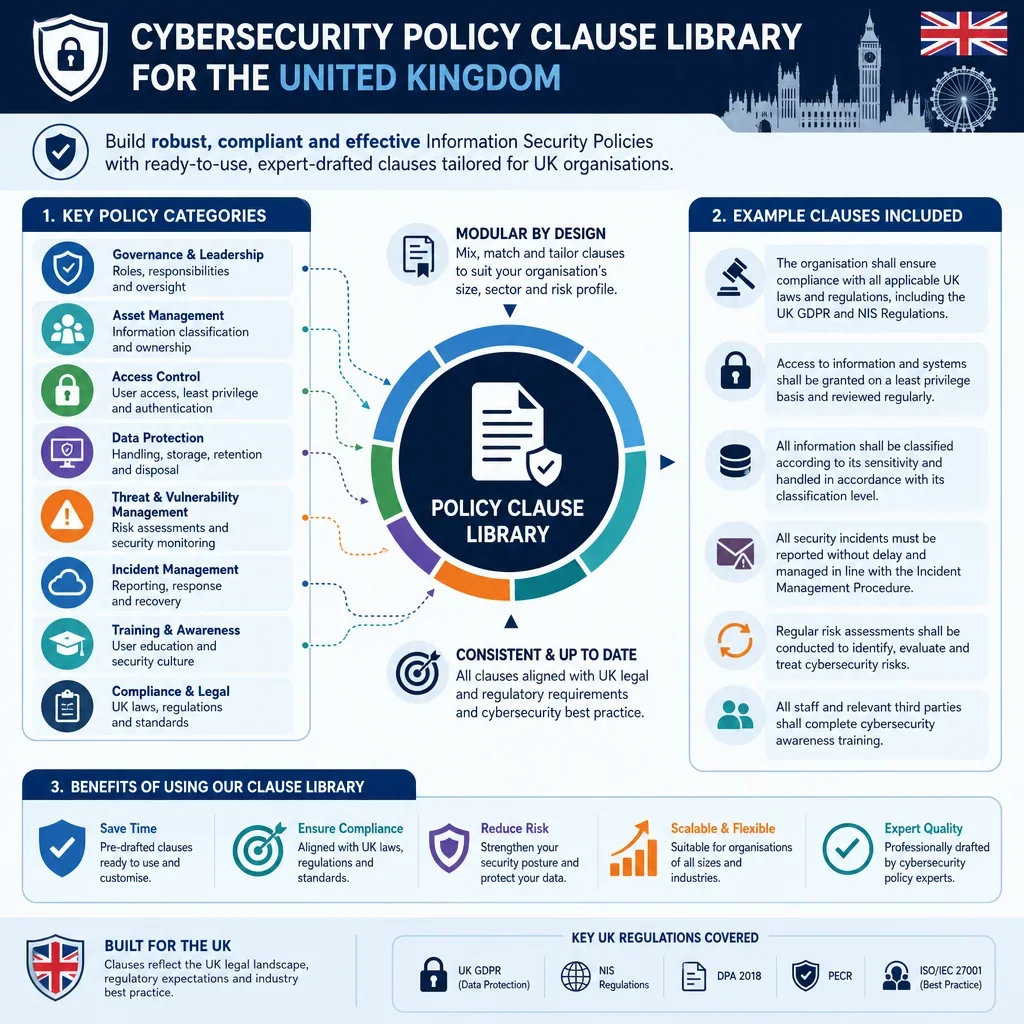
- Purpose and ScopeClearly state the policy's goals and which parts of the organization it applies to.
- Roles and ResponsibilitiesDefine who is accountable for security tasks, from leaders to everyday staff.
- Data ClassificationCategorize information by sensitivity levels to guide protection efforts.
- Access ControlsSet rules for who can view or use data, ensuring only authorized access.
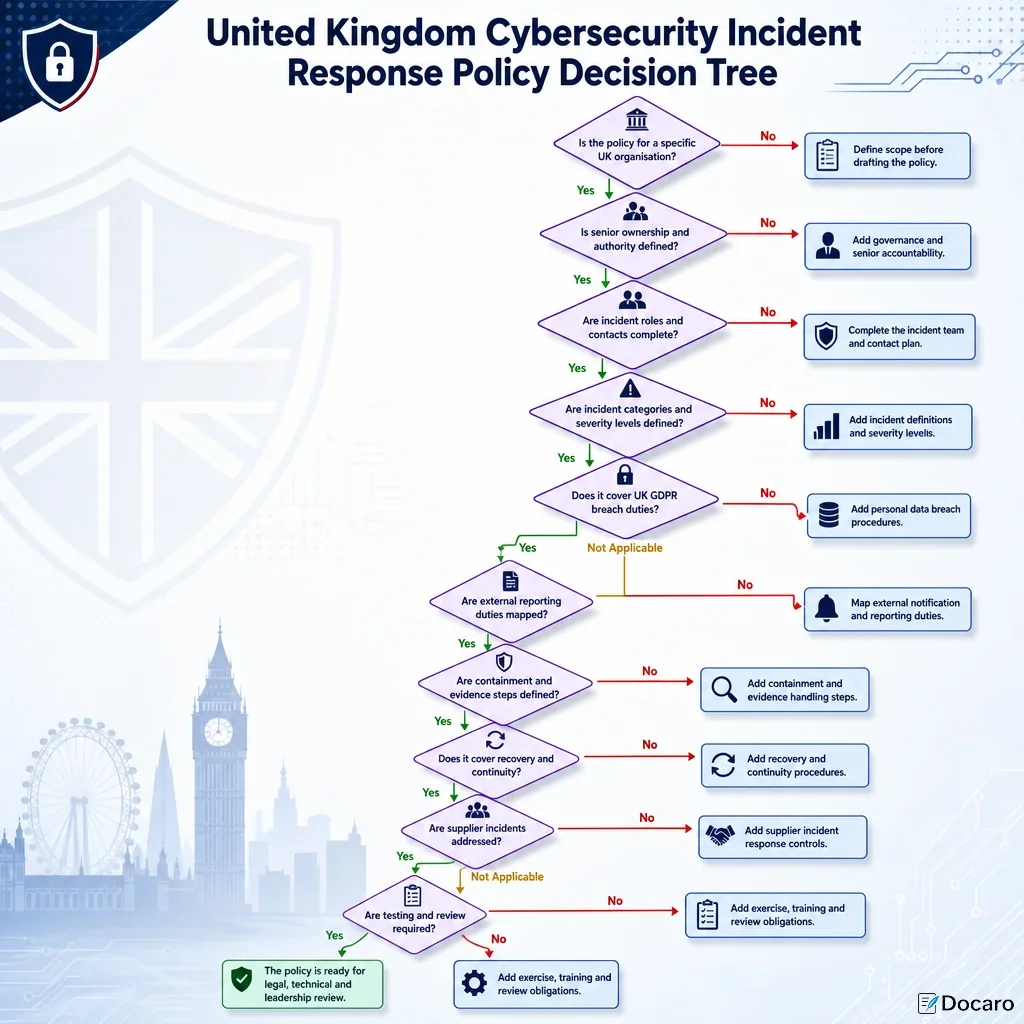
- Incident ResponseOutline steps to detect, report, and handle security breaches quickly.
- Training and AwarenessRequire regular education for employees on security best practices.
- Compliance and MonitoringDescribe how to check adherence and meet UK legal standards like the Data Protection Act.
- Review and UpdatesPlan for periodic policy reviews to keep it current with new threats.
Generate Your Document in 4 Easy Steps
Why Use Docaro?
 United Kingdom
Free Example Information Security Policy Template
Below is a free template example of a Information Security Policy for use in the United Kingdom generated by our AI model.
The clauses in your actual Information Security Policy will vary from this example as they will be entirely bespoke to your requirements as set out in the questionnaire you complete.
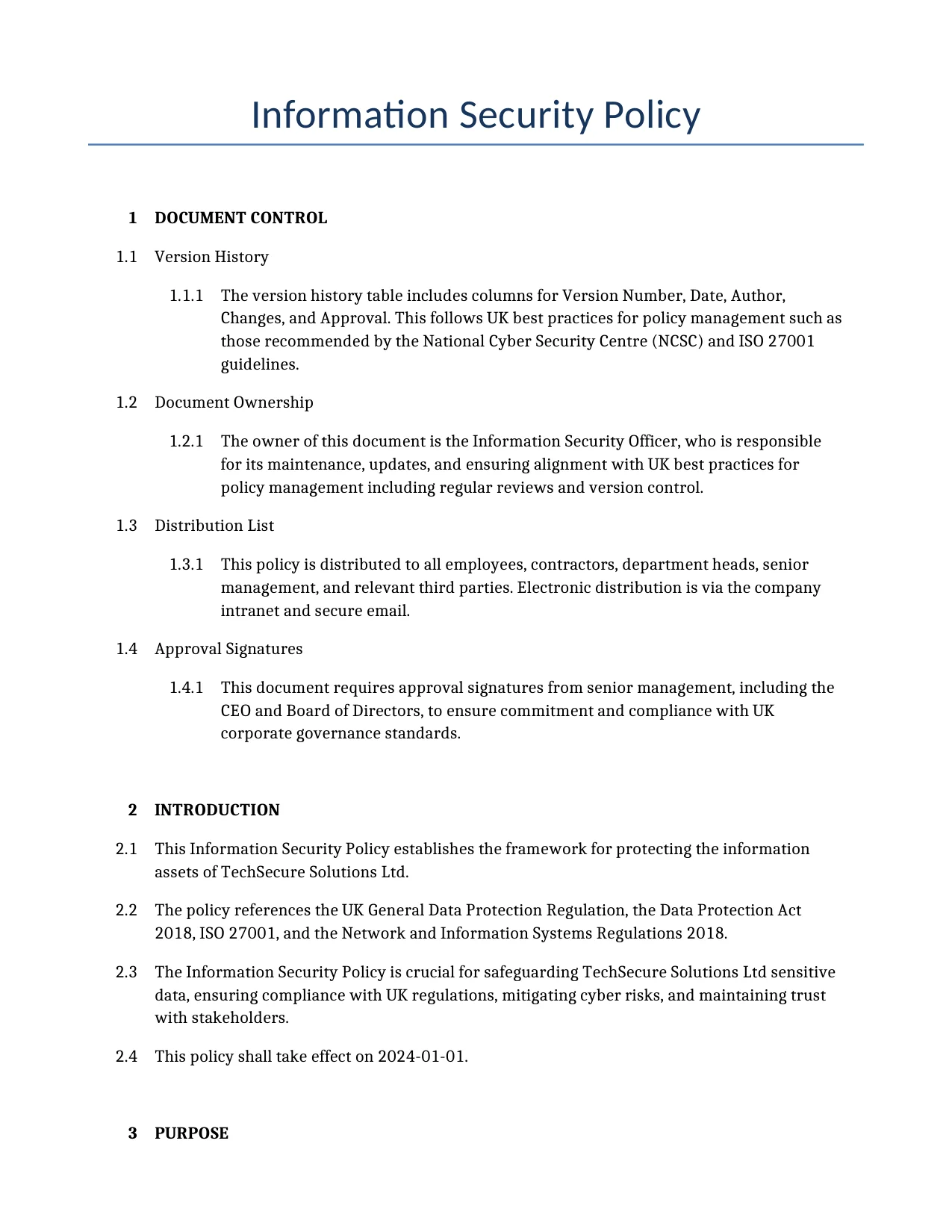
Information Security Policy
1DOCUMENT CONTROL
Version History
The version history table includes columns for Version Number, Date, Author, Changes, and Approval. This follows UK best practices for policy management such as those recommended by the National Cyber Security Centre (NCSC) and ISO 27001 guidelines.
Document Ownership
The owner of this document is the Information Security Officer, who is responsible for its maintenance, updates, and ensuring alignment with UK best practices for policy management including regular reviews and version control.
Distribution List
This policy is distributed to all employees, contractors, department heads, senior management, and relevant third parties. Electronic distribution is via the company intranet and secure email.
Approval Signatures
This document requires approval signatures from senior management, including the CEO and Board of Directors, to ensure commitment and compliance with UK corporate governance standards.
2INTRODUCTION
This Information Security Policy establishes the framework for protecting the information assets of TechSecure Solutions Ltd.
The policy references the UK General Data Protection Regulation, the Data Protection Act 2018, ISO 27001, and the Network and Information Systems Regulations 2018.
The Information Security Policy is crucial for safeguarding TechSecure Solutions Ltd sensitive data, ensuring compliance with UK regulations, mitigating cyber risks, and maintaining trust with stakeholders.
This policy shall take effect on 2024-01-01.
3PURPOSE
The primary purpose of this Information Security Policy is to establish a framework for protecting the confidentiality, integrity, and availability of information assets within TechSecure Solutions Ltd, ensuring alignment with UK regulatory requirements.
This Information Security Policy emphasizes compliance with the UK General Data Protection Regulation.
The primary objective of this Information Security Policy is to safeguard sensitive data and mitigate risks associated with data breaches, thereby supporting business continuity and stakeholder trust.
TechSecure Solutions Ltd achieves compliance with UK information security laws through proactive risk assessments, employee training programs, and the implementation of robust technical controls to meet the standards of the Data Protection Act 2018 and the UK General Data Protection Regulation.
4SCOPE
This Information Security Policy covers all aspects of information security for organizational data, including digital and physical assets, but excludes legacy systems no longer in use.
This policy applies to the protection of all confidential and sensitive information assets owned or managed by TechSecure Solutions Ltd, encompassing data in transit, at rest, and in use across all business operations within and outside the United Kingdom where applicable, including all company locations, operations, and data processing activities.
This Information Security Policy applies to all employees of TechSecure Solutions Ltd.
This Information Security Policy applies to all contractors working with TechSecure Solutions Ltd.
This Information Security Policy applies to all third parties handling organizational information of TechSecure Solutions Ltd.
This Information Security Policy explicitly includes employees and contractors working remotely.
5DEFINITIONS AND ABBREVIATIONS
Confidentiality: The property that information is not made available or disclosed to unauthorised individuals, entities, or processes (ISO 27001).
Integrity: The property of accuracy and completeness of assets (ISO 27001).
Availability: The property of being accessible and usable upon demand by an authorised entity (ISO 27001).
Personal Data: Any information relating to an identified or identifiable natural person (Data Subject) (UK GDPR Article 4).
Data Breach: A breach of security leading to the accidental or unlawful destruction, loss, alteration, unauthorised disclosure of, or access to, personal data (UK GDPR).
Risk Assessment: The process of identifying information security risks and determining their likelihood and impact (ISO 27001).
Incident: An occurrence that is not part of the standard operation of a service that causes or may cause an interruption or reduction in quality (ISO 27001).
Asset: Anything that has value to the organisation (ISO 27001).
Threat: A potential cause of an unwanted incident which may result in harm to a system or organisation (ISO 27001).
Vulnerability: A weakness of an asset or control that can be exploited by one or more threats (ISO 27001).
GDPR: UK General Data Protection Regulation, the UK version of the EU regulation on data protection and privacy.
DPA 2018: Data Protection Act 2018, which supplements the UK GDPR and provides a comprehensive data protection framework in the UK.
NIS Regulations: Network and Information Systems Regulations 2018, which implement the EU NIS Directive in the UK for cybersecurity of essential services.
ISO 27001: International standard for Information Security Management Systems (ISMS).
Data Subject: An identified or identifiable natural person to whom personal data relates (UK GDPR).
Controller: The natural or legal person which, alone or jointly with others, determines the purposes and means of the processing of personal data (UK GDPR).
Processor: A natural or legal person which processes personal data on behalf of the controller (UK GDPR).
Information Security Management System (ISMS): A systematic approach to managing sensitive company information so that it remains secure, including people, processes, and IT systems (ISO 27001).
ISMS: Abbreviation for Information Security Management System.
ICO: Information Commissioner's Office, the UK regulatory authority for data protection.
NCSC: National Cyber Security Centre, the UK government organisation providing cyber security guidance.
IDTA: International Data Transfer Agreement, the UK mechanism for international data transfers.
PECR: Privacy and Electronic Communications Regulations 2003, governing electronic marketing and cookies in the UK.
RACI: Responsible, Accountable, Consulted, Informed - a matrix for defining roles and responsibilities.
6POLICY STATEMENT
Senior management is fully committed to ensuring the confidentiality, integrity, and availability of all information assets within the organisation, in line with best practices and regulatory requirements in the United Kingdom.
Senior management explicitly commits to the key information security principles of Confidentiality, Integrity, Availability, and Compliance.
Senior management commits to an annual review of this Information Security Policy.
Senior management will lead by example in adhering to security protocols, allocate necessary resources, and ensure that information security is integrated into all business decisions and operations.
Senior management commits to proportional allocation based on risk for resources dedicated to information security.
Senior management commits to providing regular information security training for all employees.
7ROLES AND RESPONSIBILITIES
The Information Security Officer (also referred to as Chief Information Security Officer) is responsible for developing, implementing, and maintaining the information security program, conducting security reviews, and reporting to senior management. This role is held by Dr. Emily Carter.
Senior management is responsible for approving this Information Security Policy, providing resources, and ensuring integration of security into business operations.
Department heads are responsible for implementing departmental security controls, conducting security awareness training, and reporting incidents to the Information Security Officer.
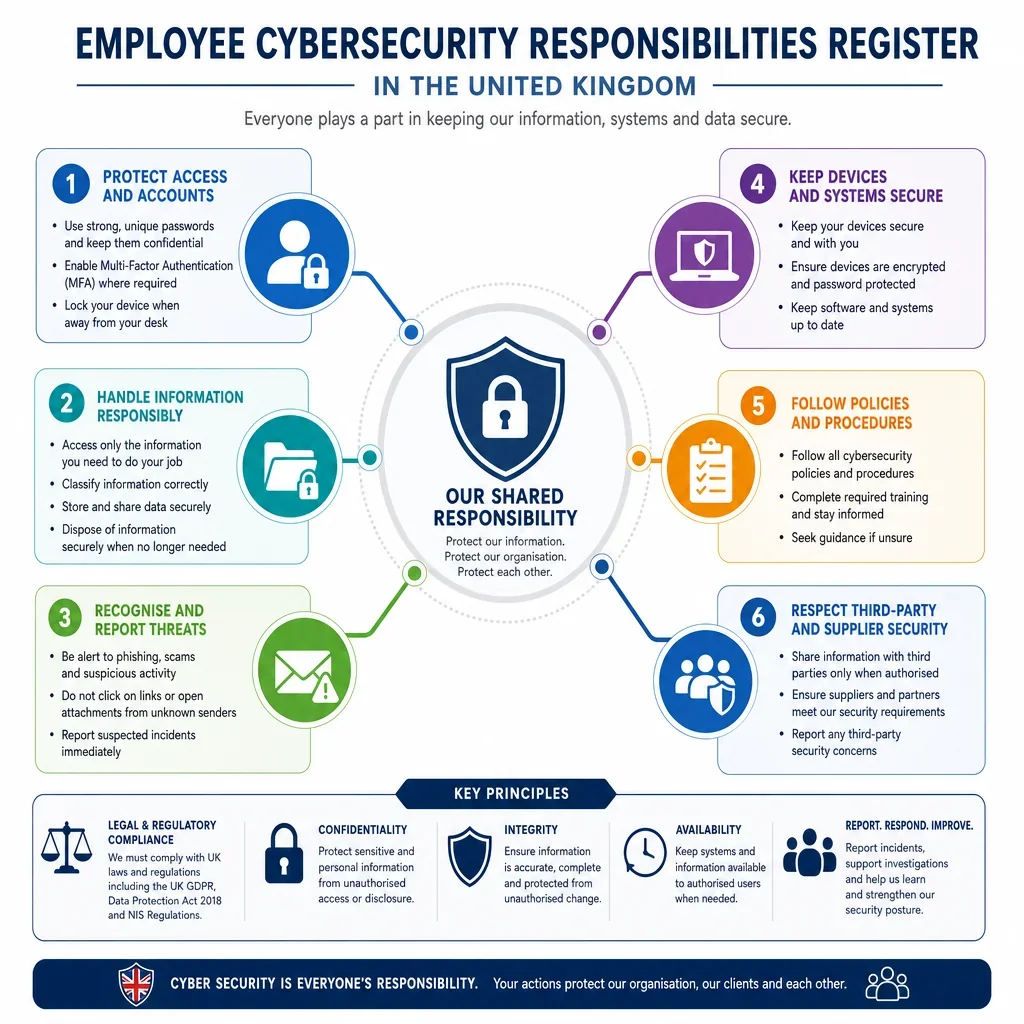
All employees are responsible for completing annual training, reporting suspected breaches, using strong passwords and MFA, avoiding sharing sensitive information unsecured, and locking workstations.
The Compliance Officer (Jane Smith) is responsible for monitoring adherence to regulations and supporting the Information Security Officer.
RACI Matrix: A RACI matrix is maintained to clarify responsibilities across roles for key ISMS activities, aligned with UK corporate governance expectations under the Companies Act 2006 for director duties on risk management. For example: Policy Approval - Senior Management (A), Information Security Officer (R); Risk Assessment - Information Security Officer (R), Department Heads (C).
8GOVERNANCE AND COMPLIANCE
The governance structure for information security at TechSecure Solutions Ltd is led by the Board of Directors, who provide strategic oversight and direct responsibility for risk management per Companies Act 2006.
The Information Security Officer (Dr. Emily Carter) is responsible for developing and implementing security policies and reports to the CEO. The Compliance Officer (Jane Smith) supports monitoring and reporting.
The Information Security Committee, comprising department heads, meets monthly to review risks and compliance.
IT Managers handle day-to-day security operations.
The board shall review this Information Security Policy and compliance reports quarterly.
TechSecure Solutions Ltd shall ensure compliance with the UK General Data Protection Regulation, the Data Protection Act 2018, and the Network and Information Systems Regulations 2018.
TechSecure Solutions Ltd is pursuing and maintaining ISO 27001 certification for its information security management system.
TechSecure Solutions Ltd shall mandate information security training annually for employees to ensure compliance awareness.
Internal reporting on governance and compliance matters shall be provided to the board quarterly.
Third-party vendors shall be required to comply with this Information Security Policy and UK regulations.
9RISK MANAGEMENT
TechSecure Solutions Ltd shall conduct risk assessments on an annual basis.
TechSecure Solutions Ltd shall use workshops and interviews, threat modeling, and automated scanning tools for identifying information security risks.
TechSecure Solutions Ltd shall apply a five point scale when assessing the likelihood of risks.
TechSecure Solutions Ltd shall define the impact of risks as negligible, minor, moderate, major, or catastrophic.
TechSecure Solutions Ltd formally defines its risk tolerance levels in this Information Security Policy.
TechSecure Solutions Ltd shall assign the risk owner based on the department most responsible for the area affected by the risk, such as the IT department for technical risks or the Human Resources department for personnel-related risks.
TechSecure Solutions Ltd shall consider the risk treatment options of avoid, mitigate, transfer, or accept for mitigating identified risks.
The risk management process shall explicitly include risks from third-party suppliers.
TechSecure Solutions Ltd shall maintain a central risk register in a digital spreadsheet using Microsoft Excel or Google Sheets, with columns for risk ID, description, likelihood, impact, owner, and treatment status.
TechSecure Solutions Ltd shall review and update the risk management process quarterly.
10ASSET MANAGEMENT
TechSecure Solutions Ltd maintains an asset inventory using a centralized database system.
The process for maintaining the asset inventory involves quarterly scans of the network to identify hardware and software assets, followed by manual verification by department heads to log data assets such as databases and documents.
New assets shall be registered upon acquisition, and the inventory shall be updated in real-time via an automated ticketing system.
This Information Security Policy requires regular updates to the asset inventory, including quarterly reviews.
TechSecure Solutions Ltd shall implement the classification levels of public, internal use only, confidential, and restricted for its information assets to categorize them based on sensitivity.
Classification of information assets shall be based on legal requirements under UK data protection laws like the UK General Data Protection Regulation, potential business impact including financial loss or reputational damage, and sensitivity of the information such as personal data or trade secrets.
Every information asset shall be assigned to a specific owner responsible for its classification and protection.
Asset classifications and protections shall be reviewed every 12 months.
This Information Security Policy mandates the protection measures of access controls, encryption, backup procedures, and audit logging for classified information assets.
At the end of an asset's lifecycle, handling procedures shall include archiving non-sensitive data to secure offsite storage.
Disposal of assets shall involve secure deletion using overwriting methods compliant with UK standards, physical destruction of media for hardware, and documentation of the process by the asset owner to ensure no unauthorized recovery is possible.
The asset inventory shall include assets managed by third parties on behalf of TechSecure Solutions Ltd.
11HUMAN RESOURCES SECURITY
This Information Security Policy includes pre-employment screening for security roles.
TechSecure Solutions Ltd shall require criminal record checks, employment history verification, and reference checks for employees in security-sensitive positions.
Employees shall sign confidentiality agreements upon hiring.
TechSecure Solutions Ltd shall mandate security awareness training for all new employees.
TechSecure Solutions Ltd shall require 4 hours of initial security training for new hires.
The notice period specified for employee terminations in this Information Security Policy is one month.
TechSecure Solutions Ltd shall conduct exit interviews for departing employees to review security obligations.
Access shall be revoked immediately upon employee termination.
12PHYSICAL AND ENVIRONMENTAL SECURITY
TechSecure Solutions Ltd shall implement a comprehensive physical security policy for all United Kingdom facilities, including perimeter fencing, 24/7 closed-circuit television surveillance, and regular security patrols to prevent unauthorized access and ensure the safety of personnel and assets.
Specific areas within the facilities shall be designated as secure areas requiring enhanced protection.
Keycard or badge access and biometric authentication shall be implemented for secure areas in the United Kingdom facilities.
Strict controls shall be implemented for visitor access to the facilities.
User access rights to facilities shall be reviewed and updated every 6 months.
Assessments shall be conducted for environmental threats such as fire, flood, or power failure in the United Kingdom facilities.
The environmental controls specified for protecting against threats in the facilities are fire detection and suppression systems, uninterruptible power supplies, and temperature and humidity controls.
John Smith, Head of Security Operations, is the designated person responsible for overseeing physical and environmental security in TechSecure Solutions Ltd.
Measures shall be included for protecting office equipment from theft or damage.
The types of facilities operated by TechSecure Solutions Ltd in the United Kingdom that require physical security controls are office buildings, data centers, and warehouses or storage facilities.
13OPERATIONS SECURITY
TechSecure Solutions Ltd shall implement a formal change management policy for its information technology systems.
The level of approval process for information technology changes in TechSecure Solutions Ltd shall be the Change Advisory Board.
The key steps in the change management procedure are submitting a change request form detailing the proposed change, initial review by the information technology team for feasibility, approval by the Change Advisory Board, testing in a staging environment, implementation during scheduled maintenance windows, and post-implementation review and documentation.
TechSecure Solutions Ltd currently has malware protection software deployed on all devices.
Malware scans shall be performed weekly.
This Information Security Policy shall include a dedicated malware incident response plan.
Continuous system monitoring shall be implemented for security events in TechSecure Solutions Ltd.
Security logs shall be retained for 90 days.
The threshold for alerts for system monitoring anomalies shall be set at medium sensitivity.
Vulnerability Management: TechSecure Solutions Ltd shall perform regular vulnerability scans (monthly) and remediate critical vulnerabilities within 7 days, in line with ISO 27001:2022 Annex A.12.6.
Logging and Monitoring enhancements: All critical systems shall log security events with centralised SIEM for real-time analysis, addressing ISO 27001:2022 A.8.15 and A.8.16.
14COMMUNICATIONS SECURITY
A clear network perimeter shall be defined for the information systems of TechSecure Solutions Ltd.
Remote access to the network of TechSecure Solutions Ltd shall be permitted for employees and third parties.
The use of secure communication channels shall be mandated for all sensitive information exchanges.
The encryption protocols required for secure communications are TLS 1.3 and IPsec.
Guest and internal networks shall be segregated to enhance security.
Compliance with communications security measures shall be monitored quarterly.
John Smith, IT Security Manager, is the designated contact person for communications security incidents within TechSecure Solutions Ltd.
15SYSTEM ACQUISITION, DEVELOPMENT, AND MAINTENANCE
A secure development lifecycle shall be adopted for all information systems acquired, developed, or maintained by TechSecure Solutions Ltd.
The phases of the secure development lifecycle included in this Information Security Policy are requirements analysis, design, implementation, testing, deployment, and maintenance.
Third-party vendors shall be required to follow the same secure development standards as TechSecure Solutions Ltd during system acquisition.
The types of security testing mandated for information systems are vulnerability scanning, penetration testing, and code review.
Security testing shall be conducted for critical systems every 6 months.
This Information Security Policy shall include a policy for regular patching and maintenance of information systems to address vulnerabilities.
The IT Security Team shall be responsible for overseeing system maintenance and updates.
The events that shall trigger mandatory system maintenance activities are new vulnerability disclosure, software updates release, and incident occurrence.
Secure System Engineering Principles: TechSecure Solutions Ltd shall follow secure by design principles including threat modelling in development, secure coding standards, and security testing throughout the SDLC per ISO 27001:2022 A.8.25 and A.8.27.
16SUPPLIER RELATIONSHIPS
TechSecure Solutions Ltd shall require that it conducts security audits on third-party suppliers.
Security audits shall be conducted on suppliers annually.
A right to audit clause shall be included in all supplier contracts.
Third-party suppliers shall implement ISO 27001 compliant information security management systems, ensure all staff handling data of TechSecure Solutions Ltd undergo background checks, and maintain encryption for data in transit and at rest.
A standard level of risk assessment shall be applied to new suppliers.
Suppliers shall be required to report security incidents to TechSecure Solutions Ltd within a specified timeframe.
Suppliers shall handle the data classification levels of official and secret.
Supplier contracts shall include a clause allowing termination for security breaches.
Detailed Supplier Risk Management: In addition to audits, suppliers are assessed using a risk-based approach considering their access to data, with ongoing monitoring, contractual security requirements, and alignment to ISO 27001:2022 A.5.19, A.5.20, A.5.21, and A.5.23. Cloud Security considerations are addressed for suppliers providing cloud services, requiring ISO 27017 compliance where relevant.
17INCIDENT MANAGEMENT
Automated tools shall be enabled for detecting security incidents in TechSecure Solutions Ltd.
The automated tools used for detecting security incidents are intrusion detection systems such as Snort and security information and event management tools such as Splunk to monitor network traffic and log anomalies in real-time.
TechSecure Solutions Ltd has a formal procedure for employees to report suspected security incidents.
The IT Security Officer shall be designated as the primary point of contact for reporting security incidents.
The maximum response time for initial assessment of a reported security incident shall be 4 hours.
The key steps in the procedure for responding to a security incident are to acknowledge the report and isolate affected systems, assess the incident's scope and severity, contain the incident by applying patches or blocking access, eradicate the threat through forensic analysis, and notify stakeholders and authorities if required.
This Information Security Policy shall include procedures for notifying the Information Commissioner's Office in the event of a security incident involving personal data, in compliance with the Data Protection Act 2018 and UK GDPR.
Relevant United Kingdom authorities (such as the ICO for personal data breaches and relevant authorities for NIS incidents) shall be notified without undue delay and where feasible not later than 72 hours after becoming aware of a personal data breach or significant incident, to comply with UK GDPR and NIS Regulations requirements.
Recovery from a security incident shall involve restoring data from secure backups, verifying system integrity, and testing operations before full restoration.
A lessons-learned session shall be conducted and security measures shall be updated to prevent recurrence, aiming to resume normal operations within 24 hours.
Post-incident reviews shall be conducted immediately after each security incident.
TechSecure Solutions Ltd shall provide regular training to employees on incident detection and reporting.
18BUSINESS CONTINUITY MANAGEMENT
The maximum duration that the business can tolerate a disruption to critical operations before significant impact occurs is 24 hours.
Full tests of the business continuity plan shall be conducted 2 times per year.
Specific strategies for responding to cyber incidents shall be included within the business continuity management section.
The critical functions that must be prioritized in the business continuity strategies are information technology systems and data access, customer service operations, and financial processing.
Jane Smith is designated as the business continuity coordinator for TechSecure Solutions Ltd.
The email address for the business continuity coordinator is jane.smith@company.co.uk.
The primary phone number for the business continuity coordinator is +44 20 1234 5678.
The next review of the business continuity plan shall be conducted by 2024-12-31.
The maximum amount of data loss that the business can tolerate for critical systems is 4.5 hours.
Offsite backups for business continuity purposes shall be stored with a secure cloud provider in the European Union.
Annual training shall be mandated for all employees on business continuity procedures.
Key suppliers must have their own certified business continuity plans, conduct annual tests, and provide evidence of resilience to disruptions within 24 hours.
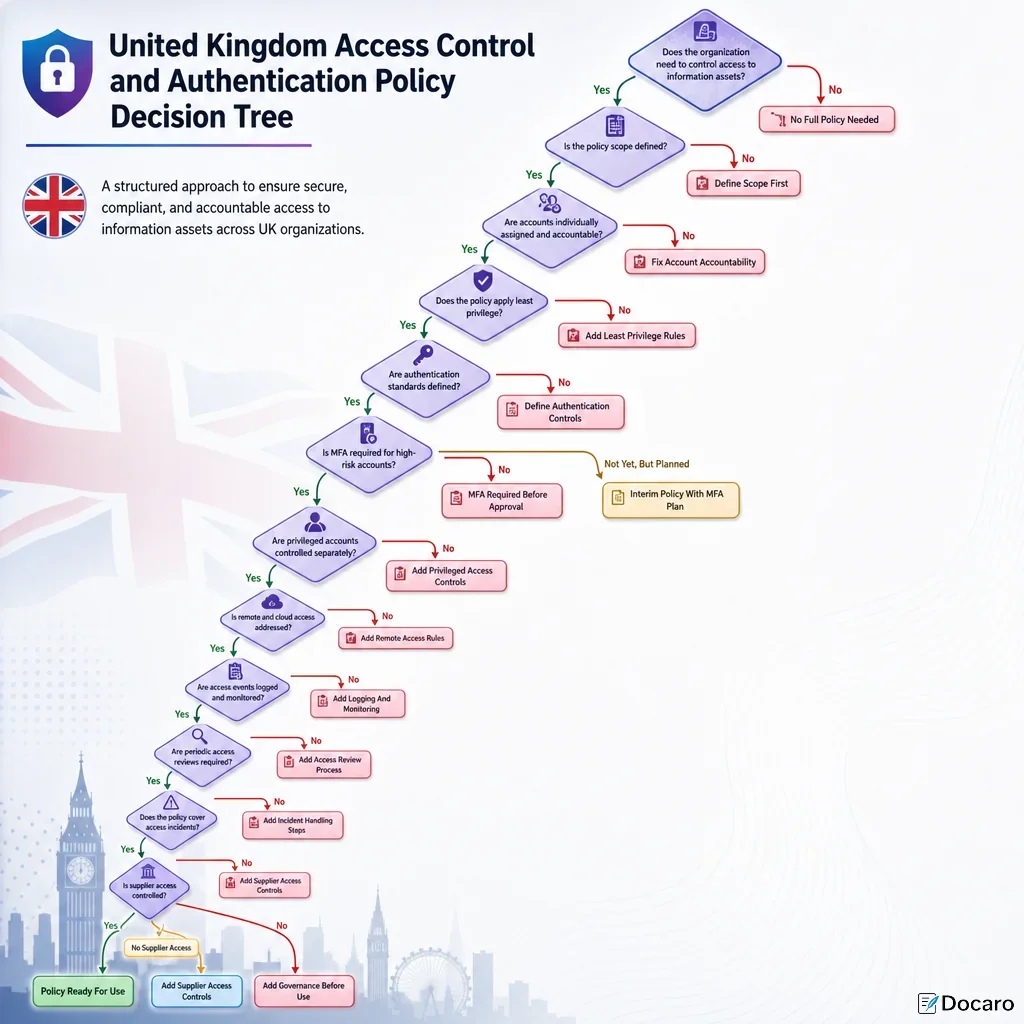
19ACCESS MANAGEMENT AND SECURITY POLICY
This policy covers all internal information technology systems, including email servers, customer databases, and cloud-based file storage, as well as sensitive data such as personal information and financial records.
Formal user registration procedures shall be required for all new users accessing information resources.
The IT Department Manager shall be designated as the authority for approving user registrations.
User registration requests shall be processed within 3 working days.
Periodic reviews of user accounts shall be conducted to confirm ongoing access necessity.
User account reviews shall occur annually.
Upon employee termination or role change, the Human Resources department shall notify the information technology department within 24 hours.
The information technology department shall then disable the account immediately, revoke all access privileges, and archive any necessary data within 5 working days.
Multi-factor authentication shall be mandated for all users accessing sensitive information resources.
The authentication methods allowed for user access are multi-factor authentication and biometric authentication.
Role-based access control shall be implemented to assign permissions based on job functions.
Upon detection of a violation, the security team shall isolate the affected account, investigate the incident within 48 hours, notify relevant stakeholders, and implement corrective actions such as enhanced monitoring or disciplinary measures.
Logs of user access activities shall be retained for 12 months.
Controlled access shall be permitted for third-party vendors to the information resources of TechSecure Solutions Ltd.
20CRYPTOGRAPHY
The use of encryption shall be mandated for all sensitive data in transit and at rest.
The cryptographic algorithms approved for use in TechSecure Solutions Ltd are AES-256, RSA-2048, and SHA-256.
The minimum key length for all cryptographic keys shall be 2048 bits.
A policy for periodic rotation of cryptographic keys shall be implemented.
Cryptographic keys shall be stored securely using hardware security modules.
Encryption shall be required for email communications, file transfers, and web traffic.
Third-party vendors shall be required to adhere to the encryption standards of TechSecure Solutions Ltd.
21DATA PROTECTION AND PRIVACY
TechSecure Solutions Ltd processes personal data of individuals within the United Kingdom or European Union.
TechSecure Solutions Ltd engages in automated decision-making and large-scale processing of sensitive data.
Dr. Emily Carter is appointed as the Data Protection Officer.
The email address of the Data Protection Officer is emily.carter@company.co.uk.
TechSecure Solutions Ltd is not an operator of essential services as defined under the Network and Information Systems Regulations 2018.
TechSecure Solutions Ltd qualifies as a relevant digital service provider under the Network and Information Systems Regulations 2018.
TechSecure Solutions Ltd shall conduct 4 information security training sessions for employees annually.
This Information Security Policy shall include a procedure for reporting personal data breaches within 72 hours to the Information Commissioner's Office as per the UK General Data Protection Regulation.
Dr. Emily Carter is the designated Data Protection Officer for TechSecure Solutions Ltd.
The email address of the designated Data Protection Officer for TechSecure Solutions Ltd is emily.carter@company.co.uk.
TechSecure Solutions Ltd processes personal data outside the United Kingdom.
TechSecure Solutions Ltd does not engage in automated decision-making, including profiling, that produces legal effects or similarly significant effects on individuals.
The categories of personal data that TechSecure Solutions Ltd processes are names, email addresses, phone numbers, financial details, and health records.
TechSecure Solutions Ltd acknowledges requests from data subjects within 48 hours and responds fully within one month, verifying identity and providing the requested information or action.
The standard retention period for personal data in TechSecure Solutions Ltd is 24 months.
TechSecure Solutions Ltd has a procedure to notify the Information Commissioner's Office of personal data breaches within 72 hours.
The security measures that TechSecure Solutions Ltd implements for protecting personal data are encryption, access controls, regular audits, and staff training.
TechSecure Solutions Ltd uses CloudService Ltd for data storage under a contract signed in 2023 and MarketingHub Inc for email campaigns with a data processing agreement in place, located in the United States with standard contractual clauses.
International Data Transfers: For transfers of personal data outside the UK/EEA, TechSecure Solutions Ltd ensures appropriate safeguards are in place in accordance with UK GDPR Chapter V. These include adequacy decisions, the UK International Data Transfer Agreement (IDTA), Standard Contractual Clauses (with UK Addendum), Binding Corporate Rules, or derogations where applicable. Transfers are documented, risk-assessed, and follow recent UK government and ICO guidance to maintain compliance.
22AWARENESS AND TRAINING
A mandatory security awareness program shall be implemented for all staff members.
Regular training sessions shall be scheduled for staff on information security topics.
Information security training for staff shall be conducted quarterly.
150 staff members have been trained on information security risks, policies, and procedures in the past year.
The specific topics covered in the staff information security training are phishing recognition, data handling procedures, password management, incident reporting, and compliance with the UK General Data Protection Regulation.
Information security training shall be required for all new hires within their first month.
The methods used for delivering information security training to staff are online modules, in-person workshops, and e-learning platforms.
The Chief Information Security Officer and the Human Resources Training Coordinator shall be responsible for overseeing the information security awareness and training programs.
23MONITORING AND AUDITING
The logging of security events shall be required in this Information Security Policy.
The retention period for security logs in this Information Security Policy shall be 12 months.
Continuous monitoring of security controls shall be implemented in this Information Security Policy.
Internal audits shall occur annually in this Information Security Policy.
Periodic external audits of security controls shall be required in this Information Security Policy.
All security incidents must be logged immediately upon detection, including details such as date, time, description, affected systems, and initial response actions.
Logs shall be stored securely and reviewed by the security team within 24 hours.
Audit reports shall be distributed to senior management, the security team, and the compliance officer.
24ACCEPTABLE USE OF INFORMATION AND ASSETS
The use of personal devices shall be permitted for accessing company information and assets.
Remote access to company information technology resources from outside the office network shall be allowed.
Company information technology resources should be used solely for business purposes, including email communication, document creation, and accessing authorized software to perform job duties efficiently and securely.
The prohibited activities explicitly included in this Information Security Policy are accessing illegal content, sharing confidential information, using resources for personal gain, and installing unauthorized software.
A strict prohibition on sharing passwords or access credentials shall be included.
The minimum number of characters required for passwords is 12.
Passwords shall include uppercase letters, lowercase letters, numbers, and special characters.
The use of social media on company information technology resources during work hours shall be restricted.
The company reserves the right to monitor all information technology usage to ensure compliance with policies and to protect company assets.
Employees should have no expectation of privacy when using company resources.
Regular training on acceptable use shall be mandated for all employees.
25DISCIPLINARY PROCEDURES
Violations that will trigger the disciplinary procedures in this Information Security Policy include unauthorized access to systems, sharing confidential information without permission, failure to report security incidents, and non-compliance with data protection protocols.
A mandatory investigation process shall be included for all reported violations before applying any sanctions.
The types of sanctions included in the disciplinary procedures for violations of this Information Security Policy are verbal warning, written warning, final written warning, and dismissal.
The right for employees to appeal disciplinary decisions related to information security violations shall be explicitly included.
The HR Director in consultation with the Information Security Officer shall be designated as the authority responsible for initiating and overseeing disciplinary procedures for policy violations.
The examples of gross misconduct related to information security that justify summary dismissal are intentional data theft, deliberate security breach, and fraudulent use of access.
26POLICY COMPLIANCE AND ENFORCEMENT
Compliance with this policy is monitored through regular internal audits, automated system checks, security awareness assessments, and management reviews, aligned with ISO 27001 requirements for continual improvement and UK GDPR accountability.
Internal audits shall be conducted at least annually by independent parties to evaluate the effectiveness of controls and identify areas for improvement.
Non-compliance with this policy may result in disciplinary action up to and including termination, in accordance with the company's disciplinary framework and UK employment law.
Escalation procedures for serious non-compliance include immediate reporting to the Information Security Officer, senior management notification, and potential involvement of the Board or external regulators where legal obligations apply.
This section integrates with the company's overall disciplinary framework (Section 25) and supports continual improvement under ISO 27001:2022, UK GDPR, and the Data Protection Act 2018.
27LEGAL AND REGULATORY COMPLIANCE
This policy ensures compliance with all relevant UK laws beyond those already mentioned, including the Computer Misuse Act 1990 (unauthorised access and modification), Privacy and Electronic Communications Regulations (PECR) 2003 (electronic communications and marketing), implications of the Human Rights Act 1998 for employee monitoring (balancing privacy rights), Freedom of Information Act 2000 (if applicable to public functions), and sector-specific regulations.
Compliance Matrix: The following maps key policy controls to legal requirements: Risk Management (Section 9) maps to UK GDPR Article 32 and NIS Regulations; Incident Management (Section 17) to UK GDPR Articles 33-34 and NIS reporting; Data Protection (Section 21) to DPA 2018 and UK GDPR Chapter V; Access Controls (Section 19) to Computer Misuse Act and ISO 27001 A.5.15; Monitoring (Section 23) to Human Rights Act considerations for proportionality. Full matrix is maintained separately but cross-referenced here for all 93 ISO 27001:2022 Annex A controls where relevant (e.g., A.5 Organisational controls, A.6 People, A.7 Physical, A.8 Technological).
28REVIEW AND UPDATE
The periodic review of this Information Security Policy shall occur annually.
The next review of this Information Security Policy shall be set for 2025-01-15.
The process for reviewing and updating this Information Security Policy shall include gathering input from key stakeholders including the information technology, legal, and compliance teams.
The process shall include assessing the current policy against the latest UK regulations like the UK General Data Protection Regulation and the Network and Information Systems Regulations.
The process shall include identifying gaps or areas for improvement based on recent incidents.
The process shall include drafting revisions and circulating for feedback.
The process shall include approving changes by senior management and distributing the updated policy.
Provisions shall be included for ad-hoc reviews triggered by significant events, such as major regulatory changes or security incidents.
The Information Security Team shall be designated as the primary party responsible for initiating and conducting the policy review.
Changes in UK regulations relevant to information security shall be monitored by subscribing to updates from the Information Commissioner's Office and UK government websites, attending regulatory webinars, and engaging legal consultants for periodic audits.
Changes in information security threats shall be monitored using National Cyber Security Centre alerts, industry reports from CREST and ISACA, and threat feeds from vendors like Microsoft and Cisco.
The retention period for records of policy reviews and updates shall be 7 years.
29REFERENCES AND RELATED DOCUMENTS
ISO 27001:2022 - Information security, cybersecurity and privacy protection — Information security management systems — Requirements (BS EN ISO/IEC 27001:2022).
UK General Data Protection Regulation (UK GDPR) - Retained EU law.
Data Protection Act 2018.
Network and Information Systems Regulations 2018 (NIS Regulations).
NCSC Cyber Assessment Framework (CAF) - https://www.ncsc.gov.uk/collection/caf.
ICO guidance on data protection - https://ico.org.uk/for-organisations/uk-gdpr-guidance-and-resources/.
UK NIS 2 implementation preparations and related guidance from NCSC and Department for Science, Innovation and Technology.
British Standards supporting ISO 27001: BS EN ISO/IEC 27002:2022 (controls), BS 7799 series historical references, and ISO 27005 for risk management.
Computer Misuse Act 1990, Privacy and Electronic Communications Regulations 2003, Human Rights Act 1998.
Full bibliography and document numbers are maintained in the company's document management system for all cited standards, laws, and guidance.
30GOVERNING LAW
This Information Security Policy shall be governed by and construed in accordance with British law.
31SIGNATURE
I, the undersigned, acknowledge that I have read, understood, and agree to comply with this Information Security Policy.
Name: _______________________________
Signature: _______________________________
Date: _______________________________
Position: _______________________________
This example shows approximately 70% of a typical document and is provided for illustrative purposes only. The remaining content has been omitted.
Every document generated by Docaro is tailored to your specific circumstances, jurisdiction and the information you provide. The completed document includes all applicable clauses and provisions required for your situation.
To generate the full, personalised document, answer a short series of questions and your document will be created instantly.
Useful Resources When Considering a Information Security Policy in the United Kingdom
United Kingdom Reference Legislation
Information Security Policy FAQs
Document Generation FAQs
Related Articles