AI Generated Whistleblowing Policy for use in the United Kingdom
PDF & Word - 2026 Updated
Docaro Pricing
When do you need a Whistleblowing Policy in the United Kingdom?
British Legal Rules for a Whistleblowing Policy
Failing to align the whistleblowing procedure with UK employment law requirements, such as those under the Employment Rights Act 1996, may undermine its legal enforceability and expose the organisation to disputes.
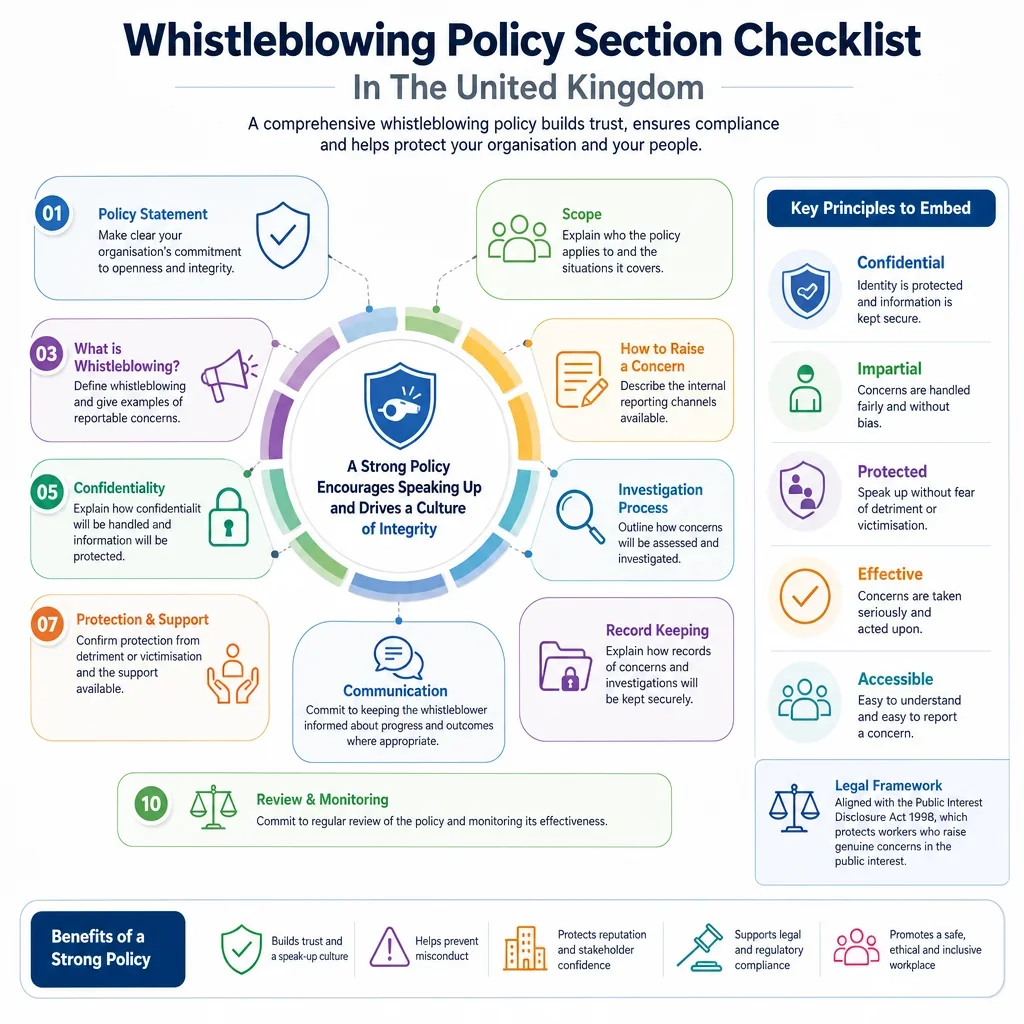
What a Proper Whistleblowing Policy Should Include
- Clear Definition of WhistleblowingExplain that whistleblowing means reporting concerns about wrongdoing, such as illegal activities or dangers to health and safety, in good faith.
- What Can Be ReportedList types of issues covered, including crimes, breaches of rules, risks to people or the environment, and misuse of position.
- Who to Report ToProvide simple steps for reporting to a manager, designated person, or external bodies like regulators when internal routes aren't suitable.
- How to Make a ReportDescribe easy ways to report, such as in writing, by phone, or online, ensuring confidentiality and no need for formal evidence upfront.
- Protections for ReportersAssure that those who report in good faith will not face unfair treatment, victimisation, or dismissal, and their identity will be kept private where possible.
- Handling Reports FairlyOutline how concerns will be investigated promptly, objectively, and without bias, keeping the reporter updated throughout.
- No Retaliation GuaranteeState clearly that the organisation prohibits any form of retaliation against whistleblowers and will take action against those who do.
- Legal Rights OverviewMention that UK law supports whistleblowers and provide guidance on seeking further help from bodies like Acas or employment tribunals if needed.
Generate Your Document in 4 Easy Steps
Why Use Docaro?
 United Kingdom
Free Example Whistleblowing Policy Template
Below is a free template example of a Whistleblowing Policy for use in the United Kingdom generated by our AI model.
The clauses in your actual Whistleblowing Policy will vary from this example as they will be entirely bespoke to your requirements as set out in the questionnaire you complete.
Whistleblowing Policy
1INTRODUCTION
This Whistleblowing Policy outlines the procedures for employees to report concerns about wrongdoing within Tech Innovations Ltd ensuring a safe and confidential environment for disclosures.
Tech Innovations Ltd strongly encourages all employees to speak up if they suspect any misconduct as their reports are vital to maintaining ethical standards and protecting the organisation.
This policy aligns with the Public Interest Disclosure Act 1998 and the Employment Rights Act 1996.
The Public Interest Disclosure Act 1998 protects workers who make qualifying disclosures in the public interest from detriment or dismissal.
This policy is endorsed by the Board of Directors and the company is committed to the highest standards of openness, integrity and accountability.
This policy shall take effect from 2024-01-01.
2SCOPE AND APPLICABILITY
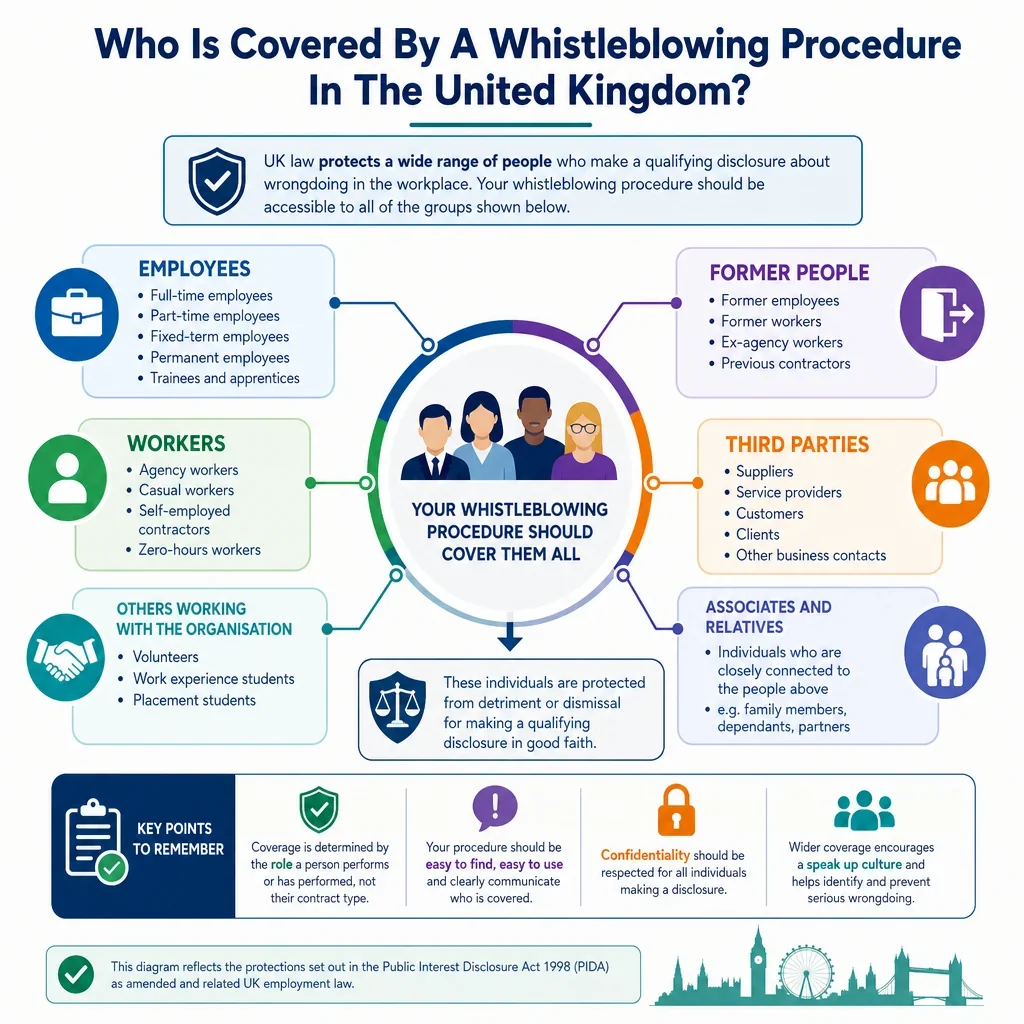
This policy applies to all employees of Tech Innovations Ltd.
This policy applies to all contractors working with Tech Innovations Ltd.
This policy applies to subsidiaries of Tech Innovations Ltd.
This policy applies to the United Kingdom only and to specific countries as designated by Tech Innovations Ltd from time to time.
3WHAT QUALIFIES AS A PROTECTED DISCLOSURE
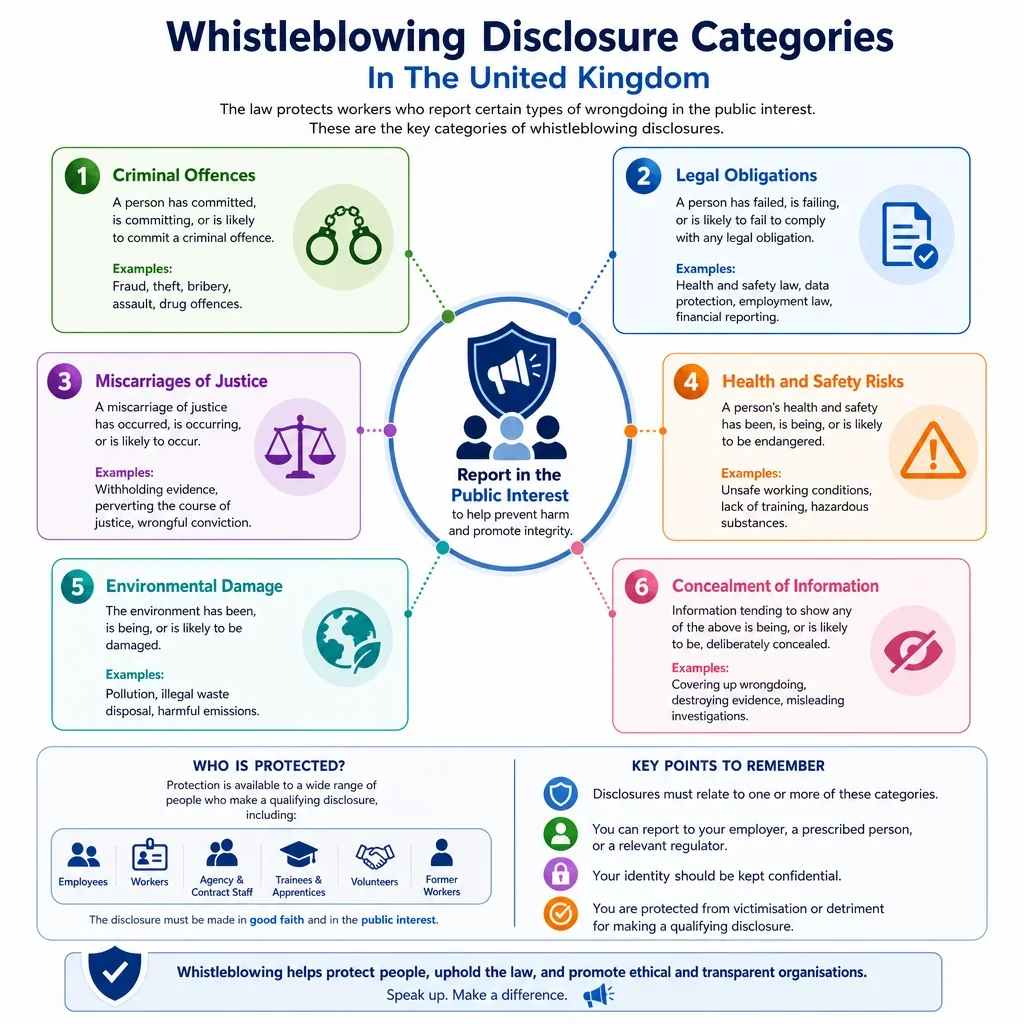
A protected disclosure under this policy includes any disclosure concerning criminal activity.
A protected disclosure under this policy includes any disclosure concerning health and safety risks.
A protected disclosure under this policy includes any disclosure concerning environmental damage.
A protected disclosure under this policy includes any disclosure concerning miscarriages of justice.
For a disclosure to qualify for protection the whistleblower must reasonably believe that the disclosure is made in the public interest.
A qualifying disclosure is one which in the reasonable belief of the worker tends to show one of the following: a criminal offence; a failure to comply with any legal obligation; a miscarriage of justice; danger to the health and safety of any individual; damage to the environment; or the deliberate concealment of any of the above.
The disclosure must be made to an appropriate recipient (internal, prescribed person, or in limited cases wider disclosure) to attract full protection under PIDA.
4REPORTING PROCEDURES
The primary internal reporting channel for whistleblowing concerns shall be known as the Whistleblowing Hotline.
The Whistleblowing Hotline is a confidential phone line available twenty four hours a day seven days a week at 0800-123-4567 or via email at whistleblower@company.co.uk where employees can report concerns without fear of reprisal.
Anonymous reporting shall be permitted through the Whistleblowing Hotline.
Internal whistleblowing reports shall be directed to the Human Resources Department or the Compliance Officer.
Tech Innovations Ltd will acknowledge receipt of any internal report within three working days and will provide an initial response within fourteen working days with further updates provided as the investigation progresses.
External regulators or bodies to which whistleblowing concerns may be reported include the Financial Conduct Authority and the Serious Fraud Office.
External reporting should be considered if internal channels have not resolved the concern or if the issue involves serious illegality.
When making an external report the whistleblower should contact the relevant regulator directly via their official website or hotline providing as much detail as possible while protecting anonymity if desired.
If the concern relates to the CEO, CFO or a Board member, the report should be made directly to the Chair of the Audit Committee or an independent non-executive director. Contact: auditchair@techinnovations.co.uk or +44 20 7946 0999.
5CONFIDENTIALITY AND ANONYMITY
Tech Innovations Ltd provides a strong assurance of confidentiality for all reports whether made internally or externally.
The organization is committed to protecting whistleblowers from any form of retaliation including dismissal demotion or harassment for making a good faith disclosure and any such actions will be treated as serious misconduct and subject to disciplinary measures.
Tech Innovations Ltd provides confidentiality protections for whistleblower identities.
The identity of the whistleblower may be disclosed where there is a legal requirement to do so where disclosure is necessary for the purposes of investigation or where the whistleblower has provided consent.
While anonymous reports will be considered, the company encourages named disclosures where possible because it is more difficult to investigate anonymous allegations and to provide feedback. The policy cannot provide the same level of protection or follow-up for anonymous reporters.
6INVESTIGATION OF REPORTED CONCERNS
Upon receipt of a whistleblowing report the company will send a written acknowledgment to the whistleblower confirming that the concern has been received and is being taken seriously.
The Compliance Officer shall be responsible for acknowledging reported concerns within three days of receipt.
The initial assessment will involve a preliminary review to determine the nature and seriousness of the concern and to decide whether a full investigation is warranted.
The Internal Audit Team shall be responsible for conducting the initial assessment within seven days of receipt of the report.
For concerns that require a full investigation an impartial process will be followed including gathering evidence interviewing relevant parties and ensuring confidentiality throughout.
The Independent Investigator shall be responsible for conducting the full investigation which shall be completed within four weeks.
Interim measures such as the suspension of involved parties may be implemented during the investigation where necessary to protect the integrity of the process or the safety of individuals.
The whistleblower will receive regular updates on the progress of the investigation at least every two weeks or sooner if significant developments occur.
Updates to the whistleblower shall be provided via secure email or a dedicated hotline.
Upon completion of the investigation the whistleblower will be informed of the findings and any actions taken while respecting the confidentiality of others involved.
The whistleblower shall be notified of the investigation outcome within five days after completion of the investigation.
7PROTECTIONS FOR WHISTLEBLOWERS
Retaliation against whistleblowers is explicitly prohibited by this policy.
Tech Innovations Ltd guarantees that it will not subject whistleblowers to any detriment such as bullying or demotion for making a protected disclosure.
The dismissal of an employee for making a protected disclosure will be treated as automatic unfair dismissal.
The types of concerns that qualify for protected disclosure protections under this policy include criminal offences health and safety risks and breach of legal obligations.
Whistleblowers have the right to claim compensation for any detriment suffered or for dismissal, the right to apply for interim relief from an employment tribunal, and protection from unfair dismissal even if they are still within their probationary period.
These protections extend to workers, contractors, agency staff, trainees, and certain others as defined in PIDA.
8ROLES AND RESPONSIBILITIES
Management must promptly investigate all whistleblowing reports received ensure the confidentiality of the whistleblower's identity and take appropriate action to address any identified issues including implementing corrective measures where necessary.
Management shall undergo regular training on whistleblowing procedures.
The Human Resources Department will provide support and guidance to whistleblowers throughout the process maintain confidential records of all reports and investigations and ensure compliance with legal requirements under the Public Interest Disclosure Act 1998.
Two designated officers shall be appointed by the Human Resources Department to handle whistleblowing reports.
Designated officers shall have the responsibility to report serious issues to external regulators if needed.
Employees are required to report any concerns about wrongdoing in good faith provide accurate information to support their reports and cooperate with any subsequent investigations without fear of retaliation.
Employees may make whistleblowing reports directly to their line manager to a designated officer or via the anonymous hotline.
The Board or a designated non-executive director shall have overall oversight of whistleblowing arrangements, including receiving regular reports on concerns raised and their outcomes.
The Compliance Officer or equivalent must have direct access to the Board.
9EXTERNAL REPORTING OPTIONS
Prescribed bodies for which guidance is provided in this policy include the Health and Safety Executive and the Financial Conduct Authority.
An employee should consider external reporting when internal options have failed to resolve the concern or where the concern involves senior management or where there is an immediate risk to public interest.
To make an external report the employee should first identify the appropriate prescribed body then gather relevant information while maintaining confidentiality and then submit the report using the chosen method.
The methods of external reporting emphasized in this policy are the online reporting portal and the telephone hotline.
When reporting externally the employee should take steps to maintain anonymity where possible by avoiding inclusion of personally identifiable information unless necessary.
10TRAINING AND AWARENESS
Initial training on this whistleblowing policy shall be provided to all employees upon joining the organization.
Refresher training on this whistleblowing policy shall be provided to existing employees annually.
The whistleblowing training shall be delivered through online modules and in-person workshops.
Specialized training on this whistleblowing policy shall be provided specifically for managers and supervisors.
This whistleblowing policy shall be included in the standard employee induction process.
Awareness of this whistleblowing policy shall be promoted within the organization through intranet posting email reminders and team meetings.
The Human Resources Department shall be responsible for organizing and delivering the whistleblowing training.
11MONITORING AND REVIEW
The effectiveness of this whistleblowing policy shall be monitored through tracking reported cases and employee surveys.
The Compliance Officer and the Human Resources Department shall be responsible for conducting the monitoring activities.
Monitoring activities will be conducted quarterly to assess the policy's implementation and effectiveness.
The next formal review of this whistleblowing policy shall take place on 2025-06-01.
This whistleblowing policy shall be reviewed every twelve months.
A review of this whistleblowing policy shall be initiated by changes in United Kingdom legislation or by significant whistleblowing incidents.
Following a review any proposed updates will be documented consulted with relevant stakeholders and incorporated into the policy before approval.
The Board of Directors shall authorize updates to this whistleblowing policy.
All employees shall be notified whenever this whistleblowing policy is updated.
An annual report on whistleblowing activity (anonymised) shall be presented to the Board, including the number and types of concerns, outcomes, and any lessons learned.
12CONTACT INFORMATION
The designated whistleblowing officer is Dr. Emily Carter.
The whistleblowing officer may be contacted by email at emily.carter@whistleuk.com.
The whistleblowing helpline number is +44 20 7946 0958.
This whistleblowing policy is published on the company website at https://www.whistleuk.com/policies.
13APPENDICES
Welcome to our confidential whistleblowing reporting form. This form allows you to report any concerns about wrongdoing or illegal activities within the organisation. Your report will be handled sensitively and in accordance with UK whistleblowing regulations.
The reporter's name field shall contain the placeholder text "Enter your full name (optional for anonymity)".
The prompt text for describing the whistleblowing concern shall be "Please provide a detailed description of your concern including what happened when and where it occurred and any relevant individuals involved.".
The whistleblowing reporting form shall include an option for reporters to attach evidence.
Instructions for submitting the whistleblowing report form shall state that once all fields have been completed the reporter should click 'Submit Report' to send the concern securely to the designated compliance officer and that a confirmation email will be received within twenty four hours.
An appendix containing key legal references for whistleblowing in the United Kingdom shall be included in this policy.
A detailed flowchart for the whistleblowing process shall be included in the appendices.
A customised reporting form tailored to the organisation's structure shall be included.
14DEFINITIONS
A qualifying disclosure is a disclosure of information that in the reasonable belief of the worker tends to show one or more of the following that a criminal offence has been committed is being committed or is likely to be committed that a person has failed is failing or is likely to fail to comply with any legal obligation to which they are subject that a miscarriage of justice has occurred is occurring or is likely to occur that the health or safety of any individual has been is being or is likely to be endangered that the environment has been is being or is likely to be damaged or that information relating to any of the above has been is being or is likely to be deliberately concealed.
For the purposes of this policy worker includes employees contractors agency staff freelancers and any other individuals who perform services for the organisation as defined under UK employment law including the Employment Rights Act 1996 and the Public Interest Disclosure Act 1998.
Detriment includes dismissal, demotion, denial of promotion, adverse changes to terms and conditions, bullying, harassment, or any other unfavourable treatment.
15GOVERNING LAW
This policy is governed by and shall be interpreted in accordance with British law.
16POLICY STATEMENT ON GOOD FAITH AND MALICIOUS REPORTS
Protection under this policy and PIDA applies even if the concern raised is not upheld, provided the disclosure was made in the reasonable belief that it was true and in the public interest.
Deliberately false or malicious reports will be treated as misconduct and may lead to disciplinary action.
This policy does not protect against disciplinary action for unrelated misconduct discovered during an investigation.
17CONSEQUENCES OF NON-COMPLIANCE
Anyone found to have retaliated against a whistleblower will face disciplinary action up to and including dismissal.
Managers who fail to escalate a report in accordance with this policy may be subject to disciplinary action.
Anyone making a knowingly false allegation will face disciplinary action up to and including dismissal.
18SIGNATURE SECTION
This Whistleblowing Policy is approved and adopted by the Board of Directors of Tech Innovations Ltd on the date set out below.
Signed for and on behalf of Tech Innovations Ltd by _______________________________ (Director) Date: ________________
I acknowledge that I have received a copy of this Whistleblowing Policy and that I have read and understood its contents.
Employee Name: _______________________________ Signature: ________________ Date: ________________
This example shows approximately 70% of a typical document and is provided for illustrative purposes only. The remaining content has been omitted.
Every document generated by Docaro is tailored to your specific circumstances, jurisdiction and the information you provide. The completed document includes all applicable clauses and provisions required for your situation.
To generate the full, personalised document, answer a short series of questions and your document will be created instantly.
Useful Resources When Considering a Whistleblowing Policy in the United Kingdom
United Kingdom Reference Legislation
Whistleblowing Policy FAQs
Document Generation FAQs
Related Articles