AI Generated British Commercial Lease Agreement
PDF & Word - 2026 Updated
Docaro Pricing
When do you need a Warehouse Lease Agreement in the United Kingdom?
British Legal Rules for a Warehouse Lease Agreement
Using the wrong structure of lease agreement may inadvertently create a tenancy rather than a protected business lease, affecting termination rights and security of tenure.
What a Proper Warehouse Lease Agreement Should Include
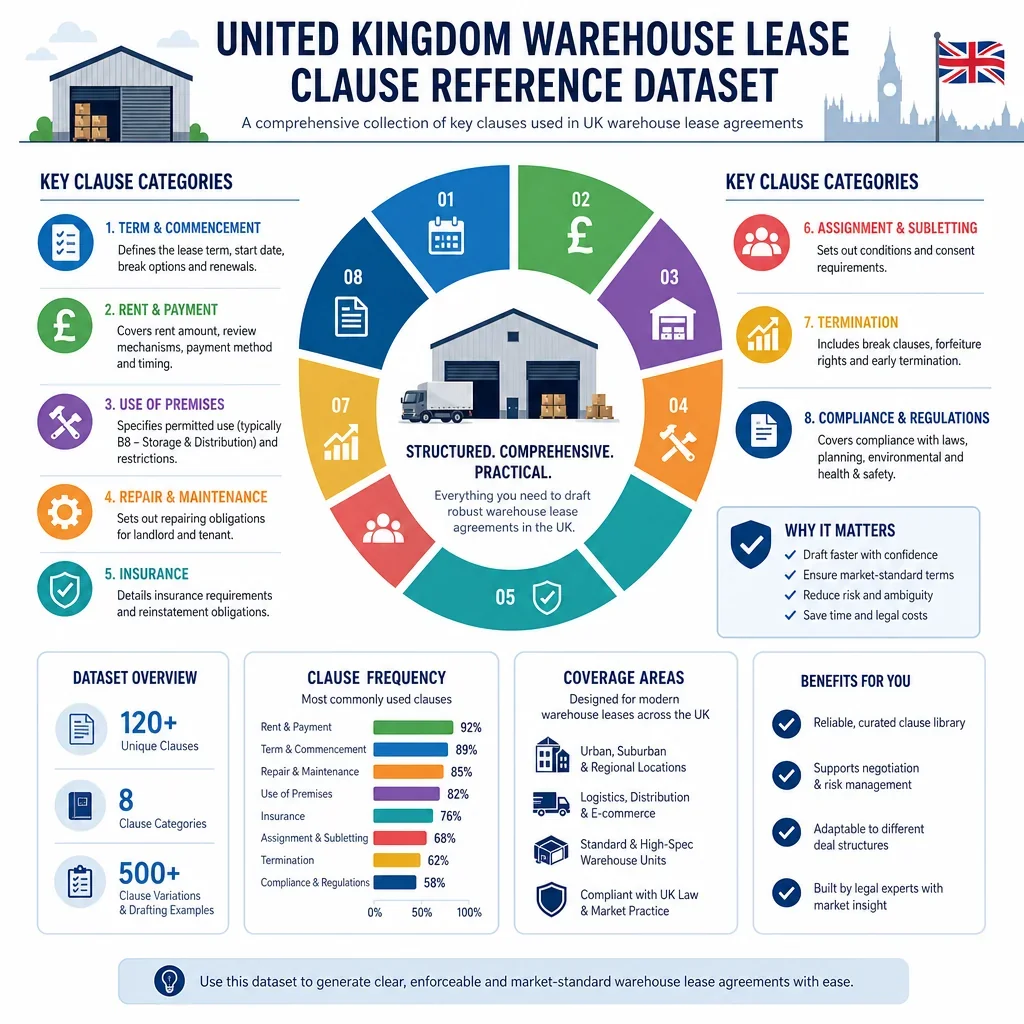
- Parties InvolvedClearly identify the landlord and tenant with their full names and addresses.
- Property DescriptionProvide a detailed description of the warehouse location, size, and any included features.
- Lease DurationSpecify the start date, end date, and any options for renewal or early termination.
- Rent DetailsOutline the rent amount, payment schedule, and any increases over time.
- Deposit RequirementsDetail the security deposit amount, how it will be used, and conditions for its return.
- Use of the WarehouseState the permitted activities, such as storage or distribution, and any restrictions.
- Maintenance DutiesClarify who is responsible for repairs, upkeep, and utilities during the lease.
- Insurance ObligationsDescribe the types of insurance required for the property and its contents.
- Access and AlterationsExplain rules for accessing the warehouse and making changes to the space.
- Ending the LeaseCover procedures for vacating the property and handling disputes at the end.
Generate Your Document in 4 Easy Steps
Why Use Docaro?
 United Kingdom
Free Example Warehouse Lease Agreement Template
Below is a free template example of a Warehouse Lease Agreement for use in the United Kingdom generated by our AI model.
The clauses in your actual Warehouse Lease Agreement will vary from this example as they will be entirely bespoke to your requirements as set out in the questionnaire you complete.
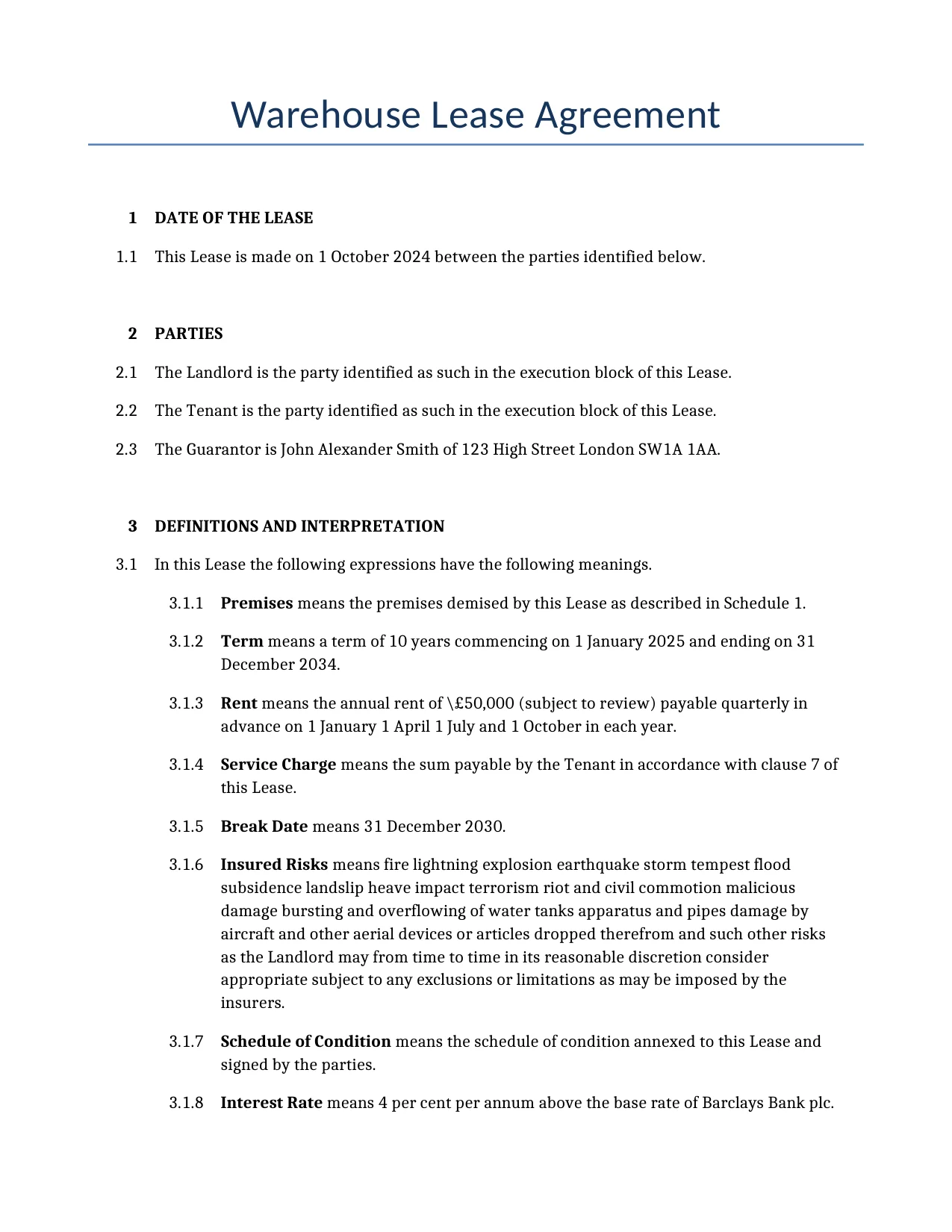
Warehouse Lease Agreement
1DATE OF THE LEASE
This Lease is made on 1 October 2024 between the parties identified below.
2PARTIES
The Landlord is the party identified as such in the execution block of this Lease.
The Tenant is the party identified as such in the execution block of this Lease.
The Guarantor is John Alexander Smith of 123 High Street London SW1A 1AA.
3DEFINITIONS AND INTERPRETATION
In this Lease the following expressions have the following meanings.
Premises means the premises demised by this Lease as described in Schedule 1.
Term means a term of 10 years commencing on 1 January 2025 and ending on 31 December 2034.
Rent means the annual rent of \£50,000 (subject to review) payable quarterly in advance on 1 January 1 April 1 July and 1 October in each year.
Service Charge means the sum payable by the Tenant in accordance with clause 7 of this Lease.
Break Date means 31 December 2030.
Insured Risks means fire lightning explosion earthquake storm tempest flood subsidence landslip heave impact terrorism riot and civil commotion malicious damage bursting and overflowing of water tanks apparatus and pipes damage by aircraft and other aerial devices or articles dropped therefrom and such other risks as the Landlord may from time to time in its reasonable discretion consider appropriate subject to any exclusions or limitations as may be imposed by the insurers.
Schedule of Condition means the schedule of condition annexed to this Lease and signed by the parties.
Interest Rate means 4 per cent per annum above the base rate of Barclays Bank plc.
The headings in this Lease are for reference only and shall not affect its construction.
Where the context so requires the masculine gender includes the feminine and neuter and vice versa and the singular includes the plural and vice versa.
This Lease is excluded from the security of tenure provisions of sections 24 to 28 of the Landlord and Tenant Act 1954 pursuant to a warning notice served on the Tenant not less than 14 days before the date of this Lease and the Tenant having made a statutory declaration in the form prescribed by the Regulatory Reform (Business Tenancies) (England and Wales) Order 2003 confirming that it has received such notice and understands its effect.
This Lease has been granted in accordance with the principles set out in the Code for Leasing Business Premises (2020).
4DEMISE AND TERM
In consideration of the Rent and the covenants on the part of the Tenant the Landlord demises the Premises to the Tenant for the Term together with the rights set out in Schedule 1 but excepting and reserving the rights set out in Schedule 1.
The Tenant shall pay the Rent from 1 January 2025 subject to a rent free period of three months from the commencement of the Term during which period the Tenant shall observe and perform the Tenant\'s covenants in this Lease.
5RENT AND REVIEW
The Tenant shall pay the Rent quarterly in advance on the dates specified in clause 3.1.3 without any deduction or set off (except as provided in clause 8.6).
The Rent shall be reviewed on every fifth anniversary of the commencement of the Term in accordance with the rent review provisions set out in Schedule 2.
6RENT DEPOSIT
The Tenant shall provide to the Landlord on or before the date of this Lease a cash deposit of \£5,000 as security for the performance of the Tenant\'s obligations under this Lease.
The Landlord shall hold the deposit on the terms set out in Schedule 3.
7SERVICE CHARGE
The Tenant shall pay by way of further rent a service charge being a fair and reasonable proportion of the total expenditure incurred by the Landlord in each service charge year in providing the services specified in Schedule 4. The proportion shall be calculated by reference to the proportion which the floor area of the Premises bears to the total floor area of the estate.
The estimated service charge for the first year is \£12,500.50 payable quarterly in advance on the usual quarter days. The Landlord shall provide to the Tenant within 3 months of the end of each service charge year a certificate prepared by the Landlord\'s surveyor or accountant showing the total expenditure incurred and the Tenant\'s proportion thereof. Any balance due from the Tenant shall be paid within 14 days of the date of the certificate or any overpayment shall be credited to the Tenant.
The Tenant shall have the right upon reasonable notice to inspect the accounts and receipts relating to the service charge expenditure and if the Tenant disputes the certificate the matter shall be referred to an independent surveyor acting as expert whose decision shall be final.
The services covered by the service charge include (but are not limited to) cleaning of common areas repairs and maintenance of the structure exterior and common parts of the estate insurance of the common parts management fees and any VAT thereon.
8INSURANCE
The Landlord shall insure the building of which the Premises form part against the Insured Risks in the full reinstatement value (including VAT architects\' and surveyors\' fees and the cost of debris removal) with a reputable insurance office or through an insurance broker and shall produce to the Tenant on demand a copy of the policy and evidence of payment of the premium.
The Tenant shall pay to the Landlord on demand a sum equal to the proportion of the insurance premium which the floor area of the Premises bears to the total floor area of the estate together with any insurance premium tax thereon.
The Tenant shall insure and keep insured in the joint names of the Landlord and the Tenant all plate glass (if any) in the Premises and all contents and trade fixtures and fittings and shall maintain public and employers liability insurance in the sum of not less than \£10,000,000 and shall produce evidence of such insurance to the Landlord upon demand.
In the event of damage to or destruction of the Premises by an Insured Risk the Landlord shall use all insurance proceeds (except those in respect of loss of rent) to reinstate the Premises as soon as reasonably practicable.
If the Premises are damaged or destroyed by an Insured Risk so as to be unfit for occupation or use then the Rent and the service charge or a fair proportion thereof according to the nature and extent of the damage shall be suspended until the Premises have been reinstated.
If the Premises are damaged or destroyed by an Uninsured Risk (being any risk not comprised in the Insured Risks) and the Landlord does not within 12 months of such damage or destruction give notice to the Tenant that it intends to reinstate then either party may determine this Lease by notice to the other.
9REPAIR AND MAINTENANCE
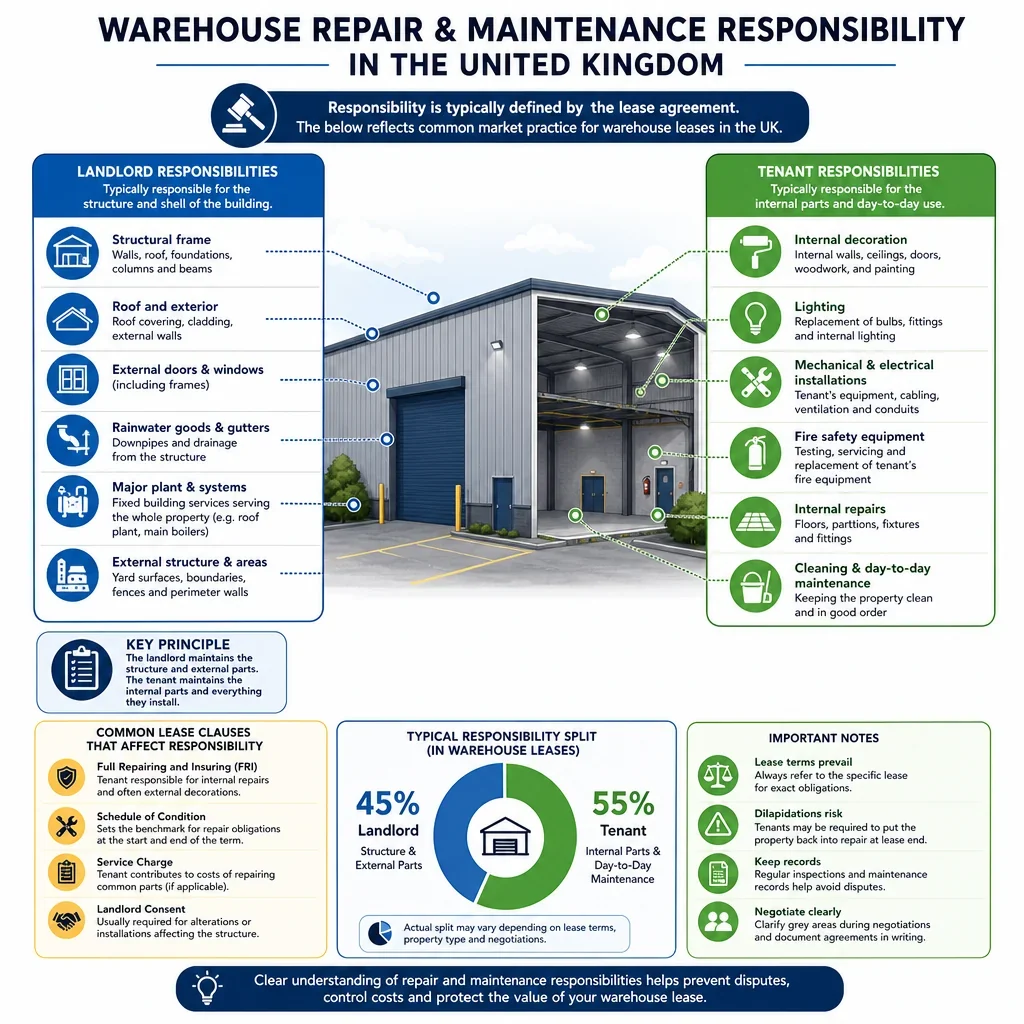
The Tenant shall keep the Premises in good and substantial repair and condition (damage by an Insured Risk excepted save to the extent that insurance proceeds are irrecoverable due to any act or omission of the Tenant) having regard to the state of the Premises as described in the Schedule of Condition but the Tenant shall not be liable to repair any inherent or latent defects in the construction of the Premises.
The Landlord shall maintain the structure and exterior of the warehouse and the common parts of the estate.
The Tenant shall yield up the Premises at the end of the Term in the condition required by this clause 9 having regard to the Schedule of Condition.
10ALTERATIONS AND IMPROVEMENTS
The Tenant shall not make any alterations or additions to the Premises without the prior written consent of the Landlord (such consent not to be unreasonably withheld or delayed) except that the Tenant may carry out internal non-structural alterations without consent provided that the Tenant gives the Landlord prior notice and such alterations are carried out in a good and workmanlike manner.
The Tenant shall pay the Landlord\'s reasonable and proper costs incurred in considering any application for consent under this clause.
All alterations shall comply with applicable building regulations planning permissions and the Tenant shall obtain all necessary consents and certificates and shall indemnify the Landlord against any claims losses or liabilities arising from any breach.
At the end of the Term the Tenant shall remove all alterations made by it (unless the Landlord otherwise directs) and shall make good any damage caused by such removal. The Tenant shall not be entitled to any compensation under section 1 of the Landlord and Tenant Act 1927 in respect of any improvements.
11USE OF THE PREMISES
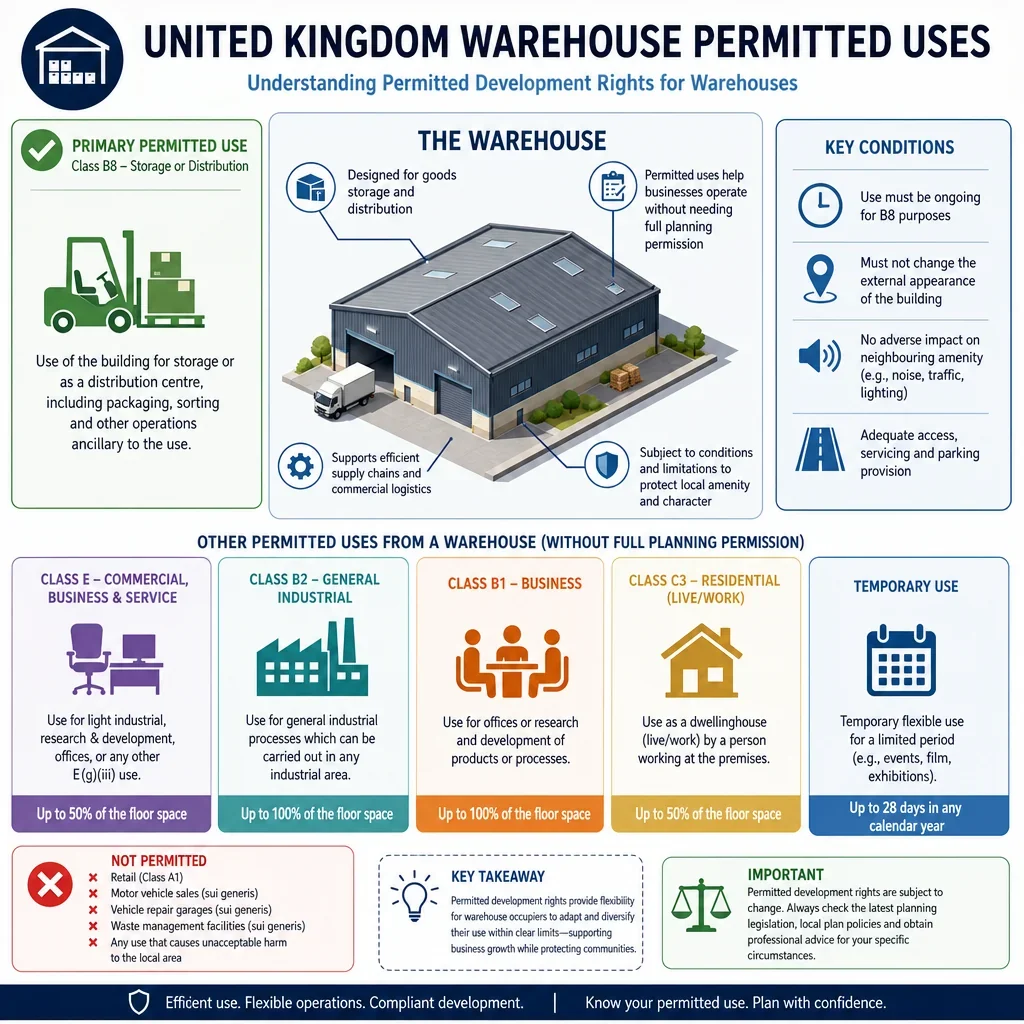
The Tenant shall use the Premises only for the storage distribution and logistics of consumer electronics and for no other purpose (such use to be in compliance with all planning permissions and environmental laws).
The Tenant shall not use the Premises for any noxious noisy or offensive trade and shall comply with all requirements of the Equality Act 2010 in relation to access and facilities.
The Tenant shall not store or use any hazardous substances on the Premises except in accordance with all applicable laws and shall provide the Landlord with an environmental indemnity in respect of any contamination caused by the Tenant\'s use.
12ASSIGNMENT UNDERLETTING AND SUBLETTING
The Tenant shall not assign the whole of this Lease without the prior written consent of the Landlord (such consent not to be unreasonably withheld or delayed) and the Landlord may require as a condition of giving consent that the Tenant enters into an authorised guarantee agreement pursuant to the Landlord and Tenant (Covenants) Act 1995 and that the assignee satisfies reasonable financial tests.
The Tenant shall not underlet the whole or any part of the Premises without the prior written consent of the Landlord (such consent not to be unreasonably withheld or delayed) and any underlease shall be at a rent not less than the open market rent and shall contain provisions equivalent to those in this Lease.
The Tenant may assign or underlet to a group company (within the meaning of section 1159 of the Companies Act 2006) without consent but shall give the Landlord prior notice and shall procure that the group company enters into a direct covenant with the Landlord to observe and perform the Tenant\'s covenants.
The Landlord may charge a reasonable sum for dealing with any application for consent under this clause and for the preparation and completion of any documents.
13COMPLIANCE WITH LAWS AND REGULATIONS
The Tenant shall at all times comply with all applicable laws regulations and statutes in force in England and Wales including (without limitation) the Health and Safety at Work etc. Act 1974 the Environmental Protection Act 1990 the Equality Act 2010 the Bribery Act 2010 and all regulations relating to data protection and GDPR.
The Tenant shall indemnify the Landlord against all claims losses and liabilities arising from any breach of this clause.
The Tenant shall ensure that the Premises have an EPC rating of not less than E and shall not carry out any works which would reduce the EPC rating.
14UTILITIES AND OUTGOINGS
The Tenant shall pay all utilities (including water electricity gas and telecommunications) and all business rates and other outgoings payable in respect of the Premises from the commencement of the Term.
15ACCESS AND RIGHTS OF WAY
The Landlord and all persons authorised by the Landlord (including agents contractors and prospective tenants or purchasers) shall have the right to enter the Premises upon giving not less than 48 hours\' prior written notice (except in emergency when no notice is required) for the purposes of inspecting repairing maintaining or renewing the Premises or the estate or for any other reasonable purpose.
16BREAK CLAUSES
The Tenant may terminate this Lease on the Break Date by giving to the Landlord not less than 6 months\' prior written notice.
The break notice shall only be effective if on the Break Date (a) there are no arrears of Rent or other sums due under this Lease (b) the Tenant has complied with all its obligations under this Lease and (c) the Tenant gives vacant possession of the Premises.
If the Tenant exercises the break option any overpaid Rent or service charge shall be repaid by the Landlord within 14 days of the Break Date.
17YIELD UP AND END OF TERM
The Tenant shall on the expiry or sooner determination of the Term yield up the Premises in the repair and condition required by clause 9 of this Lease in accordance with the Schedule of Condition and having removed all its fixtures fittings alterations and signs and made good any damage caused by such removal.
The parties shall carry out a joint schedule of dilapidations inspection not more than 6 months before the end of the Term and the Tenant shall remedy all items identified before yielding up.
18LANDLORD'S COVENANTS
The Landlord covenants with the Tenant that the Tenant may quietly hold and enjoy the Premises without interruption by the Landlord or any person claiming through or under the Landlord.
The Landlord shall maintain the structure exterior and common parts of the estate and shall insure the building as provided in clause 8.
19TENANT'S COVENANTS
The Tenant covenants with the Landlord to pay the Rent the service charge and all other sums due under this Lease on the due dates.
The Tenant covenants to observe and perform all the Tenant\'s obligations in this Lease.
20PROVISOS AND CONDITIONS
Interest shall be payable on any late payment of Rent or other sums due at the Interest Rate (both before and after any judgment) calculated on a daily basis.
If the Premises are destroyed or damaged by an Insured Risk and the insurance is not vitiated by any act or omission of the Tenant then the Landlord shall reinstate the Premises.
21FORFEITURE
The Landlord may re-enter the Premises and forfeit this Lease if (a) any Rent or other sum is in arrears for 14 days after becoming due (whether formally demanded or not) or (b) the Tenant is in breach of any covenant or (c) the Tenant enters into insolvency proceedings.
Forfeiture shall be without prejudice to any claim by the Landlord for arrears of rent or damages.
22DISPUTE RESOLUTION
Any dispute arising out of or in connection with this Lease shall first be referred to mediation.
If the dispute is not resolved by mediation within 30 days it shall be referred to arbitration in London in accordance with the Arbitration Act 1996.
This Lease shall be governed by and construed in accordance with the laws of England and Wales.
23NOTICES
Any notice under this Lease shall be in writing and shall be served in accordance with section 196 of the Law of Property Act 1925.
Notices to the Tenant shall be sent to 123 High Street London SW1A 1AA or such other address as the Tenant shall notify.
Notices to the Landlord shall be sent to 456 Warehouse Lane Manchester M1 1AB or such other address as the Landlord shall notify.
24VAT AND TAXATION
All sums payable under this Lease are exclusive of VAT which shall be payable by the Tenant at the applicable rate.
The Landlord has elected to waive exemption from VAT in respect of the Premises.
The Tenant shall indemnify the Landlord against any liability for stamp duty land tax arising from this Lease.
25COSTS
Each party shall bear its own costs in relation to the preparation and completion of this Lease except that the Tenant shall pay the Landlord\'s reasonable legal and other costs in connection with any application for consent under this Lease.
26SET OFF AND SUSPENSION OF RENT
The Tenant shall not be entitled to set off any payments against the Rent or other sums due under this Lease.
If the Premises are damaged by an Insured Risk so as to render them unfit for use then the Rent and service charge shall be suspended until the Premises are reinstated.
27GUARANTEE
In consideration of the Landlord granting this Lease to the Tenant the Guarantor guarantees to the Landlord the due performance by the Tenant of all its obligations under this Lease and as a primary obligor agrees to indemnify the Landlord against any loss arising from any failure by the Tenant to perform such obligations.
The guarantee shall remain in force for the duration of the Term and any liability of the Guarantor shall not be discharged by any variation of this Lease or by any insolvency of the Tenant.
28SCHEDULES
Schedule 1 contains a full description of the Premises a floor plan and the rights granted and excepted.
Schedule 2 contains the detailed rent review machinery.
Schedule 3 contains the rent deposit provisions.
Schedule 4 contains the services to be provided and the service charge provisions.
The Schedule of Condition is annexed to this Lease.
The designated contact for the Tenant is John Smith telephone +44 20 1234 5678 email john.smith@example.com.
The designated contact for the Landlord is Emma Johnson telephone +44 20 8765 4321 email emma.johnson@landlord.co.uk.
29BOILERPLATE PROVISIONS
This Lease constitutes the entire agreement between the parties and supersedes all prior negotiations.
If any provision of this Lease is held to be invalid or unenforceable the validity of the remaining provisions shall not be affected.
This Lease shall be governed by and construed in accordance with the laws of England and Wales.
No variation of this Lease shall be effective unless it is in writing and signed by or on behalf of each party.
A person who is not a party to this Lease shall not have any rights under the Contracts (Rights of Third Parties) Act 1999 to enforce any term of this Lease.
Nothing in this Lease shall create a partnership or joint venture between the parties.
No failure or delay by either party to exercise any right or remedy shall constitute a waiver.
The Tenant shall comply with all requirements of the Bribery Act 2010 and anti-bribery policies of the Landlord.
The Landlord shall assign to the Tenant the benefit of any guarantees or warranties received in respect of the Premises.
30EXECUTION
Executed and delivered as a deed by the parties on the date of this Lease.
| LANDLORD | |
| Signature: | |
| Print Name: | |
| Date: |
| TENANT | |
| Signature: | |
| Print Name: | |
| Date: |
| GUARANTOR | |
| Signature: | |
| Print Name: | |
| Date: |
| WITNESS FOR LANDLORD | |
| Signature: | |
| Print Name: | |
| Date: |
| WITNESS FOR TENANT | |
| Signature: | |
| Print Name: | |
| Date: |
31SCHEDULE 1 - DESCRIPTION OF THE PREMISES
The Premises comprise Unit 5 Industrial Estate Manchester Road London SW1A 1AA as shown edged red on the plan annexed and include the warehouse building loading bays office area and parking for 10 vehicles. Rights granted include the right of access over the estate roads and the right to use common loading facilities. Rights excepted include rights of support and light to adjoining property.
32SCHEDULE 2 - RENT REVIEW
The Rent shall be reviewed on the fifth and tenth anniversaries of the commencement of the Term to the open market rent at the relevant review date assuming a term equal to the unexpired residue of the Term. The review shall be conducted by an independent surveyor appointed by agreement or in default by the President of the RICS. Time shall not be of the essence. The reviewed rent shall not be less than the Rent payable immediately before the review date.
33SCHEDULE OF CONDITION
The Schedule of Condition annexed to and signed by the parties records the condition of the Premises at the commencement of the Term and limits the Tenant\'s repairing obligations accordingly.
This example shows approximately 70% of a typical document and is provided for illustrative purposes only. The remaining content has been omitted.
Every document generated by Docaro is tailored to your specific circumstances, jurisdiction and the information you provide. The completed document includes all applicable clauses and provisions required for your situation.
To generate the full, personalised document, answer a short series of questions and your document will be created instantly.
Useful Resources When Considering a Warehouse Lease Agreement in the United Kingdom
United Kingdom Reference Legislation
Warehouse Lease Agreement FAQs
Document Generation FAQs
Related Articles