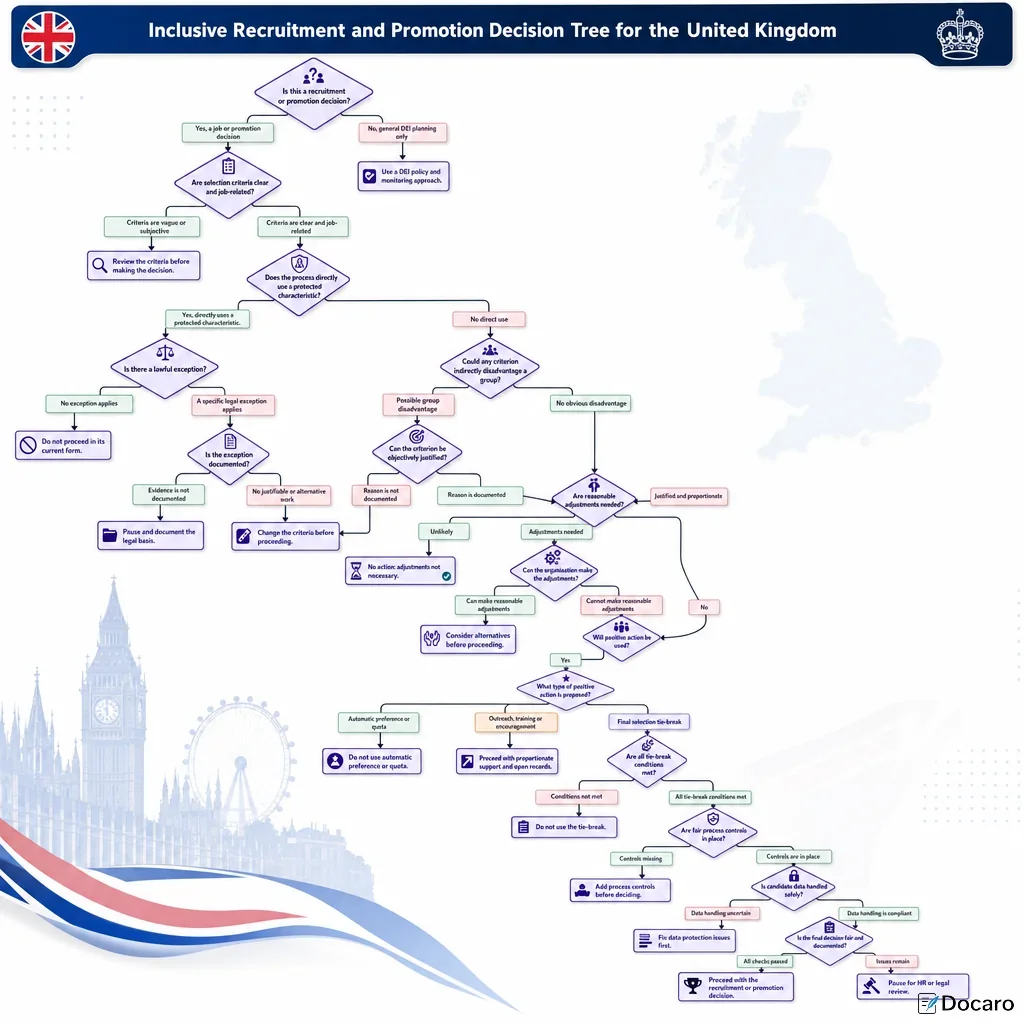
AI Generated Diversity, Equity and Inclusion Policy for use in the United Kingdom
PDF & Word - 2026 Updated
Docaro Pricing
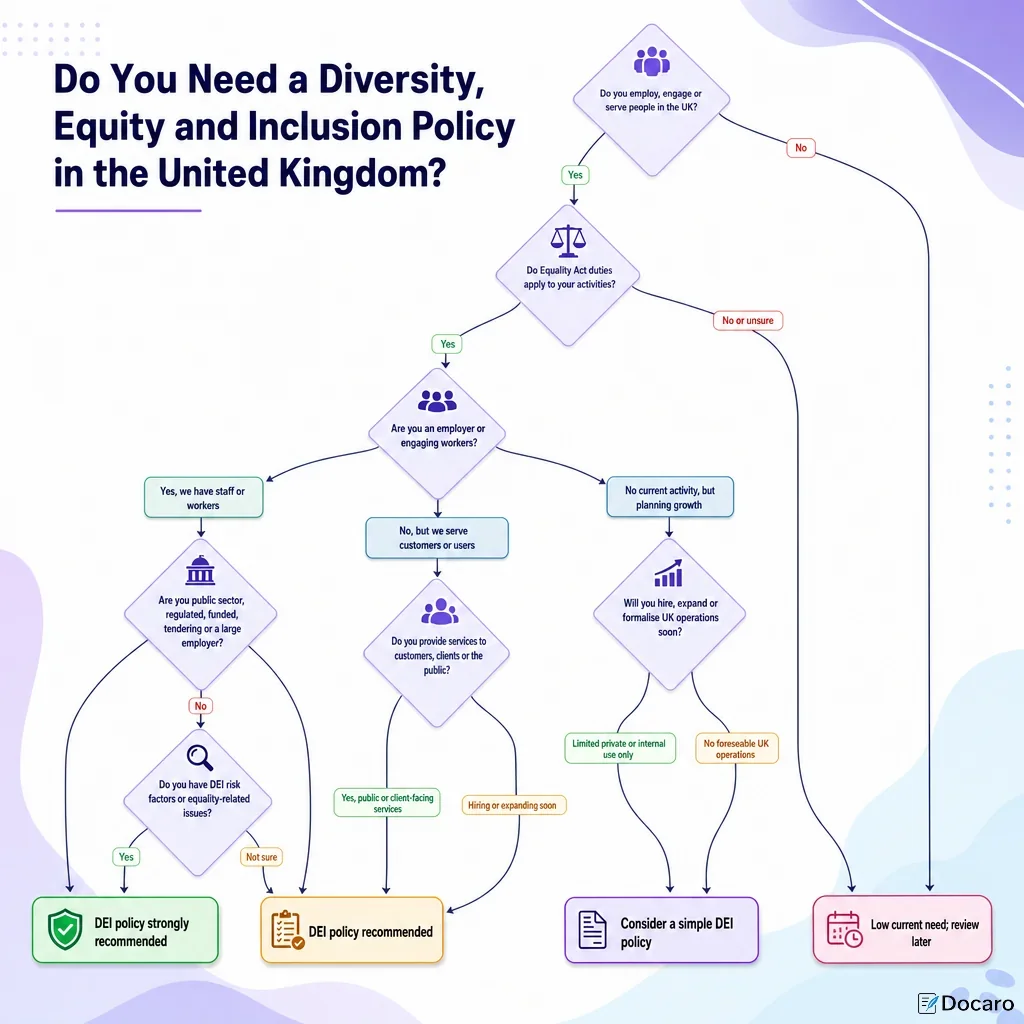
When do you need a Diversity, Equity and Inclusion Policy in the United Kingdom?
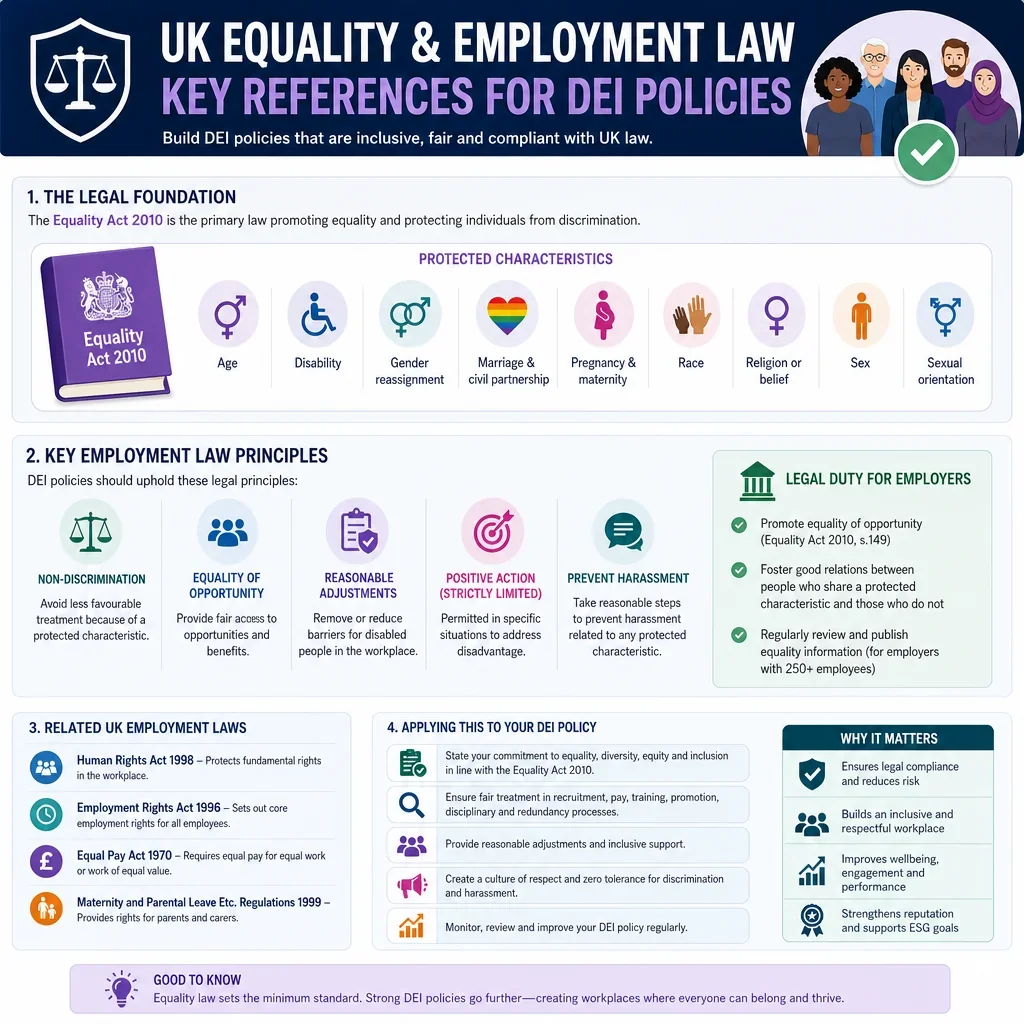
British Legal Rules for a Diversity, Equity and Inclusion Policy
Failing to tailor the DEI policy to your organisation's specific legal obligations under the Equality Act 2010 may result in non-compliance with UK anti-discrimination laws.
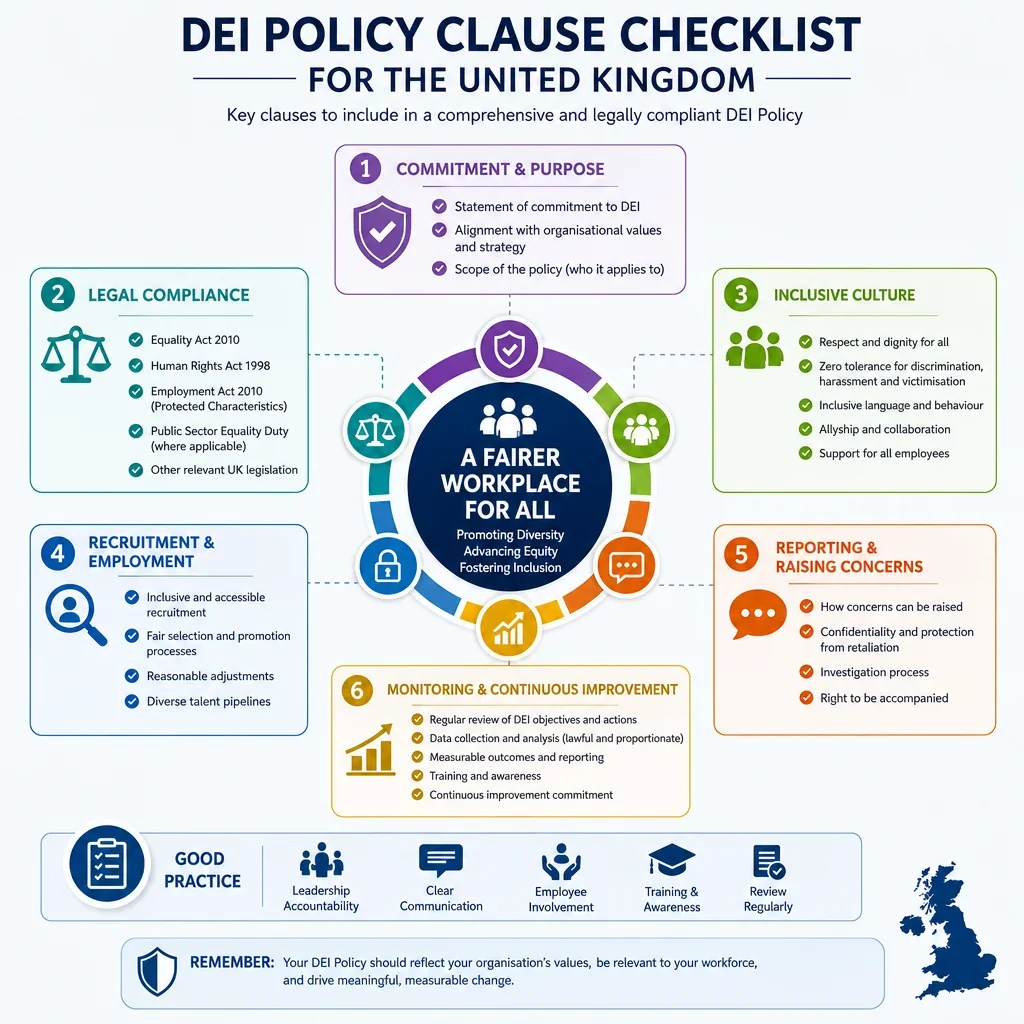
What a Proper Diversity, Equity and Inclusion Policy Should Include
- Commitment StatementA clear declaration from leadership showing the organization's dedication to fostering diversity, equity, and inclusion across all activities.
- Scope and CoverageDetails on who the policy applies to, including employees, contractors, and stakeholders, and the areas of the business it covers.
- Protected CharacteristicsRecognition of groups protected by UK equality laws, such as those based on age, disability, gender, race, religion, and sexual orientation.
- Non-Discrimination RulesFirm guidelines prohibiting any form of unfair treatment or bias against individuals based on their protected characteristics.
- Inclusive RecruitmentSteps to ensure hiring processes are fair and attract a diverse range of candidates from all backgrounds.
- Support for Underrepresented GroupsInitiatives like mentoring, training, and adjustments to help underrepresented employees thrive in the workplace.
- Reporting and Response to IssuesSimple ways for people to raise concerns about discrimination or inequity, with promises of fair and prompt handling.
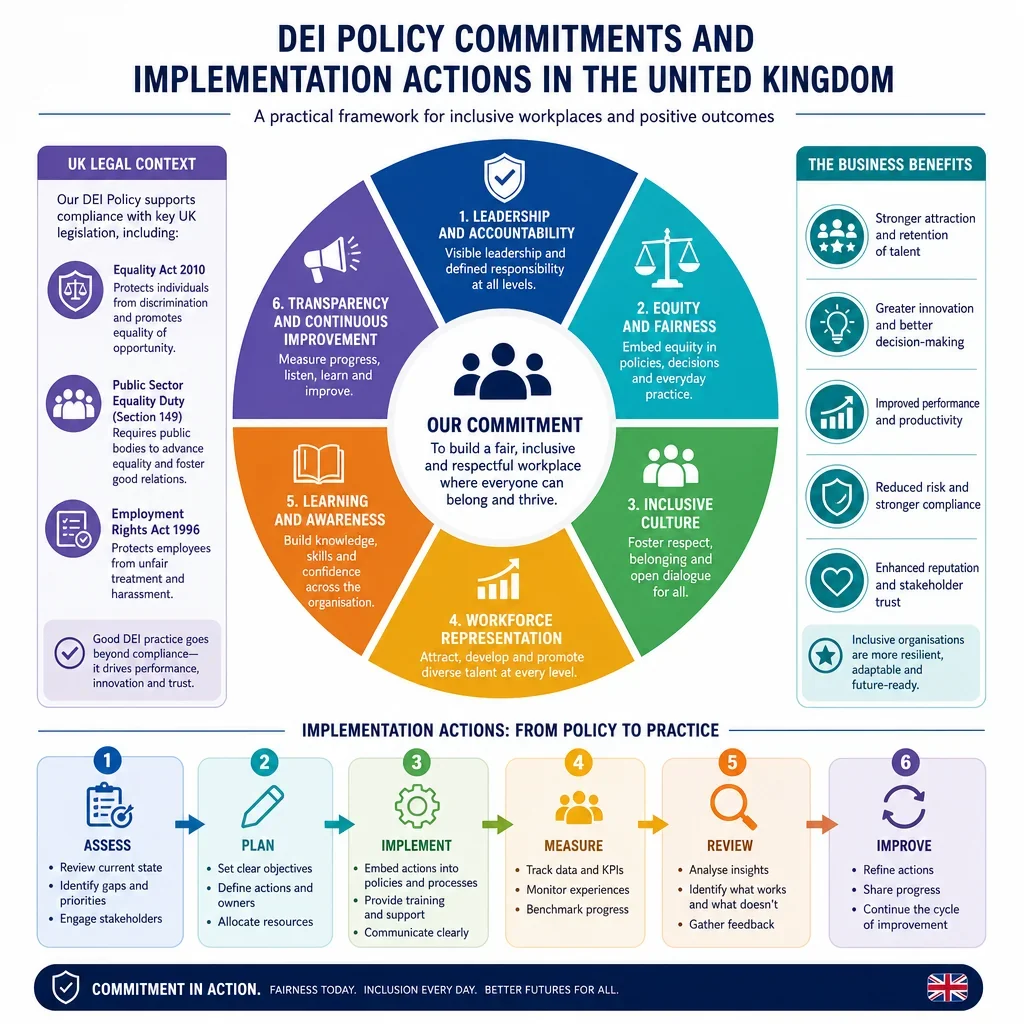
- Training and EducationOngoing programs to build awareness and skills in diversity, equity, and inclusion for all staff members.
- Monitoring and ReviewRegular checks on policy effectiveness, including data collection and updates to keep it relevant and impactful.
- Leadership AccountabilityExpectations for managers to actively promote and model inclusive behaviors in their teams.
Generate Your Document in 4 Easy Steps
Why Use Docaro?
 United Kingdom
Free Example Diversity, Equity and Inclusion Policy Template
Below is a free template example of a Diversity, Equity and Inclusion Policy for use in the United Kingdom generated by our AI model.
The clauses in your actual Diversity, Equity and Inclusion Policy will vary from this example as they will be entirely bespoke to your requirements as set out in the questionnaire you complete.
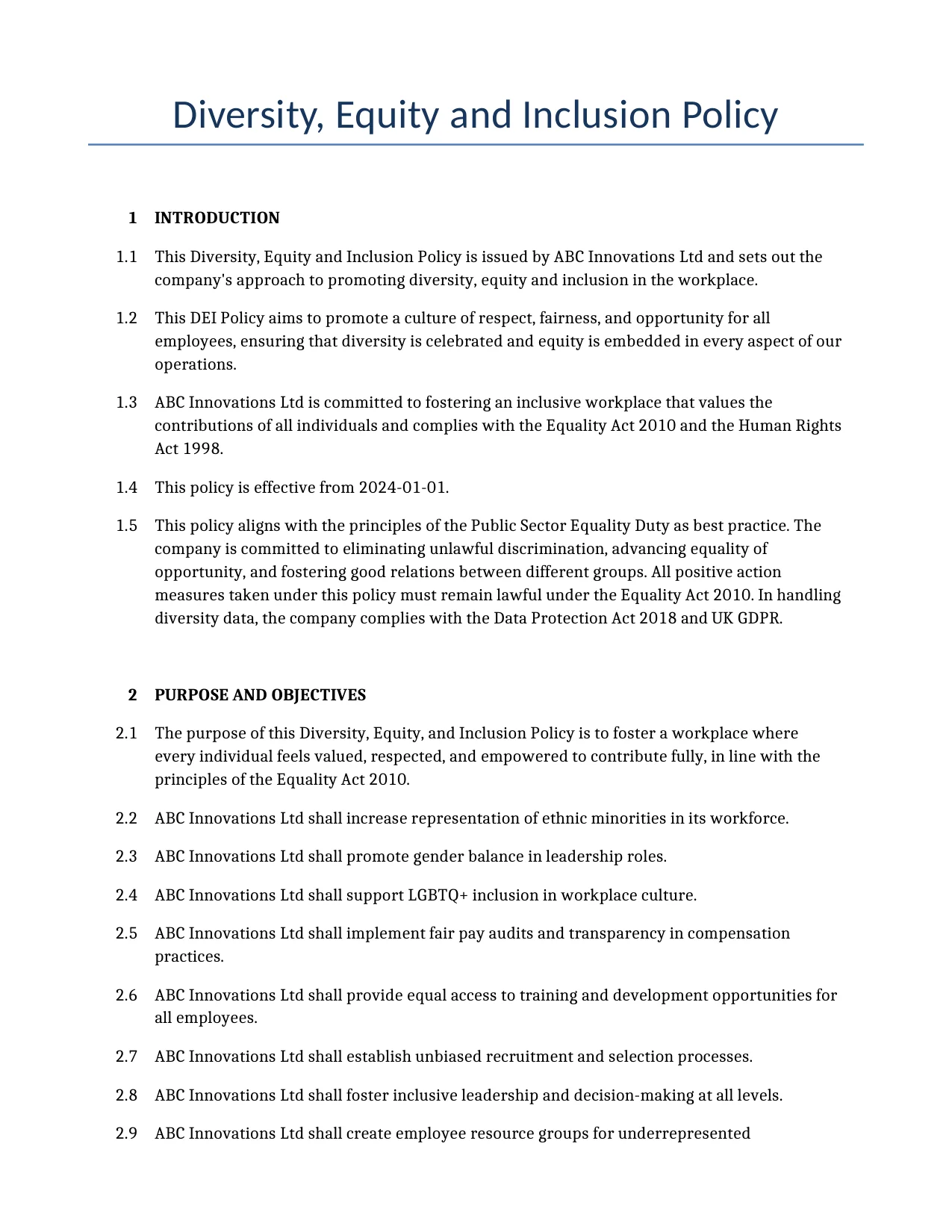
Diversity, Equity and Inclusion Policy
1INTRODUCTION
This Diversity, Equity and Inclusion Policy is issued by ABC Innovations Ltd and sets out the company's approach to promoting diversity, equity and inclusion in the workplace.
This DEI Policy aims to promote a culture of respect, fairness, and opportunity for all employees, ensuring that diversity is celebrated and equity is embedded in every aspect of our operations.
ABC Innovations Ltd is committed to fostering an inclusive workplace that values the contributions of all individuals and complies with the Equality Act 2010 and the Human Rights Act 1998.
This policy is effective from 2024-01-01.
This policy aligns with the principles of the Public Sector Equality Duty as best practice. The company is committed to eliminating unlawful discrimination, advancing equality of opportunity, and fostering good relations between different groups. All positive action measures taken under this policy must remain lawful under the Equality Act 2010. In handling diversity data, the company complies with the Data Protection Act 2018 and UK GDPR.
2PURPOSE AND OBJECTIVES
The purpose of this Diversity, Equity, and Inclusion Policy is to foster a workplace where every individual feels valued, respected, and empowered to contribute fully, in line with the principles of the Equality Act 2010.
ABC Innovations Ltd shall increase representation of ethnic minorities in its workforce.
ABC Innovations Ltd shall promote gender balance in leadership roles.
ABC Innovations Ltd shall support LGBTQ+ inclusion in workplace culture.
ABC Innovations Ltd shall implement fair pay audits and transparency in compensation practices.
ABC Innovations Ltd shall provide equal access to training and development opportunities for all employees.
ABC Innovations Ltd shall establish unbiased recruitment and selection processes.
ABC Innovations Ltd shall foster inclusive leadership and decision-making at all levels.
ABC Innovations Ltd shall create employee resource groups for underrepresented communities.
ABC Innovations Ltd shall promote inclusive communication and events across the organisation.
ABC Innovations Ltd commits to an annual review of the Diversity, Equity and Inclusion Policy.
This policy commits to eliminating unlawful discrimination, advancing equality of opportunity, and fostering good relations between different groups, in line with the three aims of the Public Sector Equality Duty (even if not a public body, as best practice). Specific targets like increasing representation must not amount to unlawful positive discrimination or quotas.
3SCOPE AND APPLICABILITY
This DEI policy applies to all aspects of our organization's operations, ensuring that principles of diversity, equity, and inclusion are upheld in all activities, decisions, and interactions.
This Diversity, Equity and Inclusion Policy applies to all employees of ABC Innovations Ltd.
This Diversity, Equity and Inclusion Policy applies to all contractors working with ABC Innovations Ltd.
This Diversity, Equity and Inclusion Policy applies to other stakeholders such as suppliers or partners of ABC Innovations Ltd.
This Diversity, Equity and Inclusion Policy explicitly applies to remote workers within ABC Innovations Ltd.
This Diversity, Equity and Inclusion Policy applies to international operations based in the UK of ABC Innovations Ltd.
This Diversity, Equity and Inclusion Policy covers operations in England, Scotland, Wales, Northern Ireland.
4DEFINITIONS
Protected characteristics refer to the nine categories outlined in the Equality Act 2010: age, disability, gender reassignment, marriage and civil partnership, pregnancy and maternity, race, religion or belief, sex, and sexual orientation. These are attributes on which discrimination is unlawful in the UK.
Harassment is unwanted conduct related to a relevant protected characteristic that has the purpose or effect of violating an individual's dignity or creating an intimidating, hostile, degrading, humiliating, or offensive environment, as defined under the Equality Act 2010.
Discrimination occurs when an individual is treated less favourably because of a protected characteristic, including direct discrimination, indirect discrimination, discrimination by association, perception-based discrimination, victimisation, and harassment, in accordance with the Equality Act 2010.
Positive Action refers to lawful measures under sections 158 and 159 of the Equality Act 2010 to address under-representation or disadvantage, where proportionate to achieving a legitimate aim. Positive Discrimination (e.g. quotas) is generally unlawful in the UK, except in very limited circumstances.
5LEGAL FRAMEWORK
This Diversity, Equity and Inclusion Policy is governed by British law, including the Equality Act 2010, the Equality Act 2006, the Human Rights Act 1998, the Employment Rights Act 1996 and the Public Sector Equality Duty under Section 149 of the Equality Act 2010. It also references the Data Protection Act 2018 and UK GDPR (for processing special category data in monitoring), Equality and Human Rights Commission guidance, the Employment Equality (Age) Regulations 2006 and other relevant secondary legislation.
ABC Innovations Ltd shall review the Legal Framework section of this Diversity, Equity and Inclusion Policy annually for updates to UK laws, including any post-Brexit updates if applicable, and commits to keeping the policy under review for changes in law.
6COMMITMENT FROM LEADERSHIP
The senior leadership of ABC Innovations Ltd shall include a public statement of commitment to diversity, equity and inclusion in this policy.
The senior leadership of ABC Innovations Ltd shall champion the roles of CEO Public Endorsement, Board Oversight and Executive Sponsorship in promoting diversity, equity and inclusion.
The senior leadership of ABC Innovations Ltd shall make regular public statements on diversity, equity and inclusion progress.
The senior leadership of ABC Innovations Ltd shall be subject to the accountability measures of Performance Metrics in KPIs, Annual Reporting Requirements and Training Participation regarding diversity, equity and inclusion.
The senior leadership of ABC Innovations Ltd shall review diversity, equity and inclusion progress four times per year.
7PROTECTED CHARACTERISTICS
ABC Innovations Ltd shall include protections for age under this Diversity, Equity and Inclusion Policy.
ABC Innovations Ltd shall include protections for disability under this Diversity, Equity and Inclusion Policy.
ABC Innovations Ltd shall include protections for gender reassignment under this Diversity, Equity and Inclusion Policy.
ABC Innovations Ltd shall include protections for marriage and civil partnership under this Diversity, Equity and Inclusion Policy.
ABC Innovations Ltd shall include protections for pregnancy and maternity under this Diversity, Equity and Inclusion Policy.
ABC Innovations Ltd shall include protections for race under this Diversity, Equity and Inclusion Policy.
ABC Innovations Ltd shall include protections for religion or belief under this Diversity, Equity and Inclusion Policy.
ABC Innovations Ltd shall include protections for sex under this Diversity, Equity and Inclusion Policy.
ABC Innovations Ltd shall include protections for sexual orientation under this Diversity, Equity and Inclusion Policy.
8DIVERSITY INITIATIVES
ABC Innovations Ltd shall implement recruitment strategies that target underrepresented groups, including women, ethnic minorities and disabled persons.
ABC Innovations Ltd shall partner with local universities to host career fairs focused on ethnic minorities and women in STEM fields, and shall implement blind recruitment processes to reduce bias against disabled candidates.
ABC Innovations Ltd shall establish partnerships with diversity organizations to support its diversity, equity and inclusion initiatives.
ABC Innovations Ltd shall implement a system for tracking and reporting on diversity metrics annually.
The company may take lawful positive action under sections 158 and 159 of the Equality Act 2010 to address under-representation or disadvantage, but only where it is a proportionate means of achieving a legitimate aim. Examples include targeted advertising of opportunities or using tie-break provisions in recruitment where candidates are equally qualified.
9EQUITY MEASURES
ABC Innovations Ltd commits to conduct regular pay equity audits.
ABC Innovations Ltd shall provide guidelines for equitable resource allocation.
ABC Innovations Ltd shall identify and address systemic barriers.
The HR Director and the Diversity Committee shall be responsible for overseeing equity measures.
10INCLUSION STRATEGIES
ABC Innovations Ltd shall provide cultural competency training to employees.
ABC Innovations Ltd shall provide annual cultural competency training covering topics such as unconscious bias, cross-cultural communication, and inclusive language. The training shall be delivered through interactive online modules and in-person workshops facilitated by certified diversity trainers.
ABC Innovations Ltd shall enable and support employee resource groups for underrepresented communities.
ABC Innovations Ltd shall support the employee resource groups of Women and Gender Diversity, Ethnic Minority, LGBTQ+ and Disability.
ABC Innovations Ltd shall support employee resource groups by providing an annual budget of \£5,000 per group for events and initiatives, access to company meeting rooms and virtual platforms for gatherings, and dedicated time during work hours for group activities.
ABC Innovations Ltd shall implement inclusive decision-making processes in company leadership and projects.
ABC Innovations Ltd shall use the methods of Diverse Committees, Feedback Surveys and Inclusive Workshops for inclusive decision-making.
11RECRUITMENT AND SELECTION
ABC Innovations Ltd shall implement blind recruitment practices in its hiring process.
ABC Innovations Ltd shall require diverse interview panels for all selection processes.
ABC Innovations Ltd shall monitor the demographics of job applicants during recruitment.
ABC Innovations Ltd shall monitor the protected characteristics of age, disability, gender reassignment, race, religion or belief, sex and sexual orientation in applicant demographics.
ABC Innovations Ltd shall use the channels of General Job Boards, Diversity-Focused Networks, Social Media and Professional Associations for advertising jobs to reach diverse candidates.
12TRAINING AND DEVELOPMENT
ABC Innovations Ltd shall make diversity, equity and inclusion training mandatory for all staff levels.
ABC Innovations Ltd shall offer optional diversity, equity and inclusion training programs in addition to the mandatory ones.
ABC Innovations Ltd shall include the specific topics of Unconscious Bias, Cultural Awareness and Inclusive Leadership in the mandatory diversity, equity and inclusion training programs.
ABC Innovations Ltd shall use the delivery methods of Online Modules and In-Person Workshops for the diversity, equity and inclusion training programs.
ABC Innovations Ltd shall tailor the diversity, equity and inclusion training differently for various staff levels, such as executives versus entry-level.
13PERFORMANCE MANAGEMENT AND PROMOTION
Our performance evaluations will use clear, objective criteria including measurable goals, 360-degree feedback, and skills-based assessments to ensure fairness and reduce bias across all employee groups.
ABC Innovations Ltd shall require that all promotion panels include members from diverse backgrounds.
ABC Innovations Ltd shall track progression rates for the protected characteristics of age, disability, race, sex and sexual orientation in performance management and promotions.
ABC Innovations Ltd shall conduct an annual review of progression rates across protected characteristics.
ABC Innovations Ltd shall select members for diverse promotion panels by nomination by HR with diversity targets.
14NON-DISCRIMINATION AND ANTI-HARASSMENT
ABC Innovations Ltd prohibits discrimination on the grounds of age, disability, gender reassignment, marriage and civil partnership, pregnancy and maternity, race, religion or belief, sex, and sexual orientation.
ABC Innovations Ltd considers the following to be examples of unacceptable discriminatory behaviour: direct discrimination such as refusing a promotion based on an employee's race; indirect discrimination like a policy that disadvantages women due to childcare responsibilities; victimisation for raising a complaint about discrimination.
Harassment is unwanted conduct related to a protected characteristic that violates a person's dignity or creates an intimidating, hostile, degrading, humiliating, or offensive environment.
ABC Innovations Ltd considers the following to be examples of unacceptable harassment: making derogatory jokes about someone's religion, sending unwanted sexual messages to a colleague, or persistently mocking an employee's accent.
Bullying is repeated offensive, intimidating, malicious, or insulting behaviour that abuses power and makes the recipient feel frightened, upset, or humiliated.
ABC Innovations Ltd considers the following to be examples of unacceptable bullying behaviour: repeatedly shouting at or belittling a team member in front of others, spreading malicious rumours about a colleague, or unfairly overloading someone with work to make them fail.
ABC Innovations Ltd explicitly prohibits all forms of discrimination, bullying, and harassment regardless of whether they relate to protected characteristics.
The non-discrimination and anti-harassment policies of ABC Innovations Ltd cover employees, contractors and agency workers, volunteers and interns, and job applicants.
Any complaints under this policy should be raised in accordance with the Company's Grievance Procedure, detailed in Section 5 of the Employee Handbook.
The company has a duty to protect employees from third-party harassment by clients or suppliers and may be vicariously liable for acts of harassment by employees. Victimisation of employees for making complaints or raising concerns about discrimination is strictly prohibited under the Equality Act 2010.
15ACCOMMODATIONS AND SUPPORT
ABC Innovations Ltd shall include a formal procedure for employees to request reasonable adjustments for disabilities.
ABC Innovations Ltd shall include a procedure for requesting accommodations for religious observances or beliefs.
ABC Innovations Ltd shall include procedures for requesting accommodations for other equity-promoting needs, such as family or caring responsibilities.
Employees shall use the methods of email to HR, online form or in person meeting for submitting accommodation requests.
The HR Manager, Jane Smith, shall be the primary contact person for handling accommodation requests.
ABC Innovations Ltd shall acknowledge receipt of an accommodation request within 3 days.
ABC Innovations Ltd shall provide a decision on an accommodation request within 14 days.
ABC Innovations Ltd shall use the criteria of medical evidence review, consultation with employee and legal compliance check when evaluating accommodation requests.
ABC Innovations Ltd shall include an internal appeal process for denied accommodation requests.
Under the Equality Act 2010, the company has a legal duty to make reasonable adjustments for disabled employees, applicants and workers where a provision, criterion or practice, physical feature or lack of auxiliary aid puts them at a substantial disadvantage. Factors considered in determining reasonableness include the effectiveness of the adjustment, its practicality, the cost, the resources available, the nature of the organisation and the size of the business. Reference is made to the EHRC Statutory Code of Practice on Employment.
16MONITORING AND REPORTING
ABC Innovations Ltd shall collect demographic data from employees for the purpose of monitoring workforce diversity.
ABC Innovations Ltd shall include the demographic categories of age, gender, ethnicity and disability in the data collection for diversity, equity and inclusion monitoring.
ABC Innovations Ltd shall collect the demographic data from employees through voluntary self-reporting via an anonymous online survey during onboarding and annual reviews.
ABC Innovations Ltd shall ensure that all demographic data collection is conducted anonymously where possible.
ABC Innovations Ltd shall prepare and publish an annual report on workforce demographics and diversity, equity and inclusion progress metrics.
ABC Innovations Ltd shall include the progress metrics of representation by grade, retention rates and recruitment diversity in the annual diversity, equity and inclusion reporting.
The company's Data Protection Officer, Jane Smith, reachable at dpo@company.co.uk, shall be the point of contact for data protection queries related to diversity, equity and inclusion monitoring.
ABC Innovations Ltd shall retain diversity, equity and inclusion demographic data for 7 years after an employee leaves, in compliance with UK data protection guidelines for employment records.
The lawful basis for processing special category data includes explicit consent or obligations under employment law. Data minimisation and anonymisation are applied where possible. Employees have rights under UK GDPR, including the right to withdraw consent. Data is stored securely with retention aligned to ICO guidance. Reports are published in compliance with privacy obligations.
17EMPLOYEE RESOURCE GROUPS
ABC Innovations Ltd shall establish Employee Resource Groups for underrepresented employees.
The primary purpose of the Employee Resource Groups established by ABC Innovations Ltd is to build a supportive community for underrepresented employees, promote inclusion, and provide a platform for sharing experiences and feedback on workplace issues.
The Employee Resource Groups established by ABC Innovations Ltd shall cover the focus areas of women and gender minorities, black, asian and minority ethnic groups, and LGBTQ+ community.
The management of ABC Innovations Ltd shall provide active support to the Employee Resource Groups.
The guidelines for establishing and operating Employee Resource Groups shall include voluntary participation, alignment with company values, regular meetings at least quarterly, inclusive leadership selection, and adherence to UK equality laws such as the Equality Act 2010.
The Employee Resource Groups shall use the mechanisms of quarterly reports to HR, direct meetings with leadership and dedicated diversity, equity and inclusion feedback portal for providing feedback to ABC Innovations Ltd.
18SUPPLIER DIVERSITY
ABC Innovations Ltd commits to diverse procurement practices.
ABC Innovations Ltd shall specify ethnic minorities, women, LGBTQ+ individuals and disabled persons for supplier diversity in this policy.
ABC Innovations Ltd shall set the specific goal to aim to allocate at least 20 percent of procurement contracts to suppliers owned by underrepresented groups within the next three years, with annual reviews to track progress and adjust targets as needed.
19REPORTING MECHANISMS
ABC Innovations Ltd shall enable anonymous reporting options for employees raising diversity, equity and inclusion concerns.
ABC Innovations Ltd shall enable confidential reporting options for employees raising diversity, equity and inclusion concerns.
ABC Innovations Ltd shall include the reporting channels of dedicated hotline, online portal and email address.
The step-by-step procedure for submitting a report is that employees should first identify the appropriate channel (hotline, portal, or email). Then, provide a clear description of the diversity, equity and inclusion concern, including any relevant details or evidence. Submit the report and retain any confirmation number provided. The company will acknowledge receipt within the specified timeframe.
This Reporting Mechanisms section explicitly references whistleblowing protections under UK law.
ABC Innovations Ltd shall acknowledge receipt to the reporter within 5 days after receiving a report.
The HR Department and DEI Officer shall be designated as recipients for receiving diversity, equity and inclusion reports.
This Diversity, Equity and Inclusion Policy includes a strong non-retaliation clause for reporters.
Employees can report diversity, equity and inclusion complaints via a secure online form accessible through the company intranet, or by emailing a dedicated address (dei-reports@company.com). For anonymous submissions, no login is required on the online form.
Employees raising concerns about discrimination or breaches of this policy are protected under the Public Interest Disclosure Act 1998 (whistleblowing legislation).
20INVESTIGATION AND RESOLUTION PROCEDURES
An internal HR professional shall be the designated investigator for diversity, equity and inclusion complaints.
ABC Innovations Ltd shall require mandatory training on impartiality and bias awareness for all investigators handling diversity, equity and inclusion complaints.
ABC Innovations Ltd shall acknowledge receipt to the complainant within 3 days after receiving a diversity, equity and inclusion complaint.
ABC Innovations Ltd shall complete the full investigation of a diversity, equity and inclusion complaint within 30 days from the date of receipt.
The resolution outcomes following a diversity, equity and inclusion investigation shall include mediation session, training program and disciplinary action.
ABC Innovations Ltd shall guarantee strict confidentiality throughout the diversity, equity and inclusion investigation and resolution process, except where legally required to disclose.
ABC Innovations Ltd shall retain records of diversity, equity and inclusion investigations and resolutions for 7 years from the date of resolution.
Complaints shall escalate to senior management or external bodies in the diversity, equity and inclusion resolution process under the circumstances of systemic or repeated issues, unresolved after initial process or legal or regulatory breach.
21DISCIPLINARY ACTIONS
A breach of the Diversity, Equity and Inclusion Policy includes any discriminatory behavior, such as harassment based on race, gender, or disability, failure to promote inclusive practices, or non-compliance with equality training requirements.
ABC Innovations Ltd shall include verbal warnings as a possible disciplinary action for minor breaches.
ABC Innovations Ltd shall include written warnings as a disciplinary action for moderate breaches.
ABC Innovations Ltd shall include suspension without pay as an option for serious breaches during investigations.
ABC Innovations Ltd shall include dismissal as a consequence for gross breaches of the Diversity, Equity and Inclusion Policy.
The consequences under this Diversity, Equity and Inclusion Policy shall align with the stages of informal resolution, first formal warning, final written warning and dismissal of the organization's existing disciplinary framework.
The procedure for investigating alleged breaches of the Diversity, Equity and Inclusion Policy is that the investigation will involve gathering statements from involved parties, reviewing relevant evidence, and conducting interviews in a confidential manner, in line with UK employment law.
Warnings shall remain active on an employee's record for 12 months.
ABC Innovations Ltd shall include an appeal process for employees facing diversity, equity and inclusion-related disciplinary actions.
22POLICY BREACHES AND EMPLOYEE RESPONSIBILITIES
All employees must comply with this Diversity, Equity and Inclusion Policy and promote its aims. Breaches of the policy may lead to disciplinary action, up to and including dismissal. Disciplinary procedures will follow the ACAS Code of Practice on disciplinary and grievance procedures.
23REVIEW AND EVALUATION
This Diversity, Equity and Inclusion Policy shall include a mandatory annual review.
The first review of this Diversity, Equity and Inclusion Policy shall occur on 2024-12-31.
There shall be 12 months between each policy review.
This Diversity, Equity and Inclusion Policy shall include the employee feedback mechanisms of annual surveys and feedback portal.
This Diversity, Equity and Inclusion Policy shall require monitoring for new UK legal changes related to diversity, equity and inclusion.
The HR Director and Legal Team shall be responsible for monitoring legal and organizational changes.
The triggers for adapting this Diversity, Equity and Inclusion Policy to new changes shall be new legislation and feedback threshold.
24COMMUNICATION AND AWARENESS
ABC Innovations Ltd shall use the methods of intranet postings, workshops and training sessions, and team meetings for disseminating the Diversity, Equity and Inclusion Policy within the organisation.
ABC Innovations Ltd shall implement annual diversity, equity and inclusion awareness campaigns as part of the policy dissemination strategy.
ABC Innovations Ltd shall target the groups of all employees, new hires, and managers and leaders specifically with diversity, equity and inclusion policy communications.
The DEI Coordinator and HR Department shall be responsible for overseeing diversity, equity and inclusion communication and awareness strategies.
25ROLES AND RESPONSIBILITIES
Employees of ABC Innovations Ltd should actively promote an inclusive workplace by respecting diverse backgrounds, participating in diversity, equity and inclusion training sessions, reporting any instances of discrimination or bias they witness, and contributing to a positive culture through everyday interactions.
Managers of ABC Innovations Ltd are responsible for ensuring equitable treatment in team assignments and promotions, conducting regular one-on-one discussions to address diversity, equity and inclusion concerns, integrating diversity, equity and inclusion principles into performance reviews, and fostering diverse team compositions.
The HR department of ABC Innovations Ltd will develop and deliver diversity, equity and inclusion training programs, monitor recruitment and hiring processes for bias, handle investigations into diversity, equity and inclusion complaints confidentially, and maintain records of diversity, equity and inclusion initiatives to ensure compliance with UK equality laws.
Executives of ABC Innovations Ltd must champion diversity, equity and inclusion at the strategic level by allocating resources for diversity, equity and inclusion programs, reviewing and approving diversity, equity and inclusion goals annually, leading by example in inclusive decision-making, and publicly committing to diversity targets in company communications.
The annual review of the Diversity, Equity and Inclusion Policy by executives shall occur on 2025-01-15.
The HR department of ABC Innovations Ltd shall report diversity, equity and inclusion metrics to executives quarterly.
Employees of ABC Innovations Ltd should report diversity, equity and inclusion-related incidents promptly to their line manager or directly to the HR department via email or the anonymous reporting hotline, providing a detailed description of the incident, including date, time, and individuals involved, to ensure swift investigation and resolution.
26SIGNATURE SECTION
This Diversity, Equity and Inclusion Policy is approved and adopted by ABC Innovations Ltd on the effective date stated above. This policy has been approved by the board/senior management.
Signed for and on behalf of ABC Innovations Ltd: _______________________________
Name: _______________________________ (e.g. CEO)
Position: _______________________________
Date: _______________________________
This policy will be communicated to all employees and made available on the intranet.
27EQUALITY IMPACT ASSESSMENT
The company will conduct equality impact assessments on key policies and practices, including this DEI Policy itself. The process involves screening for potential impacts on protected characteristics, gathering evidence, consulting stakeholders, analysing findings, and implementing mitigations where adverse impacts are identified. Outcomes will be published where appropriate, in line with best practice and the Equality Act 2010.
This example shows approximately 70% of a typical document and is provided for illustrative purposes only. The remaining content has been omitted.
Every document generated by Docaro is tailored to your specific circumstances, jurisdiction and the information you provide. The completed document includes all applicable clauses and provisions required for your situation.
To generate the full, personalised document, answer a short series of questions and your document will be created instantly.
Useful Resources When Considering a Diversity, Equity and Inclusion Policy in the United Kingdom
United Kingdom Reference Legislation
Diversity, Equity and Inclusion Policy FAQs
Document Generation FAQs
Related Articles