AI Generated British Freelance Agreement
PDF & Word - 2026 Updated
Docaro Pricing
When do you need a Freelance Contract in the United Kingdom?
British Legal Rules for a Freelance Contract
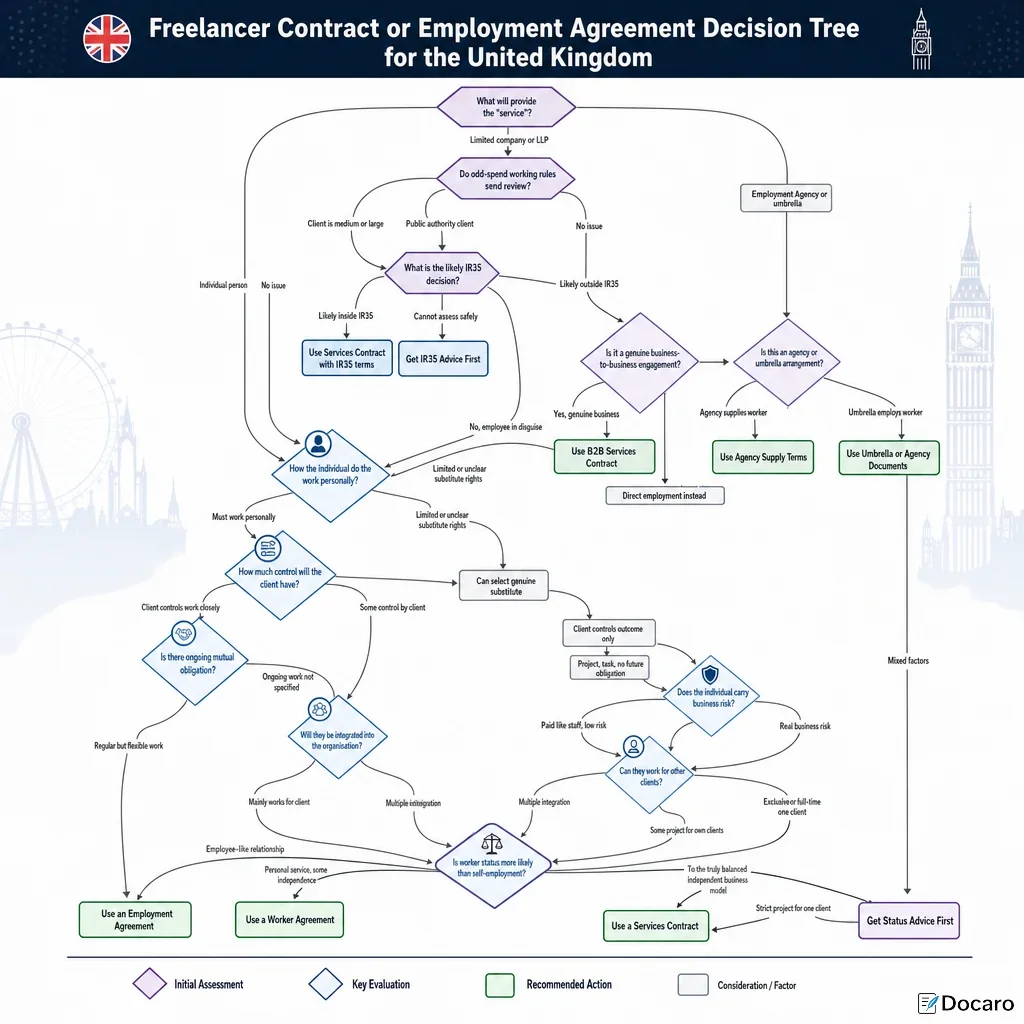
Using the wrong type of contract structure can inadvertently create an employment relationship instead of an independent contractor arrangement.
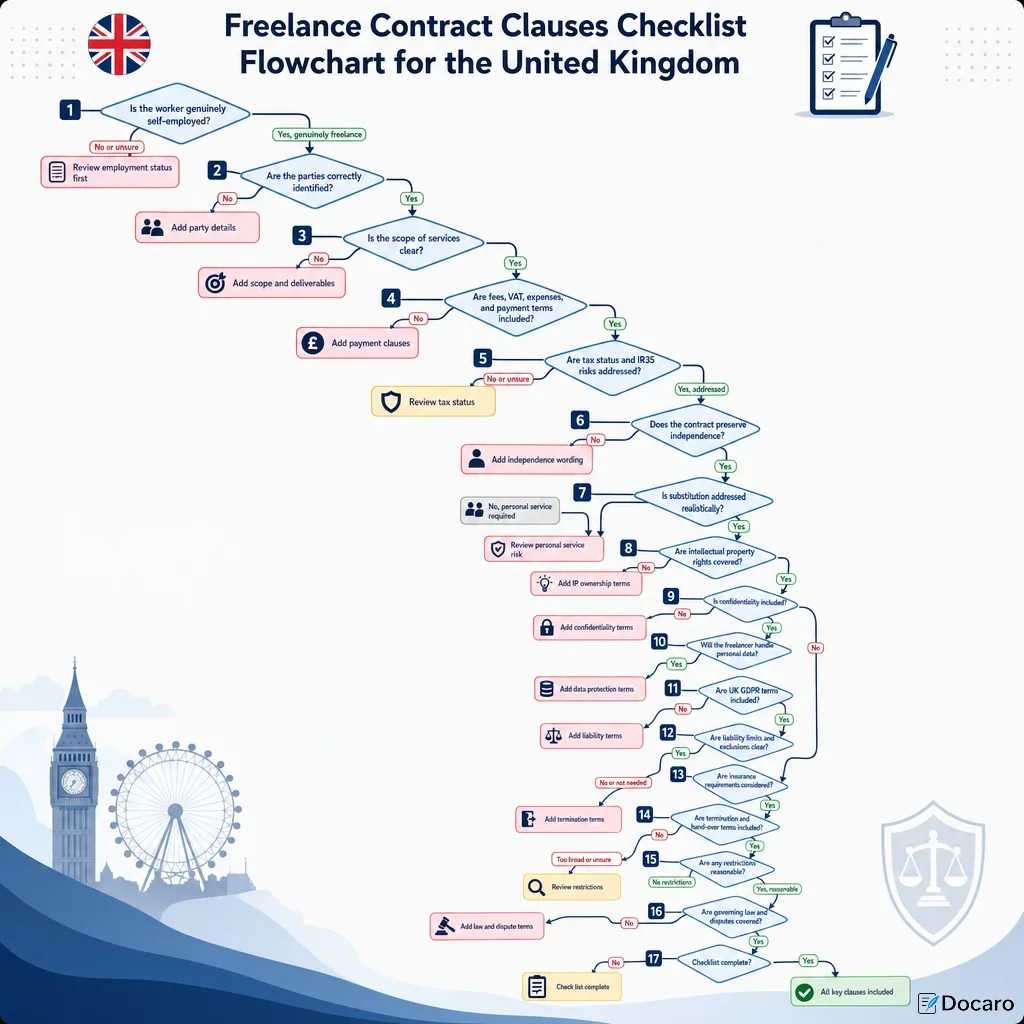
What a Proper Freelance Contract Should Include
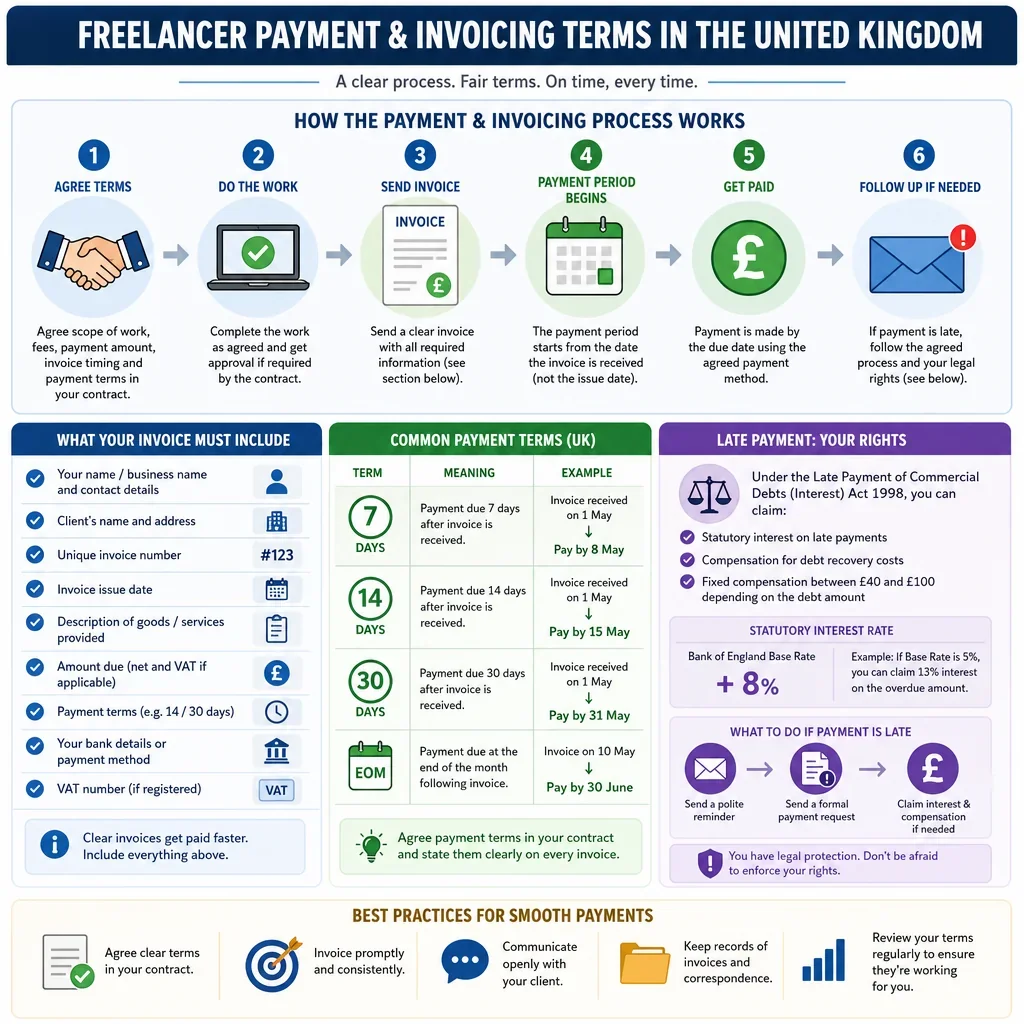
- Parties InvolvedClearly state the names and contact details of the freelancer and the client to identify everyone correctly.
- Work DescriptionDetail the specific services or tasks the freelancer will provide to avoid any confusion about expectations.
- Payment TermsSpecify the amount, method, and timing of payments, including any deposits or milestones.
- Timeline and DeadlinesOutline the start and end dates for the project, along with any key deadlines for deliverables.
- Ownership of WorkClarify who owns the final work product and any intellectual property rights after completion.
- ConfidentialityAgree to keep sensitive information shared during the project private and not disclose it to others.
- Termination RulesDefine the conditions under which either party can end the contract and what happens next.
- Dispute ResolutionDescribe how any disagreements will be handled, such as through discussion or mediation.
- Applicable LawState that the contract is governed by UK law to ensure it follows the right legal standards.
Generate Your Document in 4 Easy Steps
Why Use Docaro?
 United Kingdom
Free Example Freelance Contract Template
Below is a free template example of a Freelance Contract for use in the United Kingdom generated by our AI model.
The clauses in your actual Freelance Contract will vary from this example as they will be entirely bespoke to your requirements as set out in the questionnaire you complete.
Graphic Design Services Agreement
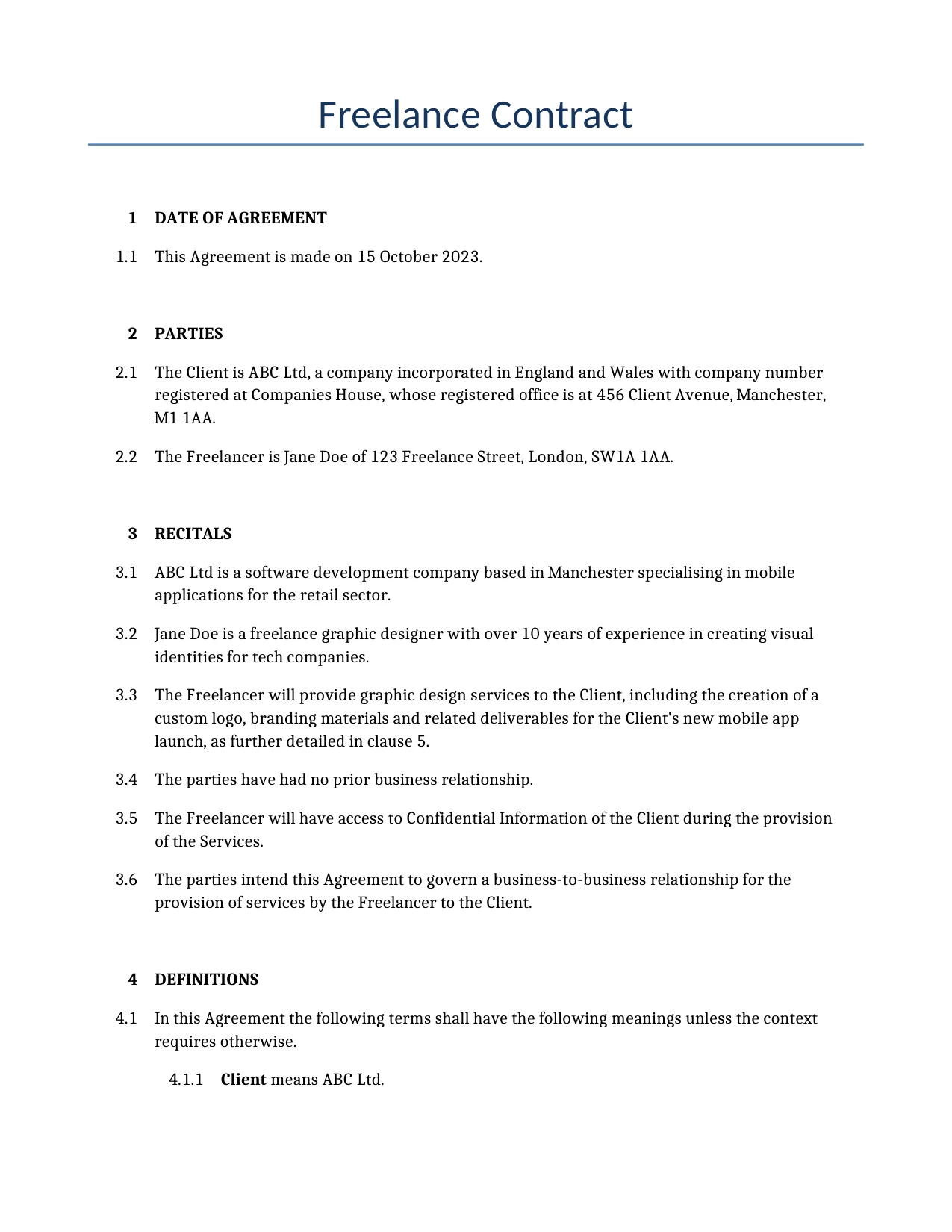
1DATE OF AGREEMENT
This Agreement is made on 15 October 2023.
2PARTIES
The Client is ABC Ltd, a company incorporated in England and Wales with company number registered at Companies House, whose registered office is at 456 Client Avenue, Manchester, M1 1AA.
The Freelancer is Jane Doe of 123 Freelance Street, London, SW1A 1AA.
3RECITALS
ABC Ltd is a software development company based in Manchester specialising in mobile applications for the retail sector.
Jane Doe is a freelance graphic designer with over 10 years of experience in creating visual identities for tech companies.
The Freelancer will provide graphic design services to the Client, including the creation of a custom logo, branding materials and related deliverables for the Client's new mobile app launch, as further detailed in clause 5.
The parties have had no prior business relationship.
The Freelancer will have access to Confidential Information of the Client during the provision of the Services.
The parties intend this Agreement to govern a business-to-business relationship for the provision of services by the Freelancer to the Client.
4DEFINITIONS
In this Agreement the following terms shall have the following meanings unless the context requires otherwise.
Client means ABC Ltd.
Freelancer means Jane Doe.
Services means the graphic design services to be provided by the Freelancer to the Client as described in clause 5 (Scope of Services).
Deliverables means the outputs from the Services as specified in clause 5 and Schedule 1.
Confidential Information means any business plans, customer lists, technical data, financial information or other proprietary information disclosed by one party to the other that is marked as confidential or reasonably should be understood to be confidential.
Intellectual Property Rights means patents, rights to inventions, copyright and related rights, moral rights, trademarks, service marks, get up and trade names, rights in designs, rights in computer software, database rights, rights to preserve the confidentiality of information and any other intellectual property rights, whether registered or unregistered.
Force Majeure means any circumstance beyond a party's reasonable control including acts of God, pandemics, epidemics or cyber attacks.
5INTERPRETATION
In this Agreement (including the Recitals and Schedules), unless the context requires otherwise: (a) the singular includes the plural and vice versa; (b) references to a person include a natural person, corporate or unincorporated body (whether or not having separate legal personality) and that person's successors and permitted assigns; (c) a reference to a clause, section or Schedule is a reference to a clause or section of, or Schedule to, this Agreement; (d) the words 'including', 'include', 'in particular', 'for example' or any similar expression shall be construed as illustrative and shall not limit the sense of the words preceding those terms; and (e) references to pounds sterling, GBP, £ or pounds are to the lawful currency of the United Kingdom.
6SCOPE OF SERVICES
The Freelancer shall provide the Services to the Client in accordance with the terms of this Agreement and Schedule 1.
The Services shall commence on or around 1 February 2024.
The Freelancer shall provide two rounds of revisions for each Deliverable. Additional revisions shall be charged at the Freelancer's standard hourly rate.
The Client shall review each Deliverable and shall notify the Freelancer in writing of acceptance or rejection with detailed reasons within 7 days of delivery. If the Client does not respond within this period, the Deliverable shall be deemed accepted.
The Client shall accept a Deliverable if it materially complies with the requirements set out in Schedule 1.
7CLIENT OBLIGATIONS
The Client shall: (a) provide timely feedback, content, access, approvals, materials and information necessary for the Freelancer to perform the Services; (b) ensure that all materials and information provided to the Freelancer are accurate, complete and do not infringe third party rights; and (c) appoint a single point of contact with authority to provide instructions and approvals on behalf of the Client.
If the Client fails to comply with its obligations under this clause 7, the Freelancer shall be entitled to: (a) an extension of any applicable deadlines by a period equal to the delay caused by the Client; and (b) additional fees for any additional costs or time incurred as a direct result of the Client's delay, calculated at the Freelancer's standard hourly rate and invoiced monthly.
8FEES AND PAYMENT TERMS
In consideration of the provision of the Services, the Client shall pay the Freelancer the fees set out in Schedule 1, which are exclusive of VAT. The Client shall pay VAT at the prevailing rate in addition to the fees.
The Freelancer shall invoice the Client following completion and the Client's approval of each milestone specified in Schedule 1. The Client shall pay each invoice within 14 days of the date of the invoice.
If the Client fails to make payment by the due date, the Freelancer may: (a) suspend work on the Services until payment is received; and (b) charge interest on the overdue sum at the rate of 8% per annum above the Bank of England base rate from time to time, in accordance with the Late Payment of Commercial Debts (Interest) Act 1998. Interest shall accrue on a daily basis from the due date until actual payment.
All amounts payable under this Agreement are exclusive of VAT, which the Client shall pay at the prevailing rate in addition to the amounts due.
9EXPENSES
The Client shall reimburse the Freelancer for all reasonable out-of-pocket expenses properly incurred in the provision of the Services (including travel costs, meals, subsistence, materials and supplies), provided that the Freelancer obtains the prior written approval of the Client before incurring any such expense exceeding £100.
The Freelancer shall submit claims for reimbursement via email to the Client's accounts department with scanned copies of receipts attached. The Client shall reimburse approved expenses within 14 days of receipt of a valid claim.
Reimbursable expenses shall be stated exclusive of VAT where applicable, and the Client shall pay any VAT in addition.
10INDEPENDENT CONTRACTOR STATUS
The Freelancer is an independent contractor. Nothing in this Agreement shall create a relationship of employment, partnership or joint venture between the parties. This is a business-to-business contract between two commercial parties.
The Freelancer shall provide the Freelancer's own equipment and tools necessary for the performance of the Services.
The Services shall be performed at the Freelancer's own premises or remotely as the Freelancer sees fit. The Freelancer shall have flexibility in setting the Freelancer's own working hours.
The Freelancer shall be free to provide similar services to other clients during the term of this Agreement, subject to the restrictions in clauses 18 and 19.
The Freelancer shall not subcontract any part of the Services without the prior written consent of the Client (such consent not to be unreasonably withheld or delayed). The Freelancer shall remain liable for the acts and omissions of any permitted subcontractors.
11CONFIDENTIALITY
Each party shall keep the other party's Confidential Information secret and confidential and shall not disclose it to any person except as permitted by this clause 11.
The obligations in clause 11.1 shall continue during the term of this Agreement and for 3 years after termination.
The obligations in clause 11.1 shall not apply to information that: (a) is or becomes publicly available otherwise than through a breach of this Agreement; (b) is required to be disclosed by law or by any court, tribunal or regulatory authority of competent jurisdiction; or (c) was lawfully in a party's possession before disclosure by the other party.
Upon termination of this Agreement, each party shall return or destroy all Confidential Information of the other party in its possession.
In the event of a breach or threatened breach of this clause 11, the non-breaching party shall be entitled to seek injunctive relief.
12INTELLECTUAL PROPERTY RIGHTS
Upon full payment of all fees due under this Agreement, all Intellectual Property Rights in the Deliverables (excluding any pre-existing Intellectual Property Rights of the Freelancer) shall automatically vest in and belong to the Client absolutely. The Freelancer shall, at the Client's cost, execute any documents and do all acts necessary to perfect such transfer.
The Client grants the Freelancer a royalty-free, non-exclusive, worldwide licence to use the Client's pre-existing Intellectual Property Rights solely to the extent necessary to provide the Services.
The Freelancer shall disclose to the Client any pre-existing Intellectual Property Rights that the Freelancer incorporates into the Deliverables and grants the Client a perpetual, irrevocable, royalty-free, non-exclusive licence to use such pre-existing rights as part of the Deliverables.
The Freelancer waives all moral rights in the Deliverables to which the Freelancer is now or may at any future time be entitled under the Copyright, Designs and Patents Act 1988.
The Freelancer may use the Deliverables in the Freelancer's portfolio or for promotional purposes provided that such use does not disclose the Client's Confidential Information.
13WARRANTIES AND REPRESENTATIONS
Each party warrants and represents to the other that: (a) it has full power and authority to enter into this Agreement; and (b) it will comply with all applicable laws in performing its obligations under this Agreement, including the Bribery Act 2010 and the Modern Slavery Act 2015.
The Freelancer warrants that: (a) the Services will be performed with reasonable skill and care and to a professional standard; (b) the Deliverables will be original (except to the extent they incorporate the Client's materials) and, to the best of the Freelancer's knowledge, will not infringe any third party Intellectual Property Rights; and (c) the Deliverables will be free from material defects for a period of 3 months from the date of final acceptance by the Client.
The Client warrants that: (a) it owns or has all necessary rights and licences to any materials, content or information it provides to the Freelancer; and (b) the Freelancer's use of such materials in accordance with this Agreement will not infringe any third party rights.
Except as expressly set out in this Agreement, all warranties, representations, conditions and all other terms of any kind implied by statute or common law are excluded to the fullest extent permitted by law.
14INDEMNIFICATION
Each party (the Indemnifying Party) shall indemnify the other party (the Indemnified Party) against all liabilities, costs, expenses, damages and losses (including reasonable legal fees) suffered or incurred by the Indemnified Party arising out of or in connection with: (a) any breach of the warranties in clause 13; (b) any infringement of a third party's Intellectual Property Rights; (c) breach of clause 11 (Confidentiality); or (d) any breach of the Data Protection obligations in clause 22.
The Indemnified Party shall: (a) give the Indemnifying Party prompt written notice of any claim; (b) allow the Indemnifying Party to control the defence and settlement of the claim (provided that no settlement shall require an admission of liability on the part of the Indemnified Party without its consent, such consent not to be unreasonably withheld); and (c) provide reasonable assistance to the Indemnifying Party at the Indemnifying Party's cost.
The Indemnified Party shall take reasonable steps to mitigate any losses in respect of which indemnity may be sought under this clause 14.
The total liability of each party under the indemnities in this clause 14 shall not exceed £10,000 in aggregate.
15LIMITATION OF LIABILITY
Nothing in this Agreement shall limit or exclude either party's liability for: (a) death or personal injury caused by its negligence; (b) fraud or fraudulent misrepresentation; or (c) any other liability which cannot be limited or excluded by applicable law.
Subject to clause 15.1, neither party shall be liable to the other, whether in contract, tort (including negligence), for breach of statutory duty, or otherwise, arising under or in connection with this Agreement for: (a) any indirect or consequential loss; or (b) any loss of profit, sales, business, agreements, anticipated savings, goodwill, reputation or data.
Subject to clauses 15.1 and 15.2, the total liability of the Freelancer to the Client under or in connection with this Agreement shall not exceed £10,000 in aggregate in respect of all claims.
The limitations in this clause 15 shall not apply to: (a) the indemnities in clause 14; (b) breach of clause 11 (Confidentiality); (c) breach of clause 12 (Intellectual Property Rights); or (d) breach of clause 22 (Data Protection).
The parties agree that the limitations and exclusions in this clause 15 are reasonable having regard to the nature of the Services, the fees payable and the commercial positions of the parties, and comply with the Unfair Contract Terms Act 1977 and the Consumer Rights Act 2015 (to the extent applicable).
16TERMINATION
Either party may terminate this Agreement immediately by written notice to the other if: (a) the other party commits a material breach of any term of this Agreement and (if such breach is remediable) fails to remedy that breach within 14 days of being notified in writing to do so; (b) the other party repeatedly breaches any of the terms of this Agreement in such a manner as to reasonably justify the opinion that its conduct is inconsistent with it having the intention or ability to give effect to the terms of this Agreement; (c) the other party fails to pay any undisputed invoice within 30 days of the due date; (d) the other party takes any step or action in connection with its winding up, administration, provisional liquidation or any composition or arrangement with its creditors; or (e) the other party suspends, or threatens to suspend, or ceases to carry on all or a substantial part of its business.
Either party may terminate this Agreement for convenience by giving not less than 30 days' written notice to the other party.
Termination notice shall be delivered in accordance with clause 31 (Notices).
Upon termination for any reason: (a) the Client shall pay the Freelancer for all Services completed and approved up to the date of termination in accordance with Schedule 1 within 14 days of termination; (b) the Freelancer shall deliver to the Client all completed and approved Deliverables; and (c) all licences granted under this Agreement shall terminate immediately except to the extent necessary for the Client to use any Deliverables for which it has paid in full.
17CONSEQUENCES OF TERMINATION
Upon termination or expiry of this Agreement, each party shall: (a) return to the other party all materials, equipment and property belonging to the other party; and (b) delete or return all Confidential Information of the other party.
Any provision of this Agreement that expressly or by implication is intended to come into or continue in force on or after termination or expiry of this Agreement shall remain in full force and effect, including clauses 11 (Confidentiality), 12 (Intellectual Property Rights), 14 (Indemnification), 15 (Limitation of Liability), 18 (Non-Compete), 19 (Non-Poaching), 22 (Data Protection) and 23 (Anti-Bribery and Modern Slavery).
18NON-COMPETE
The Freelancer shall not, during the term of this Agreement and for 3 months after its termination or expiry, directly or indirectly, in the United Kingdom, provide services to any direct competitor of the Client in the mobile retail application sector that are the same as or directly competitive with the specific Services provided under this Agreement.
If any part of this clause 18 is found to be unreasonable by a court, the parties agree that the restriction shall be read down or severed to the minimum extent necessary to make it reasonable and enforceable.
In the event of breach of this clause 18, the Client shall be entitled to seek injunctive relief and damages.
19NON-POACHING
The Freelancer shall not, during the term of this Agreement and for 6 months after its termination or expiry, directly or indirectly solicit, canvass or approach for the purpose of offering services any employee, director, contractor or customer of the Client with whom the Freelancer had material dealings in the 12 months immediately preceding termination.
This clause 19 shall not apply to any response to a general advertisement or to any approach initiated by the employee, director, contractor or customer without any solicitation by the Freelancer.
The parties agree that the restrictions in this clause 19 are reasonable and necessary to protect the Client's legitimate business interests.
20FORCE MAJEURE
Neither party shall be in breach of this Agreement nor liable for delay in performing, or failure to perform, any of its obligations under this Agreement if such delay or failure results from a Force Majeure event. The affected party shall use reasonable endeavours to mitigate the effects of the Force Majeure event.
If the Force Majeure event prevents performance for a continuous period of more than 30 days, either party may terminate this Agreement by giving 14 days' written notice to the other party.
Payment obligations shall not be suspended during a Force Majeure event except to the extent that the Services cannot be performed.
21VARIATION
No variation of this Agreement shall be effective unless it is in writing and signed by the parties (or their authorised representatives).
22DATA PROTECTION
The parties acknowledge that for the purposes of the Data Protection Act 2018 and UK GDPR the Client is the controller and the Freelancer is the processor in respect of the personal data processed in the course of providing the Services. The processing details are set out in Annex 1 to this Agreement.
The Freelancer shall: (a) process personal data only on documented instructions from the Client; (b) ensure that persons authorised to process the personal data are subject to appropriate confidentiality obligations; (c) implement appropriate technical and organisational measures to ensure a level of security appropriate to the risk; (d) not engage another processor without the prior written authorisation of the Client; (e) assist the Client in responding to data subject requests and ensuring compliance with the Client's obligations under the UK GDPR; (f) notify the Client without undue delay on becoming aware of a personal data breach; (g) at the choice of the Client, delete or return all personal data to the Client after the end of the provision of Services and delete existing copies; and (h) make available to the Client all information necessary to demonstrate compliance with this clause 22 and allow for and contribute to audits, including on-site inspections, conducted by the Client or another auditor mandated by the Client.
The Client shall ensure that it has a lawful basis for processing the personal data and for instructing the Freelancer to process it. The Client shall indemnify the Freelancer against any losses arising from the Client's breach of this clause 22.3.
If the parties determine that a separate Data Processing Agreement is required, they shall enter into one in the form required by the UK GDPR.
23IR35 COMPLIANCE
The parties have considered the off-payroll working rules (IR35) and agree that this contract is outside the scope of IR35. The Freelancer is responsible for their own tax, National Insurance contributions and VAT. The Client shall not deduct tax at source from any payments made under this Agreement.
If required by law, the Freelancer shall provide the Client with a Status Determination Statement confirming the IR35 status of the engagement. The parties shall cooperate in good faith to ensure ongoing compliance with IR35 legislation.
24ANTI-BRIBERY AND MODERN SLAVERY
Each party shall: (a) comply with all applicable laws relating to anti-bribery and anti-corruption including the Bribery Act 2010; and (b) comply with all applicable laws relating to anti-slavery and human trafficking including the Modern Slavery Act 2015.
The Freelancer shall notify the Client as soon as it becomes aware of any breach, or suspected breach, of this clause 24.
25INSURANCE
The Freelancer shall maintain professional indemnity insurance with a reputable insurer with a minimum cover of £50,000 per claim for the duration of this Agreement and for 2 years after its termination. The Freelancer shall provide evidence of such insurance to the Client upon request.
26ANNOUNCEMENTS
Neither party shall make any public announcement concerning this Agreement or the relationship between the parties without the prior written consent of the other party (such consent not to be unreasonably withheld or delayed), except as required by law or any governmental or regulatory authority.
27COSTS
Each party shall bear its own costs and expenses incurred in connection with the negotiation, preparation, execution and performance of this Agreement.
28DISPUTE RESOLUTION
The parties shall attempt in good faith to resolve any dispute or claim arising out of or in connection with this Agreement through negotiation. Either party may, at its discretion, propose mediation as a means of resolving the dispute before commencing legal proceedings.
Nothing in this clause 28 shall prevent either party from seeking injunctive or other equitable relief in the courts at any time.
29GOVERNING LAW
This Agreement and any dispute or claim arising out of or in connection with it or its subject matter or formation (including non-contractual disputes or claims) shall be governed by and construed in accordance with the law of England and Wales.
30JURISDICTION
Each party irrevocably agrees that the courts of England and Wales shall have exclusive jurisdiction to settle any dispute or claim arising out of or in connection with this Agreement or its subject matter or formation (including non-contractual disputes or claims).
31ASSIGNMENT AND SUBCONTRACTING
Neither party may assign, transfer, mortgage, charge, subcontract, declare a trust over or deal in any other manner with any of its rights and obligations under this Agreement without the prior written consent of the other party (such consent not to be unreasonably withheld or delayed).
32ENTIRE AGREEMENT
This Agreement constitutes the entire agreement between the parties and supersedes and extinguishes all previous agreements, promises, assurances, warranties, representations and understandings between them, whether written or oral, relating to its subject matter.
33SEVERABILITY
If any provision or part-provision of this Agreement is or becomes invalid, illegal or unenforceable, it shall be deemed deleted, but the validity and enforceability of the other provisions of this Agreement shall not be affected. If such deletion would cause a fundamental change to the commercial position of the parties, they shall negotiate in good faith to amend such provision.
34WAIVER
No failure or delay by a party to exercise any right or remedy provided under this Agreement or by law shall constitute a waiver of that or any other right or remedy, nor shall it prevent or restrict the further exercise of that or any other right or remedy. No single or partial exercise of such right or remedy shall prevent or restrict the further exercise of that or any other right or remedy.
35NOTICES
Any notice given to a party under or in connection with this Agreement shall be in writing and shall be: (a) delivered by hand or by pre-paid first-class post or other next working day delivery service at its registered office (if a company) or its principal place of business (in any other case); or (b) sent by email to the address specified in this clause 35.
Notices to the Freelancer shall be sent to 123 Freelance Street, London, SW1A 1AA or freelancer@example.com.
Notices to the Client shall be sent to 456 Client Avenue, Manchester, M1 1AA or client@example.com.
Any notice shall be deemed to have been received: (a) if delivered by hand, on signature of a delivery receipt; (b) if sent by pre-paid first-class post or other next working day delivery service, at 9.00 am on the second business day after posting; and (c) if sent by email, at the time of transmission, or, if this time falls outside business hours in the place of receipt, when business hours resume. Business hours means 9.00am to 5.00pm Monday to Friday on a day that is not a public holiday in the place of receipt. This clause does not apply to the service of any proceedings or other documents in any legal action or other method of dispute resolution.
36THIRD PARTY RIGHTS
A person who is not a party to this Agreement shall have no rights under the Contracts (Rights of Third Parties) Act 1999 to enforce any term of this Agreement.
37COUNTERPARTS
This Agreement may be executed in any number of counterparts, each of which when executed shall constitute a duplicate original, but all the counterparts shall together constitute one agreement.
38SCHEDULE 1 - MILESTONES AND PAYMENT SCHEDULE
Milestone 1: Delivery and Client approval of initial concepts for logo and branding guidelines (including 3 logo concepts and 1 set of branding guidelines). Payment: 30% of total fee (£1,500) due within 14 days of approval. Deadline: 4 weeks after commencement.
Milestone 2: Delivery and Client approval of final logo, full branding guidelines, social media graphics pack and website wireframes (5 pages, WCAG 2.1 compliant). Payment: 30% of total fee (£1,500) due within 14 days of approval. Deadline: 8 weeks after commencement.
Milestone 3: Delivery and Client approval of final website code (up to 10 product pages, shopping cart integration, basic SEO, tested on major browsers) and all remaining graphic assets in vector format. Payment: 40% of total fee (£2,000) due within 14 days of approval. Deadline: 12 weeks after commencement.
The total fixed fee for all milestones is £5,000 (exclusive of VAT). All payments are due within 14 days of invoice following milestone approval. The parties may agree in writing to vary the milestones or deadlines.
39ANNEX 1 - DETAILS OF PROCESSING
Subject matter and duration of the processing: The processing of personal data necessary for the provision of the graphic design and website development Services for the duration of this Agreement and for 30 days after termination.
Nature and purpose of the processing: Creating, storing and transferring graphic designs, website content and related files that may contain personal data for the purpose of delivering the Services.
Type of personal data: Names, email addresses, contact details, and any personal data contained in content or materials supplied by the Client.
Categories of data subjects: Clients, customers, employees and other contacts of the Client.
40EXECUTION
Signed by ABC Ltd acting by a duly authorised signatory ___________________________ Date ________________
Signed by Jane Doe ___________________________ Date ________________
This example shows approximately 70% of a typical document and is provided for illustrative purposes only. The remaining content has been omitted.
Every document generated by Docaro is tailored to your specific circumstances, jurisdiction and the information you provide. The completed document includes all applicable clauses and provisions required for your situation.
To generate the full, personalised document, answer a short series of questions and your document will be created instantly.
Useful Resources When Considering a Freelance Contract in the United Kingdom
United Kingdom Reference Legislation
Freelance Contract FAQs
Document Generation FAQs
Related Articles