AI Generated British Cohabitation Agreement
PDF & Word - 2026 Updated
Docaro Pricing
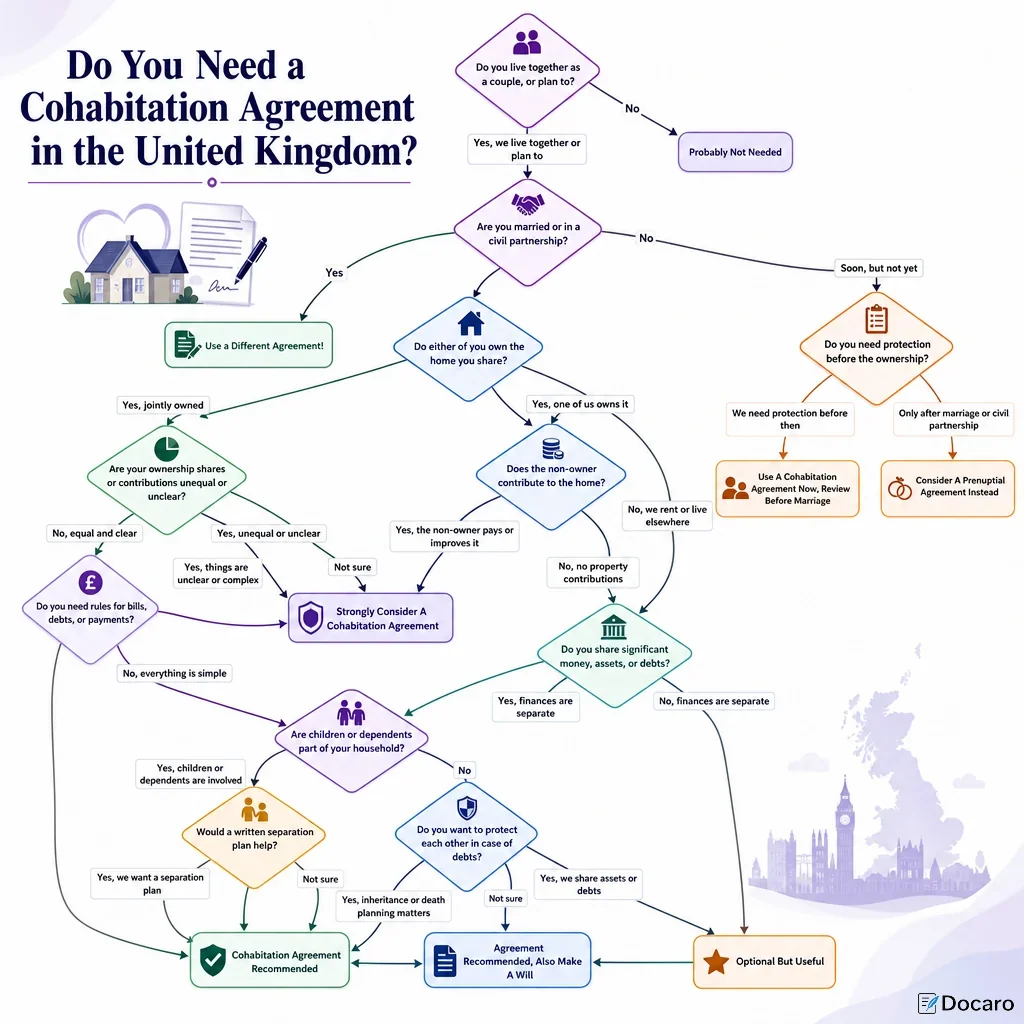
When do you need a Cohabitation Agreement in the United Kingdom?
British Legal Rules for a Cohabitation Agreement
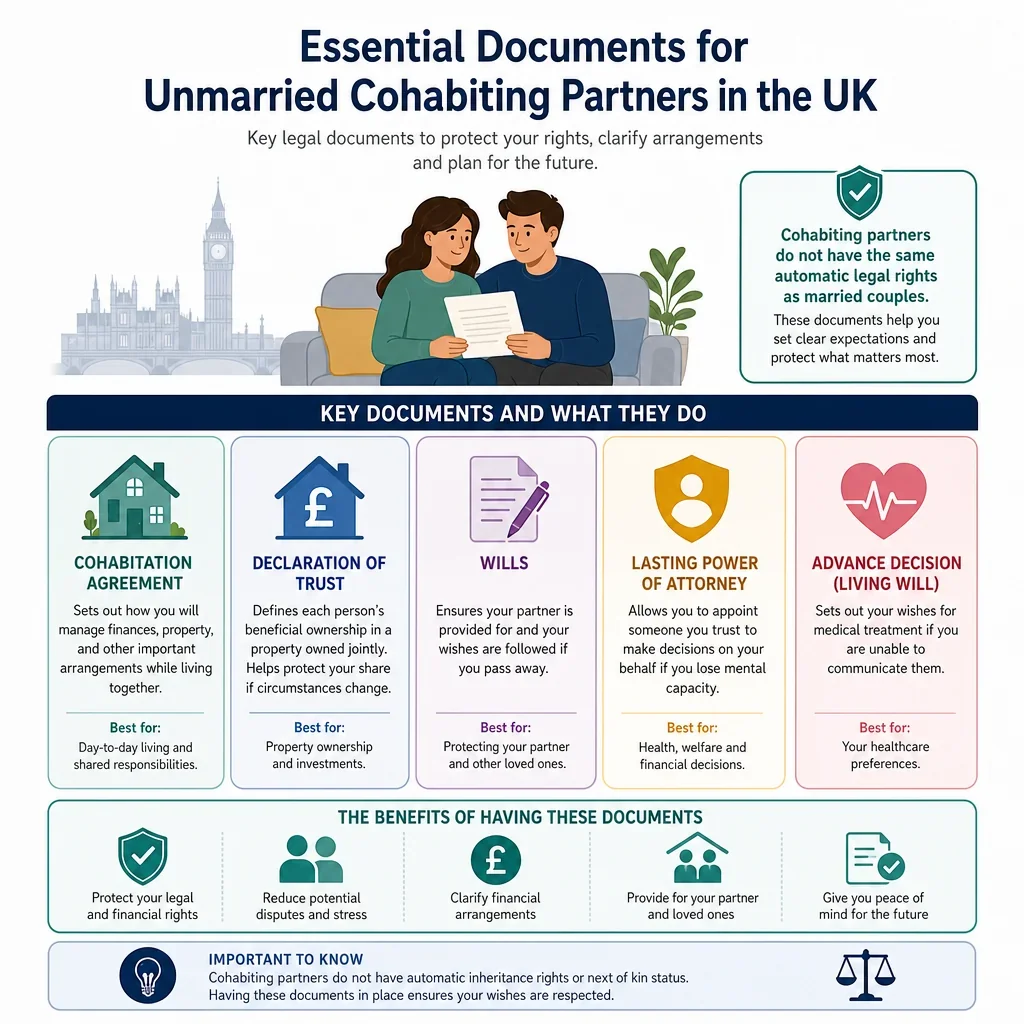
Using the wrong type of cohabitation agreement can inadvertently create unintended property rights or financial liabilities.
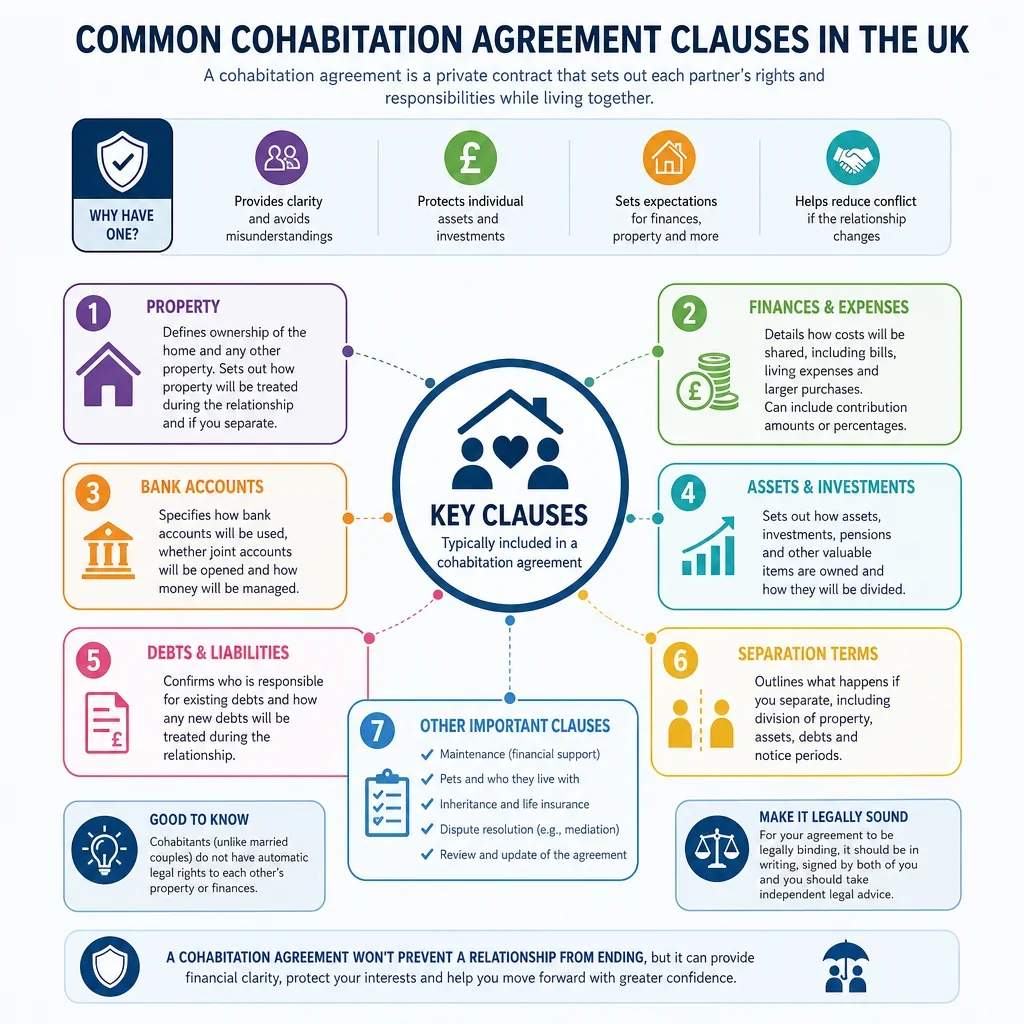
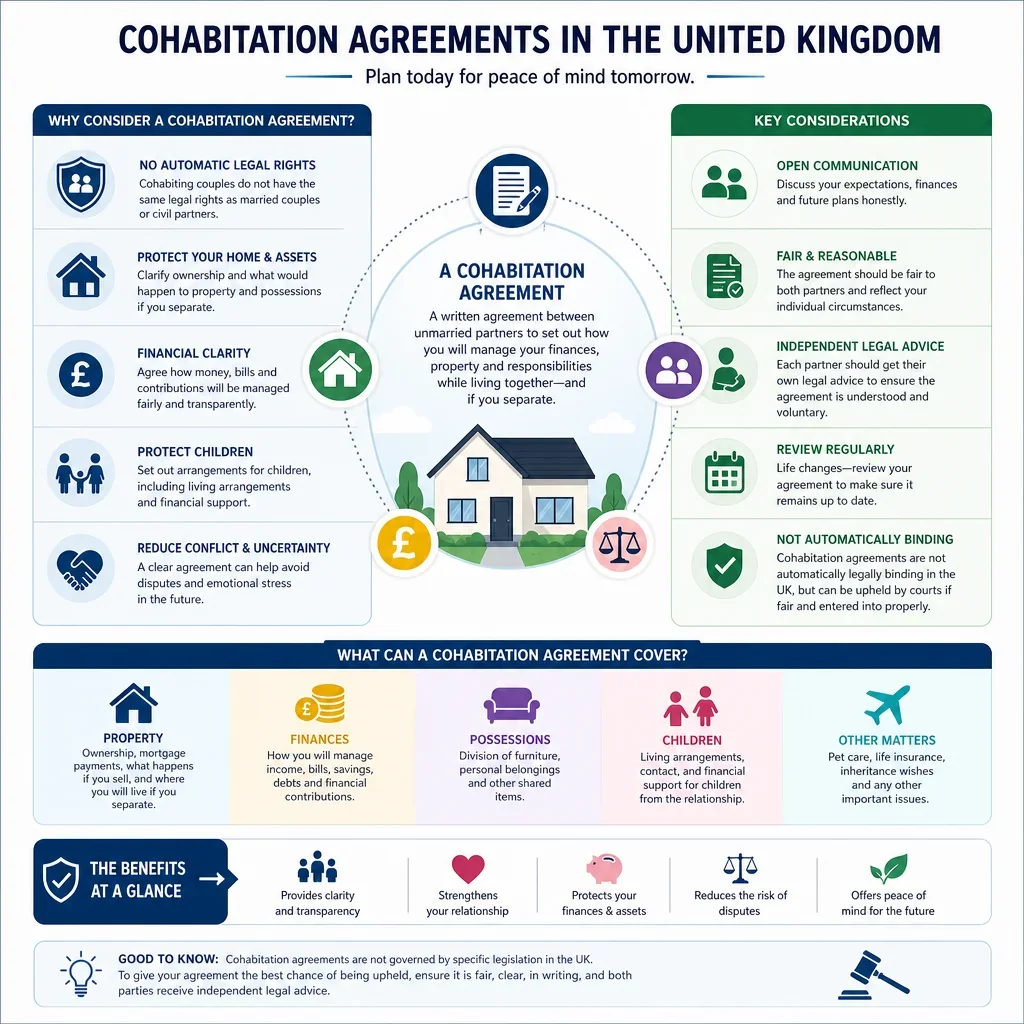
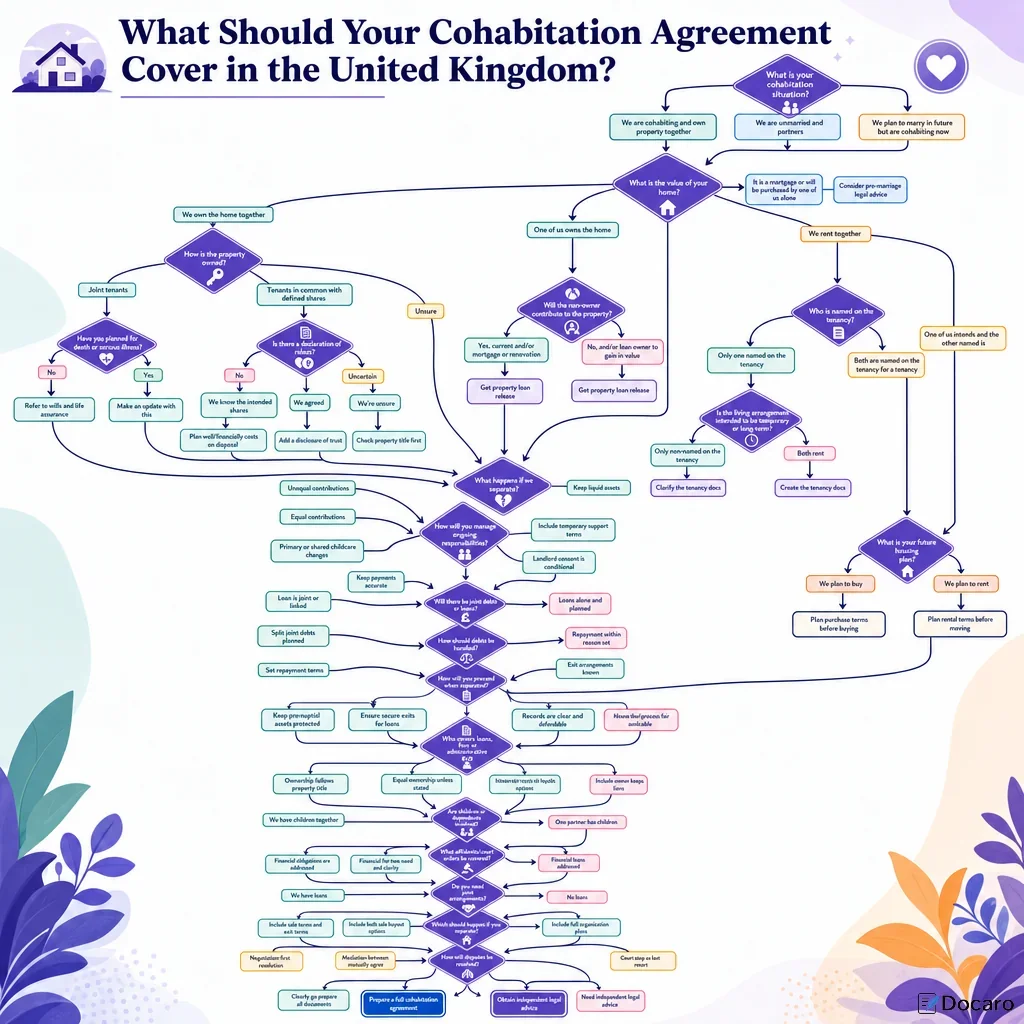
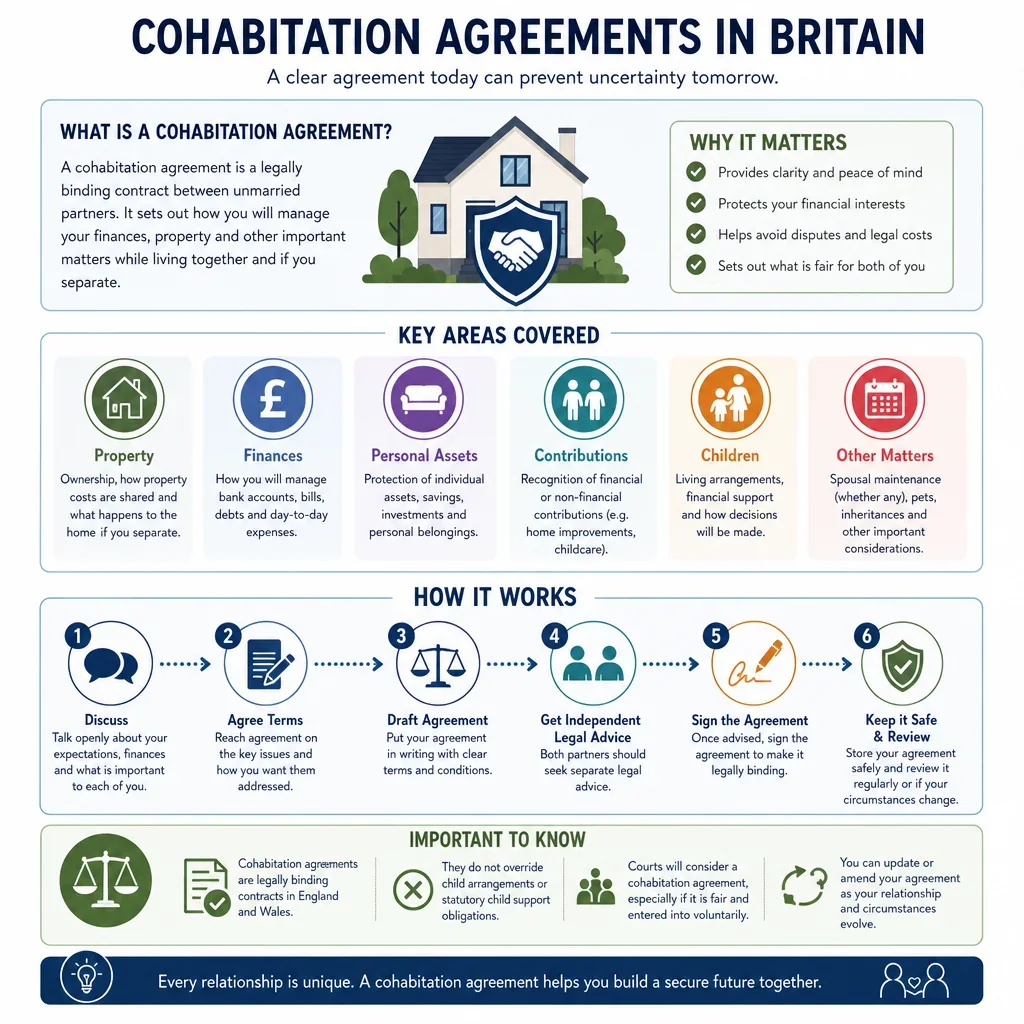
What a Proper Cohabitation Agreement Should Include
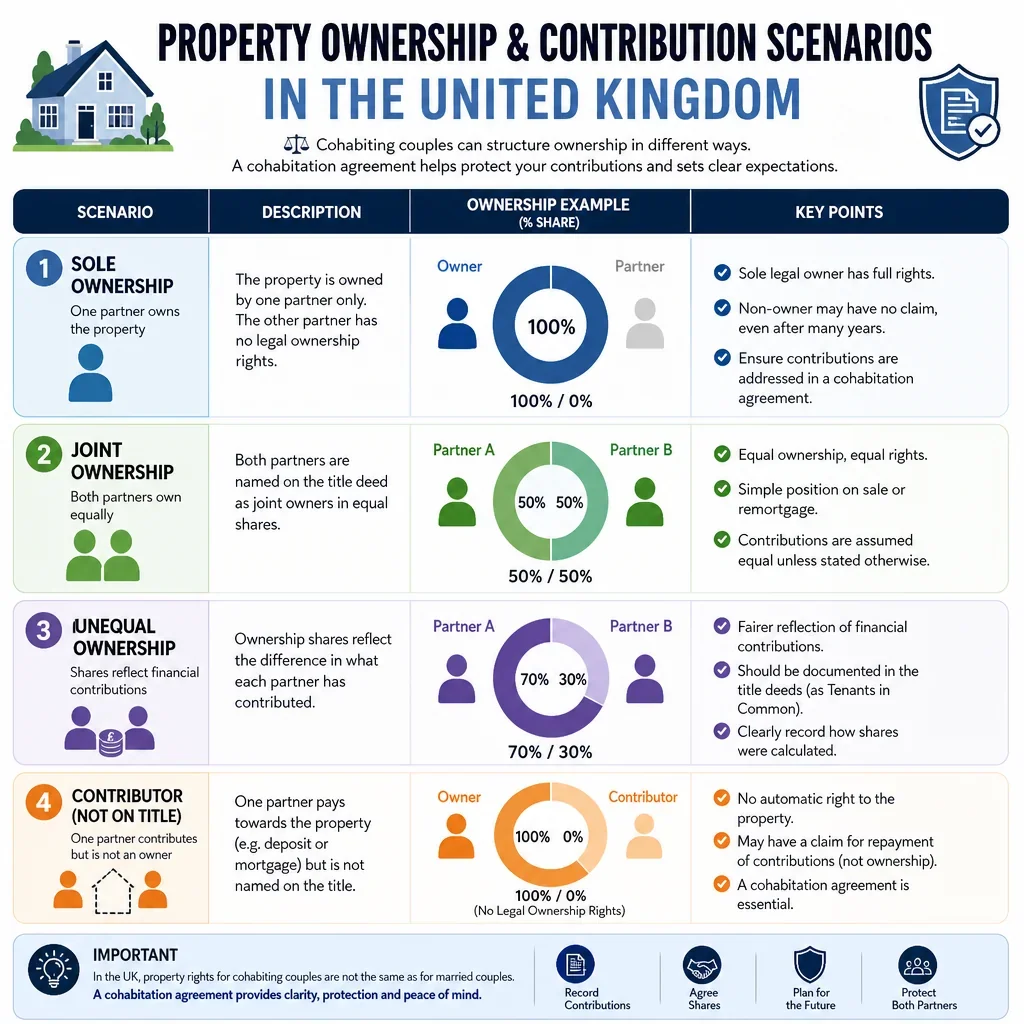
- Ownership of the HomeClearly state who owns the property and how any mortgage or costs will be shared if the relationship ends.
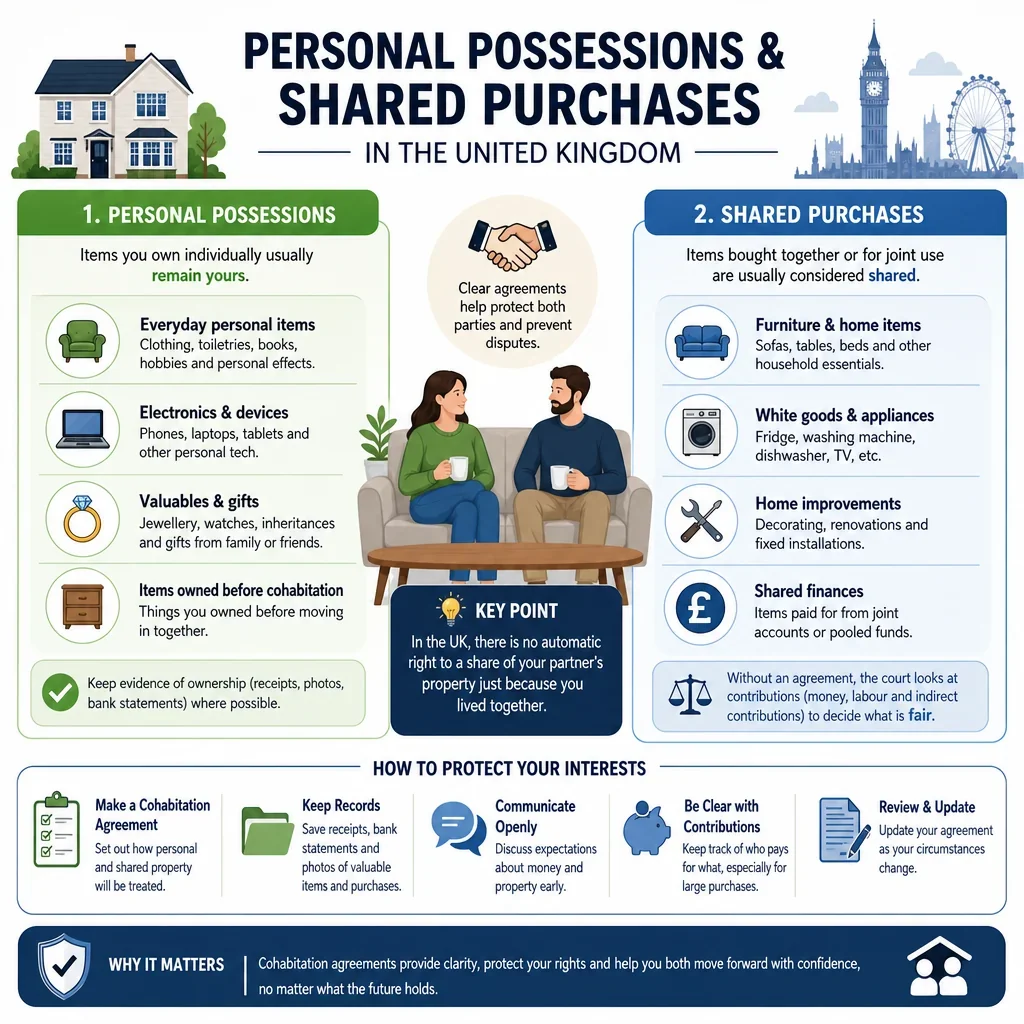
- Division of BelongingsDecide how personal items, furniture, and other possessions will be split if you separate.
- Handling FinancesOutline how joint bank accounts, debts, and everyday expenses like bills will be managed during and after the relationship.
- Arrangements for ChildrenIf applicable, specify custody, support, and living arrangements for any children involved.
- What Happens on BreakupDetail steps for ending the agreement, including notice periods and how assets will be divided fairly.
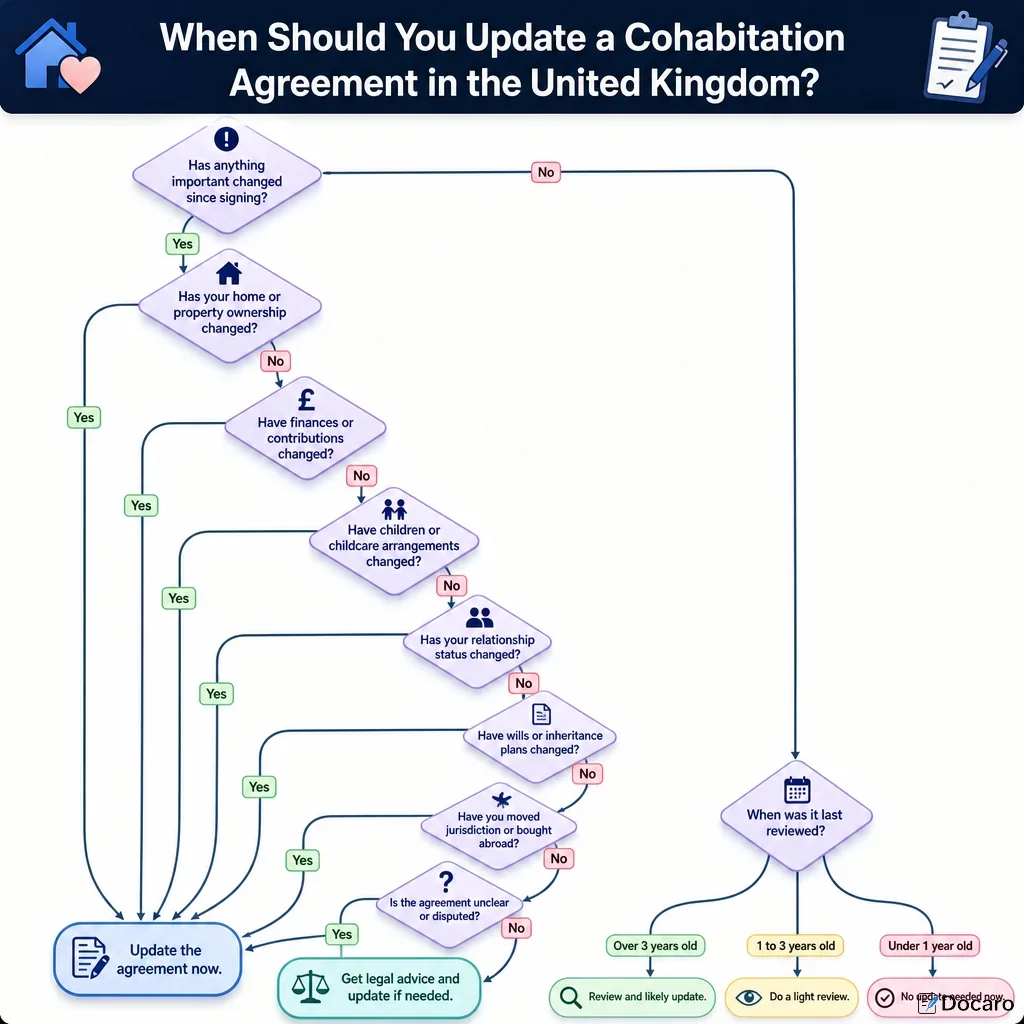
- Changes to the AgreementExplain how the agreement can be updated if your circumstances change, like getting married.
- Dispute ResolutionInclude ways to resolve disagreements, such as talking it out or seeking mediation, to avoid court.
Generate Your Document in 4 Easy Steps
Why Use Docaro?
 United Kingdom
Free Example Cohabitation Agreement Template
Below is a free template example of a Cohabitation Agreement for use in the United Kingdom generated by our AI model.
The clauses in your actual Cohabitation Agreement will vary from this example as they will be entirely bespoke to your requirements as set out in the questionnaire you complete.
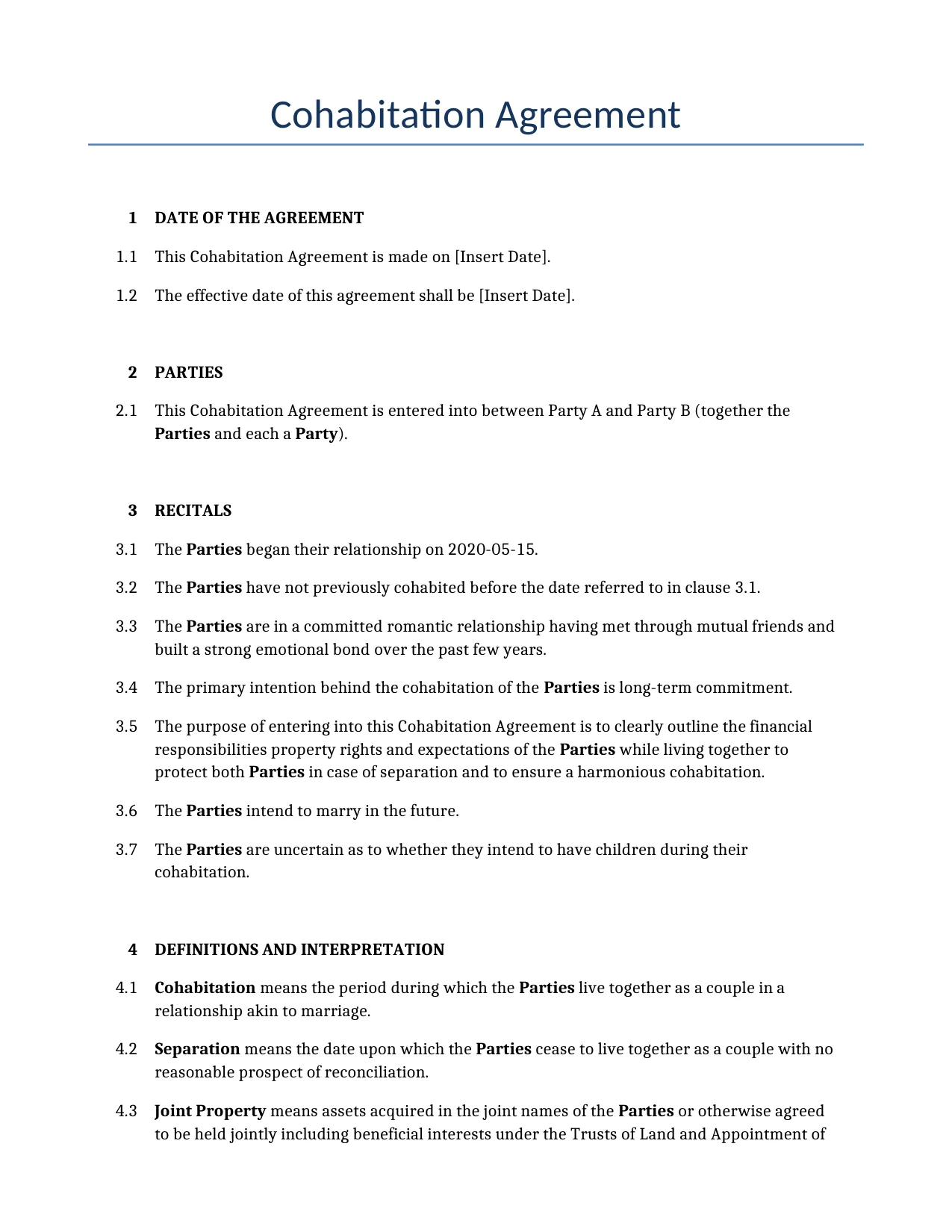
Cohabitation Agreement
1DATE OF THE AGREEMENT
This Cohabitation Agreement is made on [Insert Date].
The effective date of this agreement shall be [Insert Date].
2PARTIES
This Cohabitation Agreement is entered into between Party A and Party B (together the Parties and each a Party).
3RECITALS
The Parties began their relationship on 2020-05-15.
The Parties have not previously cohabited before the date referred to in clause 3.1.
The Parties are in a committed romantic relationship having met through mutual friends and built a strong emotional bond over the past few years.
The primary intention behind the cohabitation of the Parties is long-term commitment.
The purpose of entering into this Cohabitation Agreement is to clearly outline the financial responsibilities property rights and expectations of the Parties while living together to protect both Parties in case of separation and to ensure a harmonious cohabitation.
The Parties intend to marry in the future.
The Parties are uncertain as to whether they intend to have children during their cohabitation.
4DEFINITIONS AND INTERPRETATION
Cohabitation means the period during which the Parties live together as a couple in a relationship akin to marriage.
Separation means the date upon which the Parties cease to live together as a couple with no reasonable prospect of reconciliation.
Joint Property means assets acquired in the joint names of the Parties or otherwise agreed to be held jointly including beneficial interests under the Trusts of Land and Appointment of Trustees Act 1996.
Separate Property means assets owned by either Party prior to the commencement of Cohabitation or acquired during Cohabitation by way of gift inheritance or as otherwise specified in this Agreement.
The Parties means Party A and Party B collectively and Party shall be construed accordingly.
In this Agreement headings are for ease of reference only and shall not affect the interpretation or construction of this Agreement.
References to any statute or statutory provision shall include any amendment modification or re-enactment thereof.
5COMMENCEMENT OF COHABITATION
The cohabitation of the Parties commenced on 2020-05-15.
6PROPERTY OWNERSHIP AND DIVISION
The shared home of the Parties is situated at 123 High Street London SW1A 1AA and is held as joint tenants both legally and beneficially.
The shared home was purchased on 2021-06-01 for the sum of \£450000.00.
Upon Separation the shared home shall be sold and the net proceeds of sale divided equally between the Parties unless otherwise agreed in writing.
Any property or assets acquired by either Party before the commencement of Cohabitation shall remain the Separate Property of the original owner and shall not be subject to any claim by the other Party on Separation.
Gifts inheritances or windfalls received by either Party during Cohabitation shall remain the Separate Property of the recipient and shall be excluded from any division on Separation.
If either Party makes improvements to the other Party's Separate Property during Cohabitation any claim for reimbursement or a beneficial interest shall be determined in accordance with the principles in Jones v Kernott [2011] UKSC 53 and the Trusts of Land and Appointment of Trustees Act 1996. No constructive or resulting trust is intended to arise unless expressly agreed in writing by the Parties.
The Parties acquired other property during Cohabitation besides the shared home. Any such Joint Property shall upon Separation be divided equally unless otherwise agreed in writing.
The Parties declare that it is not their intention to create any constructive or resulting trusts in respect of Separate Property unless explicitly recorded in writing.
7FINANCIAL CONTRIBUTIONS AND EXPENSES
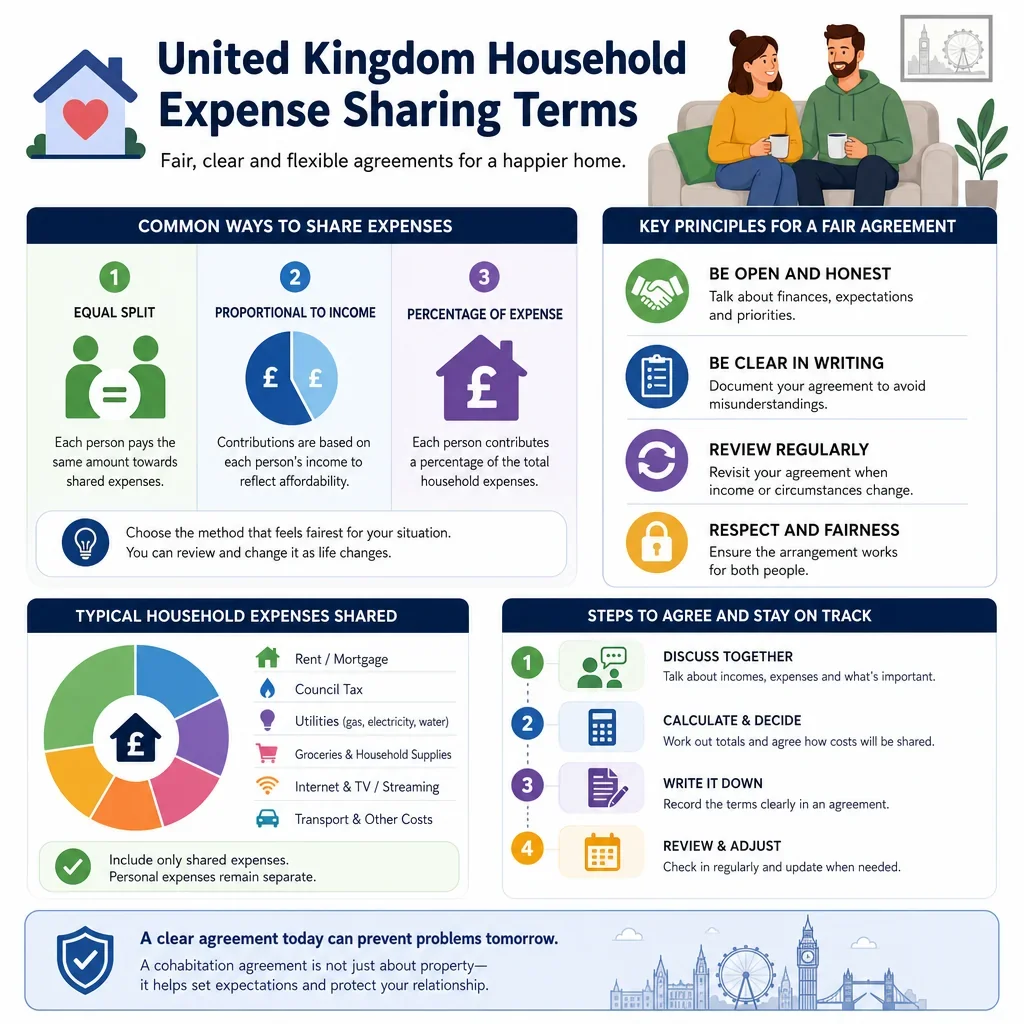
The Parties shall share the household expenses equally.
The household expenses that shall be included in the shared financial contributions are rent or mortgage payments utility bills and groceries and household supplies.
The approximate monthly net income of Party A for the purpose of any proportional sharing is \£2500.00.
The approximate monthly net income of Party B for the purpose of any proportional sharing is \£3200.50.
Personal expenses such as individual clothing or hobbies shall be paid separately by each Party.
This financial contributions section shall become effective on [Insert Date].
The monthly contributions shall be made on the first day of each month.
8JOINT BANK ACCOUNTS AND ASSETS
The Parties shall establish a new joint bank account for shared expenses.
The name of the joint bank account is the Shared Household Account.
The bank or financial institution that holds the joint bank account is Barclays Bank.
The primary purpose of the joint bank account is household expenses and joint savings.
Each Party agrees to contribute the monthly amount of \£500.00 to the joint bank account.
The monthly contributions to the joint bank account shall start on [Insert Date].
The contributions to the joint bank account shall be made on the fifteenth day of each month.
Each Party shall have full equal access to the joint bank account.
The Parties do not currently own any joint assets such as property or vehicles beyond those specified in this Agreement.
Upon Separation any Joint Property shall be sold and the net proceeds divided equally between the Parties.
The Parties agree on terms for acquiring new joint assets during Cohabitation which shall be recorded in writing and added to the Schedule of Assets.
9DEBTS AND LIABILITIES
Each Party shall be responsible for their own pre-cohabitation debts.
The Parties have or anticipate joint debts incurred during Cohabitation such as shared loans or credit accounts.
Responsibility for repaying joint debts incurred during Cohabitation shall be shared equally between both Parties.
The Parties do not wish to disclose any individual debts that may be incurred during Cohabitation.
Each Party shall be fully responsible for their own individual debts incurred during Cohabitation.
Responsibility for debts incurred by one Party without the other Party's consent during Cohabitation shall be the sole responsibility of the incurring Party.
10HOUSEHOLD GOODS AND FURNISHINGS
Furniture and household contents shall be included in the property division.
The household goods and furnishings include a leather sofa set purchased in 2020 a wooden dining table with six chairs a king-size bed frame with mattress two wardrobes a 55-inch LED television kitchen appliances such as a fridge-freezer oven and microwave as well as curtains rugs and various decorative items throughout the living room and bedrooms.
The ownership of the listed household goods and furnishings shall be classified as Joint Property.
The Parties do not wish to declare any household goods and furnishings as Separate Property not subject to division.
The estimated total value of the household goods and furnishings covered in this section is \£4500.00.
The household goods and furnishings shall upon Separation be divided by equal division or sale and equal division of proceeds.
This household goods and furnishings section shall become effective on [Insert Date].
11PETS
The pets shall be subject to joint ownership but for the avoidance of doubt shall be treated as Joint Property while the welfare of the animals shall be the paramount consideration.
The Parties have two pets: a dog named Max (microchip number [Insert Microchip Number] 3-year-old Golden Retriever) and a cat named Luna (microchip number [Insert Microchip Number] 2-year-old Siamese).
Daily care responsibilities for the pets shall be shared equally.
Upon Separation the pets shall primarily reside with Party A. Party B shall have reasonable visitation rights by mutual agreement.
Responsibility for veterinary costs and insurance shall be shared equally during Cohabitation. Upon Separation the primary carer shall be responsible for such costs unless otherwise agreed.
The pets were acquired or brought into the relationship on 2020-05-15.
12TERMINATION AND SEPARATION
This Agreement shall terminate upon the earliest of: (i) written notice by either Party of an intention to separate; (ii) the Parties living apart for a continuous period of 6 months; or (iii) the marriage of the Parties.
Upon Separation the Parties shall endeavour to agree the division of assets in accordance with the provisions of this Agreement and the Schedule of Assets. In default of agreement the provisions of this Agreement shall apply.
Joint liabilities shall be discharged equally by the Parties and each Party shall indemnify the other in respect of sole liabilities.
The Parties agree to observe a cooling-off period of 28 days following written notice of Separation during which they shall attend mediation before implementing the division of assets.
Upon Separation the Parties shall forthwith take steps to update their wills and any beneficiary designations on pensions life insurance or other policies.
The Parties acknowledge that this Agreement is a contract enforceable at law but cannot exclude the jurisdiction of the family courts. The provisions are intended to be fair and may be taken into account by a court applying the principles in Radmacher v Granatino [2010] UKSC 42.
13LIVING ARRANGEMENTS AND RESIDENCE
The shared residence where the Parties will live together is situated at 123 High Street London SW1A 1AA United Kingdom.
The shared residence is owned by the Parties as joint tenants (as set out in the Property Ownership and Division section).
Both Parties shall have equal rights of occupancy in the shared residence during the Cohabitation.
A notice period of two months shall be required before one Party can require the other to leave the shared residence (subject to any rights under the Family Law Act 1996).
The intended start date for the shared living arrangements at the residence is [Insert Date].
The division or removal of joint belongings when one Party leaves the shared residence shall be by equal division by agreement or in default of agreement by sale and equal division of proceeds.
14PERSONAL BELONGINGS
A specific list of personal belongings shall be included in this agreement.
The personal belongings of Party A that shall remain the Separate Property of Party A are the laptop smartphone collection of books and family heirloom jewellery.
The personal belongings of Party B that shall remain the Separate Property of Party B are the guitar photography equipment and vintage clothing collection.
Ownership of pets shall be specified separately in the Pets section of this Agreement.
The criteria to be used to distinguish personal belongings from Joint Property are items acquired before Cohabitation and gifts or inheritances received by one Party alone.
Upon Separation each Party shall retain their own personal belongings and Separate Property.
15CHILDREN AND PARENTING
The Parties do not currently have children together but may do so in the future.
The Parties acknowledge that any arrangements regarding children are not binding on the courts. The welfare of any child is the paramount consideration under the Children Act 1989 and any dispute shall be determined by the court on the basis of the child\'s best interests.
The Parties agree to discuss and seek to agree arrangements for any children at the relevant time. In the event of disagreement they shall first seek mediation before making an application to the court.
Any child support payable shall be determined in accordance with the guidelines issued by the Child Maintenance Service and shall not be subject to a fixed contractual amount that ousts statutory jurisdiction.
Decisions regarding the children\'s education health and welfare shall be made jointly during Cohabitation.
16FINANCIAL SUPPORT AND MAINTENANCE
During Cohabitation the Parties shall provide financial support to each other by sharing household expenses as set out in this Agreement.
In the event of Separation neither Party shall pay spousal maintenance to the other (save for any child support). This provision is not intended to oust the jurisdiction of the court under the Matrimonial Causes Act 1973 but the Parties intend that a court should give effect to this Agreement if fair in all the circumstances in accordance with the principles in Radmacher v Granatino [2010] UKSC 42.
The Parties acknowledge that any financial provision on Separation is intended to be fair and reasonable having regard to their respective needs resources and the length of Cohabitation.
Any maintenance provision shall be subject to variation or termination on the occurrence of events including remarriage of the recipient cohabitation with a new partner for a period exceeding 6 months or a significant change in circumstances. Any application to vary shall be made to the court.
17WILLS AND INHERITANCE
The Parties agree to execute wills within 28 days of the date of this Agreement leaving not less than 50% of their respective estates to the surviving Party.
The Parties record their mutual intention not to bring a claim against each other\'s estates under the Inheritance (Provision for Family and Dependants) Act 1975. This clause records their intentions at the date of this Agreement but does not prevent either Party from making such a claim in the future should circumstances change.
Each Party agrees to notify the other promptly of any material change to their will during Cohabitation.
18CONFIDENTIALITY
Each Party shall keep personal and financial information of the other Party confidential.
19DISPUTE RESOLUTION
Disputes arising from financial contributions and expenses shall be handled by mediation.
The method to be used for resolving disputes before litigation is arbitration.
Any unresolved disputes shall escalate to litigation after attempting the chosen method.
The costs of the dispute resolution process shall be shared by equal split between the Parties.
The time limit to initiate the dispute resolution process after a dispute arises shall be 30 days.
All dispute resolution proceedings shall be confidential.
20GOVERNING LAW
This agreement is governed by the law of England and Wales.
The courts of England and Wales shall have exclusive jurisdiction over any disputes arising from this agreement.
21LEGAL ADVICE AND CAPACITY
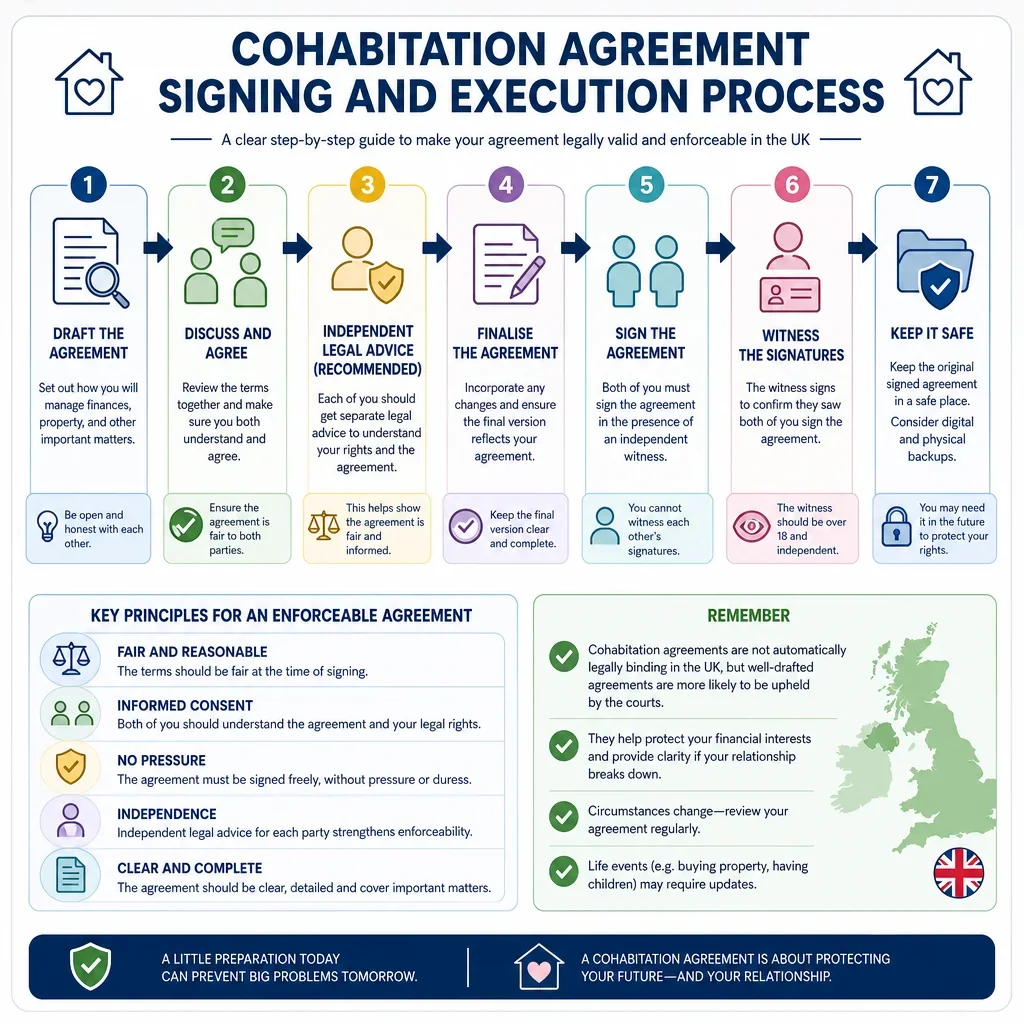
Each Party has received independent legal advice from a solicitor qualified in the law of England and Wales before entering into this Agreement. Each Party has been advised of the nature effect and implications of this Agreement and has had the opportunity to consider it fully.
Each Party confirms that they are entering into this Agreement voluntarily without duress undue influence or misrepresentation and with full understanding of its terms.
Each Party confirms that they have full mental capacity to enter into this Agreement and that it is fair and reasonable in all the circumstances. The Parties intend this Agreement to be legally binding and enforceable as a contract and not contrary to public policy.
22ENTIRE AGREEMENT
This document represents the full agreement between the Parties and supersedes any prior discussions or understandings between the Parties.
Any oral agreements made prior to this Cohabitation Agreement are superseded by its terms.
Any prior written agreements or drafts between the Parties are fully superseded.
Any future changes must be in writing and signed by both Parties.
23SEVERABILITY
If any provision of this agreement is held to be invalid or unenforceable the remaining provisions shall continue in full force and effect.
24VARIATION
Any variation of this agreement must be in writing and signed by both Parties.
25INDEPENDENT LEGAL ADVICE
Each Party has had the opportunity to seek independent legal advice before entering into this Cohabitation Agreement.
Party A confirms that they understand the nature and effect of this Cohabitation Agreement after receiving independent legal advice and fully understands the agreement.
Party B confirms that they understand the nature and effect of this Cohabitation Agreement after receiving independent legal advice and fully understands the agreement.
26CONSIDERATION
The Parties acknowledge that the mutual promises in this Cohabitation Agreement are the consideration for each other.
The primary type of consideration that the Parties are providing to each other in this agreement is financial support.
The Parties promise to support each other financially by sharing living expenses equally including rent utilities and groceries and to contribute to joint savings for future goals.
The mutual promises regarding contributions shall start on [Insert Date].
The Parties confirm that the mutual promises provide sufficient consideration for the agreement to be binding.
27EXECUTION IN COUNTERPARTS
This agreement may be executed in counterparts.
Two counterpart copies shall be used for the agreement.
28NOTICES
Any notice required to be given under this agreement shall be in writing and shall be sent by recorded delivery to the last known address of the relevant Party.
29COMPLIANCE WITH LEGISLATION
This agreement is made in compliance with the Matrimonial Causes Act 1973 the Civil Partnership Act 2004 the Law of Property (Miscellaneous Provisions) Act 1989 the Trusts of Land and Appointment of Trustees Act 1996 the Inheritance (Provision for Family and Dependants) Act 1975 and the Children Act 1989.
30SIGNATURES
SIGNED by Party A in the presence of a witness.
Signature of Party A: ___________________________ Date: ________________
Witness name: ___________________________
Witness signature: ___________________________ Date: ________________
SIGNED by Party B in the presence of a witness.
Signature of Party B: ___________________________ Date: ________________
Witness name: ___________________________
Witness signature: ___________________________ Date: ________________
31SCHEDULE OF ASSETS
Shared Home: 123 High Street London SW1A 1AA - Current estimated value: \£[Insert Value] - Ownership: Joint (legal and beneficial) - Intended division on Separation: Sale and equal division of net proceeds.
Joint Bank Account (Shared Household Account at Barclays Bank): Current balance: \£[Insert Balance] - Ownership: Joint - Intended division on Separation: Equal division.
Household Goods and Furnishings (as listed in section 10): Total estimated value: \£4500 - Ownership: Joint - Intended division on Separation: Equal division or sale and equal split.
Party A Separate Property: Laptop smartphone collection of books family heirloom jewellery - Ownership: Party A - Not subject to division.
Party B Separate Property: Guitar photography equipment vintage clothing collection - Ownership: Party B - Not subject to division.
Pets: Max (dog microchip [Insert]) and Luna (cat microchip [Insert]) - Ownership: Joint but primary residence with Party A on Separation - Welfare to be considered.
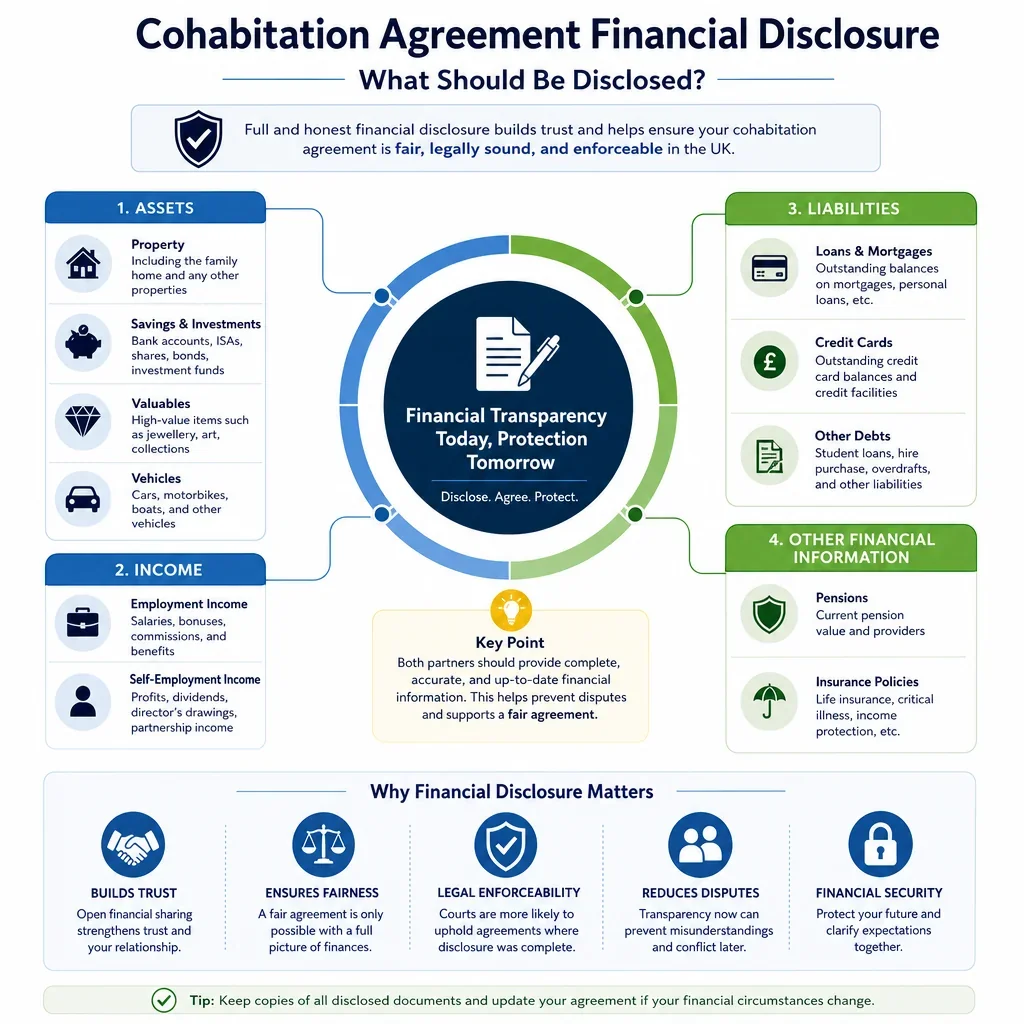
Pensions: Each Party retains their own pension provision. Pensions are not automatically shared on Separation but may be considered by a court. No sharing intended under this Agreement.
Vehicles: [Insert details if any e.g. None currently owned jointly] - Ownership: [As applicable] - Intended division: [As applicable].
Other Assets: [Insert any additional items referenced in the Agreement with values ownership and division intentions].
This Schedule may be updated in writing and signed by both Parties to reflect changes in assets during Cohabitation.
This example shows approximately 70% of a typical document and is provided for illustrative purposes only. The remaining content has been omitted.
Every document generated by Docaro is tailored to your specific circumstances, jurisdiction and the information you provide. The completed document includes all applicable clauses and provisions required for your situation.
To generate the full, personalised document, answer a short series of questions and your document will be created instantly.
Useful Resources When Considering a Cohabitation Agreement in the United Kingdom
United Kingdom Reference Legislation
Cohabitation Agreement FAQs
Document Generation FAQs
Related Articles