AI Generated British Terms of Service
PDF & Word - 2026 Updated
Docaro Pricing
When do you need a Terms of Service in the United Kingdom?
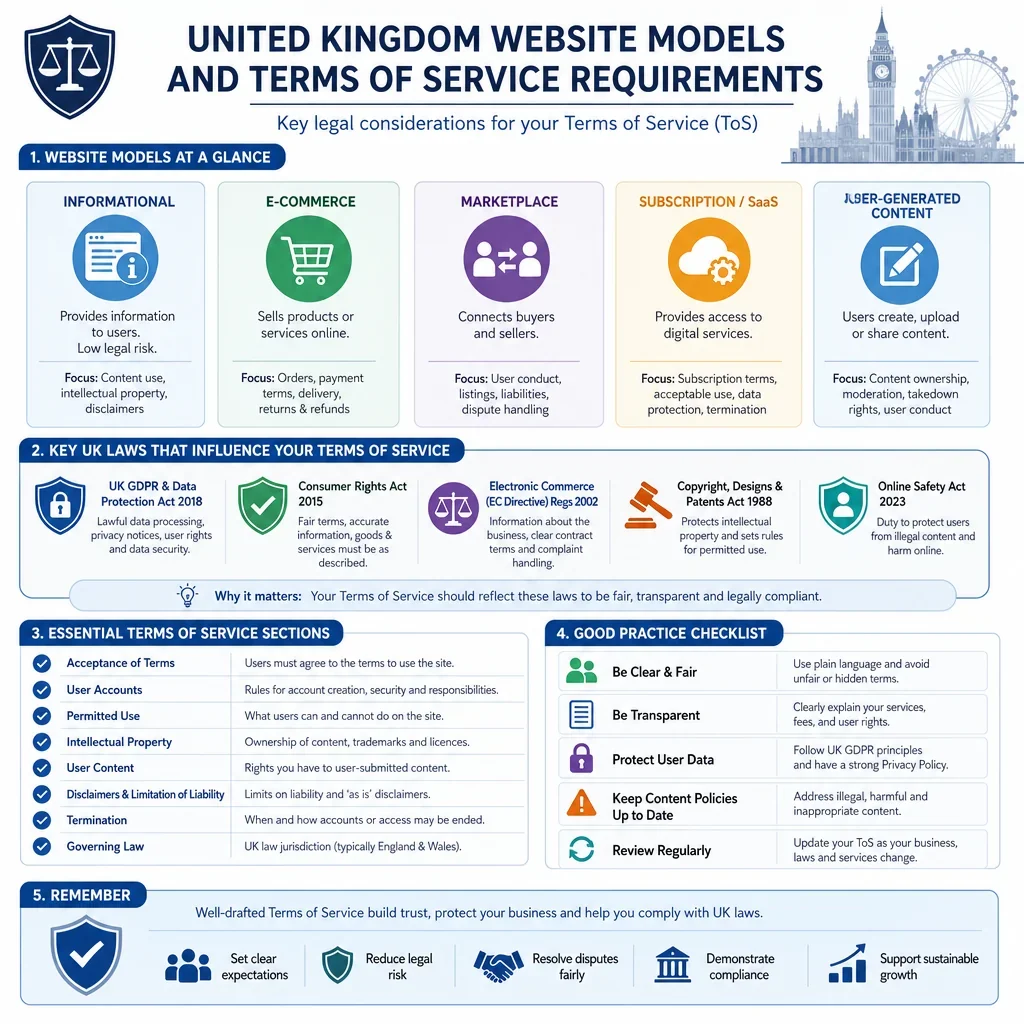
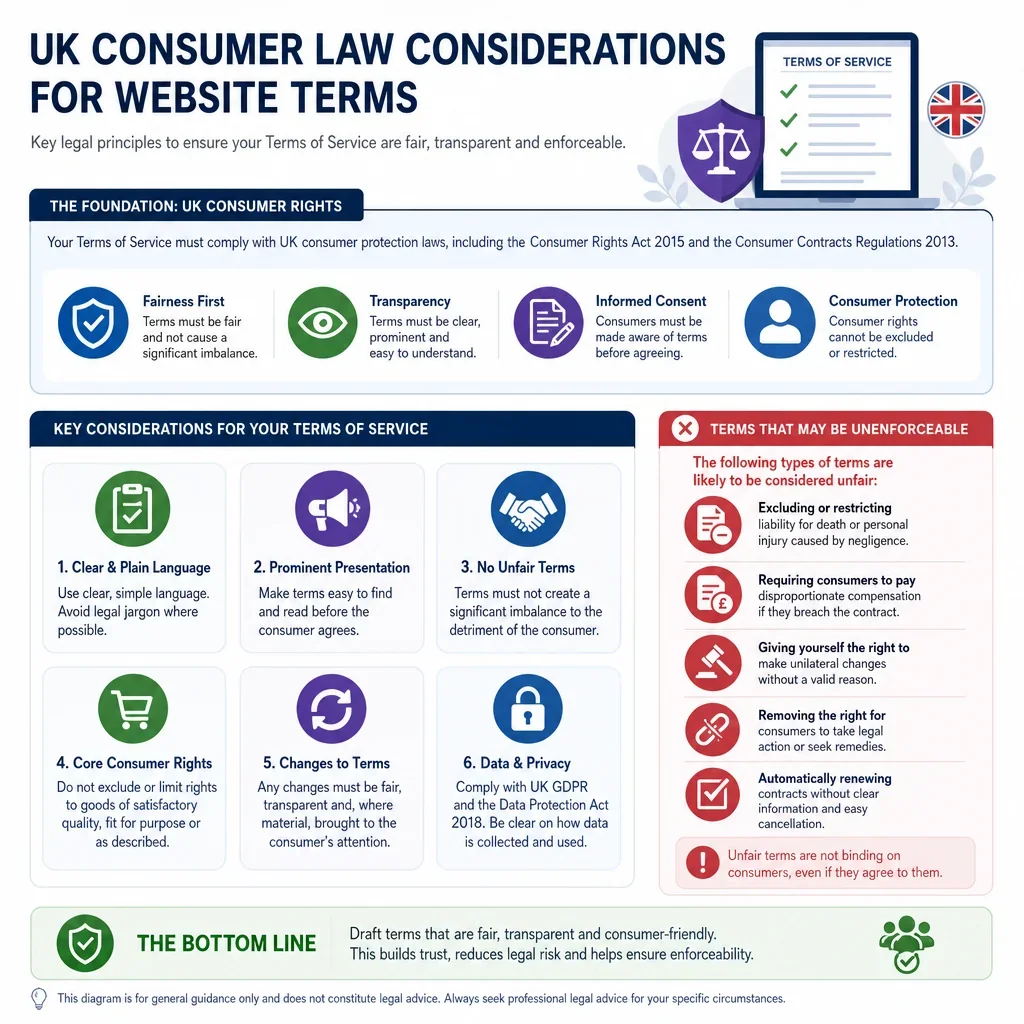
British Legal Rules for Terms of Service
Using the wrong structure for terms of service may fail to adequately limit your liability or protect your intellectual property rights under UK law.
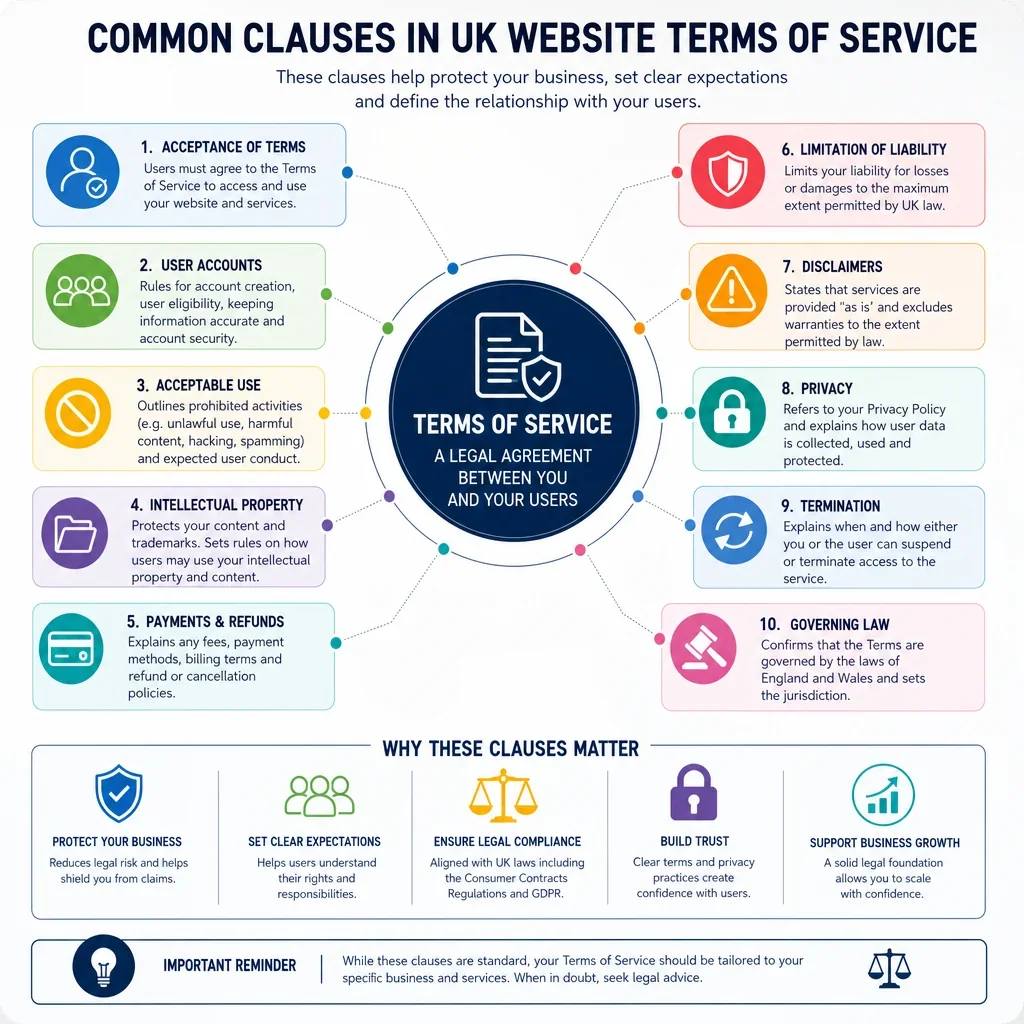
What a Proper Terms of Service Should Include
- Introduction and AgreementClearly state what the terms cover and that users agree to them by using the website.
- User EligibilitySpecify who can use the service, such as age requirements or restrictions for certain users.
- Acceptable Use RulesOutline what users can and cannot do on the website to keep it safe and fair.
- Intellectual Property RightsExplain who owns the content on the site and how users can use it.
- Privacy and Data HandlingDescribe how user information is collected, used, and protected in line with UK privacy laws.
- Limitation of LiabilitySet out the website owner's responsibility limits for any issues or damages.
- Termination of AccessDetail when and how user access to the site can be ended.
- Governing LawIndicate that UK law applies to the terms and where disputes will be handled.
- Contact InformationProvide ways for users to get in touch with questions or complaints.
Generate Your Document in 4 Easy Steps
Why Use Docaro?
 United Kingdom
Free Example Terms of Service Template
Below is a free template example of a Terms of Service for use in the United Kingdom generated by our AI model.
The clauses in your actual Terms of Service will vary from this example as they will be entirely bespoke to your requirements as set out in the questionnaire you complete.
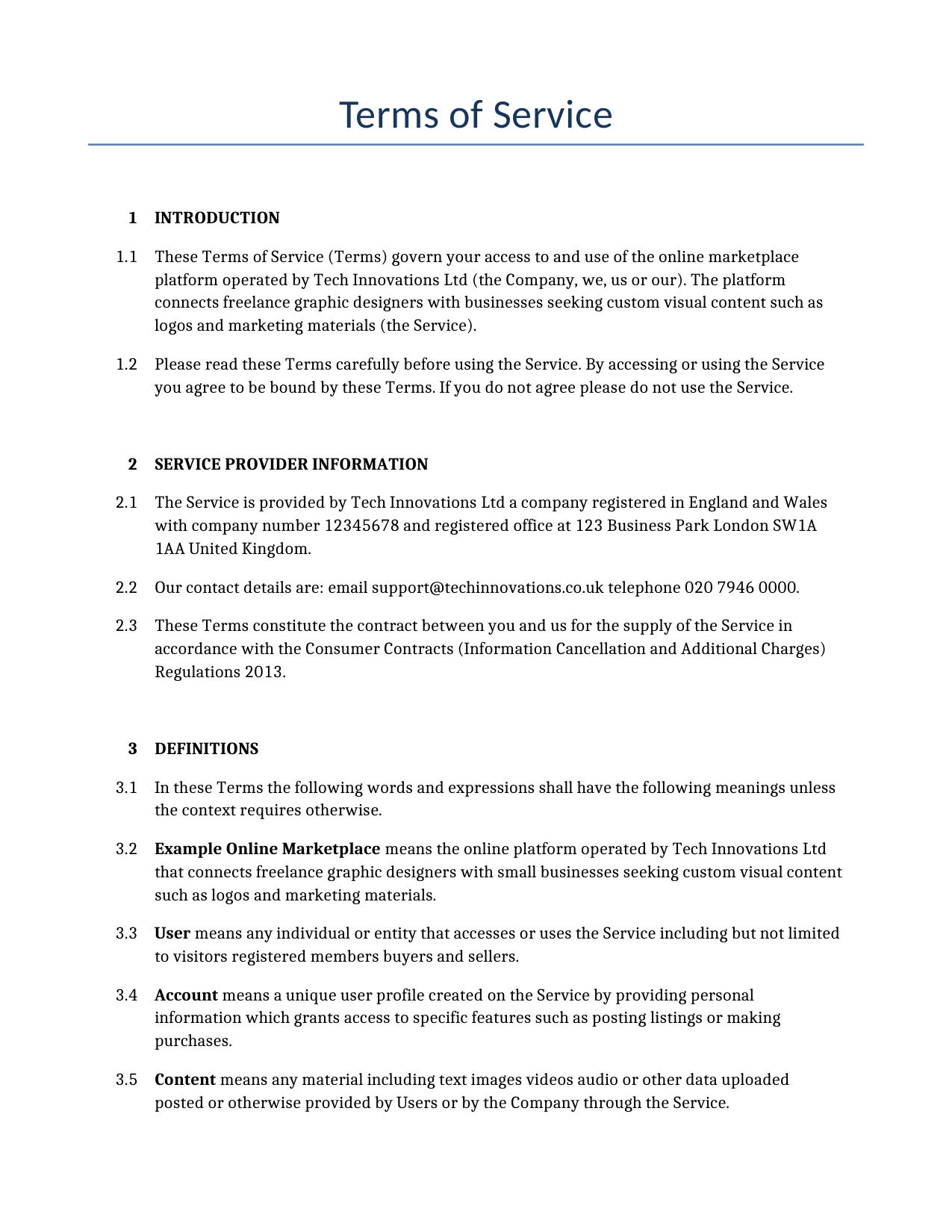
Terms of Service
1INTRODUCTION
These Terms of Service (Terms) govern your access to and use of the online marketplace platform operated by Tech Innovations Ltd (the Company, we, us or our). The platform connects freelance graphic designers with businesses seeking custom visual content such as logos and marketing materials (the Service).
Please read these Terms carefully before using the Service. By accessing or using the Service you agree to be bound by these Terms. If you do not agree please do not use the Service.
2SERVICE PROVIDER INFORMATION
The Service is provided by Tech Innovations Ltd a company registered in England and Wales with company number 12345678 and registered office at 123 Business Park London SW1A 1AA United Kingdom.
Our contact details are: email support@techinnovations.co.uk telephone 020 7946 0000.
These Terms constitute the contract between you and us for the supply of the Service in accordance with the Consumer Contracts (Information Cancellation and Additional Charges) Regulations 2013.
3DEFINITIONS
In these Terms the following words and expressions shall have the following meanings unless the context requires otherwise.
Example Online Marketplace means the online platform operated by Tech Innovations Ltd that connects freelance graphic designers with small businesses seeking custom visual content such as logos and marketing materials.
User means any individual or entity that accesses or uses the Service including but not limited to visitors registered members buyers and sellers.
Account means a unique user profile created on the Service by providing personal information which grants access to specific features such as posting listings or making purchases.
Content means any material including text images videos audio or other data uploaded posted or otherwise provided by Users or by the Company through the Service.
Intellectual Property means all rights in copyrights trademarks trade names service marks patents patent applications trade secrets and any other intellectual property rights recognised under applicable laws whether registered or unregistered relating to the Service or its Content.
User Content includes any text images videos or other materials uploaded posted or submitted by users to the website or services.
4ACCEPTANCE OF TERMS
By using the Service by clicking agree or by account creation the User accepts these Terms of Service and agrees to be bound by them.
You must be at least 18 years of age to create an Account and use the Service. If you are under 18 years of age you must have verifiable parental or guardian consent to use the Service in accordance with the UK GDPR and the Online Safety Act 2023.
The User agrees to these Terms of Service by creating an Account registering for the Service or otherwise accessing or using the Service.
The User acknowledges and agrees that continued use of the Service after any modifications to these Terms of Service constitutes acceptance of the modified terms.
5AGE REQUIREMENTS AND VERIFICATION
You must be at least 18 years of age to use the Service. Users aged 16 or 17 may only use the Service with verifiable parental or guardian consent in accordance with the UK GDPR and the Online Safety Act 2023.
During account registration you must provide your date of birth. We may use age verification processes including requesting additional documentation where necessary to confirm eligibility.
6DESCRIPTION OF SERVICE
The Service is an online marketplace platform that connects freelance graphic designers with businesses seeking custom visual content such as logos and marketing materials and is targeted at businesses and individual consumers.
The key features of the Service include user profiles for designers a project bidding system secure payment processing and a review and rating feature for completed work.
The Service offers functionalities whereby users can post project requirements browse designer portfolios communicate via integrated messaging upload files for collaboration and track project progress through a dashboard.
The Service may be accessed via a web based platform or a mobile application.
The Service is limited to graphic design projects only and does not support real time video collaboration and the maximum file upload size is 100MB.
The Company provides customer support via live chat and email.
7USER ACCOUNTS
To create an Account you must meet the age requirements set out in Section 5. If you are under 18 you must have verifiable parental or guardian consent.
During account registration the User must provide the User\'s full name email address and date of birth.
The User must explicitly accept these Terms of Service and acknowledge the Privacy Policy during registration.
The User\'s Account will be verified by means of an email verification link.
The Company implements security features including a strong password policy two factor authentication and CAPTCHA for User Accounts.
The Company provides a self service password reset feature to Users.
The Company considers a User Account inactive after 365 days of inactivity and will notify the User before taking action on such inactive Accounts.
The Company may suspend access to or delete an inactive User Account after providing notice to the User.
The User may terminate the User\'s own Account at any time via the account settings.
Users may request termination of their Account via account settings and the Company may terminate an Account for violations after providing notice.
The Company will retain certain User data after account termination for legal reasons in accordance with the Privacy Policy.
8USER OBLIGATIONS
You must meet the age requirements set out in Section 5.
The User declares that the User will not upload or share prohibited content such as illegal or harmful material.
The User shall not engage in illegal content upload harassment or bullying or commercial spam.
The User must comply with all applicable UK and international laws when using the Service.
The User must provide accurate and complete information when registering or using the Service.
The User shall not infringe any Intellectual Property rights grant a licence to the User\'s Content to the Company and respect all trademarks.
The User shall not reverse engineer decompile or disassemble the Service.
9ACCEPTABLE USE POLICY
You may use the Service only for lawful purposes and in accordance with these Terms. You agree not to use the Service in any way that breaches any applicable local national or international law or regulation.
Prohibited uses include (without limitation): uploading transmitting or distributing any illegal content (including child sexual abuse material terrorist content or content that infringes third party rights); harassment bullying or abusive behaviour; fraud or fraudulent activities; commercial spam or unsolicited advertising; infringing any intellectual property rights; reverse engineering the Service; introducing viruses or harmful code; collecting other users\' data without consent; and any activity that could harm the Service or its users.
We may monitor content and usage to ensure compliance with this policy and applicable laws including the Online Safety Act 2023.
We reserve the right to remove content suspend or terminate accounts for breaches of this policy.
10PLATFORM ROLE AND USER AGREEMENTS
The Company acts solely as an intermediary platform facilitating transactions between buyers and sellers of graphic design services. We are not a party to any contract between buyers and sellers.
We do not provide any warranties guarantees or representations regarding the quality accuracy or legality of user content services or transactions. Users contract directly with each other.
In accordance with the Electronic Commerce (EC Directive) Regulations 2002 we act as a hosting intermediary and benefit from the limitations of liability set out therein.
11PAYMENT TERMS
The Service charges a commission fee of 15% on each successful transaction between buyers and sellers (subject to VAT). Buyers may also pay optional premium fees for additional features.
We accept payments via credit cards (Visa Mastercard) PayPal and bank transfers. All payments are processed by third party payment processors who have their own terms.
All prices include 20 percent VAT as required by UK law and any additional taxes will be handled in compliance with HMRC regulations.
We may facilitate refunds or chargebacks where required by law but are not responsible for disputes between buyers and sellers. Payment obligations survive termination.
Late payment fees will apply in accordance with the Late Payment of Commercial Debts (Interest) Act 1998 where applicable.
12PLATFORM ROLE AND USER TRANSACTIONS
The Company acts solely as a facilitator connecting buyers and sellers. We are not a party to any contracts formed between users and provide no warranties regarding user content services quality or delivery.
We may charge commission fees on transactions as set out in the Payment Terms section. We do not hold funds in escrow but payments are processed securely via third party providers.
In the event of buyer-seller disputes we may provide optional assistance in mediation but we are not obliged to do so and our decision is final. Users agree to resolve disputes directly where possible.
Nothing in these Terms limits your statutory rights as a consumer under the Consumer Rights Act 2015.
13REFUNDS AND CANCELLATIONS
As a consumer you have the right to cancel your contract with us for the Service within 14 days of purchase without giving any reason in accordance with the Consumer Contracts (Information Cancellation and Additional Charges) Regulations 2013.
To exercise this right you must notify us clearly in writing or via the designated cancellation process in your account. We will refund any amounts paid within 14 days using the same payment method.
This cancellation right does not apply to services that have been fully performed with your prior consent or to custom graphic design work once the seller has begun work with your approval.
Refunds for disputes between buyers and sellers will be handled in accordance with our dispute resolution process and applicable law.
14INTELLECTUAL PROPERTY RIGHTS
The Company owns all Intellectual Property in the Service including registered trademarks copyrights in the software code and trade secrets. References to any previous service names or functionalities have been updated to reflect the current graphic design marketplace only.
The User retains ownership of the User\'s Content subject to the licence granted below.
The User grants to the Company a non exclusive royalty free worldwide licence for service operation to use the User\'s Content for purposes including hosting displaying and promoting the Service and the Company may sublicense such Content to third parties.
The Company grants to the User a limited licence to access and use the Company\'s Intellectual Property solely for the purpose of using the Service in accordance with these Terms of Service.
The User represents and warrants that the User\'s Content does not infringe any third party copyrights trademarks patents or other intellectual property rights and that the User has all necessary permissions and licences to upload and use such Content on the Service. This includes ensuring no illegal content is uploaded in compliance with the Online Safety Act 2023.
The User may report alleged Intellectual Property infringements or illegal content to the Company via a dedicated reporting mechanism. The Company will assess risks conduct content moderation and take down infringing or illegal Content where appropriate in accordance with the Online Safety Act 2023 including protections for children.
In the event of Intellectual Property infringement or illegal content by a User the Company may immediately terminate the User\'s Account and claim damages and legal costs from the User.
The User shall indemnify the Company against any third party Intellectual Property infringement claims arising from the User\'s Content.
We maintain policies for content moderation risk assessments and user reporting as required by the Online Safety Act 2023. If the Service is accessible to under-18s we implement additional protections for children including age-appropriate safeguards.
15USER CONTENT
The User retains ownership of the User Content upon submission to the Service.
The User grants to the Company a non exclusive worldwide royalty free licence to use the User Content and the Company may sublicense the User Content to third parties.
The User represents that the User Content does not infringe any third party rights and complies with our Acceptable Use Policy including prohibitions on illegal content under the Online Safety Act 2023.
The User must ensure that the User Content is accurate and not misleading complies with applicable laws and does not infringe rights and does not include harmful or illegal material. Users must not upload content harmful to children.
The Company may moderate edit or remove User Content at its sole discretion in accordance with the Online Safety Act 2023. We have systems for risk assessment user reporting of illegal content and swift takedown procedures. Platform obligations under the Online Safety Act 2023 are met through these measures including child protection features where relevant.
16THIRD PARTY CONTENT AND LINKS
The Service permits Users to upload or post third party Content and to include links to third party websites or resources within their Content.
The Company applies hybrid moderation to third party Content and links in line with our obligations under the Online Safety Act 2023.
The Company does not endorse or take responsibility for any third party Content or links and disclaims all liability for any damages arising from third party Content or links accessed through the Service to the extent permitted by law.
17COMPLAINTS AND DISPUTE RESOLUTION
If you have any complaints about the Service please contact us at support@techinnovations.co.uk. We aim to resolve complaints within 14 days.
In accordance with Alternative Dispute Resolution for Consumer Disputes (Competent Authorities and Information) Regulations 2015 we participate in ADR schemes where required. Details are available on request.
The parties shall first attempt to resolve any dispute by mediation after providing 30 days written notice of the dispute.
18TERMINATION
You may terminate your Account and these Terms at any time via account settings. Upon termination any funds held for you will be paid out in accordance with our payment processes subject to any outstanding fees or disputes.
We may terminate or suspend your Account for breach of these Terms with reasonable notice where possible (at least 7 days for non-material breaches) or immediately for serious breaches illegal content or safety risks in line with the Online Safety Act 2023.
For any non material breach the breaching party shall have 14 days to cure the breach before termination may occur.
These Terms of Service shall automatically terminate upon the insolvency of the User.
The clauses relating to confidentiality payment obligations intellectual property and limitation of liability shall survive termination of these Terms of Service.
19LIABILITY AND EXCLUSIONS
Nothing in these Terms excludes or limits our liability for death or personal injury caused by our negligence fraud or fraudulent misrepresentation or any other liability that cannot be excluded or limited by law under the Consumer Rights Act 2015 the Unfair Contract Terms Act 1977 or otherwise.
Subject to the above our total liability to you shall not exceed the total fees paid by you in the preceding 12 months.
We shall not be liable for any indirect consequential or special damages or for any loss of data or business interruption to the extent permitted by law.
We provide the Service on an as is basis without any warranties as to quality fitness for purpose or suitability for any particular use to the fullest extent permitted by law.
20DISCLAIMERS
The Company does not guarantee the accuracy completeness or timeliness of any information provided through the Service.
The Company does not guarantee continuous or uninterrupted availability of the Service.
The Service is provided on an as is basis without any warranties as to quality fitness for purpose or suitability for any particular use to the fullest extent permitted by law. Nothing in these Terms excludes liability where it would be unlawful to do so.
21INDEMNIFICATION
The User shall indemnify the Company against all claims arising from User Content violations service misuse claims terms breach damages and third party Intellectual Property infringement to the extent permitted by law.
The User must promptly notify the Company in writing of any claim or potential claim that may be subject to indemnification providing all relevant details and cooperating fully in the defence.
The Company shall have the right to control the defence and settlement of any indemnified claims.
22DATA PROTECTION AND PRIVACY
The Company Tech Innovations Ltd processes personal data in accordance with the Data Protection Act 2018 the UK General Data Protection Regulation (UK GDPR) and the Online Safety Act 2023 where applicable.
The Company\'s Privacy Policy available at https://www.techinnovations.com/privacy-policy forms part of these Terms of Service and is hereby incorporated by reference.
The Company does not process special category personal data except where necessary for age verification with explicit consent.
The Company or its processors store or process User data within the United Kingdom and within the European Economic Area. For any international transfers we implement appropriate safeguards such as Standard Contractual Clauses.
The Company relies on the legal bases of contract legitimate interests and consent for processing personal data. Our lawful bases are explained in the Privacy Policy.
You have data subject rights including access rectification erasure restriction portability and objection. To exercise these rights contact us at the details in Section 2 or via the Privacy Policy. We will respond within one month.
In the event of a personal data breach we will notify affected users and the ICO where required by law.
The Company retains User account data for the duration of the active Account plus one year after closure transaction records for seven years to comply with financial regulations and marketing preferences until withdrawn by the User.
23COOKIES AND TRACKING TECHNOLOGIES
The Company uses essential cookies and analytics cookies on the Service in compliance with the Privacy and Electronic Communications (EC Directive) Regulations 2003 (PECR).
The Company collects User consent to cookies by means of a cookie banner and provides Users with an easy way to withdraw such consent at any time.
24FORCE MAJEURE
Neither party shall be liable for any failure or delay in performing its obligations under these Terms of Service to the extent that such failure or delay is caused by a force majeure event including natural disasters strikes or labour disputes or pandemics or epidemics.
The affected party shall provide written notification of the force majeure event within five business days and shall take reasonable steps to mitigate the effects of the event.
If the force majeure event continues for more than 30 days either party may terminate these Terms of Service on written notice.
25ASSIGNMENT
Either party may assign these Terms of Service to a third party with the prior written consent of the other party and upon such assignment the original party shall be fully released from its obligations.
26SEVERABILITY
If any provision of these Terms of Service is held to be invalid or unenforceable the remaining provisions shall remain in full force and effect.
27WAIVER
No failure or delay by either party in exercising any right under these Terms of Service shall operate as a waiver of that right nor shall any single or partial exercise preclude any further exercise of that right.
The waiver clause applies to user breaches and payment obligations and applies mutually to both the Company and the User.
28ENTIRE AGREEMENT
These Terms of Service constitute the entire agreement between the Company the Customer and their affiliates and supersede all prior understandings and agreements relating to the subject matter hereof.
29NOTICES
Any notice required to be given under these Terms of Service shall be in writing and sent to the Company at 123 High Street London SW1A 1AA or by email to notices@company.co.uk.
Notices sent by post shall be deemed delivered after two business days and notices sent by email shall be deemed delivered at 9 AM on the next business day.
The Company may send notices to the User by email to the address associated with the User\'s Account or by post to the address provided by the User.
30CHANGES TO TERMS
The Company will provide Users with at least 30 days advance notice of any material changes to these Terms of Service by email and website posting.
Changes shall become effective 30 days after the date of notice. If you do not agree to the changes you have the right to opt out by terminating your Account without penalty before the changes take effect. Continued use after the effective date implies acceptance.
These Terms of Service were last updated on 2024-10-01.
31GOVERNING LAW
These Terms of Service and any dispute or claim arising out of or in connection with them or their subject matter or formation (including non-contractual disputes) shall be governed by and construed in accordance with the laws of England and Wales.
The parties agree to submit to the exclusive jurisdiction of the courts of England and Wales.
32EXPORT CONTROLS AND ANTI-MONEY LAUNDERING
Users must comply with all applicable export control laws and sanctions. The Service is not available in prohibited territories.
We comply with anti-money laundering regulations. Users must provide information if requested for compliance purposes.
33CONTACT INFORMATION
The provider of the Service is Tech Innovations Ltd whose registered office is at 123 Business Park London SW1A 1AA United Kingdom.
Users may contact the Company regarding inquiries or support at support@techinnovations.co.uk.
This example shows approximately 70% of a typical document and is provided for illustrative purposes only. The remaining content has been omitted.
Every document generated by Docaro is tailored to your specific circumstances, jurisdiction and the information you provide. The completed document includes all applicable clauses and provisions required for your situation.
To generate the full, personalised document, answer a short series of questions and your document will be created instantly.
Useful Resources When Considering a Terms of Service in the United Kingdom
United Kingdom Reference Legislation
Terms of Service FAQs
Document Generation FAQs
Related Articles