AI Generated British Software Licence Agreement
PDF & Word - 2026 Updated
Docaro Pricing
When do you need a Software Licence Agreement in the United Kingdom?
British Legal Rules for a Software Licence Agreement
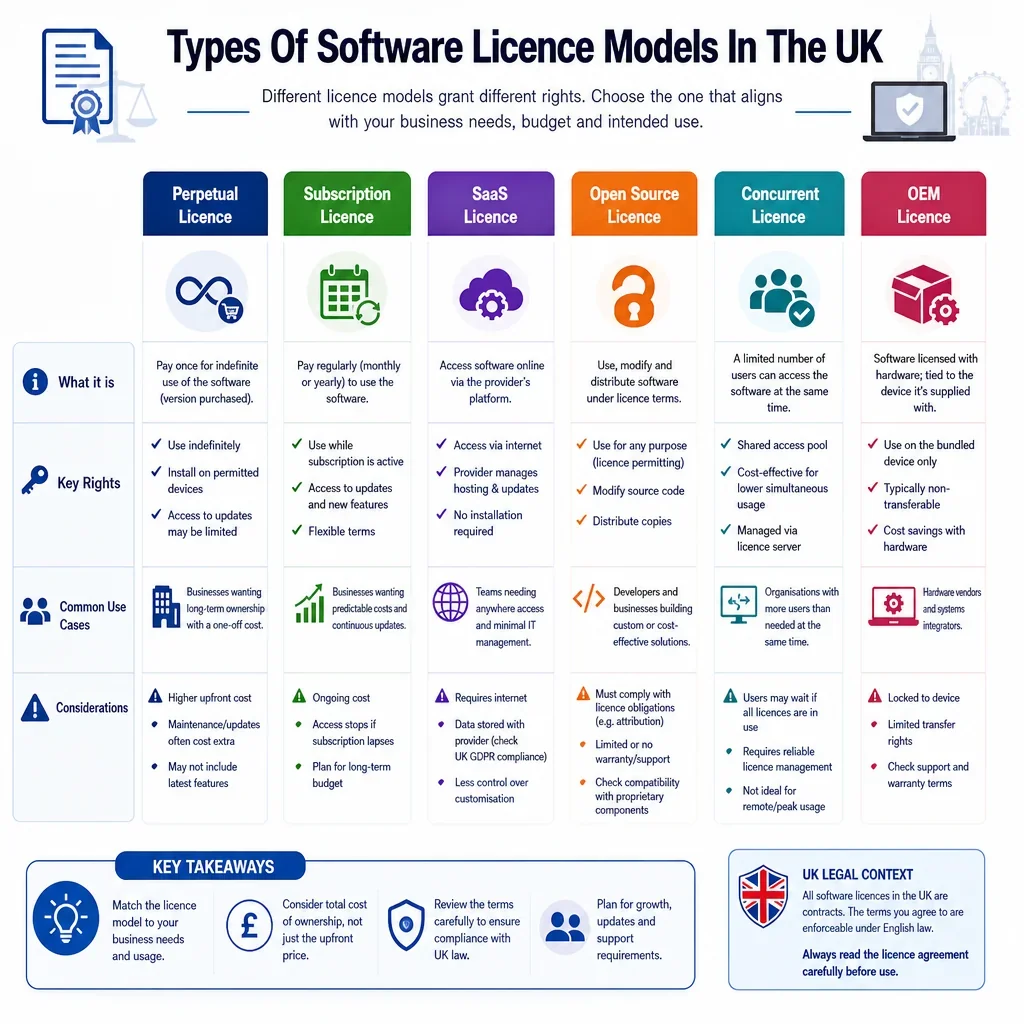
Using the wrong type of software license, such as an open-source versus proprietary structure, can inadvertently grant unauthorized rights to use, modify, or distribute the software.
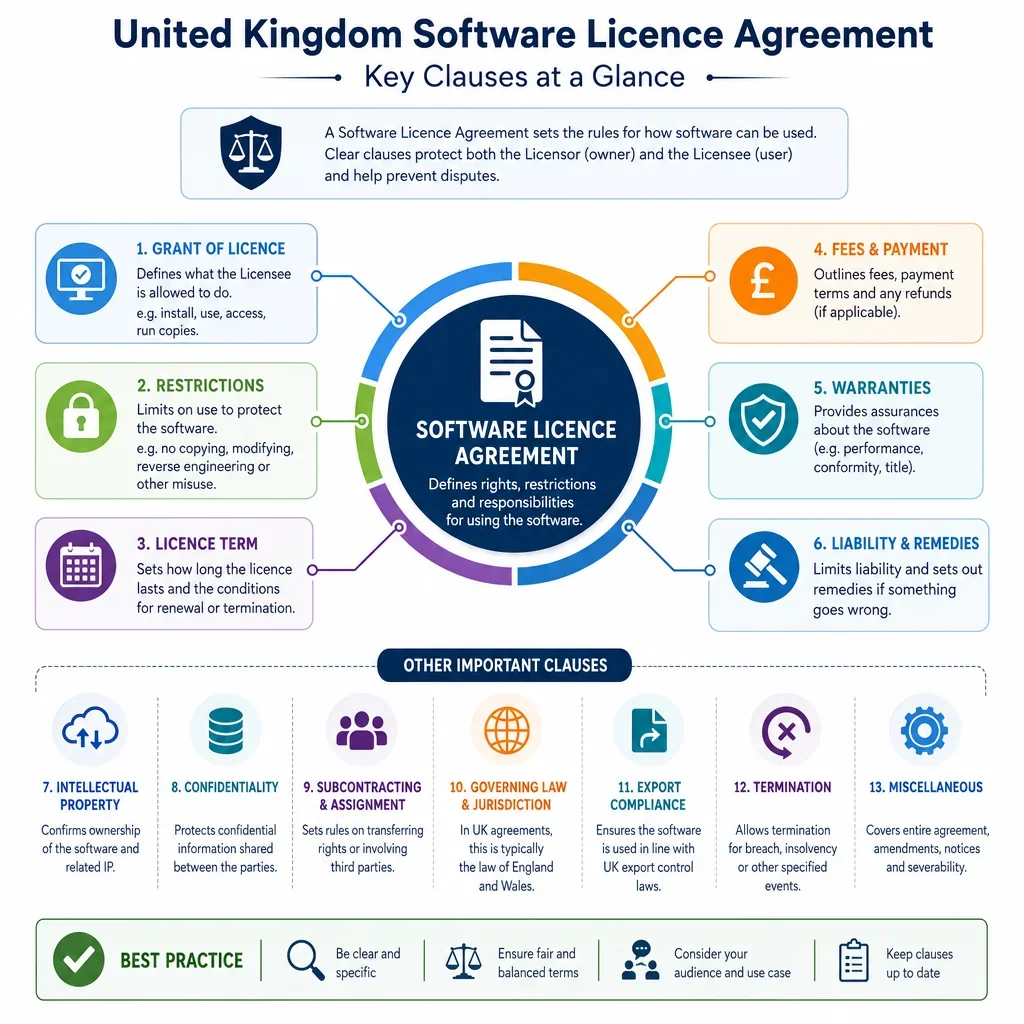
What a Proper Software Licence Agreement Should Include
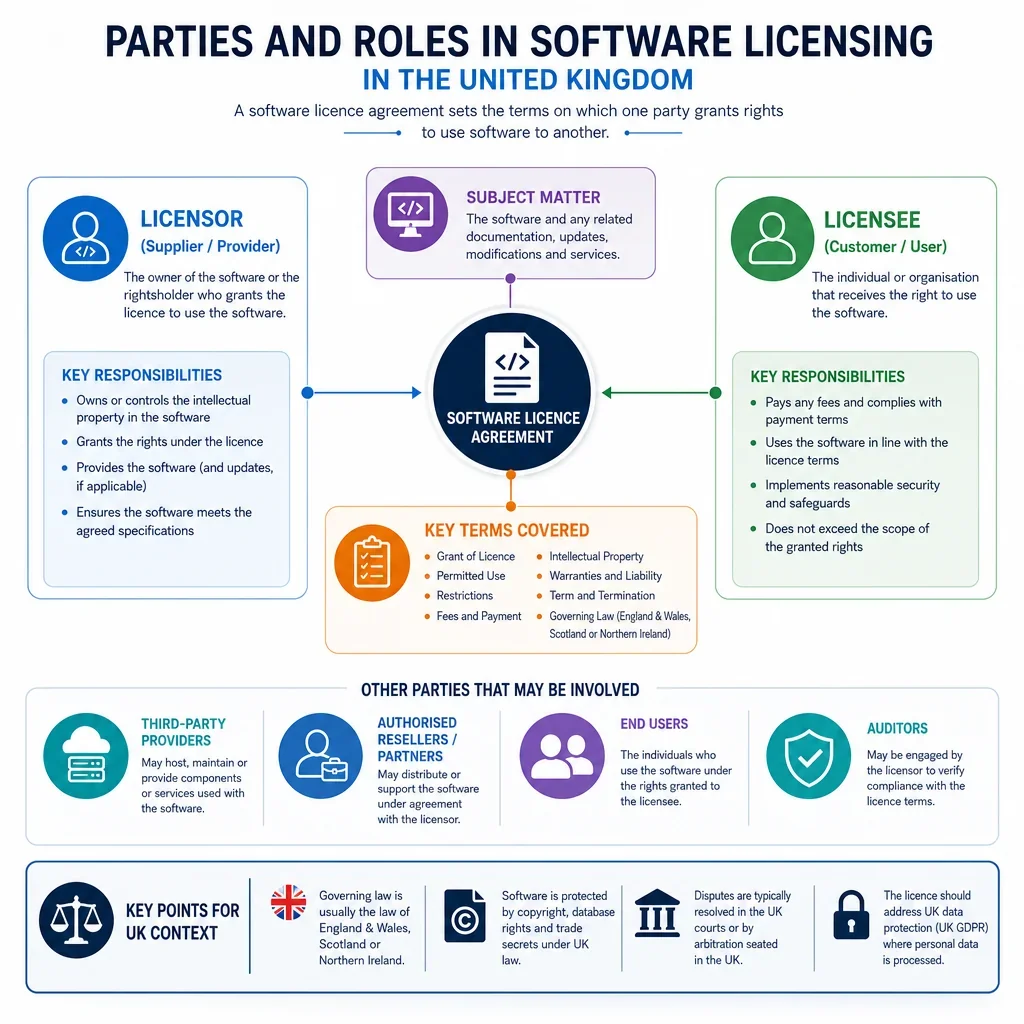
- Parties InvolvedClearly identify the software provider and the user to establish who is bound by the agreement.
- Grant of LicenceSpecify what rights the user gets, such as copying or using the software, and any limits like single-user access.
- Payment TermsOutline how much the user pays, when payments are due, and what happens if they don't pay.
- Restrictions on UseList what the user cannot do, like copying the software for others or modifying it without permission.
- Intellectual Property RightsState that the provider owns the software and the user only gets limited rights to use it.
- ConfidentialityRequire the user to keep any secret information about the software private.
- Warranties and DisclaimersExplain any promises about the software working properly and limit the provider's responsibility for issues.
- Liability LimitsCap how much the provider can be held responsible for problems, like damages from software faults.
- Termination ConditionsDescribe when the agreement ends, such as if the user breaks the rules, and what happens next.
- Governing LawSpecify that UK law applies to any disputes arising from the agreement.
Generate Your Document in 4 Easy Steps
Why Use Docaro?
 United Kingdom
Free Example Software Licence Agreement Template
Below is a free template example of a Software Licence Agreement for use in the United Kingdom generated by our AI model.
The clauses in your actual Software Licence Agreement will vary from this example as they will be entirely bespoke to your requirements as set out in the questionnaire you complete.
Custom Inventory Management Software Licence Agreement
1RECITALS
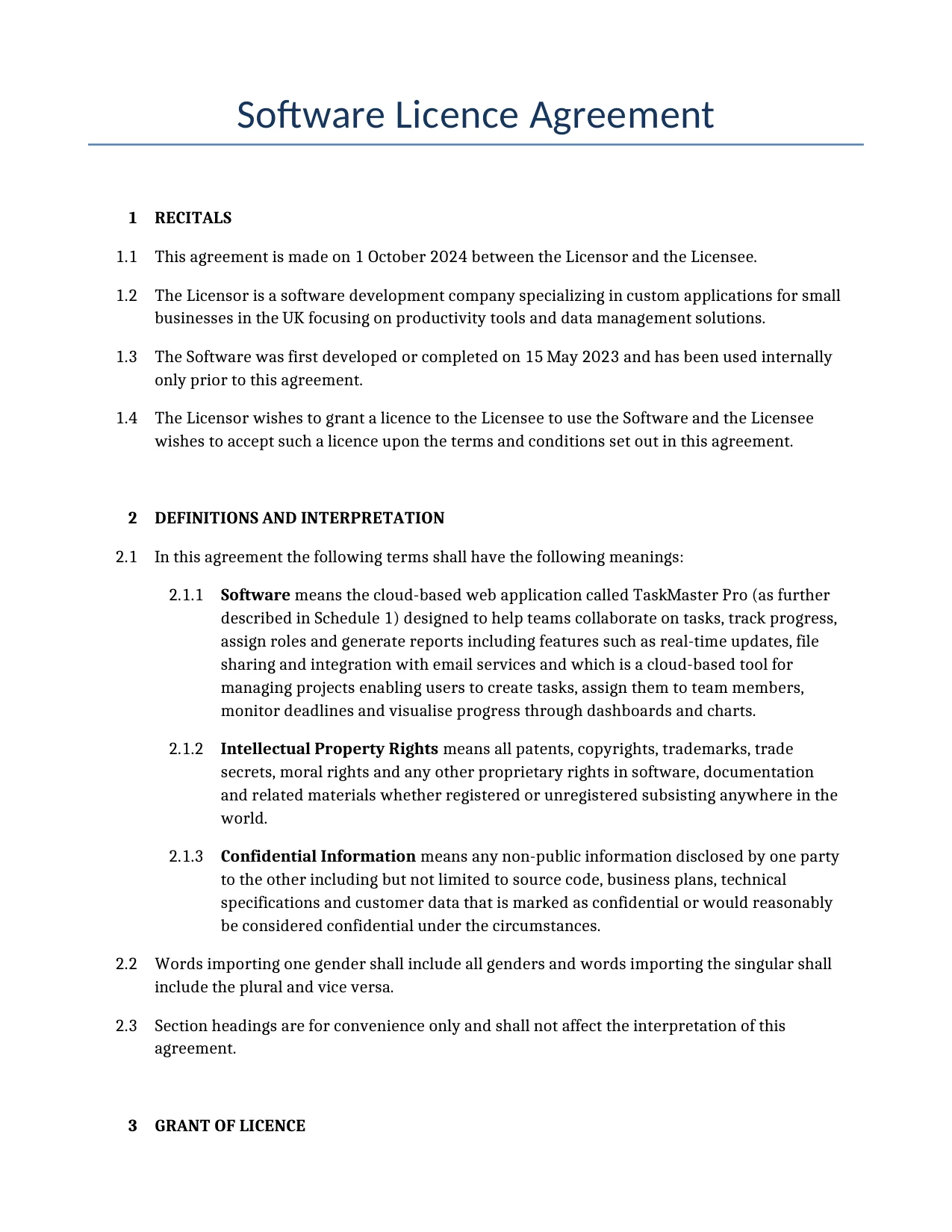
This agreement is made on 1 October 2024 between the Licensor and the Licensee.
The Licensor is a software development company specializing in custom applications for small businesses in the UK focusing on productivity tools and data management solutions.
The Software was first developed or completed on 15 May 2023 and has been used internally only prior to this agreement.
The Licensor wishes to grant a licence to the Licensee to use the Software and the Licensee wishes to accept such a licence upon the terms and conditions set out in this agreement.
2DEFINITIONS AND INTERPRETATION
In this agreement the following terms shall have the following meanings:
Software means the cloud-based web application called TaskMaster Pro (as further described in Schedule 1) designed to help teams collaborate on tasks, track progress, assign roles and generate reports including features such as real-time updates, file sharing and integration with email services and which is a cloud-based tool for managing projects enabling users to create tasks, assign them to team members, monitor deadlines and visualise progress through dashboards and charts.
Intellectual Property Rights means all patents, copyrights, trademarks, trade secrets, moral rights and any other proprietary rights in software, documentation and related materials whether registered or unregistered subsisting anywhere in the world.
Confidential Information means any non-public information disclosed by one party to the other including but not limited to source code, business plans, technical specifications and customer data that is marked as confidential or would reasonably be considered confidential under the circumstances.
Words importing one gender shall include all genders and words importing the singular shall include the plural and vice versa.
Section headings are for convenience only and shall not affect the interpretation of this agreement.
3GRANT OF LICENCE
Subject to the terms and conditions of this agreement, the Licensor grants to the Licensee a non-exclusive, non-sublicensable, non-transferable licence to access and use the Software (including any Updates provided under this agreement) solely for the Licensee's internal business purposes in the United Kingdom during the Term.
The licence granted under this clause 3 does not include access to the source code of the Software.
The licence granted under this clause 3 is limited to the number of authorised users set out in Schedule 1.
4LICENCE RESTRICTIONS
The Licensee shall not, and shall not permit any third party to:
use the Software for any purpose other than the internal business purposes expressly permitted under clause 3.1;
use the Software outside the United Kingdom;
modify, adapt, create derivative works from, decompile, reverse engineer, disassemble or otherwise attempt to derive the source code of the Software (except to the extent permitted by law);
sublicence, rent, lease, sell, assign or otherwise transfer the Software or the licence granted under this agreement;
remove or obscure any copyright, trademark or other proprietary notices contained in the Software;
use the Software in any way that competes with the Licensor's business or for commercial exploitation.
5INTELLECTUAL PROPERTY RIGHTS
The Licensor owns all Intellectual Property Rights in the Software and all Updates. Nothing in this agreement transfers any Intellectual Property Rights to the Licensee.
The Licensee shall not acquire any right, title or interest in or to the Intellectual Property Rights in the Software.
If the Licensee provides any feedback, suggestions or improvements to the Software, the Licensor may use such feedback without restriction and all Intellectual Property Rights in any resulting modifications shall belong to the Licensor.
6PAYMENT TERMS
The Licensee shall pay to the Licensor the annual subscription fee specified in Schedule 1.
The first annual subscription fee shall be payable on the Effective Date. Subsequent annual subscription fees shall be payable on each anniversary of the Effective Date.
The Licensor shall issue invoices electronically to the Licensee and the Licensee shall pay each invoice within 30 days of the invoice date.
All fees are exclusive of VAT which shall be added at the prevailing rate.
The Licensee shall pay by bank transfer to the Licensor's designated account.
If the Licensee fails to pay any sum due under this agreement by the due date, the Licensor may charge interest on the overdue amount at the rate of 4 percent per annum above the base rate of the Bank of England from time to time in force. Interest shall accrue on a daily basis.
7WARRANTIES AND REPRESENTATIONS
The Licensor warrants that it has the right to grant the licence to the Software set out in clause 3.
The Licensor warrants that for a period of 90 days from the Effective Date the Software will materially conform to the specification set out in Schedule 1 when used in accordance with this agreement.
The Licensor warrants that it will provide the Support and Maintenance services set out in clause 14 with reasonable skill and care.
The warranties set out in this clause 7 are in lieu of all other warranties, representations or conditions, express or implied, to the fullest extent permitted by law. All other warranties, including but not limited to warranties of satisfactory quality, fitness for a particular purpose, non-infringement and accuracy are excluded.
The Licensor does not warrant that the Software will be error-free, uninterrupted or compatible with all hardware and software configurations.
8DISCLAIMERS
Except as expressly provided in clause 7, the Software, Support and Maintenance services are provided on an "as is" basis.
The Licensor disclaims all other warranties, representations and conditions, whether express, implied or statutory, including but not limited to any warranties of merchantability, satisfactory quality, fitness for a particular purpose or non-infringement.
9LIABILITY
Nothing in this agreement shall limit or exclude the liability of either party for:
death or personal injury resulting from its negligence;
fraud or fraudulent misrepresentation;
any other liability which cannot be excluded or limited by law.
Subject to clause 9.1, the Licensor's total aggregate liability to the Licensee under or in connection with this agreement (whether in contract, tort (including negligence), breach of statutory duty or otherwise) shall not exceed the total fees paid by the Licensee to the Licensor in the 12 months preceding the claim.
Subject to clause 9.1, neither party shall be liable to the other for any indirect, consequential or special loss, or for any loss of profits, loss of revenue, loss of data, loss of goodwill or loss of anticipated savings.
The Licensee shall be subject to a reciprocal liability cap on the same terms as set out in clause 9.2.
This clause 9 shall survive termination of this agreement.
10INDEMNITIES
The Licensor shall indemnify the Licensee against any third-party claims that the Software (as delivered and used in accordance with this agreement) infringes any third-party Intellectual Property Rights in the United Kingdom, provided that the Licensee:
promptly notifies the Licensor in writing of any such claim;
allows the Licensor to control the defence and settlement of the claim; and
provides the Licensor with all reasonable assistance at the Licensor's expense.
The Licensee shall indemnify the Licensor against any claims, losses and expenses arising from the Licensee's breach of this agreement, misuse of the Software, or infringement of third-party rights by the Licensee.
This clause 10 shall survive termination of this agreement.
11CONFIDENTIALITY
Each party shall keep the other party's Confidential Information confidential and shall not disclose it to any third party except as permitted under this clause 11.
Each party may disclose the other party's Confidential Information to its employees, contractors or professional advisors who need to know it, provided that such persons are bound by equivalent confidentiality obligations.
The confidentiality obligations shall not apply to information that is in the public domain through no fault of the receiving party, was known prior to disclosure, or is required to be disclosed by law.
The obligations of confidentiality shall survive for 5 years after termination or expiry of this agreement.
12TERM AND TERMINATION
This agreement shall commence on the Effective Date and, unless terminated earlier in accordance with this clause 12, shall continue for an initial term of 12 months. It shall then automatically renew for successive periods of 12 months unless either party gives the other not less than 60 days' written notice prior to the end of the then current term.
Either party may terminate this agreement immediately by giving written notice to the other if the other party commits a material breach of any term of this agreement and (if such breach is remediable) fails to remedy that breach within 30 days of being notified in writing to do so.
The Licensor may terminate this agreement immediately by giving written notice to the Licensee if the Licensee fails to pay any sums due under this agreement within 14 days of the due date.
Either party may terminate this agreement immediately by giving written notice to the other if the other party suffers an insolvency event.
13CONSEQUENCES OF TERMINATION
Upon termination or expiry of this agreement for any reason:
the licence granted under clause 3 shall immediately cease and the Licensee shall cease all use of the Software;
the Licensee shall, within 14 days, delete or destroy all copies of any documentation or Confidential Information relating to the Software and certify in writing to the Licensor that it has done so;
all outstanding fees shall become immediately due and payable;
any rights, remedies, obligations or liabilities of the parties that have accrued up to the date of termination shall not be affected.
Clauses which expressly or by implication survive termination of this agreement shall continue in full force and effect.
14SUPPORT AND MAINTENANCE
During the Term, the Licensor shall provide the Support and Maintenance services described in Schedule 2.
The Licensee may contact the Licensor for support by email to support@licensor.com or by telephone on +44 20 1234 5678 during business hours (9am to 5pm UK time, Monday to Friday, excluding public holidays).
15UPDATES
During the Term, the Licensor may provide Updates to the Software from time to time at its discretion. Such Updates will be made available to the Licensee as part of the subscription fee.
The Licensee acknowledges that the Software is cloud-based and Updates will be deployed by the Licensor without requiring action by the Licensee.
16DATA PROTECTION
Each party shall comply with its obligations under the UK GDPR, the Data Protection Act 2018 and all other applicable data protection legislation.
The parties acknowledge that the Licensee is the controller of any personal data processed by it using the Software and the Licensor is a processor of such personal data on the Licensee's behalf.
The Licensor shall:
process personal data only on documented instructions from the Licensee;
ensure that persons authorised to process the personal data are subject to appropriate confidentiality obligations;
implement appropriate technical and organisational measures to ensure a level of security appropriate to the risk;
assist the Licensee in responding to data subject requests and ensuring compliance with the Licensee's obligations under the UK GDPR (including security, breach notifications, impact assessments and consultations with supervisory authorities);
notify the Licensee without undue delay on becoming aware of a personal data breach;
at the Licensee's choice, delete or return all personal data to the Licensee on termination of this agreement and delete existing copies save to the extent required by applicable law.
The Licensor shall not transfer personal data outside the UK without the prior written consent of the Licensee and appropriate safeguards (such as the UK International Data Transfer Agreement).
The specific processing activities, types of personal data, categories of data subjects, and other details are set out in Schedule 3 (Data Processing Schedule).
17FORCE MAJEURE
Neither party shall be liable for any failure to perform its obligations under this agreement if such failure is due to a force majeure event including natural disasters, acts of war or terrorism, pandemics or epidemics, provided that such event is beyond the reasonable control of the affected party.
The affected party shall notify the other party as soon as reasonably practicable and shall use reasonable endeavours to mitigate the effects of the event.
If the force majeure event continues for a period of 30 days or more, either party may terminate this agreement on written notice to the other.
18EXPORT CONTROLS
The Licensee shall comply with all applicable export control and sanctions laws and regulations. The Licensee shall not use the Software in any manner that would cause the Licensor to breach such laws.
19COMPLIANCE WITH LAWS AND ANTI-BRIBERY
Each party shall comply with all applicable laws, statutes and regulations relating to anti-bribery and anti-corruption including but not limited to the Bribery Act 2010.
20AUDIT RIGHTS
The Licensee shall maintain accurate records of its use of the Software. The Licensor (or its nominated auditor) may, on reasonable notice, audit the Licensee's use of the Software to verify compliance with this agreement. Any such audit shall be conducted during normal business hours and shall not unreasonably interfere with the Licensee's business.
If an audit reveals that the Licensee has underpaid fees, the Licensee shall promptly pay the underpaid amount together with interest at the rate set out in clause 6.6.
21NON-SOLICITATION
During the Term and for 12 months after termination or expiry, neither party shall (without the prior written consent of the other) solicit or entice away any employee of the other party who has been involved in the provision or receipt of the services under this agreement.
22ASSIGNMENT
The Licensee shall not assign, transfer, mortgage, charge, subcontract or otherwise dispose of any of its rights or obligations under this agreement without the prior written consent of the Licensor.
The Licensor may assign its rights under this agreement to any affiliate or to any successor in title to the business to which this agreement relates.
23GOVERNING LAW
This agreement and any dispute or claim arising out of or in connection with it or its subject matter or formation (including non-contractual disputes or claims) shall be governed by and construed in accordance with the laws of England and Wales.
24JURISDICTION
Each party irrevocably agrees that the courts of England and Wales shall have exclusive jurisdiction to settle any dispute or claim arising out of or in connection with this agreement or its subject matter or formation (including non-contractual disputes or claims).
25NOTICES
Any notice required to be given under this agreement shall be in writing and shall be served by post or email and shall be deemed served 2 business days after posting if sent by first class post or upon receipt if sent by email (provided no bounce-back is received).
Notices to the Licensor shall be sent to 123 Software Lane, London, SW1A 1AA, United Kingdom, or to legal@licensor.com.
Notices to the Licensee shall be sent to 456 User Street, Manchester, M1 1AA, United Kingdom, or to the email address provided by the Licensee.
26ENTIRE AGREEMENT
This agreement (including the Schedules) constitutes the entire agreement between the parties and supersedes all prior agreements, understandings or arrangements (whether oral or in writing) relating to the subject matter of this agreement.
Each party acknowledges that it has not entered into this agreement in reliance on any representation not expressly set out in this agreement.
27SEVERANCE
If any provision of this agreement is held to be invalid or unenforceable, such provision shall be severed from this agreement and the remaining provisions shall continue in full force and effect.
28WAIVER
No waiver of any right under this agreement shall be effective unless in writing and signed by or on behalf of the waiving party. No waiver shall be deemed a waiver of any subsequent breach.
29THIRD PARTY RIGHTS
A person who is not a party to this agreement shall have no rights under the Contracts (Rights of Third Parties) Act 1999 to enforce any term of this agreement.
30COUNTERPARTS
This agreement may be executed in any number of counterparts, each of which when executed shall constitute a duplicate original, but all counterparts together shall constitute one agreement.
31EXECUTION
Signed for and on behalf of the Licensor: _______________________________ Name: Position: Date:
Signed for and on behalf of the Licensee: _______________________________ Name: Position: Date:
This example shows approximately 70% of a typical document and is provided for illustrative purposes only. The remaining content has been omitted.
Every document generated by Docaro is tailored to your specific circumstances, jurisdiction and the information you provide. The completed document includes all applicable clauses and provisions required for your situation.
To generate the full, personalised document, answer a short series of questions and your document will be created instantly.
Useful Resources When Considering a Software Licence Agreement in the United Kingdom
United Kingdom Reference Legislation
Software Licence Agreement FAQs
Document Generation FAQs
Related Articles